


Get Started

Sales Suite
Field Ops
Marketing
Service CRM
Integrations & Apps
FloStack
How to Dynamically Change Content in Landing Pages Pro and Portals

1. Feature Overview
This article will help you configure your Landing Page or Portal to display multiple variations of the same page to different target audiences.
You build all the variations on a single page, and control which variation appears by adding a query parameter to the page URL. When a lead opens a URL that contains a query parameter you’ve configured, the page loads the content mapped to that parameter value. Everything else on the page remains unchanged. You can then share a different URL with each audience, instead of creating and maintaining a separate page for each one.
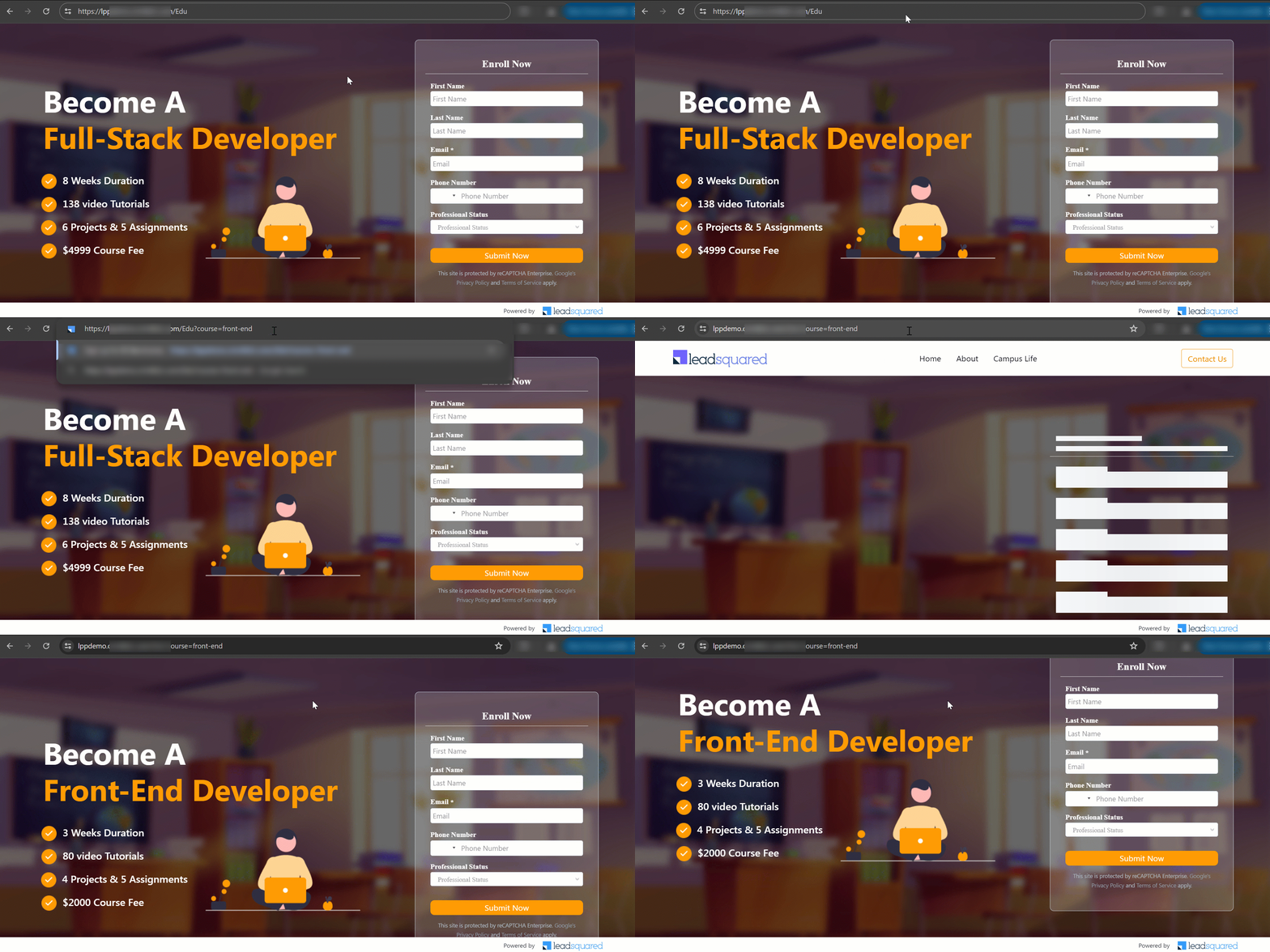
In the example below, the landing page is designed for students enrolling in a full-stack developer course. This is the default content, and it appears when a lead opens the page URL without a query parameter, for example www.example.com/edu. The same page displays content for a front-end developer course when the lead opens www.example.com/edu?course=front-end.
2. Prerequisites
- This feature is specifically for Landing Pages Pro and Portals. Landing Pages Pro and Portals are a paid feature. To enable it, contact your account manager, or send an email to support@leadsquared.com.
- To capture Leads or Opportunities, you must first create the relevant forms using Dynamic Forms.
3. How it Works
The dynamic content is controlled by Logic Cards and their display rules.
A Logic Card is a variation of a Card or Section on your page. Each Card or Section can have multiple Logic Cards, and each Logic Card holds a different version of the content. One Logic Card acts as the default, and the rest are shown only when their display rules are satisfied.
A display rule maps a Logic Card to a query parameter name and value. A query parameter is the part of the URL that follows the question mark, in the format ?parameter=value. To pass more than one parameter, separate them with an ampersand, for example ?course=front-end&city=bangalore.
Here’s the sequence –
- A lead opens the page URL you shared with them.
- The page reads the query parameters present in the URL.
- For each Card or Section, the display rules of its Logic Cards are evaluated against these parameters.
- The page displays the content of the Logic Card whose rules are satisfied. If no rule is satisfied, the default content is displayed.
Because the rules are evaluated for each Card or Section independently, a single URL can change several areas of the page at the same time, such as the banner, the course description, and the fee details.
4. Use Cases
This feature can be used across industries, for example –
| Industry | Use-case |
| Lending | Dynamically change content based on the loan product the lead is looking for. |
| Education | Dynamically change content based on the course the lead is looking for. |
| Generic | Dynamically change content based on product offers and discounts. |
5. Add Logic Cards
Logic Cards will help you dynamically change the content –
- Click on a Card/Section on your landing page.
- In the Manage Logic Cards tab, click on the Manage button.
 tab, click Convert to Logic Card.
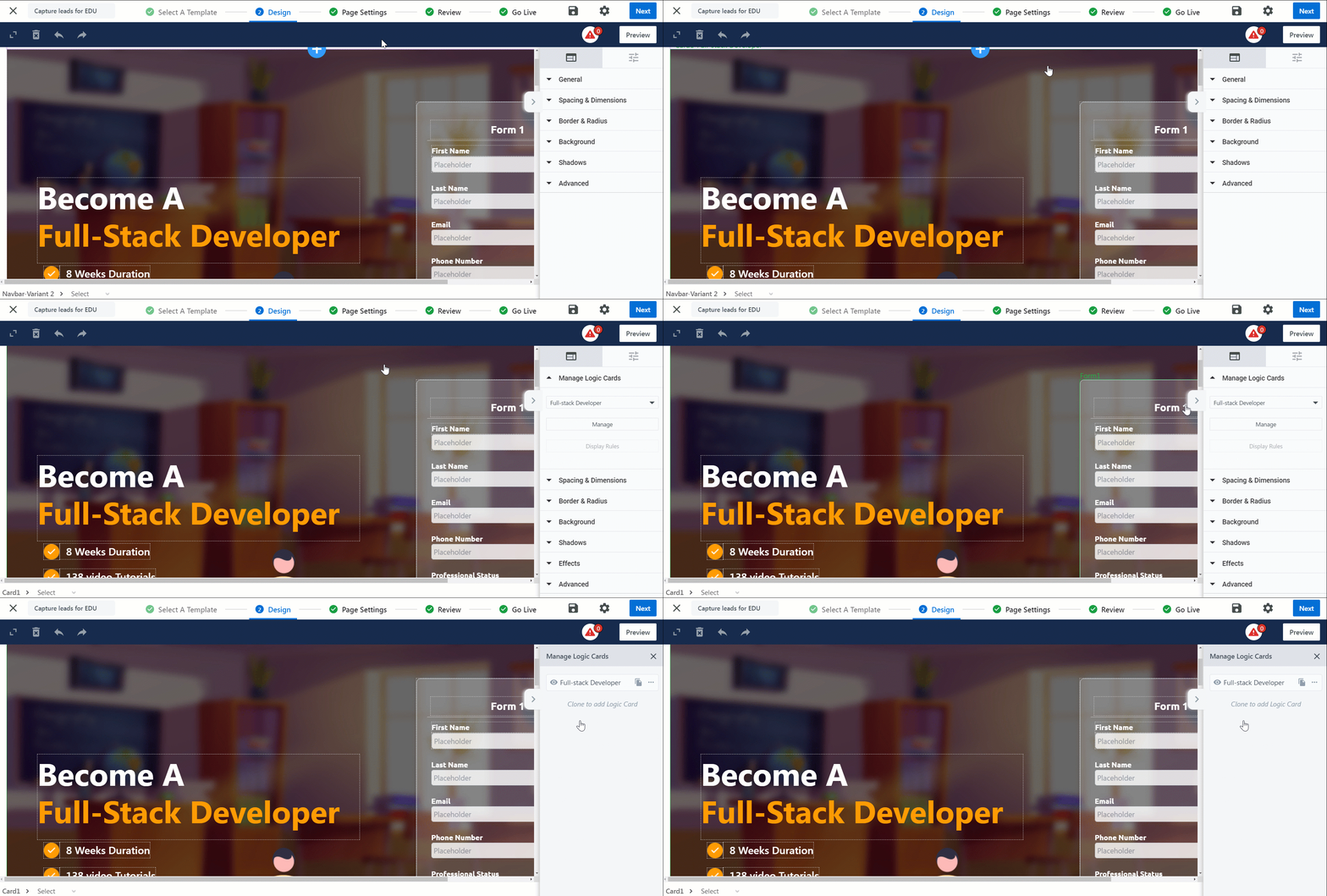
Next –
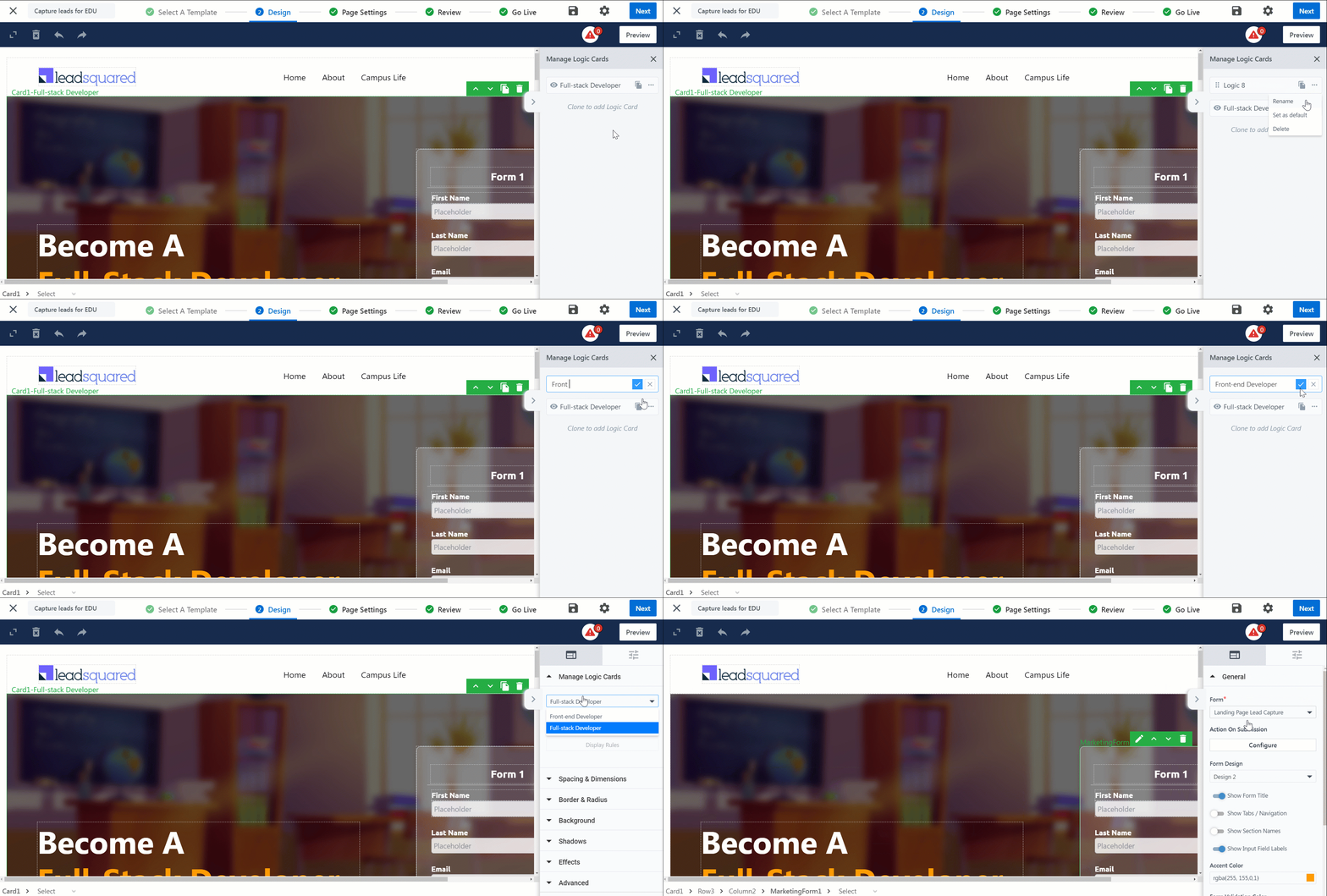
- to add a logic card, click on the
 icon to clone the existing logic card.
- Optionally, you can rename the logic card.
- Select the Card/Section, and in the Manage Logic Cards tab, select the newly created logic card from the drop-down menu.
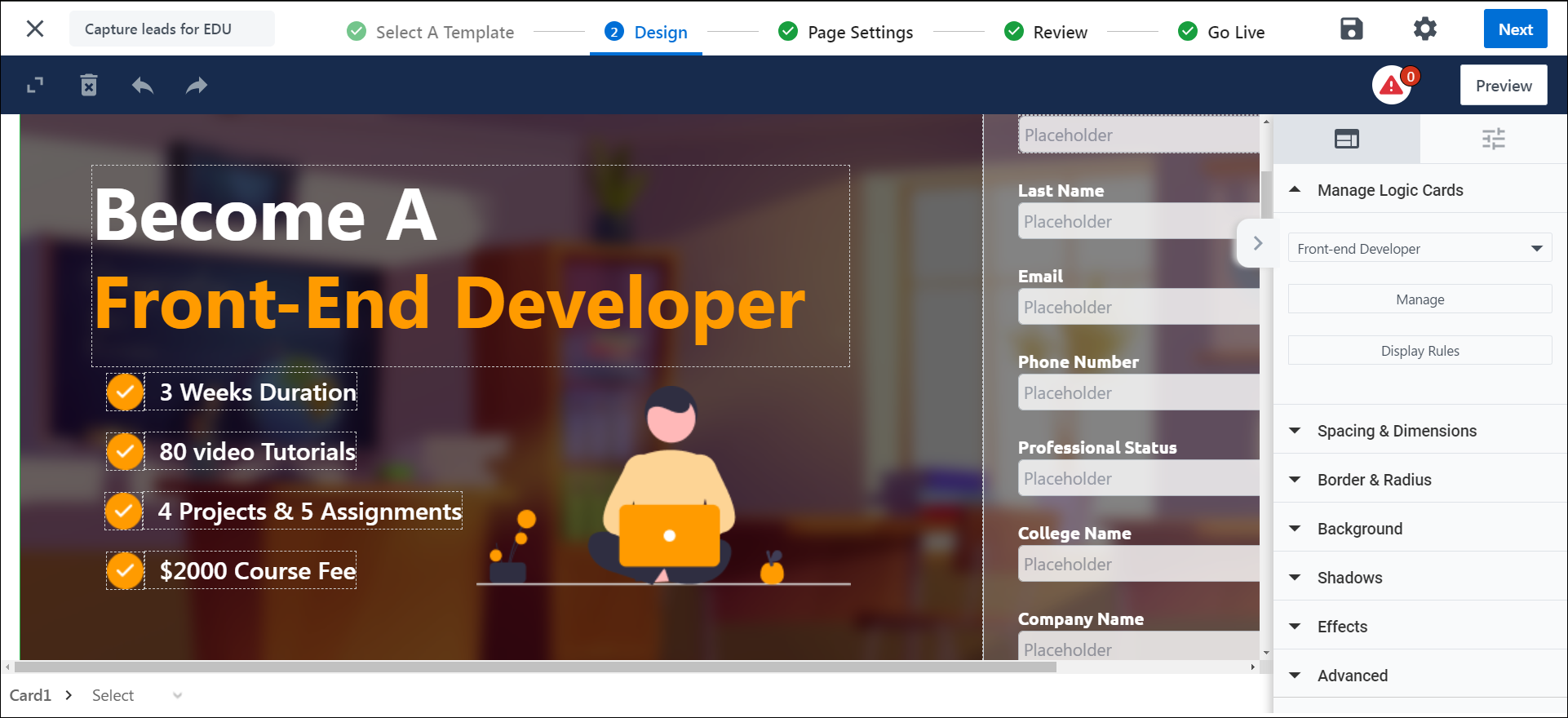
Now, change the content on the Card for a particular target audience. In the example below, we’re creating content specific to leads looking for a ‘Front-End Development’ course.
6. Configure Logic Card Rules
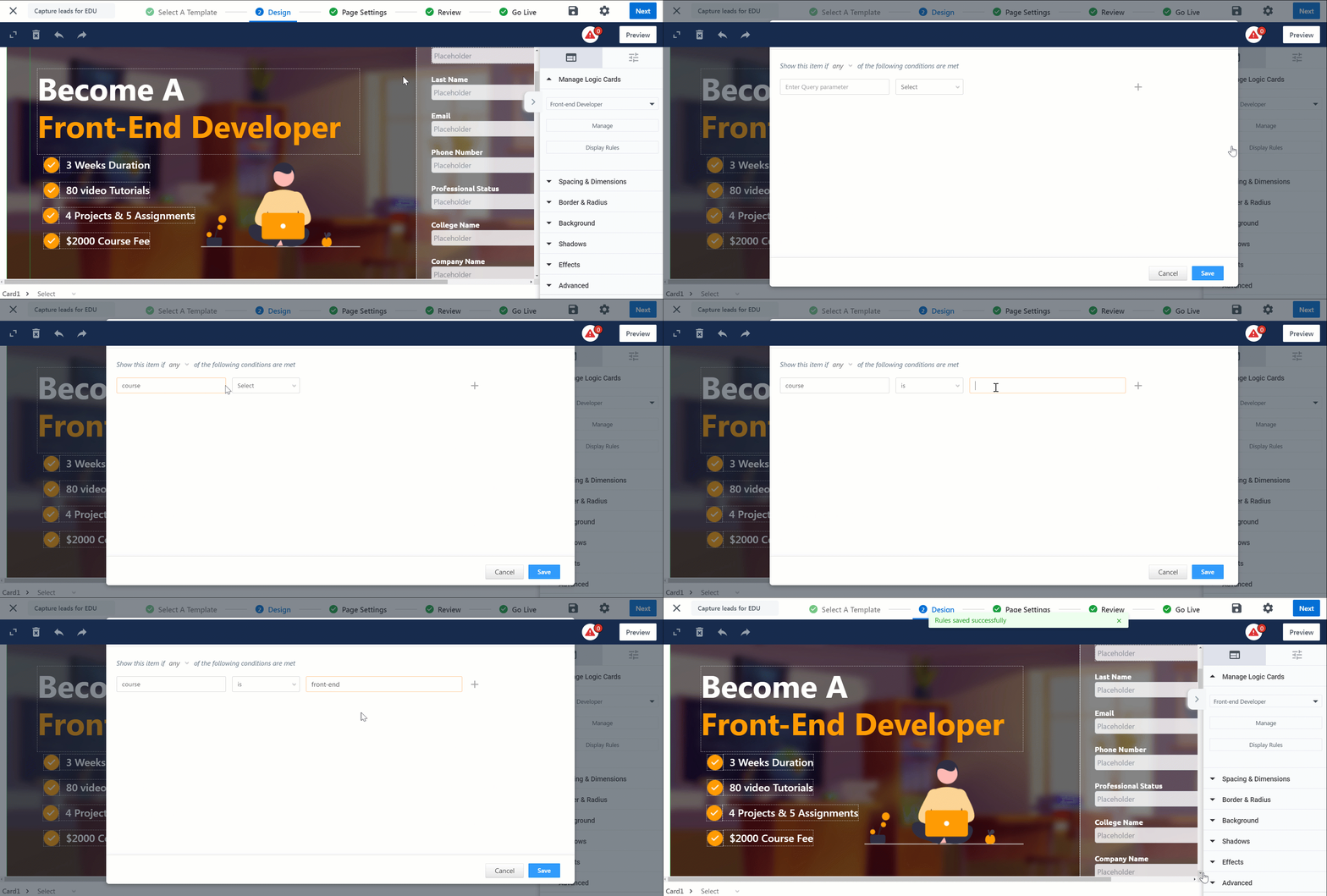
Once the Logic Card and its content are in place, you need to set up the rule for when to display it –
- In the Manage Logic Cards section, select the newly created Logic Card.
- Click the Display Rules button.
- Enter the query parameter and its value for which, when the condition is met, the page will dynamically show the content you’ve created in the Logic Card.
- For example,
- Base –
www.example.com/edu - Front End –
www.example.com/edu?course=front-end - Back End –
www.example.com/edu?course=back-end
- Base –
- If needed, add multiple rules and choose if All or Any of the rules must be satisfied.
- For example,
- Once done, click Save.
7. Go Live
Once you publish the Landing Page or Portal, any query parameter that matches the logic card rule(s) will result in a dynamic content change.
Any Questions?
Did you find this article helpful? Please let us know any feedback you may have in the comments section below. We’d love to hear from you and help you out!