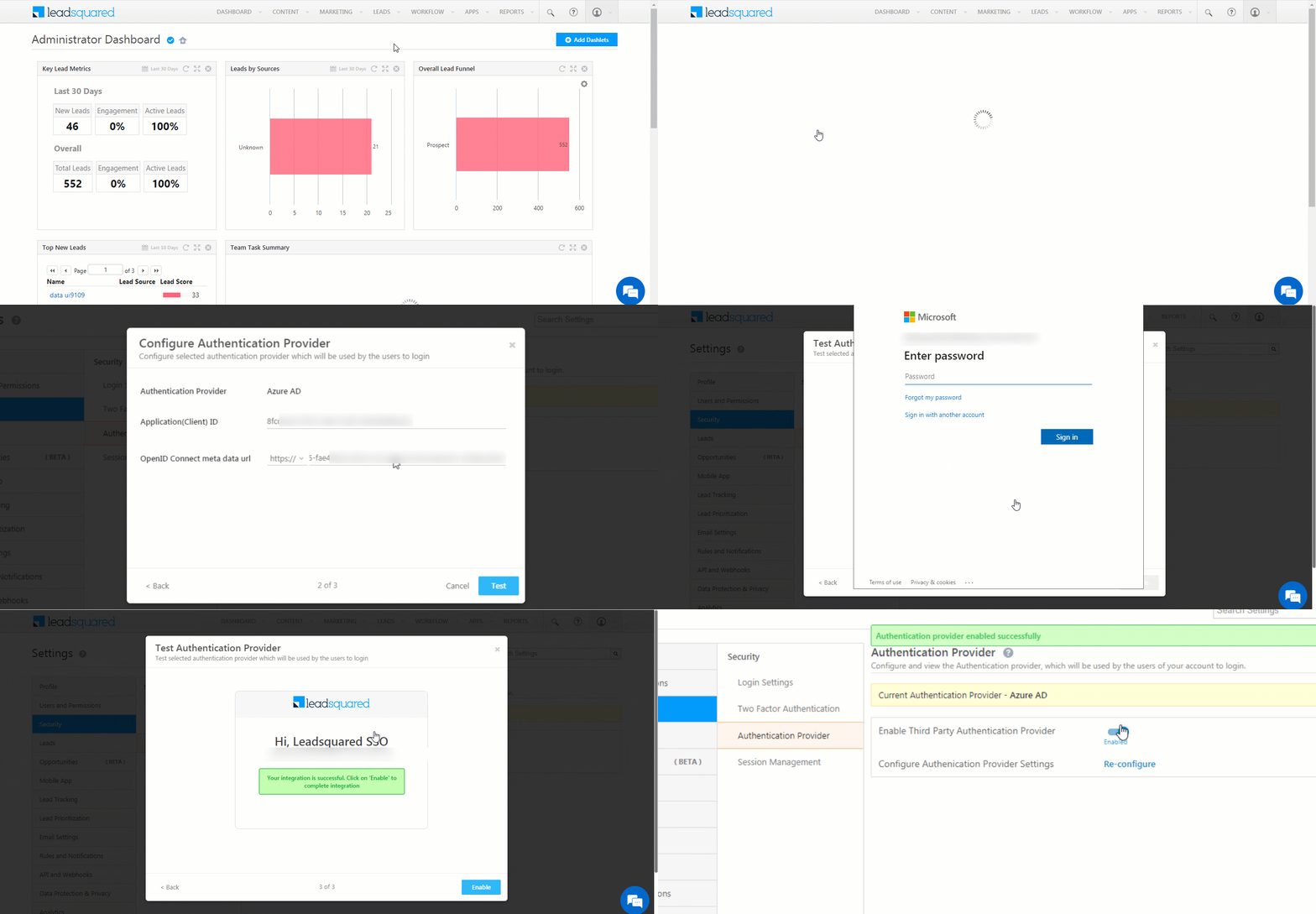
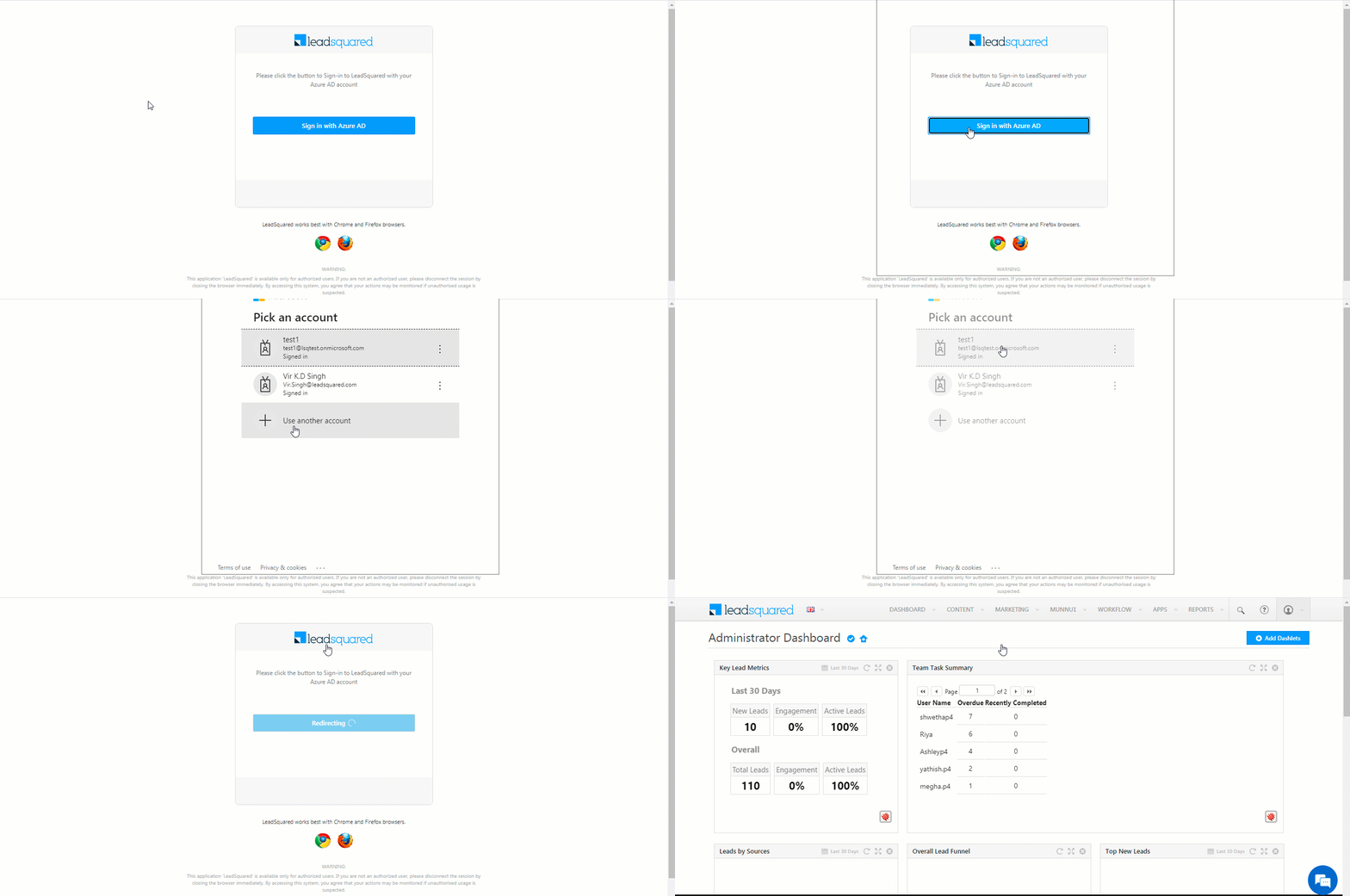
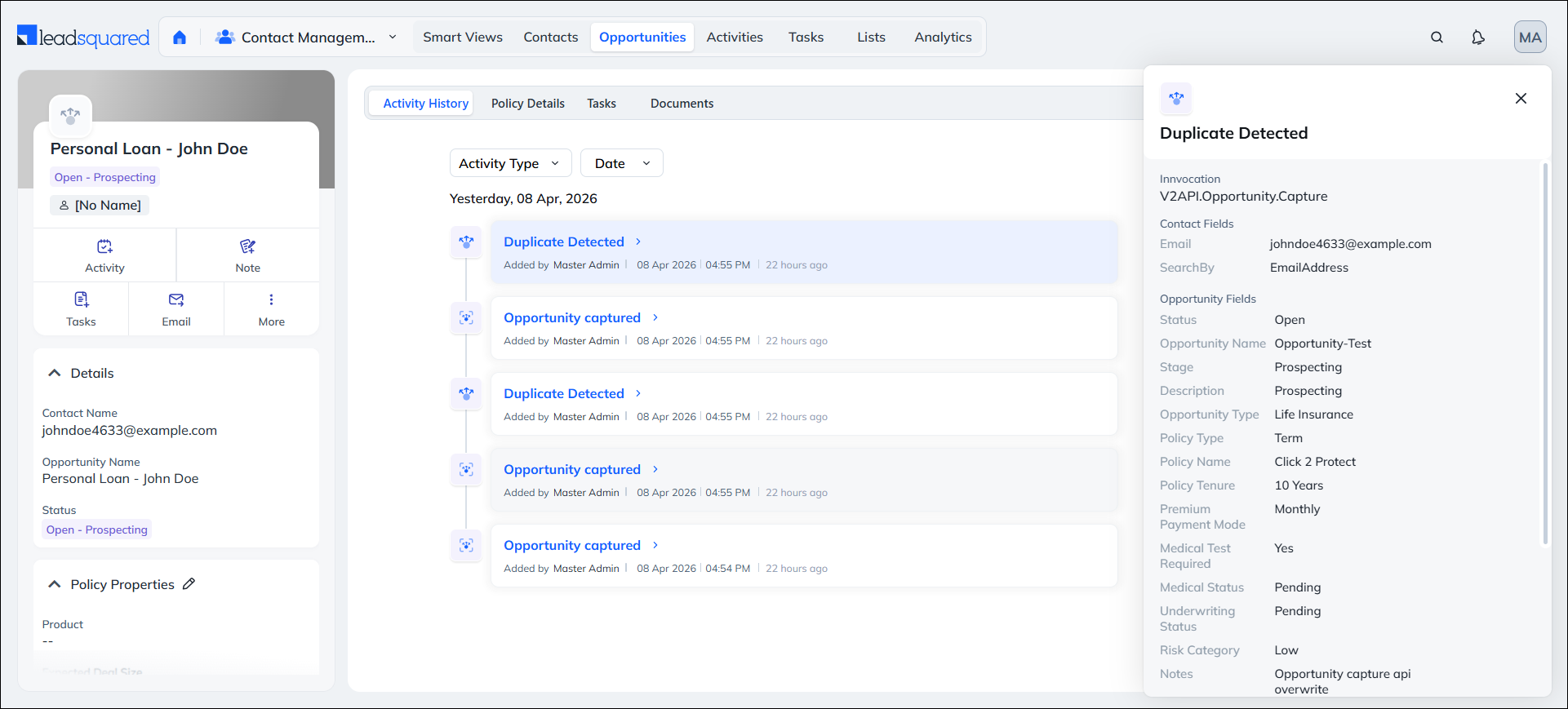
Opportunity Details View Customization (ODVC)

1. Feature Overview

Based on each Team’s requirements, LeadSquared Admin users can customize the Tabs, Actions, Buttons, and Opportunity V-Card on the Opportunity Details page. To display different Opportunity Details page views for different teams, you can select the –

  • System tabs (Activity History, Tasks, etc.) and Custom Tabs (KYC Documents Collected, Support Tickets, etc.) you want to display to your users
  • Actions your users can perform (Send Email, Call Lead, etc.) from the Opportunity Actions dropdown
  • Quick Action Buttons
  • Opportunity fields you want to display on the Opportunity V-Card

Note:

  • This article deals with ODVC on the web app. To know more about ODVC on the mobile app, click here.
  • You can also customize the Opportunity V-Card when setting it up (from the Opportunity form customization options), but you won’t be able to assign different V-Cards for different teams there. That can only be done through the Opportunity Details View Customization (ODVC) feature described in this article.

LeadSquared - Opportunity v card


2. Prerequisites

  • You must be the Administrator of your LeadSquared account.
  • To enable this feature on your account, contact your account manager or write to support@leadsquared.com.


3. Create Opportunity Details View

  1. Navigate to My Profile>Settings>Opportunities>Opportunity Details View.
  2. Click Create.

LeadSquared - Opportunity details view customisation navigation


3.1 Details

On the Create Opportunity Details View pop-up, under the Details tab, enter the following details –

  • Name – A name for the view you’re creating. This is mandatory.
  • Opportunity Type – The opportunity type you’re creating this view for.
  • Description – A description for the view you’re creating.

Once you’re done, click Next.

LeadSquared - ODVC details


3.2 V-Card

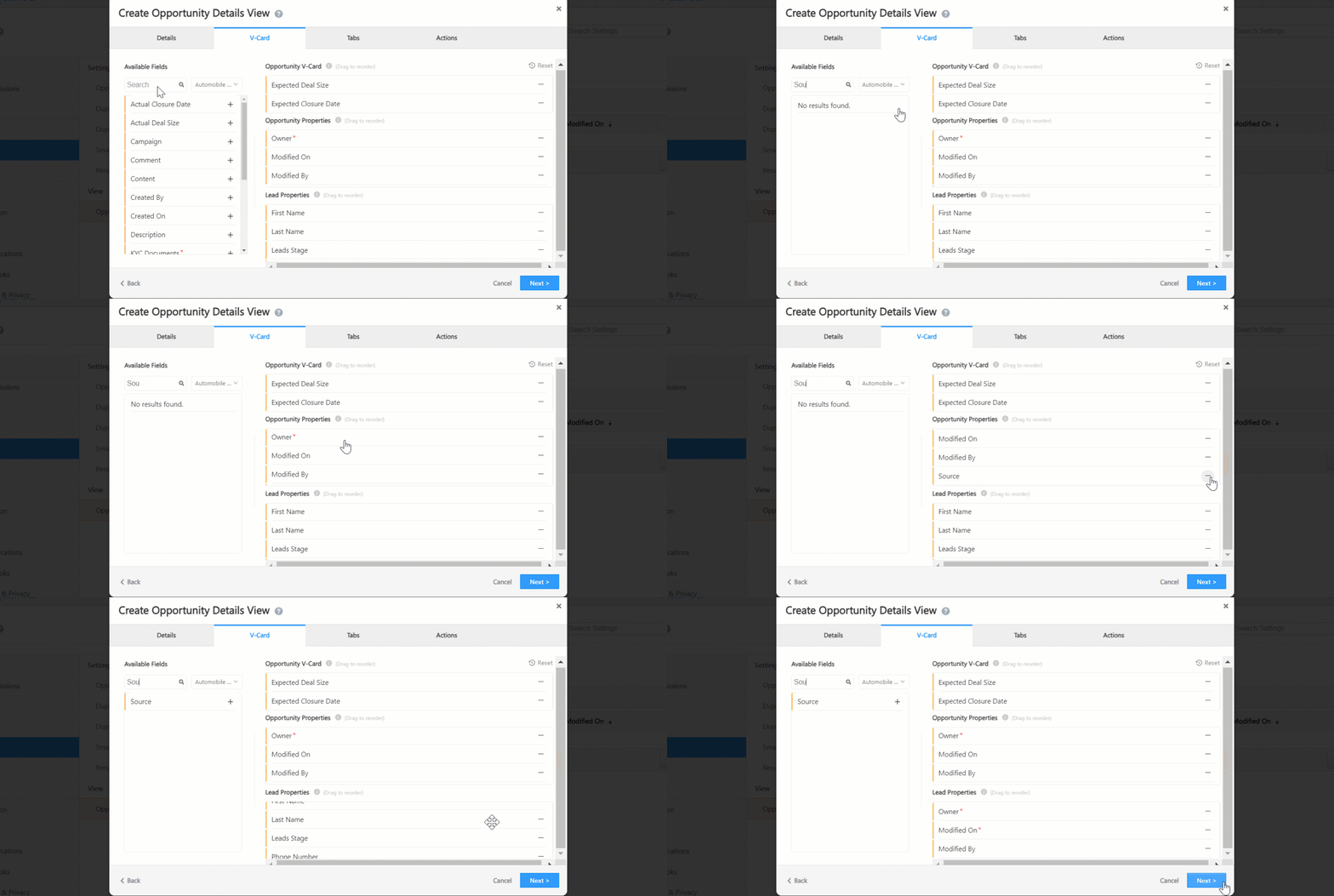
From the Available Fields, drag and drop* Opportunity fields to the relevant V-Card section –

  • Opportunity V-Card – Add/rearrange the fields you want to add to the Opportunity V-Card.
  • Opportunity Properties – Add details of the opportunity (Owner, Modified On, etc.).
  • Lead Properties – Add details of the leads associated with the opportunity (First Name, Lead Stage, etc.).

Once you’re done, click Next.

Note:

  • *Alternatively, to add a Opportunity field, click .
  • To remove a field, click Minus.
  • To reorder a field, drag and drop the field to the desired location.
  • Opportunity fields cannot be added to Lead Properties and vice versa.
  • To find a specific field, use the Search option.

LeadSquared - V card


3.3 Tabs

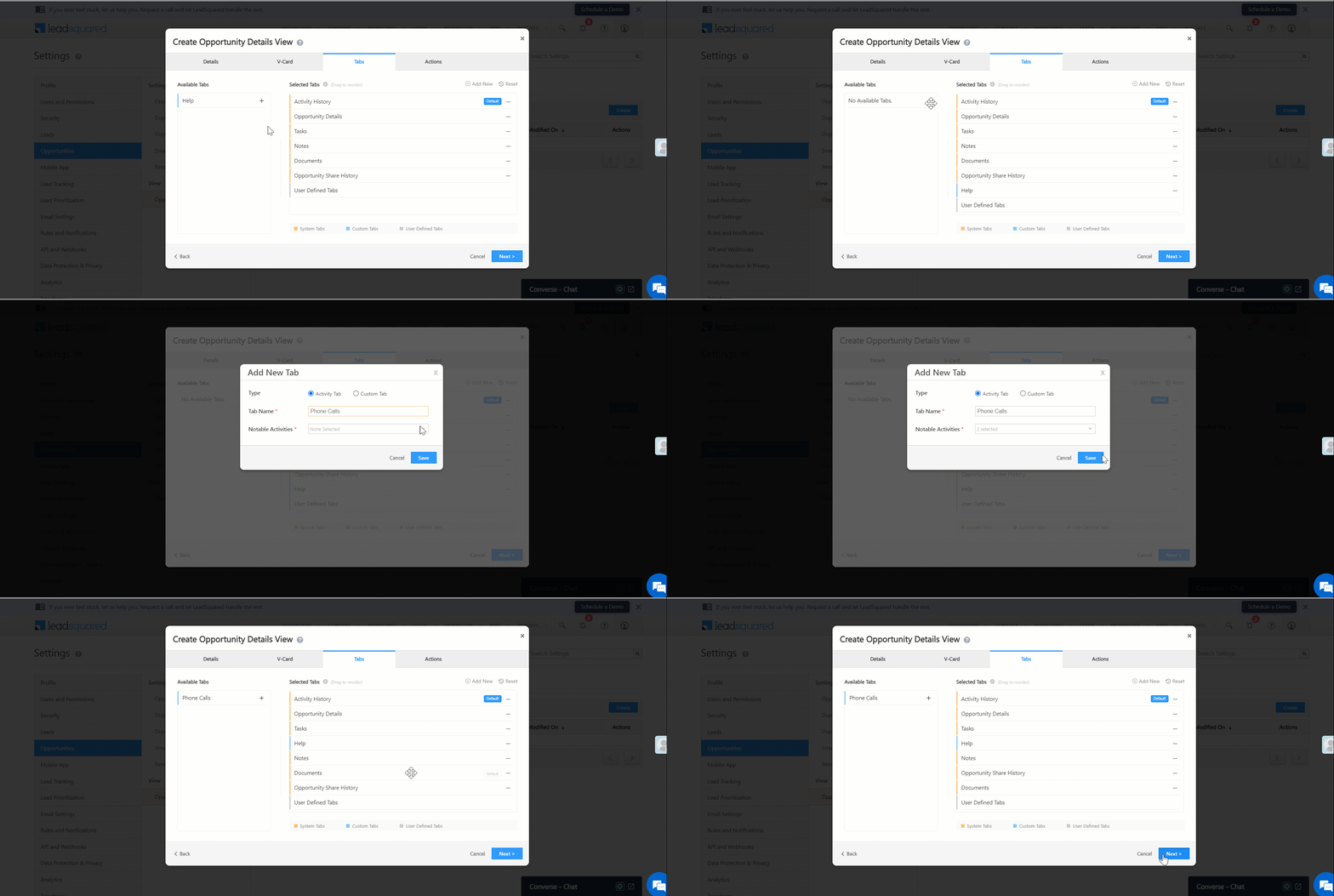
Select the tabs you want to display to your users.

  • To add a tab, from the list of Available Tabs, drag and drop the tab under Selected Tabs.
    • Alternatively, alongside the tab you want to add, click.
  • To set a default tab your users will see when they open the Opportunity Details page, alongside the tab’s name, click Default.
  • To reorder the tabs, drag and drop the tab to the desired location.
  • To reset the list of selected tabs, click Reset.
  • To add a new custom tab, click Add New, and –
    1. Type – Select if it’s an Activity or a Custom tab.
    2. Tab Name – Enter a relevant name for the tab.
    3. Notable Activities – If you selected the type as Activity, choose the activity types you want to display under the tab.
    4. URL – If you selected the type as Custom, paste the URL of the page you want to display within the tab.
    5. Once you’re done, click Save.

Once you’re done, click Next.

Note:

  • All system tabs are denoted in orange.
  • All custom tabs are denoted in blue.
  • All user-created tabs are denoted in grey.

ODVC Tabs


3.4 Actions

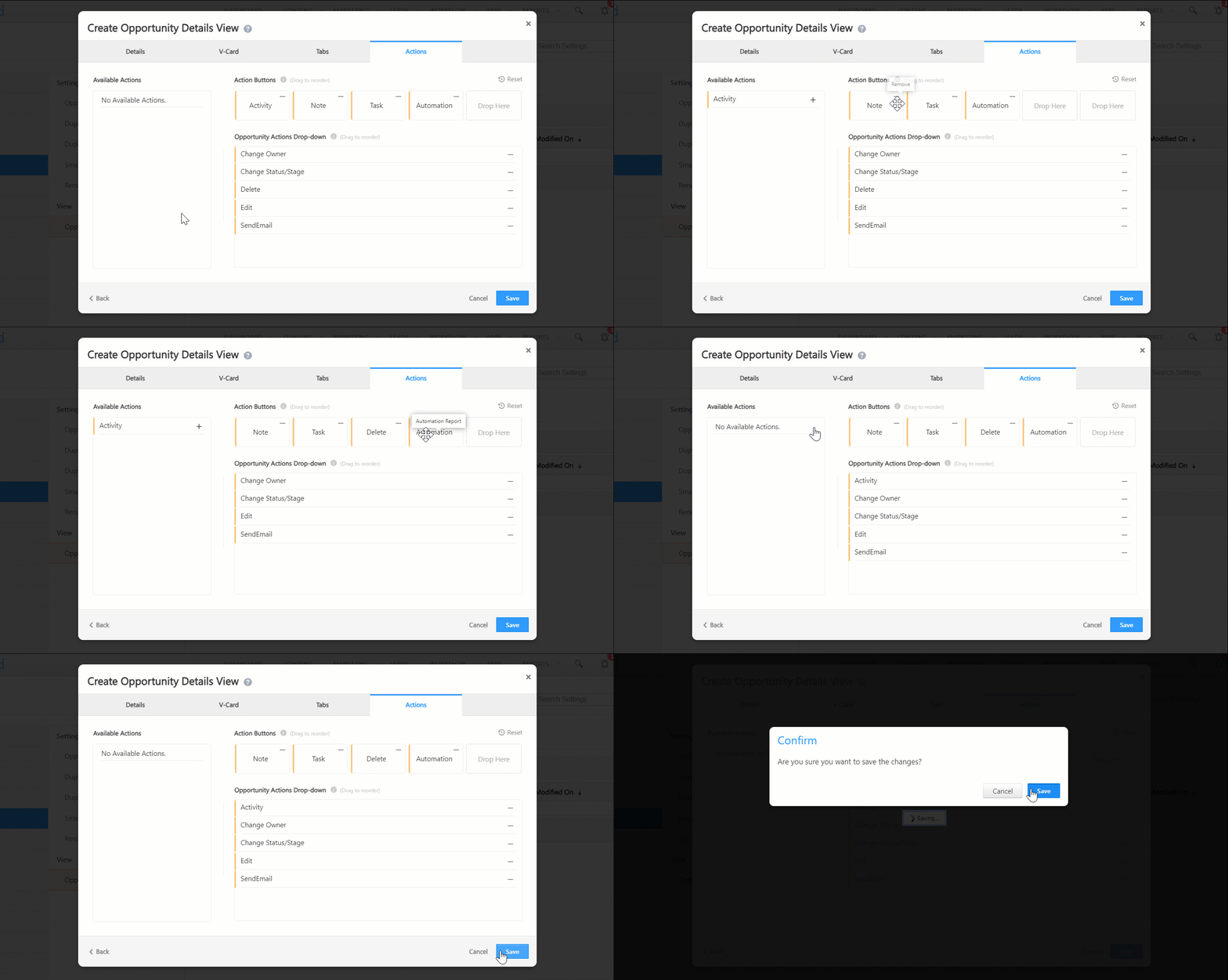
From the Available Actions, drag and drop* the desired action to –

  • Action Buttons – The button actions present on the Opportunity Details page. You can add up to five actions here.
  • Opportunity Actions Drop-down – The actions users can perform through the Opportunity Actions dropdown.

Once you’re done, click Save, and on the Confirm pop-up, click Save.

Note:

  • *Alternatively, to add an action, click .
  • To remove an action, click Minus.
  • To reorder a field, drag and drop the field to the desired location.
  • You can’t add the same action to both the Action Buttons section and the Opportunity Actions Drop-down.
  • To reset the list of selected actions, click Reset.

LeadSquared - ODVC actions


4. Assign Opportunity Details View to Teams

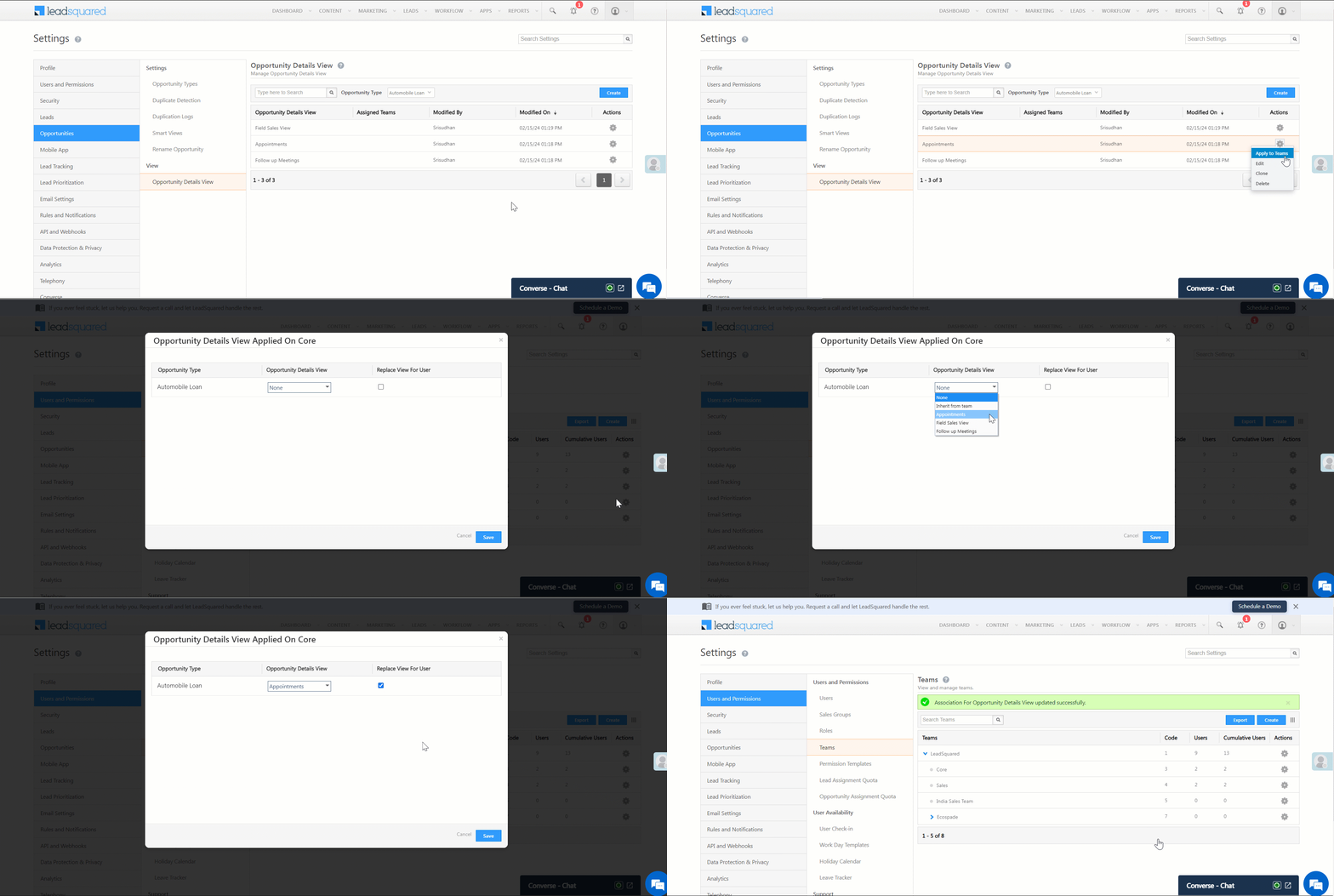
Once a view is created, to assign it to the relevant teams –

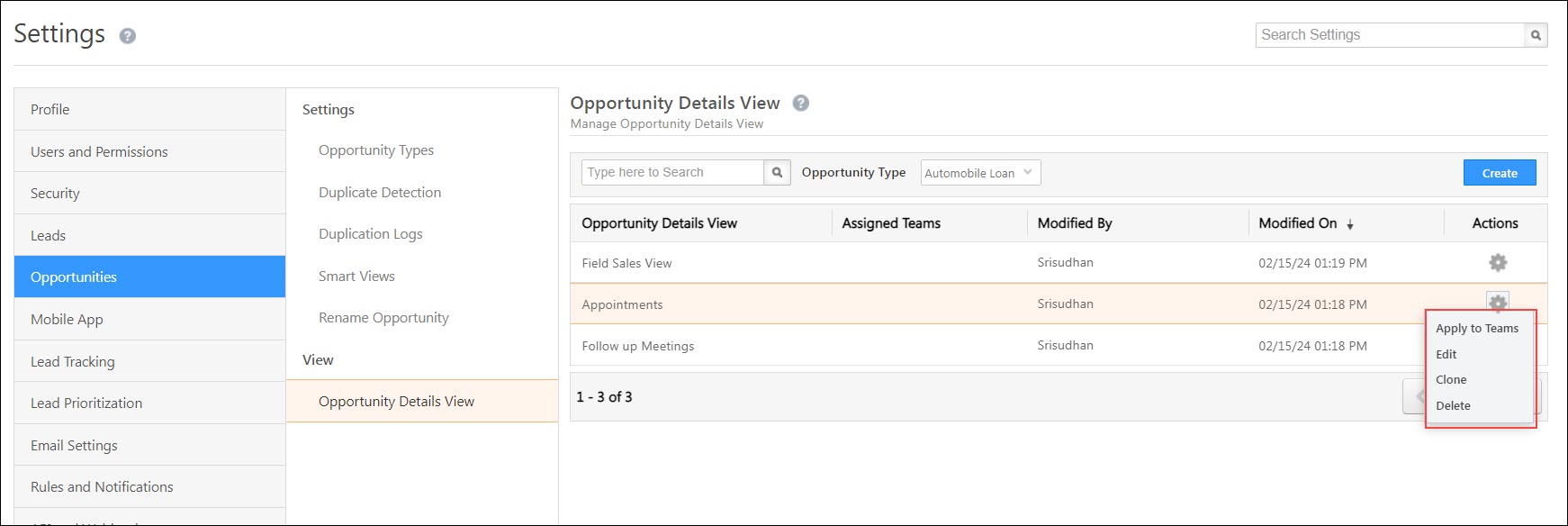
  1. Alongside the view you want to assign, hover your cursor over , and click Apply to Teams. You will be redirected to the Teams page.
  2. On the Teams page, alongside the team for which you want to assign the view, hover your cursor over , and click Apply Opportunity Details View.
  3. On the Apply Opportunity Details View pop-up, from the Opportunity Details View dropdown, select the view you want to assign.
  4. If you want to replace your User View Tabs (tabs created by individual sales users) with the Opportunity Details View tab, alongside Replace Opportunity Details View, enable the checkbox.
  5. Once you’re done, click Save. Now, the customised Opportunity Details view will be displayed to the relevant teams.

Note:

LeadSquared - Add ODVC to Teams


5. Other Actions

On the Opportunity Details View page, alongside a published view, hover your cursor over to perform the following actions –

  • Edit – Edit the view.
  • Clone – Click Clone to duplicate the view.
  • Delete – Click Delete to delete the view.

LeadSquared - ODVC other actions


Any Questions?

Do you have questions or issues with the content in this article? Let us know in the comments section below. We’ll get back to you asap!

How to Add and Manage Custom Activity Tabs in the Lead Details Page

1. Feature Overview

On the Lead Details page, you can create custom activity tabs to display logs for specific activity types. For example, you could create a tab that shows only Meetings, Demos, and Home Visits, making it easier to review relevant activity without scrolling through the full history.

Note: You can add up to 50 tabs on the Lead Details page. To adjust this limit for your account, contact your account manager or write to support@leadsquared.com.


2. Prerequisites

You must be an administrator of your LeadSquared account.


3. How It Works

Custom activity tabs are created and managed directly from the Lead Details page. Each tab is configured with a name and one or more activity types. One tab can be set as the default, which opens automatically whenever a Lead Details page is loaded.

Tab-level changes apply account-wide. Any tab you create, reorder, or set as default will reflect across all leads in your account, not just the lead you are currently viewing.


4. Create a Custom Activity Tab

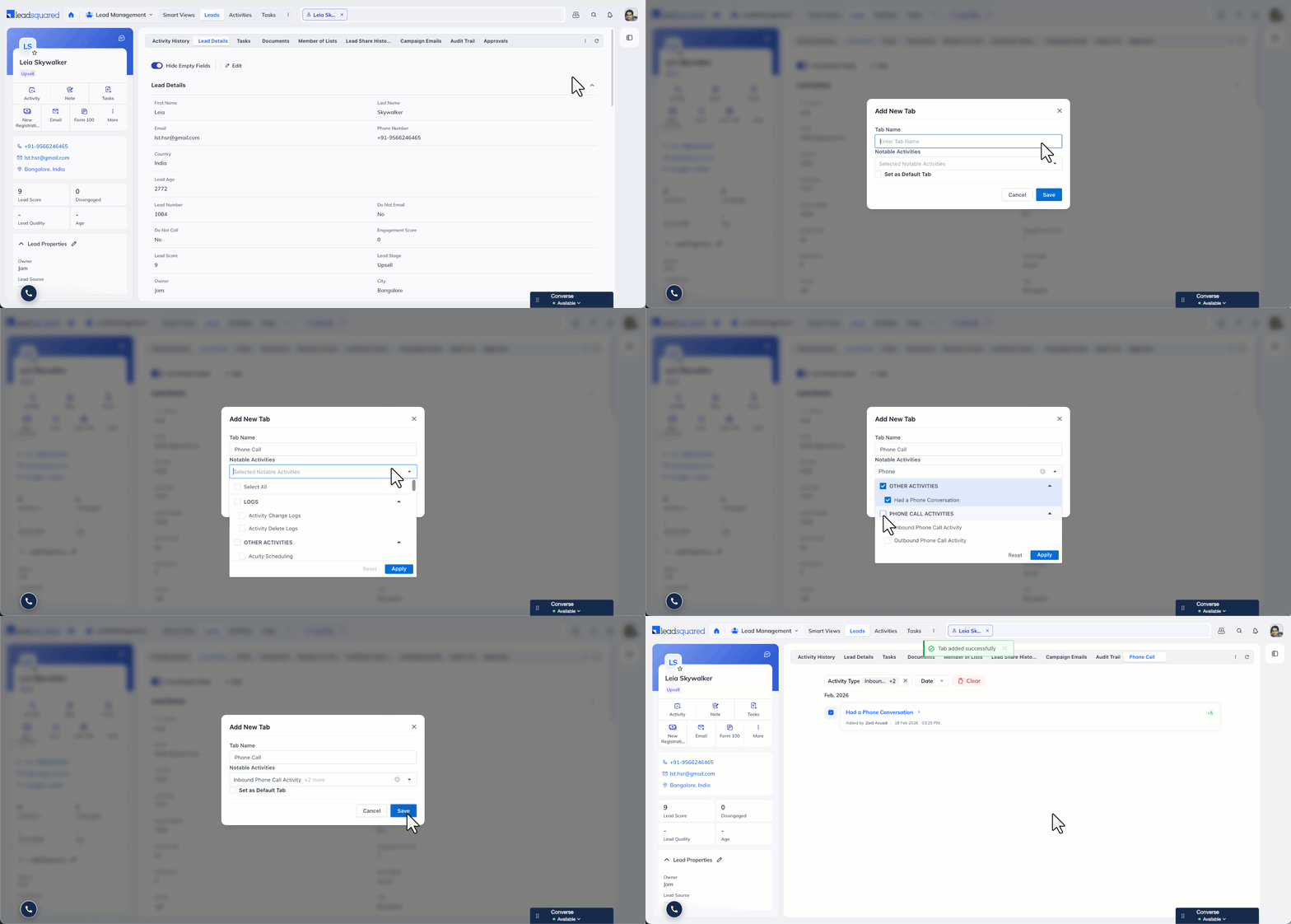
  1. Go to Lead Management>Leads and click any lead to open the Lead Details page.
  2. On the Activity Tab manager, click the 3 dotted menu, and select + Add New Tab.
  3. In the Add New Tab  pop-up, enter a tab name and select the activity types to include.
  4. To make this the default tab on the Lead Details page, enable Set as Default Tab.
  5. Click Save.

Add custom activity tab


5. Manage Activity Tabs

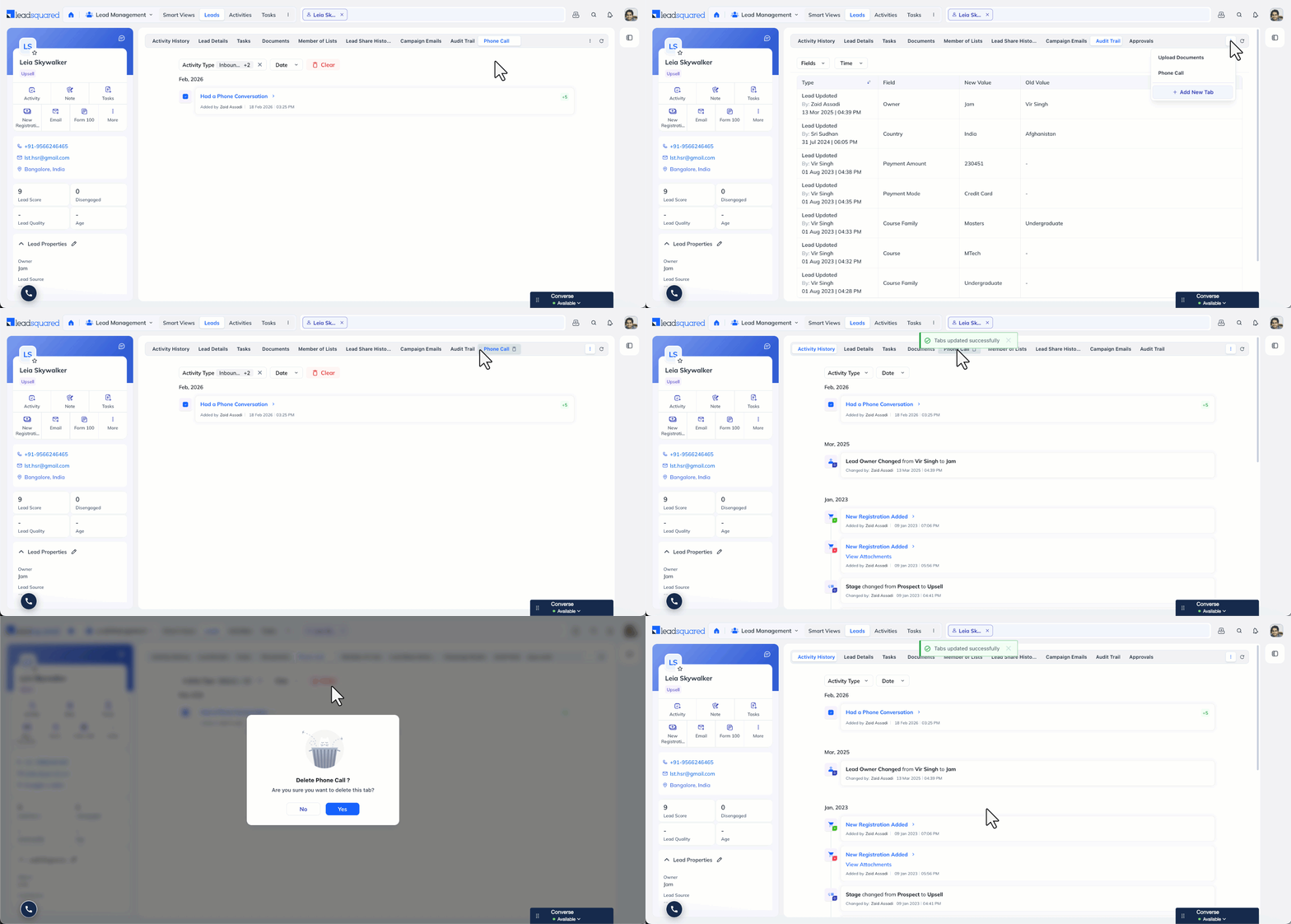
  • Switch between tabs: Select a tab to move between tabs.
  • Reorder tabs: Click and drag tabs to rearrange their positions.
  • View all tabs: Click the 3 dotted menu to see all activity tabs, including any created via the Custom Tab Connector.
  • Delete a tab: Custom activity tabs can be deleted from the tab list. System tabs cannot be deleted, but their display order and visibility can be modified through Lead Details Customization.
Note: The tab list also displays custom tabs created using the Custom Tab Connector. See Custom Tab Connector for details.

manage activity tabs


Any Questions?

Did you find this article helpful? Please let us know any feedback you may have in the comments section below. We’d love to hear from you and help you out!

SSL Certificate for Landing Pages

1. Feature Overview

By default, LeadSquared’s landing pages work on https, and on our internal viewpage.co domain. But if you’ve hosted your landing pages on custom domains (outside of LeadSquared), this article will help you obtain SSL Certificates to support these domains. The certificates are also extended to email links (see Email Link Domain Settings). We use SSL certificates generated by Amazon Certificate Manager on custom domains.

Note: We currently do not support SSL certificates purchased outside of LeadSquared.


2. Prerequisites


3. How it Works

Once you add your domains and sub-domains in LeadSquared, create the SSL Certificate Request. We generate a CNAME record, which you must add to your DNS Settings. This helps us identify the domain ownership. If your domain ownership verification is successful, we generate a subsequent CNAME record, which you must again add to your DNS Settings. The new CNAME record points to the SSL Certificate obtained from Amazon Certificate Manager.

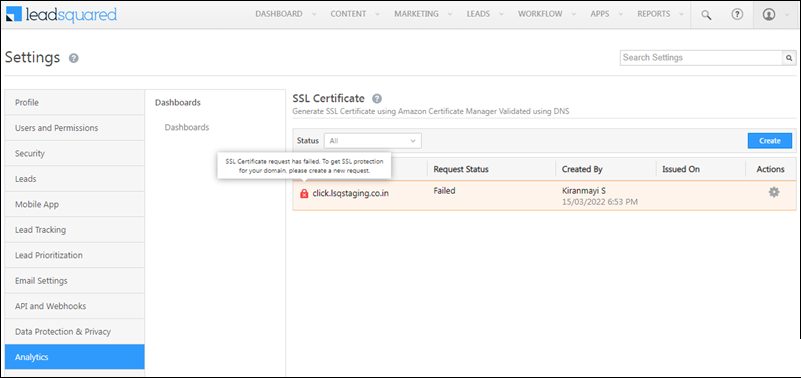
If the domain ownership verification fails, you have up to 72-hours to add the correct CNAME record, after which you must create a fresh SSL Certificate Request from LeadSquared.


4. Create SSL Request

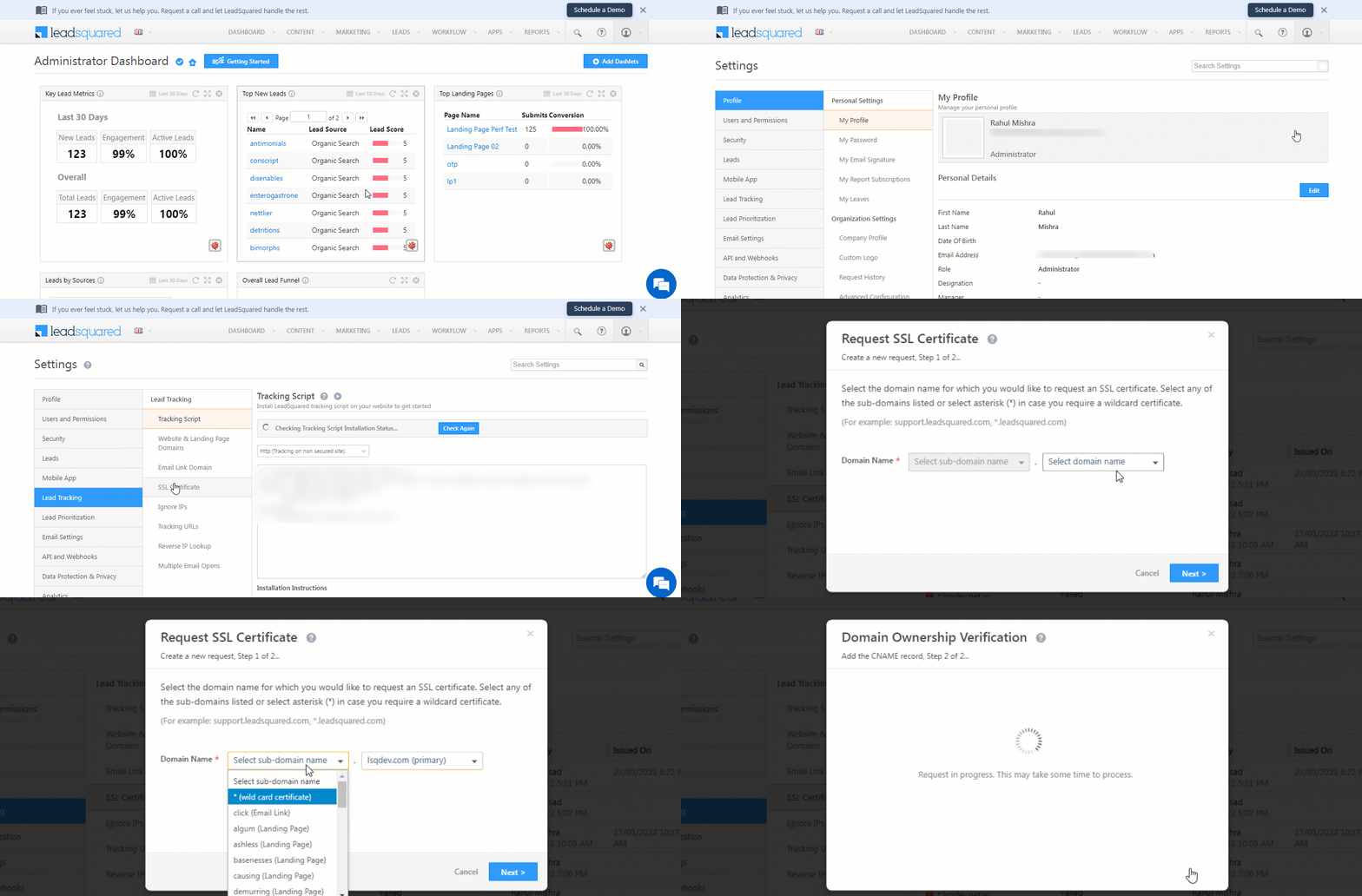
  1. After your domains and sub-domains are listed on the Website & Landing Page Domains page, navigate to My Profile>Settings>Lead Tracking>SSL Certificate.
  2. On the SSL Certificate page, click Create.
  3. On the Request SSL Certificate pop-up, Select the Domain Name.
  4. Once the domain is selected, from the following options, Select the Sub-Domains –
    • Wild Card Certificate – The SSL Certificate is requested for all the sub-domains listed under the selected domain (including the email link domain and landing page domains).
    • Email Link – The SSL Certificate is only requested for the selected email link domain.
    • Landing Page – The SSL Certificate is only requested for the selected landing page domain.
  5. Once you’re done, click Next.

LeadSquared SSL Certificate


5. Domain Ownership Verification

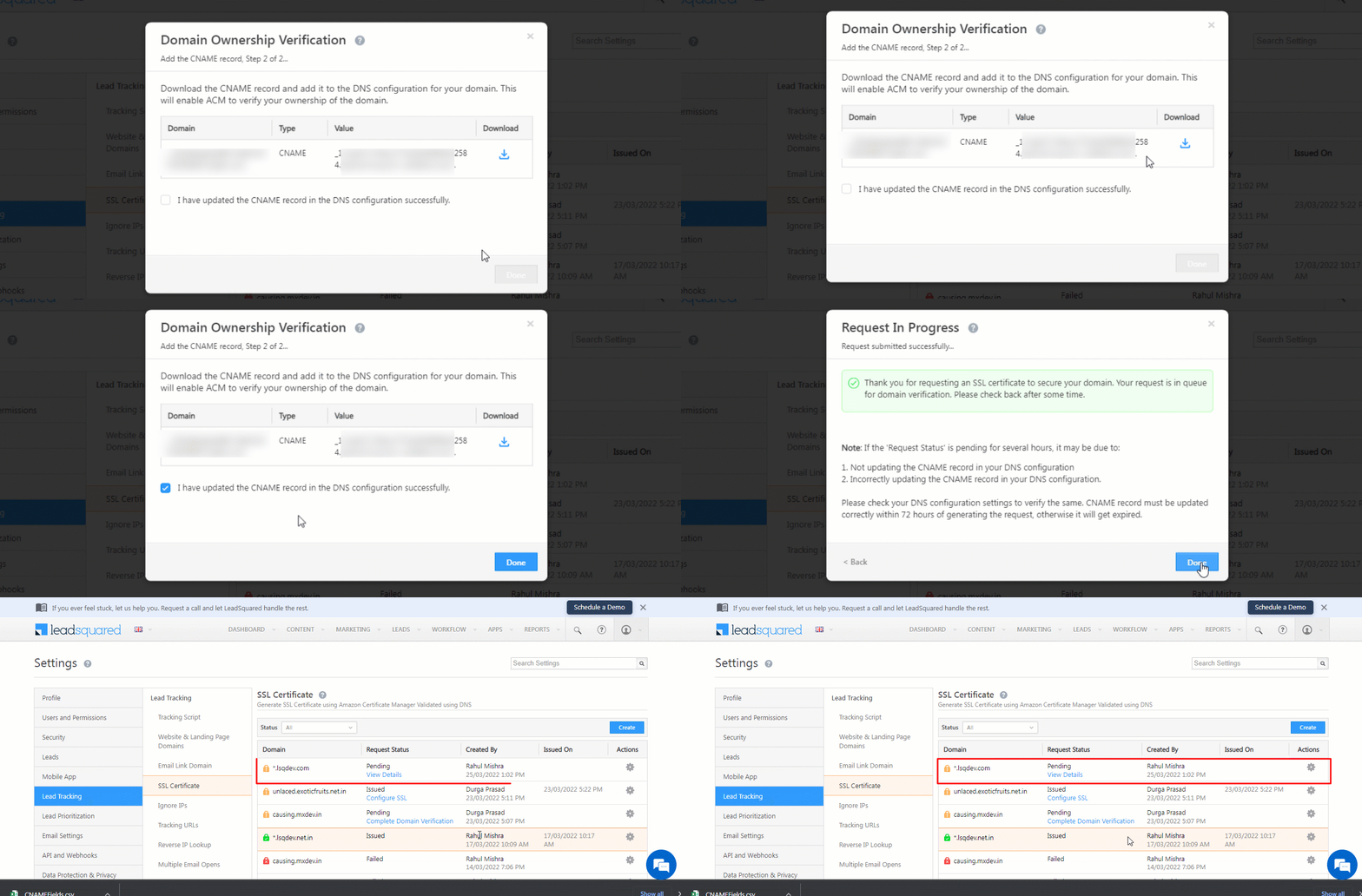
Once the SSL Request is created, on the Domain Ownership Verification pop-up –

  1. Click your cursor on the Domain and Value to copy these values.
    • Alternatively, click Download to download the CNAME Record.
  2. Add this CNAME Record in the DNS configuration for your custom domain. For example, if your service provider is –
  3. Once the CName Record is added, on the Domain Ownership Verification pop-up, alongside “I have updated the CNAME record”, click Checkbox, and then click Done.

LeadSquared SSL Certificate

Note:

  • You have a 72-hour window to add the correct CNAME record in your DNS Settings.
  • The domain ownership verification will take up to 4-hours.
  • If the CNAME mapping is done incorrectly (typos, pointing to an incorrect domain, etc.), you’ll receive an email reminder when 48-hours and 24-hours are remaining in the 72-hour window. If the CNAME mapping isn’t done correctly by 72 hours, you must create a new SSL request in LeadSquared.

LeadSquared SSL


6. Configure SSL

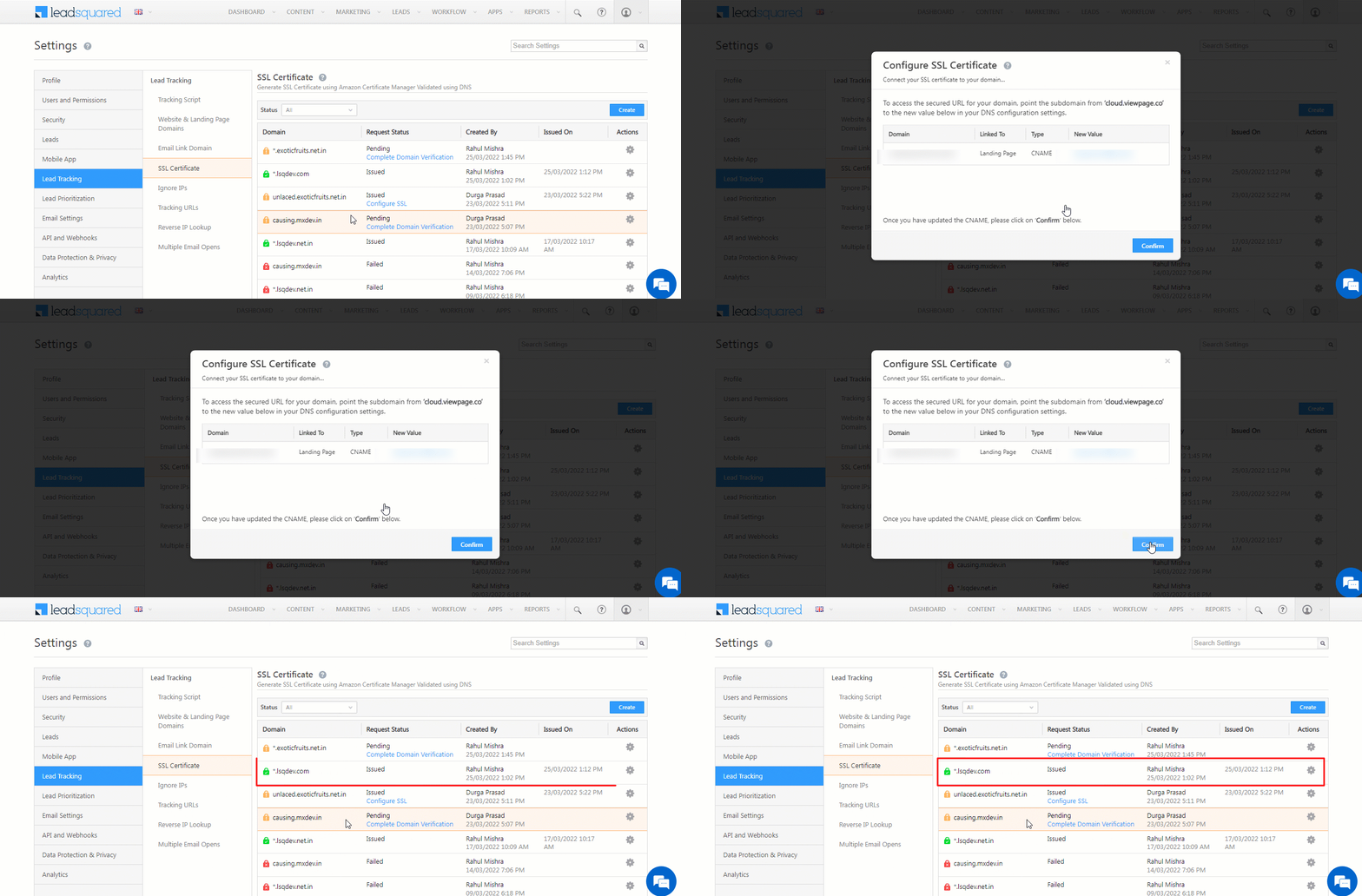
If successfully verified, the status of the request will now change from Pending – View Details to Issued – Configure SSL. To approve the CNAME in LeadSquared –

  1. Click Configure SSL, and on the Configure SSL Certificate pop-up, click your cursor on Domain and New Value to copy these values.
  2. Add this new CNAME Record in the DNS configuration for your custom domain.
  3. Once this is done, navigate back to LeadSquared, and on the Configure SSL Certificate pop-up, verify all the details and click Confirm. The SSL certificate is successfully added to your landing page.

LeadSquared SSL Certificate


7. View Certificate

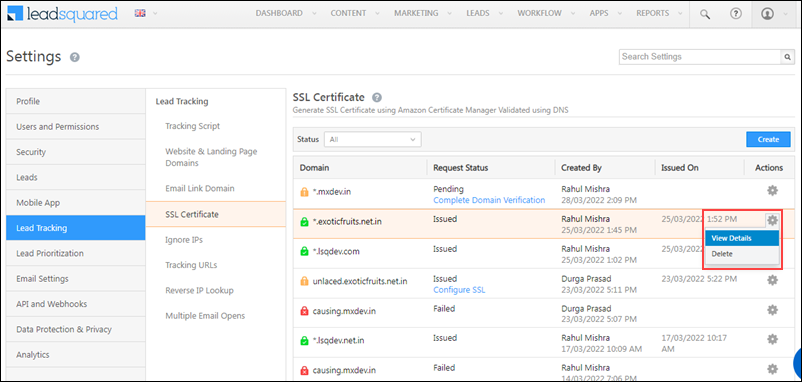
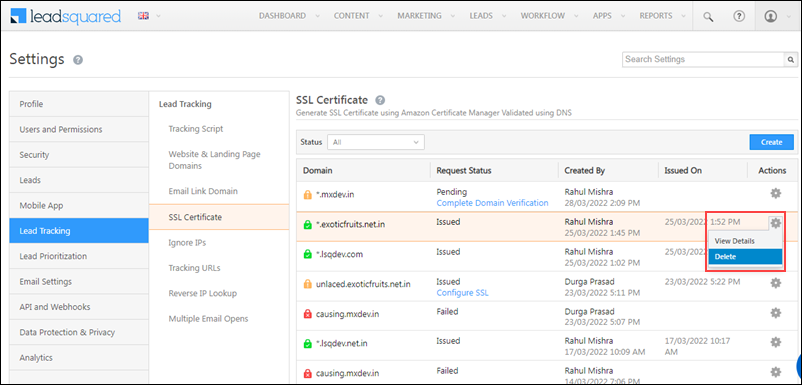
Once you add CNAME record in your DNS, to see all the subdomains where the certificate is added, hover your cursor over , and click View Details.

LeadSquared SSL

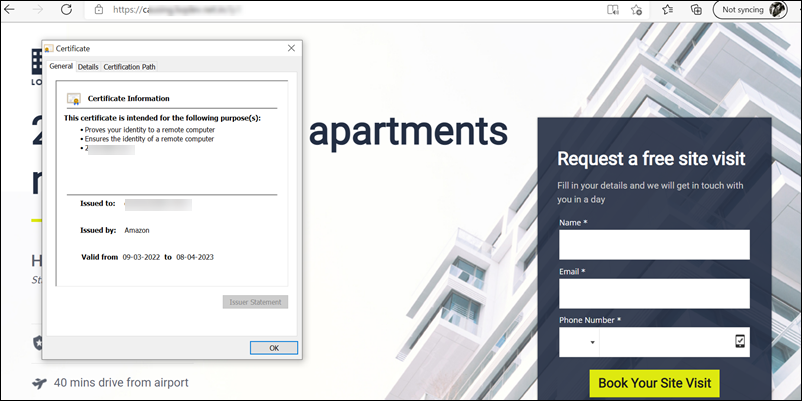
The SSL Certificate is now visible on your landing page.

LeadSquared SSL

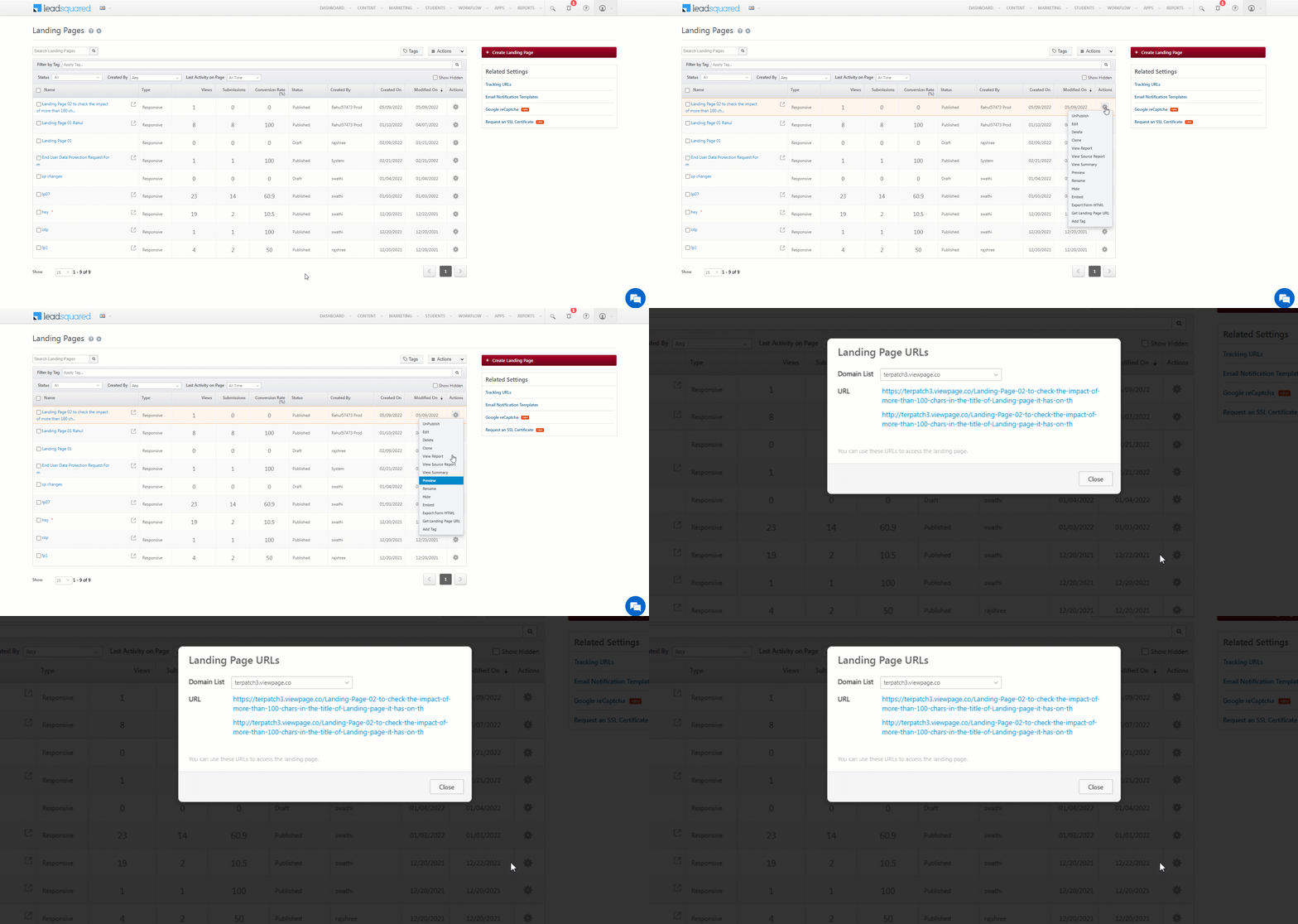
Note: On the Landing Pages screen (Marketing>Landing Pages), when you click Get Landing Page URL (alongside a landing page for which you’ve set up SSL), you’ll now see both the HTTP and HTTPS URLs.

LeadSquared SSL Certificate


8. Delete Certificate

To delete existing certificates, alongside the certificate, hover your cursor over , and click Delete.

Note: When you click Delete, all the certificates obtained for the subdomains (landing page and email link domains) listed under the domain will also get deleted.

LeadSquared SSL


Any Questions?

Did you find this article helpful? Please let us know any feedback you may have in the comments section below. We’d love to hear from you and help you out!

Opportunity Card Customization

1. Feature Overview

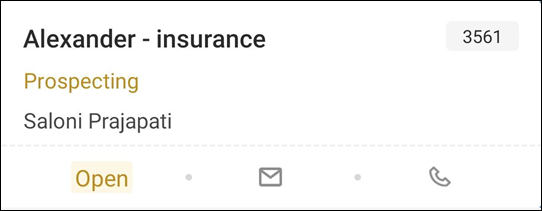
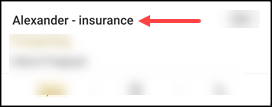
You can customize the Opportunity card on the mobile app to show the opportunity details you want to see. Here’s what the default opportunity card looks like –

LeadSquared Opportunity Card

It can be customized to include the fields and identifiers your users need to see.


2. Prerequisites

  • You must be the Administrator of your account.
  • You must have opportunities enabled in your account. To enable opportunities in your account, please reach out to your account manager, or write to support@leadsquared.com.
  • You must be running the following versions of the mobile app –


3. Customize the Opportunity Card

To customize the opportunity card on your mobile app –

  1. Login to the LeadSquared web application.
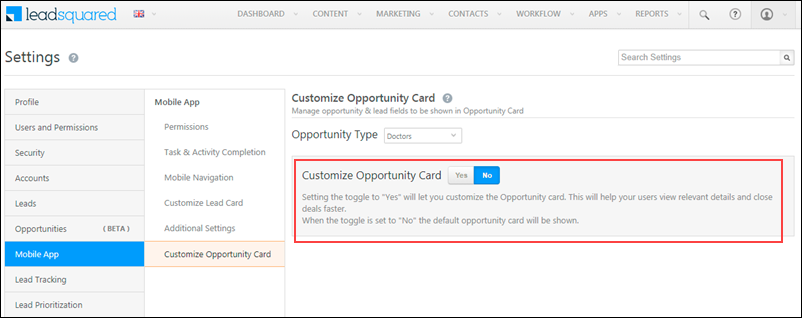
  2. Navigate to My Profile>Settings>Mobile App>Customize Opportunity Card.
  3. Alongside the Customize Opportunity Card setting, click yes no toggle.
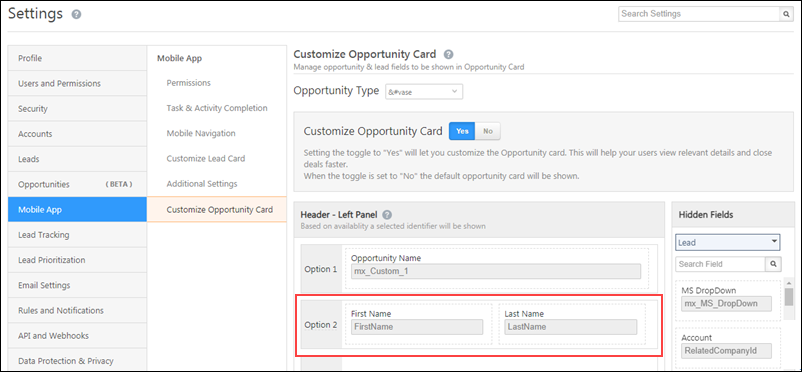
  4. From the Hidden Field panel on the right, drag-and-drop the lead and opportunity fields to the appropriate section (Option).
  5. Once you’re done, click Save.
Note: Custom Field Set (CFS) fields are not supported in Opportunity Card customization.

LeadSquared Opportunities


3.1 Header – Left Panel

The left panel header of the opportunity card.

  • You can display up to 3 identifier fields (such as First Name and Last Name, Created On Date, Lead City, etc.).
  • If Option 1 is blank for any opportunity, only then will Option 2 be displayed in the card.
  • If Option 1 and Option 2 are blank, the default message you set in Option 3 will be shown.

Note:

  • You can add only one lead/opportunity field to each option.
  • If you add the First Name lead field to any option, by default the Second Name lead field is also added. An exception to the previous point is made in this instance.

LeadSquared Opportunity Card


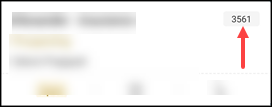
3.2 Header – Right Panel

The right panel header of the opportunity card. This section is optional.

Here, you can only add fields that contain the following data types –

  • Number
  • Date
  • Time
  • DateTime
  • Phone
  • Email
  • Boolean

You can add only one lead/opportunity field here (e.g., Expected Deal Size, Lead Score, etc.).

LeadSquared Opportunity Card


3.3 Related Details Section

Any additional details you want to display in the opportunity card. You can add up to three lead/opportunity fields here (e.g., Created By, Engagement Score, Lead Source, etc.). This section is optional.

Note: If this section is left empty, it isn’t displayed as a blank section inside the card.

LeadSquared Opportunity Card


3.4 Footer

The footer of the opportunity card. You can add up to three lead/opportunity fields here. By default, the following fields are displayed –

  • Opportunity Owner
  • Lead Email Id
  • Lead Phone Number

If you want to display other lead/opportunity fields, you must remove any of the default fields, and in it’s place, you can display other fields. You can only add fields that contain the following datatypes –

  • Dropdown
  • Number
  • Date
  • Time
  • DateTime
  • Phone
  • Email
  • Boolean

LeadSquared Opportunity Card


4. Opportunity Card on Android vs. iOS

Once you’ve customized the opportunity card, it will reflect instantly on the mobile app for all users.

  • Clicking on the email icon will redirect the user to an email platform of his choice with the email field value auto-populated in the ‘Send to’ section of the email.
  • Clicking on the phone icon will display both the call as well as SMS option. You can choose which action you want to perform.
  • If the field value is blank, then it will be displayed as a greyed-out icon.

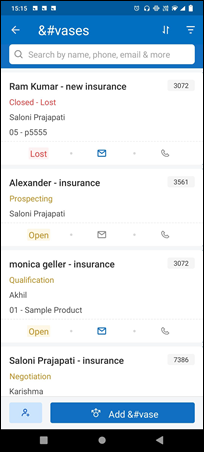
Here’s what a customized opportunity card looks like on Android –

LeadSquared Opportunity Card

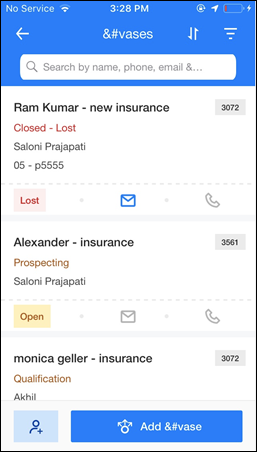
And on iOS –

LeadSquared Opportunity Card


5. Reset the Opportunity Card to Default

To revert back to the default lead card –

  1. Navigate to My Profile>Settings>Mobile App>Customize Lead Card.
  2. Alongside the Customize Opportunity Card setting, click no yes toggle.
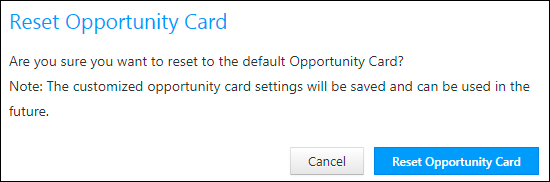
  3. On the confirmation dialog box, click Reset Lead Card.

LeadSquared Opportunities


Any Questions?

Did you find this article helpful? Please let us know any feedback you may have in the comments section below. We’d love to hear from you and help you out!

Google Meet Connector

1. Feature Overview

From your LeadSquared account, you can schedule Google Meet meetings through the Google Meet Connector. With the LeadSquared Google Meet connector, you can directly create meetings with your leads, as well as add internal and external users to your meetings. Additionally, this connector will help you –

  • Join Google Meet meetings with your leads from anywhere, on any device
  • Automatically add meeting details to your Google Calendar, with all the necessary details such as meeting date and time, meeting URL, etc.
  • Get notifications from LeadSquared about your Google Meet meetings


2. Prerequisites

  • The Google Meet Connector is a paid feature. To enable it on your account, please write to support@leadsquared.com.
  • You must be the administrator of your LeadSquared account.
  • You must have an active Google account.

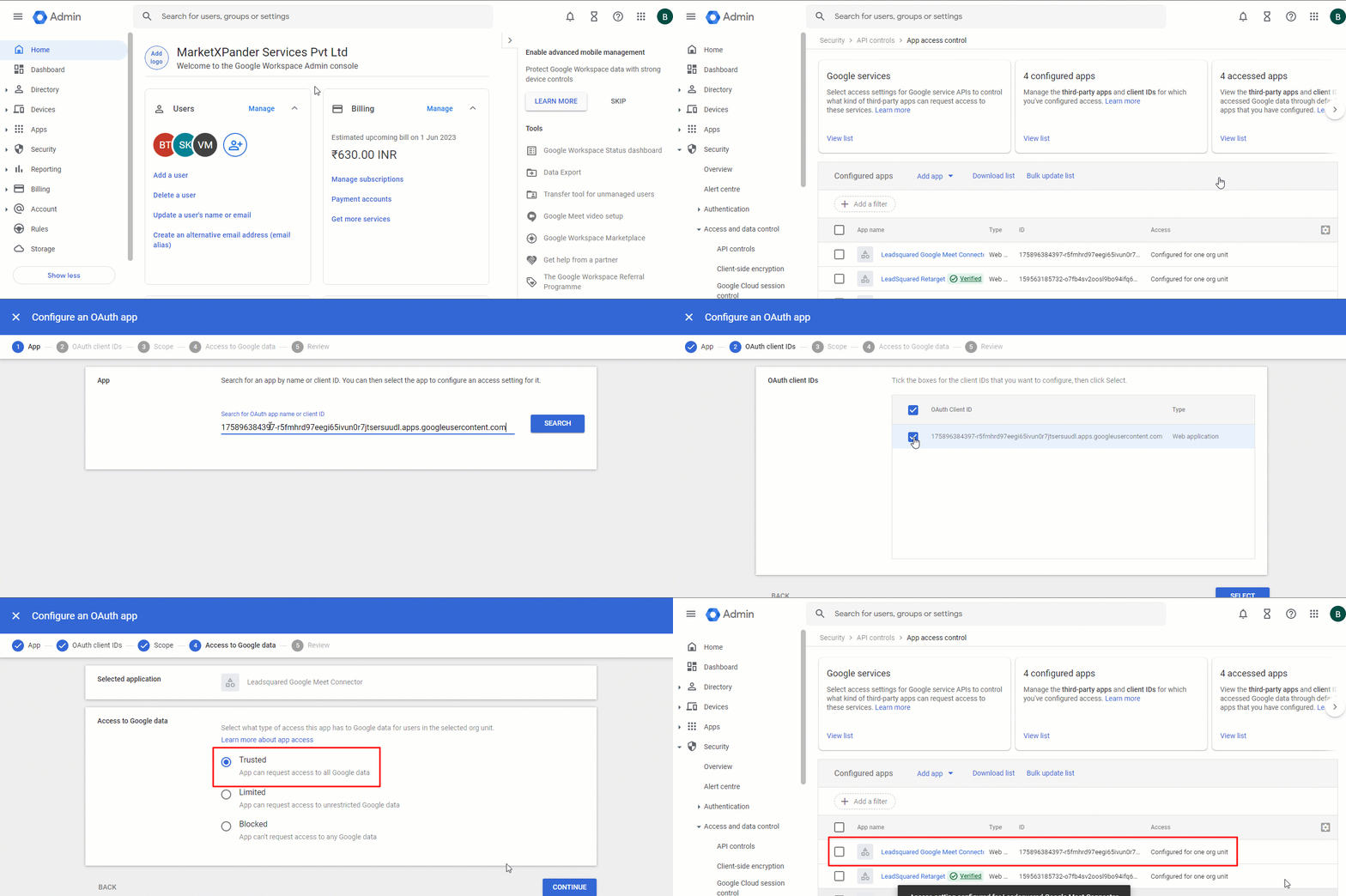
Before you connect your Google account with this connector, in your organisation’s Google Workspace, please grant access to the LeadSquared Google Meet Connector by marking it Trusted. If you don’t complete this step, you won’t be able to connect your Google Meet account with the LeadSquared app.
The steps to grant access are –

  1. Sign in to your organization’s Google Workspace as a Super Administrator, and go to Google Admin Console
  2. Navigate to Security>Access and Data Control>API Controls, and click on Manage Third-Party App Access.
  3. Click on Add New App, and search using the Client ID provided below. Once you find the LeadSquared Google Meet Connector, mark it as Trusted. To know more about this process, refer to Control which third-party & internal apps access Google Workspace data.
Note: The Client ID is 175896384397-r5fmhrd97eegi65ivun0r7jtsersuudl.apps.googleusercontent.com

Google Meet Connector


3. How it Works

Once set up, you can create and schedule Google Meet meetings with your leads and users, directly from LeadSquared.

  1. Install the connector – Begin by first installing the Google Meet Connector on your LeadSquared account.
  2. Configure the connector – Post installation, you’ll have to configure the connector with your Google account.
  3. Schedule meetings – After configuration, you can schedule Google Meet meetings with your leads and users.
  4. View Activities – After the Google Meet meeting is scheduled, you can view the meeting details.


4. Install the Connector

To install the Google Meet Connector on your LeadSquared account –

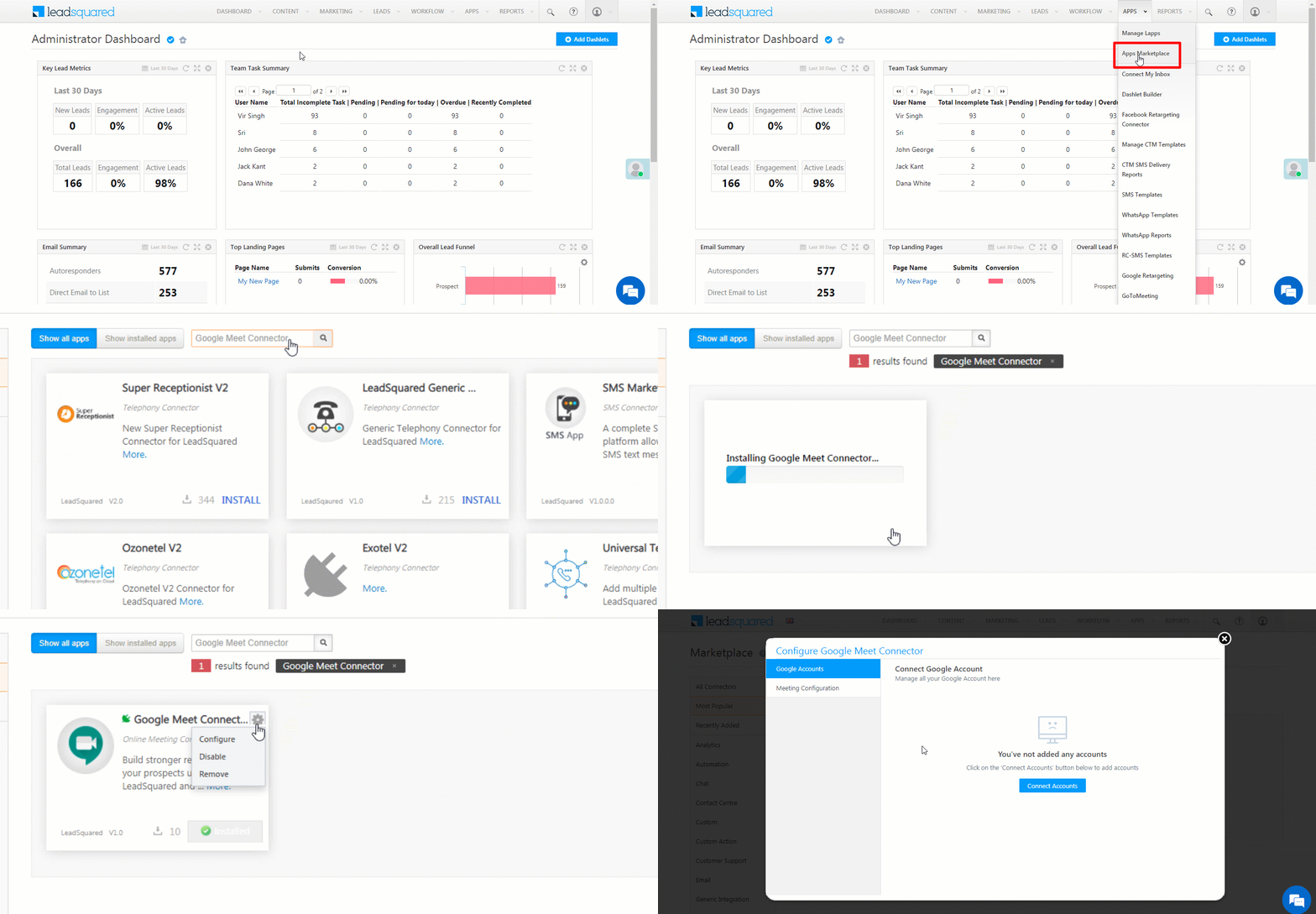
  1. From the main menu, navigate to Apps>Apps Marketplace and search for Google Meet Connector. On the connector, click Install.
    • Alternatively, you can find the connector on the left panel, under Online Meeting.
  2. Once the connector is installed, hover your cursor over the settings icon, then click Configure.

Google Meet_2


5. Configure the Connector

5.1 Google Accounts

Once the connector is installed, connect your Google account(s) to LeadSquared.

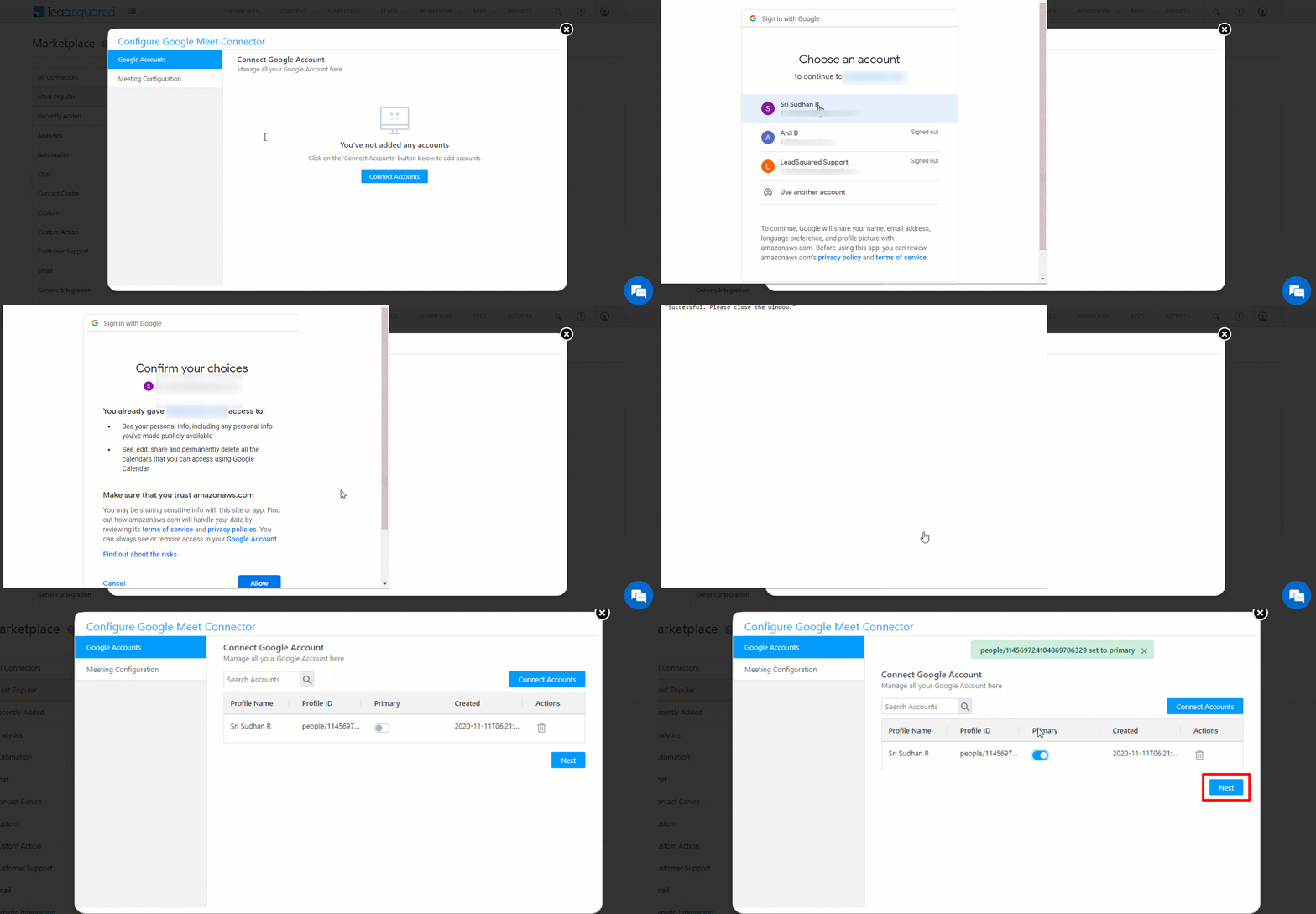
  1. On the Google Meet Connector screen, click Connect Accounts.
  2. On the Sign in with Google screen, select the Google account through which you want to set-up the connector.
  3. On the permission screens, grant access to your personal information as well as your Google calendar information.
  4. Once you’ve granted permission, click Allow. You’ll get the following message: “Successful. Please close the window.”
  5. Once your account is linked, on the Configure Google Meet Connector screen, under Primary, toggle the  Slider. This will ensure your Google account is the primary account.
    1. To delete an existing account, against the account name, click the  icon, and on the Delete Account pop-up, click Yes.
  6. Once you’re done, click Next.

Google Meet_7

Note: If you are not using G-Suite on your Google account, then your recipients will be required to login to their Google account first, in order to join the meeting. In this scenario, your recipients cannot join the meeting anonymously.


5.2 Meeting Configuration

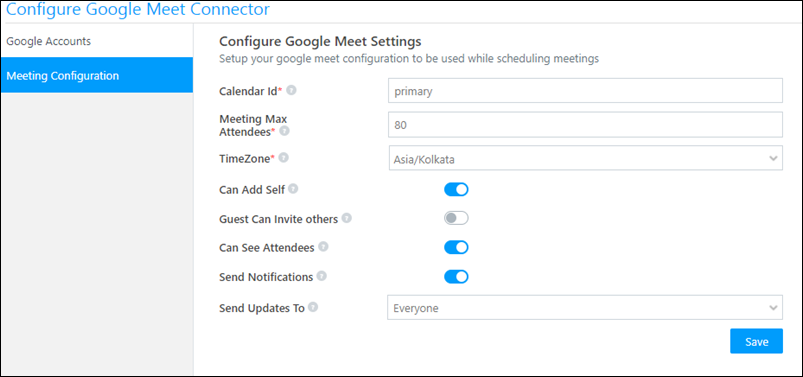
Configure the Google Meet settings that will be used while scheduling meetings –

Google Meet_6

Field Description
Calendar Id The calendar Id of your Google Account. This the primary email Id you’ve used to configure the connector in the previous step.
Meeting Max Attendees The maximum number of attendees (up to 100 attendees) that can be added to a Google Meet.
TimeZone The time zone in which the meetings will be scheduled.
Can Add Self Enable this setting to grant permission to attendees (other than the organizer) to add themselves to an existing meeting.
Guest Can Invite others Enable this setting to grant permission to attendees (both internal and external) to be able to add anyone to the meeting.
Can See Attendees Enable this setting to grant permission to attendees (other than the organizer) to be able to view the attendees in the meeting.
Send Notifications Enable this setting to send notifications to attendees, from LeadSquared, about the creation of a new meeting. Even if this setting is disabled, some form of notification is sent from Google.
Send Updates To From the dropdown, choose to whom you want to send a notification about the update in meeting details. You can choose from Everyone, Non Calendar Guests Only or None.

Once you’ve configured the settings, click Save.


6. Schedule Google Meet Meetings

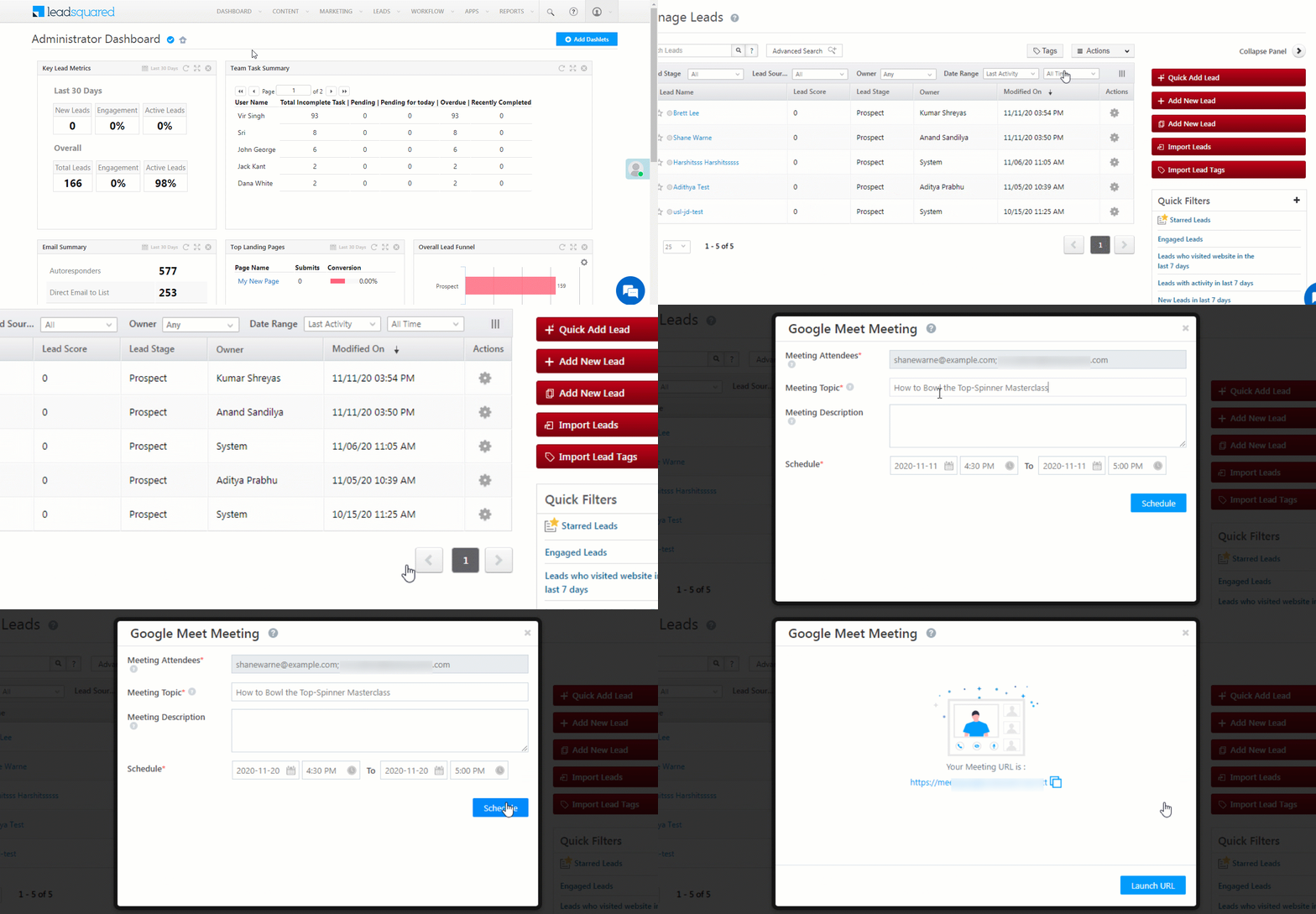
To schedule a Google Meet with your leads –

  1. From the LeadSquared main menu, navigate to Leads>Manage Leads.
  2. On a lead, hover your cursor over the Action Icon icon. From the dropdown list, hover your cursor over Online Meeting, and then click Google Meet Meeting.
  3. On the Google Meet Meeting pop-up, enter the following details –
    • The email Ids of the attendees are added by default in the Meeting Attendees field.
    • In the Meeting Topic field, enter a relevant name for the meeting. This is mandatory.
    • In the Meeting Description field, enter a brief description about the meeting.
    • Against Schedule, pick a from and to date and time for the meeting. This is mandatory.
  4. Once you’re done entering the details, click Schedule.
  5. Your Google Meet meeting URL is generated. You can share this URL with your leads and other external participants.

Google Meet_4


7. View Google Meet Meeting Details

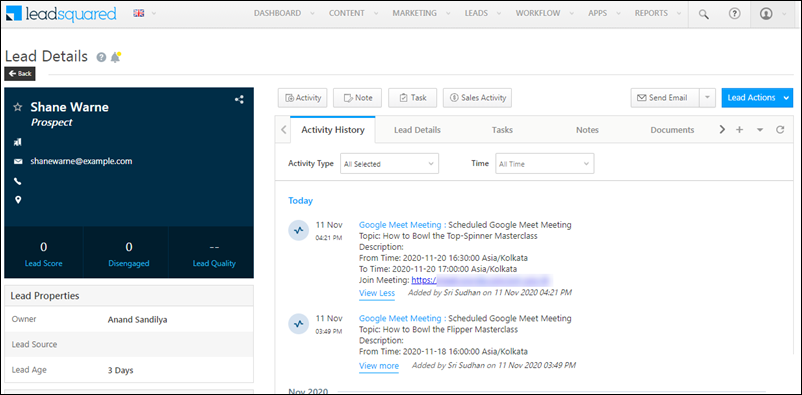
After you have scheduled a Google Meet meeting, an activity gets automatically posted against the invited lead. You can view the meeting details in the Lead Details page.

  1. From the LeadSquared main menu, navigate to Leads>Manage Leads.
  2. Click on the lead on whom the meeting is scheduled.
  3. On the Lead Details page, under the Activity History tab, you can view the meeting details.
  4. You can edit the meeting details by clicking the  icon.

Google Meet_5


8. FAQs

1. Can we edit/cancel a meeting once it’s created?
No. Once a meeting is created, it cannot be edited or cancelled.


2. Can we change the host’s email Id while creating a meeting?
By default, the email Id of the admin who installed and configured the connector is used as the host email Id. This cannot be changed. The user’s email Id is passed as an attendee.


3. Should a user be logged into their Gmail account when scheduling a meeting?
No. The user is not required to be logged in to their Gmail account when scheduling a meeting.


Any Questions?

Did you find this article helpful? Please let us know any feedback you may have in the comments section below. We’d love to hear from you and help you out!

Facebook Retargeting Connector

1. Feature Overview

The Facebook Retargeting Connector enables you to push lists of leads (interested in a particular product or service) directly to your retargeting campaign on Facebook Ads. This will help you identify the lead’s Facebook profile, and show relevant ads through Facebook Remarketing. The features of this connector are –

  • Create Audience List – Enhance existing audience lists on Facebook Ads with new leads, and create new lists as well with the data captured through the connector.
  • Target Your Leads – Reach out to leads who are already aware of your product and service. Reconnect with them on Facebook after they leave your website.
  • Field Mapping – Sync custom lead data along with standard fields to Facebook to improve your campaign’s effectiveness.
  • Campaign Statistics – Reports of how your campaigns are performing, where your ads are showing up, and what’s the cost-split of your campaign.
  • Sync Logs – Enables debugging, and lets you view sync status along with the list of errors and error details.

To know more about what the Facebook Retargeting Connector offers, please refer to Facebook Retargeting with LeadSquared.


2. Prerequisites

  • You must have an active Facebook Ads account.
  • You must be an Administrator of your LeadSquared account and your Facebook Ad account.
  • This is a paid feature. To enable it, please write to support@leadsquared.com.


3. How it Works

To push leads from LeadSquared to your Facebook Ads account, using the Facebook Retargeting Connector connector, complete the following steps –

  1. Install the connector in LeadSquared
  2. Configure the connector in LeadSquared
    1. Connect your Facebook Ads account(s)
    2. Create an empty audience list
    3. Map relevant fields to the empty list
    4. Push leads to the list you’ve created, and sync the list with Facebook Ads
  3. View the list on your Facebook Ads account


4. Installing the Connector

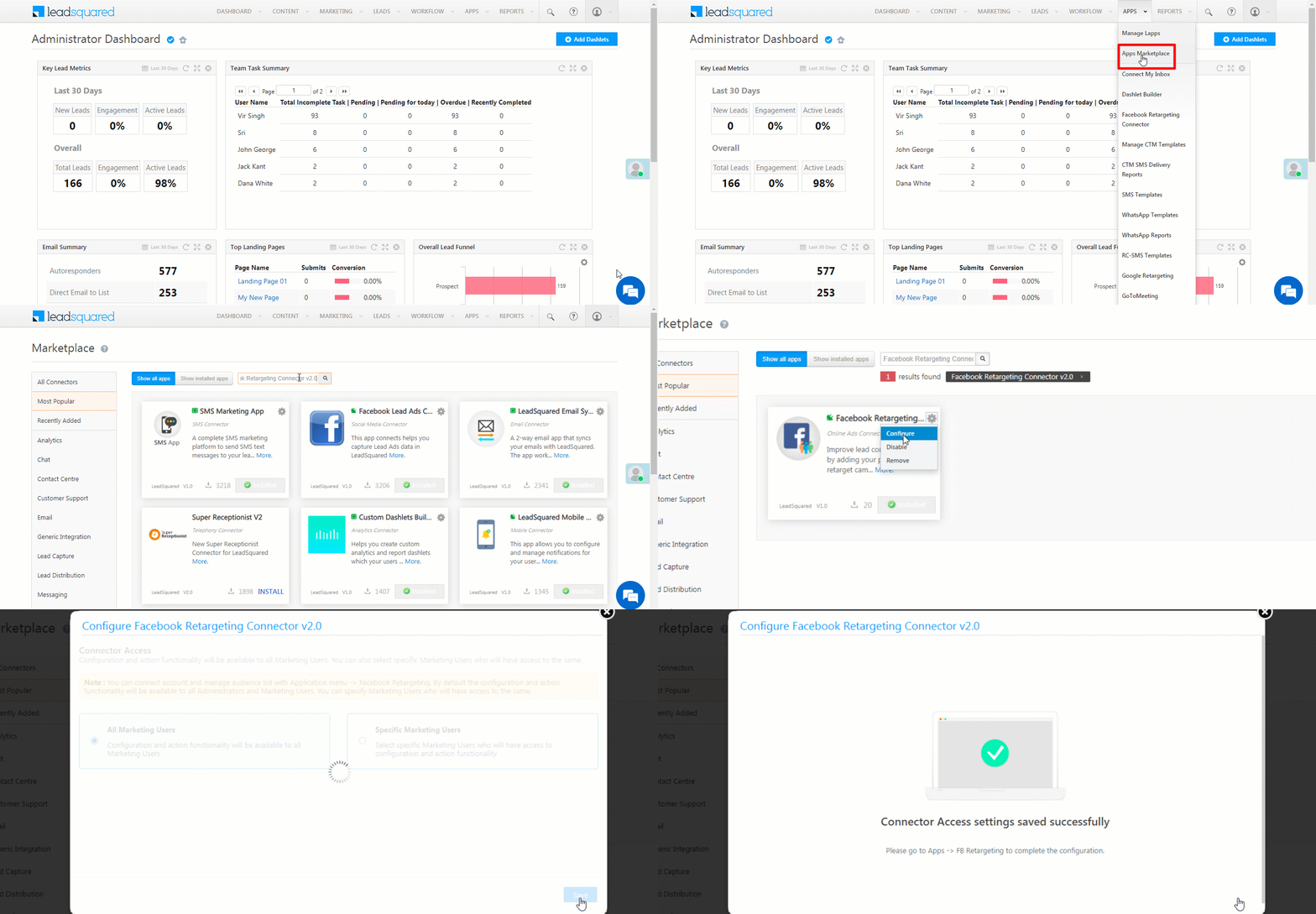
To install the Facebook Retargeting Connector on your LeadSquared account –

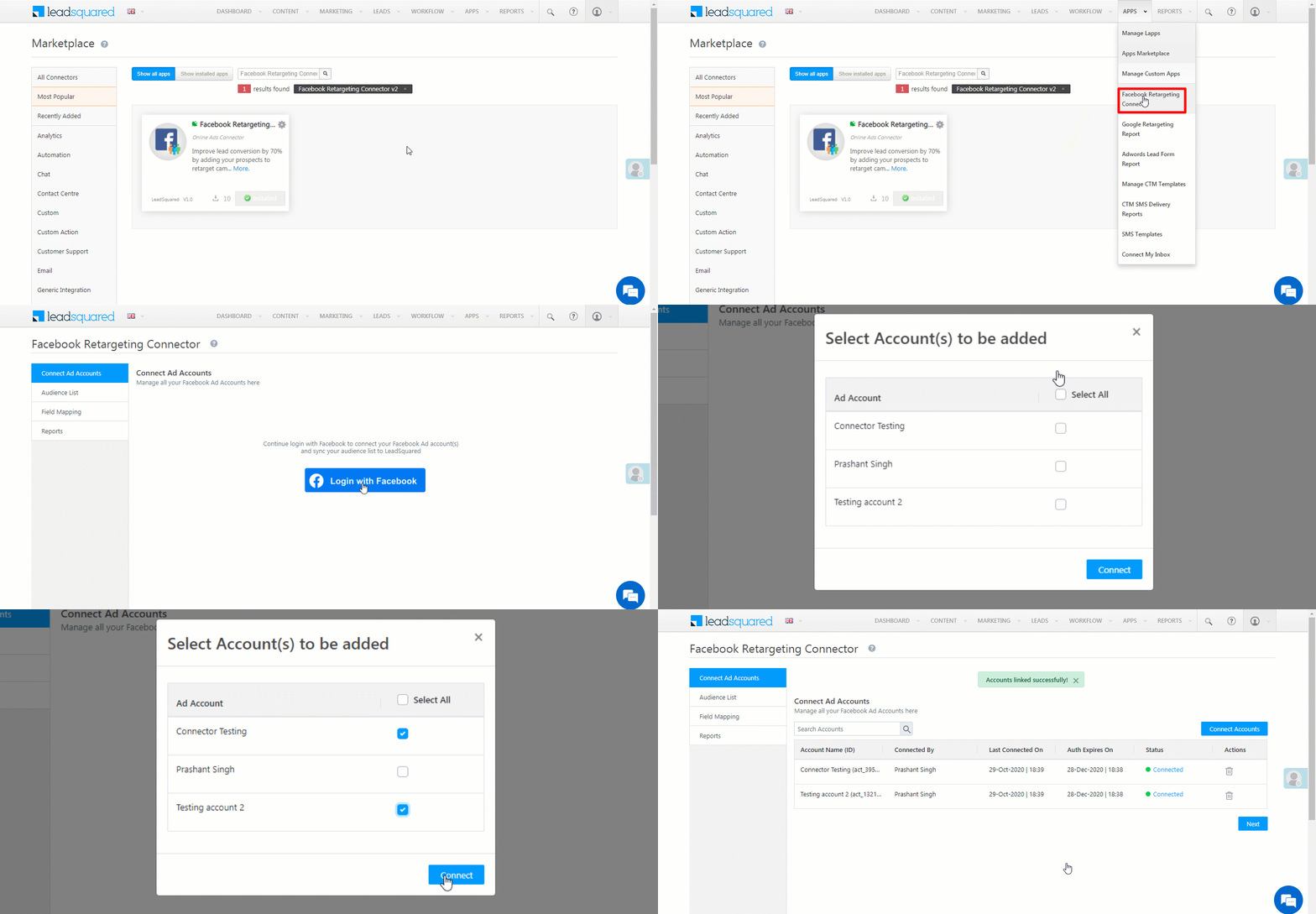
  1. From the main menu, navigate to Apps>Apps Marketplace and search for Facebook Retargeting Connector v2.
    • Alternatively, you can find the connector on the left panel, under Online Ads.
  2. Click Install.
  3. Once the connector is installed, hover your cursor over the settings icon, then click Configure.
  4. On the Connector Access screen, you can choose to give access to all your marketing users, or only specific marketing users.
    • If you choose Specific Marketing Users, from under Specific Users, you can select the marketing users from the dropdown list.
  5. Once you’re done, click Save.

Facebook Retargetting_2


5. Configuring the Connector

5.1 Connect Ad Accounts

Once the connector is installed, connect your Facebook Ads account(s) to LeadSquared.

  1. Navigate to Apps>Facebook Retargeting Connector.
  2. On the Connect Ad Accounts page, click Connect Accounts.
  3. Click Login with Facebook, and on the login window, click the Facebook Business account through which you want to login.
    • You can also choose to login with a different account by clicking Log in to another account.
  4. On the Select Account(s) to be added pop-up, click the Checkbox against accounts from the list of accounts linked to your Facebook Business account, that you want to add. You can add multiple accounts.
  5. Once you’re done, click Connect, and then click Next.
    • To delete an existing account, against the account name, click the  icon, and on the Delete Account pop-up, click Yes.

Facebook Retargetting_3


5.2 Create Audience List

After configuring the connector, you must either create an empty audience list from LeadSquared, or sync an existing list. After creating a list, you will then have to push lead data from LeadSquared to this list. To create an audience list from LeadSquared–

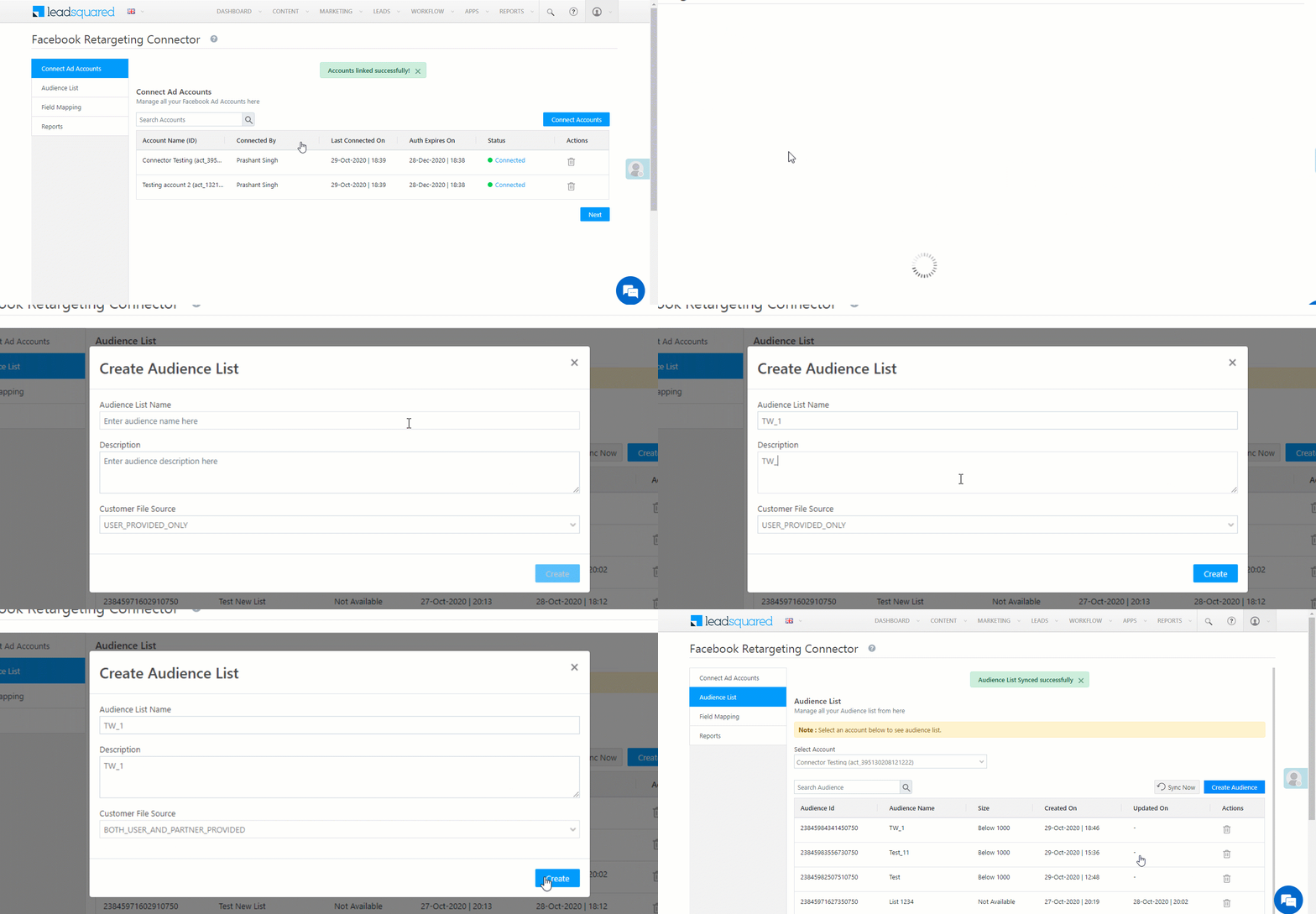
  1. On the Connect Ad Accounts page, click Audience List.
  2. Under Select Account, from the available dropdown, select the Facebook Ad account under which you want to create the list, then click Create Audience.
  3. On the Create Audience List pop-up, enter a name and description for the list.
  4. From the Customer File Source dropdown, select the source from which you want to capture lead details. You can choose from the following options –
    • User_Provided_Only – Under this option, you can upload lead data captured through internal channels, such as when a user captures lead details manually, or the system captures a lead’s deatils automatically (such as when a lead visits website, lead opens emails, lead clicks on a link, etc.).
    • Partner_Provided_Only – Under this option, you can upload lead data captured through external channels, such as third-party websites and partners who’ve provided lead data.
    • Both_User_And_Partner_Provided – Under this option, you can upload lead data captured through both internal as well as external channels.
  5. Once you’re done, click Create. You’ll get a message stating, “Audience List Synced successfully”.
    • To sync an existing or new list from LeadSquared with Facebook, click Sync Now.
    • To delete an existing list, against the list name, click the  icon, and on the Delete Audience pop-up, click Yes.

Facebook Retargetting_4


5.3 Field Mapping

To map lead fields from LeadSquared to the lead fields on the Facebook Audience List –

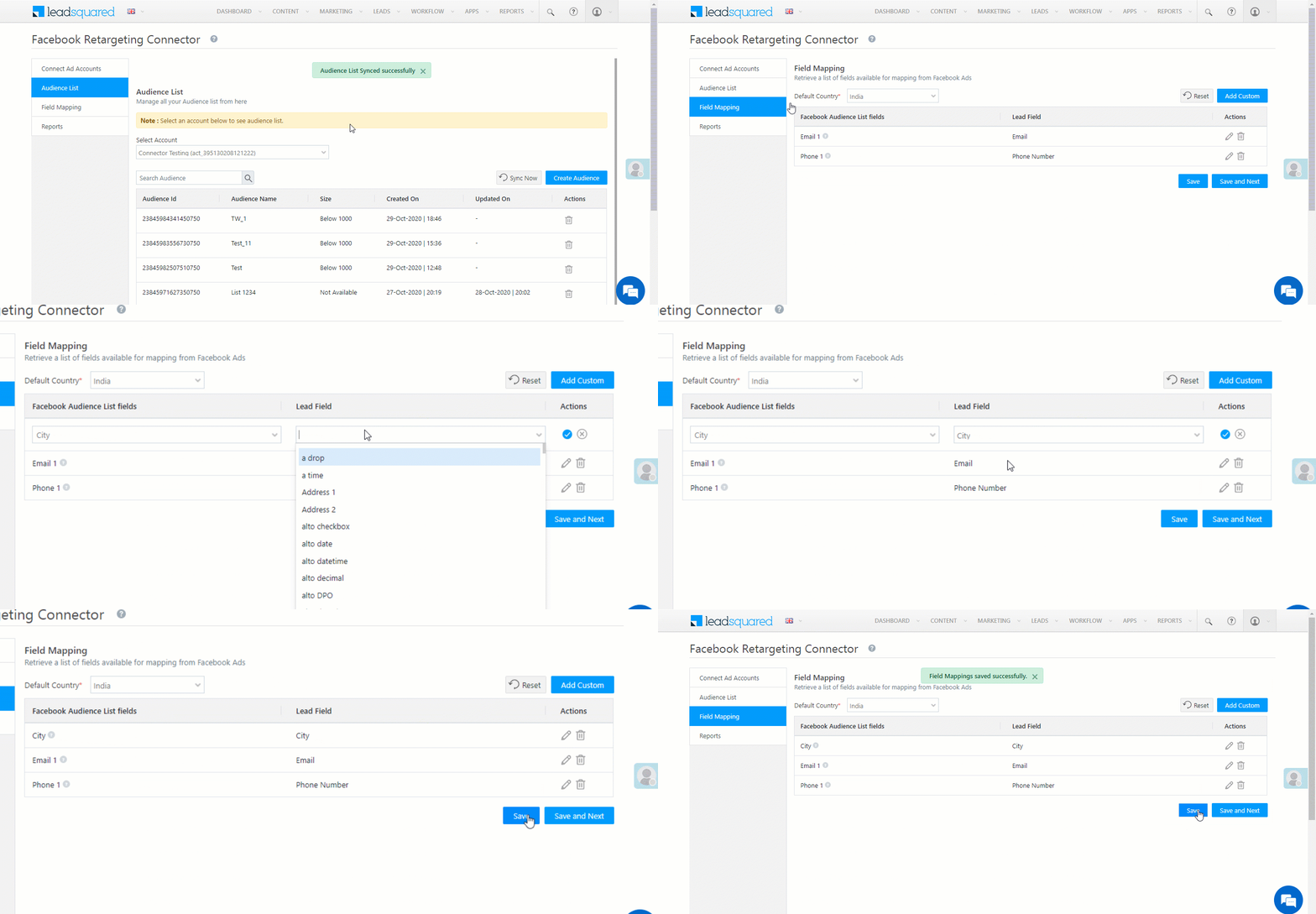
  1. On the Connect Ad Accounts page, click Field Mapping, and then click Add Custom.
    • By default, Email and Phone fields are selected.
  2. Under Facebook Audience List fields, click the dropdown to select a Facebook field from the list of available fields.
  3. Similarly, under Lead Field, select a corresponding field in LeadSquared from which you want to push data.
  4. Once you’re done, click the Google icon, and then click Save. You’ll receive a “Field Mapping saved Successfully” message.
    • To edit an existing field, click the  icon.
    • To delete an existing field, click the  icon.

Facebook Retargetting_5

Note: For any particular lead, if there’s no country code listed for their phone numbers, then the Default Country listed is automatically picked up as the country code for that lead.


6. Sync Lists

There are two ways by which you can sync your LeadSquared list with your Facebook Ads account. You can do this manually, from the Manage Lists page, or you can do this by setting up an automation.

6.1 Manage Lists Page

After successfully mapping lead fields to the empty list that you created, you will then have to push lead details to this list. Once the list is populated, you will then have to sync your LeadSquared lists to your Facebook Ads audience list –

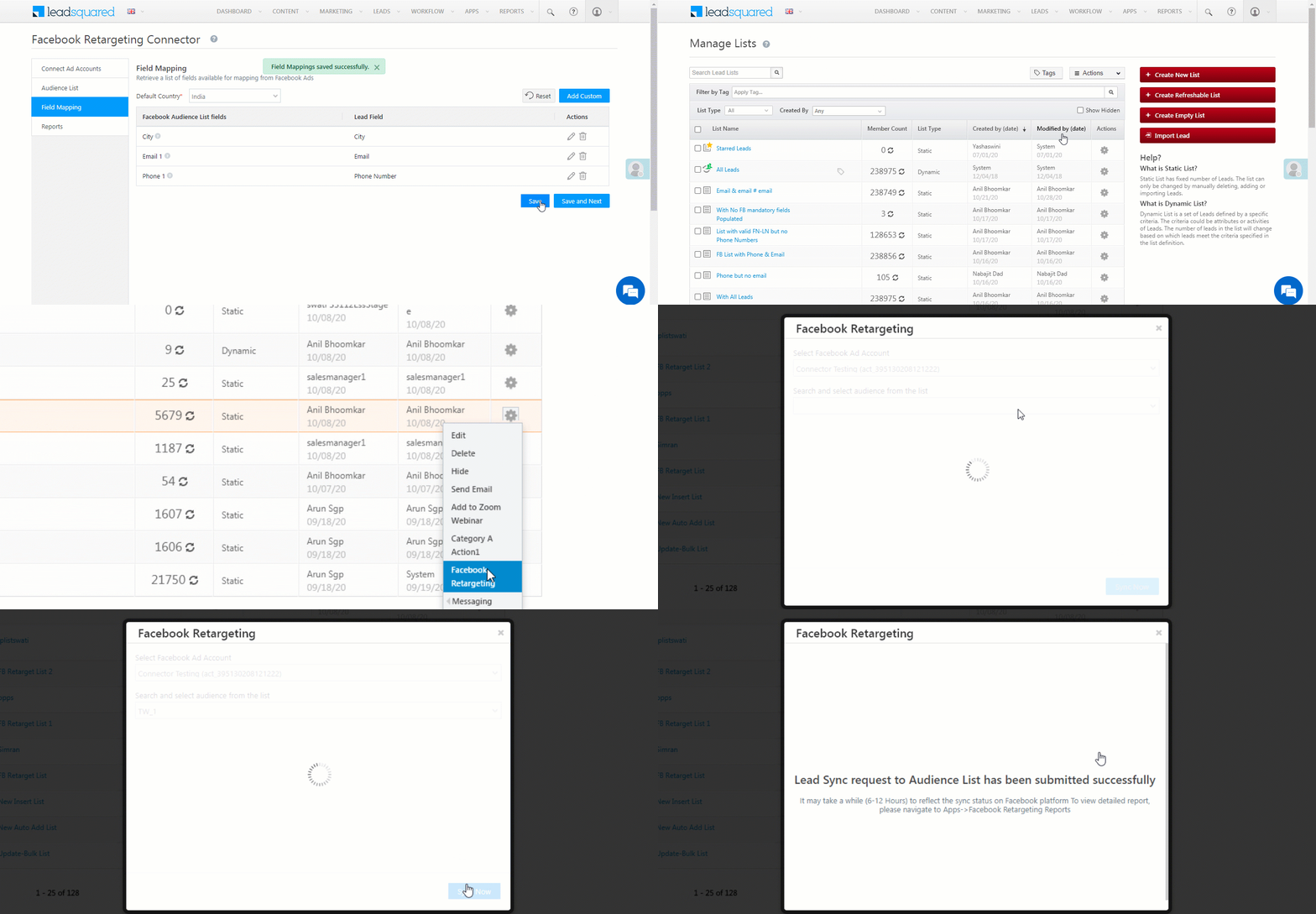
  1. Navigate to Leads>Manage Lists.
  2. Against the list from which you want to pull the lead details, hover your cursor the  icon, and click Facebook Retargeting.
  3. On the Facebook Retargeting pop-up, select the Facebook Ad account, and the Custom Audience List that you created, and then click Sync Now.
  4. On the confirmation pop-up, click Yes. You will receive a message stating your request has been submitted successfully.
    • It will take between 6-12 hours for the leads to reflect in your audience list on your Facebook Ads account.

Facebook Retargetting_9

Note: You can push a single LeadSquared list to multiple Facebook lists that you’ve created. But, you can only push a LeadSquared list to a Facebook list only once in a 12-hour cycle.


6.2 Automation

Alternatively, you can push the list from LeadSquared to Facebook Ads, by setting up an automation. An example of when you can use the automation feature is when a lead is created after visiting your landing page. Here, you can automatically add the lead to a list, and retarget the lead with the Facebook Ad of the product or service they’ve shown interest in.

You cannot configure the Facebook Retargeting Automation for the following triggers –

  • Activity Create on Activity
  • Activity Update on Activity
  • Task Created on Opportunity
  • Task Completed on Opportunity
  • Task Reminder on Opportunity

To set-up this automation –

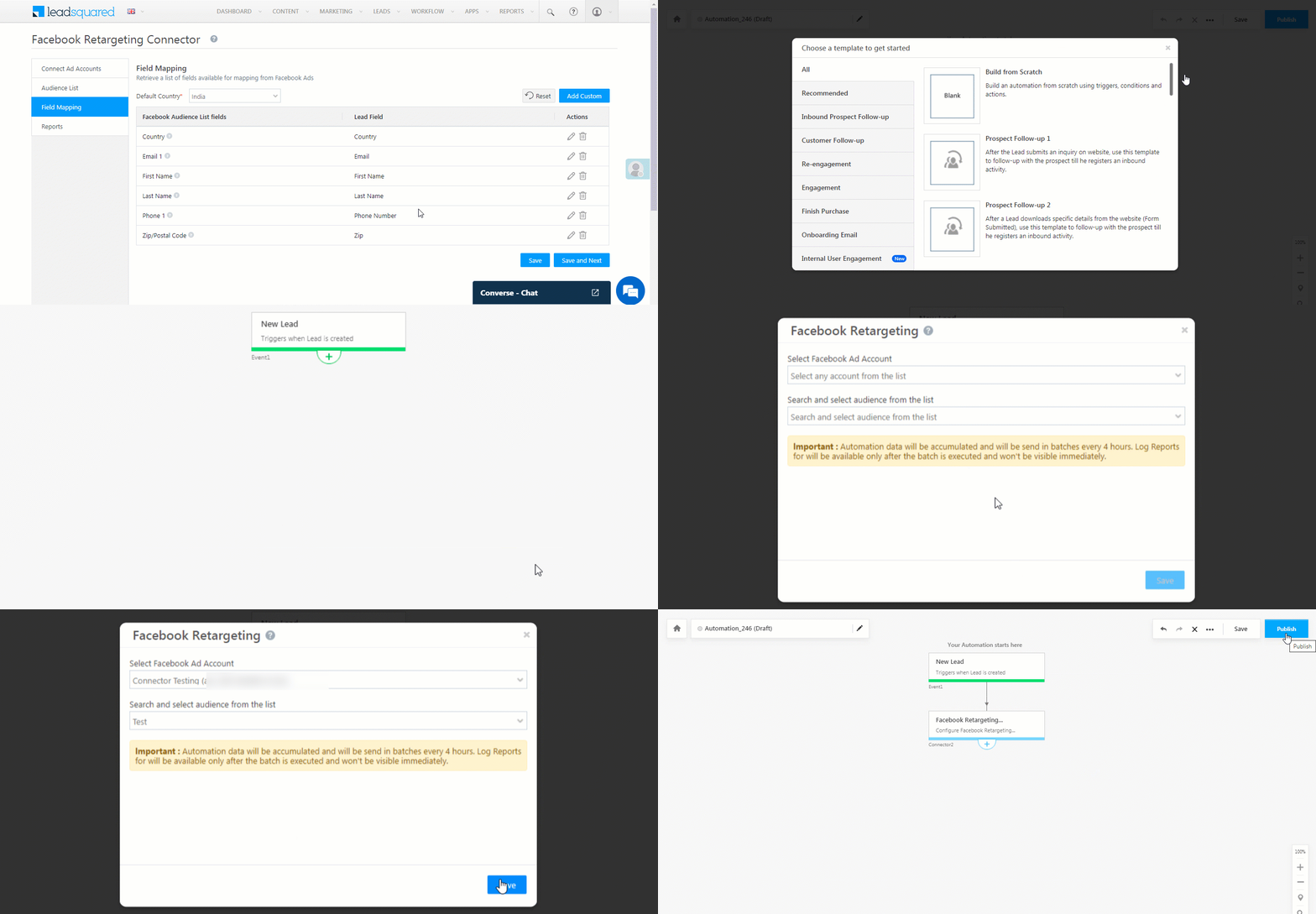
  1. Navigate to Workflow>Automation, and click Create Automation. To know how to create an automation, please refer to Automation Home.
    • You can also Live Edit a published automation.
  2. After you’ve set-up an automation trigger, click Add Automation.
  3. From the dropdown, click Online Ads, and then click Facebook Retargeting Automation.
  4. On the Facebook Retargeting pop-up, from the Select Facebook Ad Account dropdown, select the Facebook Ads account to which you want to push the list.
  5. From the Search and select audience from the list dropdown, select the LeadSquared lead list to which you want to add the leads to.
  6. Once you’re done, click Save. On the Attention pop-up, click Yes.
  7. Then, click Publish. The automation is live.

Facebook Retargeting through LeadSquared

Note: If you have installed the Facebook Retargeting Connector, you must uninstall and reinstall the connector, in order to use the Facebook Retargeting Automation feature.


7. View Reports

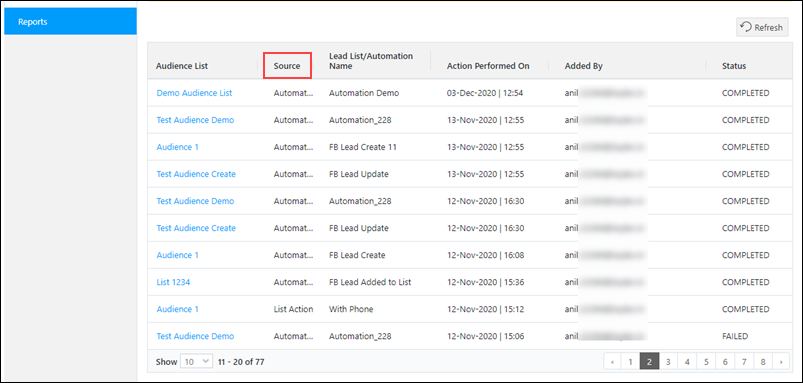
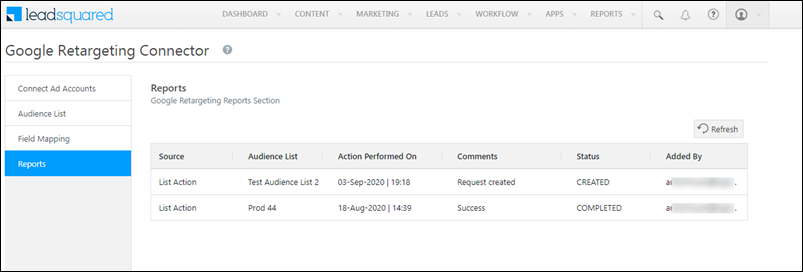
To view the Facebook Retargeting Connector’s reports, navigate to Apps>Facebook Retargeting Connector, and click Reports.

Under Reports, you can view the details of a list that’s been pushed from LeadSquared to your Facebook Ads account. You can also view the source through which the lists were pushed to Facebook Ads, either through Automation or through a List Action.

Facebook Retargeting through LeadSquared


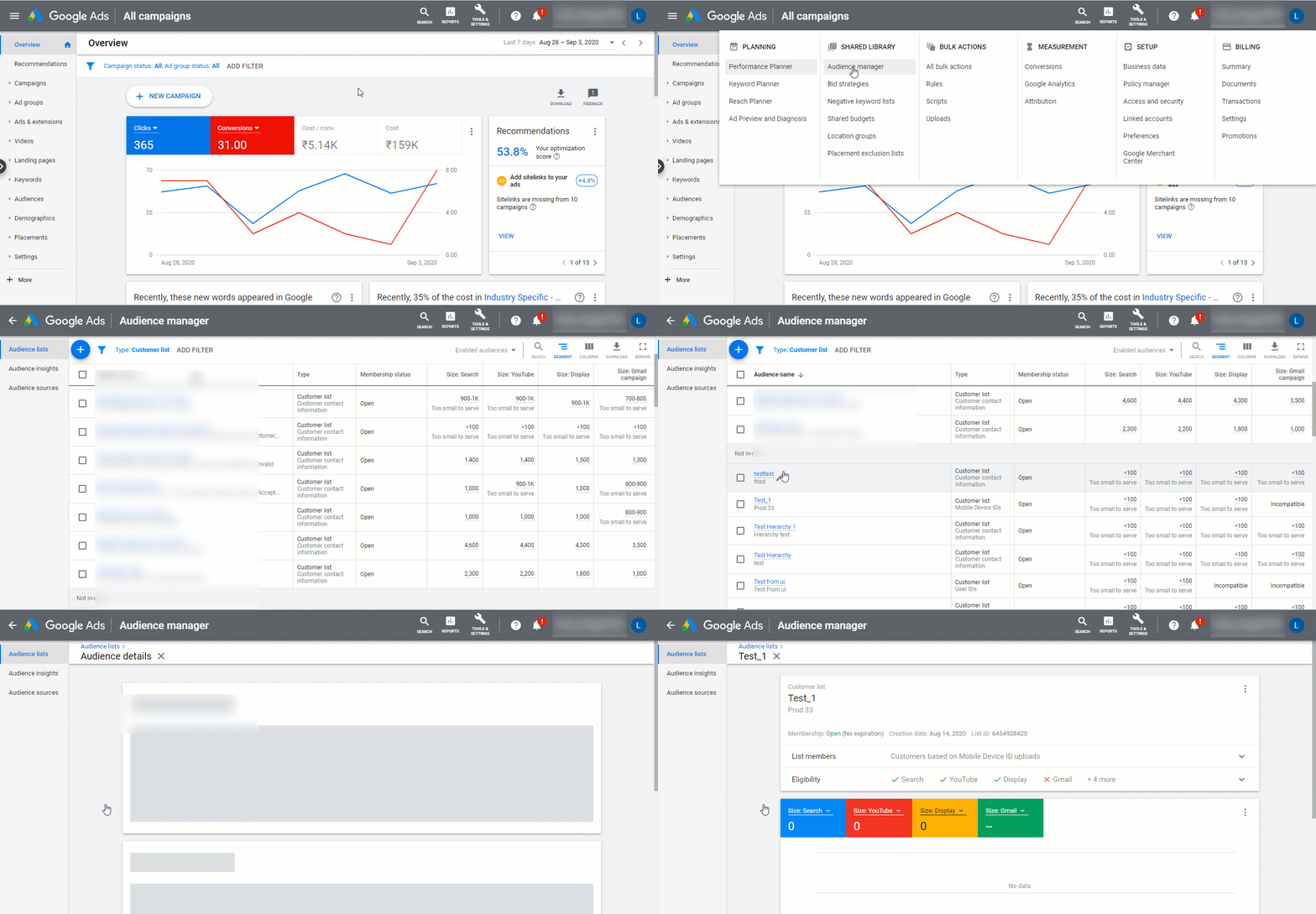
8. View the List on Facebook

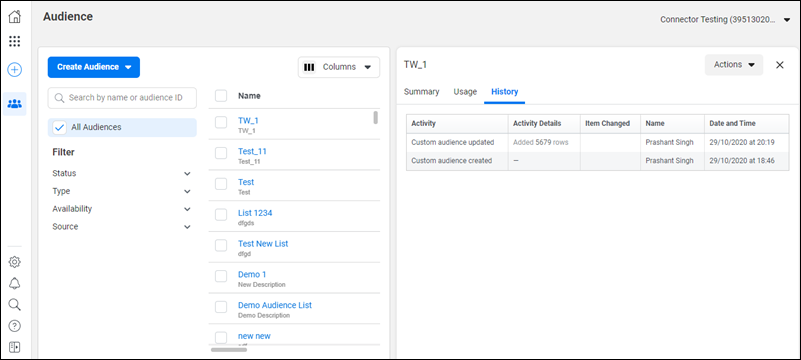
After you’ve successfully created the list, you can view it on your Facebook Ads account. To do this –

  1. Login to your Facebook Business Account.
  2. Select the Facebook Ad account to which you’ve pushed the lead data from LeadSquared.
  3. Here, you can view the list created. To view the list summary and other details, click the list. You can find the Summary, Usage and History tabs here.

Facebook Retargetting_10


9. Possible Errors and Troubleshooting Steps

9.1 User Permissions Error

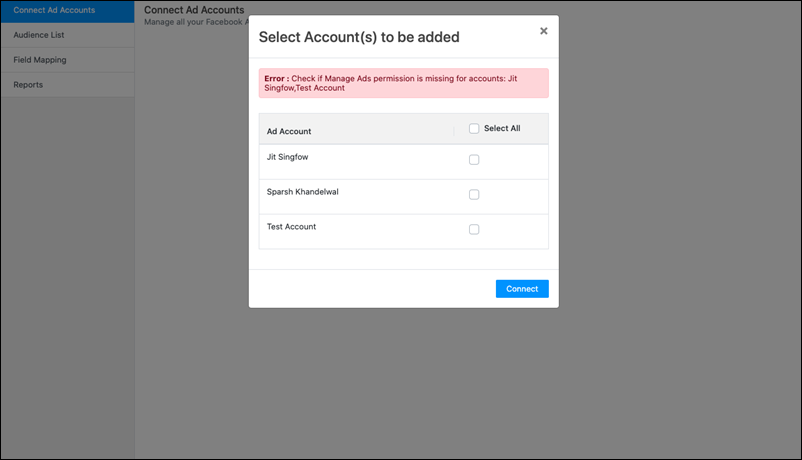
In case you get the following error messages while setting-up your account –

  • “Check if Manage Ads permission is missing for accounts” – This error shows up in LeadSquared while connecting a Facebook Ad account, when “Manage Ads Permission” is disabled for a user on that particular Facebook Ad account.

Facebook Retargetting_12

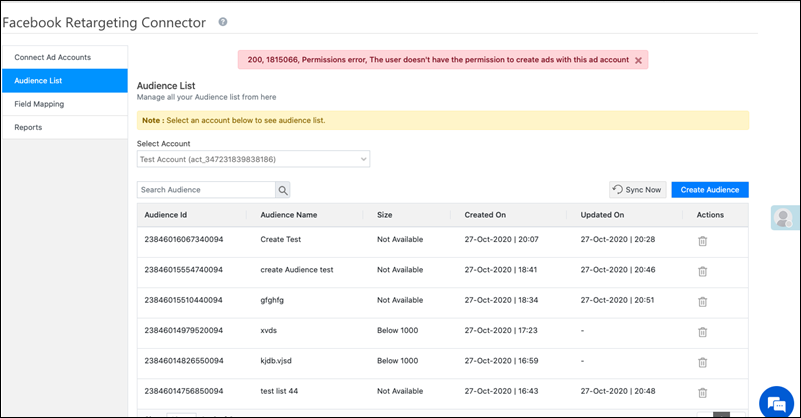
  • “200,1815066, Permission error. The User doesn’t have the permission to create ads with this ad account” – This error shows up in LeadSquared while creating Audiences,  when “Manage Ads Permission” is disabled for a user on that particular Facebook Ad account.

Facebook Retargetting_14

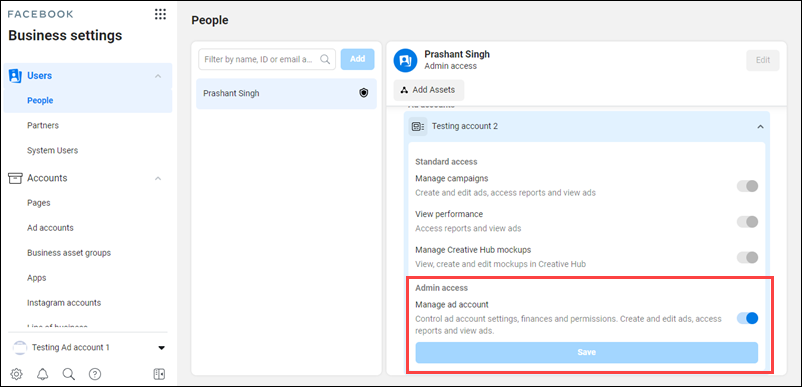
The troubleshooting steps for both the errors are the same –

  1. Login to your Facebook Business Account.
  2. Select the Facebook Ad account on which the error occurred.
  3. Click the Facebook Settings icon to open the Business Settings page.
  4. On the Business Settings page, select the user who faced this error, and click the Ad account listed under the user.
  5. Under Manage ad account, toggle Facebook Slider the slider. Once it’s enabled, click Save.

Facebook Retargetting_1


9.2 Terms of Service Error

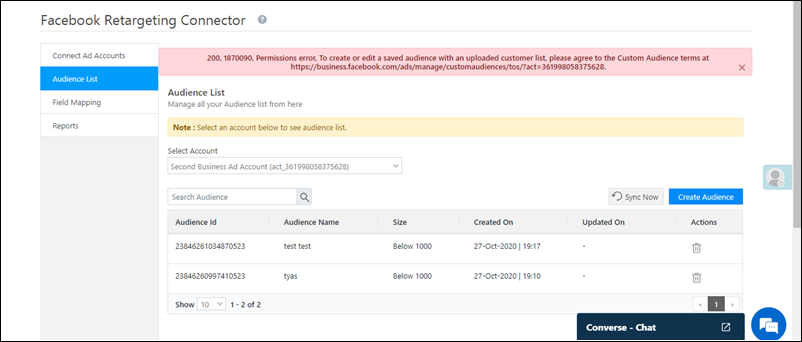
In the instance where a user in LeadSquared has not yet accepted Facebook’s Terms of Service, then the following error comes up, “200, 1870090, Permissions error. To create or edit a saved audience with an uploaded customer list, please agree to the Custom Audience terms”. To resolve this error, you can –

  • Click on the link listed in the error message, and in the new TOS tab, click Accept.
  • Or, accept the TOS in your Facebook Business account, by navigating to Audiences>Create Audience>Custom Audience>Customer list, and click I Accept.

Facebook Retargetting_13


9.3 New Business Error

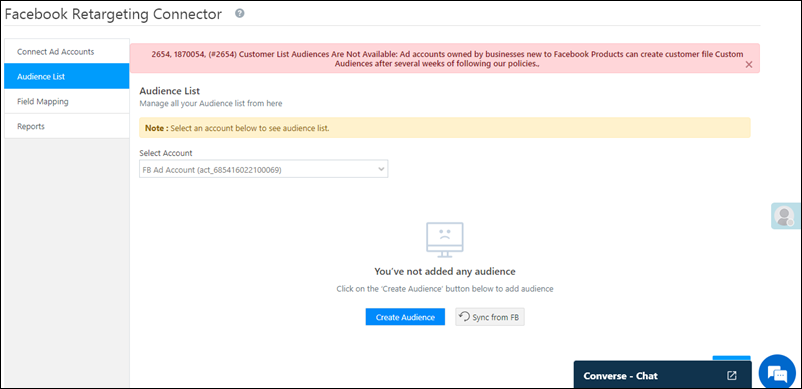
If you’re facing the following error message, “2654, 1870054, (#2654) Customer List Audiences Are Not Available: As accounts owned by businesses new to Facebook Products can create customer file Custom Audiences after several weeks of following our policies.” Once the wait-period is over, the issue is fixed automatically.

Facebook Retargetting_15

Notes:

  • On any of your Facebook Ad accounts, if only Manage Campaign permission is enabled, then your users should still be able to create audience lists and push leads.
  • If the same Facebook Ad account is accessed by multiple users, then the permissions and TOS for that account will get automatically configured on the user who most recently connected to the account.


Any Questions?

Did you find this article helpful? Please let us know any feedback you may have in the comments section below. We’d love to hear from you and help you out!

Lead Automation Conditions – If Lead Exists

1. Feature Overview

Use the ‘If Lead Exists’ condition to check if a lead with a defined set of parameters exists in the system. You can follow up with an action such as Merge Leads, to avoid creating duplicate leads in your account.


2. Set Up If Lead Exists

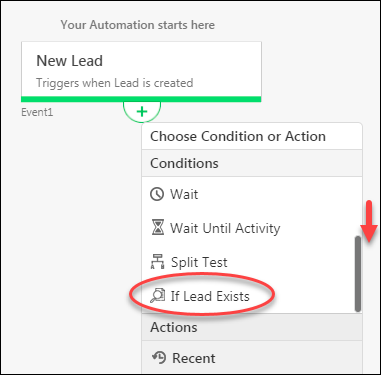
You can set up the condition at any point after the automation trigger. Scroll down under Conditions, then click If Lead Exists.

if lead exists condition

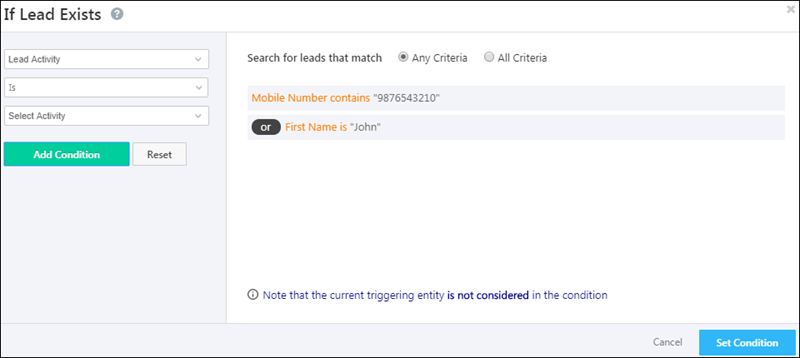
On the configuration pop-up, enter the required conditions, then click Add Condition. When you’re done adding conditions, click Set Condition.

if lead exists conditions

Note:

  • All fields configured in the IfExists card must contain a value; only then will the card be evaluated. If any configured field does not have a value, the card will fail and indicate that the specific condition is missing a value.
  • If multiple leads match your criteria, they will be sorted based on Created On date in ascending format.
  • A link to only the oldest lead will be provided in the lead level automation report.


Next Steps

You can follow up this condition with a Merge Leads action to merge duplicate leads.
For more information on any automation feature, see Automation Home.

How to Set Up Email Signatures in LeadSquared?

To create an email signature for all the email communications you’re sending from LeadSquared –

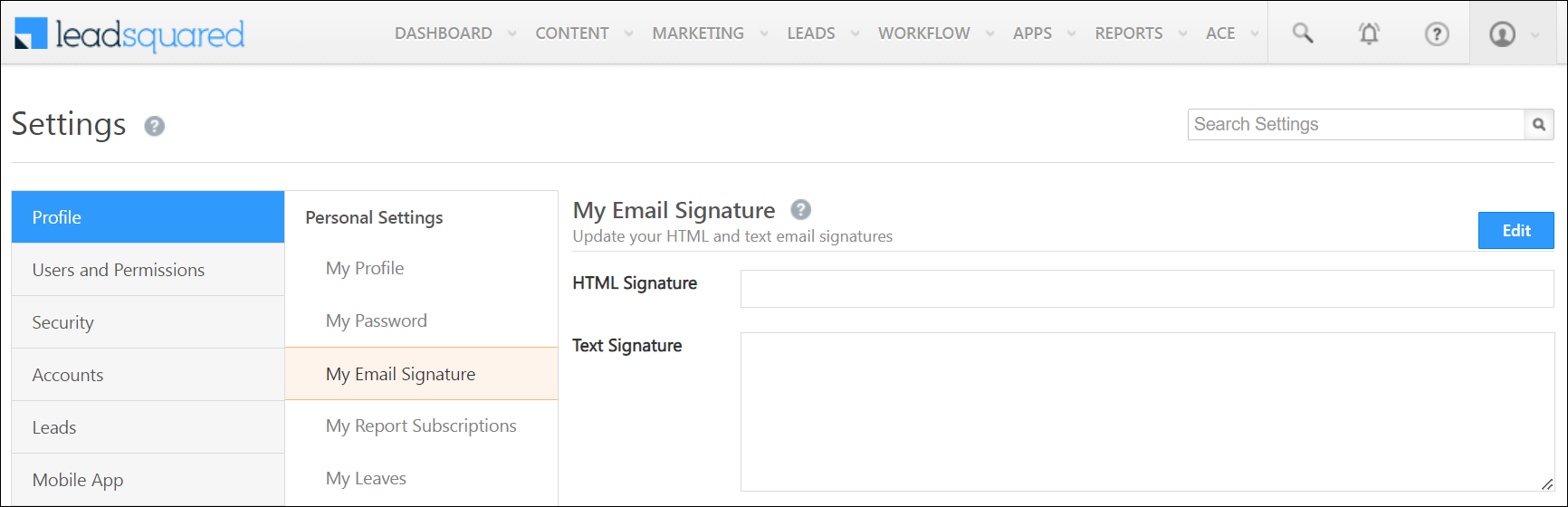
Navigate to Settings>Profile>My Email Signature. You’ll see an HTML signature box and a Text signature box.

In the HTML signature box, you can include an image, attach a file, use different fonts and styles, and even use HTML code. The text signature box allows you to create a plain text signature.

LeadSquared Email Signatures Feature

Add Leads to Zoom Webinars from LeadSquared

1. Feature Overview

In addition to the ability to create Zoom meetings from LeadSquared, the LeadSquared Zoom Meeting Connector also has a webinars feature. This enables you to host webinars, classes and sessions, depending on your business requirements. You can add up to 50,000 participants in a single webinar (depending on your Zoom webinar license), directly from your LeadSquared account.

  • Set-up the webinar and send invites to all the participants from your LeadSquared account.
  • Collect details of all the participants from the webinar.
  • Manage your Zoom webinars through LeadSquared tasks.

For setting up Zoom meetings between your leads and users, please refer to LeadSquared Zoom Connector.


2. Prerequisites

  • You must have an active Zoom account, along with the Zoom Webinar license. To obtain it, please get in touch with your Zoom account manager.
  • Call recording on Zoom is a paid feature. You can record calls through LeadSquared only if this feature is enabled on Zoom. To enable it, please get in touch with your account representative from Zoom.


3. How it Works

The steps that need to be followed while using the Webinars feature are mostly similar to the steps you follow while using the Zoom Meeting feature. Once set up, you can add leads to Zoom webinars directly from your LeadSquared account, either manually or through automation.

  1. Install the connector – You’ll have to begin by first installing the Zoom Meetings Connector on your account.
  2. Configure the connector on Zoom and LeadSquared – Post installation, you’ll have to integrate the connector with your Zoom account.
  3. Create webinars – From your Zoom account, create webinars for your leads to join.
  4. Add Leads – Once a webinar is created, you can then add leads to that webinar from your LeadSquared account. You can choose to add individual leads, multiple leads and/or leads in a list to a webinar.
  5. View Activities – Once a lead registers and joins a webinar, you’ll be able to view this as an activity, along with details of the webinar, on the Lead Details page.


4. Installation

Install the Zoom Meeting Connector from the LeadSquared App Marketplace.

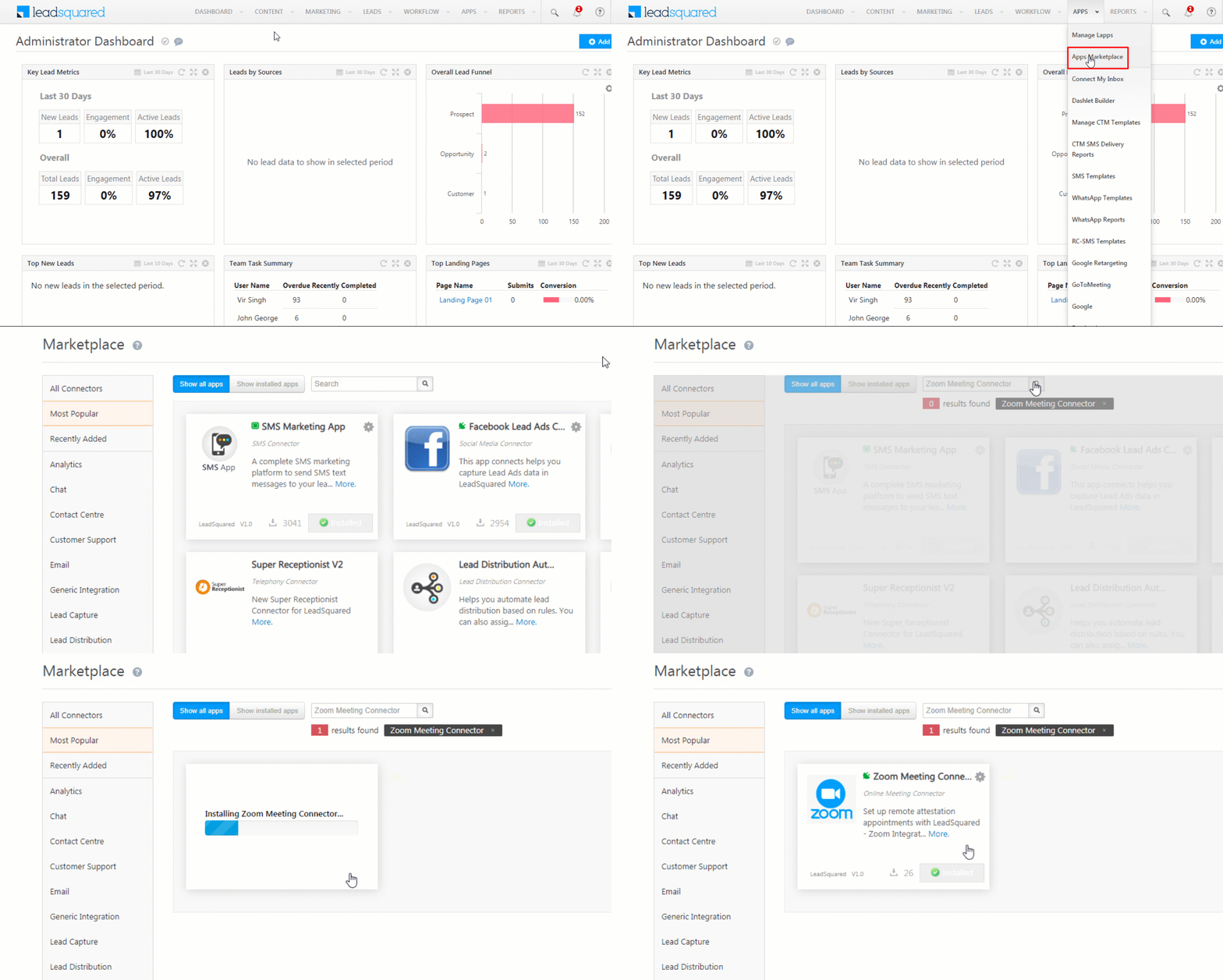
  1. On the main menu, navigate to Apps>Apps Marketplace.
  2. Search for Zoom Meeting Connector.
  3. Click Install.

Zoom_Webinar_1


5. Configuration

To integrate Zoom with LeadSquared, you must obtain the Zoom API Key, API Secret Key and Event Verification Code, and use these keys to enable the Zoom Connector in LeadSquared. To activate the Zoom connector –

  1. Obtain your Zoom API Key and Zoom API Secret Key
  2. Obtain your Zoom Event Subscription Code and Secret Token
  3. Authenticate your Zoom Connector in LeadSquared
  4. Set Up the Zoom Connector in LeadSquared
  5. Map Fields in the Zoom Connector in LeadSquared
  6. Configure Default Admin Settings in LeadSquared

5.1 Obtain your Zoom API Key and Zoom API Secret Key

You can skip this section if you have already configured your Zoom account and generated the necessary keys. If you haven’t obtained these keys, you’ll have to build and configure a Zoom JWT app to generate them. To know more, refer to Create a JWT App.

  1. Navigate to the Zoom Apps Marketplace.
  2. Under JWT, click Create.
  3. In the Information tab, fill in all the required fields.
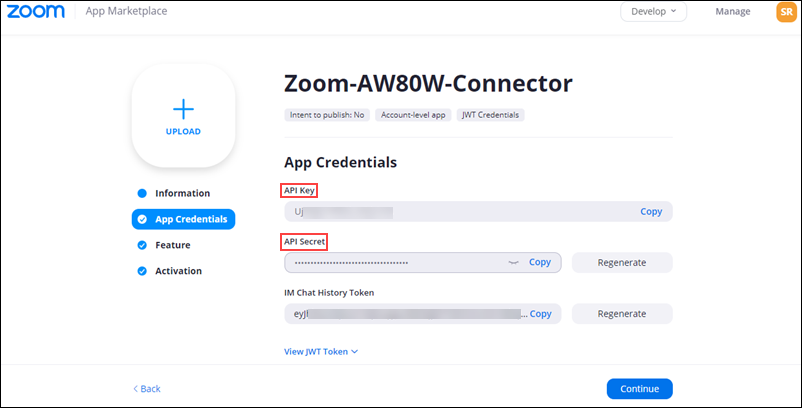
  4. Under the App Credentials tab, you’ll find the API Key and API Secret.
  5. Under the Feature tab, you’ll find the Secret Token and Verification Token.

Zoom


5.2 Authenticate Zoom Connector in LeadSquared

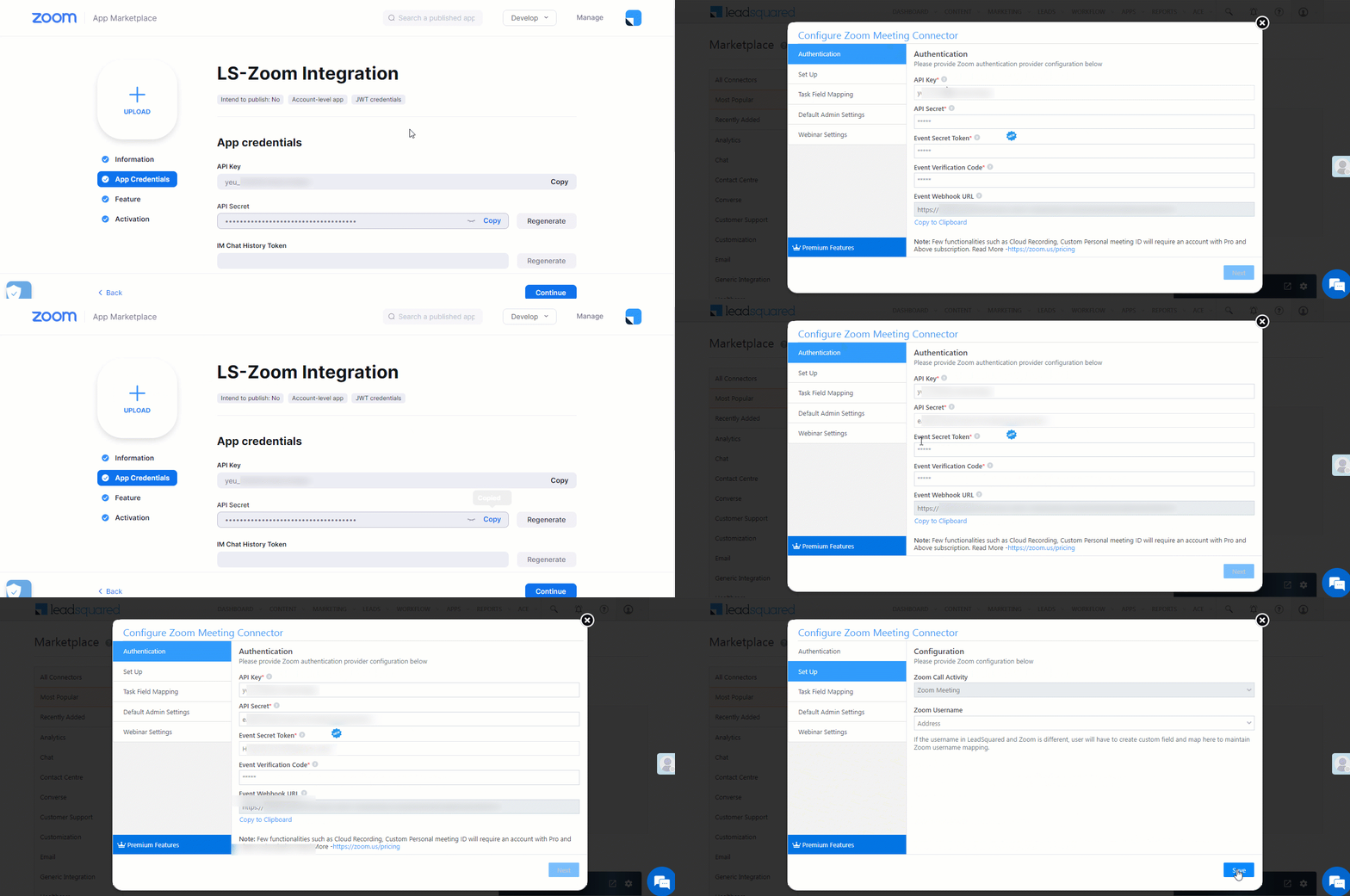
  1. Once you’ve obtained the following keys, copy them and continue the configuration process on LeadSquared –
    • API Key
    • API Secret
    • Secret Token*
    • Verification Token
  2. Under the Authentication tab, enter the above keys alongside the corresponding values.
  3. Once these keys are added, click Next, and continue to Set Up your Zoom Connector.
Note: *You’ll have to add the Secret Token if you’re installing the connector after 23rd October, 2022.

LeadSquared Zoom Connector


5.3 Set Up your Zoom Connector in LeadSquared

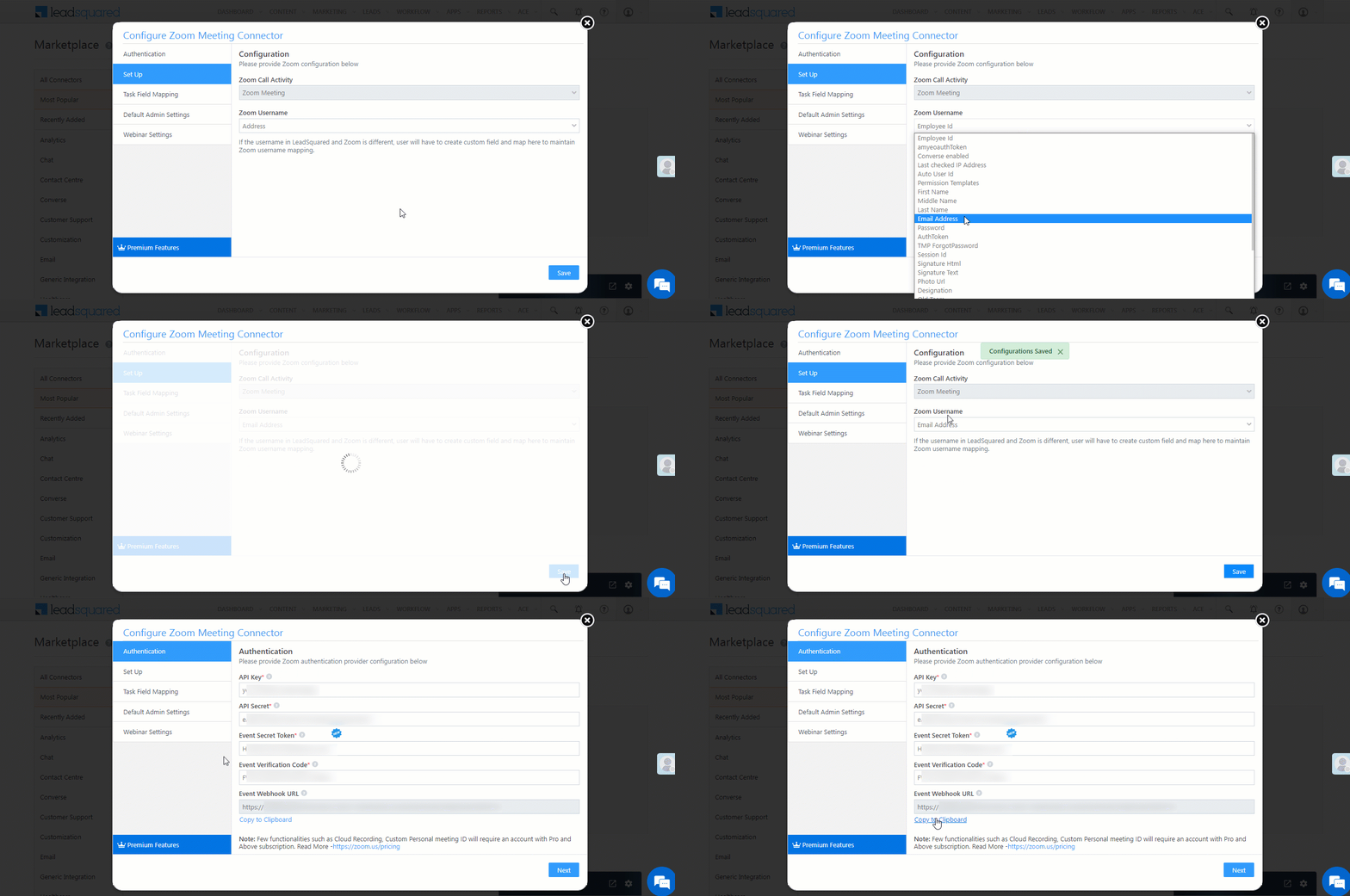
  1. The Zoom Call Activity is set to Zoom Meeting by default. This is a custom activity created by LeadSquared for Zoom calls, and it cannot be edited.
  2. For Zoom Username, if you have used the same email Id in your LeadSquared and Zoom account, you can choose Email Address as your option.
  3. Click Save.
  4. If you’re completing the Set up after 23rd October, 2022, then navigate back to the Authentication tab, and copy the Event Webhook URL.
Note: If the email Id you’ve used in Zoom is different from the one used in your LeadSquared account, you’ll have to create a custom user field and enter the Zoom email Id in that field. To know how to create a custom user field, refer to Manage User Custom Fields.

LeadSquared Zoom Connector


5.4 Generate your Zoom Event Subscription Code

In this step, you must configure the LeadSquared Event Webhook URL in your Zoom JWT app. This ensures Zoom posts data to LeadSquared for the event types you subscribe to. You can find this code under the Feature tab.

Event Subscription are the actions that are automated once an event has taken place. Examples of events are user creation or call recordings that have been completed*. The URL for these events get stored as an Activity on LeadSquared. To enable Event Subscription on Zoom –

  1. From your LeadSquared account, on the LeadSquared Zoom Configuration page, under the Authentication tab, copy the LeadSquared Event Webhook URL.
  2. Navigate to your Zoom account. Under the Feature tab, alongside Event Subscription, toggle the Zoom slider.
  3. Click the Add New Event Subscription button, and give a relevant name for the entry.
  4. On the Zoom Event Subscription page, under Event notification endpoint URL, paste the Event Webhook URL.
    • If you’re adding a new event after the 23rd October, 2022, it is mandatory for you to Validate* the webhook URL. Once the validation is successful, complete the remaining steps.
  5. Under Event Types, click on Add Events. The following events are supported in LeadSquared-
    • Participant/Host joined webinar
    • Participant/Host left webinar
    • Webinar registration has been created
    • Webinar registration has been cancelled
    • Webinar registration has been approved
    • Webinar registration has been denied
  6. Once you’ve selected the Event types, click Done.
  7. Click Save, and then click Continue. Your Event Verification Code is generated. Once you’ve completed the above steps, your Zoom JWT app is active.

Note:

  • *Before you Validate the webhook URL, ensure the connector Set Up is Saved in LeadSquared. The validation will fail if the set up is not saved.
  • If an event was created before 23rd October, 2022, and if you’re looking to edit the event after the said date, it’s recommended you create a new event, and delete the existing event (instead of editing it). Editing this event may result in you not receiving Zoom meeting updates.

Zoom Connector


5.5 Map Fields in your Zoom Connector in LeadSquared

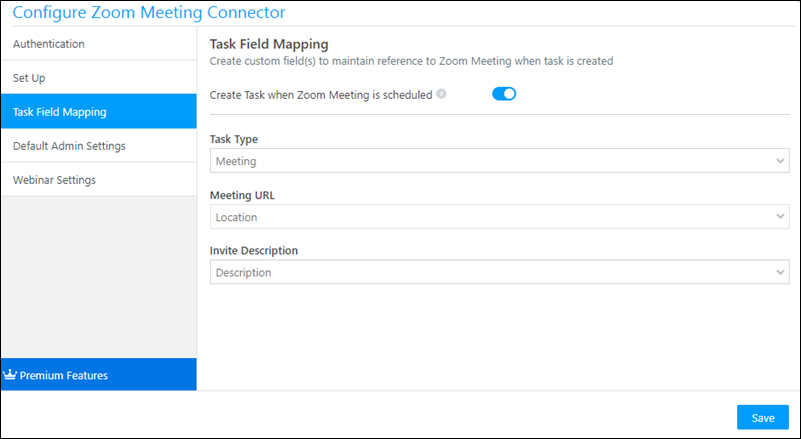
You can automate task creations in LeadSquared for every Zoom meeting you schedule. In this section, you can map the meeting details to the corresponding task fields in LeadSquared. Once this is done, you can view these tasks and details on the Lead Details and Manage Tasks page, and track them to completion.

  1. Ensure the Zoom slider at the top of the page is active.
  2. Under Task Type, select the desired task type (we recommend Meeting). This ensures that when you schedule a Zoom meeting, a Meeting task type is created in LeadSquared.
  3. Under Meeting URL, select Location. Every time you schedule a meeting, your meeting URL gets published directly to LeadSquared.
  4. Under Invite Description, select Description. This ensures your meeting description gets published to LeadSquared.
  5. Click Next.

Zoom_Webinar_6


5.6 Configure Default Admin Settings in LeadSquared

These are additional settings that are available to you.

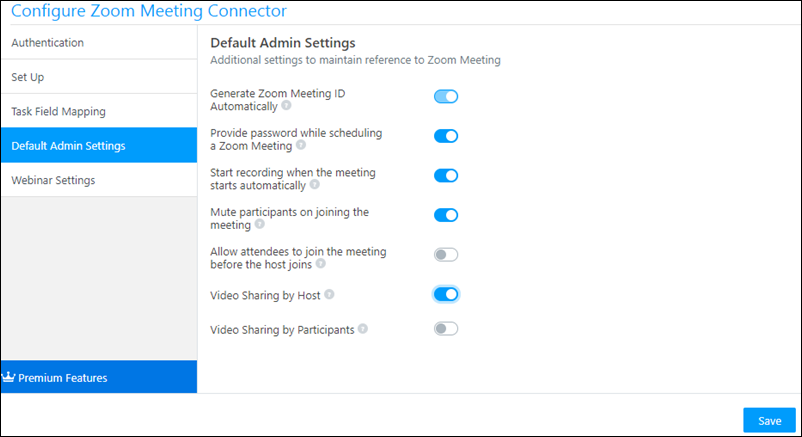
  1. “Generate Zoom Meeting ID Automatically” is enabled by default, and you can’t disable it.
  2. Enable “Start recording…” to ensure that all your calls get recorded. The other options can be turned on or off, depending on your requirement.
  3. Once you’re done, click Save.
  4. You’ll get a “Configurations Saved” notification on top of your screen.

Zoom_Webinar_7


5.7 Webinar Settings

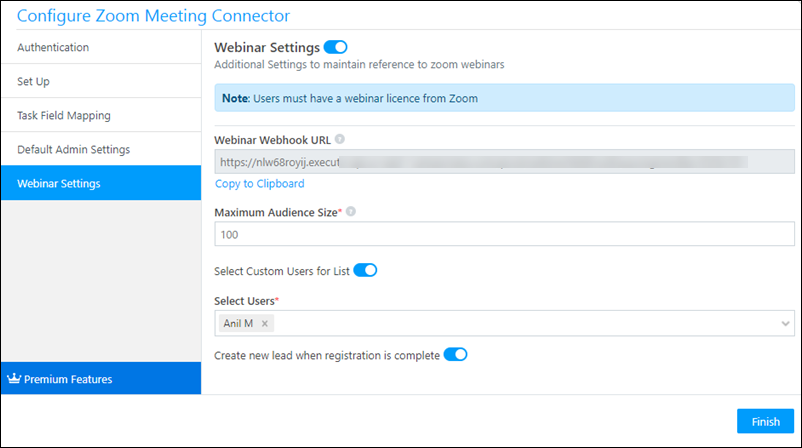
You must have a webinar licence from Zoom to enable these settings on your account. To enable it, toggle the Slider slider.

  • Webinar Webhook URL – The LeadSquared webinar webhook URL that you must enter on the Zoom Event Subscription page.
  • Maximum Audience Size – The maximum number of participants in a webinar. The limit is determined by your Zoom webinar license subscription plan.
  • Select Custom Users for List – You can restrict the number of LeadSquared users who can access the webinar feature. To do this, toggle the Slider slider, and from the Select Users dropdown list, select the users for whom you want to restrict access to.
  • Create new lead when registration is complete – To create a new lead in LeadSquared when a participant registers for the webinar, toggle the slider. When leads are captured from your Zoom Webinar registrations, we’ll capture leads with the following webinar registration fields
LeadSquared Lead Field Schema Name Zoom Webinar Registration Field Name
FirstName first_name
LastName last_name
EmailAddress email
mx_City city
mx_Street1 address
mx_Country country
mx_Zip zip
mx_State state
Phone phone
Note: The Webinar Registration form fields will be captured against lead fields only if the schema names in your LeadSquared account are exactly as listed above. If you’ve made any changes to the schema name, or if a schema field is disabled on your account, the data capture won’t work as intended.

LeadSquared Zoom Integration

Once you’re done, click Finish. You’ll get a “Configurations Saved” notification on top of your screen.


6. Create Webinars

You can only create a Zoom Webinar from your Zoom account. To know how to create a webinar, please refer to Getting started with Zoom webinar. Once a webinar is created in your Zoom account (that’s linked to your LeadSquared account) you can add leads to that webinar directly from LeadSquared.


7. Add Leads to a Webinar

7.1 Individual Leads

To add an individual lead to your Zoom webinar –

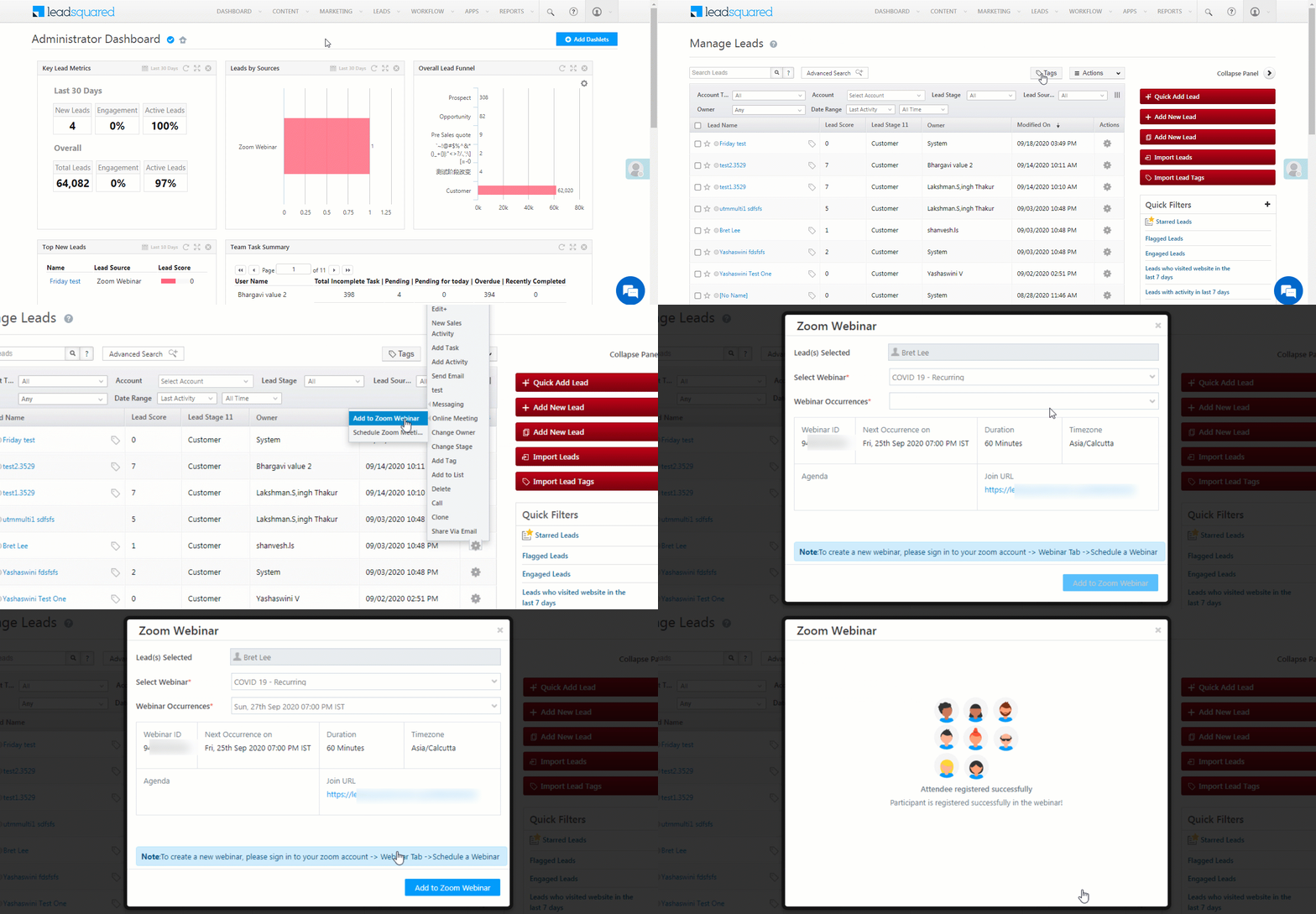
  1. From the LeadSquared main menu, navigate to Leads>Manage Leads.
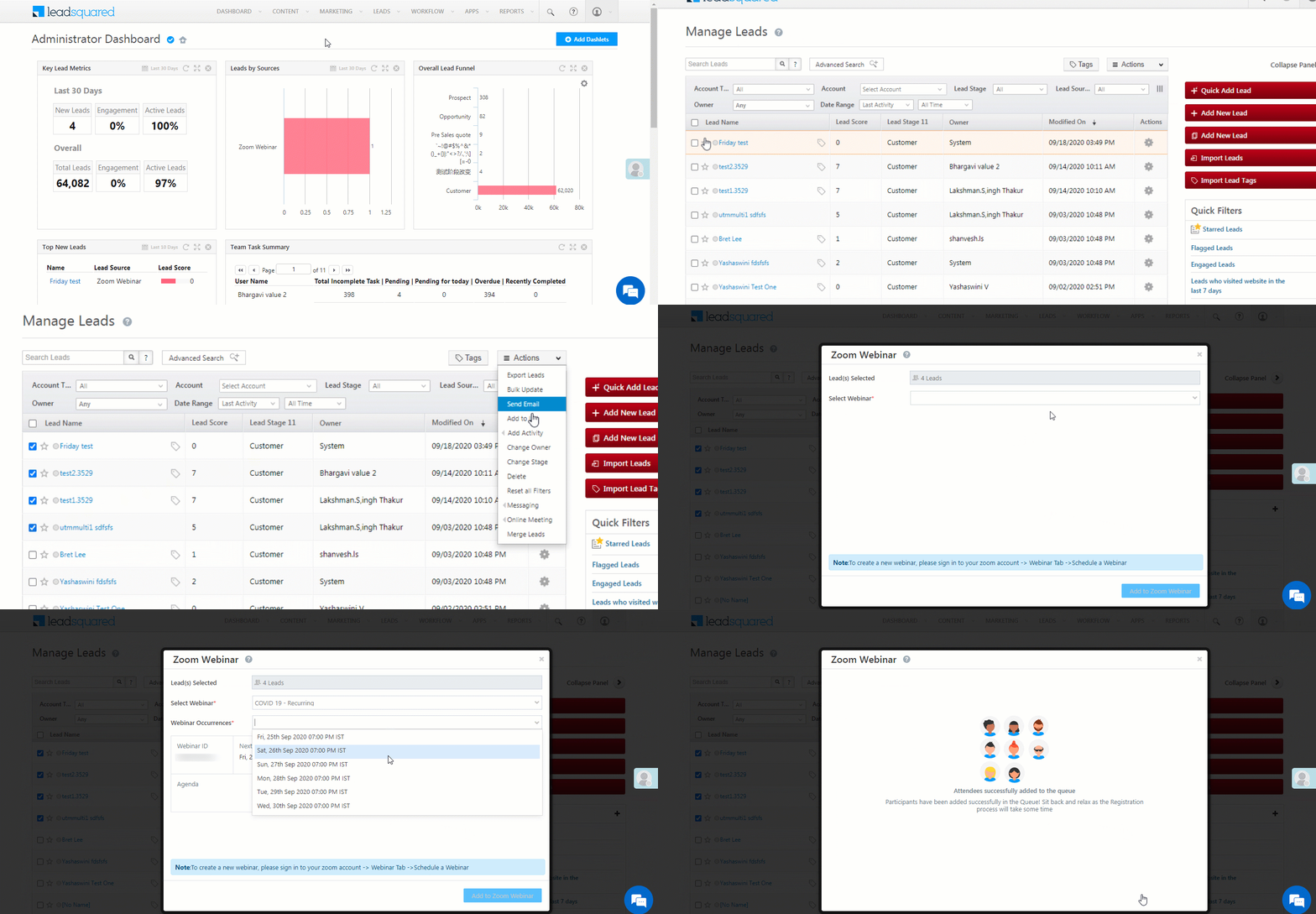
  2. On the Manage Leads page, against a lead, hover your cursor over the Action Icon icon. From the dropdown list, click Online Meeting, and then click Add to Zoom Webinar.
  3. On the Zoom Webinar pop-up, from the Select Webinar dropdown, select the webinar you want to add the lead to.
  4. From the Webinar Occurrences dropdown, select the date and time on which you want to schedule the webinar. This field is available only for recurring webinars.
  5. You’ll find other details of the webinar, such as webinar URL, ID, timezone, etc.
  6. Once you’re done, click Add to Zoom Webinar. Your lead will get an invite for the webinar.

Zoom_Webinar_10


7.2 Multiple Leads

To add multiple leads to your Zoom webinar –

  1. From the LeadSquared main menu, navigate to Leads>Manage Leads.
  2. On the Manage Leads page, select the leads you want to add to the webinar by checking the Checkbox box against their names.
  3. After selecting the leads, hover your cursor over the Leads button.
  4. From the dropdown list, click Online Meeting, and then click Add to Zoom Webinar.
  5. On the Zoom Webinar pop-up, from the Select Webinar dropdown, select the webinar you want to add the leads to.
  6. From the Webinar Occurrences dropdown, select the date and time on which you want to schedule the webinar. This field is available only for recurring webinars.
  7. You’ll find other details of the webinar, such as webinar URL, ID, timezone, etc.
  8. Once you’re done, click Add to Zoom Webinar. Your leads will get an invite for the webinar.

Zoom_Webinar_11


7.3 Leads in a List

To add leads in a list to your Zoom webinar –

  1. From the LeadSquared main menu, navigate to Leads>Manage Lists.
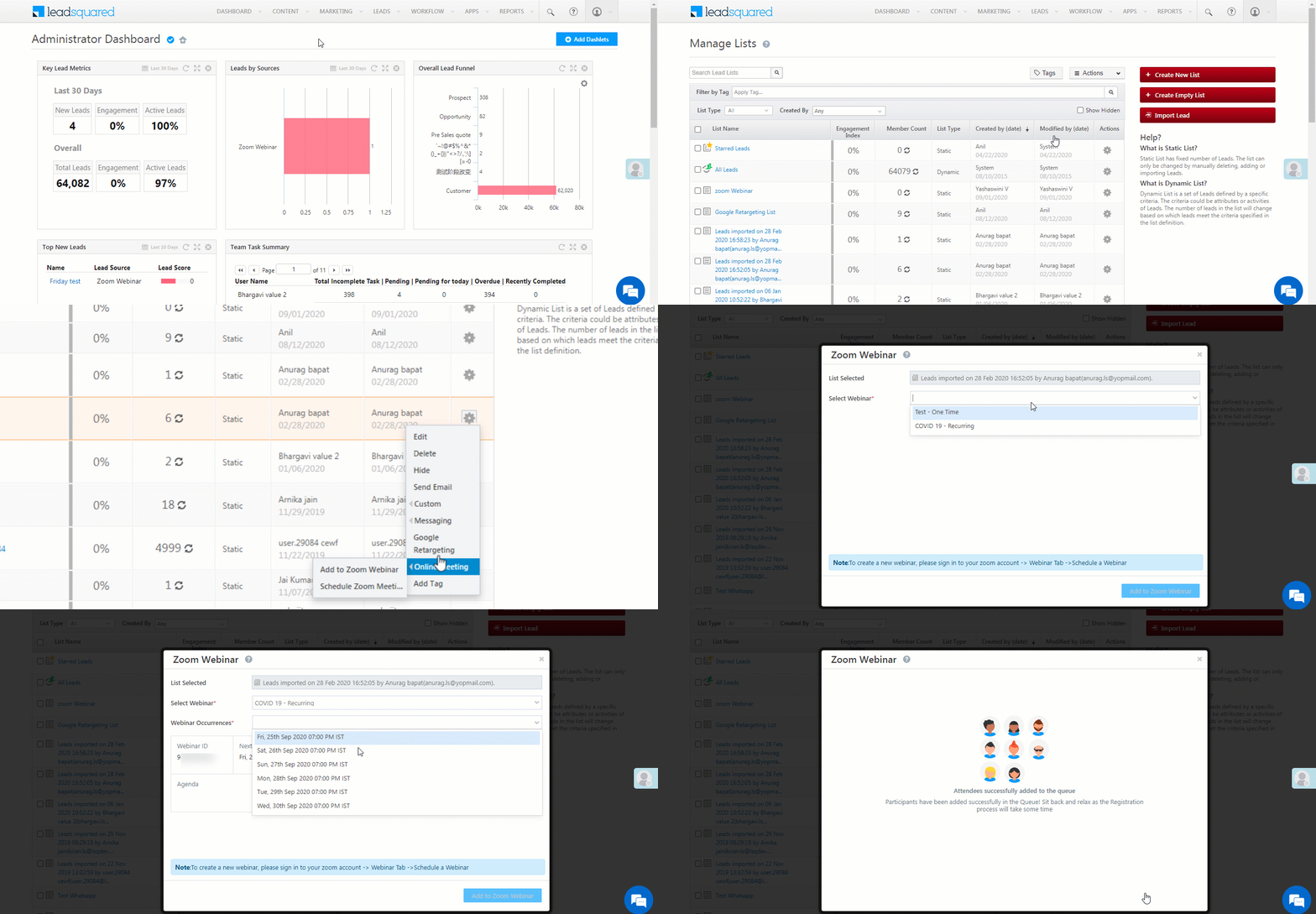
  2. On the Manage Lists page, against an existing list, hover your cursor over the Action Icon icon. From the dropdown list, click Online Meeting, and then click Add to Zoom Webinar.
  3. On the Zoom Webinar pop-up, from the Select Webinar dropdown, select the webinar to which you want to add the leads in the list.
  4. From the Webinar Occurrences dropdown, select the date and time on which you want to schedule the webinar. This field is available only for recurring webinars.
  5. You’ll find other details of the webinar, such as webinar URL, ID, timezone, etc.
  6. Once you’re done, click Add to Zoom Webinar. The leads in your list will get an invite for the webinar.
Note: The number of leads in the list will have to be within the range of the Maximum Audience Size limit, which you entered while configuring the connector.

Zoom_Webinar_12

Note: Once a lead is registered for a webinar, an invite will be sent to the lead via Zoom, if your configuration on Zoom is enabled accordingly. If this isn’t configured, then you can create an automation, based on an activity trigger, to send an invite email to the lead. To know more, refer to the Sending Invites to Leads through Automation section in the Zoom Meeting Connector article.


8. Webinar Activities

Activities are posted –

  • When a lead registers for a webinar.
  • When a lead joins/leaves a webinar.

You can filter leads based on these activities (for example, leads that attended a webinar, leads that left a webinar, etc.) and set up tasks, follow-ups and automations based on your business flow.

To view these activities, on the Lead Details page –

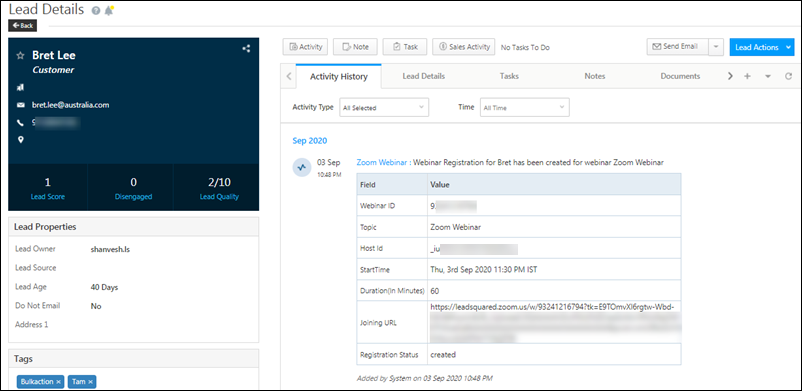
  1. From the main menu, navigate to Leads>Manage Leads, and click on the lead who’s been added to the Zoom webinar.
  2. On the Lead Details page, under Activity History, you’ll see  Zoom Webinar activities.
  3. Once you click on Zoom Webinar, you’ll be able to view the webinar details such as Webinar ID, Joining URL, etc.
Webinar_12


9. Zoom Webinar Automations

Through automations, you will be able to add leads directly to webinars. To know more about automations, please refer to Automation Home. Some examples of where you can automatically add leads to Zoom webinars are –
  • Automatically register leads to recurring webinars (such as daily online classes, training sessions, offline interest, etc.), based on certain triggers or activities on leads (such as form submission, stage change, etc.).
  • Register leads to webinars (both recurring and non-recurring ones) on form submissions from LeadSquared landing pages and portals.
To add leads to webinars –
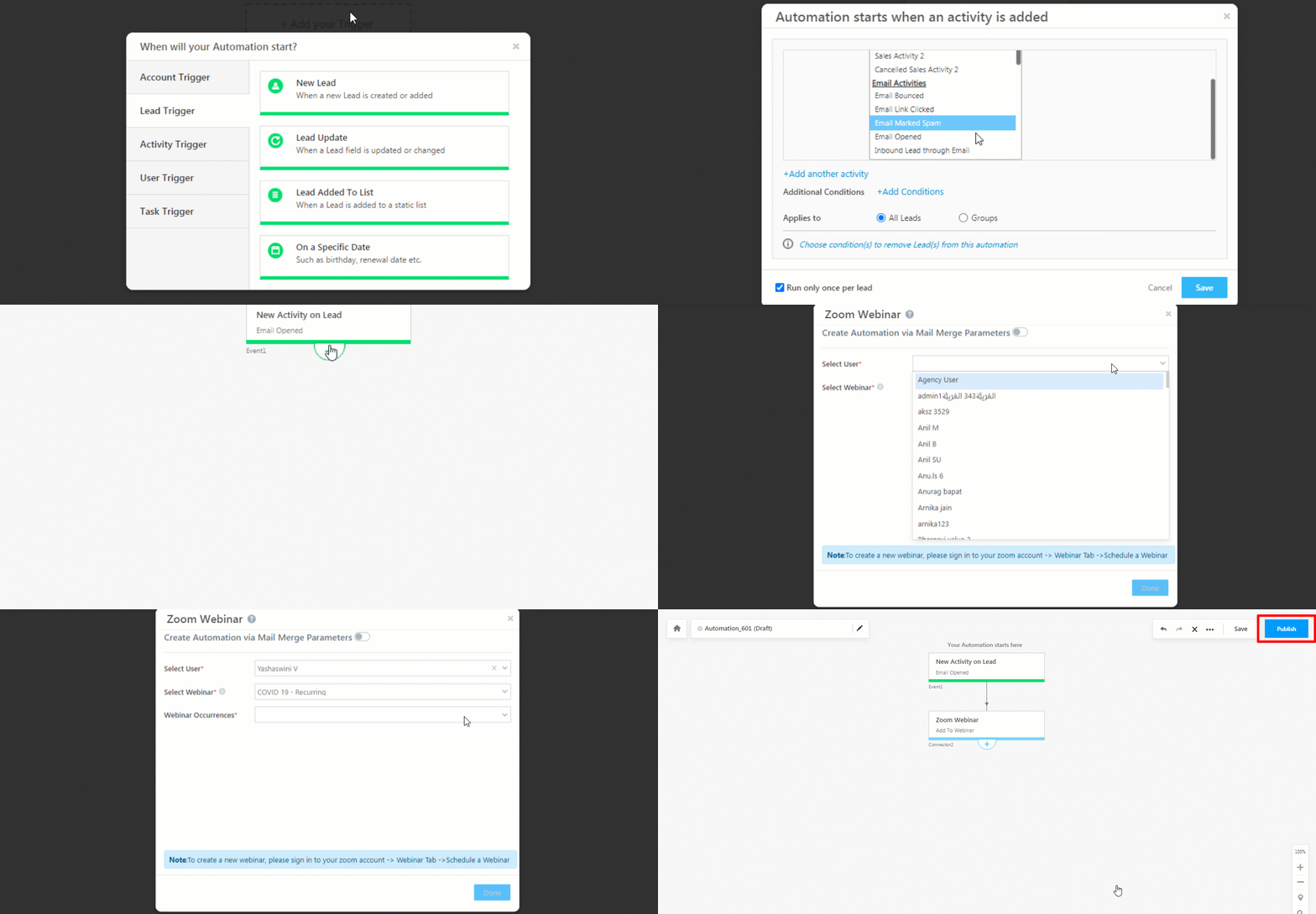
  1. From the main menu, navigate to Worklow>Automation.
  2. On the automation page, you can either edit an existing automation, or to create a new automation, click on Create Automation.
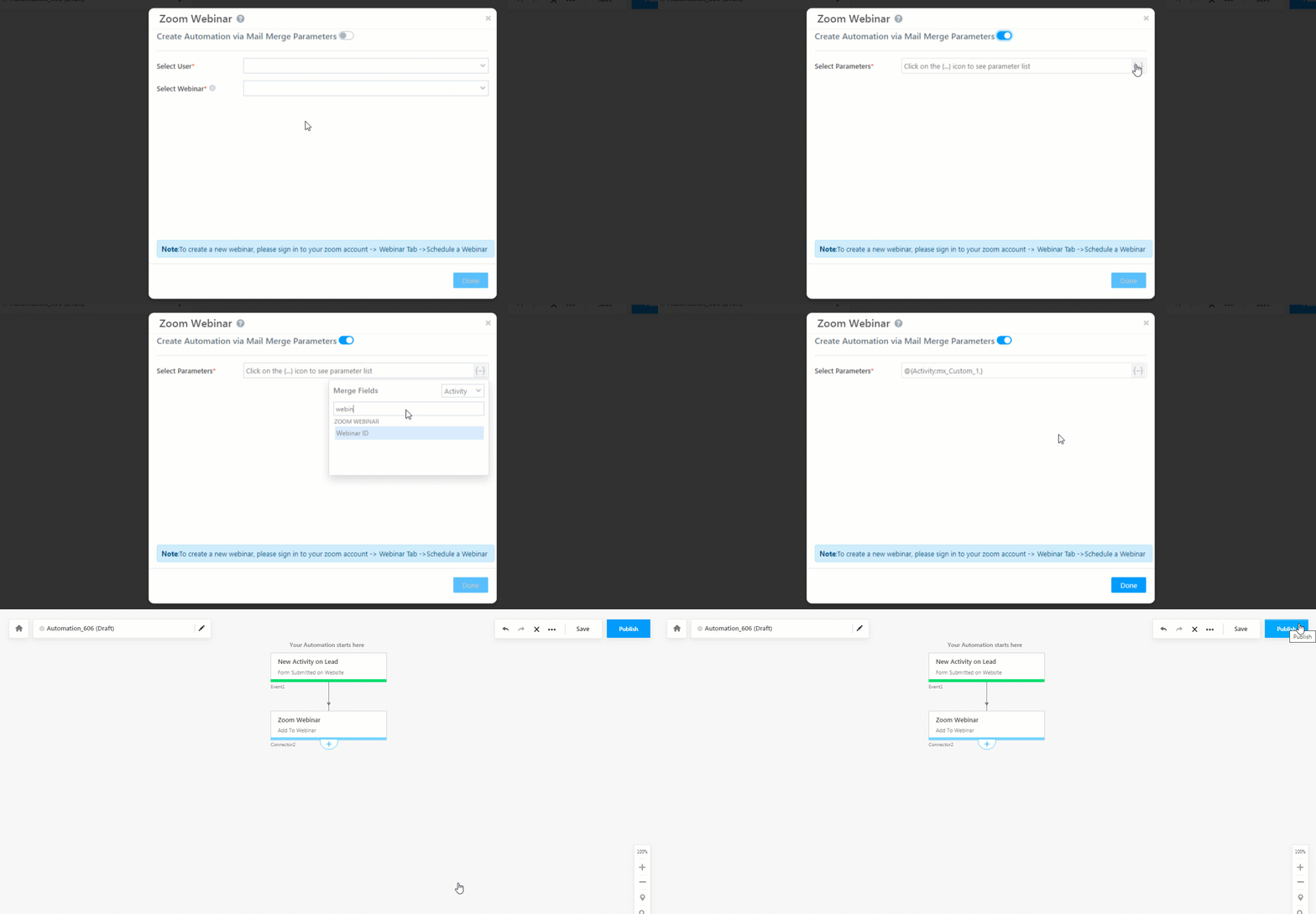
  3. After creating a trigger, click the icon, then click Online Meeting, and then click Zoom Webinar.
  4. On the Zoom Webinar pop-up, from the Select User dropdown, select the user. This will show the list of webinars that user has created.
  5. From the Select Webinar dropdown, select the webinar you want to add the leads to. These are the webinars created by the user you selected in the previous step.
    • If it is a recurring webinar, then select the Webinar Occurrences from the dropdown.
  6. Click Done, and add other actions and/or conditions if required.
  7. Click Publish once you’re done.

Webinar_13

Alternatively, you can choose to use the mail merge parameters in your automation, to directly add leads to a webinar. This is helpful if your leads are signing up for webinars from your online forms (via portals, forms, webinar landing pages, etc.). The mail merge feature will allow you to automatically capture the webinar details (such as Webinar ID, etc.) to the lead or to an activity in your LeadSquared account.

You’ll have to begin by creating a custom field (see How to Create a Custom Lead Field), listed either under an activity or a lead, to map the webinar Id to the lead. You can call this custom field “Webinar ID”, and your webinar Id will be mapped to this field. Once the lead or activity trigger on which you’re creating the automation is satisfied, the lead will get added to the webinar automatically. This will also ensure that the Zoom Webinar activity is posted on the lead.

To create the webinar automation using mail merge parameters –

  1. On the Zoom Webinar pop-up, toggle the Slider slider.
    • For an existing lead who signs up for a webinar from an online form, then the form submission activity will get created inside LeadSquared, along with webinar details selected by the lead. Select the Activity trigger, and then select the “Webinar ID” parameter.
      As an example, let us look at a recurring online class that’s being conducted. A custom activity field called Webinar ID must be created in LeadSquared. Once a student signs up for the webinar, the webinar ID will be mapped to the custom field (in this case, “Webinar ID”) that’s created as an activity field. This will in turn add the student to the online class (and all subsequent classes under the same Webinar ID). The “Zoom Webinar” activity will then get posted on the student’s Lead Details page.
    • If a new lead is created (from a landing page, portal, etc.), and signs-up for a webinar, the webinar details will be part of the lead’s data. In this instance, select the Lead trigger.
      As an example, let us look at a product demo that’s being scheduled online. A custom lead field called Webinar ID must be created in LeadSquared. Once a lead signs up for a demo, the Webinar ID will be mapped to the custom field (in this case, “Webinar ID”) that’s created as a lead field. This will in turn add the lead to the webinar that’s scheduled. The “Zoom Webinar” activity will then get posted on the Lead Details page.
  2. Once you’re done, click Done.
  3. Click Publish.

Webinar_14


Troubleshooting

My Zoom Webinar Automation Card is Failing.

  • Issue: Error in the Zoom Webinar Card of the Automation – “Error in Action Trigger”.
  • Root Cause: This error usually occurs when the Zoom account or Zoom Webinar account is disconnected at the connector level.
  • Resolution: Navigate to the connector settings and reconnect to your Zoom Webinar account.

LeadSquared Zoom Integration


Any Questions?

Did you find this article helpful? Please let us know any feedback you may have in the comments section below. We’d love to hear from you and help you out!

Mavis DB – Portals Integration

1. Feature Overview

Mavis DB enables you to create databases to store master data (for courses, programs, projects, etc.) directly within your LeadSquared account. Integrating Mavis DB with LeadSquared portals makes this data easily accessible to your customers. Doing this lets you pull data from Mavis based on rules and real-time lead inputs to populate portal fields. You can also hide specific portal display cards depending on whether certain Mavis DB conditions are met.

Note: This document does not cover creating a Mavis database or a portal. It only explains how to integrate an existing Mavis DB with portals.


2. Example Use Case

Use Case 1

Let’s look at the example of a school where the fees for each grade vary based on the mode (live classes, live + recorded classes, recorded classes, etc.) and curriculum. The school stores their course data in a Mavis table with columns for monthly tuition, curriculum, grade, etc.

Mavis Portal Integration

On our Portal page, we want to display the monthly tuition for a lead interested in opting for Language as English, Grade as Year 8, and Mode as Live + Recorded.

Use Case 2

We want to display a Payment Status block on the portal to leads whose Language is English and Curriculum is British.

Note: You can set up a variety of rules, both simple and complex, to pull data from your Mavis DB for display in your portal. This article only illustrates a generic use case.

LeadSquared Mavis Portal Integration


2. Prerequisites

  • You must be an admin user.
  • Mavis DB should be enabled on your account. To get this feature, please reach out to your account manager, or write to support@leadsquared.com.
    • Once enabled, create a Mavis table from where data can be displayed.
  • Create a LeadSquared Portal.


3. How it Works

3.1 To Fetch and Display Mavis DB Data in your Portal

  1. First, create a Mavis database to store your data.
    • To create a Mavis database using APIs, see Mavis APIs.
    • To create a Mavis database using the LeadSquared web application UI, please refer to Mavis Database.
  2. Next, create a LeadSquared portal.
  3. Then, set up a rule that fetches data from your Mavis table, and displays it on the portal.
    • This action fetches the specific information (from your Mavis DB) that you want to display to your leads when they meet the configured conditions.
  4. Preview and Publish your Portal.
    • After you’ve added all the necessary rules, preview and publish the Portal.

3.2 To Display or Hide a Portal Block.

  1. Set up a rule that determines which blocks are shown to your leads.
    • This rule must contain a minimum of two conditions, and only if both conditions are met will the block be displayed to your lead. The two conditions we’ll be configuring are leads must have English as their Language and British as their Curriculum.
      • If both these conditions are satisfied, the block will be displayed to the lead.
      • If even one of these conditions is not satisfied, the block will not be displayed to the lead.
    • If even one of the conditions is not satisfied, the block will be hidden from your lead.
  2. Preview and Publish your Portal.
    • After you’ve added all the necessary rules, preview and publish the Portal.


4. Integrate Mavis with Portals

Here, we want to display the monthly tuition for a lead interested in selecting their Language as English, Grade as Year 8, and Mode as Live + Recorded.

Note: Before setting up the rule, ensure the Requires Login setting is enabled for the portal page you’re integrating with Mavis. This is mandatory, and without it, the integration will fail.
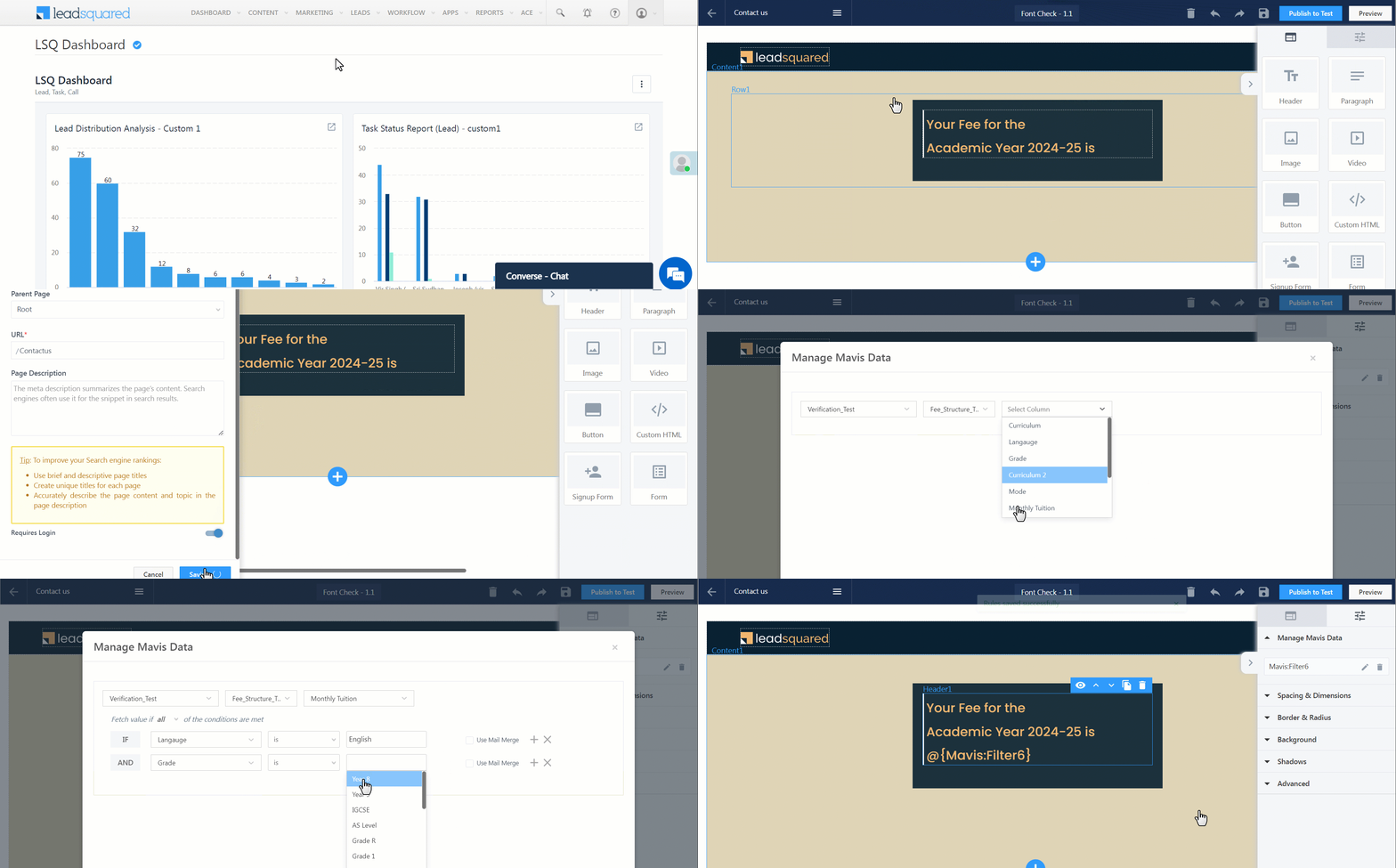
  1. On the Portals Designer screen, navigate to the page you want to integrate with your Mavis table.
  2. On the page, inside a textbox or form field, enter the ‘@’ symbol, and select Fetch Mavis Data.
  3. On the Manage Mavis Data pop-up, select the Database, Table, and Column from which you want to display the data. We want to display the data present in the Monthly Tuition column.
  4. Next, add the conditions that need to be satisfied for the data to be fetched from the Mavis table. We’re adding Language is English AND Grade is Year 8 AND Mode is Live + Recorded*.
    • We’ve configured the conditions to fetch the value if all the conditions are met. You can also configure it to fetch the value if any of the conditions are met.
    • You can also use the Mail Merge option to fetch data from lead fields. If the mail merged data satisfies the conditions, the value will be fetched from the Mavis column.
  5. Once you’re done, click Save.

Preview the portal, and click Publish. When a lead visits this page, and if they satisfy the configured conditions, the value will be fetched from the Mavis column and displayed to the lead.

Note: *You can add up to 10 filter conditions.

Mavis Portal Integration


5. Show or Hide Portal Blocks Using Mavis Data

Hide or display various blocks in your portal based on the values fetched from your Mavis table. This is useful when you want to show specific blocks only to leads that meet certain conditions.

Note: 

  • Before setting up the rule, ensure the Requires Login setting is enabled for the portal page you’re integrating with Mavis. This is mandatory, and without it, the integration will fail.
  • You can hide or display blocks only if activities are associated with the blocks you want to control. To know more, refer to Link Activities with Portal Blocks. This is mandatory, and without it, the integration won’t work.

Here, we want to show the “British Students Payment Status” portal block, for all leads who select English as their Language and British as their Curriculum.

  1. On the Portals Designer screen, navigate to the block you want to hide or display.
  2. Click the outer border of the Element, and from the Components panel, click Display Rules.
  3. On the Dashboard Item Display Rules pop-up, select whether you want to display the block if Any or All of the conditions you configure are satisfied.
  4. Next, on the first dropdown, select Mavis Data.
  5. Select the database, table, and column you want to display on the block. We’re selecting the Language.
  6. Next, add the filter condition that needs to be satisfied to display the block. We’re selecting Curriculum is British.
  7. Then, from the dropdown below IF, select the relevant function, and the corresponding value. We’re selecting is English.
    • The logic here is that if the Language is English and the Curriculum is British, the block will be displayed to the lead.
    • If a lead visits this portal block and their Language is English with a South African Curriculum, or Afrikaans with a British Curriculum, the block will NOT be displayed.
    • If required, you can add multiple similar conditions.
  8. Once you’re done, click Save.

Preview the portal, and click Publish. When a lead visits this page, and if they satisfy the configured conditions, this block will be displayed to them. If they don’t satisfy the configured conditions, this block will be hidden from them.

Note: When configuring conditions, you can also use the Mail Merge option to fetch data from lead fields. If the mail merged data satisfies the conditions, the block will be displayed to that lead.

Mavis Portal Integration


Any Questions?

Did you find this article helpful? Please let us know any feedback you may have in the comments section below. We’d love to hear from you and help you out!

LeadSquared Converse in Mobile App

1. Feature Overview

LeadSquared Converse is a multi-channel engagement platform that enables you to have real-time conversations with leads. If you’ve enabled Converse in your web application, it will be available on the mobile app (on both Android and iOS devices) by default.

Converse currently supports the following channels –

  • SMS (currently available only in the United States)
  • WhatsApp

Using Converse, you’ll be able to –

  • Send and receive images, videos, GIFs, etc.
  • View conversations in the context of a lead.
  • Eliminate the need to switch between multiple applications to converse with your leads.
  • Get real-time notifications for messages sent by leads.
  • Send content-rich messages, with multi-language and emoji support.


2. Prerequisites

  1. You must have LeadSquared Converse enabled in your account. To enable it, please write to support@leadsquared.com.
  2. Once Converse is enabled in your web app, to configure it, follow the steps mentioned in LeadSquared Converse.


3. Add Converse in Mobile App

If you’ve enabled Converse on the web app, it’ll be available on the mobile app as well. To add Converse on the bottom navigation bar or the side menu –

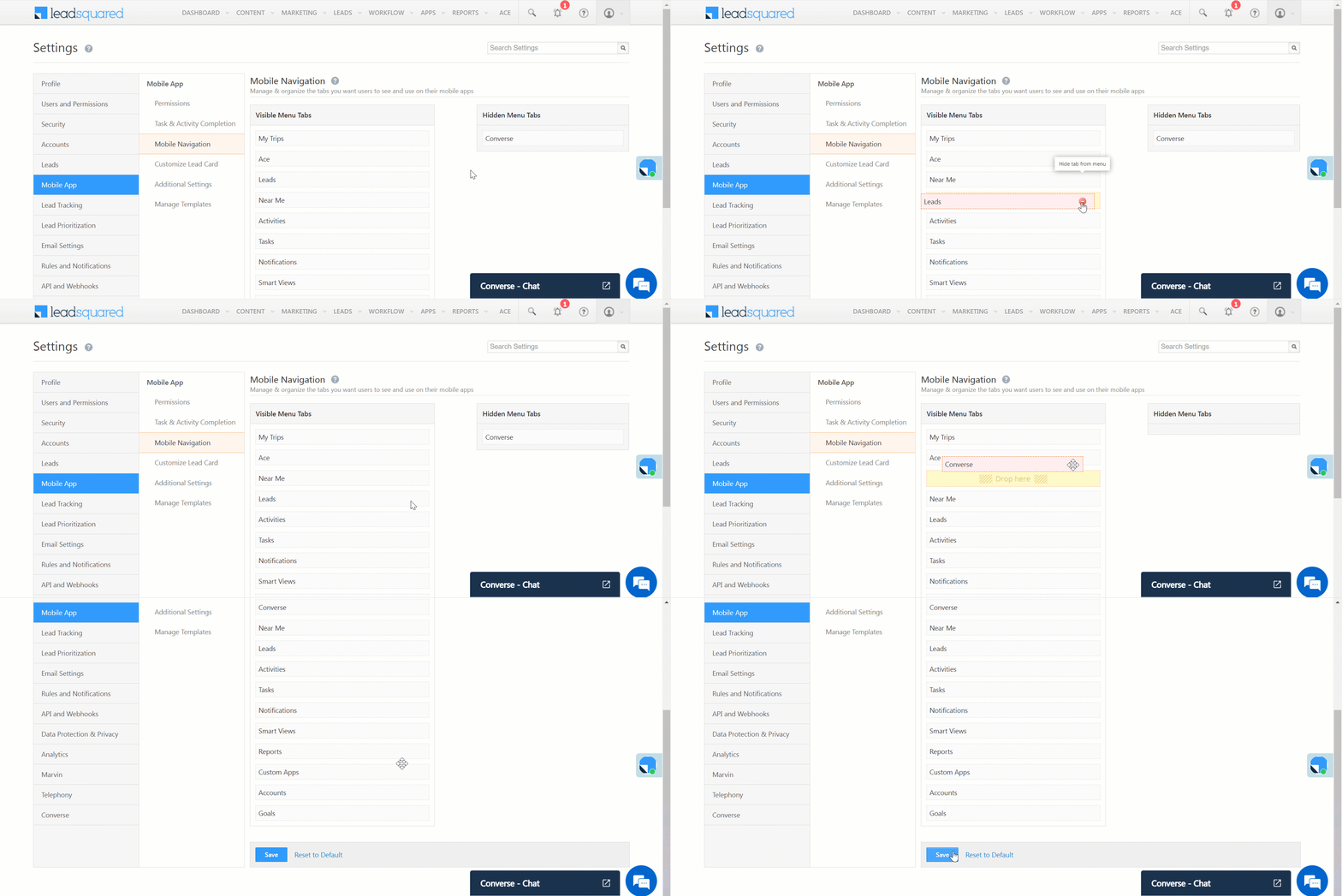
  1. Navigate to My Account>Settings>Mobile App>Mobile Navigation.
  2. Under Hidden Menu Tabs, drag the Converse option and drop it under Visible Menu Tabs. You can drag and drop the options in order of where you want them to be displayed.
  3. Once you’re done, click Save.

Note:

  • On the Mobile Navigation screen, the first (top) 4 tabs are displayed on the navbar, and the next 5 tabs are displayed as tiles in the side menu.
  • To know more about menu customization on mobile, refer to Configure Mobile App Settings from the Web Platform.

LeadSquared - Add converse to mobile app


4. Converse on Mobile App

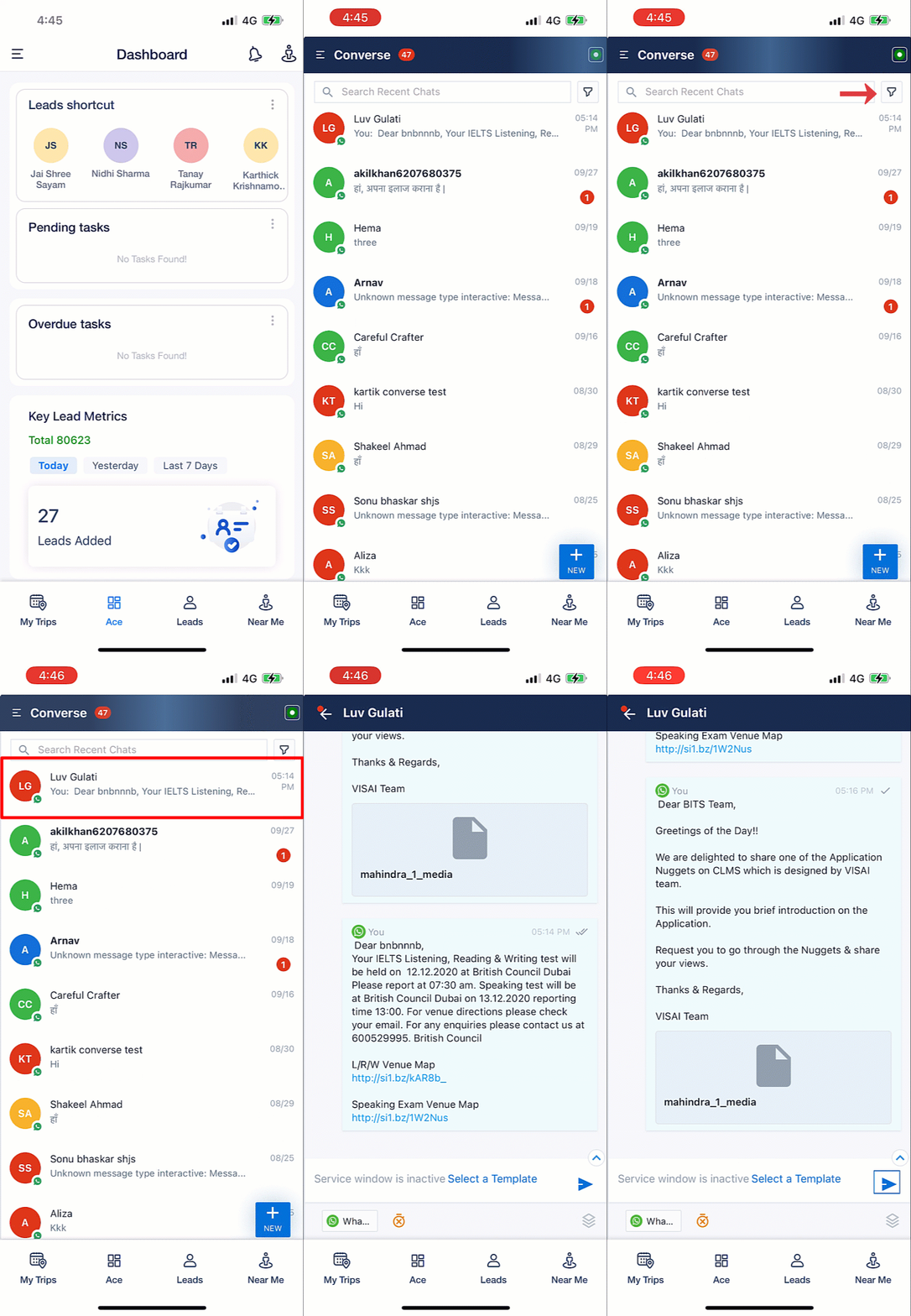
  • If you’ve added Converse on the bottom navigation bar, you can find it there. If you’ve added Converse on the side bar-
    1. From the Dashboard, tap LeadSquared - Mobile app menu.
    2. Select Converse.
  • On the Converse page, at the top right corner of the screen, you can set your availability status. You will only receive messages if your status is available.
  • To filter your chats, tap filter icon.
  • To send a message to a lead, tap on the lead’s name. You will now be redirected to the chat-box. You can draft your own messages or select a template here.

Note:

  • When you send a WhatsApp message directly from the mobile app, the message will be sent from your phone number. However, when you send a WhatsApp message using Converse, the message will be sent from the configured WhatsApp business account. There’s less chance of your messages being marked as spam when you use a business account.
  • You must change your availability status manually. Your status will remain the same until you change it, even when you’re not using the app.
  • You will receive notifications from the mobile app whenever you get Converse messages from a lead. You can tap the notification to get redirected to the lead’s chat. Make sure your notifications are switched on for the LeadSquared mobile app.

LeadSquared - Converse in Mobile App


Any Questions?

Did you find this article helpful? Please let us know any feedback you may have in the comments section below. We’d love to hear from you and help you out!

Lead Automation Conditions – Compare

1. Feature Overview

The Compare automation action lets you compare the values of lead and activity fields and set up different courses of action based on the results. You can also use saved responses from webhooks and Lapps in your comparisons.


2. Set Up the Compare Condition

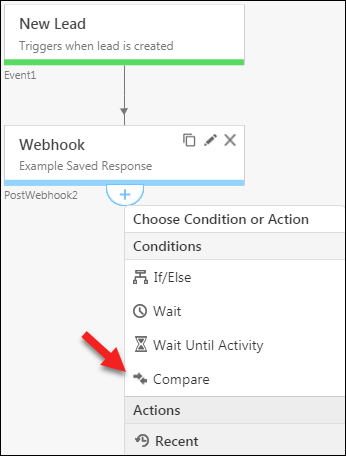
You can set up the compare condition at any point after the automation trigger. If you want to make use of a saved response from a webhook or lapp and compare it with a lead or activity field, select the Compare condition after the saved response card –

compare lead and activity fields


3. Enter the Fields You Want to Compare

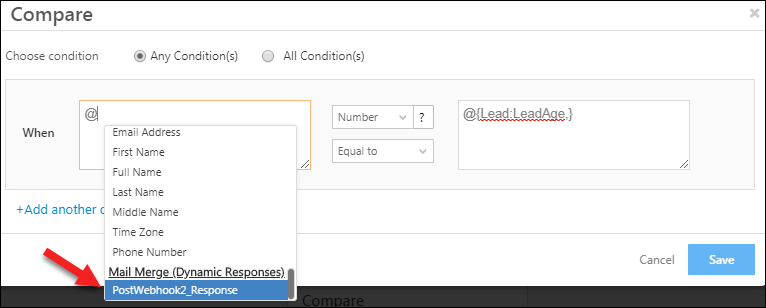
Select a field to compare by typing in @<fieldname>. The auto-suggest options should help you find the field quicker. If you’ve saved the response from a webhook or lapp, the option to select it will appear below the lead and activity fields as shown below.

Note: To compare activity fields, the automation must have an activity based trigger (New Activity on a Lead, Activity Update on a Lead).

compare options


4. Choose a Data Type and Operator

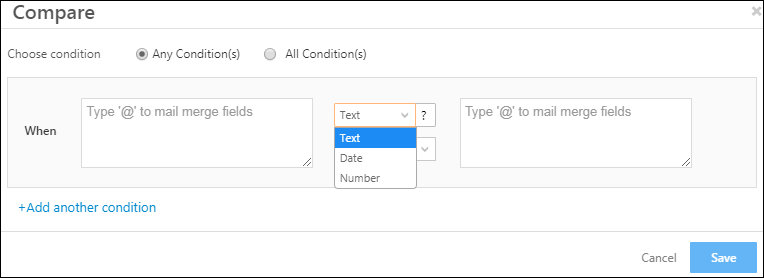
When comparing fields, it is imperative to choose a data type –

comparing fields

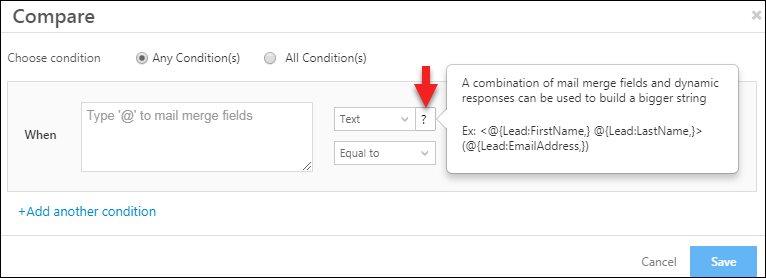
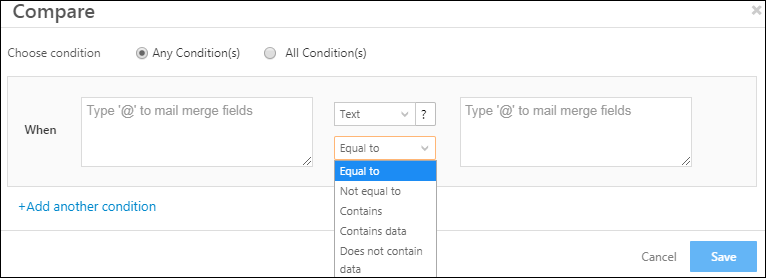
Click the help icon to understand how the comparison for each data type works –

comparing help

Based on the data type, different operators will appear –

compare operators

Here’s what you can do with each data type –

Data Types Operators Notes
Text Equal to, Not equal to, Contains, Contains Data, Does not contain data. You can combine mail merge lead and activity fields as well as dynamic responses to create a bigger string.

For example, you can combine a lead’s first and last name.<@{Lead:FirstName,} @Lead:LastName,}>

Date Equal to, Not equal to, Before, After, Is defined, Is not defined. The date you enter must be in the format yyyy-MM-dd HH:mm:ss

For example, 2018-07-26 09:45:00

If you’re comparing a date in a dynamic response, ensure that the correct format is followed.

Number Equal to, Not equal to, Lesser than, Greater than. You can perform the following arithmetic operations with number fields –

  • + (addition)
  • – (subtraction)
  • * (multiplication)
  • / (division)
  • % (modulus)

For example., (@{Lead:Score,} + 1)/2


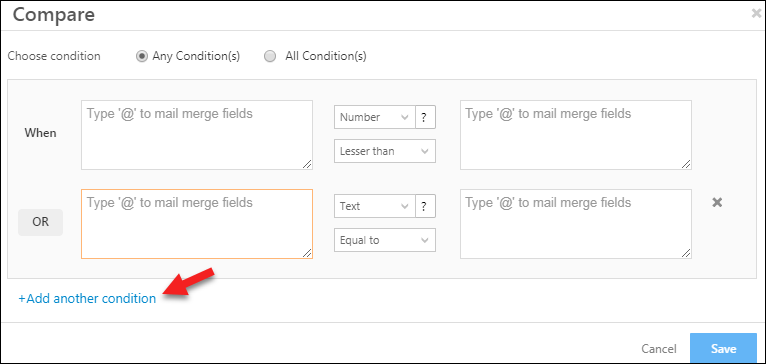
5. Add Multiple Conditions

You can add multiple conditions for comparison. Be sure to choose whether you want Any Condition(s) or All Condition(s) met when proceeding to the next action in your workflow.

compare add conditions


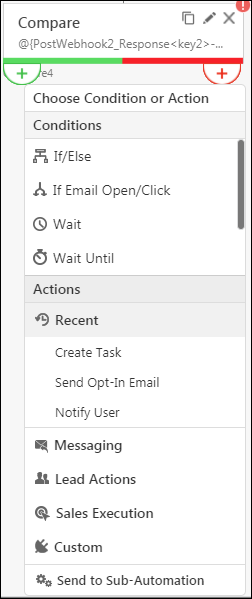
6. Choose Follow Up Actions

After setting up the condition you can choose 2 sets of follow up actions. Actions on the Yes path will trigger for leads when the Compare conditions hold true, while actions on the No path will trigger when your conditions are false.

follow up actions

Note: If the date format is incorrect, the lead will go down the No path. The automation will not fail due to incorrect date formats.


7. Example Use Case

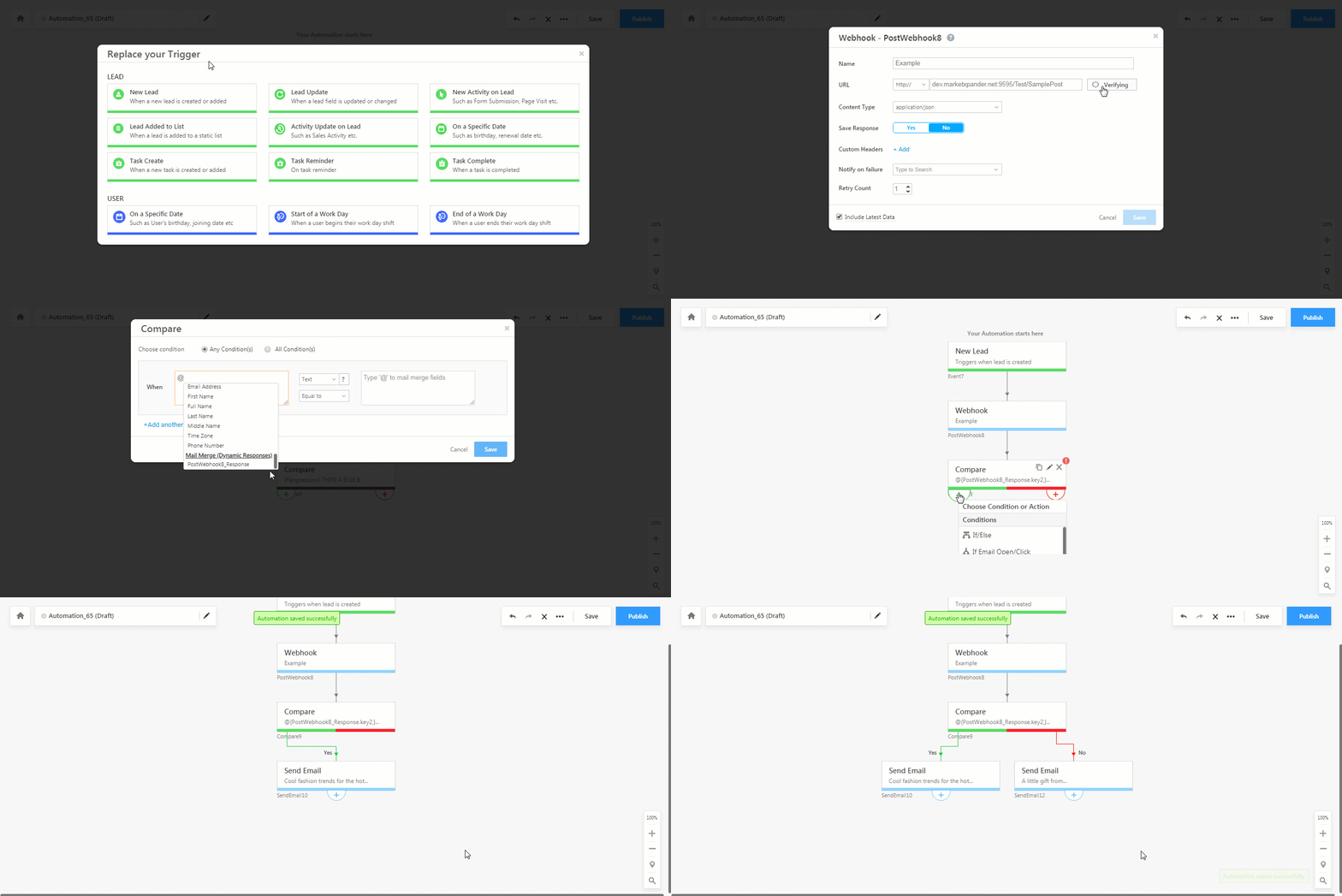
In this example, a clothing brand is sending out discounted offers to new leads based on gender. They’re sending a particular catalog to male leads and another to female leads. Here’s how they’re doing it –

  1. Choose the New Lead automation trigger.
  2. Under the new lead trigger set up a webhook action (Custom>Webhook) and save the webhook response as a JSON file. This webhook has the lead’s gender data. For more information on how to use saved responses, see Dynamic Responses in Lead Automation.
  3. Select the Compare condition. Compare the saved response with Male. Ensure the data type is Text.
  4. Follow up the yes path with the male catalog. Follow up the no path with the female catalog.

Compare Automation Example


Any Questions?

Was this article helpful? Leave us a comment and let us know.

How to find Schema Name of a Lead field?

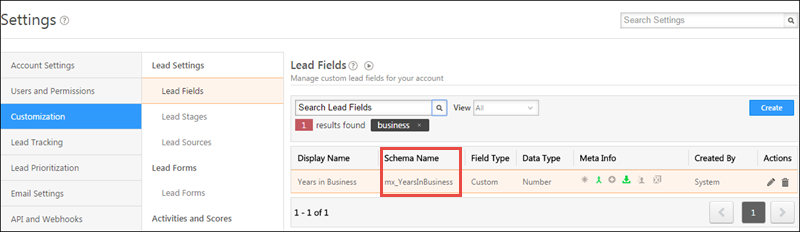
Navigate to My Account -> Settings -> Customization -> Lead Fields.  You will see schema name for each lead field as illustrated below.

Schema Name

Integrating Azure AD with LeadSquared

1. Feature Overview

LeadSquared offers sign-in integration with Azure Active Directory services, using OpenId Connect. After the integration, you won’t need to manage a separate set of credentials for LeadSquared, and can log in directly with your AD credentials. This integration will also enable you to seamlessly sign in to the LeadSquared mobile app as well. For information on other ADFS integrations, see ADFS Integration for Signing in to LeadSquared.

Note: 

  • When you enable ADFS integration, it is applied by default to all the users in your account. It CANNOT be disabled for specific users.
  • We support Microsoft Azure Integration through the mobile app as well. To enable it, you must be running the following app versions –


2. Prerequisites

  • You must have a Microsoft Azure Active Directory.
  • You must be an Administrator of your LeadSquared account.
  • You must use the same email Id on Azure and LeadSquared.
  • You must have the Azure AD authentication provider enabled on your LeadSquared account. To enable it, please reach out to support@leadsquared.com.


3. How it Works

  1. Create an application on Azure.
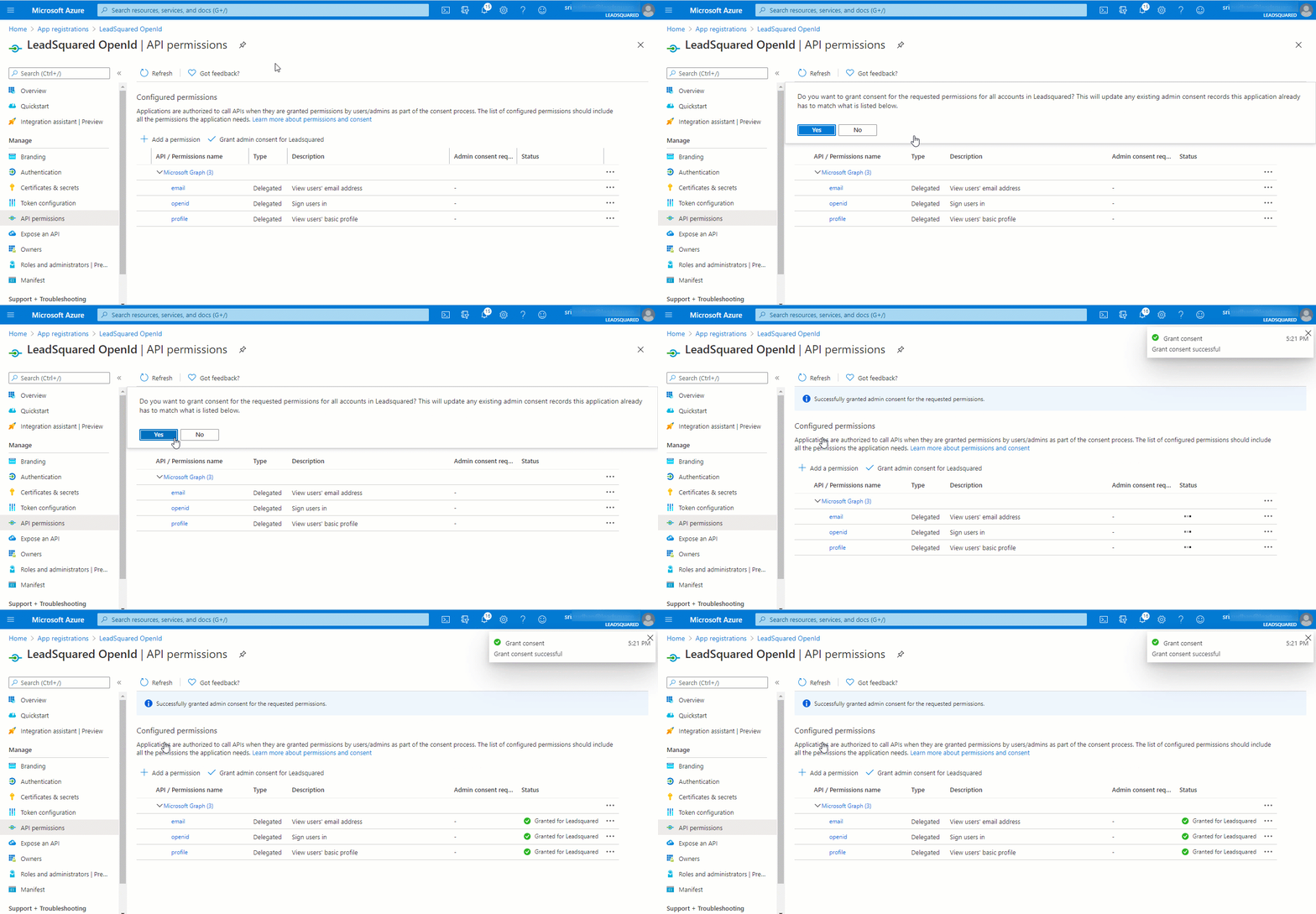
  2. Grant application access on Azure.
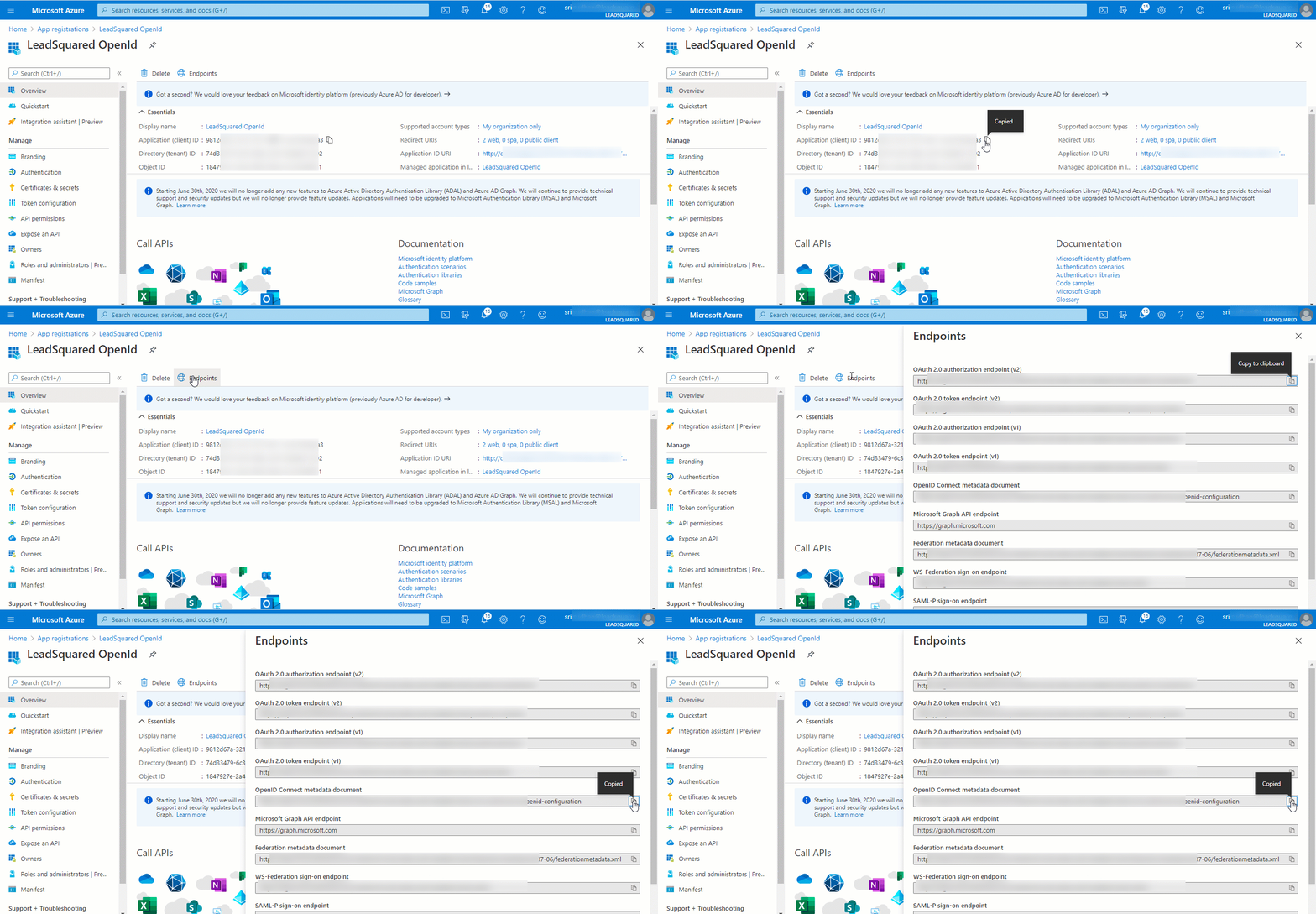
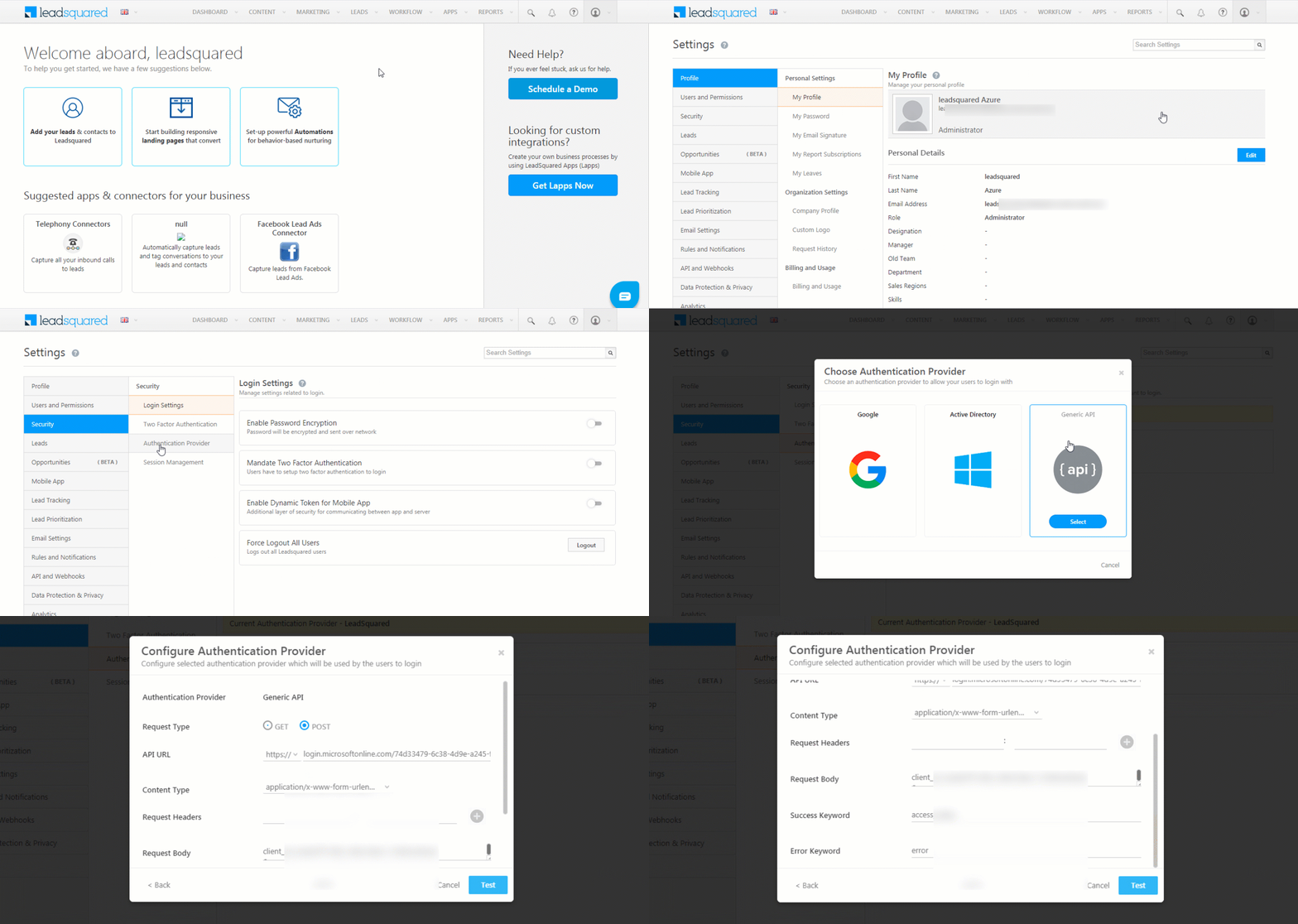
  3. Set up authentication on LeadSquared
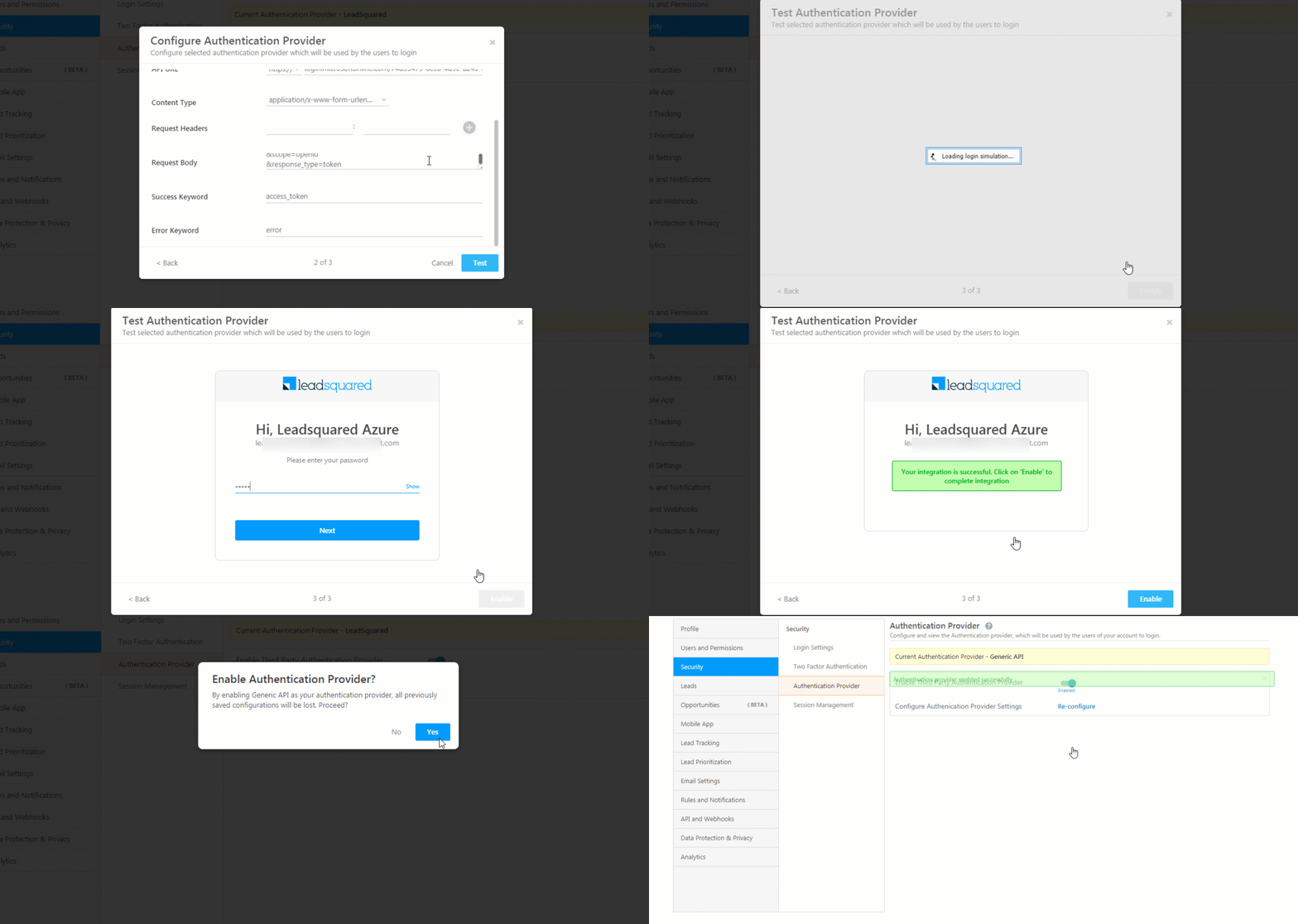
  4. Test the application on LeadSquared.


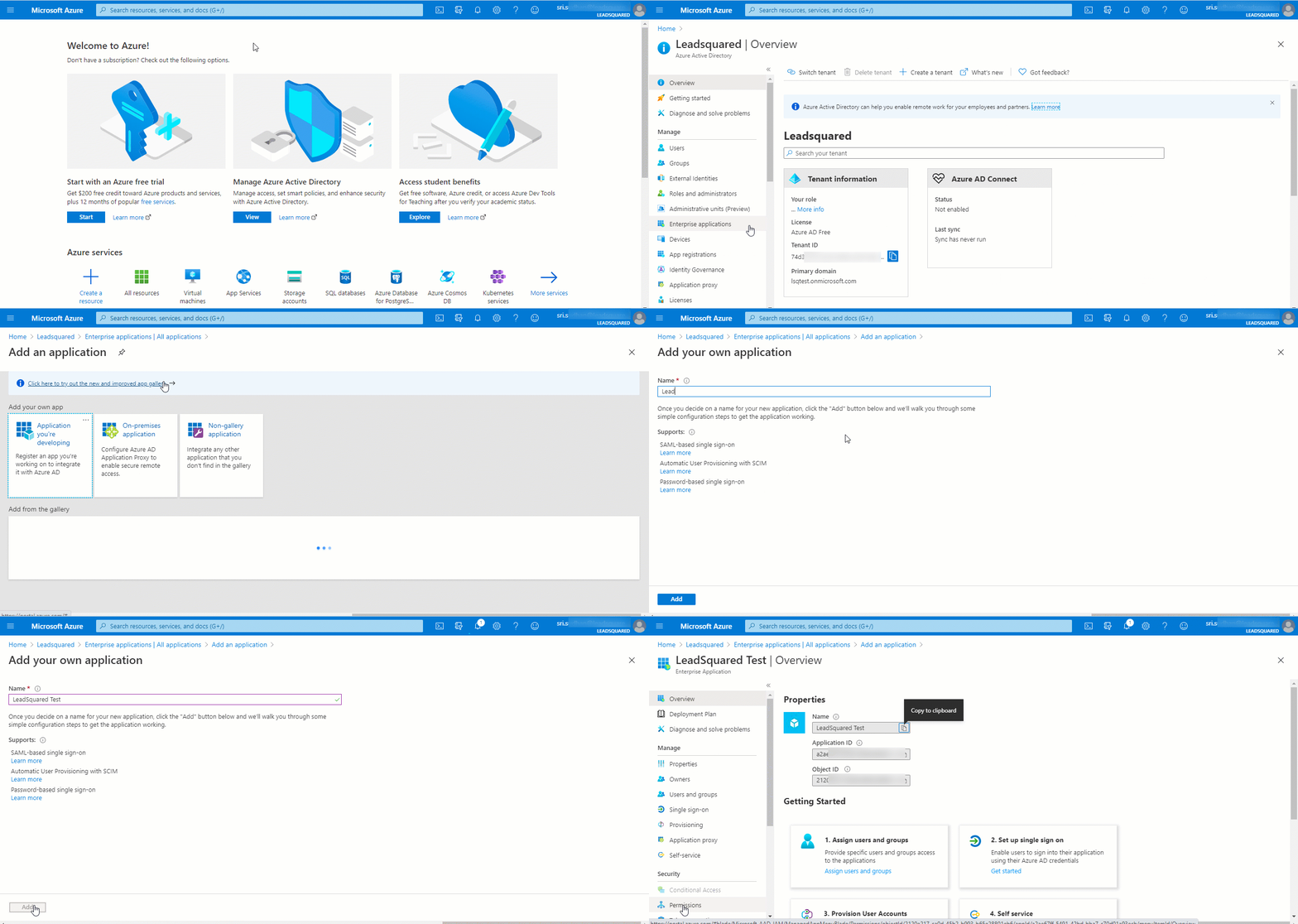
4. Create an Application on Azure

To create a new application on Azure –

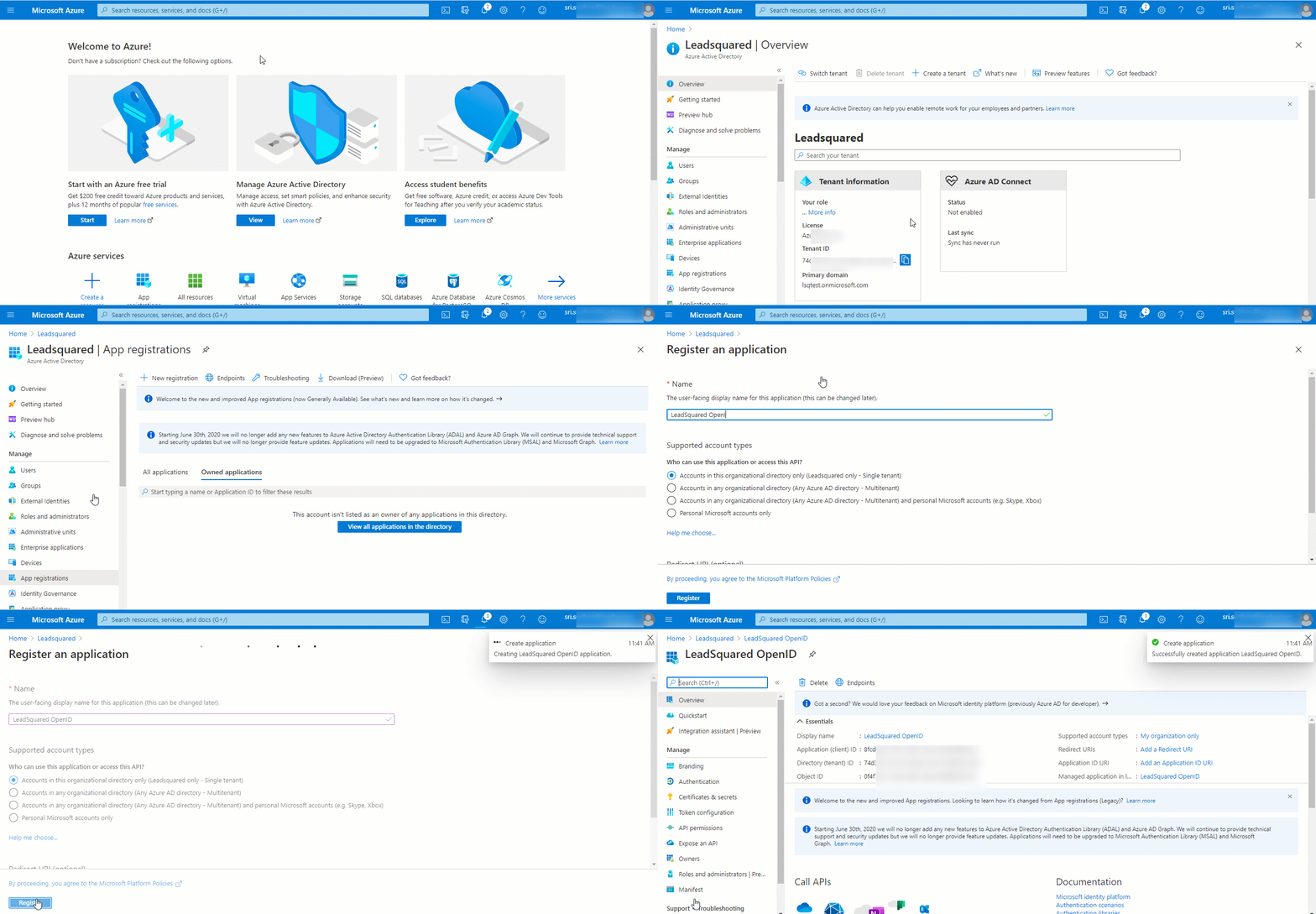
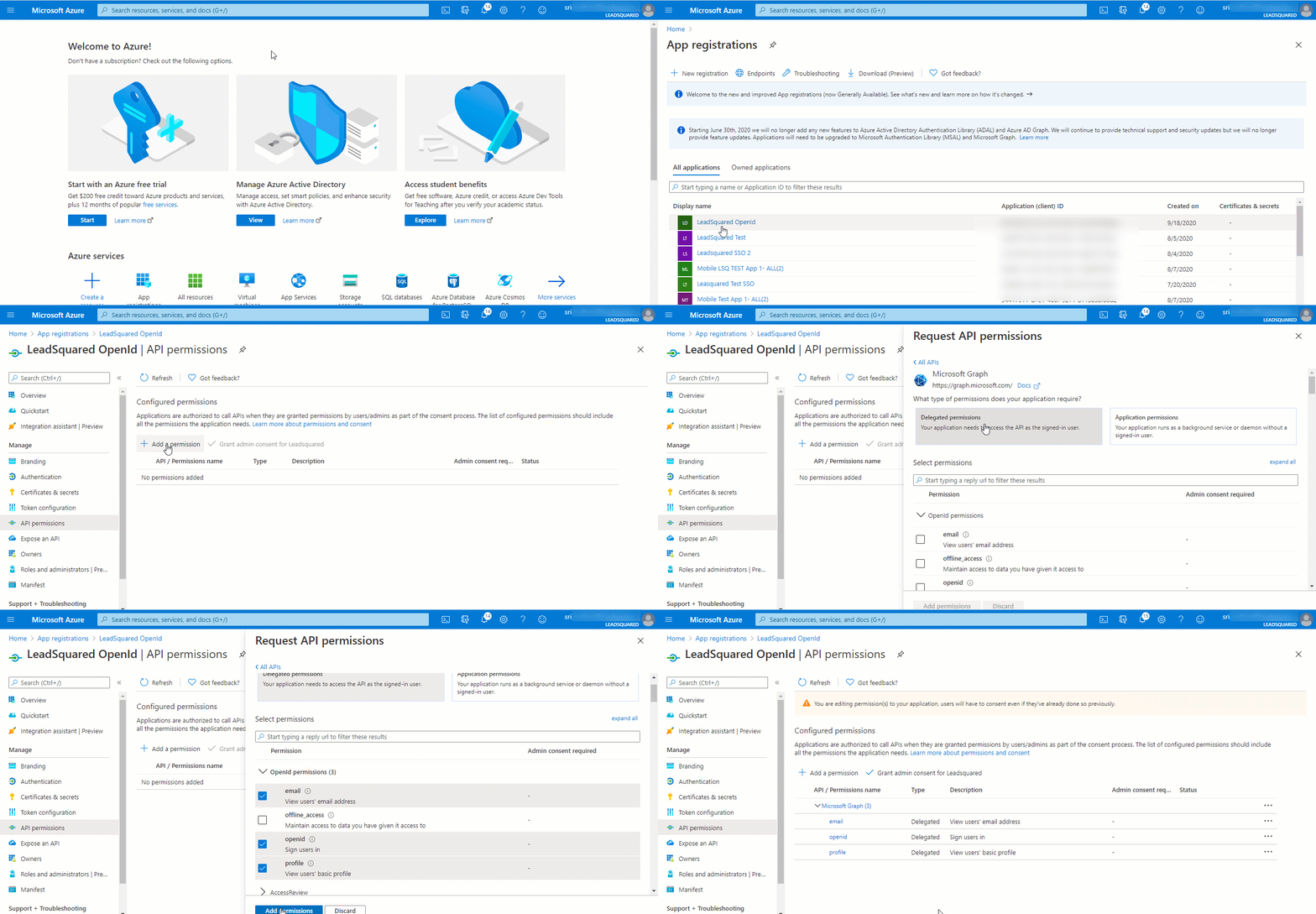
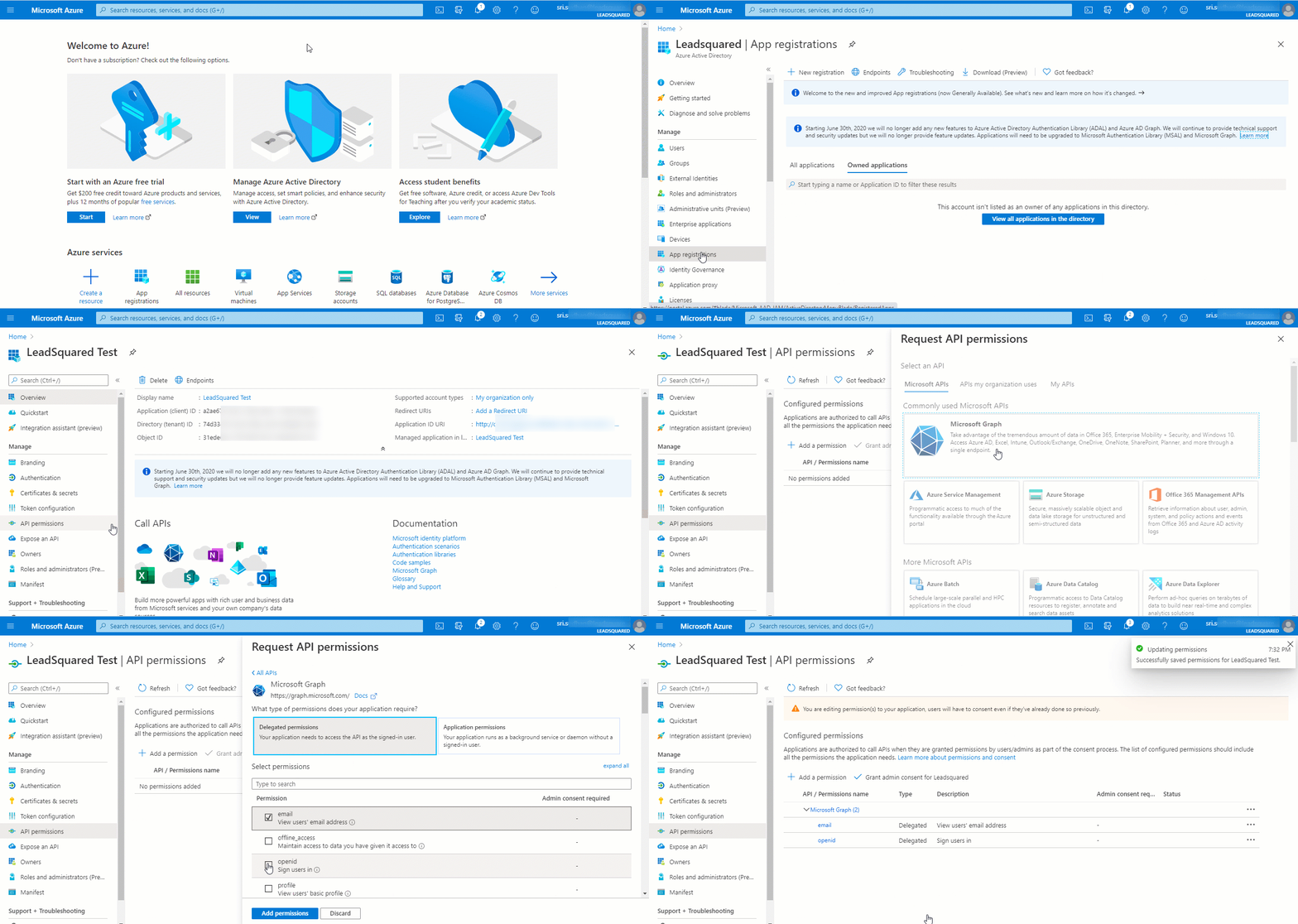
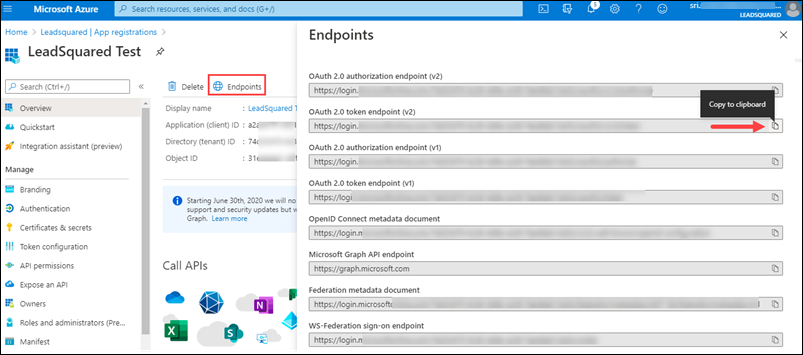
  1. Navigate to the Microsoft Azure portals home page, and under Manage Azure Active Directory, click View.
  2. On the left panel, click App registrations.
  3. On the App registrations page, click New registration.
  4. Enter a relevant name for the app.
  5. Under Supported account types, select “Accounts in this organizational directory only”
  6. Once you’re done, click Register.

Azure_OpenId_7


5. Authenticate Azure Application

5.1 Application Access

To grant application access to the new application you created –

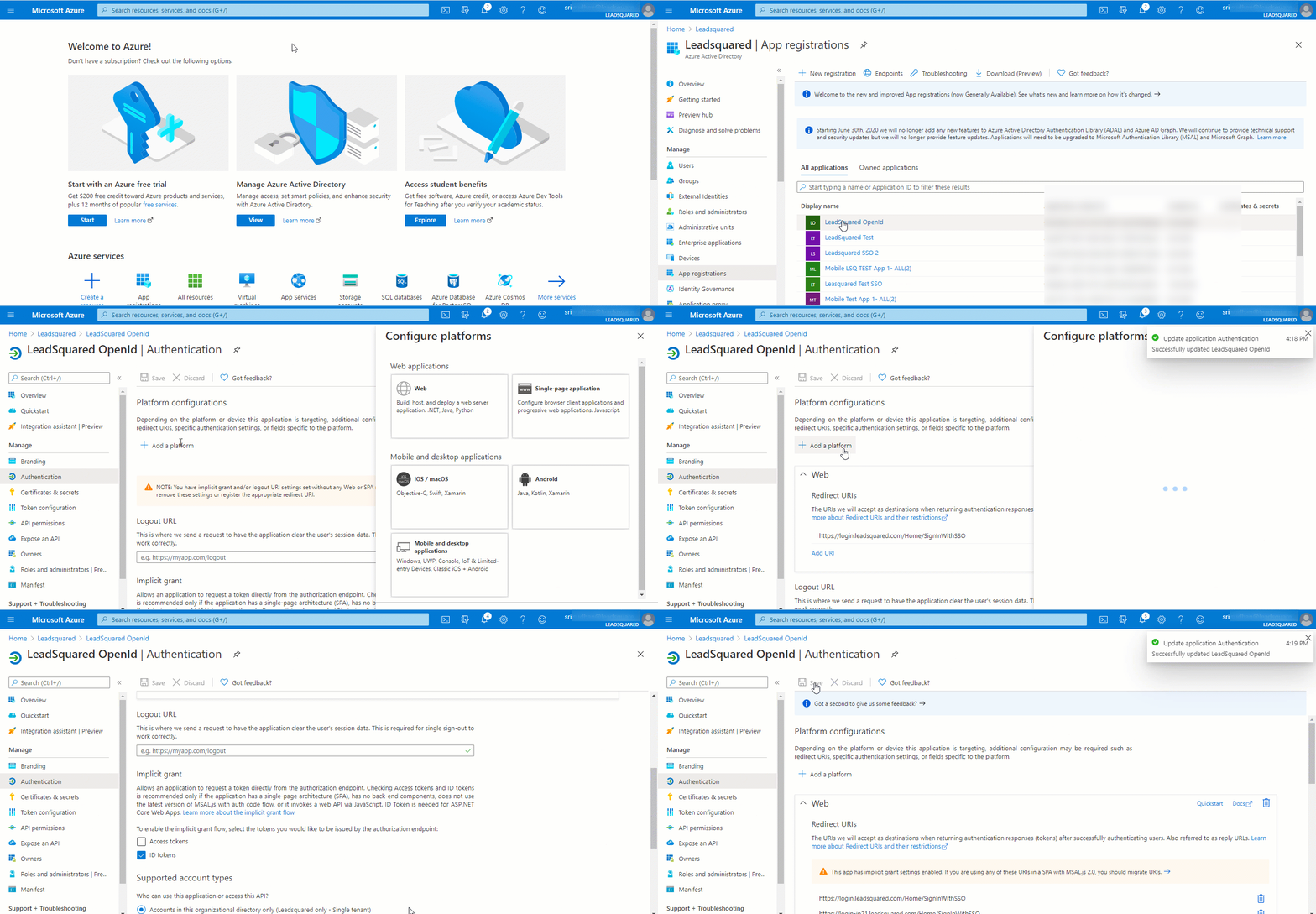
  1. On the Microsoft Azure portals home page, under Manage Azure Active Directory, click View.
  2. On the left panel, click App registrations.
  3. On the App registrations page, click All applications.
  4. Under Display Name, click the application you’ve created.
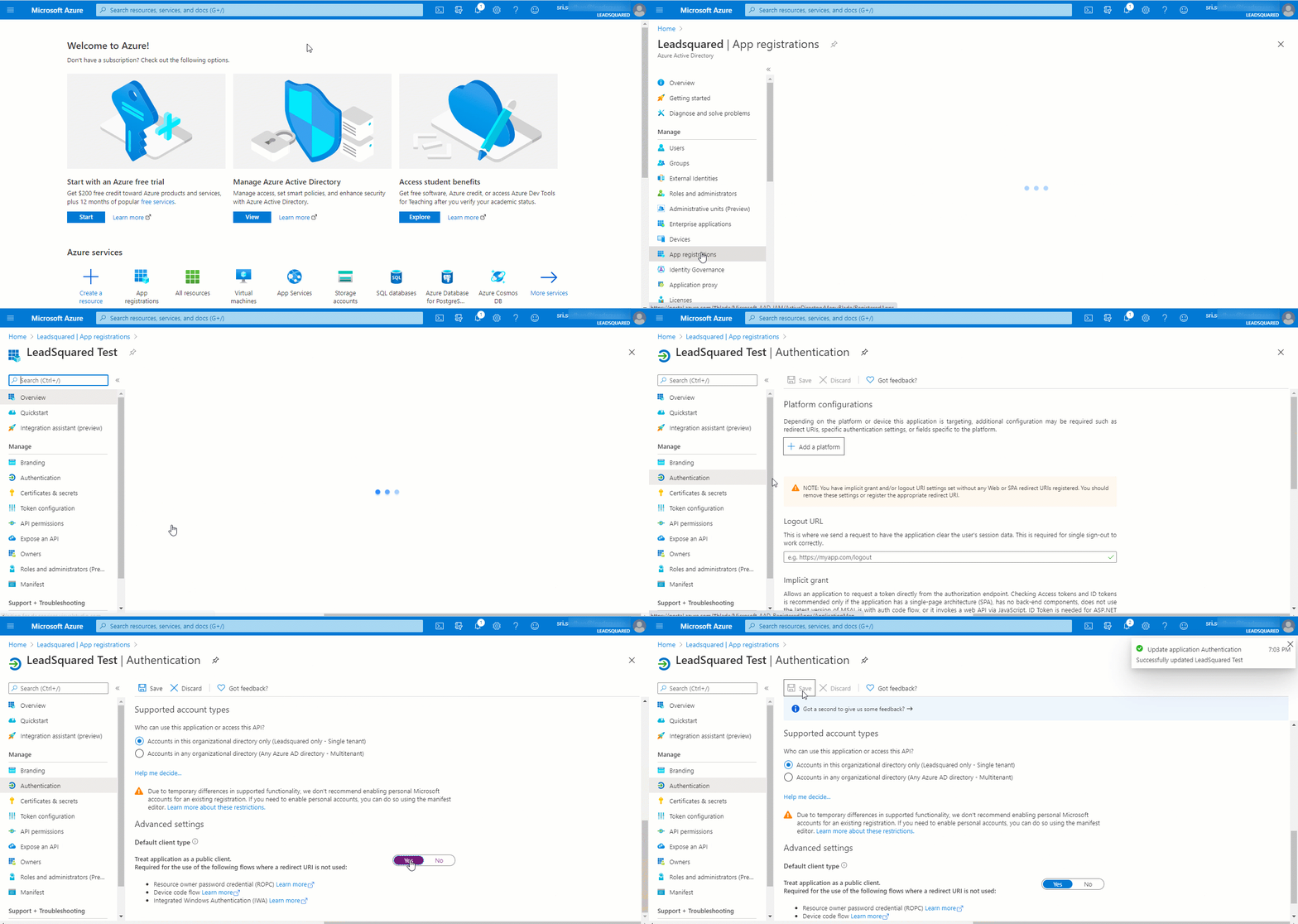
  5. On the application page, on the left-panel, click Authentication.
  6. On the Authentication page, click Add a platform, and then click Web.
  7. Enter this default URL, and click Configure
    • https://login.leadsquared.com/Home/SignInWithSSO
  8. Depending on your region, enter the following additional URLs, and click Configure
    • If your LeadSquared account in the Mumbai (India) region –
      • https://login-in21.leadsquared.com/Home/SignInWithSSO
    • If your LeadSquared account is in the Hyderabad (India) region, pas
      • https://login-in22.leadsquared.com/Home/SignInWithSSO
    • If your LeadSquared account is in the USA region –
      • https://login-us11.leadsquared.com/Home/SignInWithSSO
    • If your LeadSquared account is in the Ireland region –
      • https://login-ir31.leadsquared.com/Home/SignInWithSSO
    • If your LeadSquared account is in the Canada region, pass
      • https://login-ca12.leadsquared.com/Home/SignInWithSSO
    • If your LeadSquared account is in the Singapore region, only the default URL is required. No additional URL is required.
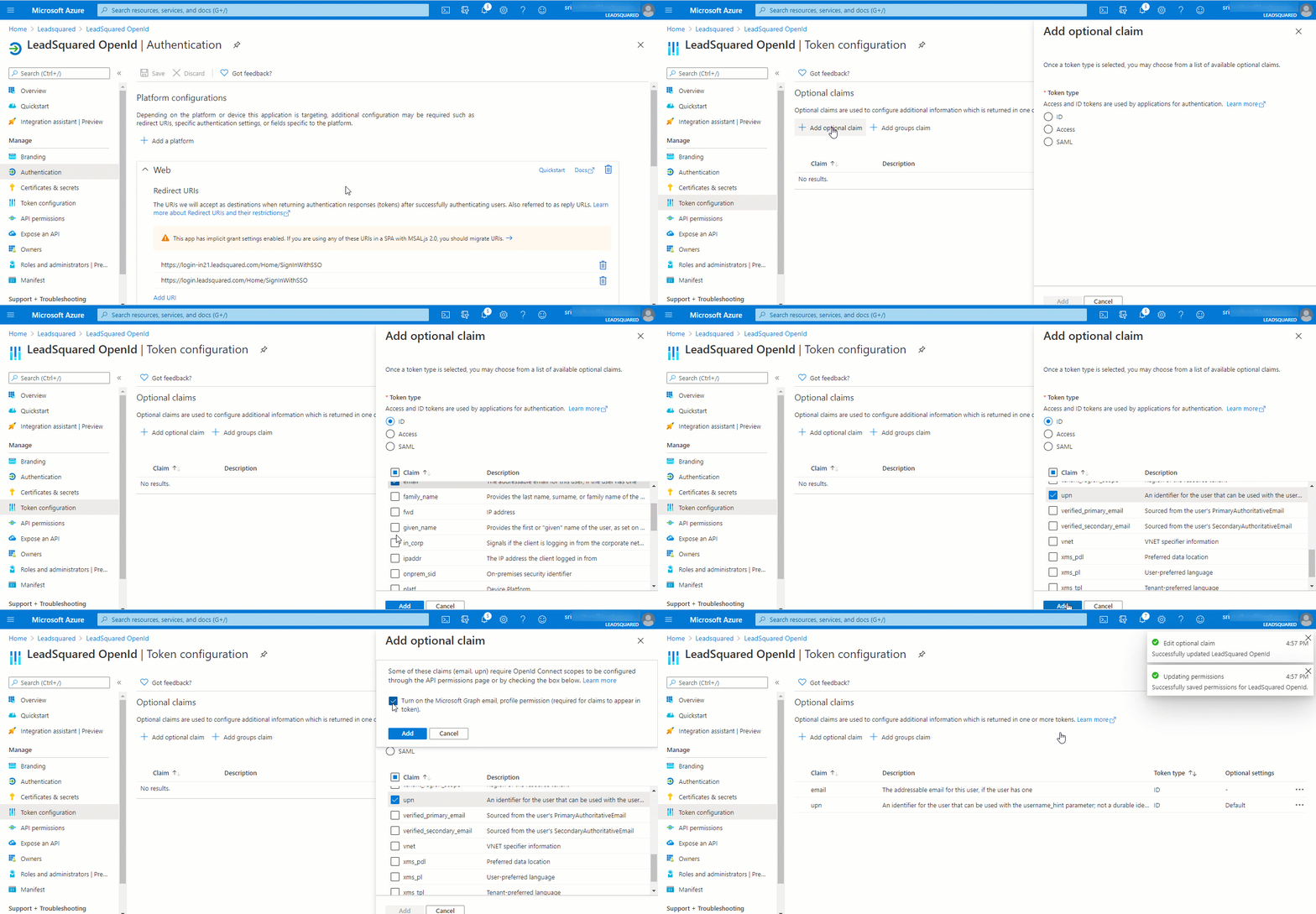
  9. Once you’re done adding the platforms, scroll down to “enable implicit grant flow”, and select Access tokens and ID tokens by checking the Azure checkbox box.
  10. Click Save.

Azure_OpenId_2

NextGen/LeadSquared New UI

If you’re using LeadSquared’s NextGen/New UI, in addition to the steps (until step 5) listed above, the following steps must be completed –

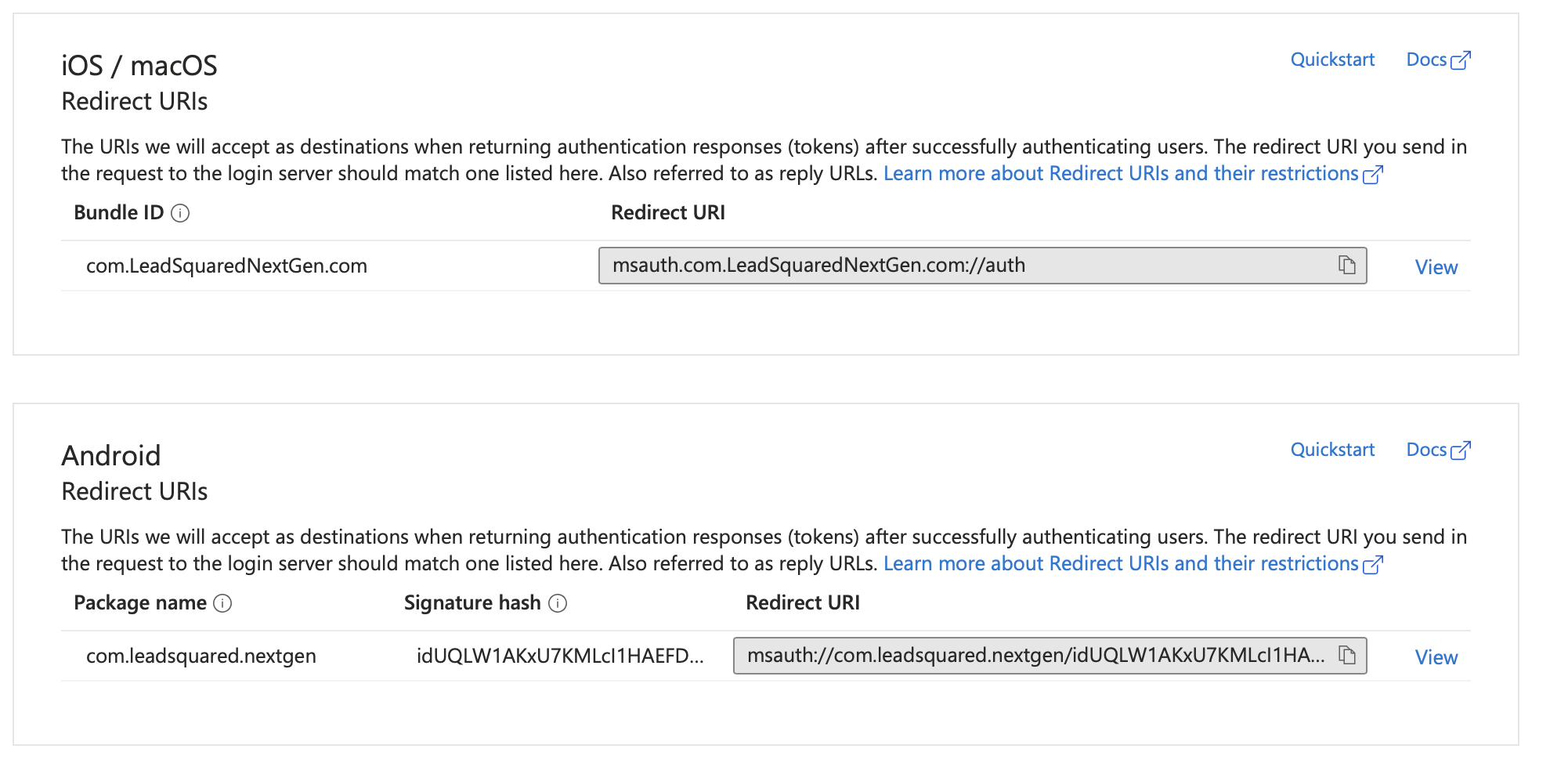
  1. On the Authentication page, click Add a platform, and then click Single-page Application.
  2. Enter this default URL, and click Configure
    • https://marvin.leadsquared.com
  3. Depending on your region, enter the following additional URLs, and click Configure
    • If your LeadSquared account in the Mumbai (India) region –
      • https://marvin-in21.leadsquared.com
    • If your LeadSquared account is in the Hyderabad (India) region, pas
      • https://marvin-in22.leadsquared.com
    • If your LeadSquared account is in the USA region –
      • https://marvin-us11.leadsquared.com
    • If your LeadSquared account is in the Ireland region –
      • https://marvin-ir31.leadsquared.com
    • If your LeadSquared account is in the Canada region, pass
      • https://marvin-ca12.leadsquared.com
    • If your LeadSquared account is in the Singapore region, only the default URL is required. No additional URL is required.
  4. Once you’re done adding the platforms, scroll down to “enable implicit grant flow”, and select Access tokens and ID tokens by checking the Azure checkbox box.
  5. Once you’re done, click Save.

Note: 

If you’re adding iOS as a platform, configure the following –

  • Bundle IDcom.LeadSquaredNextGen.com
  • Redirect URImsauth.com.LeadSquaredNextGen.com://auth

If you’re adding Android as a platform, configure the following –

  • Package Namecom.leadsquared.nextgen
  • Signature HashidUQLW1AKxU7KMLcI1HAEFDcZIk=
  • Redirect URImsauth://com.leadsquared.nextgen/idUQLW1AKxU7KMLcI1HAEFDcZIk%3D

Inetgrate Azure AD with LeadSquared Ios Android

5.2 Single Page Application

Then, create a single page application, and configure LeadSquared’s Unified Login feature.

  1. On the Authentication page, click Add a platform, and then click Single-page Application.
  2. Enter this default URL, and click Configure
    • https://identity.leadsquared.com
  3. Depending on your region, enter the following additional URLs, and click Configure
    • If your LeadSquared account in the Mumbai (India) region –
      • https://identity-in21.leadsquared.com
    • If your LeadSquared account is in the Hyderabad (India) region, pas
      • https://identity-in22.leadsquared.com
    • If your LeadSquared account is in the USA region –
      • https://identity-us11.leadsquared.com
    • If your LeadSquared account is in the Ireland region –
      • https://identity-ir31.leadsquared.com
    • If your LeadSquared account is in the Canada region, pass
      • https://identity-ca12.leadsquared.com
    • If your LeadSquared account is in the Singapore region, only the default URL is required. No additional URL is required.
  4. Once you’re done, click Save.

5.3 Implicit Access

To grant access to your login email ID –

  1. From the Authentication page, on the left-panel, click Token configuration.
  2. On the Token Configuration page, click Add optional claim.
  3. On the right-panel, under Token type, click ID.
  4. Under Claim, select email and upn by checking the Azure checkbox box.
  5. Once you’re done, click Add.
  6. On the Add optional claim confirmation pop-up, confirm by checking the Azure checkbox box.

Azure_OpenId_3


6. Application Permissions on Azure

6.1 Grant Permissions

To grant application permissions to the new application you created –

  1. On the Microsoft Azure portals home page, click App registrations, and then click All applications.
  2. Under Display Name, click the application you’ve created.
  3. On the application page, on the left-panel, click API permissions.
  4. On the API permissions page, click Add a permission.
  5. On the Request API permissions pop-up, click Microsoft Graph, and then click Delegated permissions.
  6. Under Permissions, click the Azure Checkbox checkbox against email, profile and openid.
  7. Once you’re done, click Add permissions. This will successfully grant permissions.

Azure_OpenId_4

6.2 Grant Admin Access

To grant admin access to the new application you created –

  1. Navigate to the API permissions page, and click Grant admin consent for LeadSquared.
  2. On the confirmation pop-up, click Yes. This will successfully grant admin access.

Azure_OpenId_5


7. Authenticate the Azure Application in LeadSquared

To authenticate the application you’ve created on LeadSquared –

7.1 Obtain Client ID and OpenID from Azure

To obtain the client Id for the application you’ve created –

  1. On the Microsoft Azure portals home page, click App registrations, and then click All applications.
  2. Under Display Name, click the application you’ve created.
  3. On the application page, copy the Application (client) ID.
  4. Then, click Endpoints, and under OpenID Connect metadata, click the Azure icon to copy the token.

Azure_OpenId_6


7.2 Authentication on LeadSquared

To authenticate and activate your Azure application on LeadSquared –

  1. From your LeadSquared main menu, navigate to My Profile>Settings>Security>Authentication Provider.
  2. Against Enable Third Party Authentication Provider, toggle the enable icon slider.
  3. On the Choose Authentication Provider pop-up, select Azure AD.
  4. On the Configure Authentication Provider pop-up, enter the Application (client) ID and OpenID Connect metadata, and click Test.
  5. On the Test Authentication Provider window, click Sign in with Azure AD, and on the Microsoft pop-up, enter the password for your Microsoft Azure Id.
  6. Once you’ve signed in successfully, on the Test Authentication Provider window, click Enable.
  7. On the Enable Authentication Provider pop-up, click Yes. Your Azure OpenId login will be authenticated successfully.

Azure_OpenId_9


8. Sign-in with Azure AD Credentials

Once the set-up is complete, when you log in to your LeadSquared account (https://login.leadsquared.com/), you’ll be prompted to enter your Azure AD credentials (or choose the Microsoft account if already signed in on the browser).

Sign in to LeadSquared with Azure AD account


Any Questions?

Did you find this article helpful? Please let us know any feedback you may have in the comments section below. We’d love to hear from you and help you out!

Integrate QuikrHomes with LeadSquared

We no longer support the existing QuikrHomes connector. This won’t affect your integration if it’s already installed. But if you’re looking to build a new integration to capture leads from QuikrHomes, please refer to Integrate Your Custom Data Source with LeadSquared.

Lead Automation Actions – Sales Execution

1. Feature Overview

Here you’ll learn about sales related automation actions. These actions are all directed towards your sales users. Use this feature to –

  • Notify users when certain criteria are met.
  • Create tasks for users.
  • Automate lead and activity distribution among your users.


2. Notify Users

Allows you to send a notification email to a LeadSquared user. Click Notify UserLeadSquared Automation

By default, the notification is directed to the lead owner. You can add more LeadSquared users to the ‘To‘ field. You can also direct the notification to the activity owner or include the activity owner in the ‘Cc‘ or ‘Bcc‘ fields
You can also mail merge lead fields, owner fields, sender fields and activity fields into your email content using the mail merge option highlighted below.

LeadSquared Automation

Here’s a sample automation to notify a user when a task is overdue.

Notify User When Task is Due Automation


3. Create Tasks

Allows you to create both appointment and to-do type tasks (see Managing Task Types). Click Create Task and enter the task details.

create tasks

When creating appointment type tasks, you can also set it up as a recurring task. To do this, click Make Recurring.

LeadSquared Platform Updates

Note: You can mail merge lead and activity fields in the subject and description of the task. You can also schedule the task to be created using date-time fields from an activity (only for automations with activity triggers).


4. Distribute Leads

The distribute lead action allows you to set conditions to distribute leads among your users. To know more, please refer to Lead Distribution Automation in LeadSquared.

Choosing conditions


5. Distribute Opportunities

The distribute opportunity action allows you to set conditions to distribute opportunities among your users. To know more, please refer to Opportunity Distribution Automation.

Distribute LeadSquared Opportunities


6. Distribute Activities

Activity distribution works largely the same way as lead distribution. However, there are a few pre-conditions that must be met –


6.1 Example Use Cases

You can use this feature to distribute activities amongst users, sales groups or teams, to complete different phases of a process or steps in an implementation cycle. For example, you can distribute –

  • A ‘Document collection’ activity to a field sales team to collect identification documents.
  • An ‘Account Creation’ activity to a supervisor or manager for approval.
  • A ‘Loan Application’ activity to a risk assessment team to determine eligibility.


6.2 Distribute Activity Configurations

The Distribute Activity action appears under Sales Execution following a lead activity-based trigger.

distribute activity

When you click the Distribute Activity action, the configuration pop-up will appear. You can create multiple distribution rules consisting of various conditions.

  1. Enter the Rule Name in the space provided (Use the New Rule option to create multiple rules).
  2. Click the Choose Condition(s) link.

choose distribution conditions

Select the appropriate conditions, click Add Condition (you may add multiple conditions), then click Set Criteria. For more information on setting conditions, see How to Use Advanced Search.

set distribute activity conditions

Now assign the activity to/based on users, groups or user properties. For more information on each of these, see the ‘Distribute Leads to Users’, ‘Distribute Leads to Groups’ and ‘Distribute Leads Based on User Properties’ sections above. The process is exactly the same for activity distribution. Click Save when you’re done.

Note: You must set a default rule that will execute when no other rules match the set criteria. The default rule will automatically distribute the activity to a user you select.

distribute activity final

You can now continue to add actions or conditions to the automation.

If you distribute an activity to a user who doesn’t have permission to view a particular lead, you can use the Add Share Lead link (only for ESS tenants) to temporarily give the user lead access. For more information, see How to Share Leads for a Limited Duration.

add lead share to activity distibute


7. Distribute Tasks

Like with leads and activities, you can also distribute tasks amongst your users. The distribute task action will appear only if the automation trigger is set to ‘Task Create’ and ‘Task Reminder’.


7.1 Distribute Task Configurations

The Distribute Task action appears under Sales Execution following any of the task-based triggers mentioned above.

distribute tasks action

The distribute task card works exactly the same way as the distribute lead card (Section 4. Distribute Leads). You can set rules with multiple conditions, assign them directly to users and sales groups, or on the basis of user properties.

distribute task card


Any Questions?

Did you find this article helpful? If you have any doubts or feedback, please leave us a comment below.

Google Retargeting Connector

1. Feature Overview

When a lead interacts and shows interest in your product or service, on your website or landing pages, LeadSquared captures these leads, along with their details (such as name, phone number, email Id, etc.). Google retargeting (or remarketing) enables you to mount a sustained marketing campaign that shows only relevant ads to these leads, about the specific offering they’re interested in.

Through LeadSquared’s Google Retargeting Connector, you’ll be able to automatically send the list of leads who’ve shown interest in a particular product or service, from LeadSquared to Google Ads. These leads will get ads only for those specific products or services.

Some of the benefits of Google retargeting are –

  • Narrows down the target audience of a Google ad, to focus on only the list of leads who’ve shown interest in that specific product or service.
  • Reduces manual effort and time spent in populating Google Ads with the list of leads who’ve shown interest.
  • Up-sell and cross-sell products and services to existing customers, by showing them relevant ads.
  • Gather more information from your leads with advanced field mapping for both standard and custom fields.
  • Reduces the overall cost of a campaign, while increasing its efficiency, relevance and impact.
  • Analyse and measure the effectiveness of each campaign with detailed reports and analytics.

To know more about what the Google Retargeting Connector offers, please refer to Google Retargeting with LeadSquared.


2. Prerequisites

  • You must be an Administrator of your LeadSquared account.
  • This is a paid feature. To enable it, please write to support@leadsquared.com.
  • You must have an active Google Ads account.
  • To use this feature, your Google Ads account must fulfill a list of requirements that meet Google’s Customer Match policy.


3. How it Works

To push leads from LeadSquared to your Google Ads account, using the Google Retargeting Connector connector, you’ll have to complete the following steps –

  1. Install the connector on LeadSquared
  2. Configure the connector on LeadSquared
    1. Connect your Google Ads account(s)
    2. Create an audience list
    3. Map relevant fields to the list
    4. Sync the list with Google Ads
  3. View the list on your Google Ads account


4. Installing the Connector

To install the Google Retargeting Connector on your LeadSquared account –

  1. From the main menu, navigate to Apps>Apps Marketplace and search for Google Retargeting Connector.
    • You’ll also find the connector on the left panel, under Online Ads.
  2. Click Install.
  3. Once the connector is installed, hover your cursor over the settings icon, then click Configure.
  4. On the Connector Access screen, you can choose to give access to all your marketing users, or only specific marketing users.
    • If you choose Specific Marketing Users, from under Specific Users, you can select the marketing users from the dropdown list.
  5. Once you’re done, click Save.

Retargeting_3


5. Configuring the Connector

5.1 Connect Ad Accounts

Once the connector is installed, connect your Google Ads account(s) to LeadSquared.

  1. Navigate to Apps>Google Retargeting.
  2. On the Connect Ad Accounts page, click Connect Accounts.
  3. On the Choose an Account window, choose the Google account to which your Google Ads account is linked.
  4. Give LeadSquared access to your Google account by clicking Allow. Once you get a successful message, please close the Google window.
  5. On the Select Account(s) to be added pop-up, from the available Google Ads accounts, select the list of accounts you want to add. You can add multiple accounts.
  6. Once you’re done, click Select.
  7. Once you get a “Successfully Saved” message, click Next.

Note: To delete an existing account, against the account name, click the icon, and on the Delete Account pop-up, click Yes.

Retargeting_4


5.2 Create an Audience List

To create an audience list from the list of leads –

  1. On the Connect Ad Accounts page, click Audience List.
  2. Under Select Account, from the available dropdown, select the account under which you want to create the list, then click Create Audience.
  3. On the Create Audience List pop-up, enter a name and description for the list.
  4. Under Data to Upload, you can select the data type that should be uploaded to the list. You can choose from –
    • Email address, phone number, and/or mailing addresses.
    • User IDs
    • Mobile Device ID
  5. Once you fill in the necessary details, click Done. You’ll get a message saying, “Created Successfully.”

Retargeting_E_1

Note: To delete an existing list on the Create Audience List pop-up, against the list name, click the icon, and on the Delete Audience pop-up, click Yes.


5.3 Field Mapping

To map lead fields from LeadSquared to the lead fields on the Google Audience List –

  1. On the Connect Ad Accounts page, click Field Mapping, and then click Add Custom.
  2. Under Google Audience List fields, click the dropdown to select a field from the list of available fields.
  3. Similarly, under Lead Field, select a corresponding field in LeadSquared from which you want to push data.
  4. Once you’re done, click the Google icon, and then click Save. You’ll receive a “Field Mapping saved Successfully” message.

Retargeting_5

Notes:

  • Along with Email and Phone fields, it is mandatory to map the following fields to the relevant LeadSquared lead fields –
    • First Name
    • Last Name
    • Country
    • Zip
  • To edit an existing field, click the icon.
  • To delete an existing field, click the icon.


5.4 Sync Lists

After successfully mapping lead fields, to sync your LeadSquared lists to Google Ads –

  1. To populate lead details on this list, navigate to Leads>Manage Lists.
  2. Against the list from which you want to pull the lead details, hover your cursor the icon, and click Google Retargeting.
  3. On the Google Retargeting pop-up, select the Google Ad account, and the Custom Audience List that you created, then click Done. You will receive a message stating your request has been submitted successfully.

Retargeting_E_2

Notes:

  • You can pull lead details from a particular LeadSquared list, and map it to your Google Audience List only once every 12 hours.
  • It will take between 6-12 hours for the leads to reflect in your audience list on your Google Ads account.


5.5 View Reports

Under Reports, you can view the details of a list that’s been pushed from LeadSquared to Google Ads.

Retargeting_6


6. View the List on Google

After you’ve successfully created the list, you can view it on your Google Ads account. To do this –

  1. From your Google Ads home page, navigate to Tools & Settings>Shared Library>Audience Manager.
  2. Under Audience name, you’ll find the list that’s been pushed from LeadSquared to Google Ads.

Google Retargeting_9


Any Questions?

Did you find this article helpful? Please let us know any feedback you may have in the comments section below. We’d love to hear from you and help you out!

Rename the Opportunity Entity to Reflect Your Business Terminology

1. Feature Overview

Opportunities in LeadSquared represent potential deals. Through opportunity management, you can track various aspects of deals in progress. Users can rename “Opportunity” as per their business needs. For example, an insurance company can rename “Opportunities” as “Policies” and an education organisation can rename them as “Courses” for better adoption among users.

Note:

  • All the admin settings, reports & configurations will continue to use the keyword Opportunity. The name change will not be reflected on these pages.
  • To know more about opportunities, refer to Opportunity Management – Feature Guide.


2. Prerequisites

You must be the Administrator of your LeadSquared account.


3. Enable Opportunity Rename

  1. Navigate to My Profile>Settings>Profile>Advanced Configurations.
  2. Alongside Enable Opportunity Rename setting, slide the toggle.

LeadSquared - Enable Opportunity Rename


4. Rename Opportunity

  1. Navigate to My Profile>Settings>Opportunities>Rename Opportunities.
  2. On the Rename Opportunity tab, under Actions, click the Edit icon.
  3. On the Rename Opportunity pop-up, change the Display Name and Plural Name, and click Save.
  4. On the Confirmation pop-up, click the Confirm button.
  5. You will receive a confirmation notification at the top of the page once the name change has been accepted by the system.

Note: It will take up to one hour for the name change to reflect in your account.

LeadSquared - Rename Opportunity


Any Questions?

Did you find this article helpful? Please let us know any feedback you may have in the comments section below. We’d love to hear from you and help you out!

Opportunity Duplicate Detection

1. Feature Overview

Duplicate opportunities contain details of the same lead who shows interest in the same Opportunity Types across multiple sources, like websites, landing pages, incoming calls, etc. To prevent this, set up dedupe rules to identify duplicate opportunities, which helps optimise your users’ efforts, maintain clean data and improve reporting accuracy.

LeadSquared Opportunitites


2. Prerequisite

You must be the Administrator of your LeadSquared account to configure this feature.


3. How it Works

This feature lets you identify duplicate opportunities raised by a lead based on how often the lead shows interest in the same product or service. To do this, set rules (conditions) that are used to identify these leads. For example, identify leads that apply for the same home loan product more than once within the last 30 days. The system posts these duplicates as activities on the Opportunity Details page.


4. Use Cases

Some of the example use cases across various industries for which you can create dedupe rules are –

Industry Use Cases Example Dedupe Rule
Automobile Loans To ensure the customer is not pitched multiple loans for the same automobile. Detect a duplicate opportunity

  • if the same lead
  • with the same vehicle registration number
  • applies for an automobile loan
Health Insurance To ensure the same customer is not pitched an upgraded policy by multiple sales users. Detect a duplicate opportunity

  • if the same lead
  • applies for a health insurance
  • with a coverage amount greater than their existing policy (e.g., more than 1 crore)
  • submits the insurance form
Real Estate To ensure the same lead is not pitched the same property by multiple sales users. Detect duplicate opportunity

  • if the same Lead
  • for the same project
  • in the same locality
  • submits an application to buy the property
Education To ensure the same student is not pitched the same course by multiple sales users. Detect a duplicate opportunity

  • if the same lead
  • for the same college campus
  • and the same course they previously applied for
  • submits the admission form


5. Set Rules

To configure dedupe rules –

  1. Navigate to My Profile>Settings>Opportunities>Duplicate Detection.
  2. Against an existing Opportunity Type, click Set Rule.
  3. On the Set Rule pop-up, the first three dropdowns are preset by default, and you do not need to make any changes here.
  4. On the fourth dropdown, select the opportunity field the system uses to identify duplicate opportunities.
    • For e.g., if you select “Status” is “Open”, then Life Insurance opportunities (in our GIF) created on the same lead with the status set to Open are marked as duplicates.
  5. Then, add a lead identifier condition (e.g., Email is Lead’s Email ID). This condition is mandatory, otherwise the system cannot identify the lead on which a duplicate is created.
    • Here, use the mail merge* option to fetch data from the lead identifier field.
  6. Similarly, set as many conditions as required for your business. You can only set multiple AND conditions.
  7. Once done, click Set Rule. Then, click Save, and on the Confirm pop-up, click Save.
    • Here, you can also add multiple rules as well.
  8. Lastly, enable the dedupe rule. Once this is done, duplicate opportunities

Note:

  • *Ensure you use the mail merge option by entering the ‘@’ symbol. This dynamically pulls the value of the selected lead or opportunity field.
  • On existing rules, hover over the settings icon to –
    • Edit – Lets you update the conditions configured on a rule.
    • Disable – Lets you disable an existing rule, which allows duplicates to be created.

LeadSquared Opportunity Duplicate Detection


6. View Duplicates

To view duplicates, navigate to the Opportunity Details page, and under Activity History, view the duplicate entry.

LeadSquared Opportunitites


7. FAQs

Why Is the Opportunity Duplicate Detection Rule Not Working?

  • Issue: The duplicate detection rule for opportunities is not functioning as expected, despite being configured.
  • Possible Cause: The duplicate detection rule might be set up but not enabled for the specific opportunity type.
  • Solution:
    • Go to Settings>Opportunity>Duplicate Detection in your LeadSquared account.
    • Check if the duplicate detection rule is enabled for the relevant opportunity type. A green button indicates the rule is active.

Leadsquared Opportunity Management


Any Questions?

Did you find this article helpful? Please let us know any feedback you may have in the comments section below. We’d love to hear from you and help you out!

Opportunity Mapping in Converse

1. Feature Overview

LeadSquared’s Opportunities feature can be used to manage your potential deals. On LeadSquared Converse, Opportunities in the form of incoming messages can be automatically routed to the respective Opportunity Owners, Chat Groups, or specific users.

In this article, you will learn how to set up Opportunity mapping on Converse, and how to route those Opportunities to the correct users in your account.

Note: The configurations in this article are only required if you are chatting with the lead at an Opportunity level. If you are chatting at the lead level, then these configurations are not required.


2. Prerequisites


3. How it Works

  1. Create a routing rule that will route the incoming Opportunities to an Opportunity Owner; or a Chat Group, Admin, or Specific user, if the Opportunity Owner is unavailable.
  2. Map an Opportunity Type to your Business Number, configure auto responses for the incoming message, and apply a relevant routing rule from the previous step.

3.1 Example Use Case

This example illustrates the Opportunity mapping feature on Converse. We will use a similar example in this article –

Industry Use Case
Education A student enrolled in a graduate computer course at a particular university also shows interest in a postgraduate course in AI or Data Science. The courses the student has shown interest in are Opportunities. When the student enquires about these Opportunities on Converse, they will be routed to the relevant Opportunity Owner or Chat Group based on your Converse Opportunity settings.

converse opp working example


4. Routing Management

Routing management will route the Opportunity to the relevant Opportunity Owner or to a Chat Group, Admin, or Specific User.

4.1 Chat Group Settings

Note: Creating a Chat Group is optional. If you do not create a Chat Group, then the Opportunity can still be routed to the Opportunity Owner, Admin, or a Specific User.

You can create multiple chat groups in your account. Incoming Opportunities can be assigned to these users in a round-robin manner. For example, we can create two Chat Groups, one to receive Opportunities for AI courses and the other to receive Opportunities for Data Science courses, both under the Postgraduate Course Opportunity Type.

  1. Navigate to My Profile>Settings>Converse, and select Chat Group Settings.
  2. Click on + Add a New Group.
  3. Assign a set of users to this group.
  4. Enter a Group Name and Group Description.
  5. Click Save.

Opportunity Converse

4.2 Configure Routing Management

  1. Navigate to Settings>Converse Settings>Routing Management.
  2. On the Routing Management page, click + Add New Rule.
  3. Enter a Rule Name.
  4. Select your routing preference –
    1. Default Routing – When there is an incoming Opportunity, the lead will first be routed to this user/group. For example, if the customer chooses an existing opportunity, through the default rule, you can route it to the opportunity owner.
    2. Fallback 1– When the user/group in default routing is unavailable, the Opportunity will then be routed to the Fallback 1 user/group. For example, if the customer chooses a new Opportunity (there’s no Opportunity Owner associated), the Opportunity can then be routed to a Chat Group (we have selected the Chat Group created in section 4.1), where it will be assigned to a user via round-robin.
  5. Once done, click on the converse opp routing done icon.

Opportunity Routing Management

Note: You can create additional Fallback options by clicking the converse opp multi fallback icon. For example, if there is no Opportunity Owner or user available in the Chat Group, the Opportunity should then be routed to the Admin.
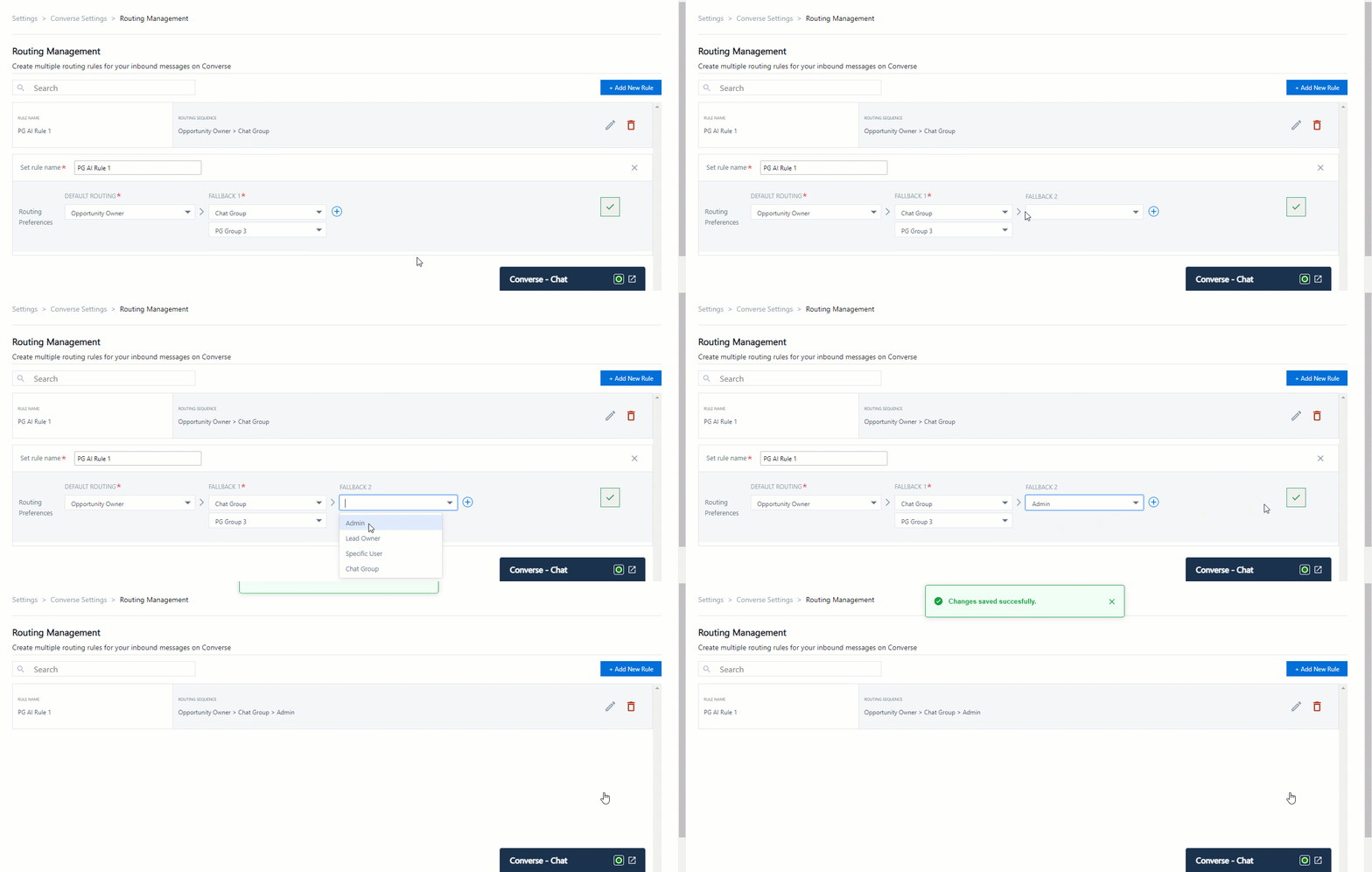
Opportunity Routing Management


5. Opportunity Mapping

Map incoming messages for the Opportunity Type to the relevant Business Number. You can configure auto-responses when the lead sends a message. Lastly, we will apply the routing rules to route each Opportunity to the correct user/chat group.

5.1 Connect to Opportunities

Here, you can connect different Opportunity Types to your Business Numbers. For example, you can map the Opportunity Types Postgraduate Course and Undergraduate Course to a single business number, and map an Opportunity Type Education Loan to a separate Business Number.

In our example, we will be mapping the Postgraduate Opportunity Type to a Business Number. Further, under the Postgraduate Opportunity Type, we will select only AI and Data Science course enquires to be routed to this number.

  1. Navigate to My Profile>Settings>Converse, and select Number Rule Mapping.
  2. From the Select Mapping Type to Continue dropdown, select Map to Opportunity.
  3. Click on Map Opportunities.
  4. On the Connect to Opportunities step, select a Business Number.
  5. Map an Opportunity Type to this Business Number.
  6. Further, you can also specify the Opportunity Fields (of dropdown datatype) and Opportunity Value(s). For example, If the Opportunity Type is Postgraduate Courses, and you have multiple listed courses, you can specify which ones will be routed to the Business number.
  7. Click Next.

Opportunity Converse

Note: You can add multiple Opportunity Types to a Business Number by clicking the converse opp multi fallback icon.

converse opp mapp multiple

5.2 Set up Autoresponses

Autoresponses are WhatsApp messages sent to your leads that present them with a list of options (Opportunities) to choose from. They allow leads to raise new inquiries (create new opportunities) or discuss an existing opportunity.

There are 3 settings to select and configure in this step –

  • Creates New Opportunity – When a lead without existing Opportunities sends an incoming message, this option will automatically create a default Opportunity Type you have selected.
  • First Response Message – The First Response Message shows a list of Opportunities for the lead to select. The lead can engage to specify which Opportunity they are interested in, and based on their response, they will be routed to an appropriate user.

first auto response

  • Second Response Message – The Second Response Message is useful when a lead with multiple existing Opportunities sends an incoming message. After the lead makes a selection in the First Response Message, the Second Response Message will trigger so the lead can specify which existing Opportunity they want to discuss. Or, they can choose to enquire about something else. Based on their response, they will be routed to the Opportunity Owner, or a specific user. In the example below, the Second Response Message shows a list of existing Opportunity Owners the lead can choose from.
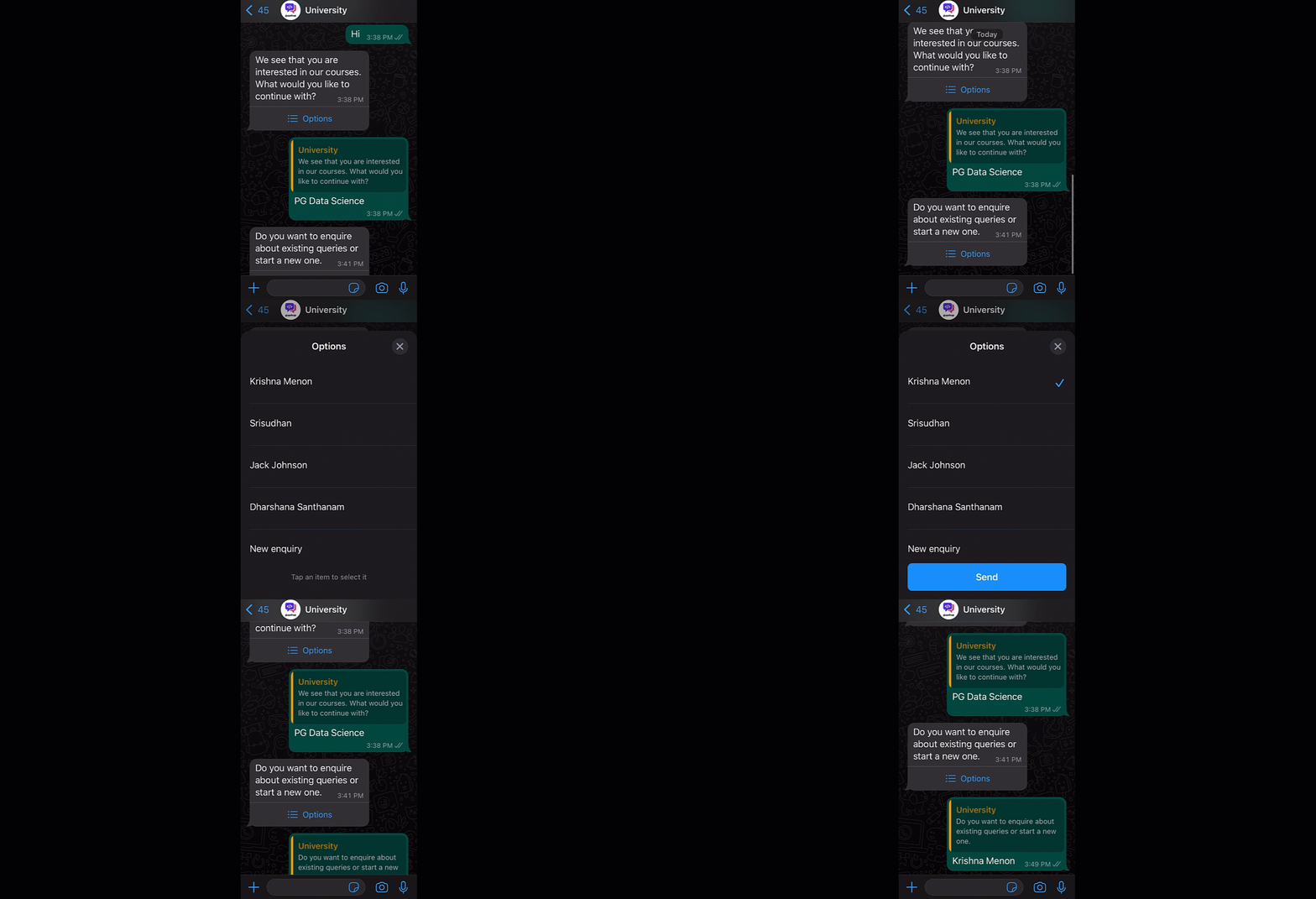
second response message

5.2.1 Creates New Opportunity

When a lead without existing Opportunities sends an incoming message, this option will automatically create a default Opportunity Type you have selected.

Note: If you enable this option and select a default Opportunity type, you don’t need to configure the first and second response messages. Every time a lead sends a message, the opportunity will be auto-created in LeadSquared. However, if you have multiple opportunity types that you want to present to leads (and separate routing flows for each of them), we recommend you set up the first and second response messages.

In our example, when a lead sends an incoming message we will automatically create a Postgraduate Opportunity Type against the lead.

  1. Select Creates New Opportunity.
  2. Select the Opportunity Type that must be created under Select Default Opportunity Type.
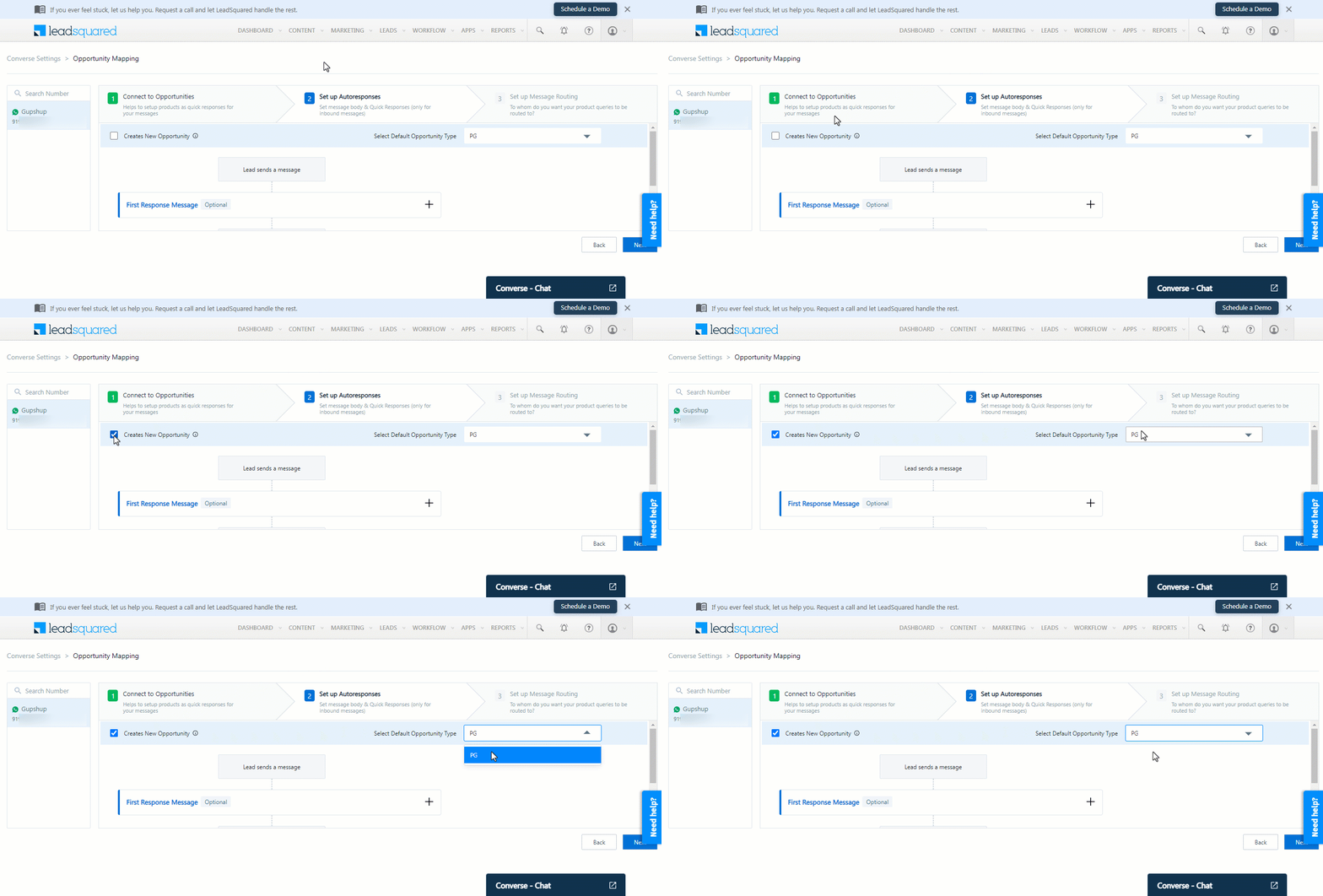
converse opp create new opp autores 1

5.2.2 First Response Message

If configured: When a lead sends an incoming message, the First Response Message will trigger and ask the lead to select from a list of Opportunities. Based on the selection, the lead will be routed to the appropriate user or chat group.

In our example, when a lead sends an incoming message, they will be asked to choose between an AI postgraduate course or a Data Science postgraduate course.

Note:

  • If you select Creates New Opportunity (refer to section 6.2.1) and also configure the First Response Message, then an Opportunity will be automatically created based on the Opportunity the lead has selected in the First Response Message instead of the Default Opportunity Type.
  • If Creates New Opportunity is not selected, and the First Response Message is configured, then the user will have to manually create the Opportunity against the lead.
  1. Click on the configure first and second response icon to configure the First Response Message. A preview of your First Response Message will be displayed on the right-side panel.
  2. Display option as
    • List – Select this option if you want the quick responses (Opportunities) to be displayed as a list that is selectable.
      • Add list header – Enter the header name for the list.
    • Button – Select this option if you want the quick responses (Opportunities) to be displayed as button(s) that are clickable. You can only accommodate 3 quick responses. For more than 3 responses, the display option will change to a List view.
  3.  Add Message
    • Message Header – Add a header for your message, this step is optional.
    • Message – Add a message.
    • Message Footer – Add a footer for your message, this step is optional.
  4. Add Quick Responses – Once configured, Opportunities mapped with the Business Number (refer to section 6.1) will be listed as quick response options.
    1. Click on + Add Responses.
    2. From the drop-down, select the fields to be mail-merged.
  5. Add “Other queries” as an action – If you select this option, an additional quick response will be added. This can be selected by leads who cannot find the product they are looking for. You can create a specific routing rule for these leads to be routed to a different user/Chat Group (refer to section 5).
    • Option Label – You can edit the text for the additional quick response.
converse opp first response1

5.2.3 Second Response Message

The Second Response Message will trigger in the following case –

If the First Response Message is configured, and a lead with multiple existing Opportunities sends an incoming message, the First Response Message will trigger first. Once the lead submits a selection, the Second Response Message will trigger. Here, the lead can specify which one of the multiple existing Opportunities they want to discuss.

For example, if a lead has 3 existing Opportunities (one for himself, and two others for his siblings), and the lead selects AI in the First Response Message, then in the Second Response Message, he can specify if he wants to discuss his existing Opportunity, or the existing Opportunity of one of his two siblings.

Note: If the First Response Message is configured, and a lead with a single existing Opportunity (for example, AI) sends an incoming message, the First Response Message will trigger. The lead can then select an Opportunity (for example, AI) after which the lead is directly routed to the relevant Opportunity Owner. The Second Response Message will not trigger, since there’s only one opportunity.

The configuration for the Second Response Message is similar to the First Response Message (refer to section 6.2.2), but with an additional setting –

  • New Opportunity – This setting allows the lead to enquire about a different product apart from their existing Opportunity.
    • Edit Label – Enter a quick response label for the New Opportunity.
Note: Here, when you configure the Add Quick Responses option, you can map the lead’s existing Opportunities as the existing Opportunity options.
converse opp second response 2

Once you are done configuring the Set up Autoresponses section, click Next.

5.3 Set up Message Routing

In this step, you can route each Opportunity to the respective user(s). Under the Set Routing Rule dropdown, select a rule for each Product or Opportunity Types (these rules were created in section 5). Once done, click Submit.
converse opp message routing

Note: If you have selected the Creates New Opportunities setting (without configuring First or Second Response Message) or the Other queries action, then you can create a separate routing rule and apply it to them.
create new opp route


Any Questions?

Did you find this article helpful? Please let us know any feedback you may have in the comments section below. We’d love to hear from you and help you out!

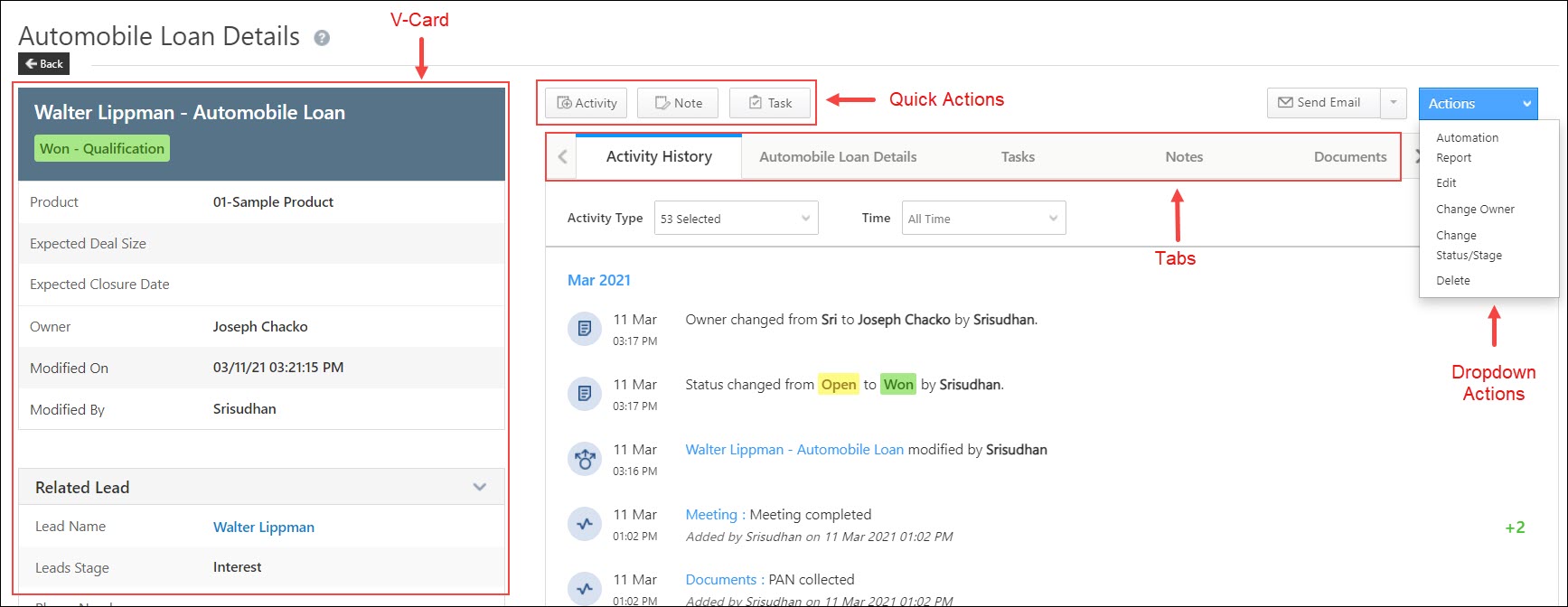
Integrating Azure AD with LeadSquared Using the ROPC Approach

1. Feature Overview

LeadSquared offers sign-in integration with Azure Active Directory services, using the Resource Owner Password Credential (ROPC) approach. After integration, you won’t need to manage a separate set of credentials for LeadSquared, and can log-in directly with your AD credentials. This integration will also enable you to seamlessly sign in to the LeadSquared mobile app as well.

For information on other ADFS integrations, see ADFS Integration for Signing in to LeadSquared.

Note: When you enable ADFS integration, it is applied by default to all the users in your account. It CANNOT be disabled for specific users.


2. Prerequisites

  • You must have a Microsoft Azure Active Directory.
  • You must be an Administrator of your LeadSquared account.
  • You must use the same email Id on Azure and LeadSquared.
  • You must have the API authentication provider enabled on your LeadSquared account. To enable it, please reach out to support@leadsquared.com.


3. How it Works

  1. Create an application on Azure.
  2. Grant application access on Azure.
  3. Set up authentication on LeadSquared
  4. Test the application on LeadSquared.


4. Create an Application on Azure

Create a new non-gallery application on Azure.

  1. Navigate to the Microsoft Azure portals home page, and under Manage Azure Active Directory, click View.
  2. On the left panel, click Enterprise applications.
  3. On the Enterprise applications page, click New Application.
  4. From the available option, click Non-Gallery Application.
  5. Provide an appropriate name for the application, and click Add.

Azure


5. Authenticate Azure Application

To grant application access to the new application you created –

  1. On the Microsoft Azure portals home page, under Manage Azure Active Directory, click View.
  2. On the left panel, click App registrations.
  3. On the App registrations page, click All applications.
  4. Under Display Name, click the application you’ve created.
  5. On the application page, on the left-panel, click Authentication.
  6. On the Authentication page, scroll down to Advanced Settings, and against Default client type, click Yes.
  7. Once you’re done, click Save.

Azure


6. Application Permissions on Azure

6.1 Grant Permissions

To grant application permissions to the new application you created –

  1. On the Microsoft Azure portals home page, under Manage Azure Active Directory, click View.
  2. On the left panel, click App registrations.
  3. On the App registrations page, click All applications.
  4. Under Display Name, click the application you’ve created.
  5. On the application page, on the left-panel, click API permissions.
  6. On the API permissions page, click Add a permission.
  7. On the Request API permissions pop-up, click Microsoft Graph, and then click Delegated permissions.
  8. Under Permissions, click the Azure Checkbox checkbox against email and openid.
  9. Once you’re done, click Add permissions. This will successfully grant permissions.

Azure

6.2 Grant Admin Access

To grant admin access to the new application you created –

  1. Navigate to the API permissions page, and click Grant admin consent for LeadSquared.
  2. On the confirmation pop-up, click Yes. This will successfully grant admin access.

Azure

6.3 Add Users

To add your LeadSquared users on Azure –

  1. On the Microsoft Azure portals home page, under Manage Azure Active Directory, click View.
  2. On the left panel, click Enterprise applications.
  3. On the Enterprise applications page, under the Name column, click the application you’ve created.
  4. On the application Overview page, under Getting Started, click Assign users and groups.
  5. On the Users and groups page, click Add user.
  6. On the Add Assignment page, click Users, then select from the list of users available on the right panel, and click Select.
  7. Once you’re done, click Assign. The user is now successfully added.

Azure


7. Authenticate Azure Application in LeadSquared

To authenticate the application you’ve created on LeadSquared-

7.1 Obtain the Client Id from Azure

To obtain the client Id for the application you’ve created –

  1. On the Microsoft Azure portals home page, under Manage Azure Active Directory, click View.
  2. On the left panel, click App registrations.
  3. On the App registrations page, click All applications.
  4. Under Display Name, click the application you’ve created.
  5. On the application page, click Endpoints.
  6. Under OAuth 2.0 token endpoint (v2), click the Azure icon to copy the token.

Azure

7.2 Authentication on LeadSquared

To authenticate and activate your Azure application on LeadSquared –

  1. From your LeadSquared main menu, navigate to My Profile>Settings>Security>Authentication Provider.
  2. Against Enable Third Party Authentication Provider, toggle the enable icon slider.
  3. On the Choose Authentication Provider pop-up, select Generic API.
  4. On the Configure Authentication Provider pop-up, enter the details of the Azure API.
Field
 
Description Sample Value
Request Type Choose HTTP request method as POST. This is a mandatory field. NA
API URL Select either http:// or https:// and enter your Azure API OAuth 2.0 token endpoint (v2) URL here. This is a mandatory field. NA
Content Type Select “application/x-www-form-urlencoded” as the content type. This is a mandatory field. NA
Request Headers You can pass multiple request headers here. This is not a mandatory field. NA
Request Body Pass the following key-value pairs in the request body.
client_id The Azure application client id. This is available on the application page, and is called Application (client) ID. a2ae67ff-test-example
grant_type
This is the grant type to capture the password you’ve used to log in to your Azure account.

You must pass the value password

password
username This is the mailmerge value of the email address you’ve used to log in to your Azure account. The mailmerge field will be replaced with the actual email address when you log in. @{User:EmailAddress,}
password This is the mailmerge value of the password you’ve used to log in to your Azure account. The mailmerge field will be replaced with the actual password when you log in. @{User:Password,}
scope Scope must be specified as openid openid
response_type The type of response must be specified as token token
Success Keyword This is the success keyword that will show up in a successful response. This is a mandatory field.

You must pass the value access_token

access_token
Error Keyword The error keyword that will show up in an unsuccessful response. This is a mandatory field.

You must pass the value error

error

Azure

7.3 Test the Application on LeadSquared

  1. Once you’re done entering the values, click Test.
  2. Enter the password you used to login in to Azure on the verification screen, and click Next.
  3. Once you get the success message, click Enable.
  4. On the Enable Authentication Provider confirmation pop-up, click Yes.
  5. The Azure authentication provider is now enabled on your account. Users can now login to LeadSquared using their Azure AD credentials.

Azure


Any Questions?

Did you find this article helpful? Please let us know any feedback you may have in the comments section below. We’d love to hear from you and help you out!
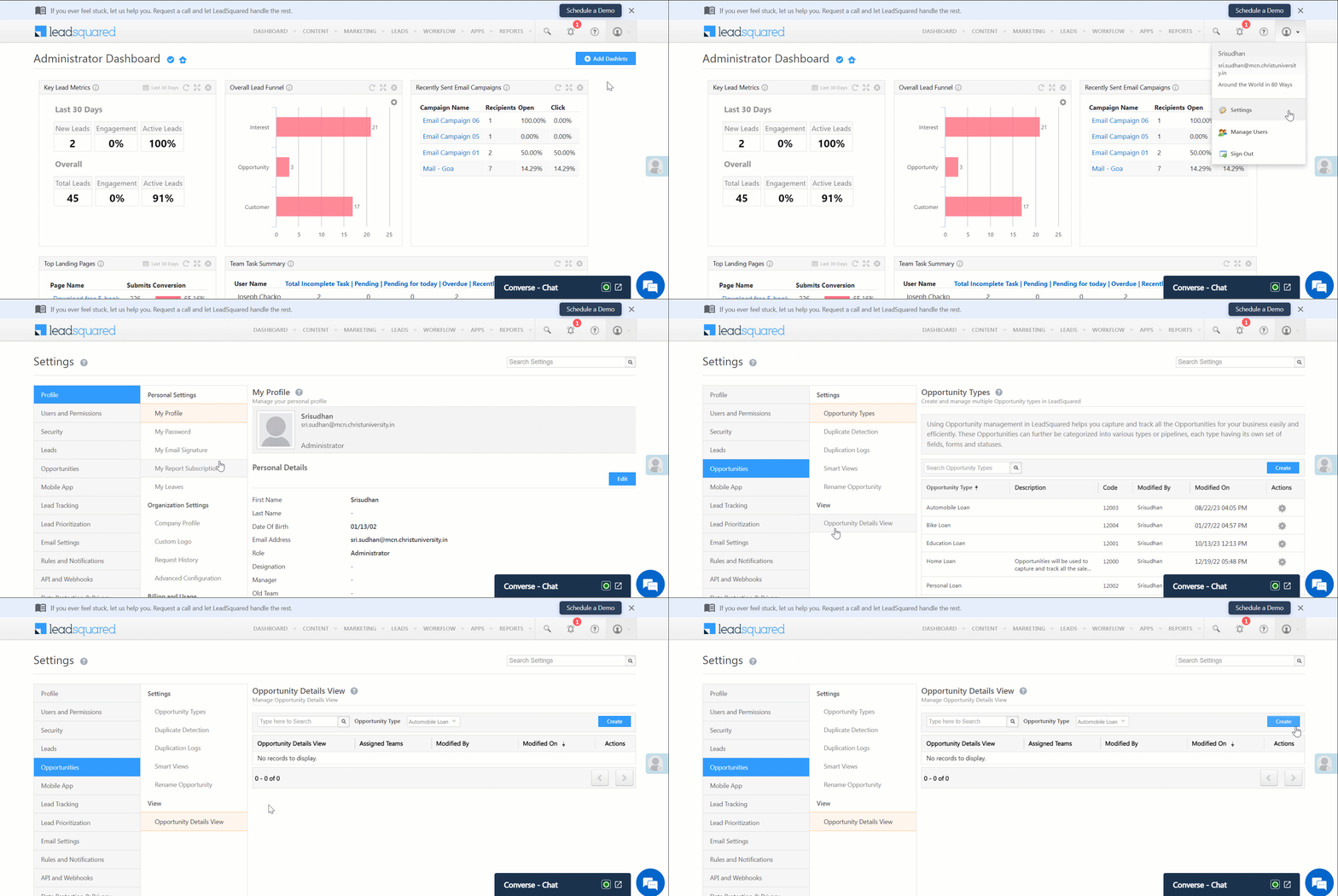
Opportunity Integrations in Telephony

1. Feature Overview

The Opportunities feature can be used to manage your potential deals. Opportunities can now be integrated with the LeadSquared Generic Telephony ConnectorOzonetel v2 Connector and the Ameyo Connector.

Additionally, you can also integrate opportunities with the Universal Telephony Connector, by adding an instance of the LeadSquared Generic Telephony Connector or the Ozonetel v2 Connector. This will enable you to track phone call interactions with your leads, for each opportunity or potential deal. Once the call is completed, a call activity, with all the call details, is posted on the Opportunity Details page.


2. Prerequisites

  • You must be the Administrator of your account.
  • You must have opportunities enabled in your account. To enable opportunities in your account, please reach out to your account manager, or write to support@leadsquared.com.
  • From the Advanced Configuration settings page, the Enable Opportunity – Telephony setting must be enabled. To know more, please refer to Organization Settings – Advanced Configuration.
  • The Opportunity Telephony Mapping must be enabled on your account. To enable this setting, please reach out to your account manager, or write to support@leadsquared.com.
  • You must have either the LeadSquared Generic Telephony Connector, the Ameyo Connector or the Ozonetel v2 Connector installed in your account.


3. How it Works

To integrate opportunities with your telephony providers –

  1. Map your telephony provider’s virtual number to opportunity types in your account.
  2. Configure the telephony connector in LeadSquared.
  3. Create an agent pop-up form to capture inbound/outbound call details.

Once steps 1-3 are completed successfully, your phone call activities will now be tracked against the relevant opportunity. The activities can be viewed on the Opportunity Details page.


4. Virtual Number Mapping

As part of this configuration, you must map your virtual numbers to specific opportunity types. Let’s understand this better with the example of a bank.
The bank offers credit cards, debit cards and loans, each of which is an opportunity type. In this scenario, one unique virtual number is mapped to each opportunity type. This helps keep track of phone calls related to each opportunity.
To map your virtual number to an opportunity type –
  1. From the main menu, navigate to My Profile>Settings>Opportunities>Telephony.
  2. On the Add Mapping pop-up –
    1. Against Virtual Number, enter the virtual number of your telephony service. This field is mandatory.
    2. If there’s an IVR number you want to list, then against IVR Number, enter the number.
    3. From the Opportunity Type dropdown, select the opportunity type to which you want to map the virtual number.
  3. Once you’re done, click Save. If you want to add more agents or add telephony to different opportunity types, then click Save and Add New.

Opportunity Integrations in Telephony_1


5. Configuration

You can configure the opportunity integration in the LeadSquared Generic Telephony Connector and Ozontel v2 Connector. The following configuration steps are common for both the connectors –

  1. From the main menu, navigate to Apps>Apps Marketplace, and search for either the LeadSquared Generic Telephony Connector or the Ozonetel v2 Connector.
    • Alternatively, you can find both the connectors on the left panel, under Telephony.
  2. Against the connector name, hover your cursor over the icon, and click Configure.
  3. On the pop-up, click Call Route API, and copy the Opportunity Route API. For both the connectors, call this API to route calls directly to the opportunity owner.
  4. All the other steps remain the same, as detailed in the documentation links given above.

Opportunity Integrations in Telephony_2


6. Share Opportunities via Agent Pop-up

When configuring the Telephony Agent pop-up, you may want to grant access to opportunity details to users that are not opportunity owners. This allows them to have the relevant information available on the pop-up while conversing with leads.

Navigate to Settings>Telephony Settings>Entity share via popup and click on Configure to Enable opportunity share via agent pop-up.

telephony opportunity share

The configuration will have the following permission settings –

  • Enable – Select to enable the configuration.
  • Access Type – Define the access type for the configuration –
    • View – Non-lead owners can only view the lead details.
    • Modify – Non-lead owners can view and modify the lead details.
  • Duration In Min – Specify the duration (in minutes) of lead share allowed while the agent is on the call.

telephony opportunity share permission


7. Create Agent Pop-Up Form

Once you’ve configured the connector, you must create an agent pop-up form to enable users to capture opportunity details while on call with your leads. This will ensure that the call is mapped to the correct opportunity type, and all the relevant lead details are captured on the call. To do this, you’ll first have to create a form, then, create and publish a process, to integrate the form with the agent pop-up for incoming and outgoing calls.

7.1 Create Form

  1. From the main menu, navigate to Workflow>Manage Forms, and click Create Form.
  2. On the Create Form pop-up, under Choose the type of fields to use, you must select Opportunity Fields.
    • You can also select other fields, but the Opportunity Fields are mandatory.
  3. Then, from the Select Opportunity dropdown, select the opportunity type for which you’re creating the form.
  4. Now add the opportunity fields you want to capture using the agent pop-up during your phone calls.
  5. On the form designer, ensure that all the relevant opportunity fields (such as Associated Lead, Opporrtunity Name, Owner, Status and Stage) are present in the form. For the subsequent steps on creating the form, please refer to How to Create a Form.
  6. Once you’re done, click Publish.

Opportunity Integrations in Telephony_3

7.2 Create a Process

  1. From the main menu, navigate to Workflow>Process Designer, and click Create Process.
  2. On the Where do you want to start the process pop-up, select At Specific Work Area.
  3. On the Choose starting point pop-up, click Others. Under Available Work Areas>Telephony>Agent Popup, you must select Inbound Phone Call and Outbound Phone Call by clicking the . Once you’re done, click Save.
  4. Then, click Add process. From under Actions, click Show Form.
  5. On the Show Form, from the Select Form dropdown, select the form that was created in the previous step. To complete the rest of the process, please refer to How to Create a Process.
  6. Once you’re done, click Publish.

Opportunity Integrations in Telephony_4

Note: You can also select the Multi If/Else User condition. By doing this, you can set conditions to choose which users you want to show the pop-up to.


8. Capture Phone Calls Details

Once the agent pop-up form is published, you can now capture inbound and outbound call details on the form.

8.1 Outbound Phone Calls

To place an outbound call, and capture details –

  1. From the main menu, navigate to Leads>Manage Opportunities>Opportunity Type.
  2. On the Manage Opportunities page, under Enquiry, click on the desired opportunity.
  3. On the Opportunity Details page, under Related Lead, click the lead’s phone number.
  4. On the Confirm pop-up, click Ok. This will open the agent pop-up. Fill in the necessary details here.
  5. Once you’re done, on the pop-up, click Save.

Telephony integration for opportunities

Alternative Implementation

If you prefer to not use the pop-up form, you can alternatively pass the opportunityTelephonyMappingId code in the Click 2 Call URL, and then pass the value for this parameter in the Call Log API, to ensure the call is logged. To do this –

  1. On the configuration screen of a connector (on which the pop-up form is not configured), open the Click 2 Call tab.
  2. In the URL field, at the end of the existing URL, add the following parameter – &opportunityTelephonyMappingId=@opportunityTelephonyMappingId. This will mailmerge the opportunity telephony mapping Id when the Click 2 Call API is being called.
  3. Once you’re done, click Save.

Opportunities Telephony in LeadSquared

iv. Next, pass the @opportunityTelephonyMappingId (received from the Click 2 Call API) as a key-value pair in the post-body of the Call Log API.

Opportunities Telephony in LeadSquared

The outbound calls will now be logged automatically.

Note: Instead of opportunityTelephonyMappingId, you can now directly use the OpportunityId in the Click2Call URL and in the post data of the Call Log API. This allows the activity to be posted directly on the respective opportunity.

8.2 Inbound Phone Call

An inbound call will trigger the agent pop-up on any page within LeadSquared. On the agent pop-up, fill in the necessary details, and then click Save.

Telephony integration for opportunities


9. Telephony Logs

To view the telephony logs of all the opportunity related calls in your account, navigate to My Profile>Settings>Opportunities>Telephony.

Opportunities in LeadSquared


10. Points to Note

  • You must place a call to an opportunity from the Opportunity Details page in order for the phone call activities to be posted against the opportunity. If a call is placed to the related lead from the Lead Details page, then the opportunity details will not get captured, and the phone call activity will be posted against the lead.
    Once the call is complete, you can view the phone call activity on the Opportunity Details page.

Opportunity Integrations in Telephony_5

  • If an agent doesn’t select an opportunity type from the agent pop-up, then information collected on the call is posted only on the lead, and not the opportunity.


Any Questions?

Did you find this article helpful? Please let us know any feedback you may have in the comments section below. We’d love to hear from you and help you out!
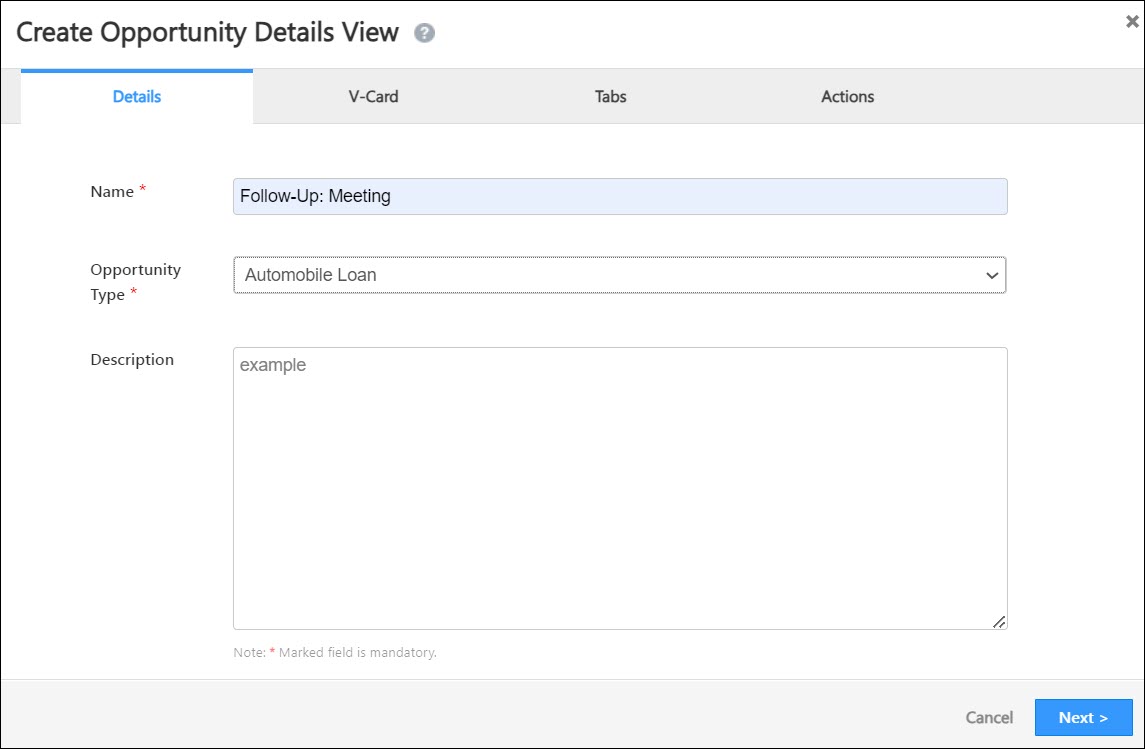
LeadSquared Portal Designer – Create Sign Up Forms

1. Feature Overview

You can use LeadSquared forms to create registration forms (sign-up forms) on your portals. Once you create a registration form and integrate it into the Portal Designer, you can configure it to appear in different states to provide registration, login, forgot password, and reset password functionality.

The most basic registration form consists of a username/email address/phone number field and a set password field, but you can build more complex registration forms as per your requirements.

LeadSquared Portals Signup Form


2. Prerequisites

  • You should be an administrator of your LeadSquared account.
  • You must have access to the Portal’s license.
  • Forms and Processes must be enabled on your LeadSquared account.


3. How it Works

  1. First, create a portal registration form using the Forms feature.
  2. Next, integrate the form in your portal and customize its look, feel and behaviour.


4. Types of Portal Registration Forms

Portal registration forms can either have Password-based registration/log-in or OTP-based registration/log-in.

4.1 Password-based Registration Forms

Password-based registration forms can be displayed in the following ‘states’ on your portal –

  • Register – This state appears when the lead registers on your portal for the first time. All fields added to your form will be visible in this state. Here, the lead must enter their details and provide a password for their profile.

LeadSquared Portals Signup Form

  • Login – If a lead has already registered on the portal, they can click the “Already have an account? Login” link. The registration form will now be displayed in the login state, where only the unique field configured (such as email Id, PAN, mobile number, Student Id, Customer Id, etc.) and password field will be visible.

LeadSquared Portals Signup Form

  • Forgot Password – If the lead forgets the password they provided at the time of registration, then they can reset the password by clicking the ‘Forgot Password’ link on the form. This will open the Forgot Password state, where the lead must provide the unique login field details (such as email Id, PAN, mobile number, Student Id, Customer Id, etc.), which you have configured as the search key on the form. The system will then identify the email Id linked to this search key, and send a reset password link to that email Id. The lead must click on this link, and provide a new password. To modify the content sent in the forgot password email, see the Email Settings section under LeadSquared Portals Designer.

LeadSquared Portals Signup Form

  • Reset Password – The link sent to the lead’s email Id, when the lead has clicked on Forgot Password, will open the Reset Password state. Here, the lead must enter a new password for their account, and save the password once they’re done.

LeadSquared Portals Signup Form

4.2 OTP-based Registration Forms

OTP-based registration forms can be displayed in the following ‘states’ on your portal –

Note:

  • For the OTP-based registration and login to work in your Registration Form, you must enable OTP Validation on either the Email field or the Phone Number field, while creating the form.

LeadSquared Portals Signup Form

  • You must enable Register with OTP under Portal Settings, while creating the form.

LeadSquared Portals Signup Form

  • Register – This state appears when the lead registers on your portal for the first time. All fields added to your form will be visible in this state. Here, the lead must enter the OTP sent to their email Id or phone number.

LeadSquared Portals Signup Form

  • Login – If a lead has already registered on the portal, they can click the “Already have an account? Login” link. The registration form will now be displayed in the login state, to (on whichever filed the OTP Validation has been enabled) and OTP field will be visible.

LeadSquared Portals Signup Form


5. Create a Portal Registration Form

Forms can be used to create a login to your portal, by enabling password or OTP functionalities. You can also prevent junk leads and spam submissions by enabling the captcha functionality.

5.1 Enable Password and Captcha

  1. From the main menu, navigate to Workflow>Manage Forms.
  2. You can select an existing form, or create a new form by clicking Create Form. To know more, refer to How to Create a Form.
  3. On the left panel, under Special Fields, click the  icon against the Captcha and Password fields to add them to your form.
  4. On the Forms Designer page, click the Settings icon.
  5. On the Portals Settings tab, against Portal Registration Form, enable theenable icon slider.
  6. Against Search Key for Portal Registration, select a unique field (such as email or phone number). To know more, refer to How to Make a Custom Field Unique.
    Note: The search key can be any unique field in your account, which acts as the identifier for your lead’s login. For example, if your search key is set to email, then their email address would be used as their identifier (similar to a username).
  7. Once you’re done, click Publish.

Portal

5.2 Enable OTP and Captcha

  1. From the main menu, navigate to Workflow>Manage Forms.
  2. You can select an existing form, or create a new form by clicking Create Form. To know more, refer to How to Create a Form.
  3. You must add either the Phone Number or Email address field to your form. Then, click the unique field that you’ve added, and then click Validation Properties on the right side of your screen. Against Required and OTP Validation, enable the enable icon sliders.
  4. You can also choose to enable a dual-login form. You must add either Email/Phone Number or Email/Mobile Number fields to your form. Then, click the unique fields that you’ve added, and then click Validation Properties on the right side of your screen. Against Required and OTP Validation, enable the enable icon sliders for both unique fields.
  5. On the Forms Designer page, click the Settings icon.
  6. On the Portals Settings tab, against Register with OTP, enable theenable icon slider.
  7. Against Search Key for Portal Registration, select a unique field (such as the email or the phone number). To know more, refer to How to Make a Custom Field Unique.
    Note: The search key can be any unique field in your account, which acts as the identifier for your lead’s login. For example, if your search key is set to email, then their email address would be used as their identifier (similar to a username).
  8. Once you’re done, on the left panel, click the  icon against Captcha, to add it to your form.
  9. Once you’re done, click Publish.

Portals

Note: If required, you can enable password as well as OTP fields.

When you’re done, click Publish to make your form live. Published forms can be used in the Portal Designer. You can also set up an application process using a series of forms through the process designer.

sign up form


6. Integrate the Form in the Portals Designers

On the Portal Designer page, click the Elements icon LeadSquared Portal Elements, and then drag-and-drop the Signup Form.

To learn how to build a portal, please refer to LeadSquared Portals Designer.

LeadSquared Portals Signup Form

Under General, under LSQ Form, select the registration form you created in the previous section.

integrate registration form in portals


7. Customize Signup Form

The Signup Form can be customized using the following properties –

7.1 General

  • LSQ Form – From the list of published LeadSquared forms in your account, select the form you want to use as the Signup Form on your Portal.
  • Form Design – There are three default form designs available in the Portal Designer. You can select a relevant design from the Form Design dropdown.
  • Default State of form – Set the default form state as either Registration (sign-up) form or Login form, depending on how the portal is being used. For new portals, the default state can be set to ‘Registration form’, while for existing portals with a significant number of existing users, you can set it to ‘Login form’.
  • Show Form Title – To show the title of the form on your Signup Form, toggle the enable icon slider.
  • Show Tabs / Navigation – To show the tabs that hold the sections in a form, and to show navigations between different tabs in the form, toggle the enable icon slider.
  • Show Section Names – To show the names of each section within the form, toggle the enable icon slider.
  • Accent Color – Select the font colour for section headers and buttons from the gradient screen, or enter the hex code for a specific colour.
  • Font – From the dropdown, select the font you want to display on the form.

LeadSquared Portals Signup Form

7.2 States

  • Selected State – Depending on how the Portal Registration form was configured, you can configure the various actions available on the form, such as Register, Login, Forgot Password and Reset Password.
  • Enable Dual Login – Allow your lead to log in using Email and Mobile/Phone number
    • Default Mode  – Choose to enable login through password or OTP.
  • Action on Successful submission – You can configure the following actions on a successful form submission –
    • Open External Link – Add an external link, and configure if it opens in the same tab or a new tab.
      • Link – If you choose Open External Link as the Action on Successful submission, then add the URL of the website you want your lead to be redirected to, when the form is submitted.
    • Link Page – Select the portal page you want the lead to be redirected to on successful submission.
      • Page – From the dropdown, select the page or section you want your lead to be redirected to within the portal, when the form is submitted.
    • Download File – Enable your leads to download a file (like prospectus, etc.) on submission by uploading it here.
      • File – If you choose Download File as the Action on Successful submission, then under File, click Choose File, to choose a file from your Document Library.
      • Use Mail Merge Value – Alternatively, you can mail merge a custom field set (CFS) that contains a file, by selecting the CFS from the dropdown.
    • Based On Rules – This option allows you to set up rules based on the choices a lead makes. For example, if the lead chooses “City” as “New Delhi”, you can set up a condition that redirects the lead to the portal page for leads in New Delhi. Similarly, if the lead chooses “Course” as “B.Tech”, you can set up a condition to download the prospectus form for B.Tech applicants. To set up rules –
      1. From the Actions on Successful submission dropdown, select Based on Rules.
      2. Click Configure Rules, and on the Configure Rules pop-up, rename the rule.
      3. From any dropdown, choose if you want the condition to be any or all, and set up the base rule.
      4. From the Then dropdown, select the action you want to be carried out when the condition is satisfied.
    • None – No action will be taken on successful submission.
  • Query String – You can send the value of a particular field (First Name, Mobile field, etc.), by adding a mail merge parameter here. This will ensure that the field value is carried forward to the subsequent pages that have been configured.
  • Open in New Tab – This is applicable only for Open External Link and Link Page. To open the new page in a new browser tab, on a successful submission of the form, toggle the enable icon slider.
  • Header Text – Enter the form’s title here.
  • Button Text – Enter the submission button’s display text here.

dual login

7.3 Spacing & Dimensions

You can customize the space and dimensions of the entire form, as well as each individual section within the form. To customize a section, click on the outer border of that section.

  • Padding – Set the padding for the form. If you want the padding dimensions to be applicable on all sides of the layout, against All Sides, toggle the enable icon slider.
  • Margin – Set the margin width for the form. If you want the margin to be applicable on all sides of the layout, against All Sides, toggle the enable icon slider.
  • Min Height – Set a minimum height for the form. If you want the height to be applicable on all sides of the layout, against All Sides, toggle the enable icon slider.
  • Max Width – Set the maximum width for the form. If you want the width to be applicable on all sides of the layout, against All Sides, toggle the enable icon slider.

LeadSquared Portals Signup Form

7.4 Border & Radius

  • Border – Set the size, style and colour for the border around the form. If you want the border to be applicable on all sides of the selected layout, against All Sides, toggle the enable icon slider.
  • Color – Set a colour for the form’s border. You can select a colour either from the gradient screen, or enter the hex code for a specific colour.
  • Border Radius – Set the radius for the border around the form. If you want the border radius to be applicable on all sides of the layout, against All Sides, toggle the enable icon slider.

LeadSquared Portals Signup Form

7.5 Background

You can either choose to leave the form’s background blank, or set an image or background colour.

  • To set the background colour, from the dropdown, select Color. Then, choose a colour from the gradient screen, or enter the hex code for a specific colour.
  • To add an image, from the dropdown, select Image. Then, click Choose Image to choose an image from your Image Library.
  • To leave the background blank, from the dropdown, select None.

Portal Designer_E_1.1

7.6 Shadows

Set a shadow for the form.

PDesigner_8

7.7 Advanced

  • Opacity – Set the opacity for the form.
  • Hide on Mobile – To hide this layout on a mobile device, toggle the enable icon slider.

LeadSquared Portals Signup Form

7.8 Typography

Click on any section within the form to access the typography setting.

  • Font – Select the font you want to display in that section.
  • Font Size – Enter the preferred font size for the font in that section.
  • Font Weight – From the dropdown, select how thick or thin you want the font to look.

LeadSquared Portals Signup Form


8. Other Actions

To access the additional actions available on the form, click the form’s outer border.

  • To move up the Signup Form, click LeadSquared Portal Elements.
  • To move down the Signup Form, click LeadSquared Portal Elements.
  • To delete the Signup Form from the page, click LeadSquared Portal Elements.

LeadSquared Portals Signup Form


9. Login Only Forms – Hiding the Registration Form

If you want your portal to display only login forms, you can now hide the registration/sign-up form. Users will be to login, but won’t be able to register.

Note: You must call the Register User Portal API to register new users.

  1. Select the Sign-up form, and on the properties panel, click States.
  2. Choose the Register state.
  3. On the properties panel, navigate down to the Advanced tab.
  4. Enable the Hide Registration Form setting Zoom.
  5. If required, edit the CTA and form title, and publish the portal.

Hide Registration Forms on Portals


10. Troubleshooting

Why Are Dynamic Form Submissions Showing Blank Data, and Form Rules Not Triggering?

  • Issue: Dynamic form submissions are appearing with blank data, preventing form rules from being triggered.
  • Explanation: This issue usually occurs due to the portal’s form behaviour settings. Specifically, when the setting “Form behaviour when lead duplicate detected” is configured as “Don’t update any fields,” the portal blocks any updates to existing lead data, resulting in blank fields in dynamic form submissions.
  • Solution: To resolve this, modify the portal setting to allow field updates when lead duplicates are detected. This will ensure that the dynamic form submissions contain all the necessary data, allowing the form rules to trigger correctly.

Form Changes Are Not Reflecting in the Live Portal

  • Issue: Changes made to a form are not reflecting in the Live Portal. This includes:
    • New fields not appearing or removed fields still showing
    • Form rules and validation updates not applying
    • Changes to form layout not visible
  • Possible Cause: This is not a portal cache issue. By design, any changes made to a form do not auto-update in the live portal. The updates remain in draft until they are manually published.
  • Solution:
    1. Test your changes in the test environment to verify updates before deployment.
    2. Publish the updated form manually to apply the changes to the live portal.
    3. If updates are still not visible, clear browser cache and refresh the portal.


Any Questions?

Did you find this article helpful? Please let us know any feedback you may have in the comments section below. We’d love to hear from you and help you out!

Non-lead Owners Can Create Opportunities Through Dynamic Forms

1. Feature Overview

There are cases where the existing lead might be reaching out to a different Sales User to enquire about a different product. So, a Sales User who is not the lead owner can create an Opportunity on the existing lead through LeadSquared’s Dynamic Form.

Note: This functionality is also available to users on LeadSquared’s Mobile App.

forms opportunity form


2. Prerequisites


3. Non-lead Owners Can Create Opportunities Through Dynamic Forms

Navigate to Settings>Profile>Advanced Configuration and search for Allow Users without lead access to create opportunities. Click Configure

forms allow Users without lead access to create opportunities

You can select two configuration permissions –

  • Allow sales user to create Opportunity on inaccessible leadsSales users can create opportunities on leads they don’t have access to if a correct lead identifier is passed.
  • Allow sales user to update or overwrite lead fields of inaccessible leads – Sales users can update or overwrite lead fields if the correct lead identifier is passed. 

Click Save once you have selected the permissions.

Note: You can select only the first configuration permission, or the first and second configuration permission together. But, you cannot select only the second configuration permission alone.

form opportunity config permission

On your Form, Navigate to Form Settings>Additional Settings and enable Allow Non-lead Owners to create Opportunities by toggling toggle. Once enabled, Overwrite lead field based on unique fields will also enable automatically and it cannot be disabled.
forms opportunity overwrite lead field based on unique field

If you have selected Allow sales user to update or overwrite lead fields of inaccessible leads in the Advance Configuration Settings, then you can select from the three overwrite mechanisms for the Lead Fields on Form submission –

  1. Update All Fields – This will update all the Lead Field values that are present in the Form post the Form submission.
  2. Do Not Update – This will not update any Lead field value post the Form submission.
  3. Update If Empty – This will update Lead field values that are empty at the time of Form submission. 
Note: Permission Template settings will be respected first when overwriting any Lead fields on the Form. If a Permission Template defines a Sales User cannot update Lead Fields, then the field values will be read-only after auto-populating.

form opportunity overwrite lead field mechanism

When an existing lead is recognized on the Form through a unique identifier field (For example, an email or phone number), the Sales User will be presented with an option – Would you like to fill field values? Yes | No. You can hover your mouse over View Details to preview the lead details. Click Yes to auto-populate the fields. On successful Form submission, an Opportunity will be created on the existing lead, and the existing Lead Field details will be updated according to the overwrite mechanism you have specified.

forms opportunity form


4. FAQs

Why is the form not getting submitted when I mark the opportunity task as complete?

  • Issue: When marking an opportunity task as complete, users encounter the error message: “You are not authorized to update the records.” The permissions have already been verified, and the issue does not stem from user permissions.
  • Root Cause: This issue arises when the opportunity owner submits the form, which includes lead, opportunity, and activity fields, but the lead owner is a different user. The user submitting the form does not have edit access to the lead because the lead’s owner is someone else. Although the lead is shared with the user due to the opportunity, the form still attempts to update the lead fields, causing the “You are not authorized to update this record” error.
  • Solution/Workaround: To resolve this, enable the two advanced configurations – Allow sales user to create Opportunity on inaccessible leads and Allow sales user to update or overwrite lead fields of inaccessible leads described above.


Any Questions?

If you have any questions related to forms that weren’t answered here, please leave comments below. We’ll be happy to help!