Integrate SuperBot with LeadSquared

1. Feature Overview

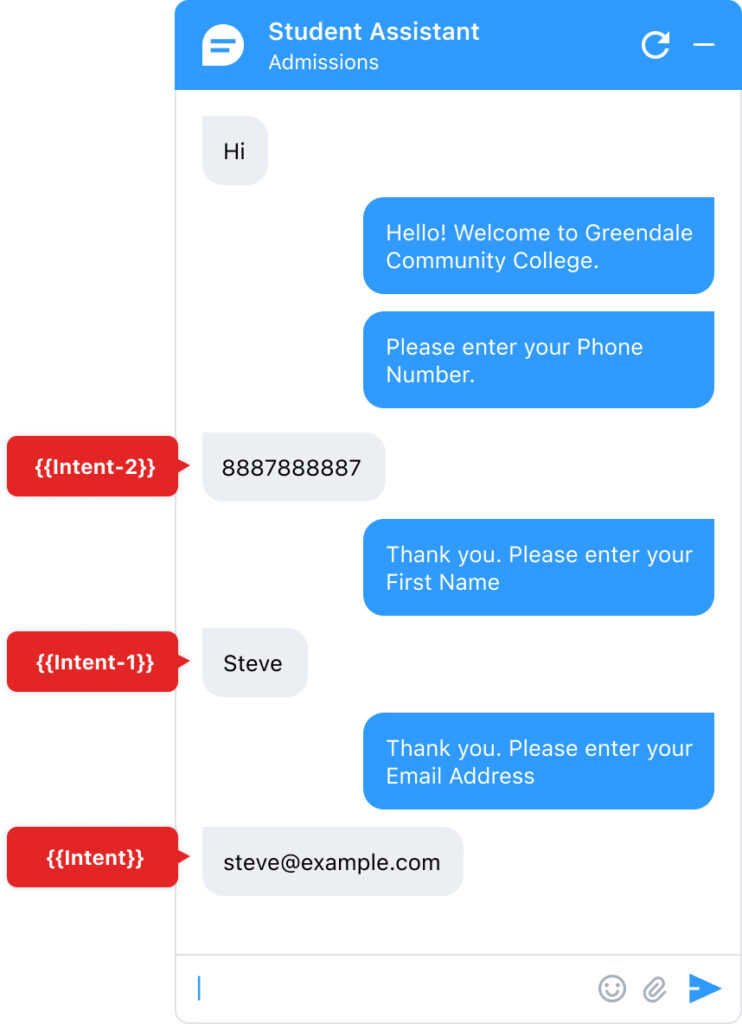
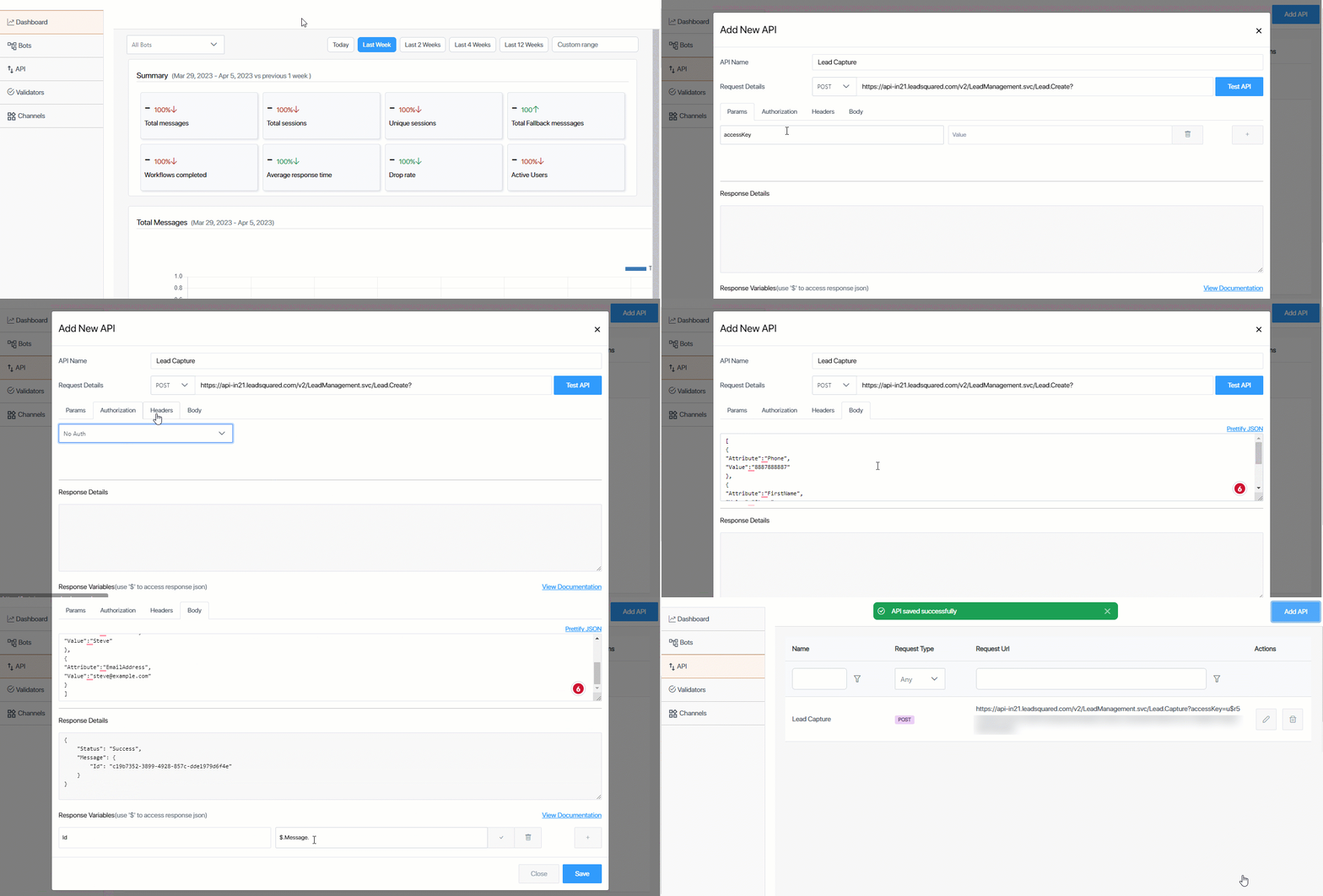
This connector sends lead details like name, phone number, etc., to your SuperBot account.


2. Prerequisites

  • You must be the Administrator of your LeadSquared account.
  • You must have an active SuperBot account.
  • This is a paid feature. To enable it, reach out to your account manager, or write to support@leadsquared.com.


3. How it Works

To push leads from LeadSquared to your SuperBot account, configure the SuperBot connector. Once configured, enable the connector sync.

During the configuration, a webhook URL is generated in LeadSquared. Copy this URL and configure it in your Automation.


4. Installation

You must first install and configure the SuperBot connector.

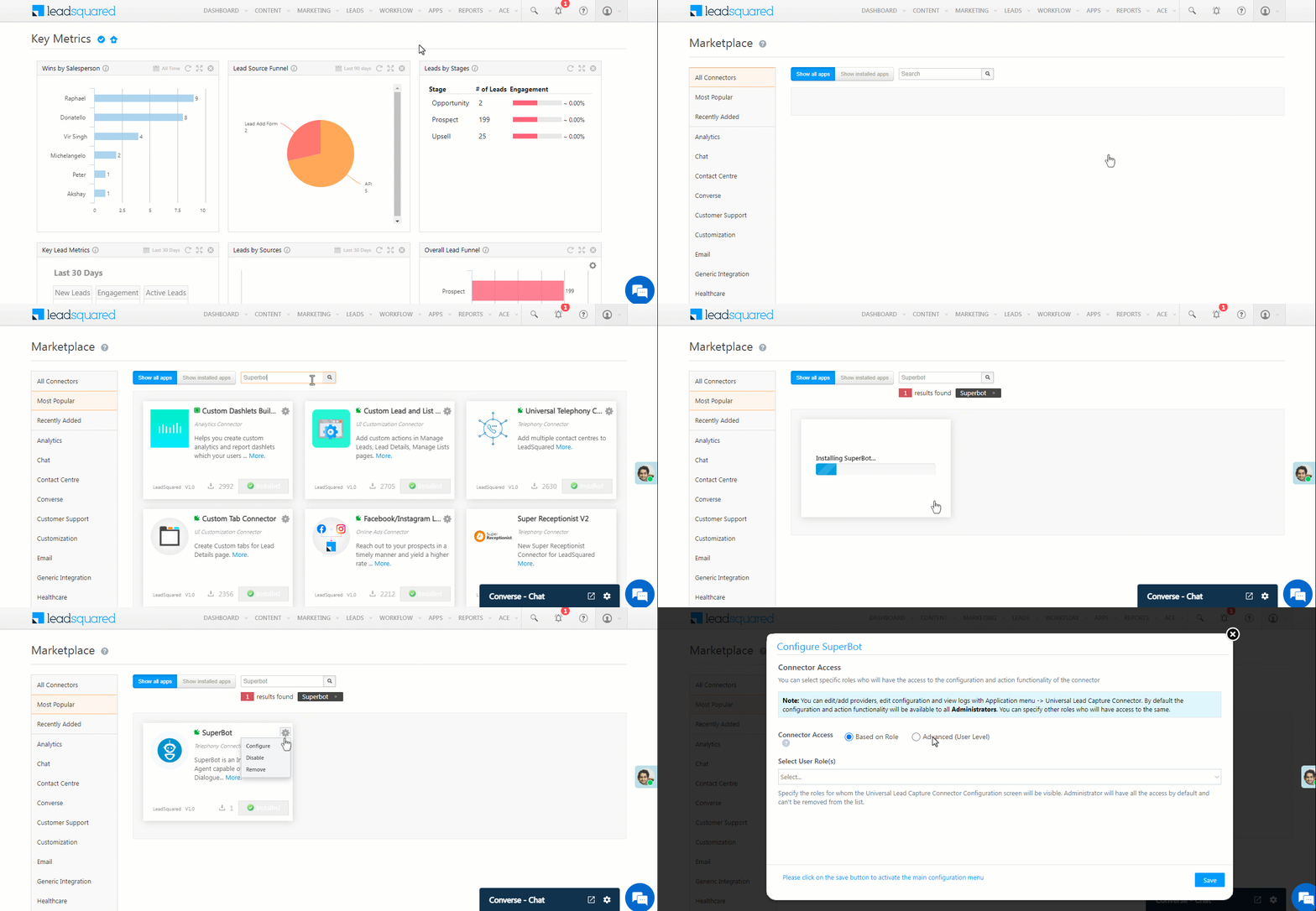
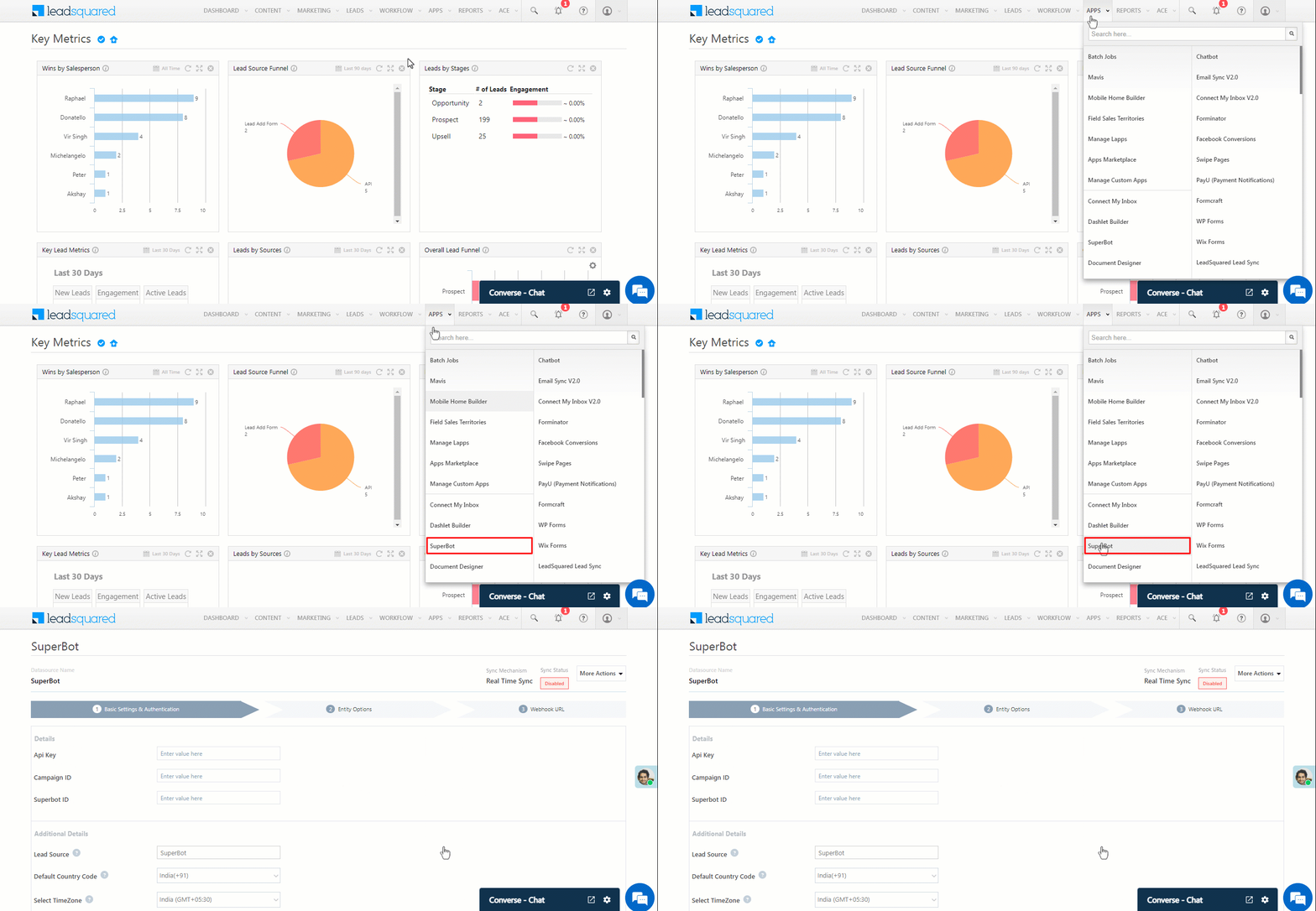
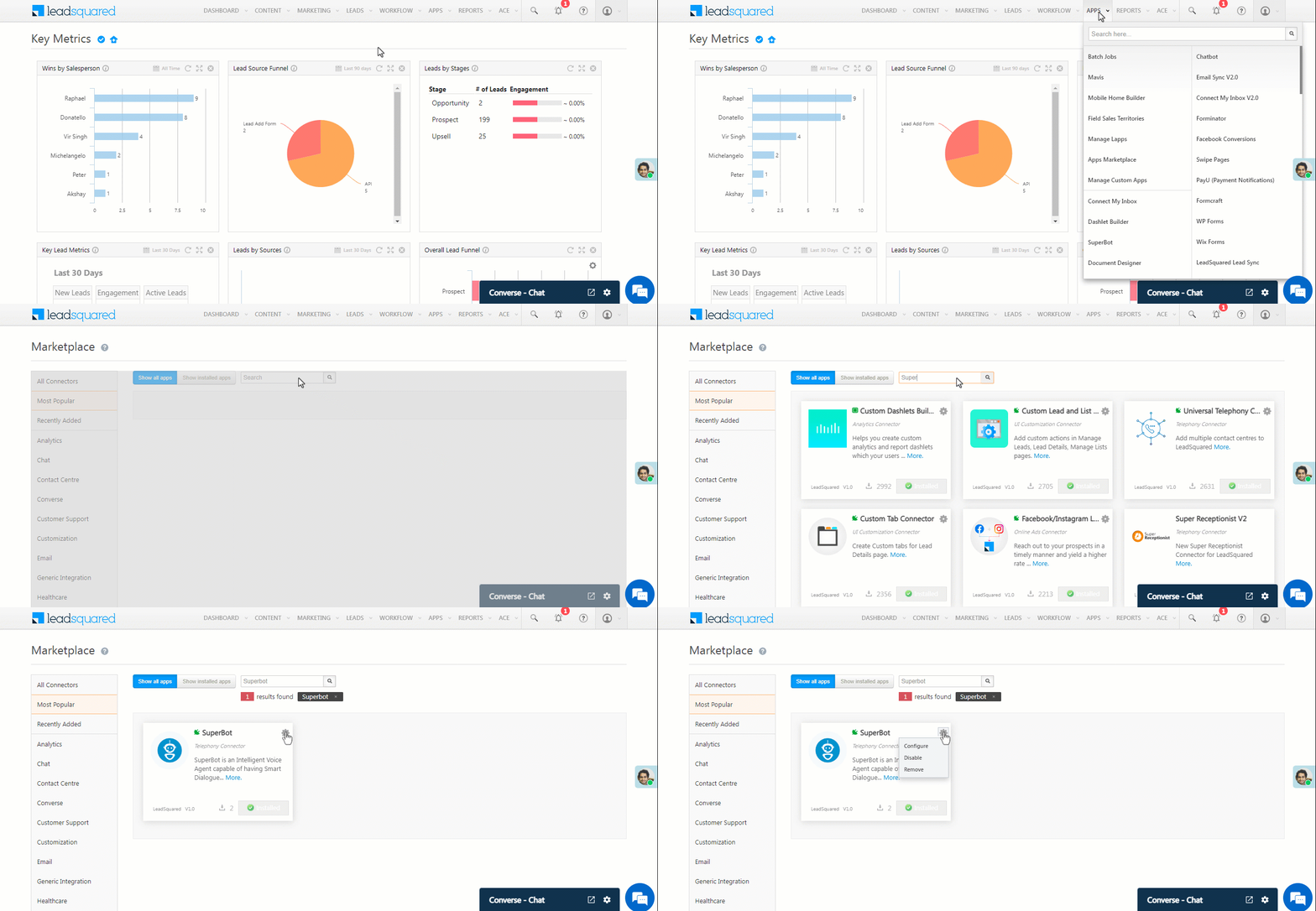
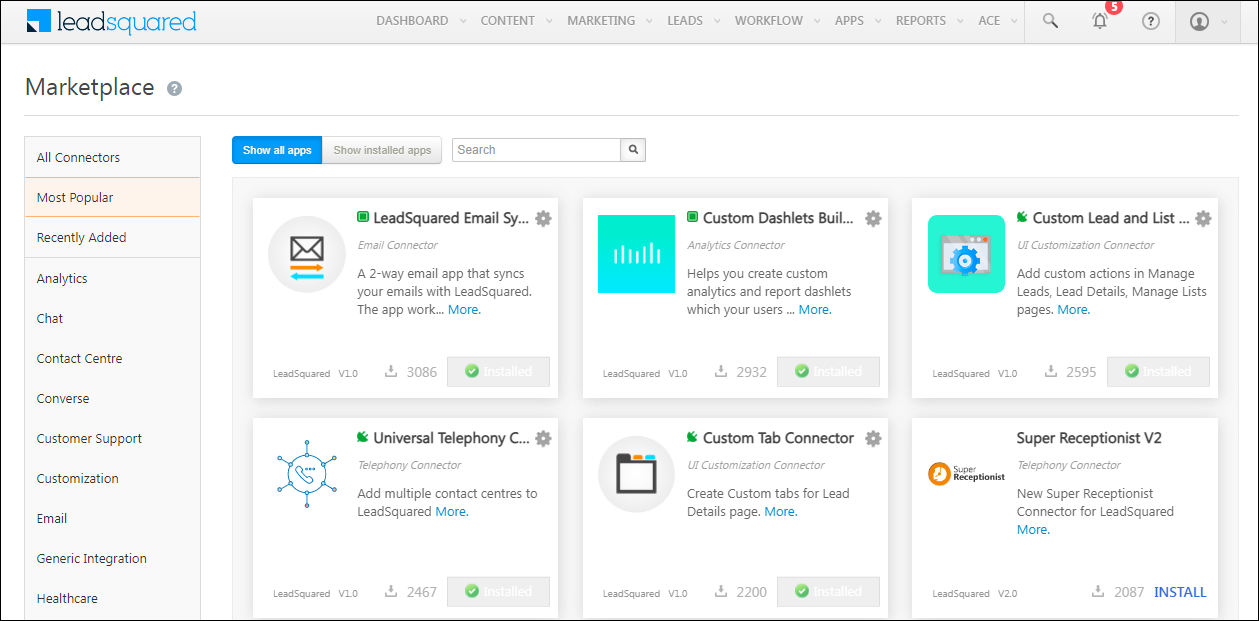
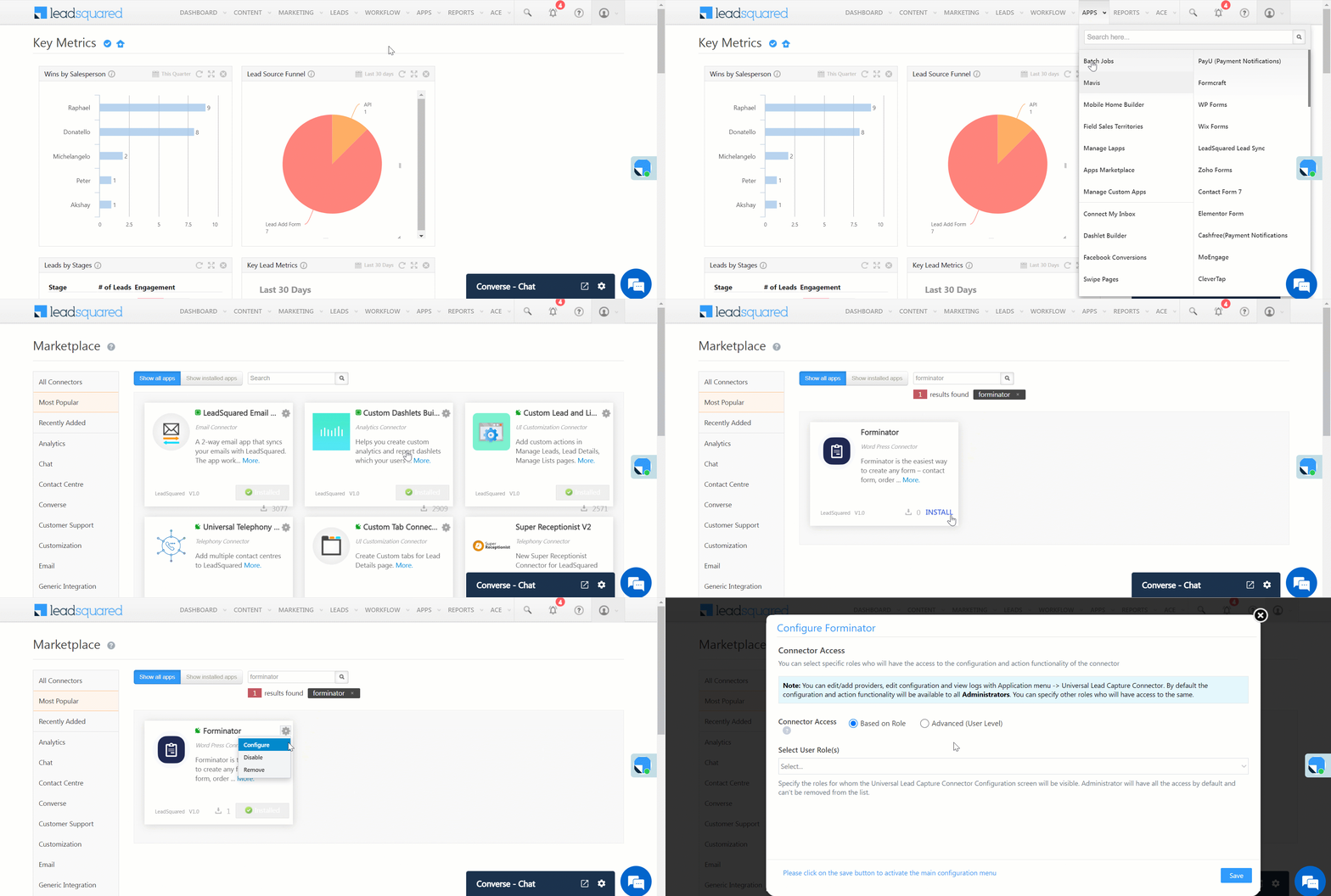
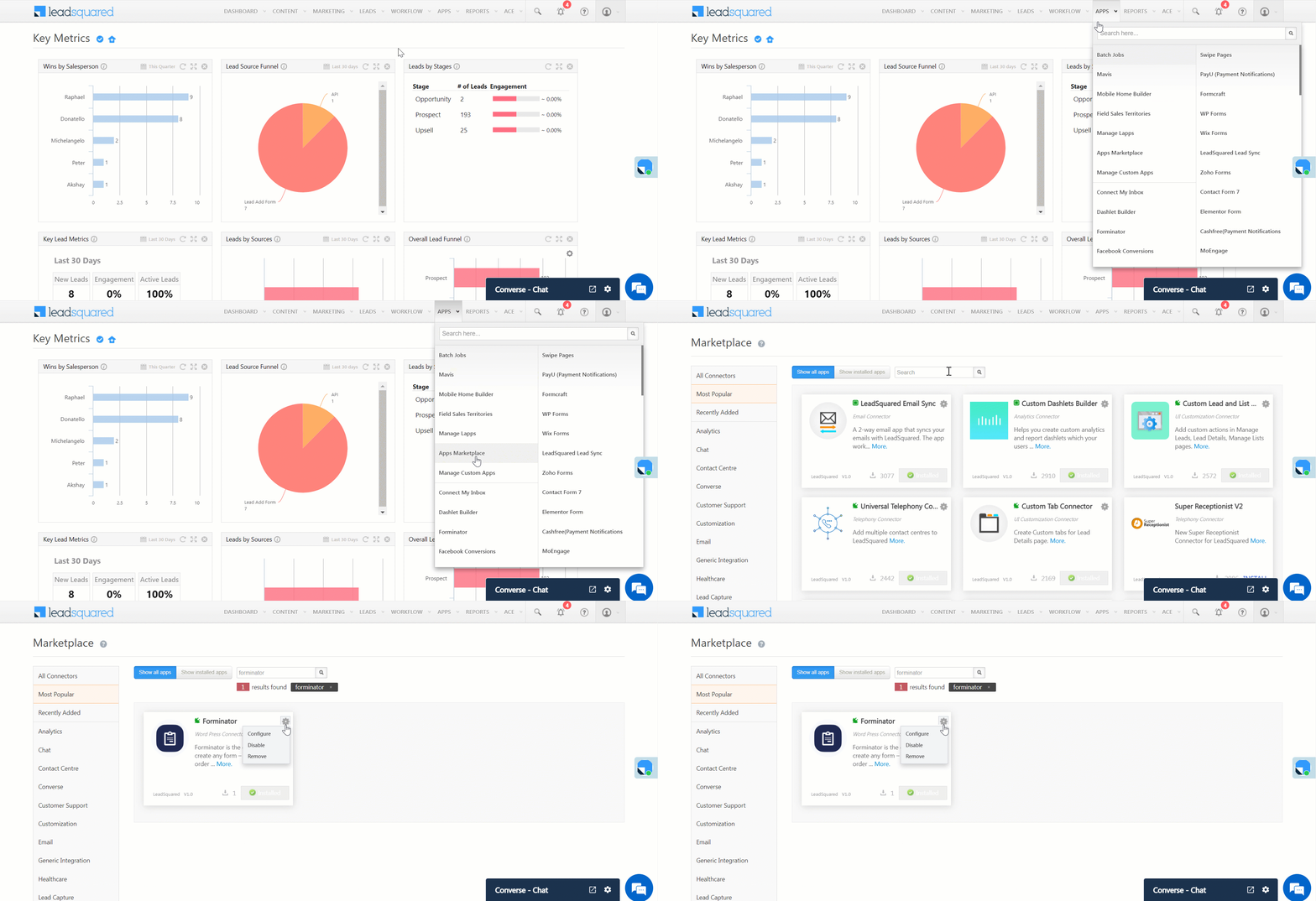
  1. Navigate to Apps>Apps Marketplace.
  2. Search for SuperBot, and click Install.
    • Alternatively, you can find the connector on the left panel, under Telephony.
  3. Once installed, hover your cursor over , and click Configure.

Superbot install

4.1 Configure the connector

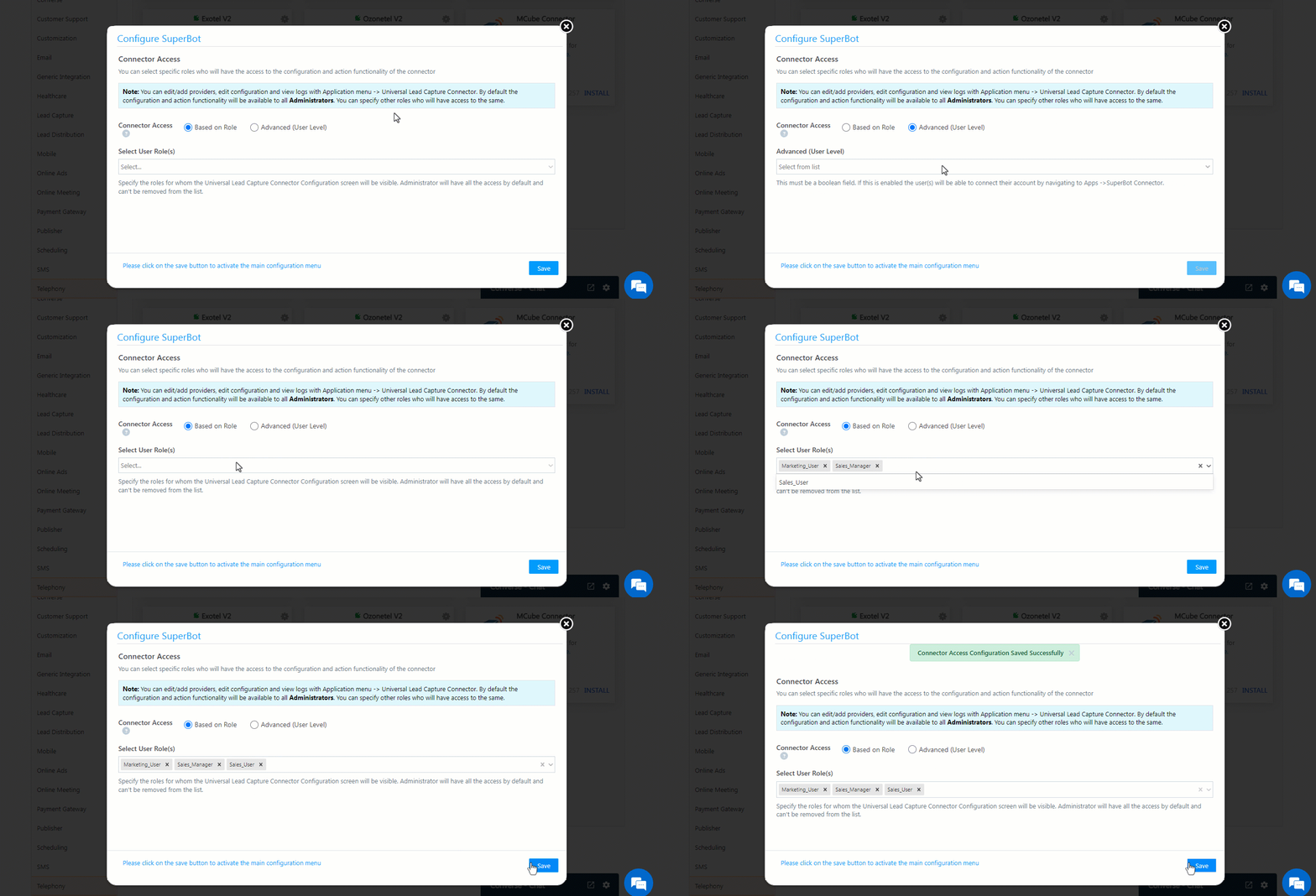
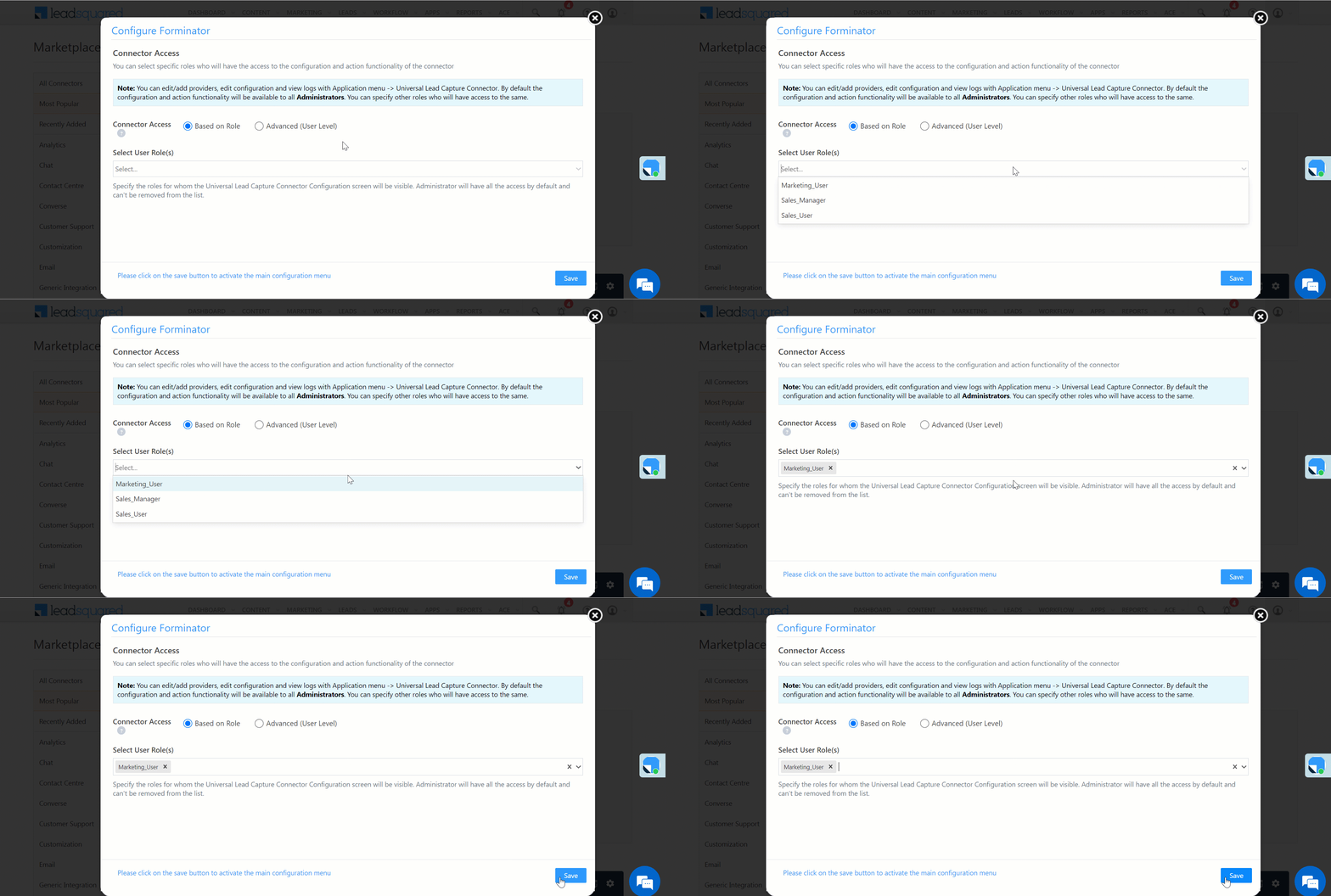
Once you’ve installed the connector, on the Configure SuperBot pop-up, configure the connector access for the non-Admin users in your account. Only those users for whom access is granted can view and access the connector (under the Apps main menu).

  1. Select if you want to grant Connector Access that’s Based on Role or Advanced (User Level).
    • Based on Role – From the Specify Roles dropdown, select the LeadSquared user roles that can use the connector.
    • Advanced (User Level) – From the Advanced (User Level) dropdown, select a user boolean field. Based on the value entered in the selected boolean field, the user can access the connector (e.g., for the user Sam, if the “Is Employee” boolean user field contains the value “Yes”, then this user can access the connector).
  2. Once you’re done, click Save Details. To continue the configuration, refer to the below sections.
Note: By default, all Admin users will have access to the connector.
superbot configure


5. Admin Configuration

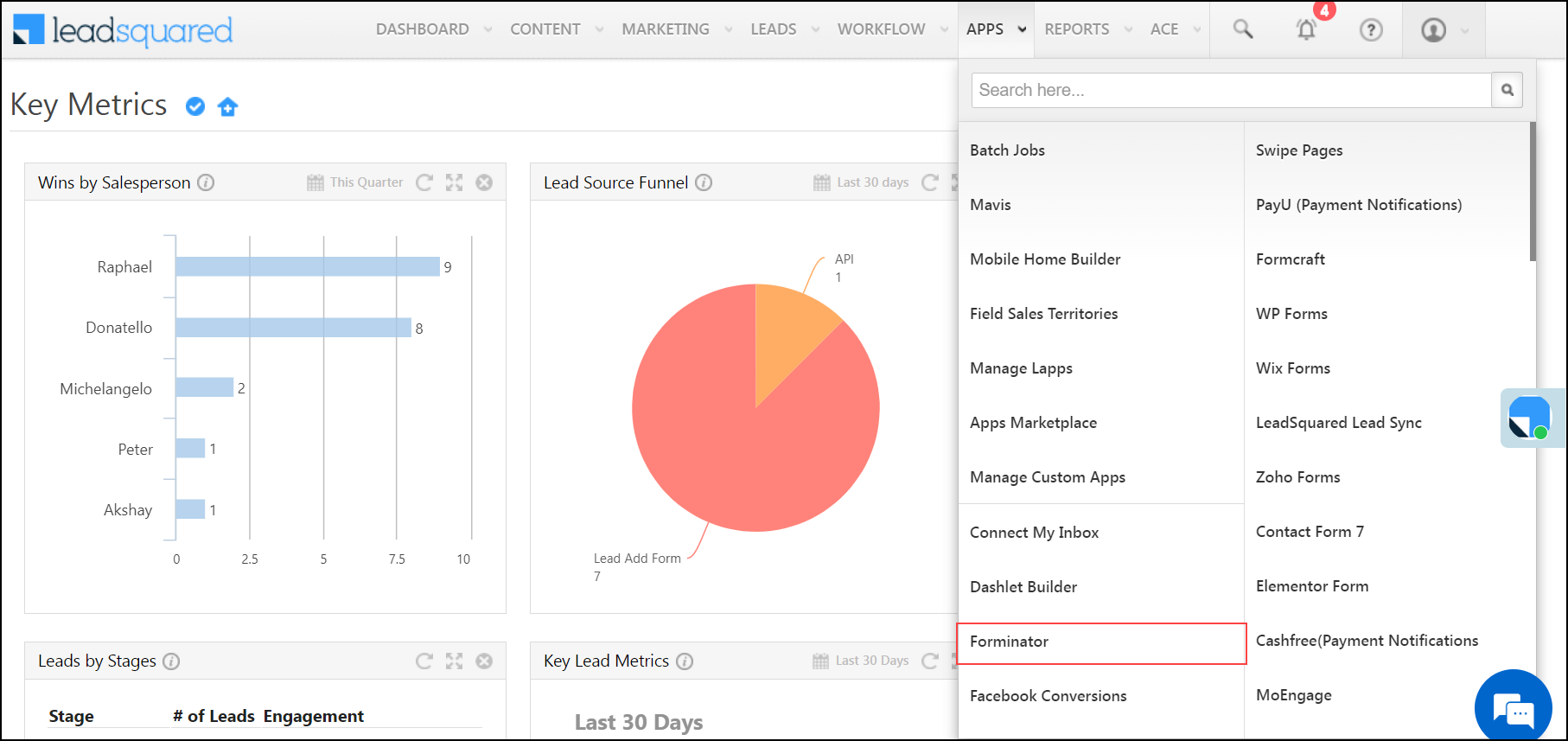
To continue the connector configuration, navigate to Apps>SuperBot.

superbot admin config

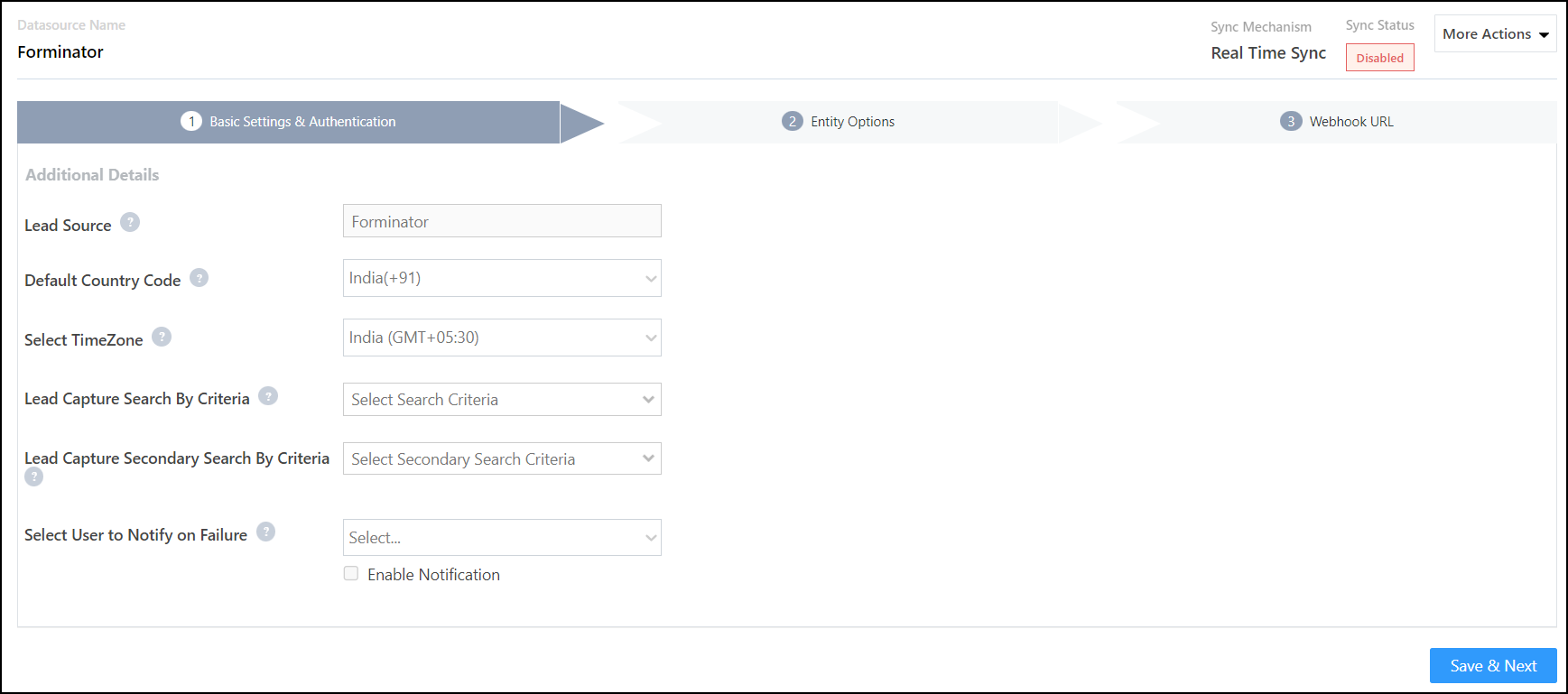
5.1 Basic Settings

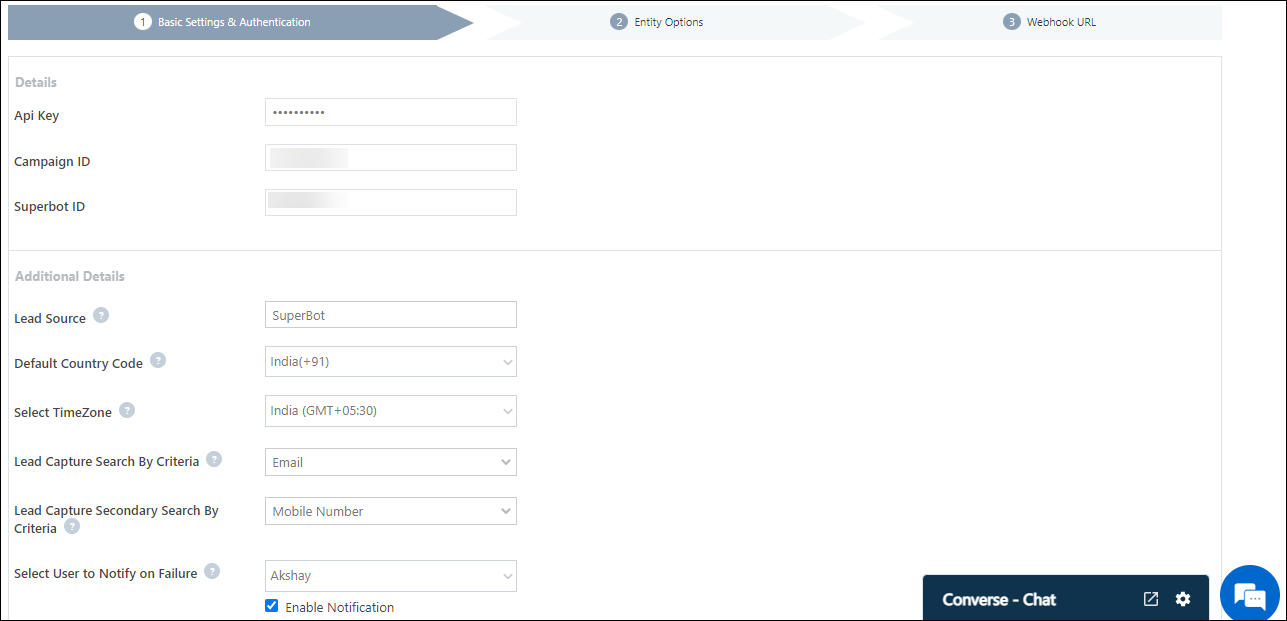
Enter the following details –

Property Description
Api Key Pass your SuperBot account’s API Key here.
Campaign ID Pass your SuperBot campaign ID here.
SuperBot ID Pass your SuperBot ID here.
Lead Source Enter the lead source through which the leads were captured (e.g., SuperBot, email campaign, etc.). This detail will be displayed on the Lead Details page, under Lead Source.
Default Country Code If the lead’s mobile number is captured without a country code, the default country code that’s selected from the dropdown will be added to the lead’s mobile number.
Select Time Zone The time zone followed in your SuperBot account.
Lead Capture Search By Criteria To avoid duplicate leads, you must select one unique lead field (e.g., email Id, mobile number, PAN number, etc.) as the search key. This is used to identify the leads pushed from Superbot.

To know how to mark a LeadSquared lead field as unique, please refer to How to Make a Custom Field Unique.

Lead Capture Secondary Search By Criteria If lead identification and capture through the primary Search By criteria fails, it will be re-attempted using the secondary Search By criteria.
Select User to Notify on Failure If there is an error in fetching leads, the selected user will receive a failure message via email. You can select a user from the list of all the users available in your LeadSquared account.

To know more about the type of errors, please refer to Error Notifications.

Enable Notification To ensure notification emails are sent to the selected user when there’s a failed query, enable the Checkbox checkbox.

Once you’ve entered all the details, click Save & Next.

Superbot basic settings save


5.2 Entity Options

Define the sync behavior of the connector when leads are captured.

5.2.1 Lead/Contact Entity

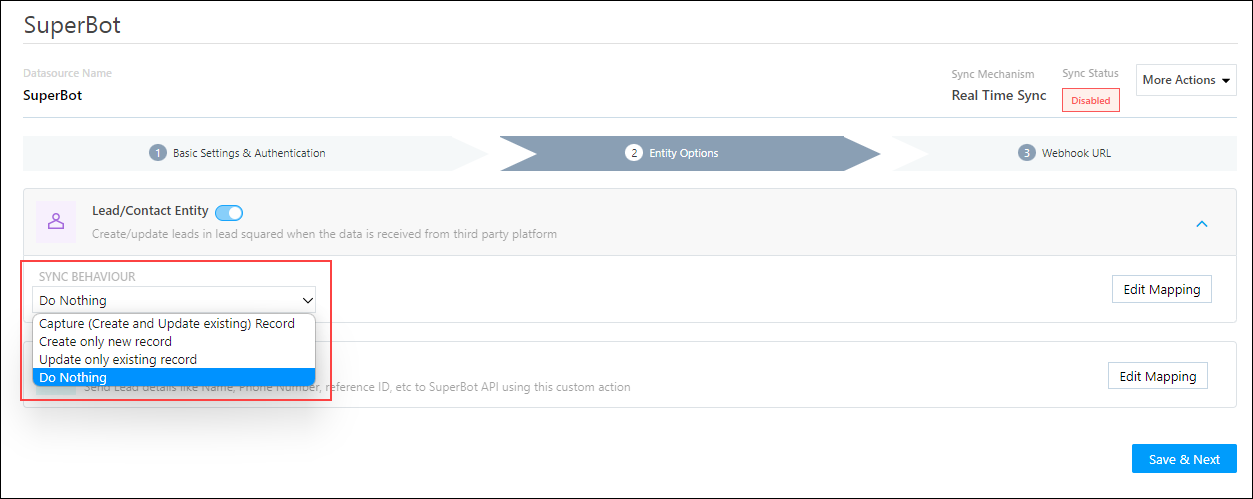
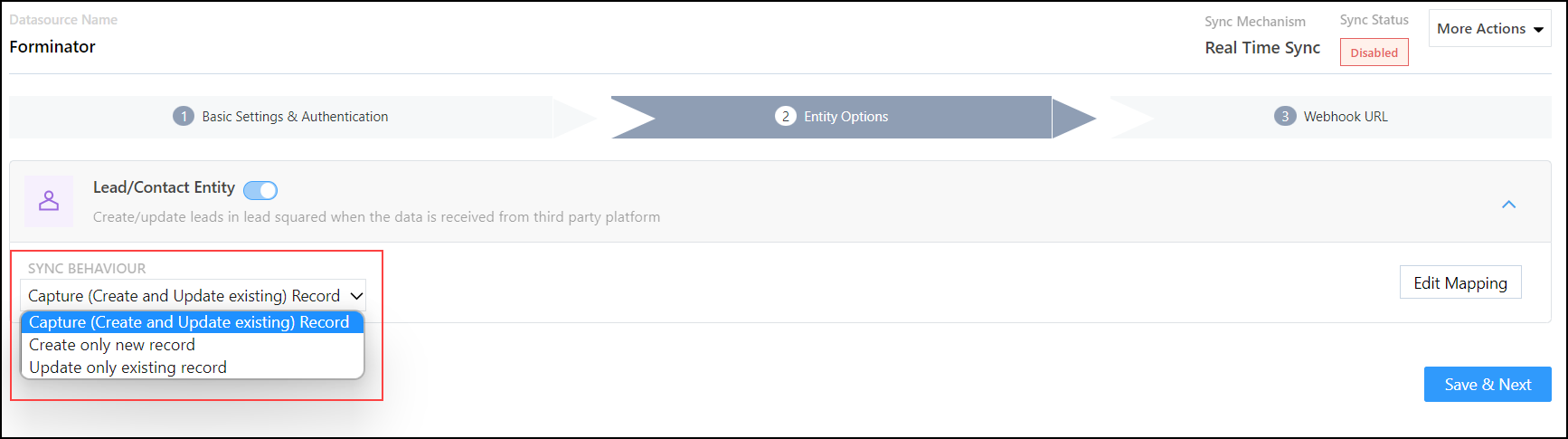
Based on the Lead Capture Search By criteria (email Id, phone number, etc.), LeadSquared identifies and captures leads from your SuperBot account. Lead capture is enabled by default, and it cannot be disabled. The following options are available to configure the connector’s Sync Behaviour –

  • Capture (Create and Update existing) Record – Leads that only exist in your SuperBot account (but not in your LeadSquared account) will get created in LeadSquared. Leads that exist in both your data provider and LeadSquared accounts will get updated.
  • Create only new record – Leads that only exist in your SuperBot account (but not in your LeadSquared account) will get created in LeadSquared.
  • Update only existing record – Leads that exist in both your SuperBot account and LeadSquared accounts will get updated in LeadSquared.
  • Do nothing – Leads do not get created or updated by syncing.
Note: This connector sends lead details like Name, Phone number, etc., to SuperBot. So, the Sync Behaviour is by default set to Do Nothing. It is recommended you don’t change this to any other setting.

superbot lead sync

5.2.2 Mapping

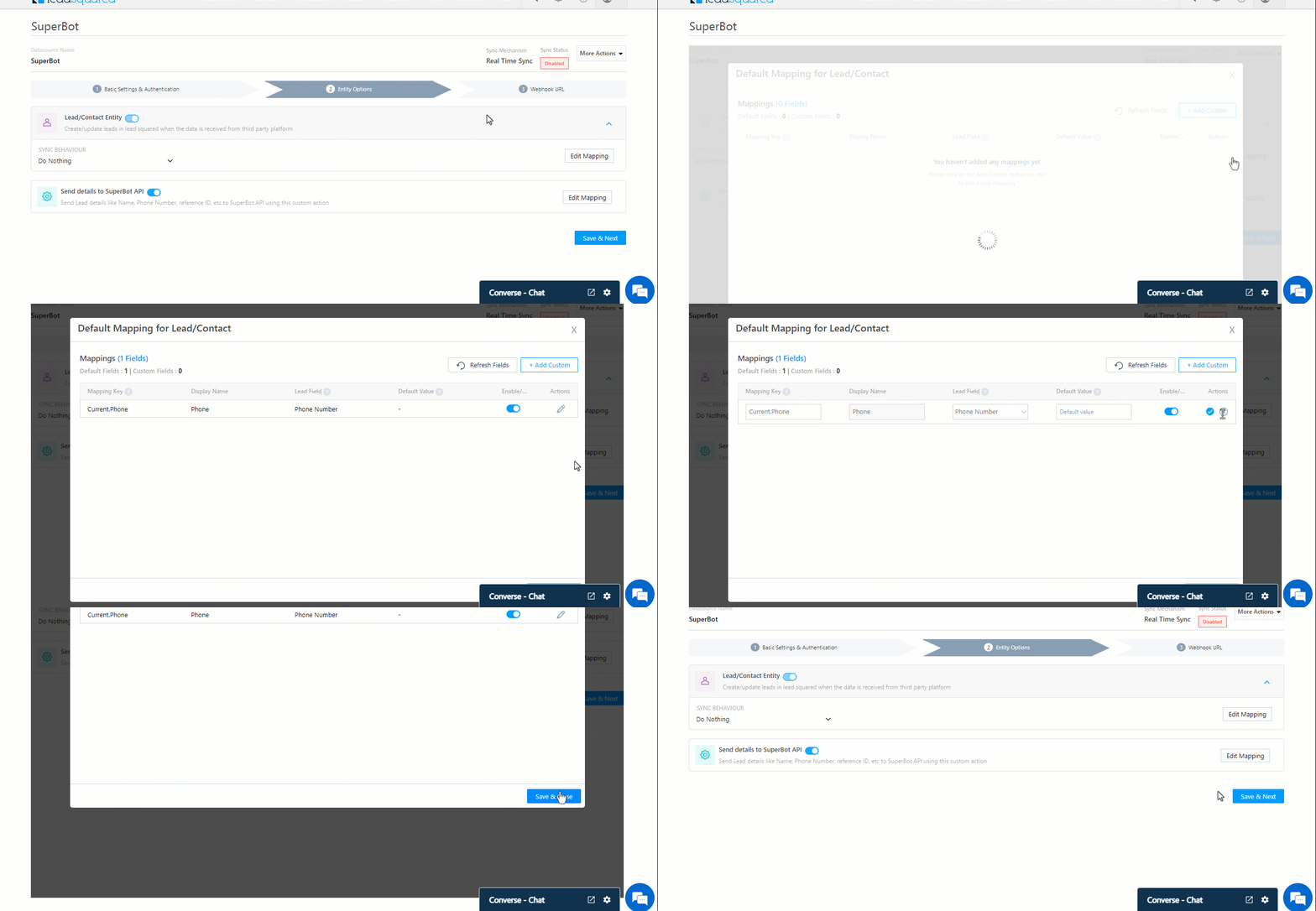
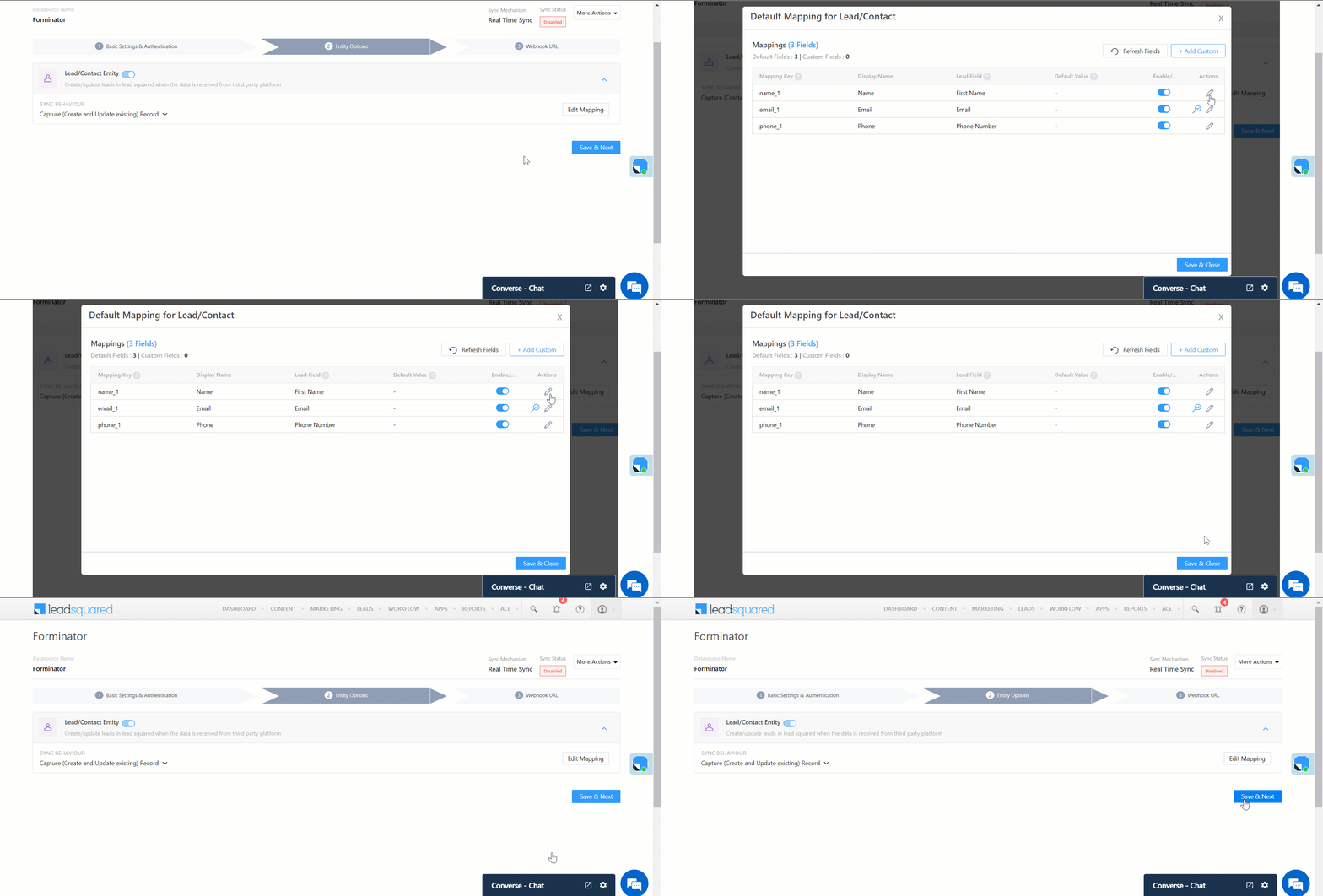
On the Mapping screen, the SuperBot system fields mapped to the corresponding LeadSquared lead fields are visible. This mapping is carried out by default. If required, you can change or update the default field mapping.

  • To provide a default value for any field, click  , enter the value under Default Value, and click Google.
    • If the data provider doesn’t send data for any lead field, then the default value will get assigned to that specific field. But if the field already has an existing value, then the default value will be ignored.
  • To disable lead data capture for any field, disable the Zoom slider.
  • You can also mark and update a unique lead field as the search key from this screen, by clicking unique icon.
  • To create a custom SuperBot field, click the Add Custom button.
    1. Once this field is created, you must map it to the relevant LeadSquared lead field.
    2. After the field is mapped, to save the custom field, click Google.
    3. To delete a custom field, click .

Once you’re done, click Save & Next.

superbot lead mapping

5.2.3 Send details to SuperBot API

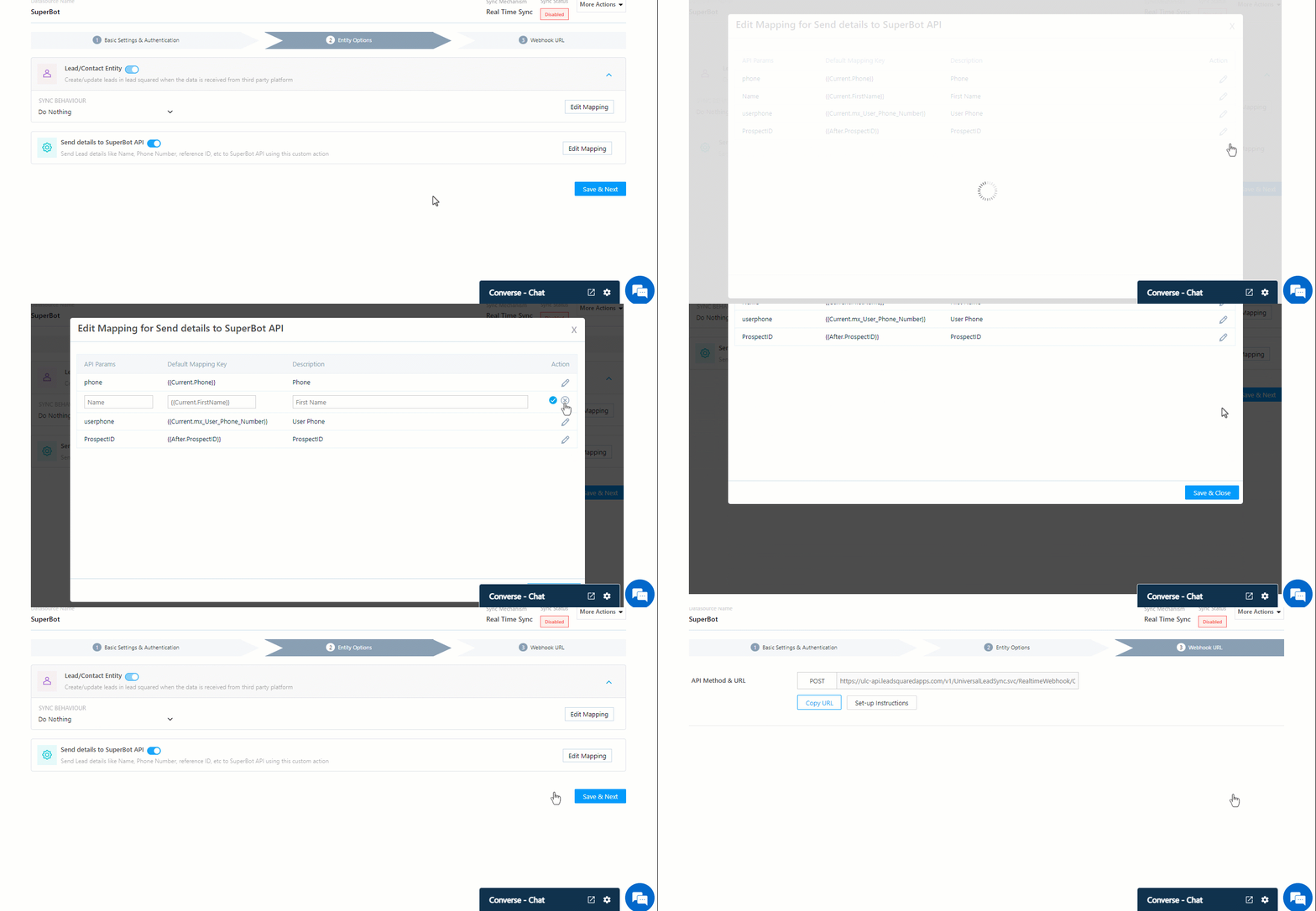
You can use this action to send Lead details like Name, Phone Number, etc to SuperBot API using this custom action.

  1. On the Mapping screen, click    if you need to edit the API Params, Default Mapping Key, and Description.
  2. click Save & Close.
  3. Once you are done, click Save & Next.

superbot send lead details


5.3 Generate Webhook URL

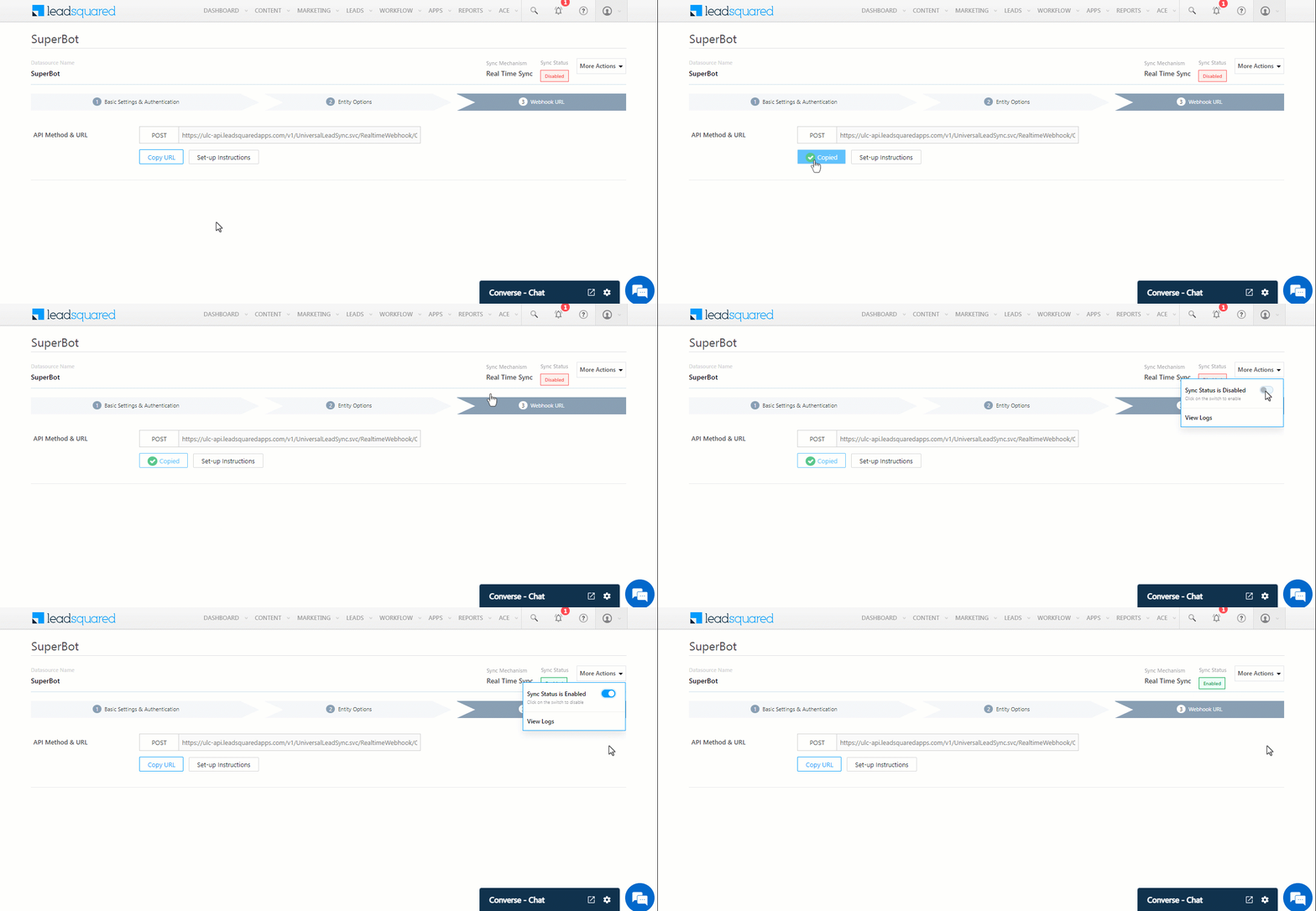
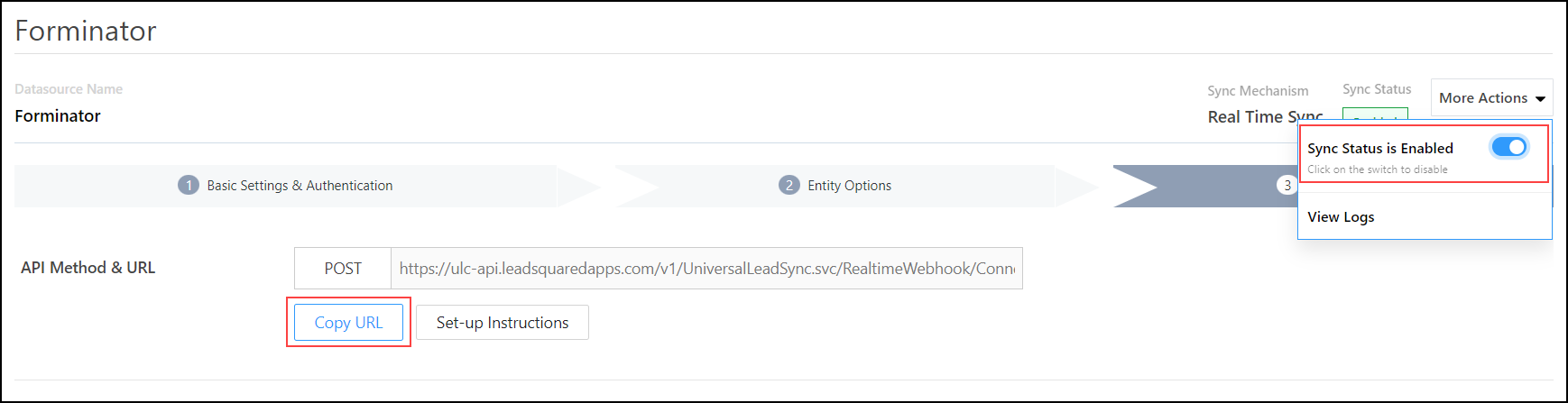
After you provide basic details and finish field mapping, a custom webhook URL is generated. To automate lead capture, copy this URL and configure it on your SuperBot account.

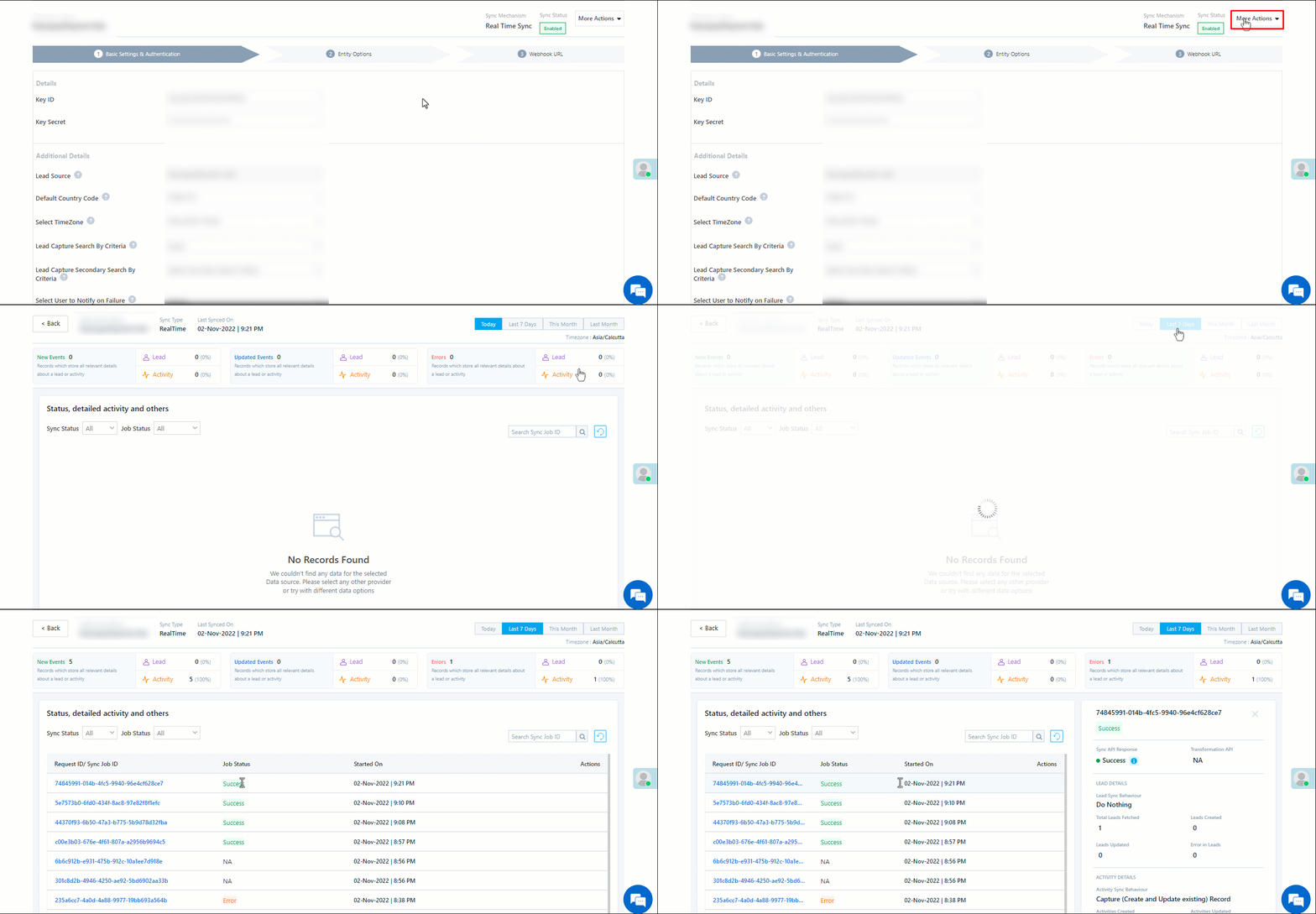
After you’ve set up the webhook, click More Actions, and enable the sync job. This ensures that through the webhook, lead data from SuperBot is pushed to LeadSquared.

Note: To view logs of all the sync jobs that have taken place, from the More Actions dropdown, click View Logs.

superbot webhook url


6. Create an Automation

Use the Webhook URL to create an automation that sends lead details like Name, Phone number, etc., to SuperBot. 

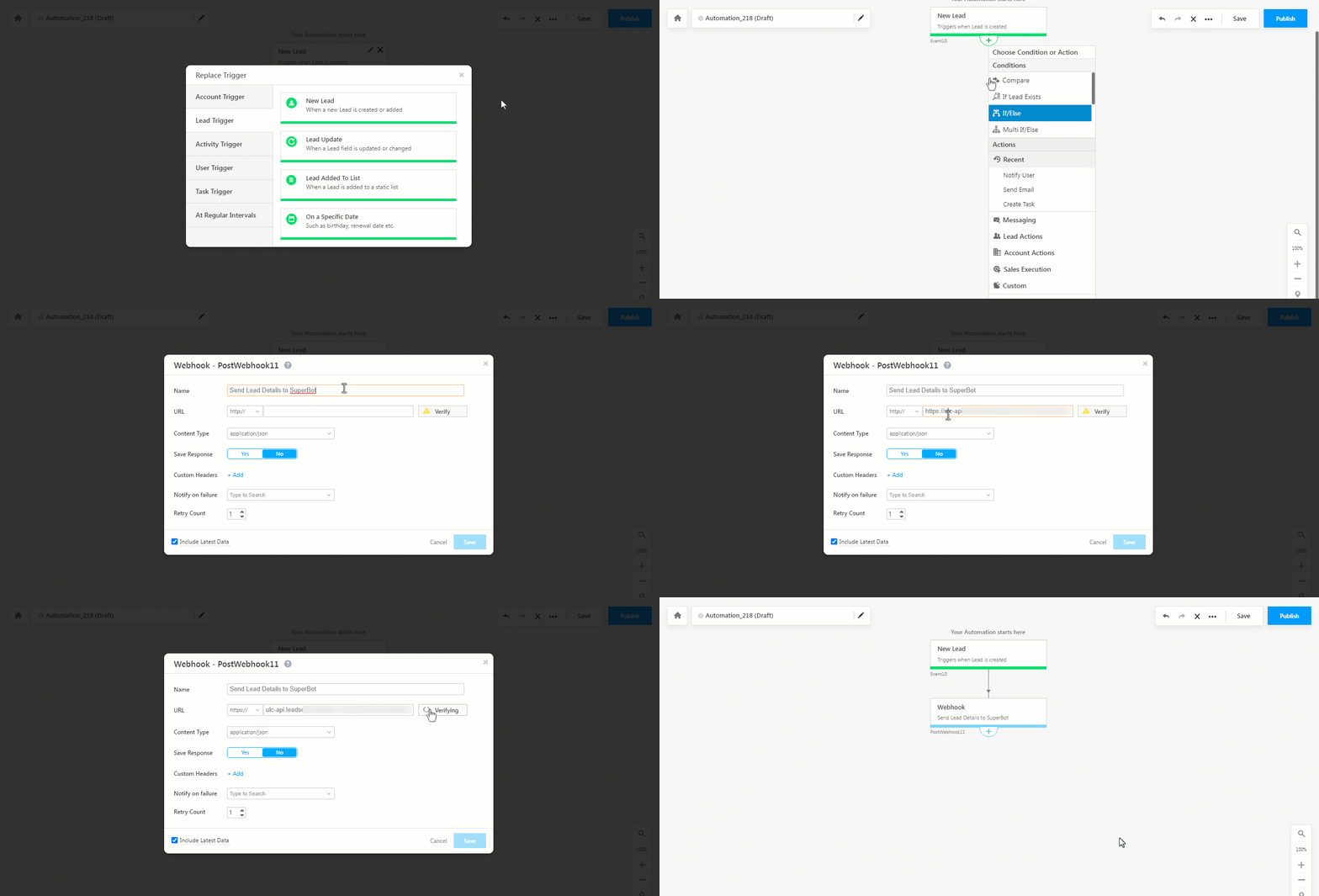
  1. Navigate to Workflow>Automation, click Create Automation, and select an appropriate trigger. We will be selecting the New Lead trigger.
  2. Click Add Automation, and under Custom, click Webhook.
  3. On the Webhook pop-up, enter the following details –
    • Name – Enter a relevant name for the webhook. We’re calling it “Send Lead Details to SuperBot”.
    • URL – Select the method as https://, and paste the connector’s webhook URL that was generated in the previous step. Ensure you remove “https://” from the URL.
    • Content Type – Select application/json.
    • Save Response – You can select either Yes or No.
    • Custom Headers – You can skip this step.
    • Notify on Failure – Select which user you want to notify if the webhook fails.
    • Retry Count – The number of times you want to retry when the webhook fails.
  4. Once you’re done, click Save, and then click Publish.
Note: To know more about the Webhook action, refer to User Automation Actions – Webhook.

superbot automation


7. View Logs

Here, you can view logs of all the sync jobs that have taken place. View New Events (New Leads), Updated Events (Updated Leads), and Errors (when capturing leads).

  1. Navigate to Apps>SuperBot.
  2. From the More Actions dropdown, click View Logs.
  3. You can filter the logs by selecting a date range (Today, Last 7 Days, This Month, and Last Month), by selecting the Job Status (“All”, “Success” and “Failure”), and by selecting the Sync Status (All, Error, and Success).
  4. You can view the sync status of the following events –
    • New Events – List of all the new leads that have been created in LeadSquared during the selected date range.
    • Updated Events – A list of all the –
      • Duplicate leads that were created with the same Search by Criteria value (e.g., with the same Email Id, Mobile Number, etc.).
      • Leads that previously contained errors, which were fixed and synced successfully.
    • Failed – The list of leads that have not been captured due to mapping errors (e.g., when a boolean field is mapped to an integer field, etc.).
  5. To view the Sync Response details, under Request ID/Sync Job ID, click the Id.
    • Under the right panel, you can view the response status, the API URL, the request, and the response.
    • The responses that are successful will contain the details of the leads that have been pushed from SuperBot.
    • To view the lead capture response under Sync API Response, Leads Updated and Errors in Leads, click Information.

Note:

  • For a response that contains an error, the reason for the error is listed in the response. Once you fix it, you can click the Retry button to perform the sync again.
  • The current Lead Sync Behaviour will reflect in the Logs screen. This will help identify the sync that’s used (Capture or Update) for the selected Request/Sync Job Id.

google forms view logs


8. Other Actions

You can edit or delete the SuperBot connector instance that you created. To do this –

  1. Navigate to Apps>App Marketplace.
  2. Search for SuperBot.
  3. Alongside the SuperBot connector, hover your cursor over .
  4. From the list of options, you can perform the following actions –
    • Edit Configuration
    • Disable Configuration
    • Remove Configuration

superbot extra


Any Questions?

Did you find this article helpful? Please let us know any feedback you may have in the comments section below. We’d love to hear from you and help you out!

How to Create a Lead Automation?

Lead automation lets you set up workflows that automatically execute based on a lead’s behaviour. It only needs to be set up once and requires no manual intervention thereafter.
Once you’ve created and published an automation, be sure to view the Automation Report. It’ll give you insights into the leads entering and transitioning through your automation as well as its overall performance.

For detailed information on the Automation feature, see Automation Home.

The following topics are covered in this article:

  • Creating a lead automation
  • Lead automation triggers
  • Conditions and actions
  • Automation reports
  • Sample lead automations


Creating an Automation

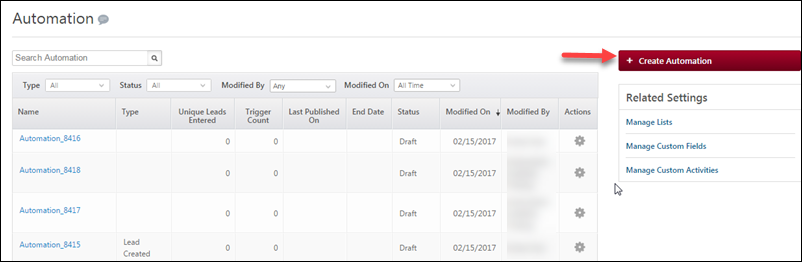
From the Automation window, click Create Automation. The Choose a template pop-up will appear.

create automation

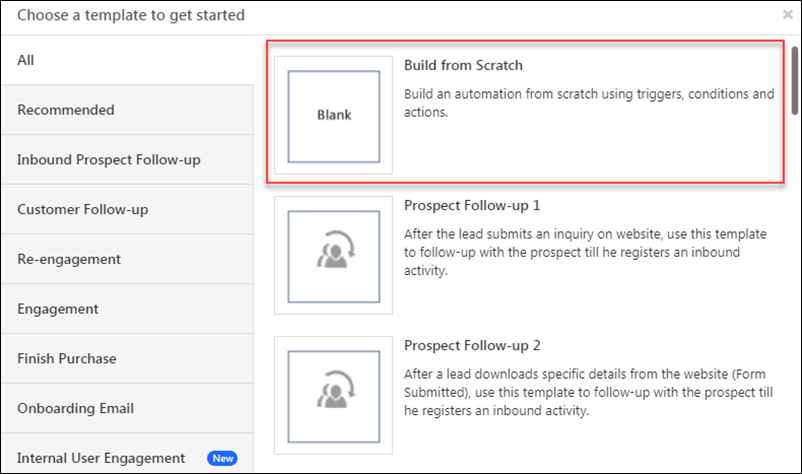
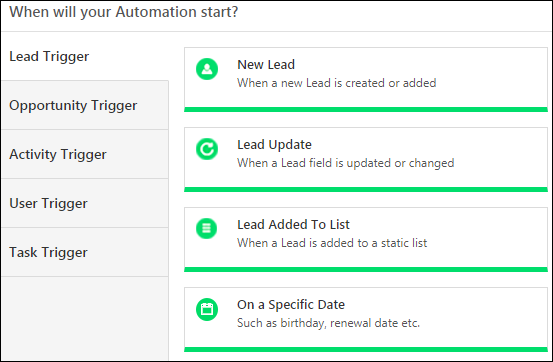
You can build an automation from scratch as well as from preset templates for common workflows. If you build an automation from scratch you’ll first have to choose an automation trigger.

new automation

Here, the New Lead trigger is selected –

New lead trigger.

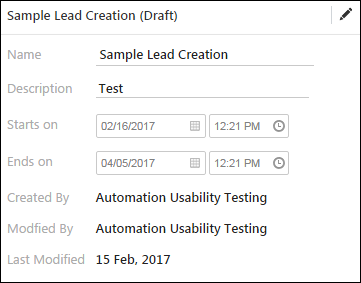
Theedit button button on the top-left corner of the automation window allows you to add the following details:

  • Name – The name of your automation (E.g., Welcome email workflow).
  • Description – Enter a brief description for your automation (E.g., Welcome email and follow-up)
  • Starts On – Enter the specific date to start the automation.
  • Ends On – Enter the specific date to end the automation.

edit popup

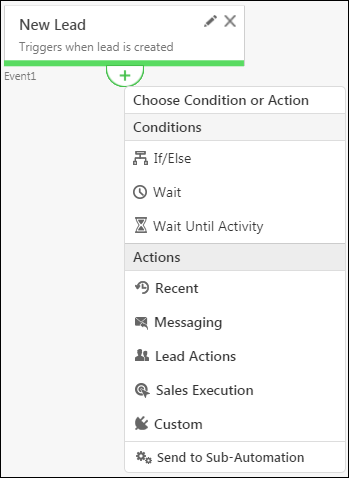
Thebutton below the trigger allows you to add Conditions and Actions to the trigger.

Actions and conditions


Triggers

Triggers_1

For more information, see Triggers in Lead Automation.

Note: To perform bulk updates through automation, contact your billing team or reach out to support@leadsquared.com.


Conditions and Actions

For detailed information on the various conditions and actions, see –


Publishing an Automation

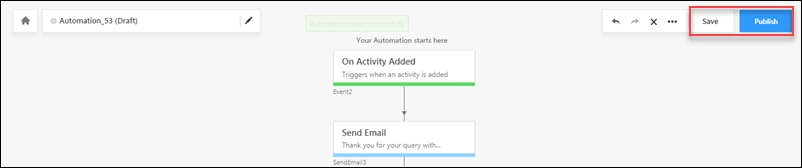
Once you add the required conditions and actions to your Automation:

publish

  1. Click Save. The automation will get saved as a draft.
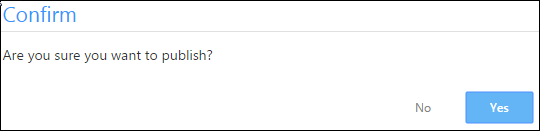
  2. Click PublishPublishing an automation sets it live. Leads will begin entering your automation in the next few minutes. Click Yes to confirm your decision to publish the automation.

publish2

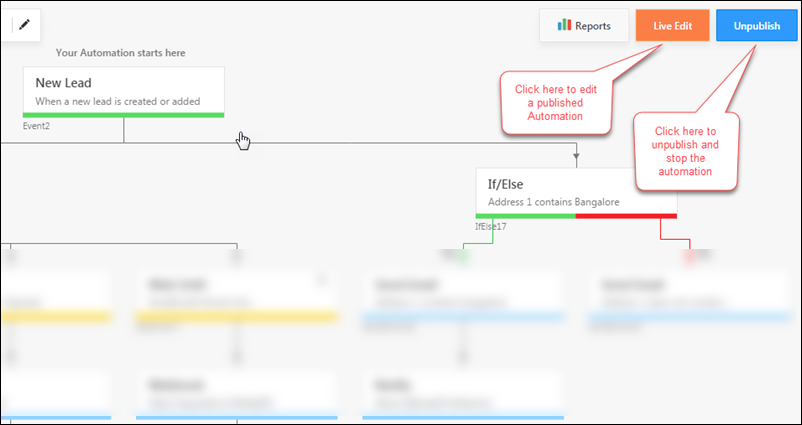
You can still make changes to a published automation using the Live Edit option –

edit and publish

Note: Changes that can be made are only to the content. Additional actions/conditions cannot be added. To unpublish and stop the automation, click Unpublish.


Cloning a Node

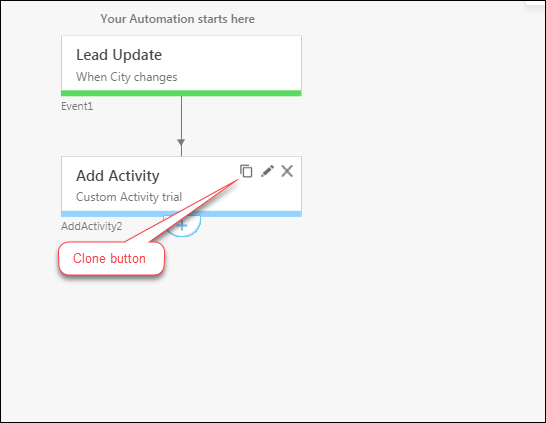
You can clone or create an automation node/card using the clone button –

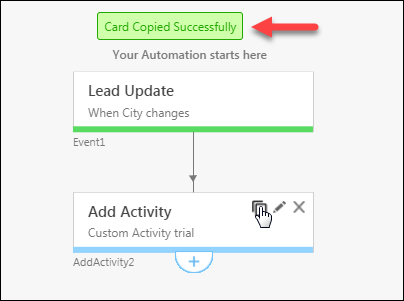
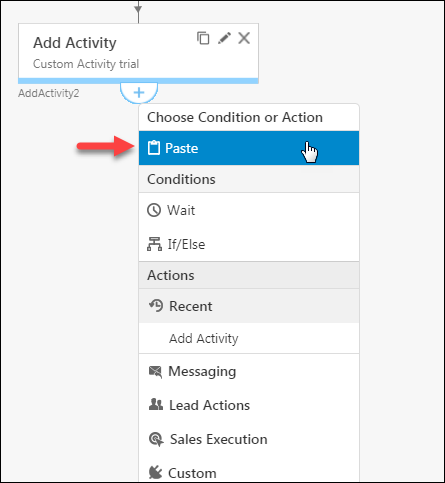
Once the card is copied, you can reuse it in the same automation. Click  and the paste option will appear –

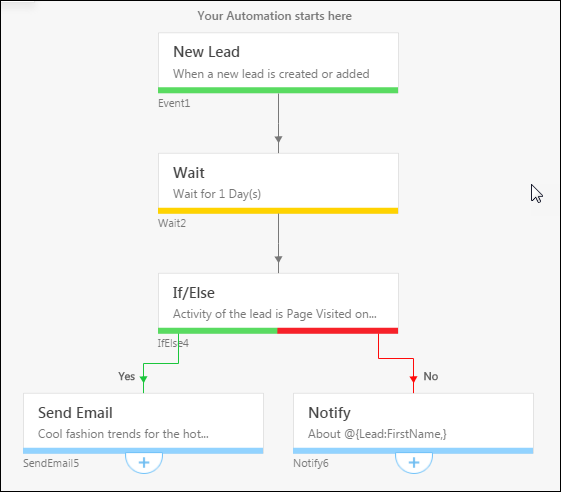
An image of a sample automation created using the procedure above is given below:

final automation

In the above image, the trigger or starting point is Lead Creation. After a time period of 1 day (Wait condition), if the Lead visits your web page (If/Else condition), an Email is sent to the Lead ( Yes criteria). If the Lead does not visit your web page after 1 day (No criteria), a notification Email is sent to your LeadSquared user to follow up.


Automation Reports

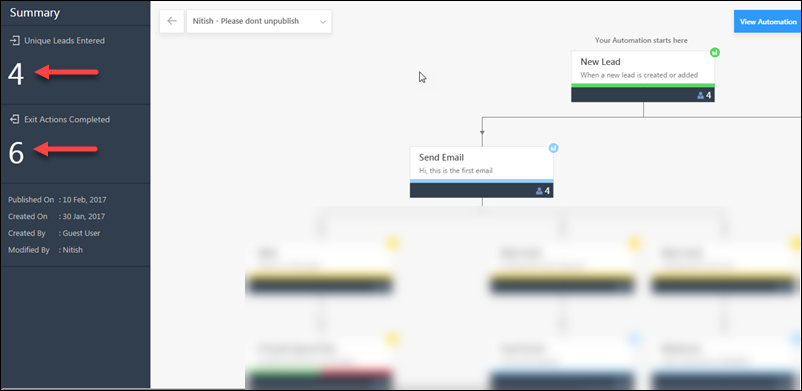
Reports allow you to analyze the performance of your automation. It gives you details like the number of leads who entered the automation, the number of exit actions completed and so on. For more information, see  Automation Report.

To access the Report of a published Automation:

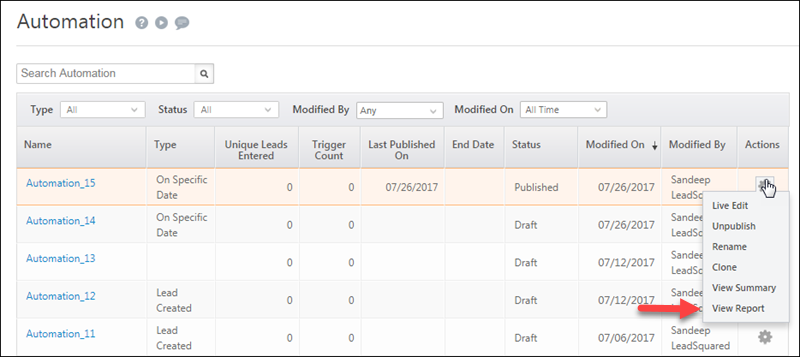
From the Automation window, click View Report under Actions against any published automation. The Automation reports window will appear –

summary

Note: The “Exit Actions Completed” count in the Automation Report refers to leads who have successfully completed all steps in the automation and reached the final card. This is not the same as leads who are removed due to the “Remove Leads from Automation” condition in the trigger. Those leads are stopped from entering or progressing in the automation based on specific criteria and do not count towards the Exit Actions Completed metric.

You can also view the automations that a lead is part of from the Lead Details window –

Document Designer

1. Feature Overview

LeadSquared’s Document Designer is a DIY feature that lets you create document templates (such as Application Forms, Fee Receipts, etc.). When a lead fills out a form on your Portal, their data is automatically populated into the document template. This template can then be previewed and downloaded by your leads from the portal.

Through this feature, you can create documents from scratch, or build documents using pre-existing templates available by default in your account. This gives you complete control over the look and feel of the documents hosted on your website, and helps streamline the entire document generation process. What’s more, you can make real-time updates and changes to live document templates on your own, without having to depend on the LeadSquared support team. This will help increase efficiency, and reduce turn-around time (TAT).

Note: This connector is currently available only for customers in India and the USA.

LeadSquared Document Designer


2. Prerequisites

  • This is a paid feature. To enable it, contact your account manager, or write to support@leadsquared.com.
  • You must be an Admin user to install this feature and create document templates.


3. How it Works

Choose to integrate either Activities, Opportunities or Leads with the Documents you generate. The fields of the selected entity type will be available for mail merging in the generated document.

Note: You can also choose to create lead-based templates. To do this, select Activities or Opportunities, and follow the steps listed below. The important thing to note here is, after you select either of the entity types available (Activities or Opportunities), DO NOT integrate any of the corresponding Activity or Opportunity fields with the template. Instead, select and integrate the relevant lead fields with the template.

If you choose to Mail Merge Activity fields –

Before you install the Document Designer app, Create a Custom Activity that’ll be posted when a lead performs an action on your website/Portal (e.g., Application Submission, etc.). To generate payment receipts, you can choose to integrate a system-generated Payment Activity.

When creating the custom activity, it’s recommended you include the below two fields in the activity. Alternatively, you can also choose to create these as lead fields in your account –

  • A String type field to store the document generation status.
  • A Custom Field Set (CFS) field with the Type set to File and the File Type set to PDF to store the URL of the generated document.

LeadSquared Document Designer

  1. Once the custom activity is created, install the connector, and select Activity as the entity type. When configuring the form design, you can choose to create a template from scratch or edit a pre-existing template.
  2. After preparing the document design, Publish it. During the publishing process, choose the CFS PDF file type custom activity field you created to store the document URL. Additionally, select the String type activity field you created to store and display the document generation status.
  3. After publishing the document, a webhook URL is generated. Use this URL to configure an Automation using the custom activity you created as the trigger. Add a webhook card to this automation, and pass the webhook URL. This ensures that whenever the custom activity is posted, the webhook is triggered, leading to the generation of the document.
  4. Add the CFS field (from the custom activity) to the portal/website (either directly to the portal code or by adding a block using the Portal Designer), where your leads can preview and download the document.

If you choose to Mail Merge Opportunity fields –

Before you install the Document Designer app, it’s recommended you have an Opportunity type that contains the following fields. Alternatively, you can also choose to create these as lead fields in your account –

  • A String type field to store the document generation status.
  • A Custom Field Set (CFS) field with the Type set to File and the File Type set to PDF to store the URL of the generated document.

LeadSquared Document Designer

  1. Once the opportunity is created/updated with the fields mentioned above, install the connector, and select Opportunity as the entity type. When configuring the form design, you can choose to create a template from scratch or edit a pre-existing template.
  2. After preparing the document design, Publish it. During the publishing process, choose the CFS PDF file type opportunity field you created to store the document URL. Additionally, select the String type opportunity field you created to store and display the document generation status.
  3. After publishing the document, a webhook URL is generated. Use this URL to configure an Automation using any trigger on the opportunity you created/updated. Add a webhook card to this automation, and pass the webhook URL. This ensures that whenever the automation is triggered, the webhook is triggered, leading to the generation of the document.
  4. Add the CFS field (from the opportunity) to the portal/website (either directly to the portal code or by adding a block using the Portal Designer), where your leads can preview and download the document.
Note: For demonstration purposes, we used the Activity entity type to set up and configure the connector and automation. The steps to configure Opportunities as the entity type remain the same, unless specified otherwise.


4. Install the Connector

Before you create document templates, you must install the Document Designer connector in your account –

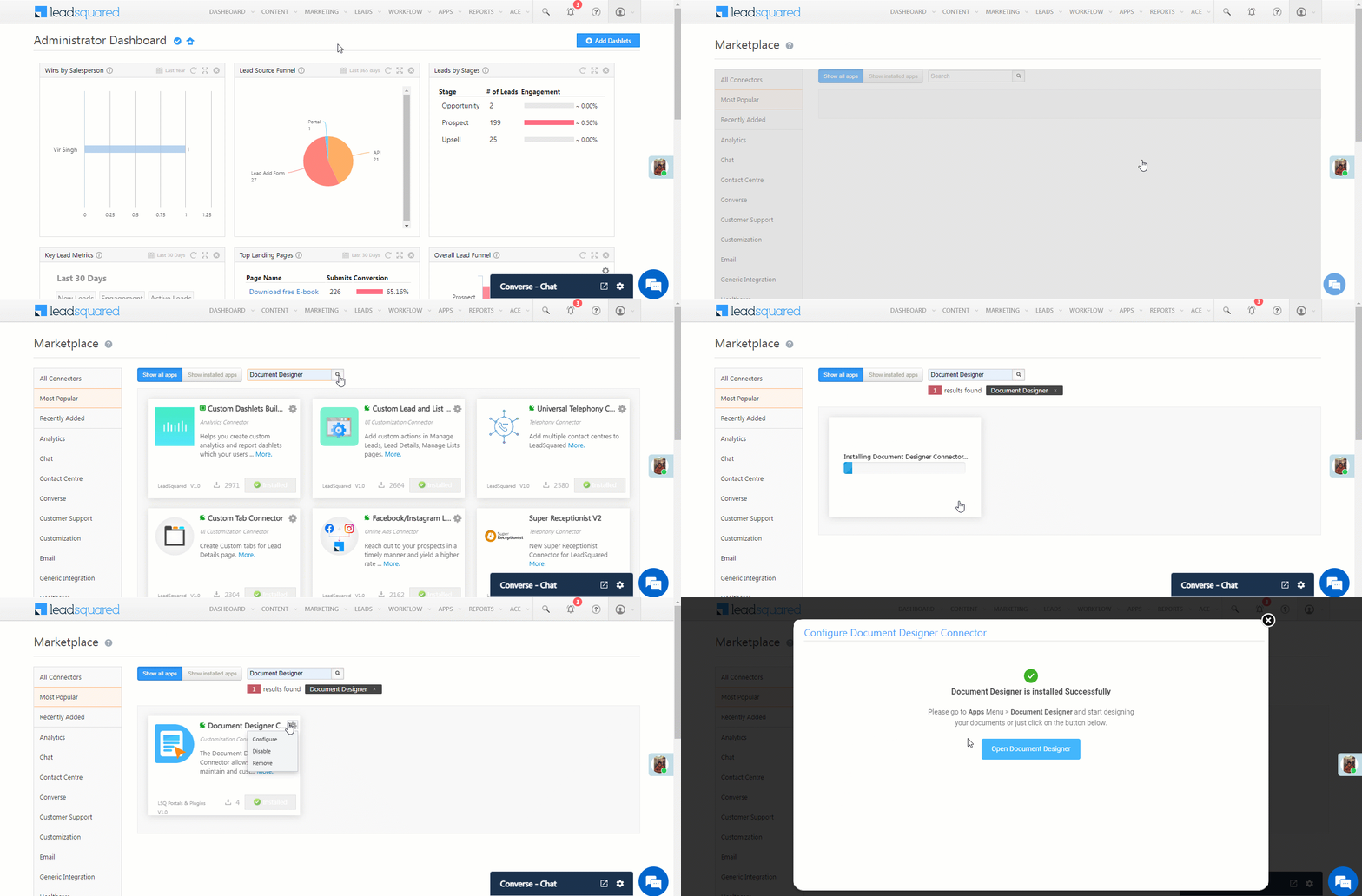
  1. Navigate to Apps>Apps Marketplace.
  2. Search for Document Designer, and click Install.
    • Alternatively, you can find the connector on the left panel, under Generic Integration.
  3. Once installed, hover your cursor over , and click Configure. On the Configure Document Designer pop-up, click Open Document Designer.

LeadSquared Document Designer


5. Create Document Templates

Once the connector is installed, to design the document generation process –

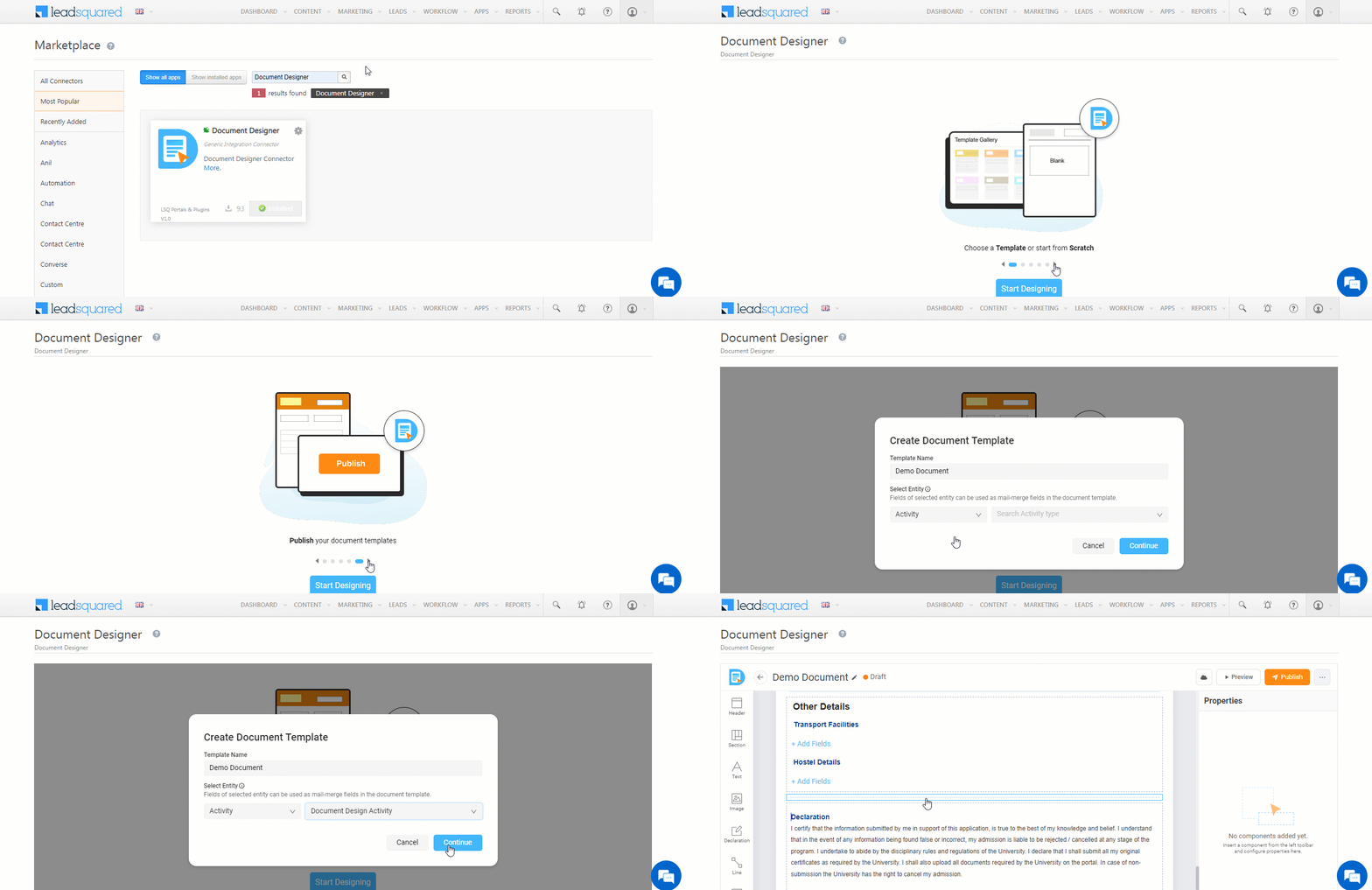
  1. Navigate to Apps>Document Designer.
  2. On the Document Designer page, click the New Template button.
  3. On the Create Document Template pop-up, enter the following details –
    • Template Name – An internal display name for the template.
    • Select Entity – Select the LeadSquared entity whose fields you want to use for mail-merging with the document. You can choose between Activity and Opportunity.
      • Activity – Select the custom activity you created to store the generated document and its status.
      • Opportunity – Select the opportunity you created/updated, where you’ll store the generated document and its status.
  4. Once you’re done, click Continue.
  5. You can either choose to build a document from scratch, or you can edit and modify a pre-existing template. We’ll be editing a pre-existing template and selecting the Application Form template.
  6. Then, Select Page Size. You can choose between the A4 format or US Letter Size format.

Note:

  • If you choose to integrate leads with the template, select either Activity or Opportunity from the Select Entity dropdown. However, ensure you integrate lead fields only with the template in the subsequent steps listed below.
  • The components required to create a template from scratch are similar to the components present when editing a template. You can refer to the steps listed below if you’re looking to create a template from scratch.

LeadSquared Document Designer


6. Add Components

Configure the components you want to add to your document.

6.1 Header

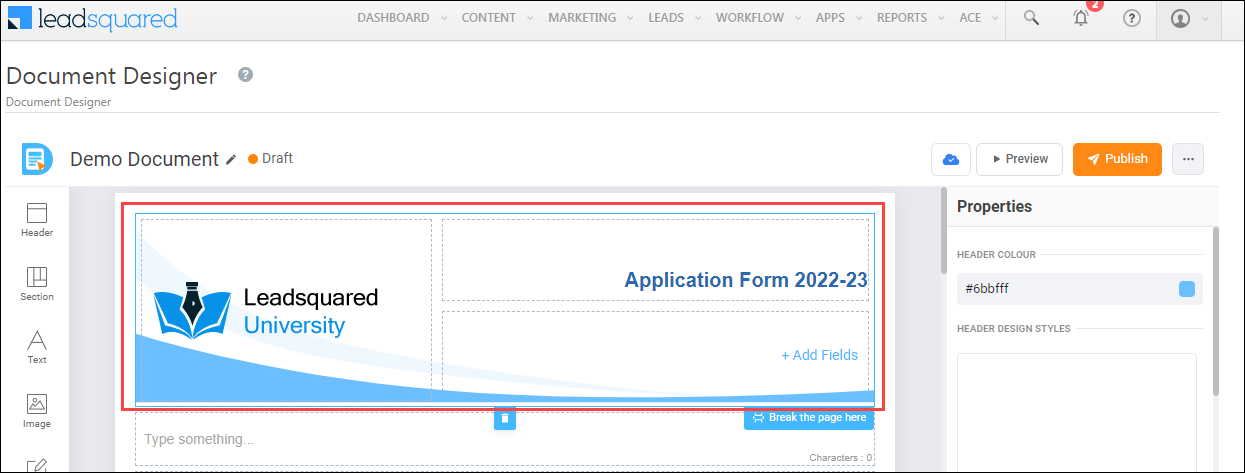
The header is the top-bar section in the document. Edit and configure the header to reflect your organization’s details.

LeadSquared Document Designer

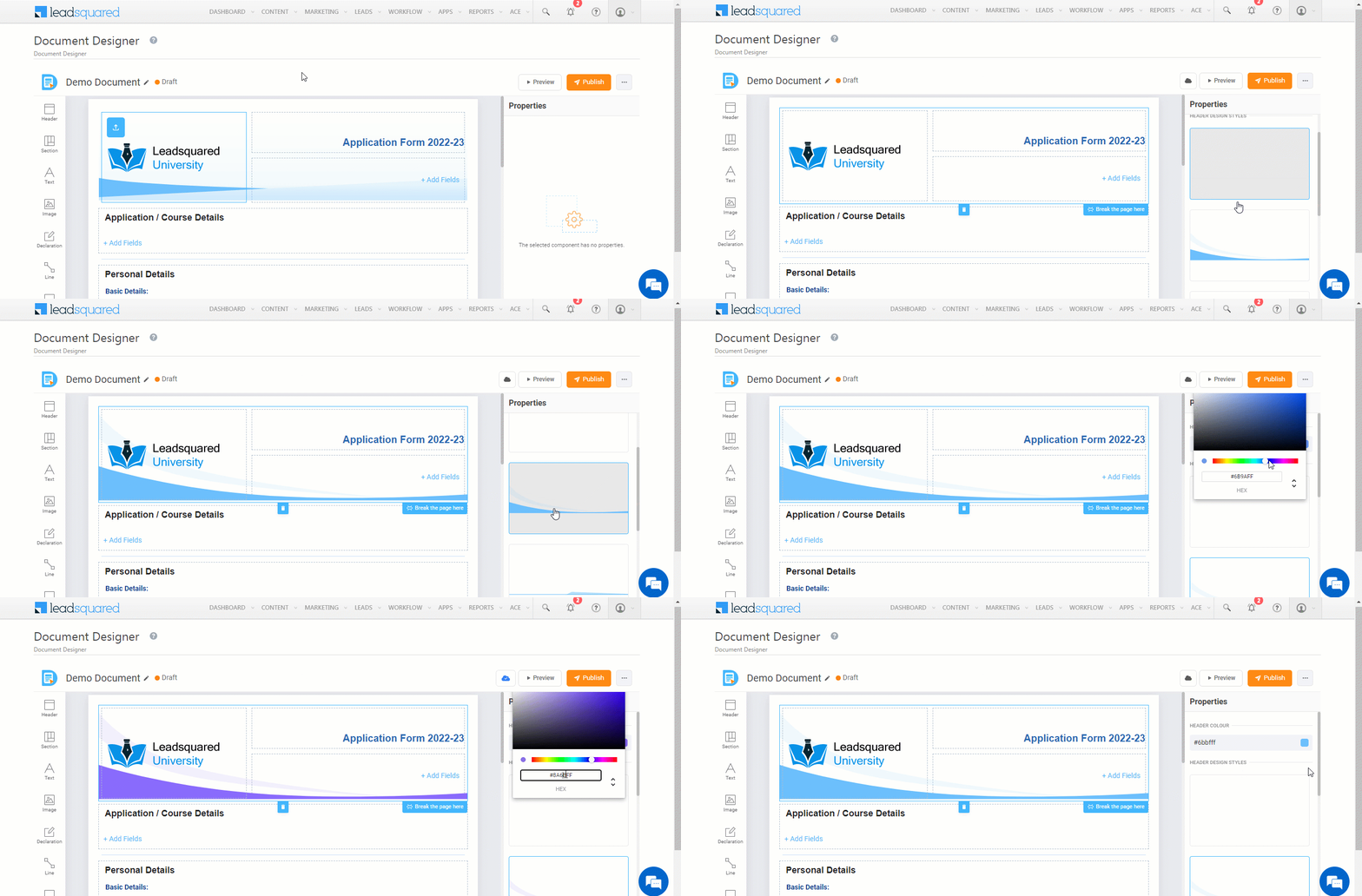
Header Design
From the options listed under Header Design Styles, select the background design style and the background colour of the Header. From the colour picker, select the background colour. Alternatively, you can enter the hex code of the colour of your choice.

LeadSquared Document Designer

Logo
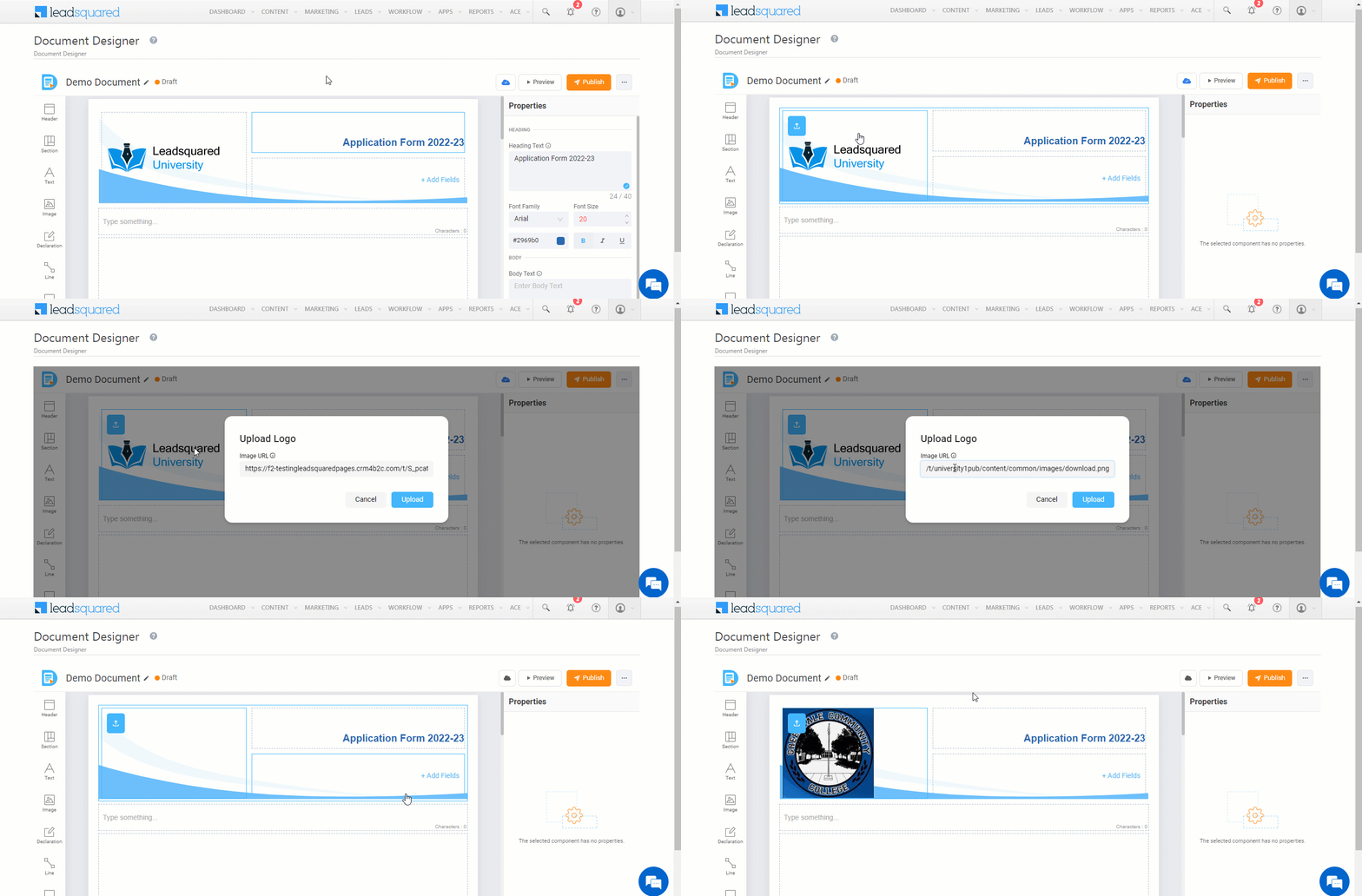
The logo that’s displayed in the document header. To change the header logo, click LeadSquared Document Designer, and enter the Image URL of the new logo.

Note: Only URLs of images uploaded to the Images and Documents library are supported.

LeadSquared Document Designer

Header Text
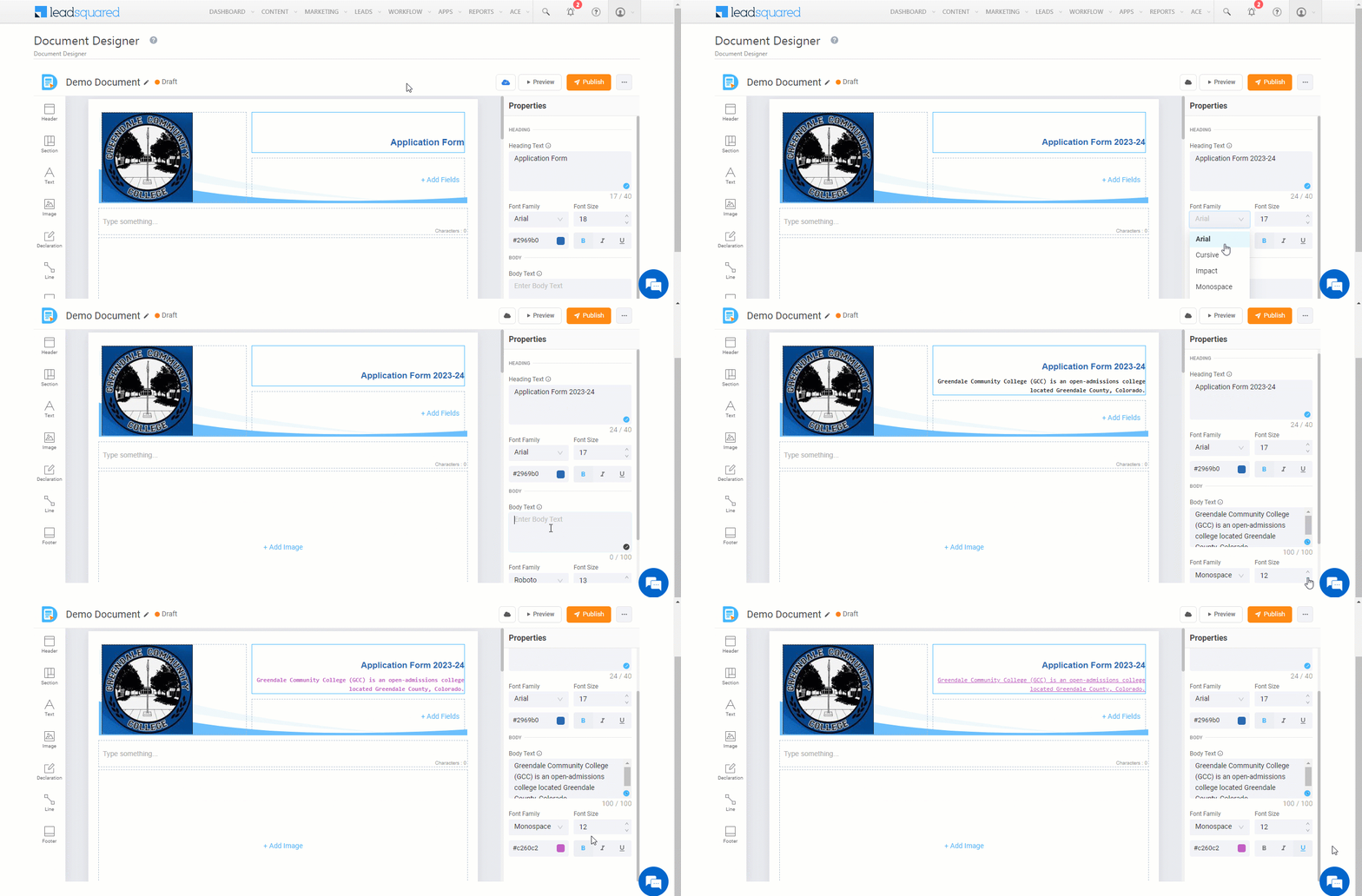
Configure the Heading and Body display text present on the form header.

  • Heading Text – The header display text. Only alpha-numeric characters are supported. You can add up to 40 characters in the Header (including spaces), and 100 characters in the Body (including spaces).
  • Font Family – From the dropdown, select the header text font.
  • Font Size – Configure the header text font size.
  • Colour – From the colour picker, select the font colour. Alternatively, you can enter the hex code of the colour of your choice.
  • Style – You can also change the text style to Bold, Italics and Underline.

LeadSquared Document Designer

Add Fields
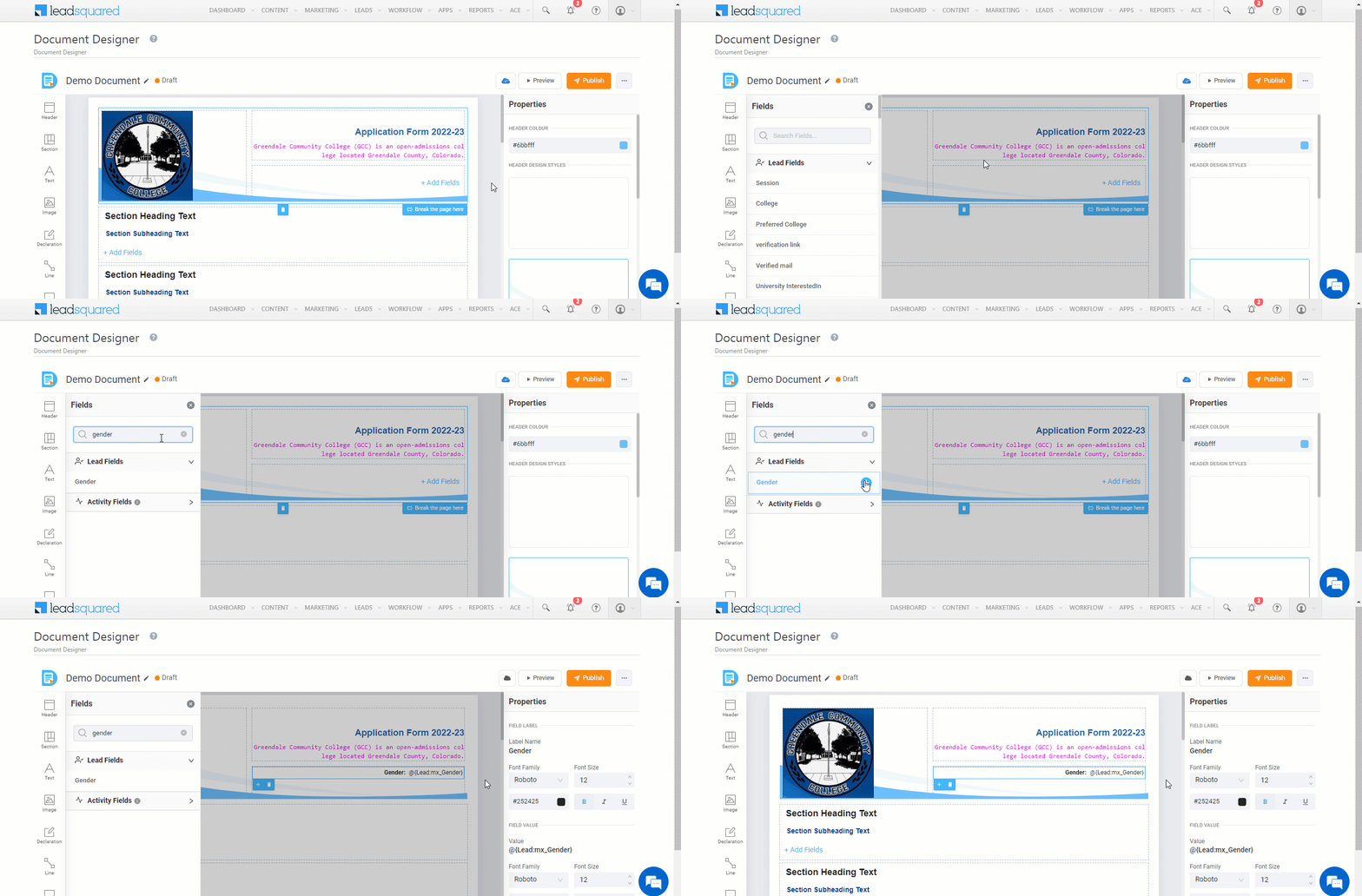
You can display data present in lead/activity fields directly on the document. For e.g., you can select the Gender lead field to dynamically display the lead’s gender. You can select custom and system lead fields, but only custom activity fields.

Note: You can also edit and update the Label Name (field name).

LeadSquared Document Designer

Special Fields

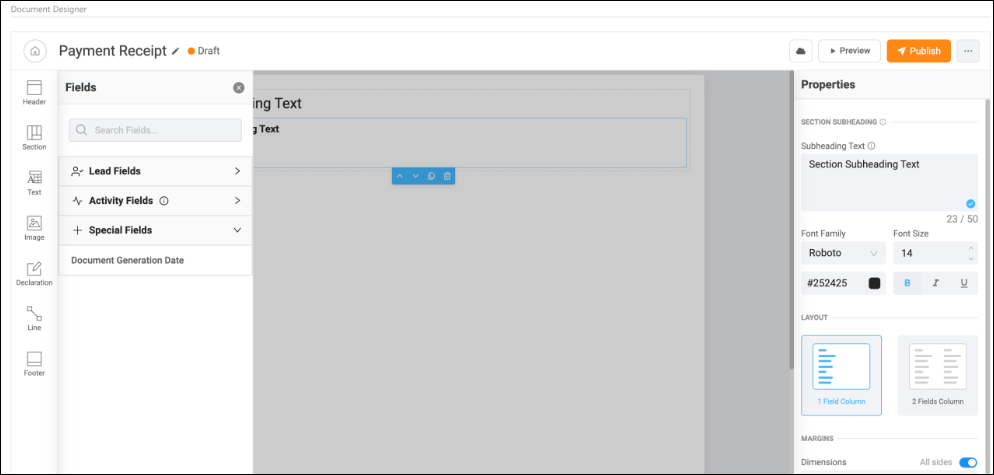
Here, you can choose to display the date on which the document was generated.

LeadSquared Document Designer

6.2 Section

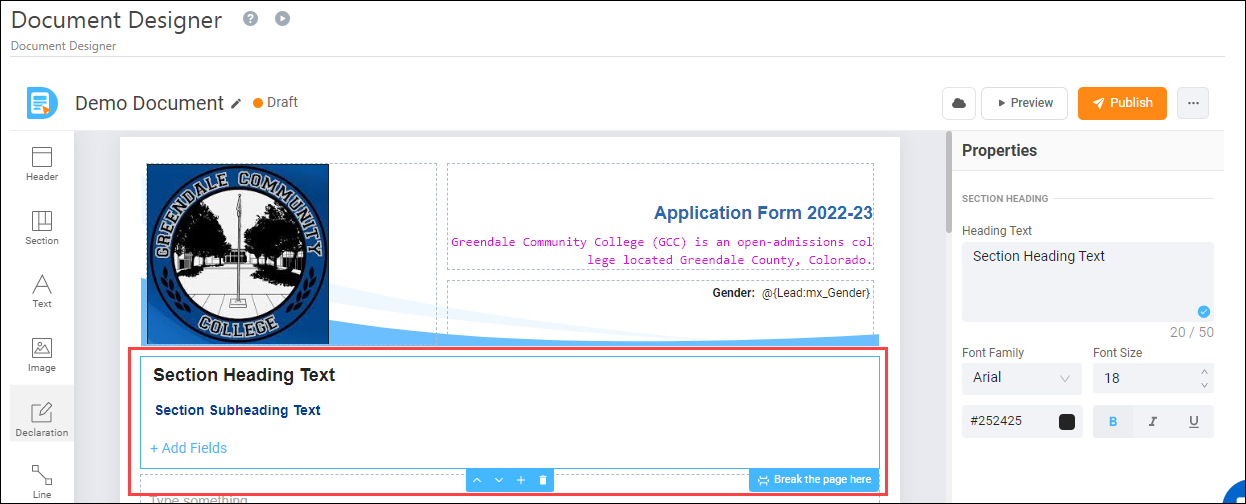
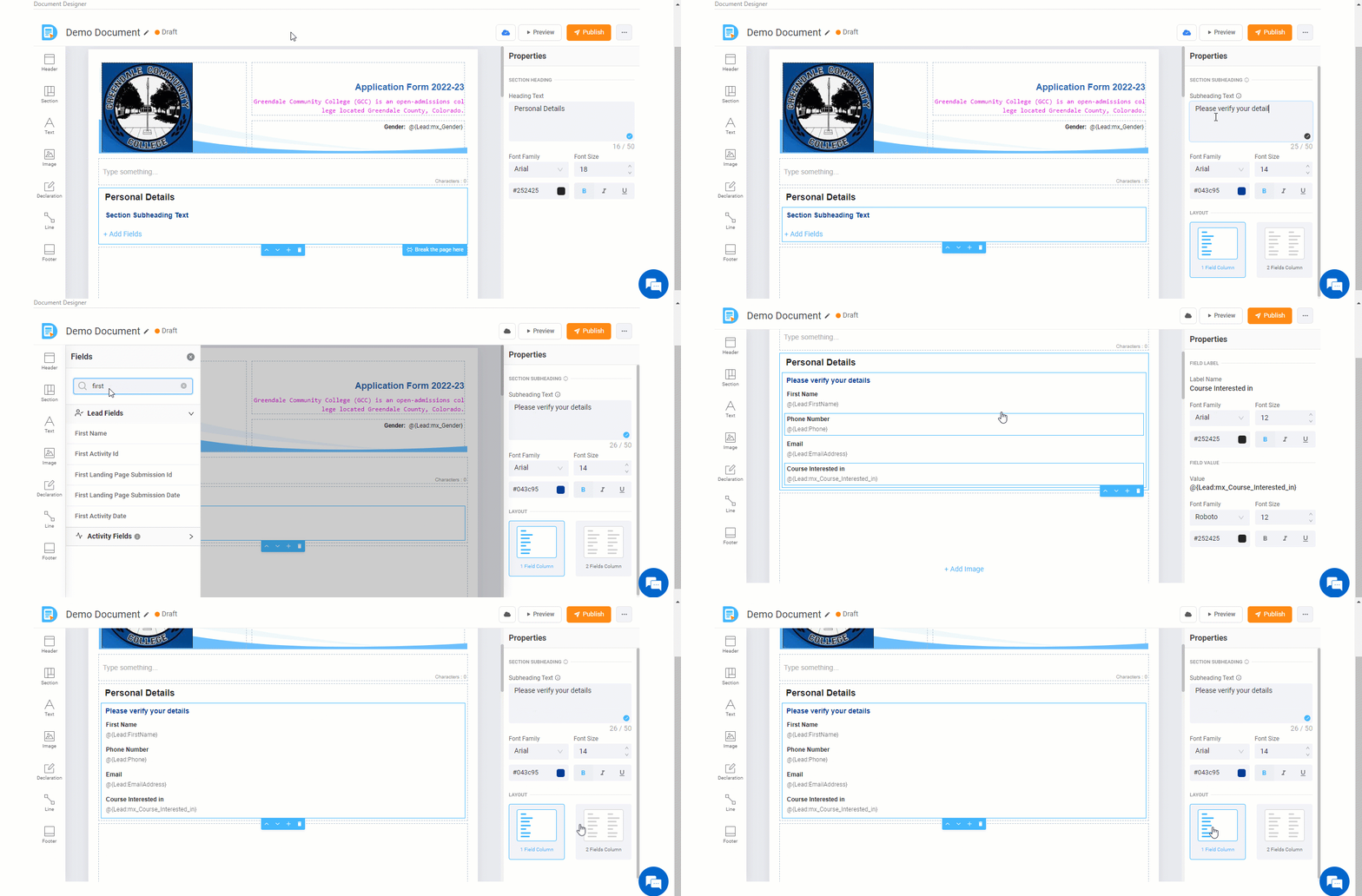
A section is used to display text content, along with lead/activity field details. Each section contains a Heading and Subheading text box, and under each subheading, you can add lead/activity fields. You can add and configure multiple sections. You can also mail merge lead/activity fields to dynamically display data stored in these fields.

LeadSquared Document Designer

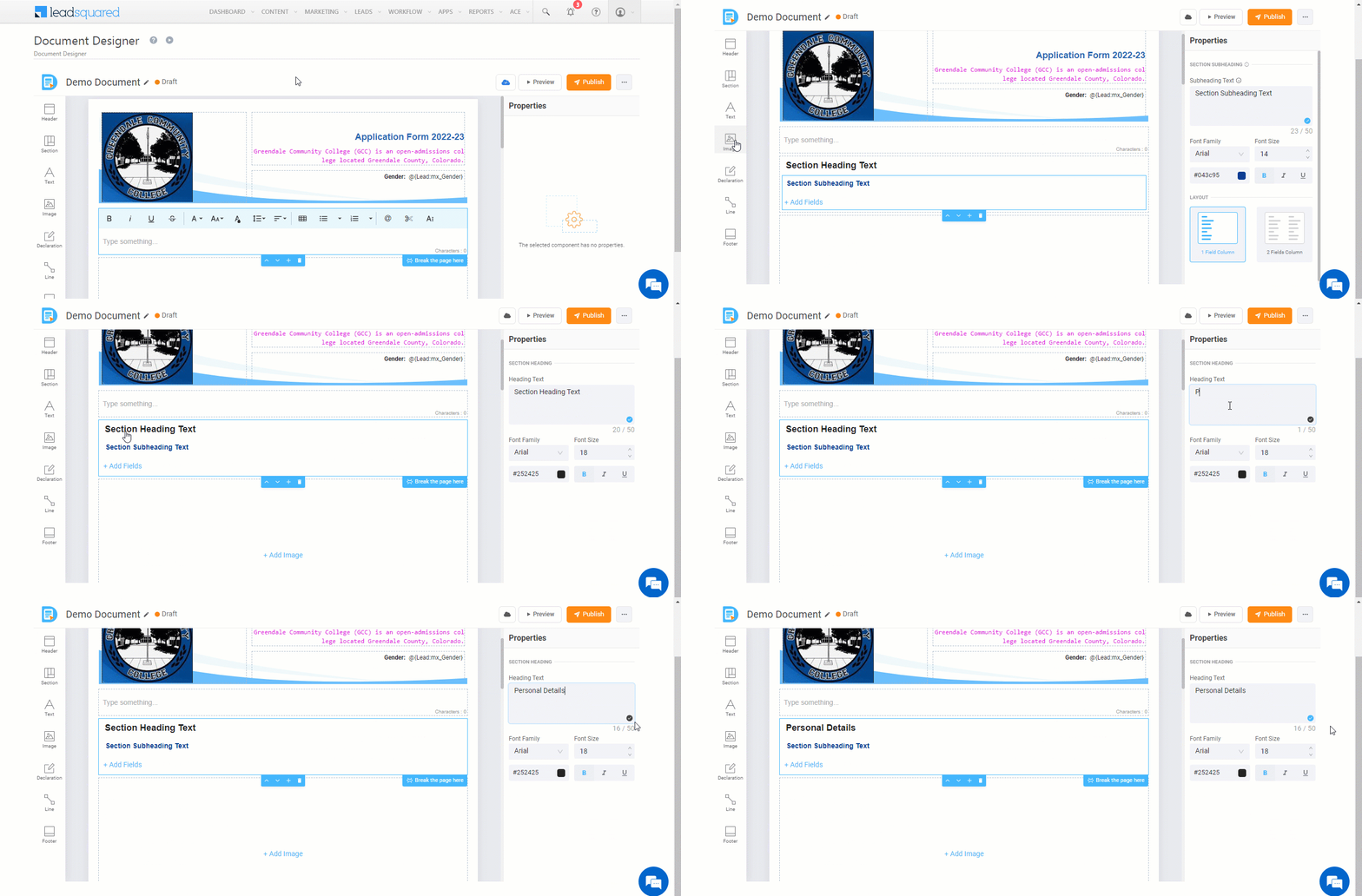
Section Heading
Enter and configure the header text for a section.

  • Heading Text – The header display text. Only alpha-numeric characters are supported. You can add up to 40 characters in the Header (including spaces).
  • Font Family – From the dropdown, select the header text font.
  • Font Size – Configure the header text font size.
  • Colour – From the colour picker, select the font colour. Alternatively, you can enter the hex code of the colour of your choice.

LeadSquared Document Designer

Section Subheading Text
Select the lead/activity fields you want to display as a part of the section (e.g., First Name, Phone Number, etc.). The subheading text is similar to the header text, where you can change the subheading of a section.

LeadSquared Document Designer

6.3 Text

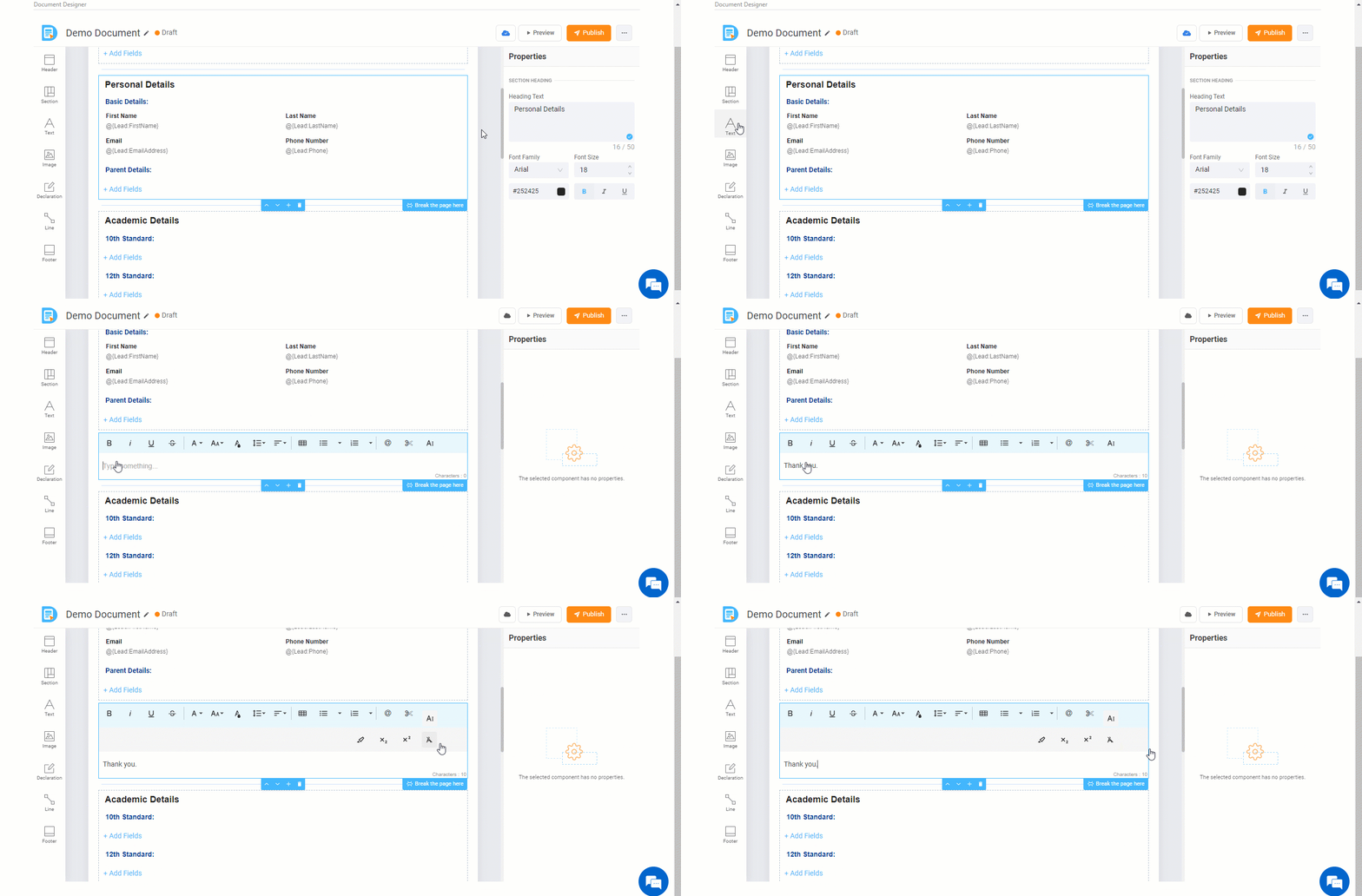
The Text component allows you to display simple text data on the document. The rich text editor allows you to modify the text as per your preference. You can also add a Table to the document through the Text component.

LeadSquared Document Designer

6.4 Image

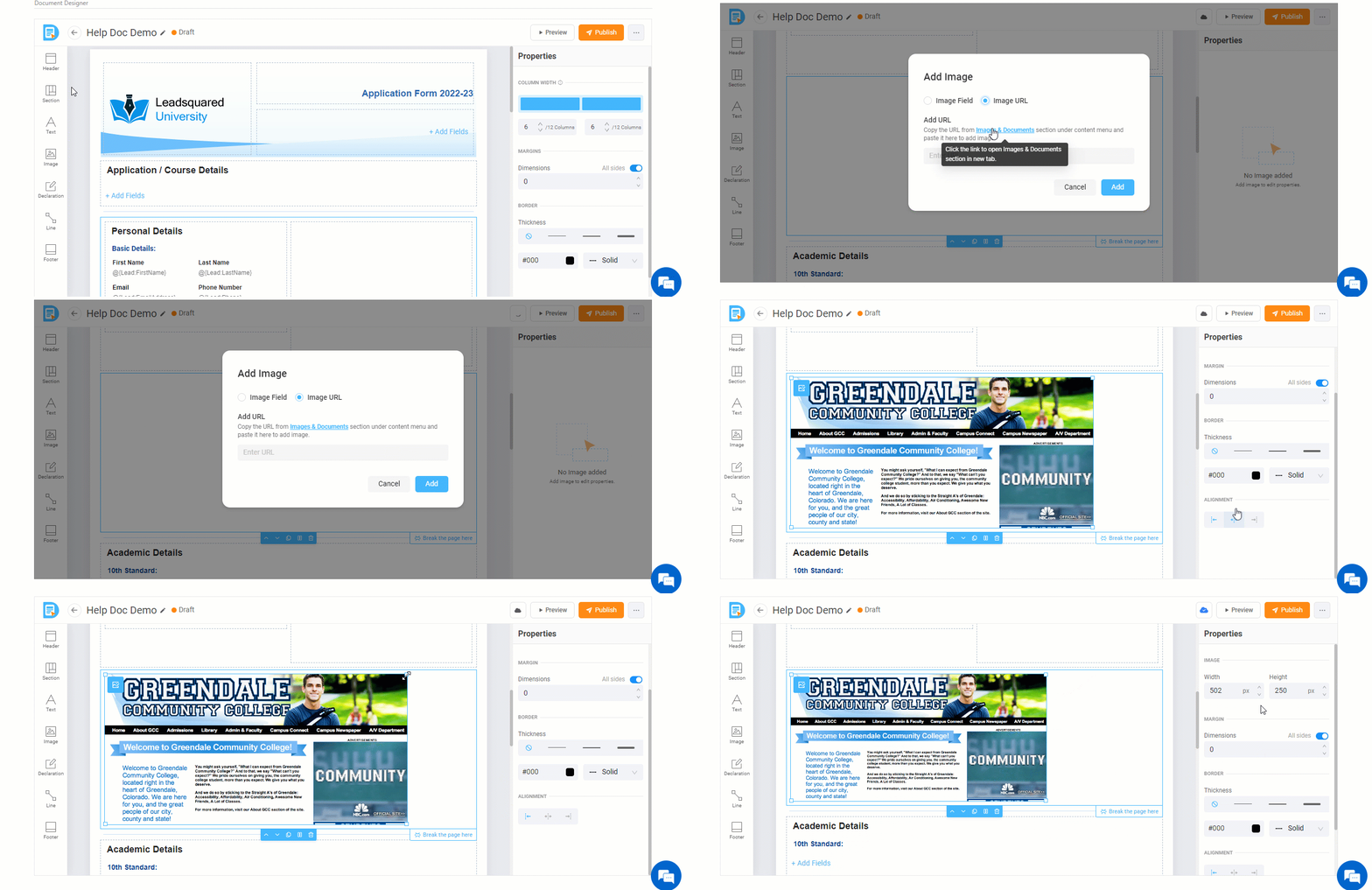
This component allows you to display an image in the document. You can mail merge an image type field that’s a part of the lead or custom activity or add the Image URL that’s uploaded to the Images and Documents library.

Once you’ve added the image, you can align it as per your preference.

Note: For images added using the Image URL option, resizing an image will result in the height changing proportionally to the change in width, and vice versa. You cannot adjust the height and width independently of each other.

LeadSquared Document Designer

6.5 Declaration

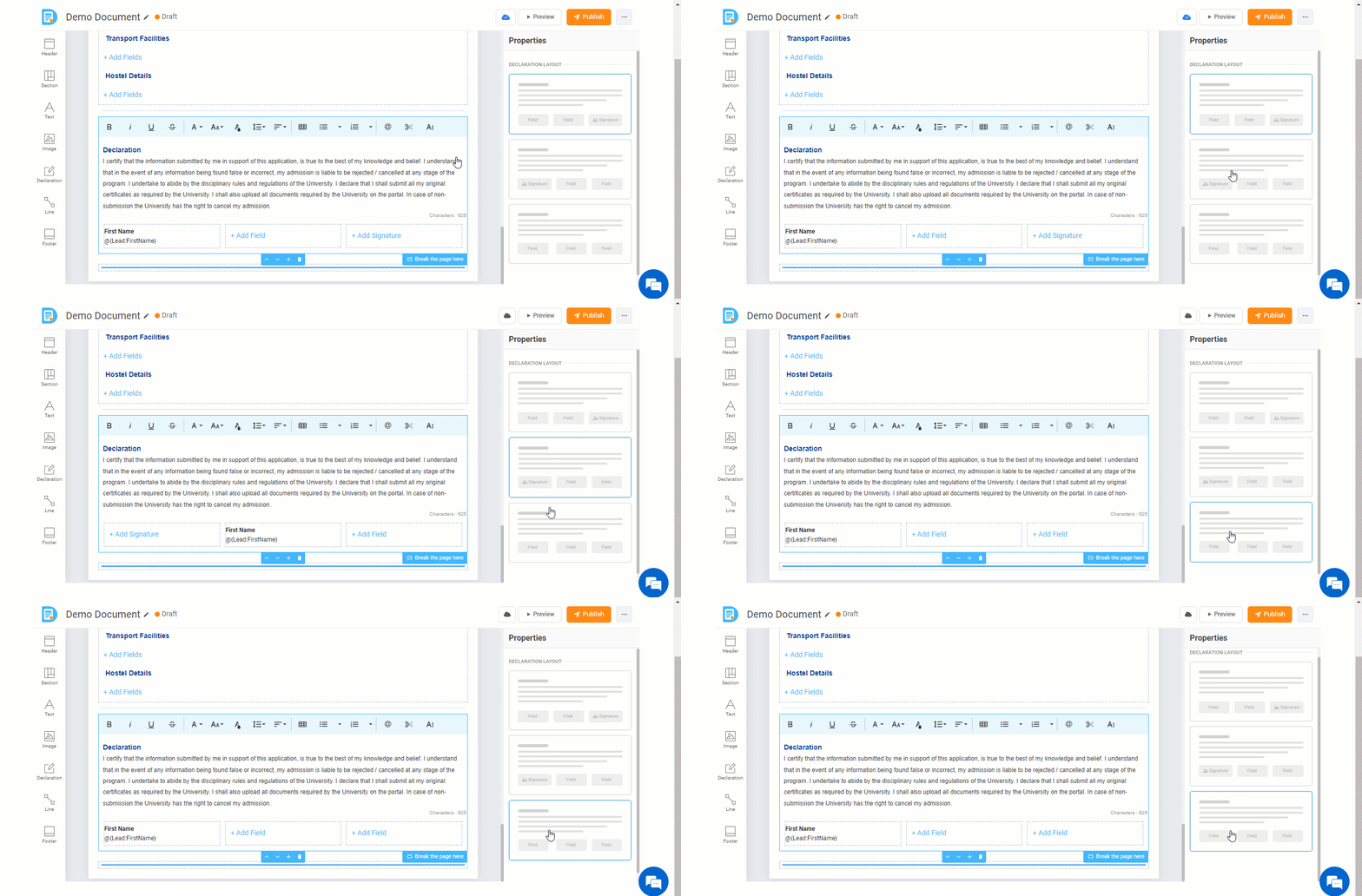
This component displays your lead’s declaration. We’ve provided a templatized version of a declaration. You can make modifications to the declaration, add lead/activity fields, and change the declaration layout.

LeadSquared Document Designer

Custom Layout

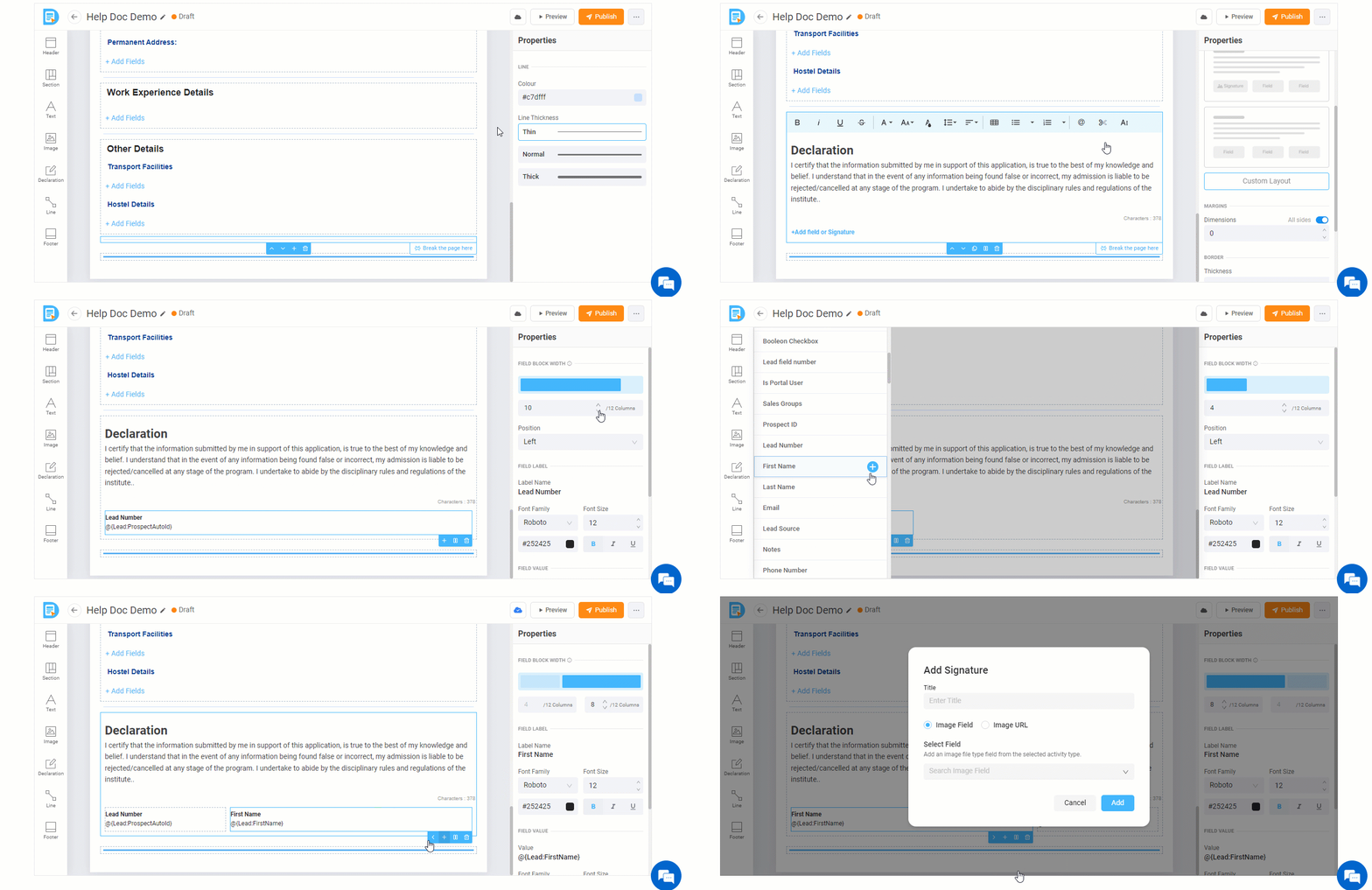
In addition to the templates provided, you can create a Custom Layout for the Declaration by adding Lead and Activity/Opportunity Fields, along with Signature fields. Arrange these fields either side-by-side or one below the other. You can include up to three fields in one row and resize them as needed.

LeadSquared Document Designer

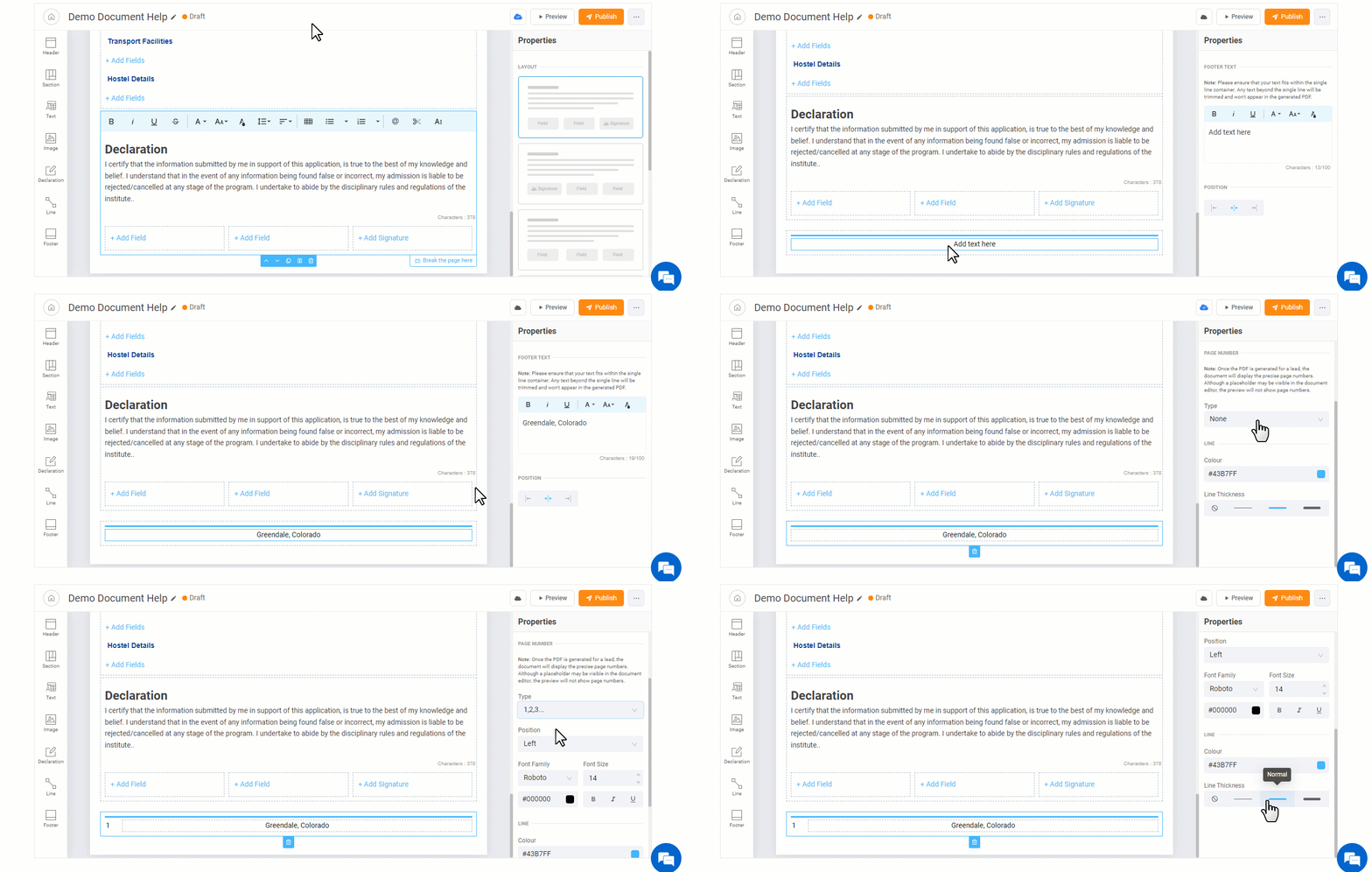
6.6 Line

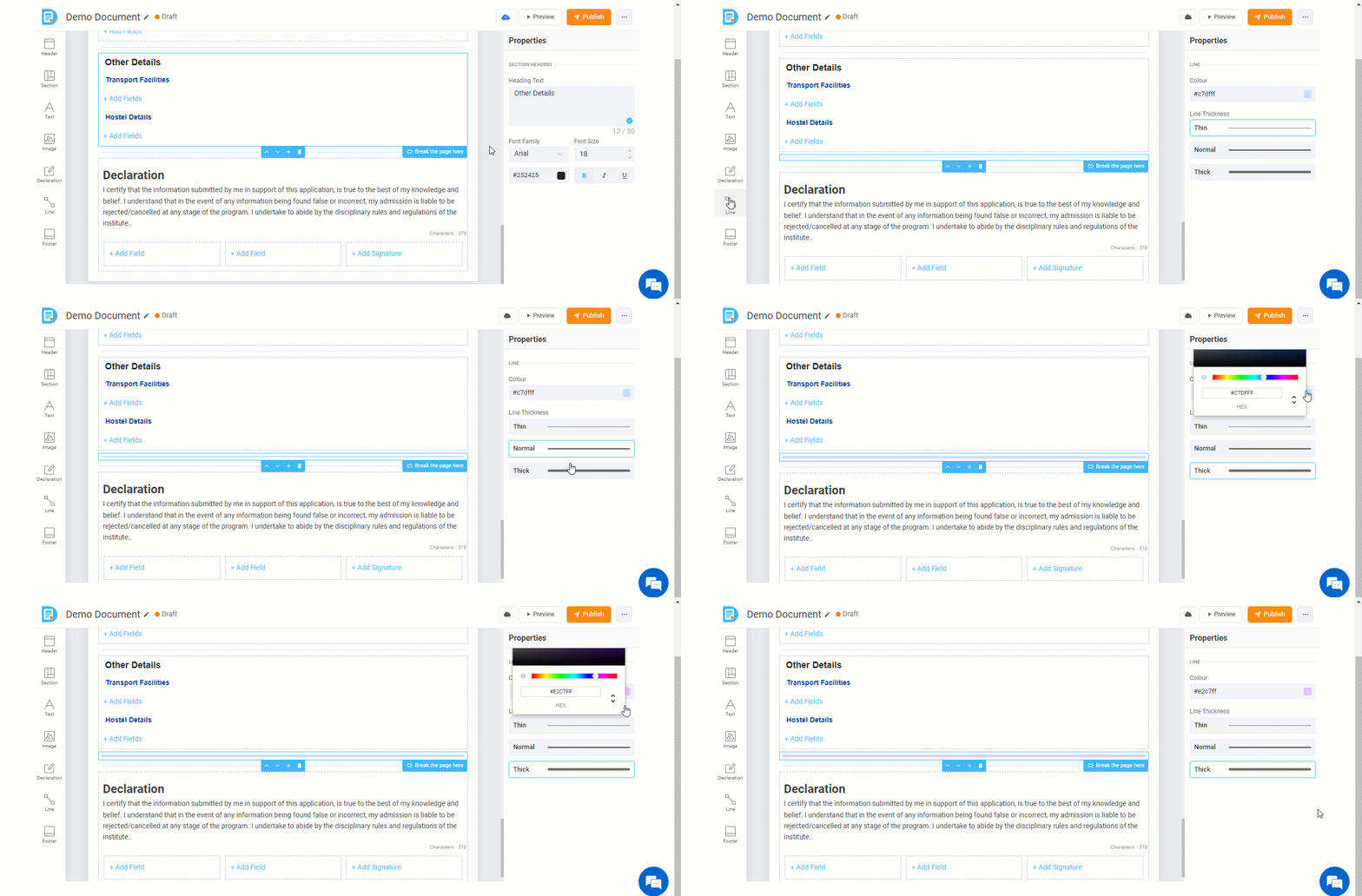
Lets you add a line break line between different components. You can change the line colour, by picking a colour from the colour picker. Alternatively, you can enter the hex code of the colour of your choice. You can also change the line thickness.

LeadSquared Document Designer

6.7 Footer

Here you can add plain text content (e.g., college address, contact details, etc.) to the document’s footer. The footer also comes with a default line, which you can edit and modify. You can also add page numbers and logos to the footer.

Footer Text
Enter and configure the footer text.

  • Footer Text – The footer display text. Only alpha-numeric characters are supported. You can add up to 50 characters in the footer.
  • Font Family – From the dropdown, select the footer text font.
  • Font Size – Configure the header text font size.
  • Colour – From the colour picker, select the font colour. Alternatively, you can enter the hex code of the colour of your choice.
  • Style – You can also change the text style to Bold, Italics and Underline.

Line
Configure the line present above the footer text. You can change the line colour, by picking a colour from the colour picker. Alternatively, you can enter the hex code of the colour of your choice. You can also change the line thickness.

LeadSquared Document Designer

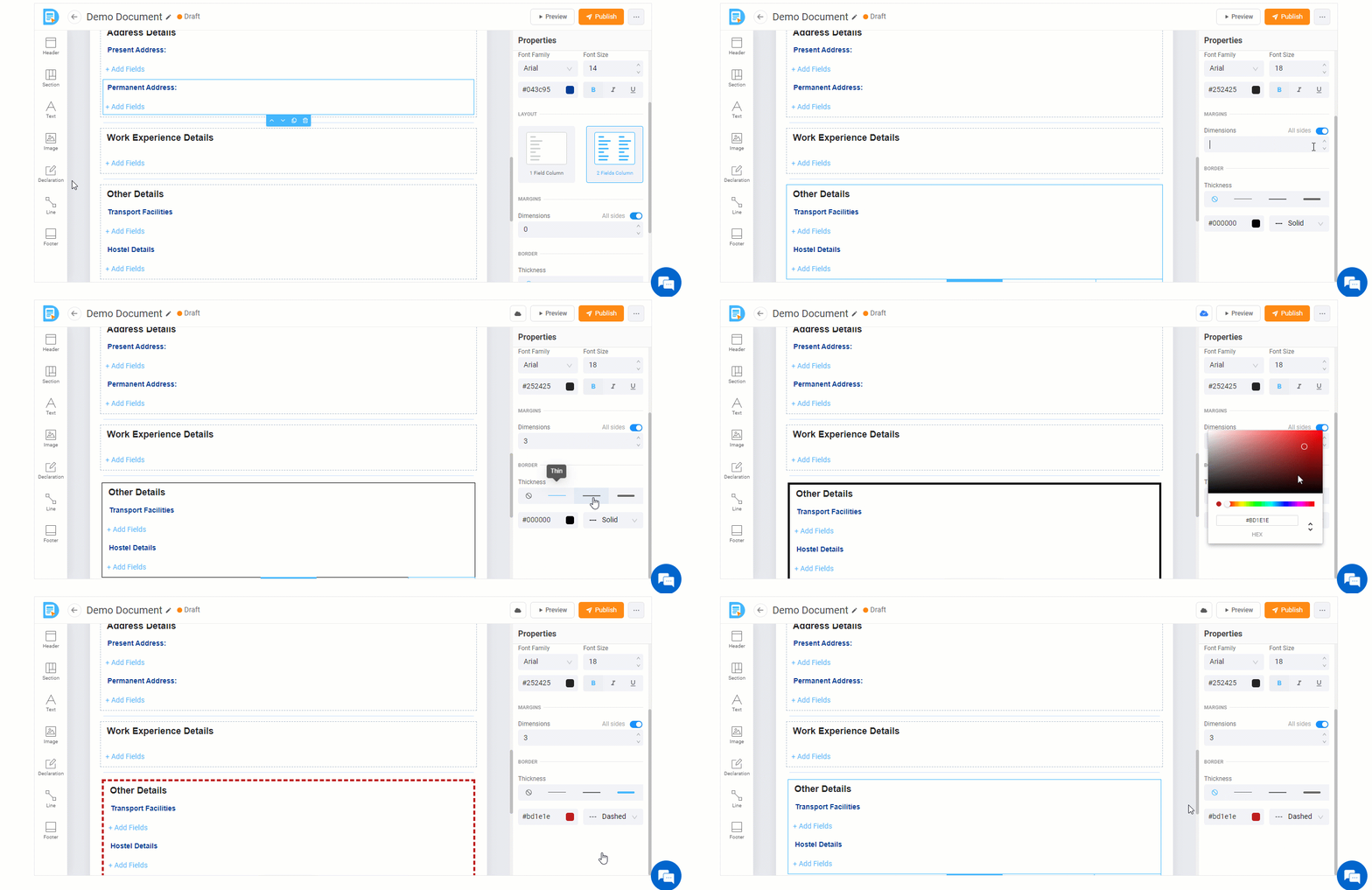
6.8 Margins & Border

You can add margins and borders to the following components –

  • Section
  • Text
  • Image
  • Declaration
Note: You can add borders and margins to the container that holds the components listed above.
  • Margin – Configure the margin width and dimensions for the selected component. If you want the margin to be applicable on all sides of the layout, against All Sides, toggle the enable icon slider.
  • Border – Set the thickness, style (Solid or Dashed), and colour for the border around the selected component. Choose a colour from the colour-picker or enter a hex code of your choice.

LeadSquared Document Designer

6.9 Other Actions

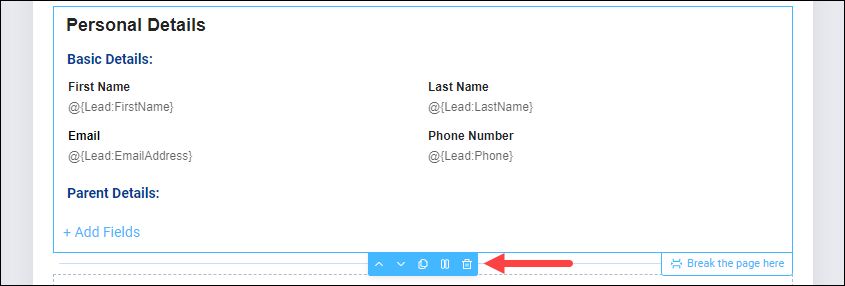
You can perform the following actions on a component –

  • Move the component up/down.
  • Add a similar component.
  • Delete the component.
  • Add an additional component* on the right. You can add the following components side-by-side –
    • Section
    • Text
    • Image
    • Declaration
  • The document designer auto-saves your progress every 20 seconds.
  • You can also break the page using the Break the Page action.
Note: *You can place any of the components mentioned next to each other (e.g., you can place an Image component next to a Declaration component).

LeadSquared Document Designer

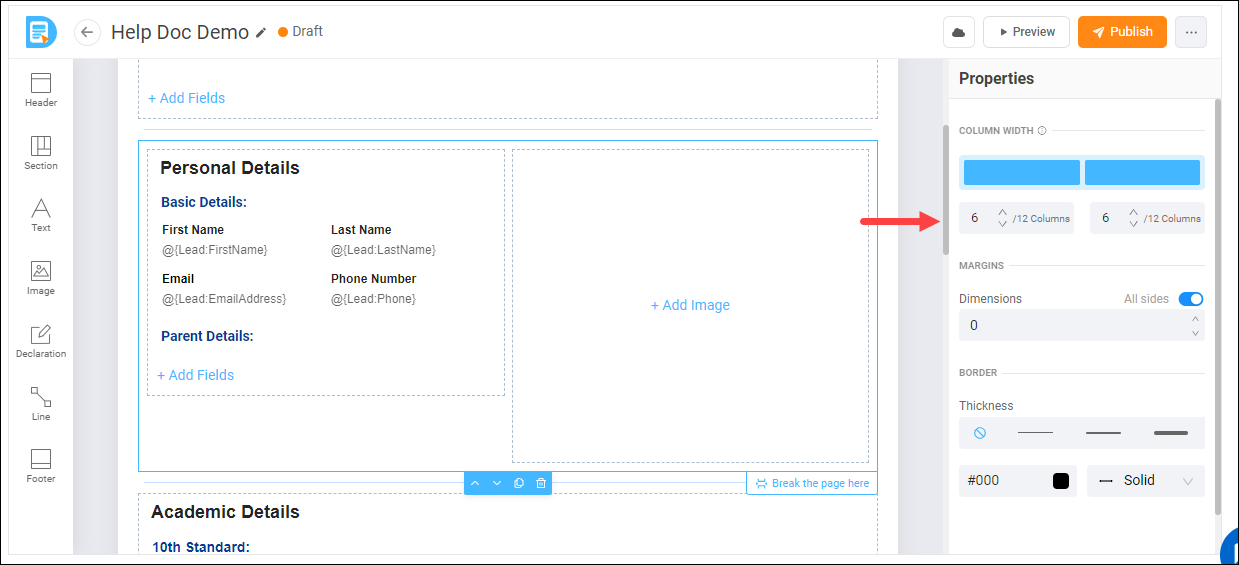
You can also resize the component when you’ve added two components side-by-side.

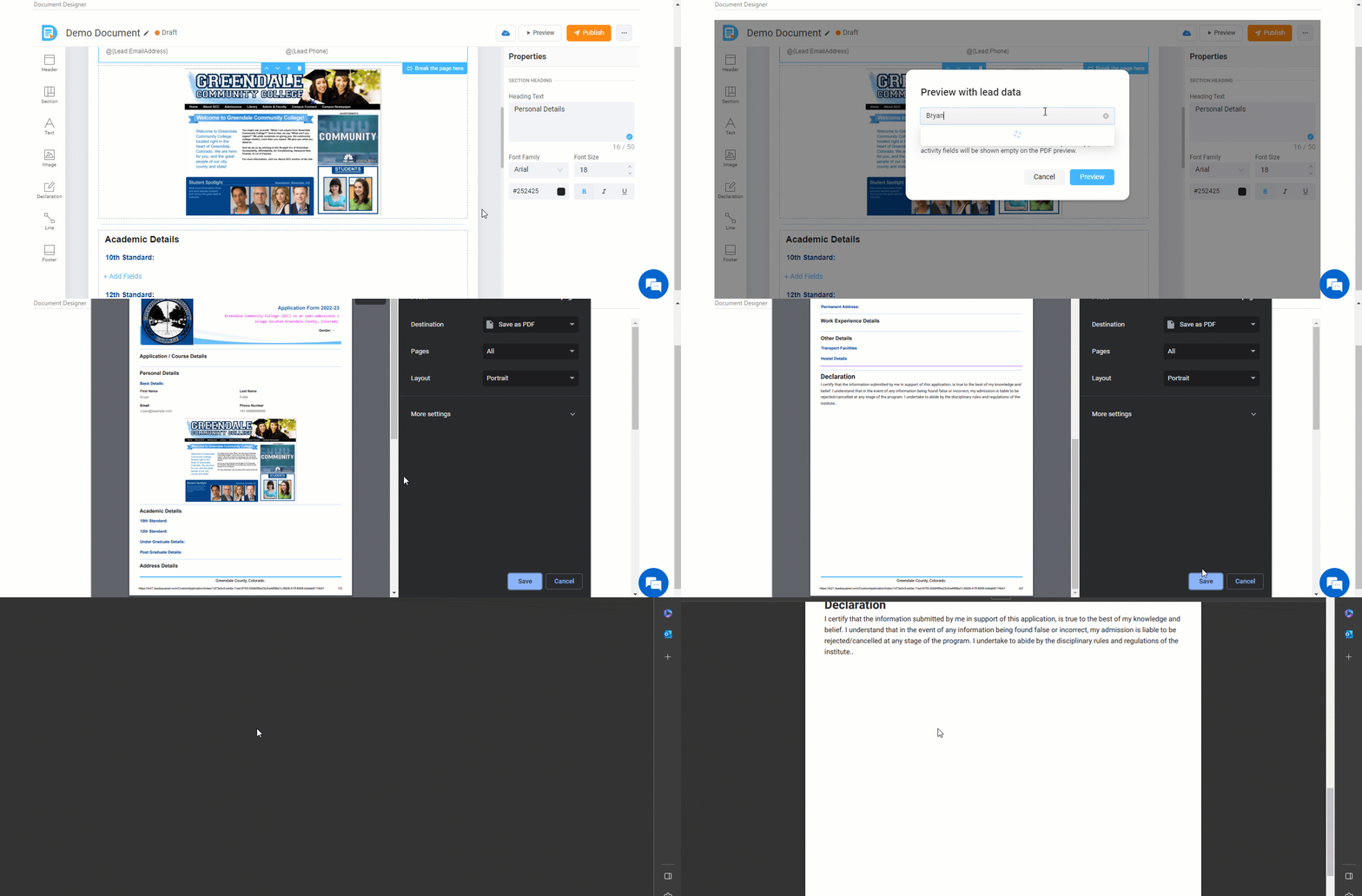
LeadSquared Document Designer

6.10 Preview Document

You can preview the document anytime during the document creation process. Click Preview, and select a lead whose details are visible on the document.

LeadSquared Document Designer


7. Publish the Template

Once the document is ready, publish it to your account.

Note: Before you publish the document, ensure the following activity fields are added to the Custom Activity on which you’re setting up the document –

  • A String type field.
  • A Custom Field Set (CFS) field, with the Type set to File, and the File Type set to PDF.
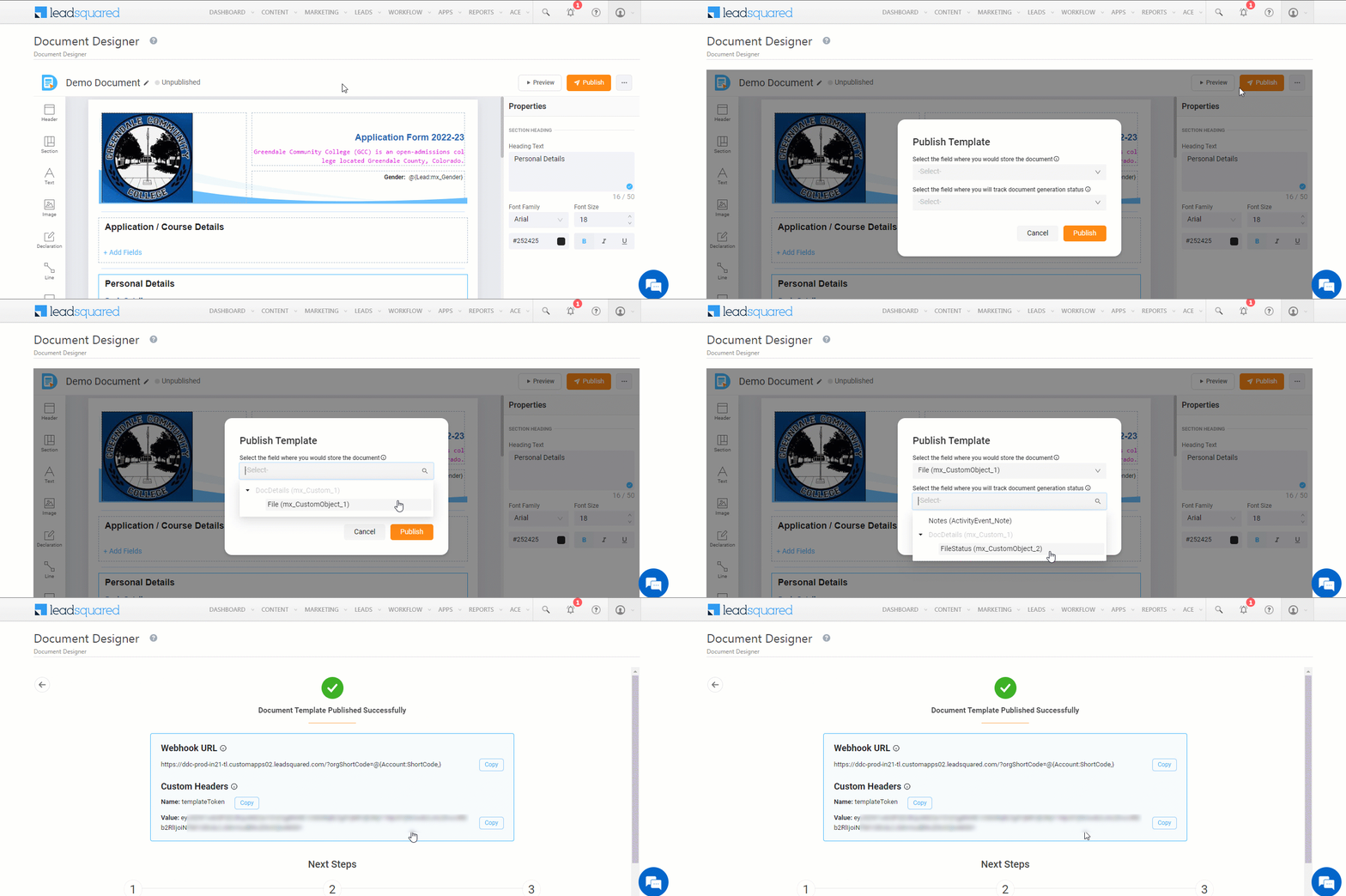
  1. On the top-right corner, click Publish.
  2. On the Publish Template pop-up, select the following –
    • Store the document – From the dropdown, select the CFS PDF type field you’ve integrated with the custom activity. Once generated, the document is stored in this CFS field, from where the lead can view and download the document.
    • Document generation status – From the dropdown, select the String type activity field that’s part of the custom activity. The document generation status is stored in this field.
  3. Once you’re done, click Publish.

LeadSquared Document Designer

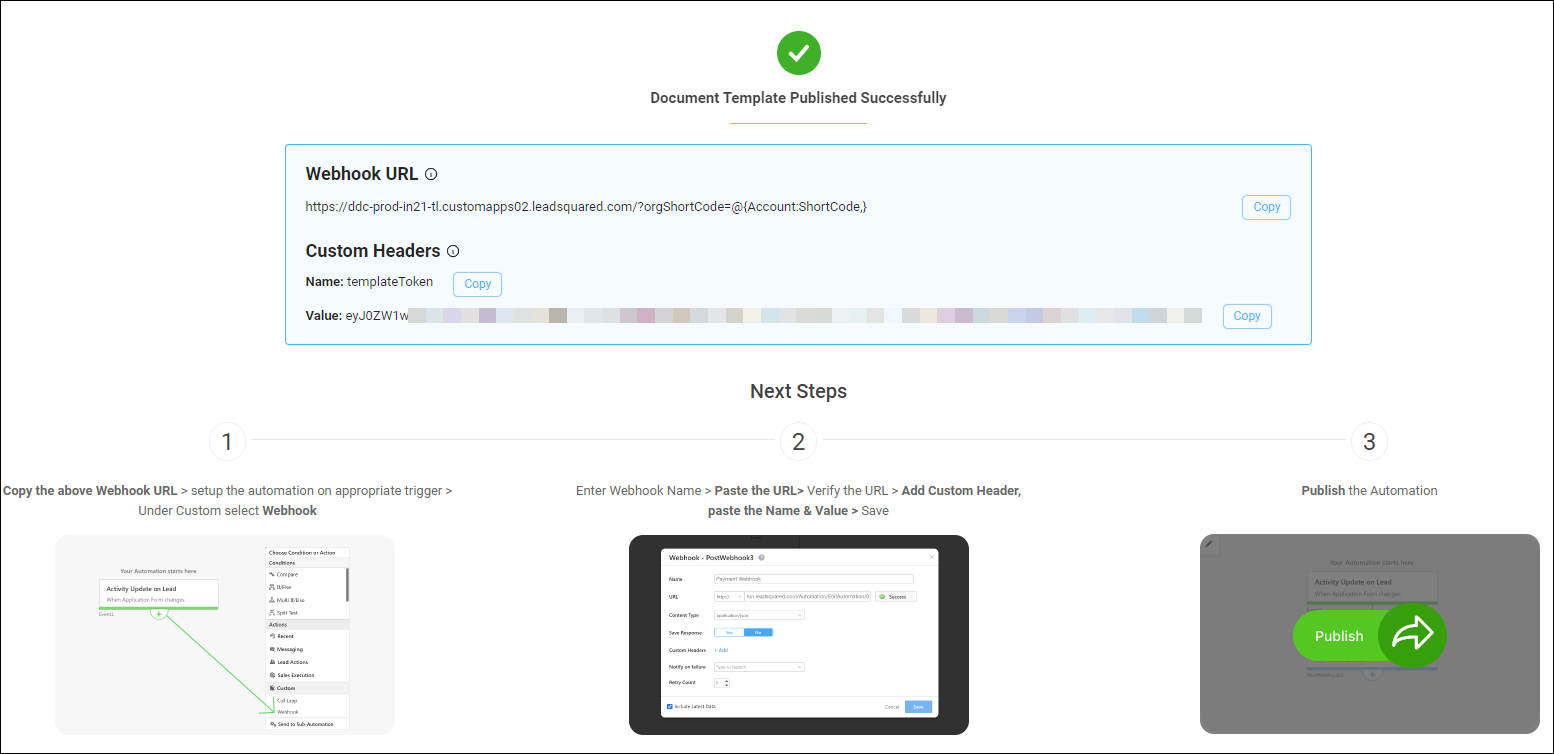
Once the document is published, a webhook URL and token value are generated. Use these URLs to set up the automation in the next step.

LeadSquared Document Designer


8. Set up the Automation

This automation is set up using the custom activity as the trigger. Every time the activity is posted, the webhook URL (which was generated after the document was published) generates a document for the lead.

Note:

  • In this section, we’ve chosen an Activity trigger, but you can set up the automation using a lead, activity, or opportunity trigger. The steps listed below will remain similar for all three entities.
  • If you choose an activity trigger, you can integrate only an activity-based document template with the automation. Likewise, if you select a lead or opportunity trigger, you can integrate only a lead-based or opportunity-based document template with the automation.
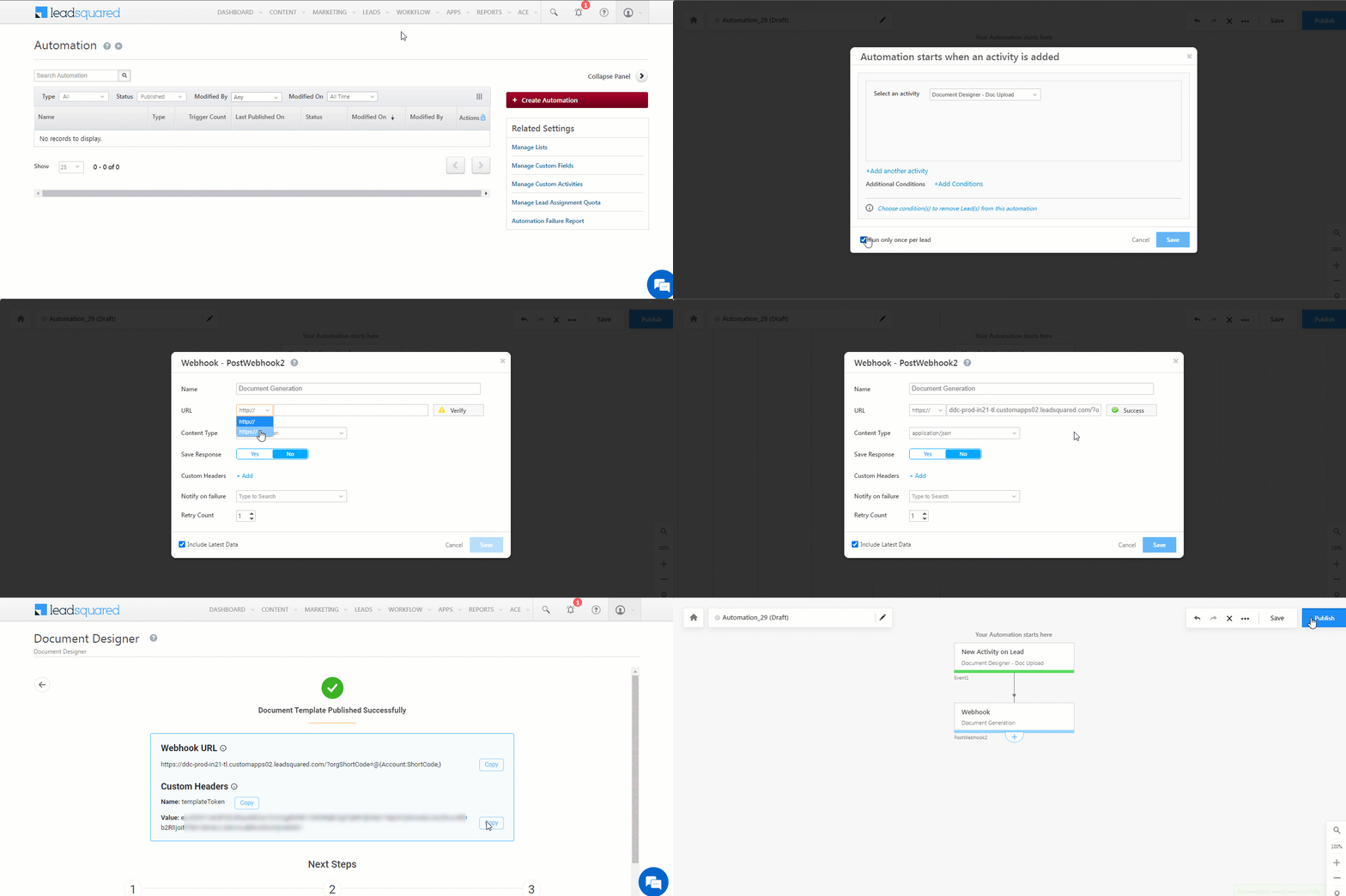
  1. Navigate to Workflow>Automation, click Create Automation, and select New Activity on Lead as the trigger.
  2. From the Select an activity dropdown, choose the custom activity you created, and click Save.
    • Disable the “Run Only Once Per Lead” setting.*
  3. Click Add Automation, and under Custom, click Webhook.
  4. On the Webhook pop-up, enter the following details –
    • Name – Enter a relevant name for the webhook. We’re calling it “Document Generation”.
    • URL – Select the method as https://, and paste the connector’s webhook URL that was generated. Before you paste the URL, ensure you remove “https://” from the URL.
    • Content Type – Select application/json.
    • Save Response – You can select either Yes or No.
    • Custom Headers – Click Add, and enter the following details that were generated in the previous step
      • Name – Enter the name (“templateToken”) present under Custom Headers.
      • Value – Enter the value present under Custom Headers.
    • Notify on Failure – Select which user you want to notify if the webhook fails.
    • Retry Count – The number of times you want to retry when the webhook fails.
  5. Once you’re done, click Save, and then click Publish.

Each time the automation is triggered, the webhook generates a document, and this file is stored in the CFS PDF-type field within the custom activity/opportunity.

Note:

  • *It is recommended you disable the “Run Only Once Per Lead” setting when selecting the automation trigger. This is to ensure the automation triggers even when the lead is looking to generate a document multiple times.
  • To know more about the Webhook action, refer to User Automation Actions – Webhook.

LeadSquared Document Designer


9. Manage Templates

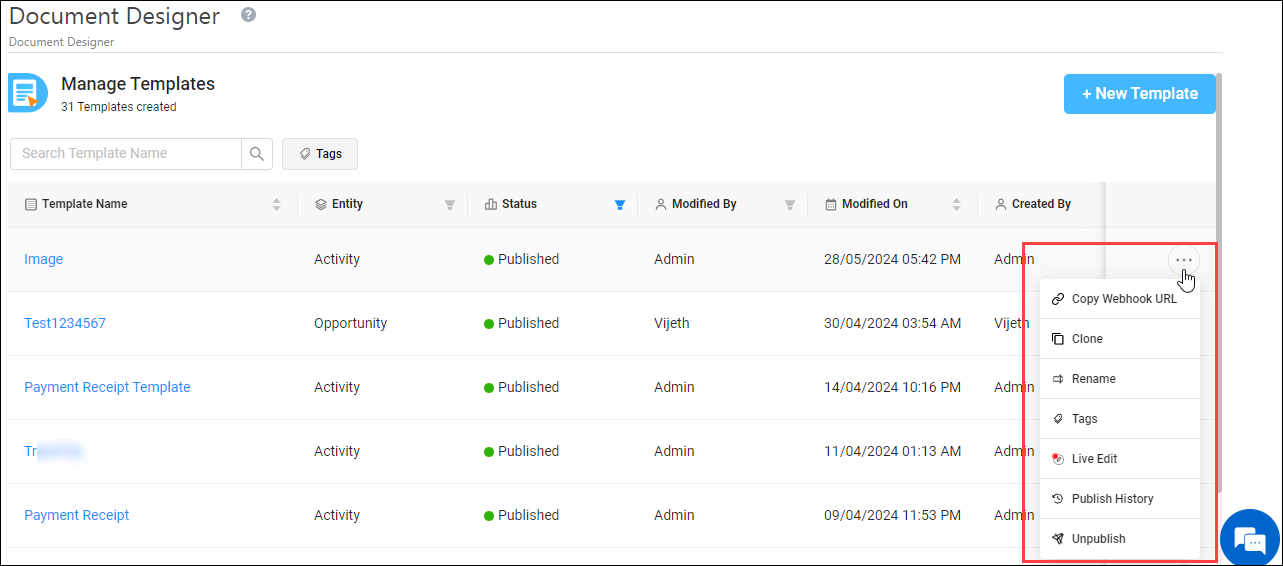
Once the document template is published, you can perform the following actions from the Manage Templates screen –

  • Copy Webhook URL – This lets you copy the webhook URL directly from the dashboard screen.
  • Clone – This lets you clone the entire template.
  • Rename – This lets you change the internal display name.
  • Live Edit – This lets you make changes to a live document template, without having to unpublish the template.
  • Tags – This lets you add tags to the templates created in your account.
  • Unpublish – This lets you unpublish the template.
  • Delete – This lets you delete the template.
  • Version History– Automatically displays the version number of the template, and displays the name of the user that made the changes to the template.

LeadSquared Document Designer


10. Tags

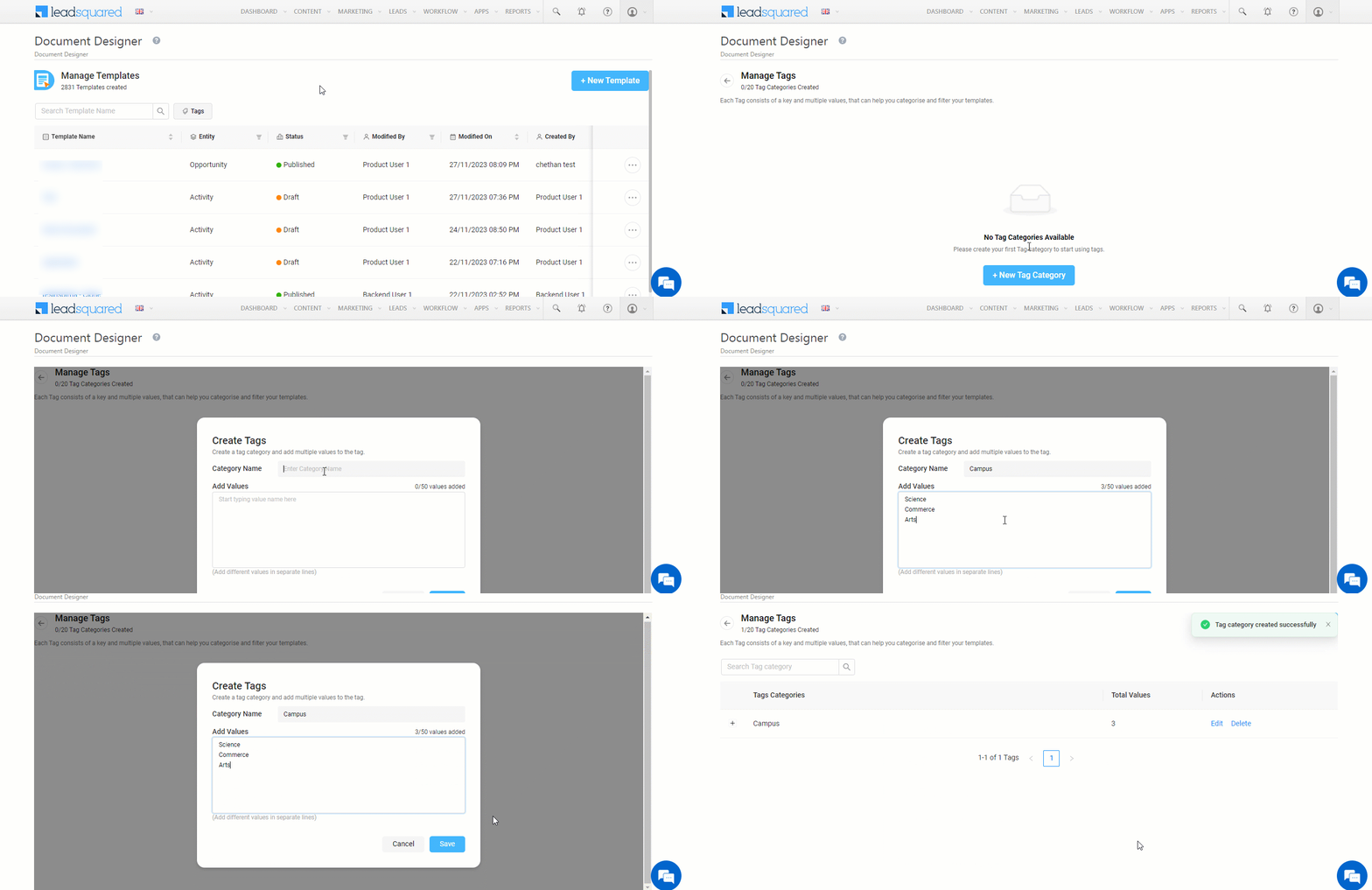
Ease internal document identification for your users by adding tags to each of the document templates you’ve created. Users can also filter and search by the tags assigned to a template.

For example, if there’s a university with multiple campuses, create a tag with the Category set to Campus 1. Then, create a list of tag Values corresponding to the courses offered in that campus, such as Science, Commerce, and Arts. Assign the appropriate tag to the relevant document template.

10.1 Create Tags

  1. On the Manage Templates screen, click the Tags button LeadSquared Document Designer.
  2. On the Filter By Tags pop-up, click Manage all Tags.
  3. On the Manage Tags screen, click New Tag Category.
  4. On the Create Tags pop-up, enter a relevant Category (Campus 1 in our example) and add relevant Values (Science, Commerce and Arts in our example).
  5. Once you’re done, click Save.t

Note:

  • You can add up to 20 tag categories.
  • Under a category, you can add up to 50 values.

LeadSquared Document Designer

10.2 Assign tags

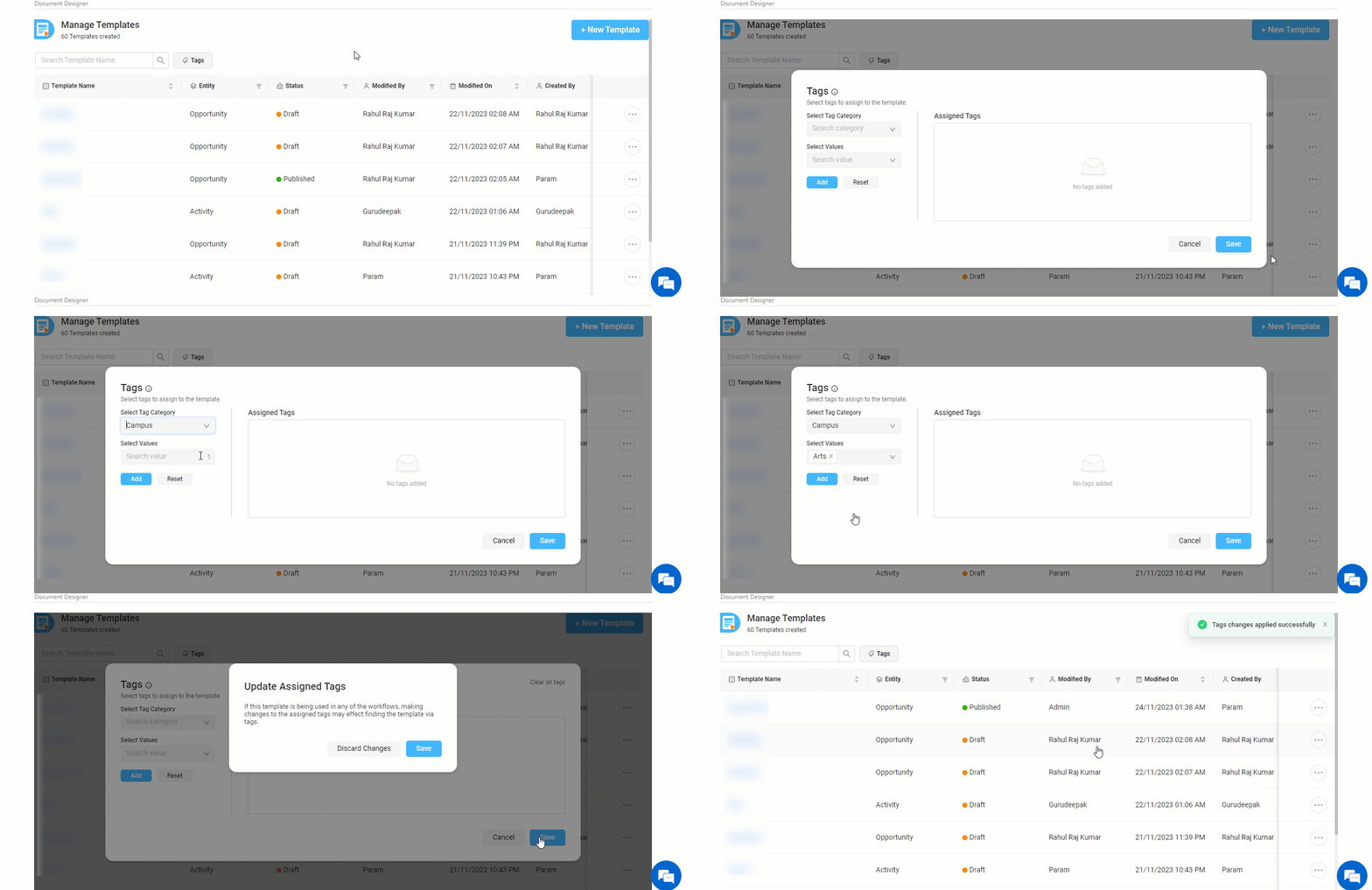
  1. On the Manage Templates screen, hover your cursor over LeadSquared Document Designer, and click Tags.
  2. On the Tags pop-up, from the list of options available, Select Tag Category and Select Tag Values.
  3. Once you’re done, click Add, and then click Save. The selected tags will be added to the template.

LeadSquared Document Designer


11. Next Steps

When the automation fires, the document is generated and stored in the CFS PDF-type activity field. To display the document to your leads, you must include the CFS PDF in the Portal

Note: If you’re unable to integrate the CFS field with your portal,  please contact documentdesigner.support@leadsquared.com.


Any Questions?

Did you find this article helpful? Please let us know any feedback you may have in the comments section below. We’d love to hear from you and help you out!

Integrate Consent Management App with LeadSquared

1. Feature Overview

When you collect sensitive information about your leads (as part of KYC processes, etc.), which may include their identification documents, address proof, credit score, etc., you need to receive consent from the lead to collect this data. Recording the lead’s consent is helpful for audits and lets you stay compliant with government rules and regulations.

Once you integrate the Consent Management App with LeadSquared, you can use LeadSqured Dynamic Forms to trigger a consent approval email to collect sensitive data belonging to the lead. If the lead provides or denies their consent, it will be captured as an Activity on the Lead Details page.

consent management demo


2. Prerequisites

  • You must be the Administrator of your LeadSquared account to install and configure this connector.
  • This is a paid feature. To enable it, reach out to your account manager, or write to support@leadsquared.com.


3. How it Works

First, install and configure the Consent Management connector. Then, create a Dynamic Form to facilitate the actual consent approval from your leads. You can use Form Rules to trigger the consent approval and map the response from the lead as an Activity.

The Consent Management App requires the following steps –

  1. Install and configure the Consent Management connector
    1. Create a consent purpose and enter the relevant details (Consent Name, Consent Text, Company Logo, etc.,). You can create multiple consent approval flows to maintain approvals for different KYC/document collection processes.
    2. Map the Lead Field with the Email ID Attribute. This mapping is required to send a consent approval email to the lead.
  2. Create a Dynamic Form to trigger the consent approval 
    1. Add the lead fields to the Form.
    2. Use the Initiate Lead Consent details from the Consent Management connector to create a Form Rule on this Form. This rule is used to trigger the consent management process.
    3. Publish the Form.


4. Install the Connector

  1. From your LeadSquared account, navigate to Apps>Apps Marketplace.
  2. Search for Consent Management, and click Install.
    • Alternatively, you can find the connector on the left panel, under Verifications.
  3. Once installed, hover your cursor over , and click Configure.

consent management install


5. Configure the Connector

Click on Consent management add to add a Consent Purpose. The configuration has two steps –

5.1 Page Configuration

You can enter the following details on your Consent Page Configuration –

*Mandatory fields.

Page Configuration Field Description
Consent Name* Name of the consent capture configuration.
Consent Purpose* Purpose of the consent collection from the lead. There is a 100 character limit to this field.
Company Logo* Your company’s logo. This logo will be visible on the consent page UI.
Primary Colour* Enter a Primary Colour as a hex code – you could match the colour of your company branding
Consent Text* The consent approval text displayed to the lead. There is a 500 character limit to this field.
Link to Terms & Conditions Link to the Terms & Conditions page of your company.
Support Email Address Your company’s support email address. This address will be shown to the lead when they withdraw their consent.

To take a look at how your landing page will look, click Preview. Once you’re satisfied, click Next.

Consent management app configure 1

5.2 Communication Configuration

Configure the consent communication and mapping.

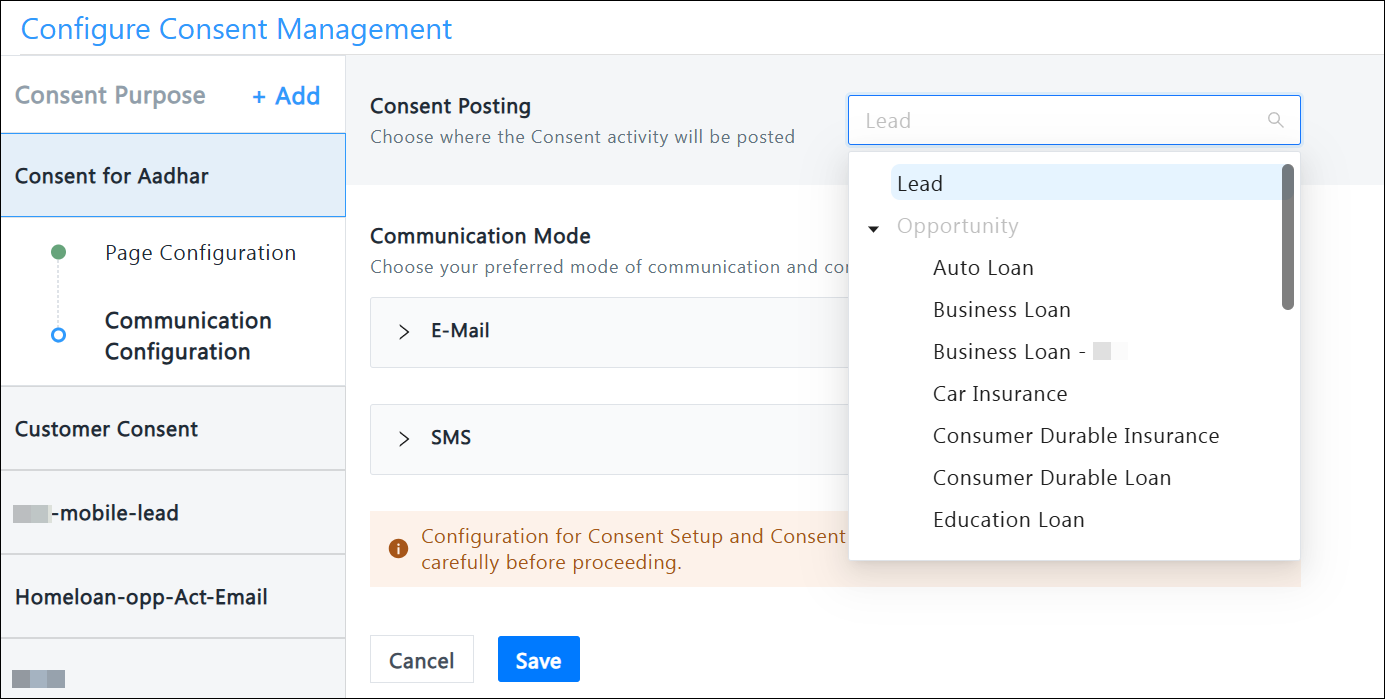
5.2.2 Consent Posting

Choose where the consent activity should be posted: at the lead level or for a specific opportunity.

For instance, selecting Lead will apply the consent to the lead and all subsequent opportunities associated with it. On the other hand, selecting a specific opportunity will restrict the consent to that particular opportunity only.

consent posting lead or opportunity

5.2.3 Communication Mode

The consent communication can be sent via either Email or SMS.

Note: You can enable only one method at a time—Email or SMS, but not both.

Email

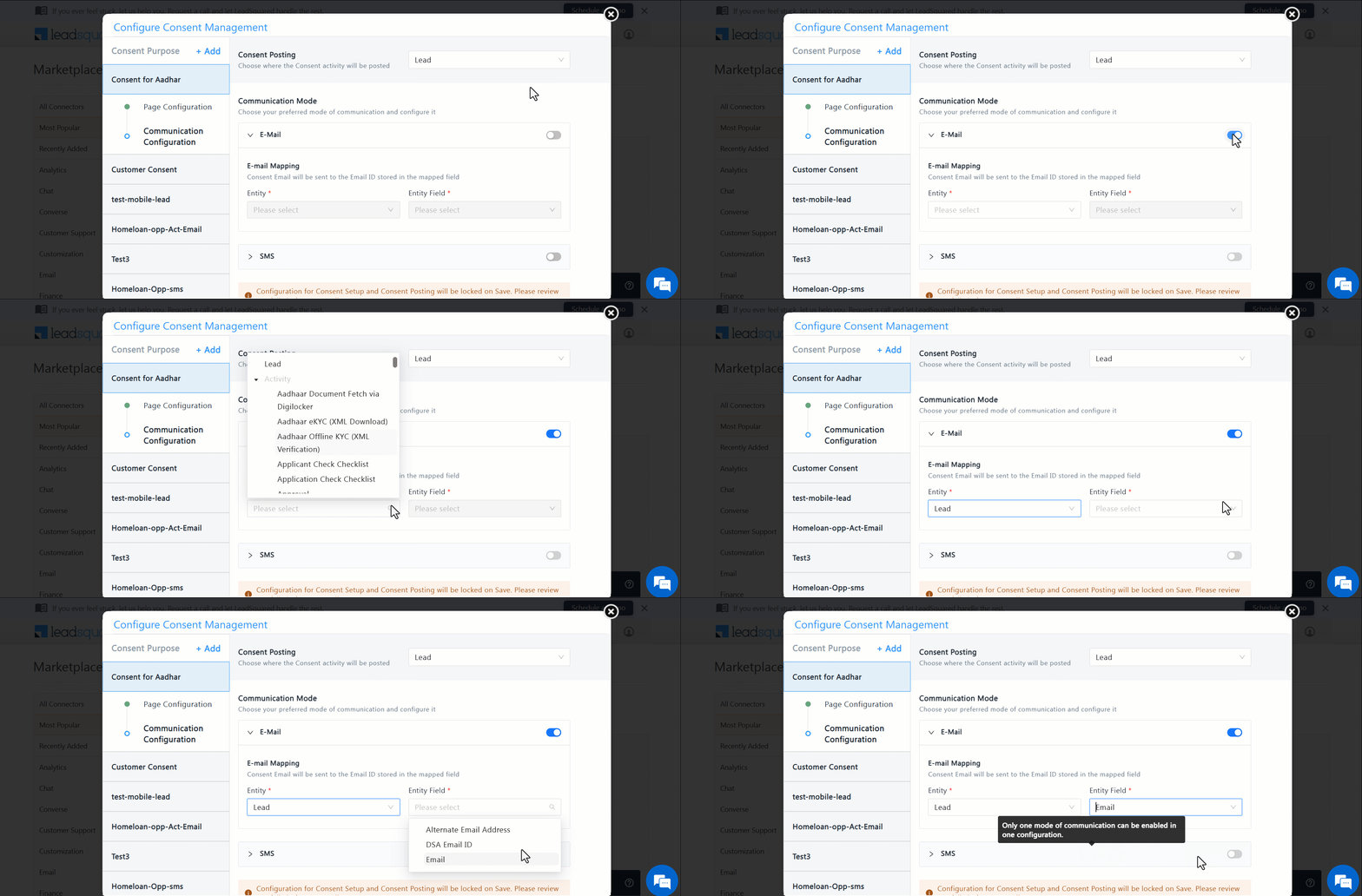
When the Email option is enabled, you can map the email to be sent to an entity field in either a Lead or an Activity under the Email Mapping section.

Note:

  • For Lead and Opportunity, the entity field must support the Email data type.
  • If Activity is selected as the Entity in Email Mapping, the supported data type must be String.

consent management email communication

SMS

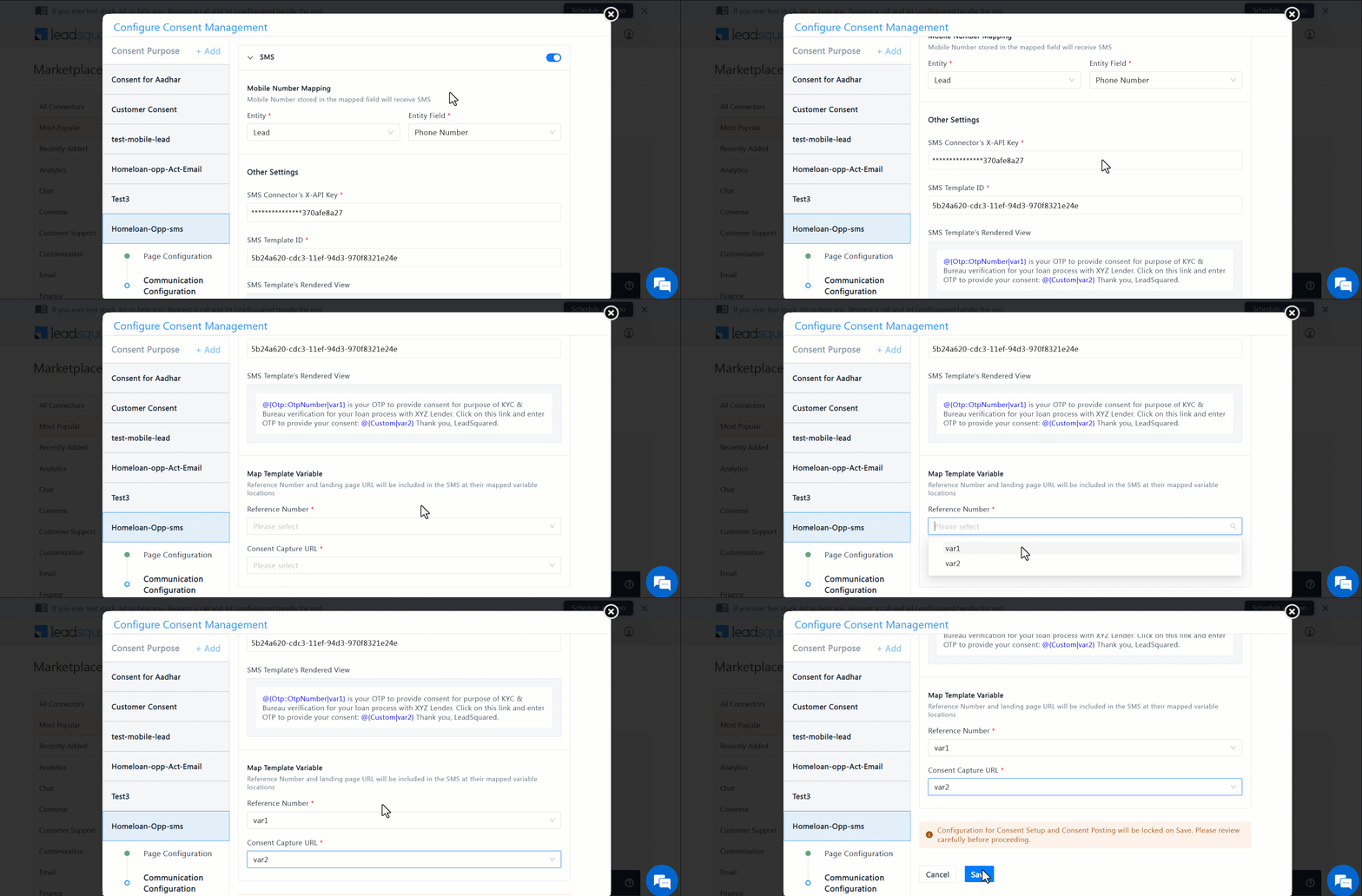
When the SMS option is enabled:

  1. Map the SMS to an entity field in either a Lead or an Activity under the Mobile Number Mapping section.
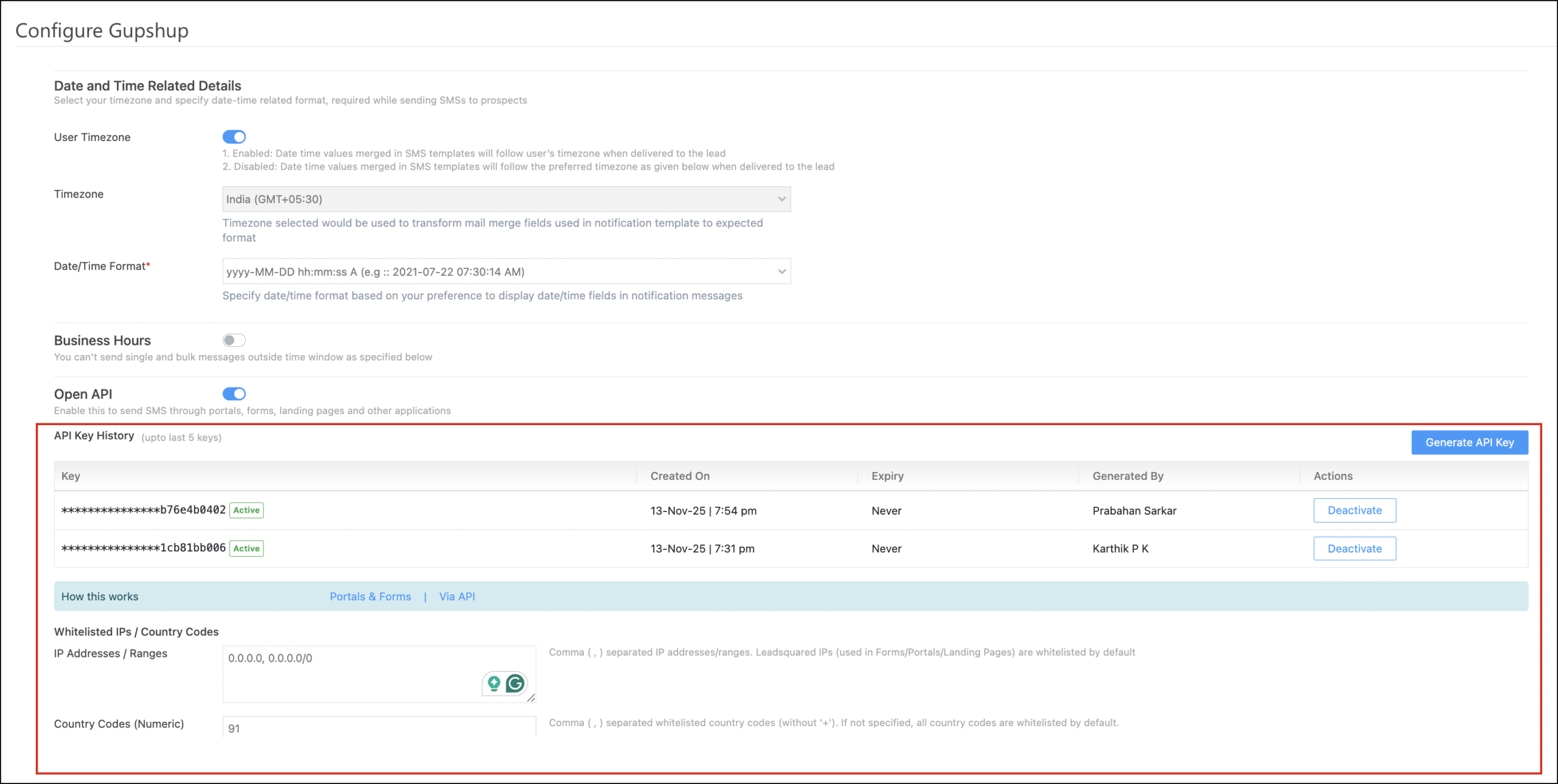
  2. Configure the SMS Connector’s X-API Key and SMS Template ID, as provided by your telephony/SMS provider.
    • For example, if you’re using Gupshup, you can find the X-API Key under the Advanced tab on the configuration screen in LeadSquared (it will be visible once when you generate the key). Additionally, ensure that you whitelist your APIs and country code in the Whitelist section.

finding the sms x api key and whitelist ips

  1. In the Map Template Variable section:
    • Map the Reference Number (OTP) as var1.
    • Map the Consent Capture URL as var2.
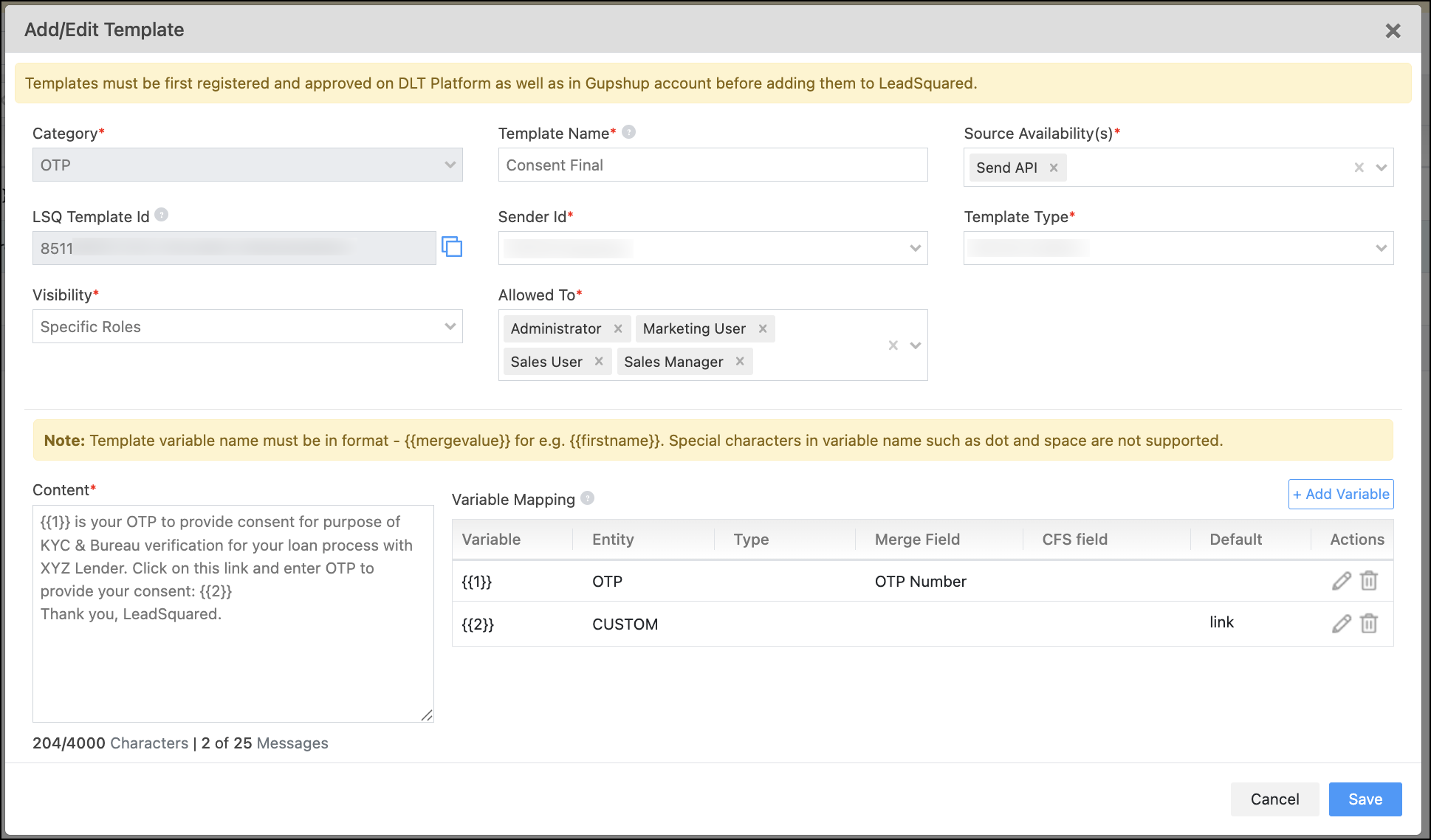
    • Note: When creating the SMS template, the category must be set to OTP, and Source Availability must be Send API.

configuring sms template for consent management

Review the SMS Template’s Rendered View to ensure proper mapping.

Note: 

  • For Lead and Opportunity, the entity field must support the Phone Number data type.
  • If Activity is selected as the Entity in Phone Number Mapping, the supported data type must be String and must follow the +91-xxxxxxxxx format.

consent management sms communication

Once done, click Save.

Note: When saved –

  • The configuration for Consent Setup and Consent Posting is locked.
  • Only the Company Logo and Primary Color can be modified on the first page.
  • Changes to the Consent Posting Entity (Lead, Opportunity) are no longer allowed.

5.3 Initiate Lead Consent

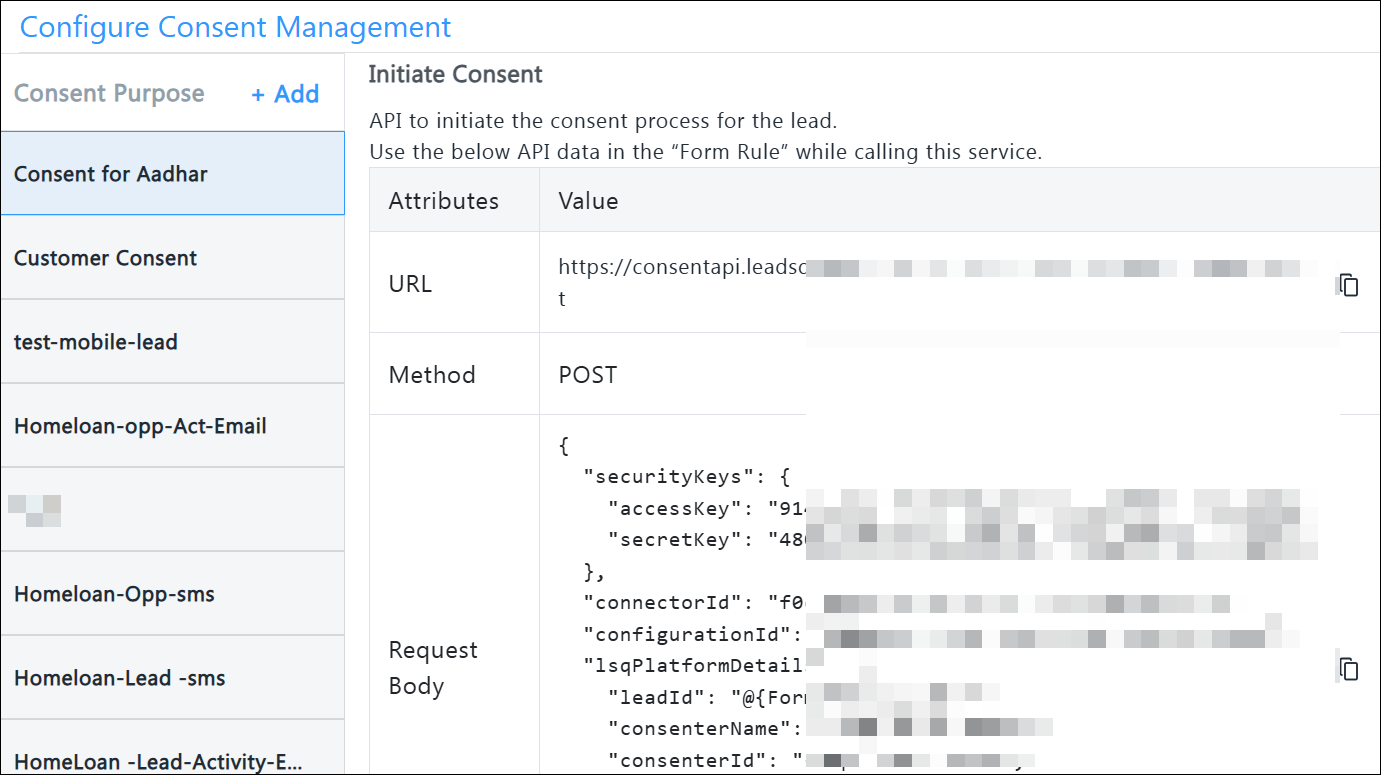
Once the Consent Management App is successfully configured, the Initiate Lead Consent API details are generated. This internally created API is used to trigger the consent approval process. Copy Copy these API details and use them to create a Form Rule. For more information, refer to the Create a Dynamic Form section.

Note:

  • consenterName is a mandatory parameter.
  • consenterID, consenterAddress, and customIdentifier are Optional. These fields can be mapped in the form and serve as identifiers for the consenter, the individual providing consent, or the reason for obtaining consent.

initiate consent

5.4 Trigger Multiple Consent Processes

You can trigger multiple consent processes. For example, you can create a consent process to perform KYC and a separate consent process to fetch CIBIL Scores. You can define the Consent Purpose for each process. The Consent Purpose will be visible to the lead on the consent email and on the Consent Capture Link.
consent management multiple trigger config


6. Create Custom Lead Fields for the Form

Before you configure a Form to initiate the consent approval process, create the following lead fields –

Note: To know how to create lead fields, refer to How to Create Custom Lead Fields.
Custom Lead Field Description
Trigger Consent Approval Create a consent approval trigger to trigger a consent email to the lead. Set the Data Input Type to Dropdown or Boolean, and add the options Yes or No.
Response This field will capture the response once the API is triggered. Set the Data Input Type to Text.
Status This field will capture the status of the consent approval from the lead –

  • INITIATED – Consent has neither been given nor denied.
  • ACTIVE – Consent is given.
  • DENIED – Consent is denied.

Set the Data Input Type to Text.

Consent Capture Link This field will display the URL of the consent capture landing page sent to the lead. Set the Data Input Type to Text.

consent management custom fields


7. Create a Dynamic Form for the Consent Approval Process

Note: If you’re new to the Forms and Processes feature, see How to Create a Form. This section assumes you have some familiarity with setting up forms and form rules.

Create a Dynamic Form and add the Custom Lead Fields.

Consent management fields form

Next, create a Form Rule for the trigger field. This is set up using the following example rule –

If ‘Trigger consent process to collect Aadhaar details’ is true,
Then Set Value of Field ‘Consent Approval Response’, ‘Consent Approval Status’, and ‘Consent Capture Link’ using Data From API – POST <API URL, post data obtained from Initiate Lead Consent> and map the specific response parameters to set the field values.

consent management form rules config

Once a consent email is generated, the consent capture link will expire 72 hours (3 days) after being generated. If a response has not been captured in this time frame, then a new consent email will need to be triggered.

consent management capture link

Note: You can trigger multiple consent processes through a single Dynamic Form.

consent management multi-trigger


Next Steps

When you’re done, Publish the form. Next –


Any Questions?

Did you find this article helpful? Please let us know any feedback you may have in the comments section below. We’d love to hear from you and help you out!

LeadSquared Getting Started Guide for Administrators

Hello, Admin. Welcome to LeadSquared.

This guide has step-by-step instructions on setting up your LeadSquared account. At the same time, you will learn how LeadSquared can help your organization.

Note: If you aren’t looking to configure LeadSquared in a live environment yet, you can create a test environment through LeadSquared Sandbox. The Sandbox duplicates your existing Live Production account, to test and evaluate LeadSquared features before subscribing to them.

1. Prerequisites

Before we begin, here are a few prerequisites –

  • LeadSquared account – You will need a paid LeadSquared account. If you do not have one, you can create one by booking a demo.
  • Missing Features – Some of the features listed here may not be available in your current plan. For more information on plans and pricing, visit https://www.leadsquared.com/
  • Account Number – Once your sign-up is complete, log into LeadSquared and note down your account number. You will need to quote this number in all communications with us.


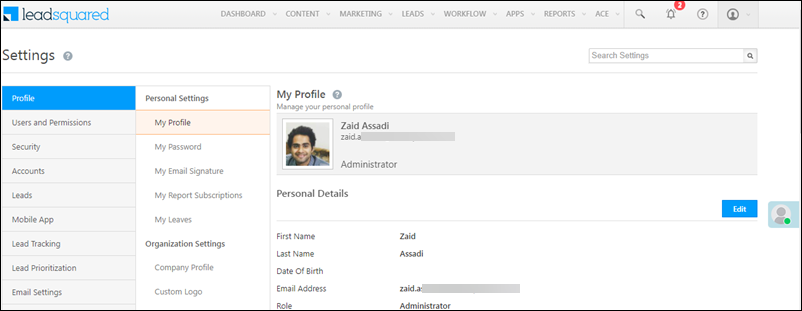
2. Setup your Profile

Personal Settings and Organization Settings capture details about you and your organization. Some of these details are used while interacting with your leads, prospects, and customers. Further, as an administrator, you can choose your daily report delivery preferences.

The Billing and Usage section displays your LeadSquared subscription details. You can view all the features of your account and the status of their current usage. Under Manage Subscriptions, you can view the purchase history of all your orders and make further purchases.

Note: For more information on plans and pricing, visit https://www.leadsquared.com/

getting started admin My profile`

Help Article Description
Setup your personal profile This article will help you set up your personal profile.
Setup your company profile This article will help you set up your company profile
Setup your custom logo This article will help you set up your business/custom logo.
View your LeadSquared billing and usage This article will help you understand and manage your billing and usage, and your recurring and one-time subscriptions.


3. Configure your Lead Settings

Leads are your potential customers. In LeadSquared, you can track your lead’s journey from creation, through marketing and sales activities, all the way to conversion.

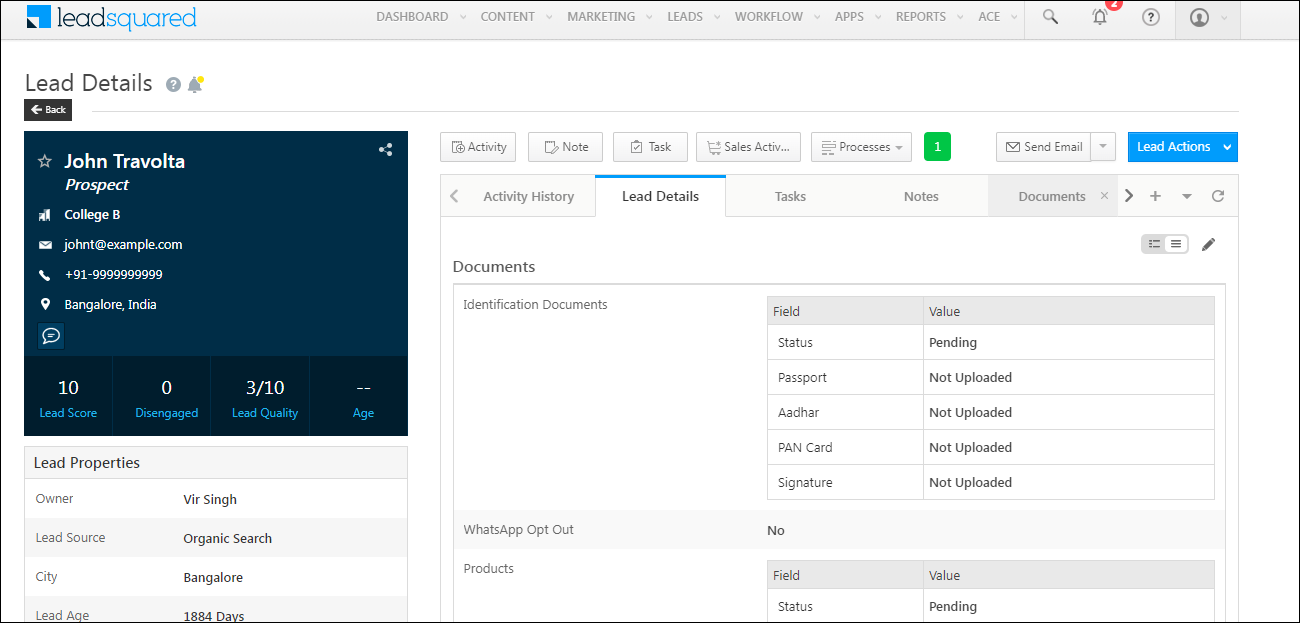
The lead entity is customizable. In addition to system fields (first name, email, etc.,), you can create custom Lead Fields (enrolment Id, passport number, etc.,) to capture details specific to your business use cases. Also, you can create a set of fields (using the Custom Field Sets feature) for your document collection business use cases (KYC documents, education qualifications, etc.,)

You also have the option to create a custom Lead Form that is easy to set up. It’s a quick way to capture new leads or update existing ones.

Also, when a lead gets captured, you will know the source through which it originated (for example, social media, newsletters, ads, etc.)

getting started lead details

Help Article Description
Lead Management Feature Guide This article will give you a brief overview of LeadSquared’s Lead Management feature.
Customize the Lead Details View This article will help you understand how to customize your Lead Details page.
Create your custom Lead Fields This article will help you understand how to create custom Lead Fields based on your organization’s requirements
Create a dependency between Lead Fields. This article will help you understand how to create a dependency between 2 Lead Fields. For example, the Campus field is dependent on the Department field for an account created for colleges.
Manage your Lead Stages This article will help you understand how to create different Lead Stages as the lead passes through the sales funnel.
Manage your Lead Sources This article will help you understand how to create and manage Lead Sources.
Rename a lead entity to reflect your business terminology This article will help you understand how to rename the lead entity. For example, rename “lead” to “contact”.
Create Custom Field Sets This article will help you understand how to create Custom Field Sets. For example, a custom field set for KYC Documents with fields Passport, PAN Card, Aadhar Card, and Address Proof.
Create a Lead Form This article will help you understand how to create a Lead Form.

Note: This is a basic version of a Form. You can create more powerful forms through LeadsSquared’s Dynamic Forms.


4. Lead Prioritization and Scoring

LeadSquared provides three configurable metrics to help you qualify and prioritize leads. Each of these metrics tells you something about the quality of the lead or their propensity to buy your product/service.

4.1 The Lead Score

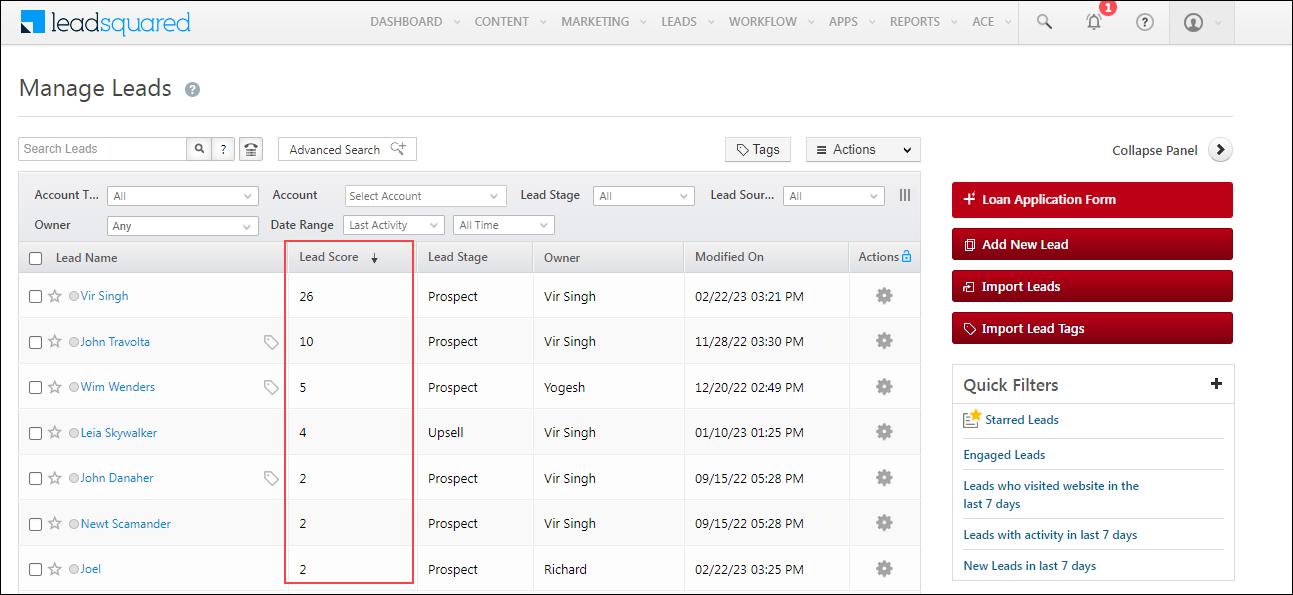
Lead scoring helps you understand how active a lead is. LeadSquared tracks system activities (email open/clicked, website visits, etc.,) of your leads and assigns them a score based on these engagements. Higher the Lead Score, the higher the chance of your lead converting. LeadSquared also allows you to customize the lead score, by assigning numerical values to different Custom Activities along your sales pipeline.

getting started lead score

Help Article Description
How does Lead Scoring Work? This article will help you understand how lead scoring works.
Add Custom Activity Types This article will help you add custom activities for lead scoring.


4.2 The Engagement Score

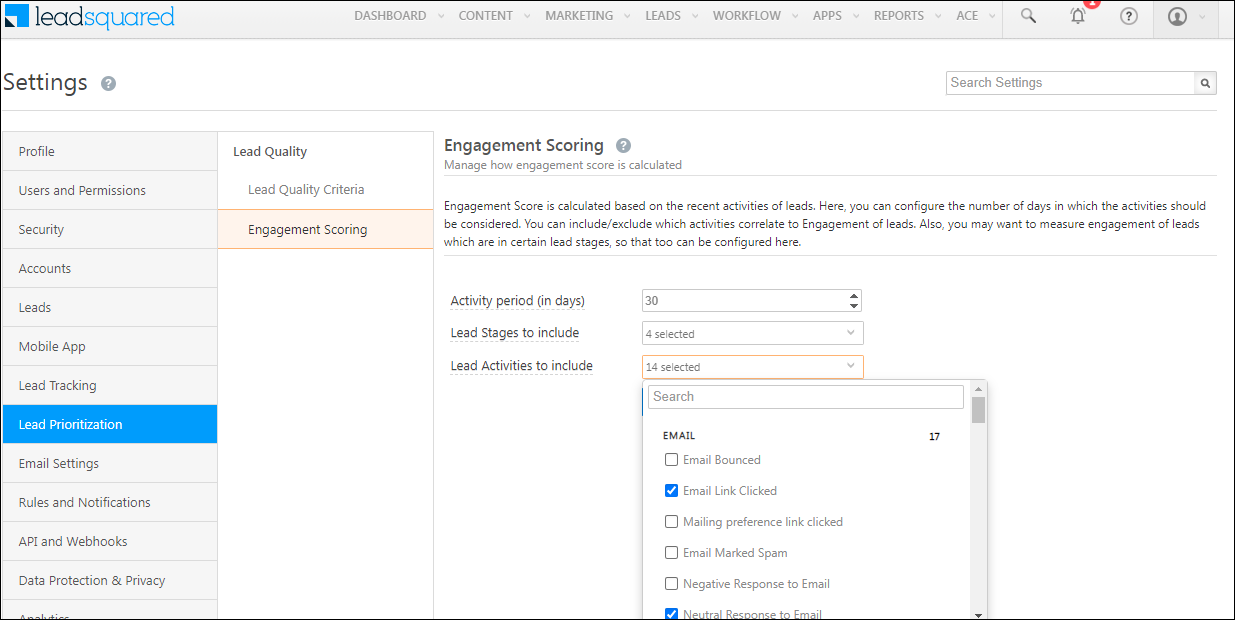
The engagement score is similar to the lead score, but the key difference is that the engagement score looks at specific activities performed by/on the lead within a specified time period.

getting started engagement scoring

Help Article Description
Setup Criteria for Lead Engagement Scoring This article will help you create Lead Engagement Scoring.


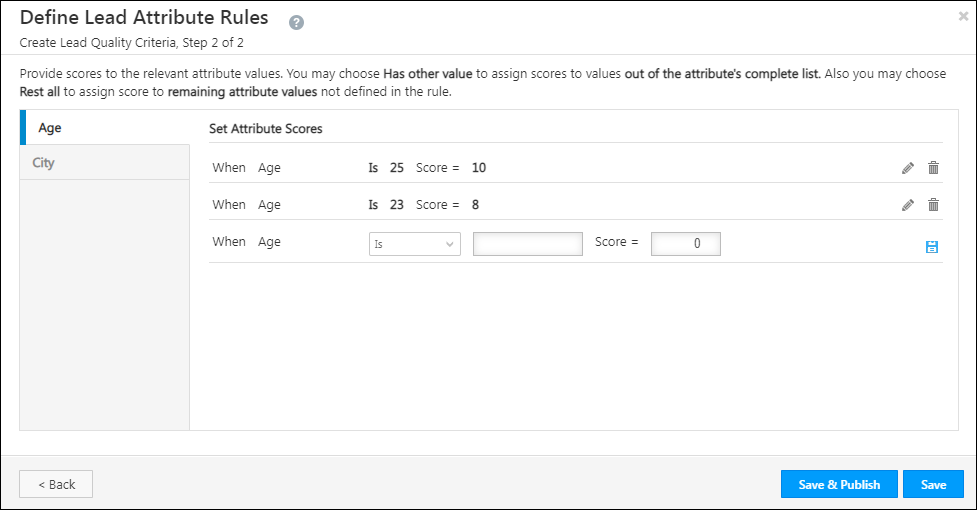
4.3 The Lead Quality Criteria

The Lead Quality Criteria helps you recognize leads that match your ideal customer profile (ICP). You can set up rules to identify your ICP. For example, your ICP could be an age group between 21 and 25, working in particular locations – leads are evaluated against these rules and assigned a score.

getting started lead quality criteria

Help Article Description
Setup Lead Quality Criteria This article will help you create Lead Qualification Criteria.


5. Capture Activities on Your Leads

Once Leads are captured in your account, you can monitor their progress down the sales funnel by tracking notable interactions and events, or ‘Activities’. Activities help you understand a lead’s position in the conversion funnel, and accordingly automate nurturing and sales processes.

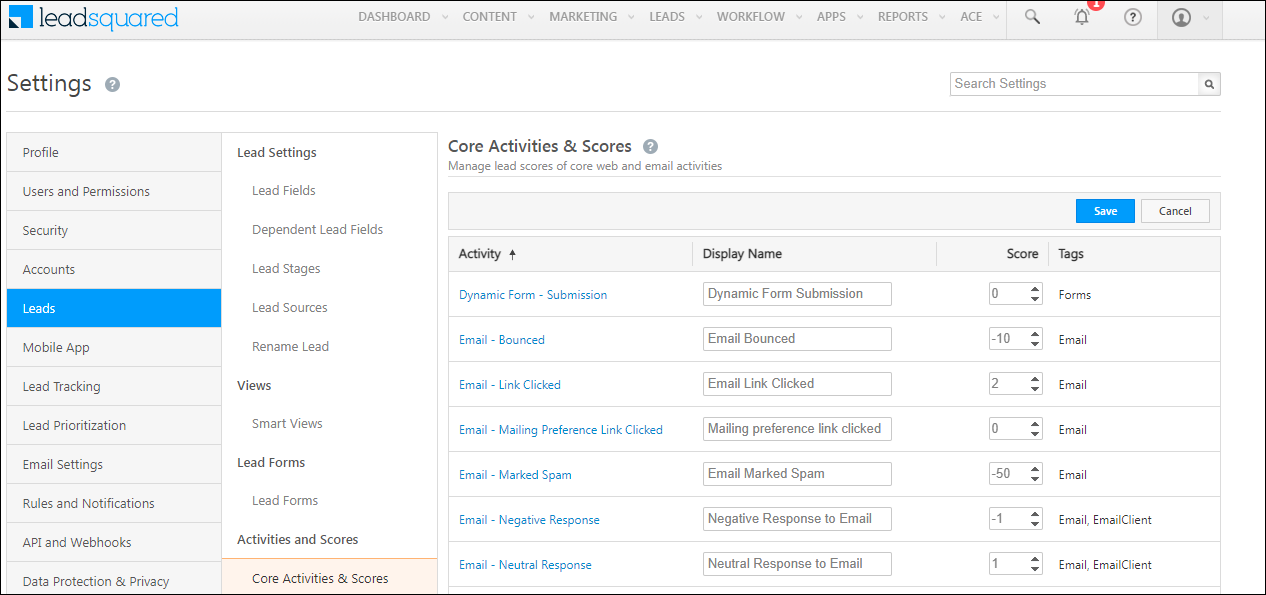
5.1 System/Core Activity

Some activities are available by default on your LeadSquared account. These activities are common across industries. E.g., Emails – Bounced/Link Clicked/Opened, Phone Calls, Website Visits, etc.

getting started core activities and scores

Help Article Description
Activity Management Feature Guide This article will help you understand LeadSquared’s Activity Management feature.


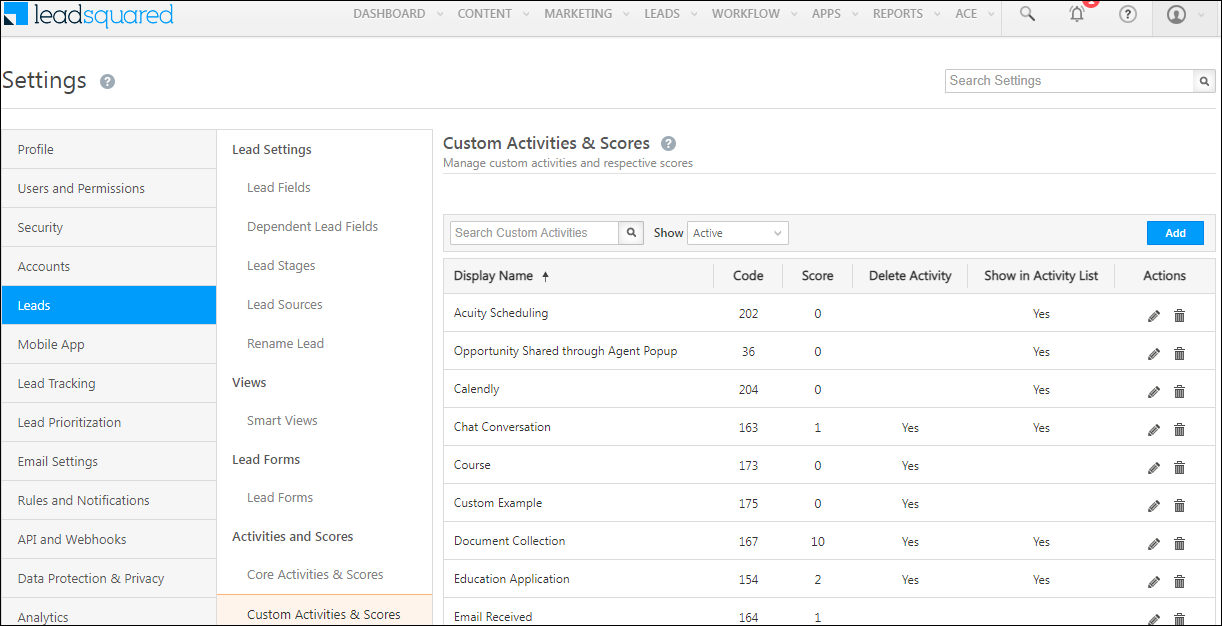
5.2 Custom Activities

You can also add custom activities to your LeadSquared account. This allows you to create and assign scores to new activities specific to your industry. For example, if you’re in the education industry your custom activities may be attending a seminar, completing a payment, campus visit, etc.

getting started custom activities and scores

Help Article Description
Add Custom Activities This article will help you understand how to add Custom Activity Types.


5.3 Sales Activities

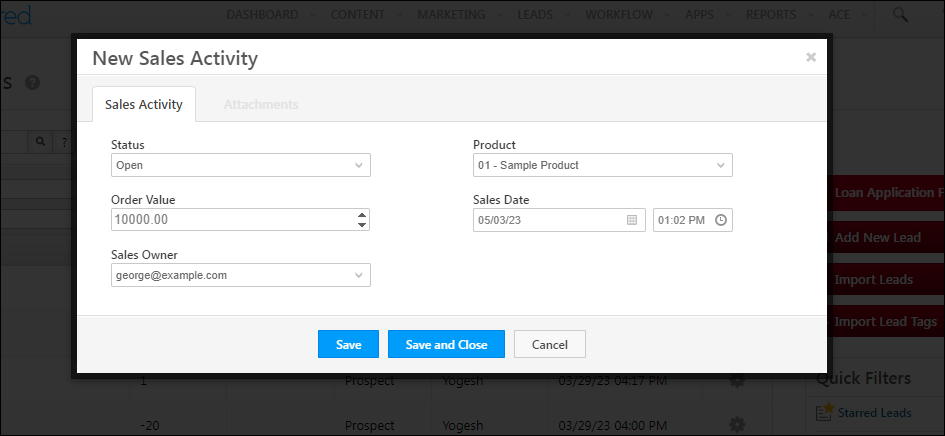
The Sales Activity Management feature lets you capture important information related to each sale (e.g., product sold, sales owner, date, order value, etc.,). You can add and manage the revenue generated by your customers for different products and services offered by your organization. You can also cancel or edit sales activities to manage refunds and returns.

getting started new sales activity

Help Article Description
Sales Activity Management  This article will help you understand how to configure Sales Activities.


6. Configure Tasks for Users

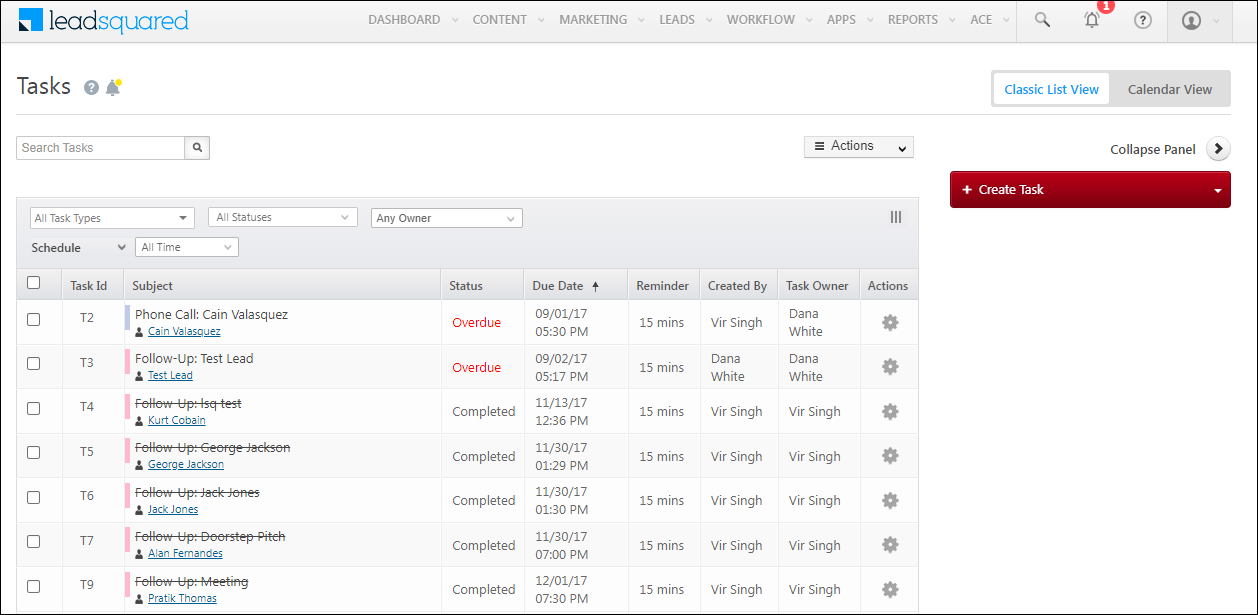
Once a lead is created in your system, you can assign and manage Tasks among your users (schedule meetings, demos, site visits, etc.), and use a variety of other features to convert them into customers.

getting started tasks

Help Article Description
Tasks – Feature Guide Understand all the capabilities of the Tasks feature.
Configure your Tasks This article will help you understand and configure Tasks.
How to Create Tasks and Schedule Reminders? This article will help you understand and create Tasks and schedule reminders.


7. Manage Accounts and Opportunities

7.1 Create and Manage Your Accounts

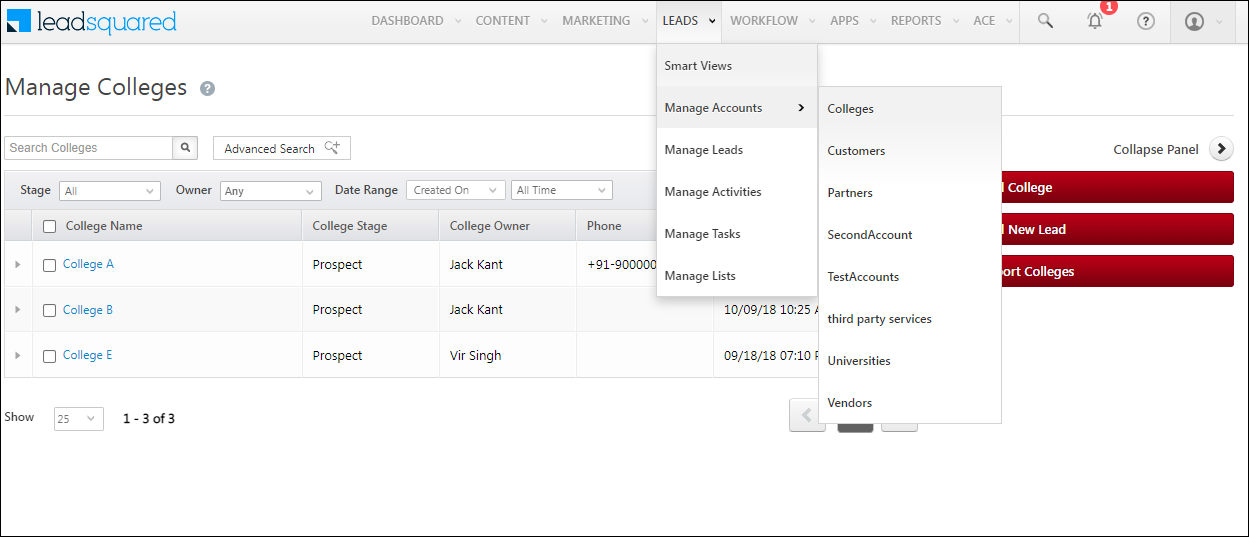
All your B2B relationships can be managed through LeadSquared’s Accounts feature. If you work with partners, vendors, third-party services, etc., you can create accounts for them on LeadSquared and store the data you need (account details, account owners, stages, etc.). You can also add and manage your leads under these accounts.
getting started manage accounts
Help Article Description
Accounts Management Feature Guide This article will help you understand LeadSquared’s Account Management Feature
Account Settings This article will help you set up LeadSquared’s Account feature.
Accounts, Leads, and Opportunities This article will help you understand the difference between Accounts, Leads, and Opportunities.


7.2 Create and Manage Your Opportunities

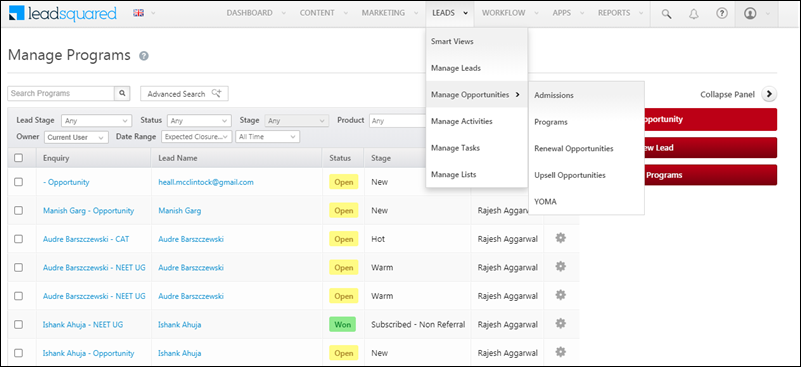
Opportunities in LeadSquared represent potential deals. A lead could be interested in more than one product offered by your company. For example, a lead might be interested in buying car insurance, term insurance, and health insurance. LeadSquared’s Opportunities feature lets you manage different opportunities for the same lead without creating duplicate contacts. You can route the lead to agents specialized in different products, and create separate sales workflows.

Help Article Description
Opportunity Management Feature Guide This article will help you understand LeadSquared’s Opportunity Management Feature.
Opportunity Configuration This article will help you understand how to create forms for multiple opportunity types, configure opportunity types, and add opportunities to your leads.
Manage Opportunities This article will help you understand how to add opportunities to leads, and perform multiple actions on these opportunities such as bulk and grid updates, export opportunities and reset filters.
Accounts, Leads, and Opportunities This article will help you understand the difference between Accounts, Leads, and Opportunities.


8. Manage Your Leads Through Smart Views

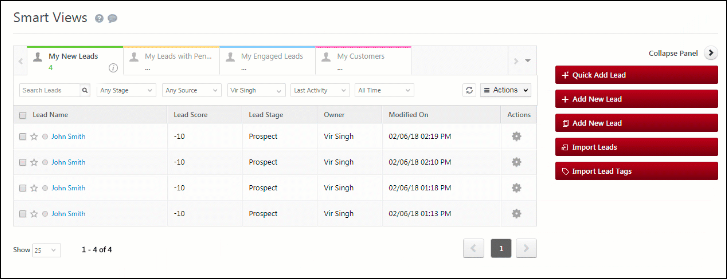
To bring all your important information into one place, LeadSquared launched Smart Views. The Smart Views page gives users a personalized view of your accounts, leads, opportunities, activities, and tasks. Sales users can create their own individual smart views, but as an Admin you create smart views at the organization level and assign them to different teams.

getting started smat views

Help Article Description
Smart Views This article will help you understand Smart Views.
Smart Views for Administrators This article will help you understand how to create Smart Views as an administrator.


9. Build Workflows

9.1 Creating LeadSquared Dynamic Forms

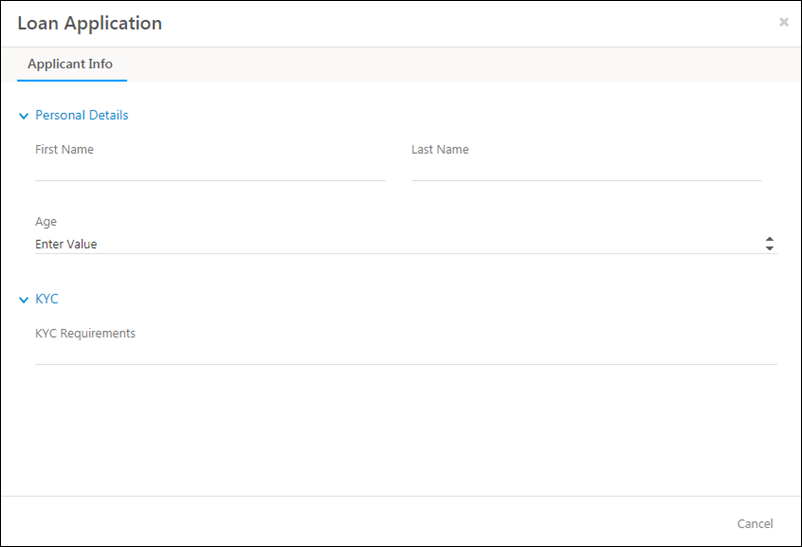
In addition to the basic lead forms feature, the Dynamic Forms Designer feature helps you create intelligent forms to capture entire application processes (e.g, college admission applications, loan applications, etc.). You can customize forms to behave in ways specific to your use cases, and prompt users to collect the right information based on a lead’s previous inputs.

Once you’ve created a form, the Process Designer helps you choose where, and to which users you want the form to appear. You can also use it to combine multiple forms into processes.

preview form

Help Article Description
LeadSquared Dynamic Forms and Processes – Feature Guide This article will give you an overview of the Dynamic Forms and Process features
LeadSquared Forms This article will help you understand how to create a LeadSquared Dynamic Form.
LeadSquared Process Designer This article will help you organize your forms into workflows with Process Designer.


9.2 Create an Automation Workflow

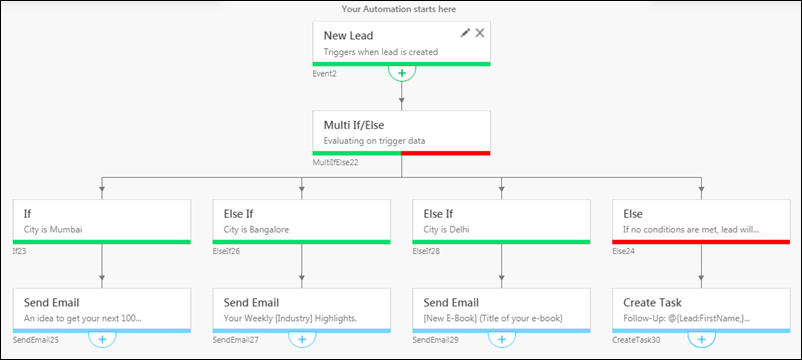
The Automation feature lets you automate your entire workflow using an intuitive and easy-to-use visual designer. It’s a powerful way to push your leads to conversion. Just set it up once and watch your leads trickle down the sales funnel with minimal manual effort.

multi if else example

Help Article Description
Automation Feature Guide This feature guide will help you understand LeadSquared’s Automation feature.


9.3 Create LeadSquared Portals and Widgets

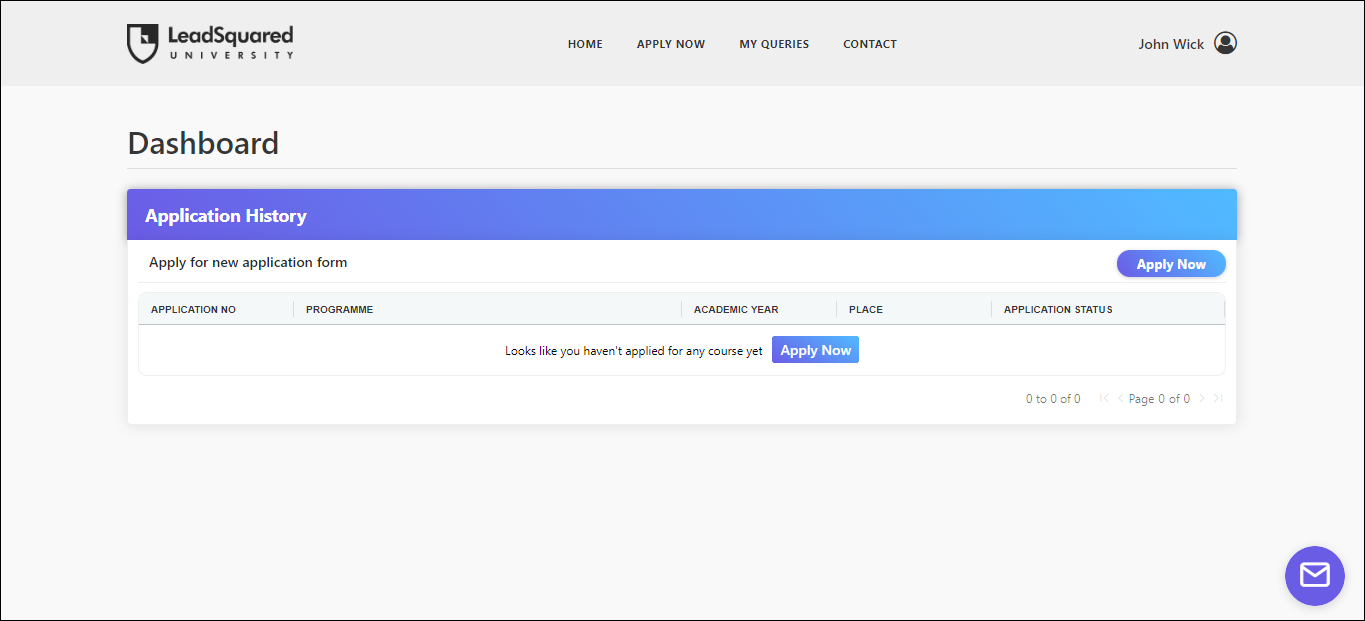
LeadSquared’s Portals are a great way to design a self-service website that helps with lead management like online applications or registration processes. LeadSquared’s Portal feature allows you to build your own online portals to capture leads and opportunities, through online forms, making the entire process paperless.

You can also create and embed Widgets on your website or landing page. An LSQ widget acts as a “lead magnet”. An example of a lead magnet is a special deal offered to customers in exchange for their contact details. It can be a discount code, webinar, white paper, ebook, template, inquiry form, or another resource.

Portal

Help Article Description
Portals Management Feature Guide This article will help you understand and create a LeadSquared Portal.
Capture Leads with LeadSquared Widgets  This article will help you create LeadSquared Enquiry Widget or Registration Widget.


10. Setup Email Campaigns

Communicating with your leads is a breeze with LeadSquared’s Email Campaigns. It’s quick and easy to design and send out email campaigns to engage and nurture leads. You can personalize the content, schedule the timing of the campaigns, and track your lead’s interactions through Campaign Reports and Analytics.

With LeadSquared’s Email Settings, you can manage subscriptions to your email campaigns, set restrictions on which users can send emails, and set restrictions on recipients by blocking email addresses or domains.

Also, LeadSquared’s List Management feature lets you create Static and Dynamic lead lists. You can leverage this feature with your email campaigns to send targeted campaigns. The Manage Lists page allows you to create, edit, and view all your lead lists in one place.

getting started email campaign

Help Article Description
Email Settings Feature Guide This article will help you understand and configure your email settings.
Email Campaign Feature Guide This article will help you set up Email Campaigns through LeadSquared
List Management Feature Guide This article will help you understand and create Lists for your email campaigns.


11. Create Users and Permissions

As an administrator, you can create LeadSquared users and grant them permissions based on their role in your organization.

After creating the users, you can group them into different sales groups based on location, business unit, or any other categorization of your choice.

Based on the reporting structure of your users, LeadSquared will also create an organizational hierarchy.

You can also group users into Teams that reflect your organization’s structure. The most powerful merit of the Teams feature is the ability to auto-check in your users. You can configure work-day templates and holiday calendars in accordance with your organization’s work schedule.

getting started users

Help Article Description
Manage Users This article will help you understand how to create and manage LeadSquared Users.
Manage User Custom Fields This article will help you create Custom Fields for your users.
Check-in/Check-out Users This article will help you understand the Check-in/Check-out feature for users.
Permission Templates Feature Overview This article will help you understand LeadSquared’s Permission Templates feature.
How to Create a Permission Template This article will help you understand how to create a Permission Template.
How to Apply Permission Templates This article will help you understand how to apply a Permission Template.
Managing Sales Groups This article will help you understand how to create and manage your LeadSquared Sales Groups.
Managing Teams This article will help you understand how to create and manage your LeadSquared Teams.
How to Set Up User/Organization Hierarchy  This article will help you understand how to create and manage your organization hierarchy.


12. Reports and Analytics

LeadSquared provides powerful features to track your reports and dive into analytics –

12.1 Create a Custom Dashboard

Your dashboard is the first page you see when you log in to your LeadSquared account. It displays all the important sales and marketing metrics and reports of your account. The dashboard is completely customizable. And, you can also add third-party reports to your LeadSquared dashboard through an external URL.

getting started dashboard

Help Article Description
Create a Custom Dashboard This article will help you create a Custom Dashboard on LeadSquared to view your reports and metrics.
Assign Custom Dashboards to Teams This article will help you assign Custom Dashboards to your Teams.
Set a Dashboard as Default  This article will help you understand how to set a Dashboard as default.


12.2 SIERA

Sales Intelligence and Efficiency through Reports and Analytics (SIERA) is LeadSquared’s new-gen self-service reporting tool. Through SIERA, you can track leads, opportunities, organization revenue, user performance, and more.

getting started SIERA

Help Article Description
SIERA Feature Guide This article will help you understand LeadSquared’s SIERA feature for viewing your reports and analytics.


12.3 LeadSquared Reports

You can use the LeadSquared Reports feature to analyze your marketing and sales business processes. It helps you track and manage the activities performed by the lead and your users, across all LeadSquared features.

Help Article Description
LeadSquared Reports This article will help you understand and create LeadSquared Reports

LeadSquared Reports


13. Integrate Your Third-Party Apps

The App Marketplace helps you extend LeadSquared’s functionality. If you use an external application that manages lead data, you can sync that data with LeadSquared. Simply download and install the respective application from the App Marketplace and start syncing the data. Once the leads are synced, you can leverage LeadSquared’s CRM features to nurture and convert your leads.

getting started app marketplace

Here are some popular apps on LeadSquared’s App Marketplace –

Help Article Description
WhatsApp Business Messaging Connector This article will help you integrate your WhatsApp business account with LeadSquared.
Email Sync Connector This article will help you integrate your Outlook or Gmail account with LeadSquared.
Facebook/Instagram Lead Ads Connector This article will help you integrate your Facebook Ads account or Instagram Ads account with LeadSquared.
Custom Lead and List Actions Connector This article will help you understand how to extend LeadSquared’s functionality and create Custom Actions (in addition to the actions available by default) on a lead, group of leads, or a list.
Gupshup SMS Connector This article helps you set up WhatsApp messaging through your LeadSquared account using Gupshup as your service provider.
Kalera SMS Connector This article will help you integrate your Kaleyra SMS with LeadSquared.
Super Receptionist Telephony Connector This article will help you integrate the Super Receptionist Telephony provider with LeadSquared.
Exotel Telephony Connector This article helps you integrate the Exotel Telephony provider with LeadSquared.
Universal Telephony Connector This article will help you integrate your cloud telephony service provider(s) with LeadSquared.
Google Forms Lead Capture Connector This article will help you integrate your Google Forms with LeadSquared.
Universal Lead Capture Connector This article will help you integrate your custom connectors with LeadSquared.
Note: LeadSquared also has extensive API Documentation for your reference.


14. Setup Website Tracking

You can start tracking your leads by installing the LeadSquared tracking script on your website.

LeadSquared’s lead tracking system helps you understand the sources from where the leads landed on your website (google search, email newsletters, social media advertisements, etc.,). These statistics give you an insight into what channels or mediums are working well for your business, and the ones that need improvement.

You can even track the leads’ web events such as page views, button clicks, and link clicks on your website.

Once you list your website under Website & Landing Page Domains, you can install the tracker. Plus, there are additional options you can use to configure your lead tracking.

getting started tracking

Help Article Description
Install the LeadSquared tracking script This article will help you install LeadSquared’s Tracking Script on your website.
Add your website and landing page domains This article will help you link your business/brand domains with your LeadSquared account.
Domain settings for email links This article will help you track links sent to your leads through email campaigns.
Control settings for multiple email opens Enabling Multiple Email Opens may help you in case the emails are forwarded in the same organization, and different people open it to trigger a higher lead score.


15. Create Landing Pages

LeadSquared’s landing page module offers powerful features to design and publish conversion-optimized Landing Pages. You can use LeadSquared’s built-in templates to easily create Landing Pages.

getting started landing pages

Help Article Description
Create and Publish a Landing Page This article will help you understand how to create and publish a landing page
Generate an SSL certificate If you’ve hosted your landing pages on custom domains (outside of LeadSquared), this article will help you obtain SSL Certificates to support these domains.
Create tracking URLs for your landing page This article will help you create tracking URLs through LeadSquared.
Manage reverse IP lookup This article will help you manage reverse IP Lookup. The Reverse IP Lookup setting allows you to automatically view the location (City, State, and Country) of a lead that’s captured from a landing page.


16. Security and Privacy

Here is how you can manage the Security and Privacy settings for your LeadSquared account –

16.1 Manage Your Security Settings

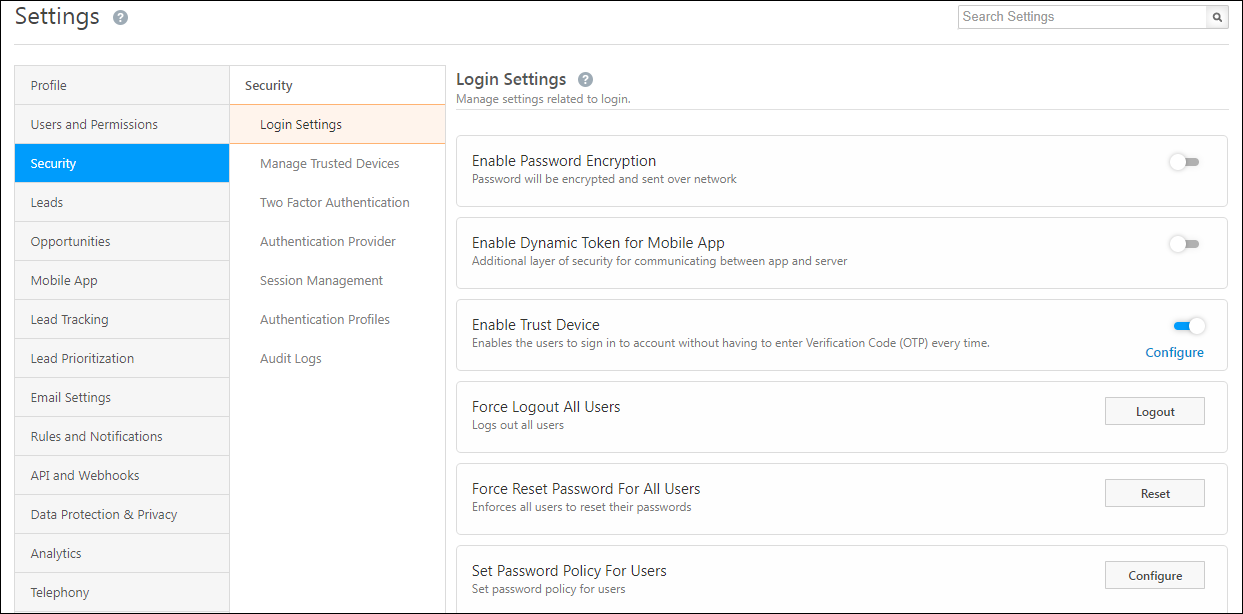
You can secure your account through LeadSquared’s security settings. You can configure the login settings, enable two-factor authentication for all or specific users, enable third-party authentication, manage password policies, manage sessions for users, and more.

login settings

Help Articles Description
Manage Login Settings This article will help you manage your Login Settings on LeadSquared.
Enable Two Factor Authentication This article will help you enable two-factor authentication on your LeadSquared account.
Authentication Profiles If two-factor authentication is enabled/disabled on your account, it is applied by default to all your users. But if you want to enable or disable this feature for only specific users, it can be done by configuring Authentication Profiles.
Enable Third Party Authentication This article will help you enable third-party authentication through Google, Okta, etc., for your LeadSquared account.
Session Management This article will help you manage login expiration time and session timeout for your LeadSquared users.


16.2 Configure Data Protection and Privacy

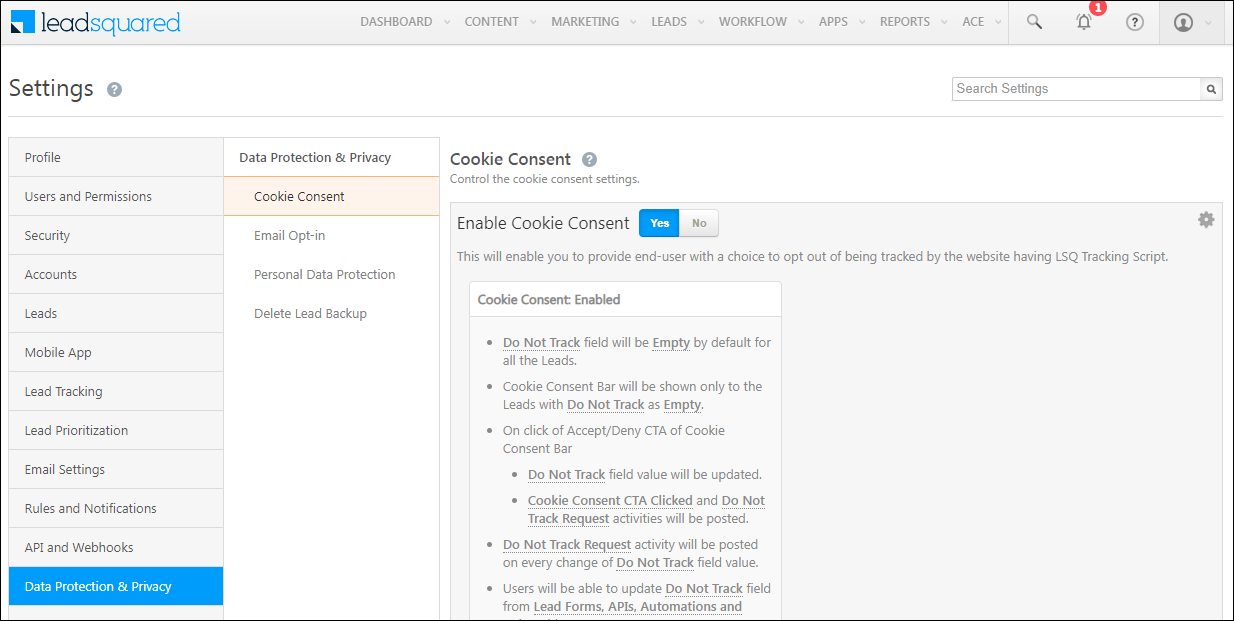
You have the option to configure the data protection and privacy of your lead details. It includes the option to enable cookie consent, request for email opt-in, personal data protection, and deletion of lead data backup.

getting started data protection

Help Article Description
Data Protection & Privacy Settings This article will help you manage Data Protection & Privacy Settings for your leads.


17. Install LeadSquared’s Mobile App

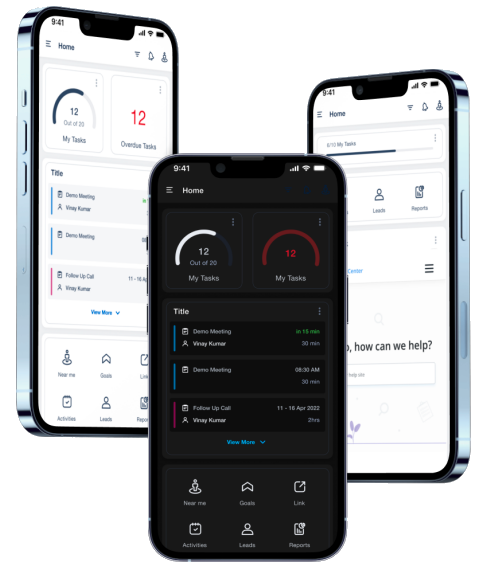
You can efficiently manage your entire field workforce with LeadSquared Mobile App. When new leads come in, you can easily distribute them to your field agents based on their availability, zip code, product, etc. You can also set tasks and meetings for the leads and assign them to your field agents as well. With instant notifications on the app, your agents will know when new leads or tasks are assigned to them and can get in touch with the lead instantly.

Agents can also instantly add leads they meet on the field using the mobile app, and edit and modify the details on the go. You will have complete visibility into your agents’ day. You will know the sales route that your agent has taken for the day, and get reports on the meetings that they have attended and the status of these meetings.

The LeadSquared Mobile App is available on iOS and Android.

getting started mobile

Help Article Description
LeadSquared Mobile App Video Tutorial This video will help you understand the LeadSquared Mobile App.
Features Supported on LeadSqaured Android and iOS This article will help you understand all the features supported on the LeadSquared Android and iOS App.
Casa – Mobile Home Builder This article will help you create and customize the homepage of the LeadSquared mobile application to reflect your business requirements.


18. Store Your Data on Mavis DB

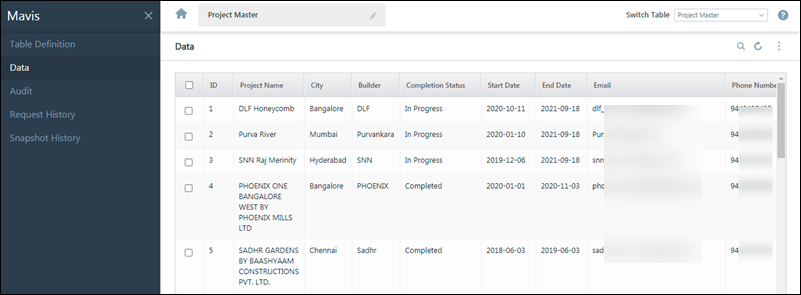
The Mavis DB lets you create databases where you can store master data (for courses, programs, projects, etc.) right inside your LeadSquared account. Providing an easy-to-use UI, Mavis lets you define table structures, and store and manage data including text, numbers, dates, JSON, coordinates, and more. You can directly import your spreadsheets (CSV format) to create and manage tables within your databases.

In addition to the UI, Mavis API offers a powerful RESTful interface to perform operations, filter, and export your data.

LeadSquared's Mavis Database

Help Article Description
Getting Started with Mavis This article will help you understand and create a Mavis DB.


19. Improve Your Sales Performance with ACE

Ace is LeadSquared’s sales performance management suite. If your organization has a revenue goal for the current year, Ace will help you break it down into smaller goals (or targets) for your users. You can set up Goals for different sales teams in your organization and reward them when they reach their targets or exceed them. Users and Managers can track their achievements and gain insights into the best-performing teams and individuals.

incentives

Help Article Description
Goals Feature Guide This article will help you understand and create Goals for your organization.
Create an Incentive Program This article will help you understand how to create an Incentive Program.
View and Manage Incentive Programs This article will help you view and manage Incentive Programs.

LeadSquared WhatsApp Integration with Ivosights

1. Feature Overview

Ivosights’ WhatsApp self-serve solution helps you engage your customers simply, securely and reliably. Ivosights facilitates customer support and other marketing efforts through WhatsApp.

LeadSquared offers WhatsApp integration to help users communicate with their leads. Our WhatsApp functionality supports integrations through other solution providers like InfobipKaleyra, and Gupshup. This article helps you set up WhatsApp messaging through LeadSquared using Ivosights as your service provider.


2. Prerequisites

If you’re not familiar with LeadSquared’s WhatsApp integration, see WhatsApp Business Messaging Connector. For frequently asked questions, see WhatsApp Business FAQs.

  1. Reach out to us at support@leadsquared.com regarding Ivosights WhatsApp integration.
  2. Get an approved WhatsApp Business Number and Account.
  3. Submit Message Templates for Approval. To know how to do this, refer to Add WhatsApp Templates to LeadSquared.


3. Installation

To know how to install the WhatsApp Business connector, refer to WhatsApp Business Messaging Connector.


4. Configuration

Once the connector is installed, add and configure your WhatsApp phone numbers to the connector.

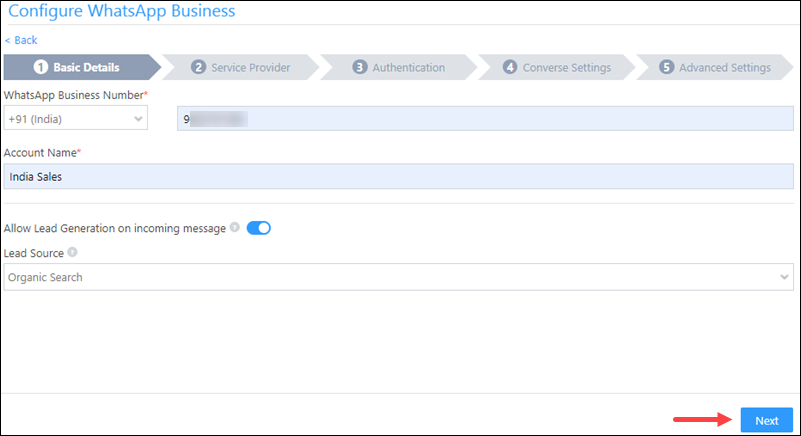
4.1 Basic Details

WhatsApp Zoko LeadSquared Integration

Field Description
WhatsApp Business Number Select the country code, and provide your WhatsApp business number. This field is mandatory.
To get your WhatsApp business number, contact your Ivosights account representative.
Account Name Provide a relevant name for your connector. This field is mandatory.
Allow Lead Generation on incoming message EnableSlider to allow automatic lead creation when you receive messages from unknown mobile numbers.
Lead Source From the dropdown, select a lead source for your leads.

Once you’re done, click Next.


4.2 Service Provider

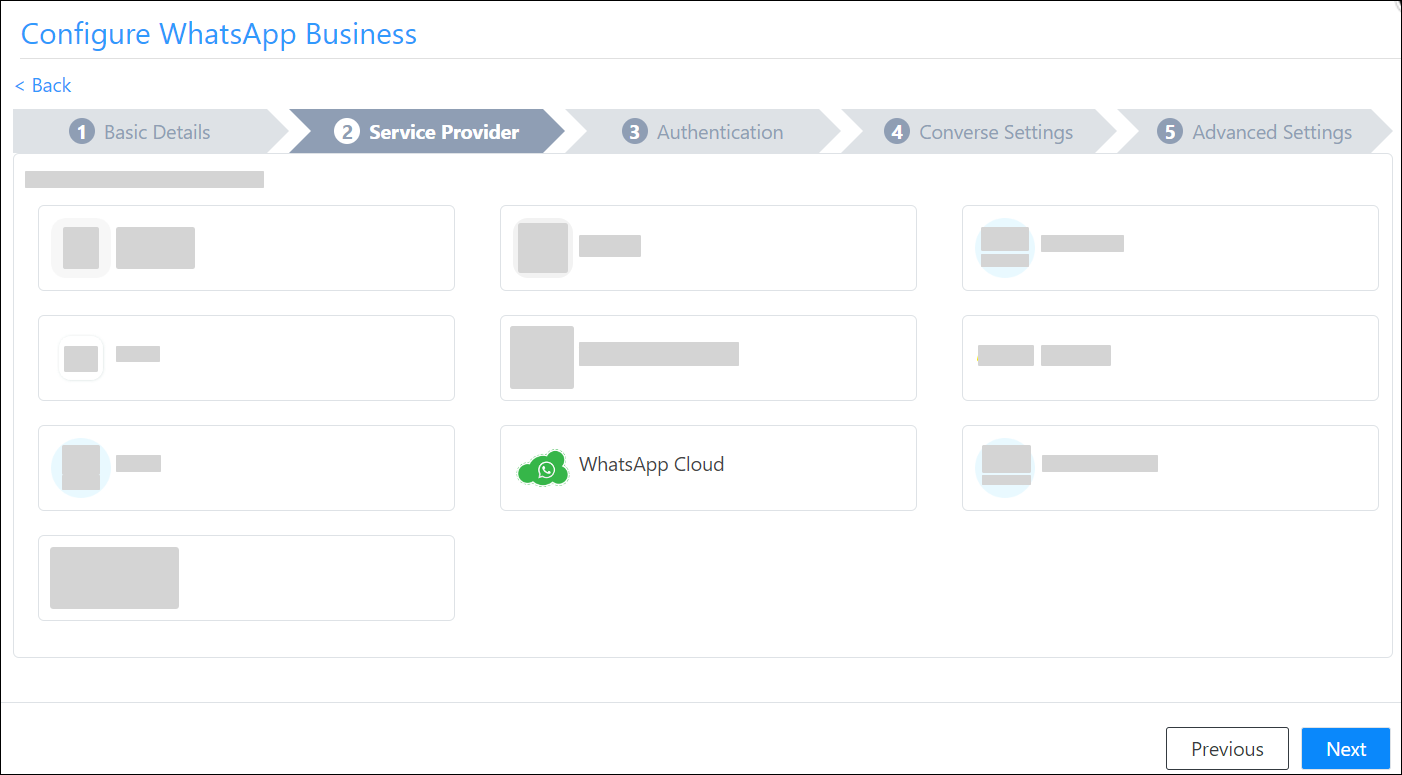
From the available options, select Ivosights and click Next.

LeadSquared - Ivosights Service Provider


4.3 Authentication Set-up

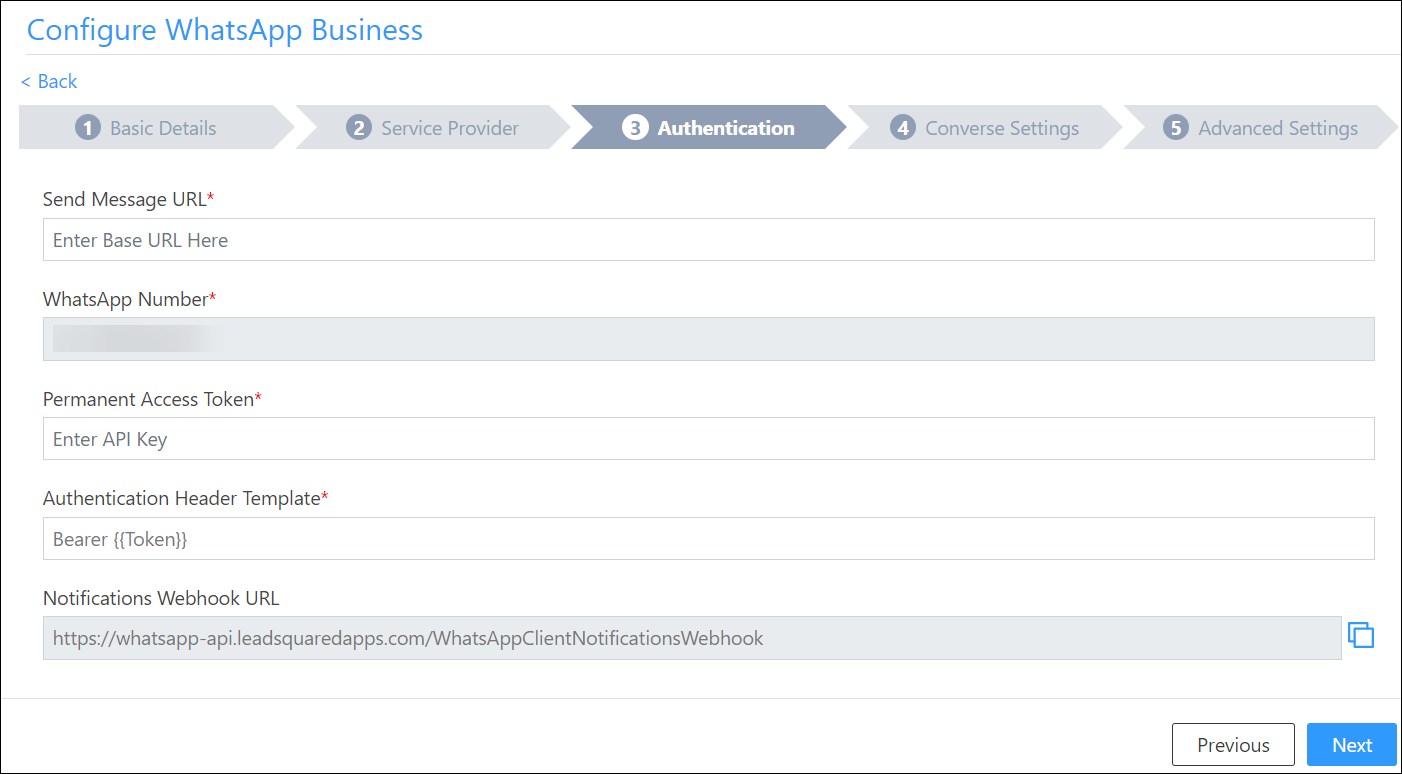
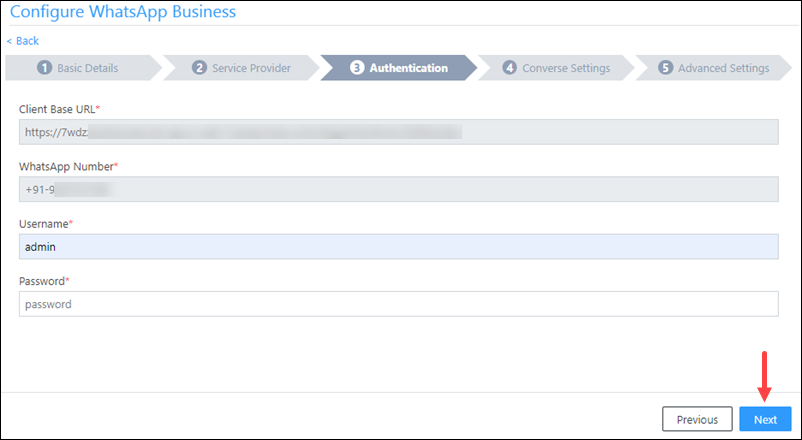
On this screen, enter –

LeadSquared - Ivosights authentication setup

Field Description
Client Base URL The base URL is listed here. This is a non-editable field.
WhatsApp Number The WhatsApp business number you provided in the Basic Details screen. This is a non-editable screen. To change the number, navigate back to the Basic Details screen, and change the number there.
Username LeadSquared-IvoSight
Password Enter the API Key provided by Ivosights.

Once you’re done entering all the details, click Next.


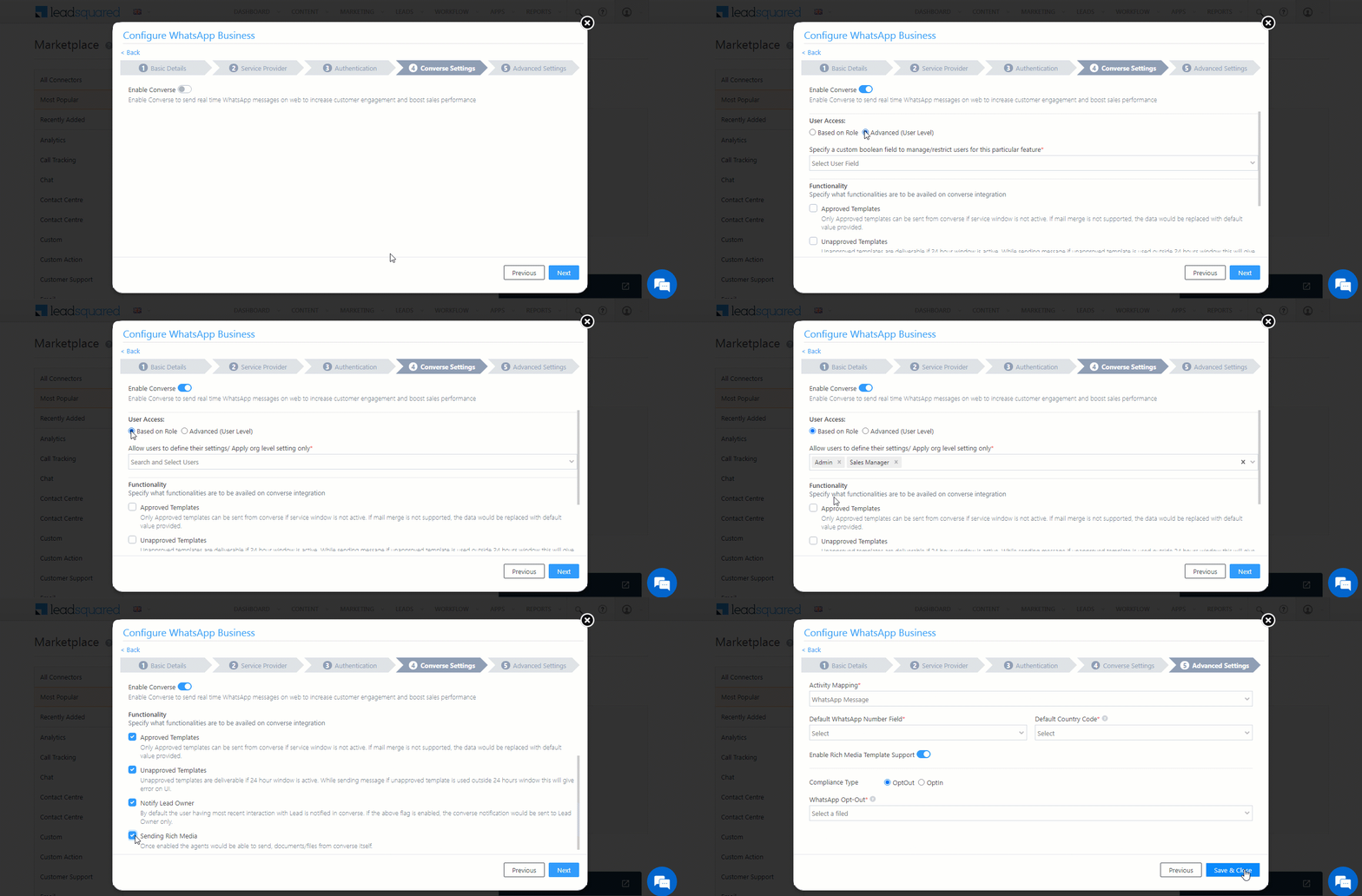
4.4 Converse Settings

LeadSquared Converse is an instant messaging feature that allows you to have real-time conversations with your leads via WhatsApp.

LeadSquared WhatsApp Integration

To integrate LeadSquared Converse with WhatsApp, complete the following steps –

  1. On the Converse Settings tab, toggle the Enable Converse Slider slider.
  2. Under User Access, grant permissions to users who can communicate with leads through the LeadSquared Converse.
    • Based on Role – From the Search and Select Users dropdown, select the LeadSquared user roles that can send messages through LeadSquared Converse.
    • Advanced (User Level) – Based on the value entered in the selected user boolean field (e.g., for the user Sam, the “Is Employee” user field contains the value “Yes”), the user will be able to send messages through LeadSquared Converse. From the Select User Field dropdown, select a relevant boolean field.
  3. Functionality – The following additional settings must be configured –
    • Approved Templates – Enable this functionality to allow your users to send approved WhatsApp templates to your leads.
    • Unapproved Templates – Enable this functionality to allow your users to send unapproved WhatsApp templates to your leads. These can only be sent if the 24-hours service window is active.
    • Notify Lead Owner* – When enabled, only lead owners will get notifications of the WhatsApp messages a lead sends. When disabled, all logged-in users will receive notifications of these WhatsApp messages.
    • Sending Rich Media – Enable this functionality to allow your users to send media files in the WhatsApp messages.

Note:

  • *Message notifications are only sent to one user, i.e., either the Lead Owner or to the user (other than the Lead Owner) that sent the WhatsApp message to the lead. When the Notify Lead Owner setting is enabled, only the Lead Owner will get notified, while the user who sent the message will not get a notification.
  • If you enable the Send Rich Media option, you must also enable the Approved Templates option. This ensures that you can add your media files to a template when messaging your leads.

LeadSquared Gupshup Integration


4.5 Advanced Settings

On this screen, provide the following details –

  • Activity Mapping – A LeadSquared activity field to your WhatsApp messages. This is the activity that will be posted every time a WhatsApp message is sent or received.
  • Default WhatsApp Number Fields – The number you set as the default phone number will be automatically selected when you’re sending a WhatsApp message to a lead. You can also select other numbers that are available from the Add Another Number dropdown.
  • Default Country Code – The default country code will be used to send messages to a phone number that’s stored in a custom field, if no country code is listed.
  • Enable Rich Media Template Support – If you want to include media files in your WhatsApp message, you must enable the Slider slider.
  • Enable HSM – Disable the Slider slider.
  • Compliance Type – Here, you can select the compliance type for the WhatsApp template, by choosing either WhatsApp Opt-out or Opt-in.
  • WhatsApp Opt-out – Your leads can opt-in or out of receiving WhatsApp messages on the basis of this field. From the dropdown, select a LeadSquared lead field for the WhatsApp opt-in/opt-out functionality.

LeadSquared - Ivosights Advanced Settings

Note: You must create a custom lead field of boolean type to map to the WhatsApp opt-out functionality. For example, you may create a custom lead field called “WhatsApp Opt Out”. Leads for whom the field is selected/checked won’t receive WhatsApp messages.

Click Save & Close when you’re done.

  • If your credentials are correct, you’ll see the success message highlighted below.
  • If they were incorrect, the integration will fail.


5. Conversing with Leads via WhatsApp

Integrating Converse with LeadSquared’s WhatsApp connector will enable your users to have real-time conversations with your leads through WhatsApp. Using templatised messages, you’ll be able to attach and send media files (such as images, documents, etc.) in your conversations. To know more, refer to LeadSquared Converse.
LeadSquared WhatsApp Integration


6. WhatsApp Templates

To configure WhatsApp templates, refer to Adding WhatsApp Templates to LeadSquared. While configuring templates in the LeadSquared portal , the Template ID has to be copied from the Ivosights portal and pasted in the “Namespace” field.

Ivosights portal

LeadSquared - ivosights message template

LeadSquared portal – 

LeadSquared - ivosights modify template


Any Questions?

Did you find this article helpful? Please let us know any feedback you may have in the comments section below. We’d love to hear from you and help you out!

Create Custom Validators for the Chatbot

1. Feature Overview

This article helps you create custom validators (regex) to validate the details captured through the Chatbot. While Phone and Email validators are available by default in your account, this article helps you create validators for other lead details you’ll capture (like Pin Codes, Social Security Numbers, PAN Cards, etc.).

LeadSquared Chatbot


2. Prerequisite

  • You must be an Admin user of your account.
  • You must install and enable the Chatbot feature on your account.


3. Add Validators

  1. On the Chatbotscreen, from the left-menu, navigate to the Validators tab.
  2. Click the Add Validator button, and on the New Validator pop-up, enter the following details –
    • Name – An internal display name for the regex. This will show up when Creating a Node, under the Validate User Input dropdown.
    • Regex – The regex for the information you’re looking to validate. We’re adding the regex for pin codes.
    • Message – The failure message sent to your lead when they input incorrect values.
  3. Once you’re done, click Save.

Note: You can search for validators by applying the following search filters –

  • Starts with
  • Contains
  • Not contains
  • Ends with
  • Equals
  • Not equals

LeadSquared Chatbot


Any Questions?

Did you find this article helpful? Please let us know any feedback you may have in the comments section below. We’d love to hear from you and help you out!

Configure Chatbot Channel

1. Feature Overview

Once you’ve built a chatbot, you must add it to a channel. We support three channels – WhatsApp, Web, and Mobile SDKs.
The WhatsApp channel lets you integrate your chatbot with your WhatsApp business account. The Web channel lets you integrate the chatbot on a portal/landing page/website/mobile apps of your choice.

Note: For the mobile SDK, the following are supported –

  • Android
  • iOS
  • React Native

LeadSquared Chatbot


2. Prerequisites

  • You must install and configure the Chatbot feature.
  • If you’re integrating the chatbot with WhatsApp, you must have a WhatsApp Business account with a service provider supported by LeadSquared.
  • If you’re integrating the chatbot with Web, prior developer experience is required.


3. Integrate the Chatbot with WhatsApp

Note: Before you integrate the chatbot with your WhatsApp , the following steps must be completed in LeadSquared. This is mandatory.

  1. On the Chatbot screen, from the left-menu, navigate to the Channels tab.
  2. Click WhatsApp, and then click the Add Configurations button.
  3. On the Publish WhatsApp Channel pop-up, choose the WhatsApp number and bot you want to integrate.
  4. Once you’re done, click Publish. The chatbot is integrated with your WhatsApp Business account, and your leads can now interact with the chatbot through WhatsApp.

LeadSquared Chatbot


4. WhatsApp Templates

You can create message templates for both Web and WhatsApp chatbots. When creating a node, you can add a Template Message Node, and use the content present in these templates as the response to your leads. The WhatsApp template’s content must be approved by your service provider.

Note: While the web template can be used on any web-based chatbot, the WhatsApp template can only be used if you have a WhatsApp Business account with either Gupshup or Kaleyra.

To create a new template –

  1. From the left-menu, click WhatsApp Templates.
  2. On the Whatsapp Templates screen, click the Create New Template button.
  3. On the Create New Template pop-up, enter the following details for a WhatsApp Template
    • Template Name – Enter a relevant name for the template. This will be used to internally identify the template.
    • Name – Enter the template name. This is mandatory.
    • Message Type – Select the message type from the following options. This is mandatory –
      • Text – This lets you send text- as the message content. Select the Button Type from the following options –
        • None
        • Quick Reply
        • CTA (if you select this, pass the button URL)
      • Image – This lets you send an image as the message content. In the Media URL box, pass the image URL.
      • Video – This lets you send a video as the message content. In the Media URL box, pass the video URL.
      • Document – This lets you send a document as the message content. In the Media URL box, pass the document URL.
    • Header – The header text of the message.
    • Body Text – Enter the text for the message body.
    • Body Parameters – If you’re using this template in a chat flow that contains an API, you can fetch response parameters from the API, and display it in this field. To do this, pass the response parameters (e.g., “EmailAddress”, etc.) within {{}} (e.g., {{EmailAddress}}, etc.).
    • Enter the mailmerge parameters that are contained in the message body.
    • Footer – Enter the footer for the message body.
  4. For a Web Template, enter the message in the Body Text.
    • From the Buttons dropdown, select if you want the button in the template to perform a website open action or a phone call action.
  5. Once you’re done, click Save. These templates will now be available to use when you’re building the chatbot.

LeadSquared Chatbot


5. Integrate the Chatbot with Web

  1. On the Chatbot screen, from the left menu, navigate to the Channels tab.
  2. Click Web, and from the right panel, click Add New Configurations.
  3. On the Web pop-up, enter the following details –
    • Bot Title – The external display name for the chatbot. This is what your leads will see when they interact with the bot.
    • Bot Subtitle – If required, you can add a subtitle for the bot. Your leads can see this when they interact with the bot.
    • Bot Logo – You can add a bot logo. To do this, add an image URL of the logo.
    • Select Bot – From the list of chatbots you’ve created, select the bot you want to integrate with WhatsApp.
    • Whitelist URL – Enter the website URL on which the bot is going to be integrated. This is to ensure the LeadSquared servers don’t block the website in which the bot is integrated. This is mandatory.
    • Help Text – Help text on the bot, to help your lead initiate the chat. For e.g., the help text can read, “Send ‘Hi’ to begin the conversation”.
    • Theme Color – The overall theme color for the bot. You can enter the hex code of a color, or select one from the colour picker.
    • Font Color – The font color of the messages sent through the bot. You can enter the hex code of a color, or select one from the colour picker.
    • Position – Configure the position of the chatbot on your website. The values you enter here are pixels to the right and bottom of the screen where you want to display the chatbot.
    • Automatically expand Bot on page visit – When enabled, the chatbot screen will automatically expand when the lead lands on the website on which the bot is integrated.
    • Disable input box for interactive messages – When selected, the chat input box for interactive messages will be disabled. This ensures the lead can only select an input from options provided in the interactive message.
    • Show Powered by Converse – Disable this checkbox if you don’t want to display the Converse branding on your chatbot.
  4. Once you’ve entered the details, click Save.
  5. Once the channel is saved, click LeadSquared Chatbot to copy the chatbot script. Embed this script into the header of the website on which you want to integrate the chatbot. Once this is done, the chatbot is live on your website.

LeadSquared Chatbot


6. Integrate Chatbot with Mobile SDK

The steps to integrate the chatbot with a mobile SDK are similar to those for integrating it with a webpage. However, you must also complete the additional steps listed below –

  1. On the Chatbot home screen, click Authorization.
  2. Under Generate API Key, alongside SDK, click Generate.
    • You don’t have to copy this key. No further action is required on this screen.
  3. Navigate to Channels, and click SDK.
  4. On the SDK screen, click Add Configurations. To know how to set up the configurations, refer to Integrate the Chatbot with Web.
    • If you have an existing SDK configuration, verify if the details are correct. To do this, click LeadSquared - edit territory allocation.
  5. Once the SDK is configured, alongside the bot you configured, click LeadSquared Chatbot. On the SDK Parameters for Scheduling pop-up, all the parameters, and use it in the SDK*.
Note: *To obtain the detailed SDK documentation, contact your account manager, or write to support@leadsquared.com.

LeadSquared Chatbot


7. Integrate Chatbot with LeadSquared Portals

Integrate a published bot with a LeadSquared Portal. Once integrated, leads can interact with the chatbot directly from the portal page. During these interactions, the bot captures the visitor’s information and the logged-in user’s details.

  1. On the Chatbot screen, from the left menu, click Channels, and then click Web.
  2. Alongside the bot you want to integrate with the Portal, under Actions, click LeadSquared Chatbot .
  3. In the pop-up, click to LeadSquared Chatbot copy the HTML script displayed on the left side, under Add the below script in the head of your HTML page.
  4. Next, from your LeadSquared dashboard, navigate to Workflow>Manage Portals, open the portal you want to integrate with the bot, and access the Portal Designer screen.
  5. On the Portal Designer, click Configurations, and under Script, paste the script.
  6. Navigate back to the Chatbot screen, and now copy the HTML script displayed on the right side, Add the below HTML tag in your page.
  7. Then, navigate to the Portal Designer, and under End of Body, paste the script.
  8. Once you’re done, Publish the portal. The chatbot is now live on your LeadSquared portal.

LeadSquared Chatbot


8. Integrate Chatbot with Landing Pages

Integrate a published bot with a LeadSquared Landing Page. Once integrated, leads can interact with the chatbot directly from the landing page. During these interactions, the bot captures the visitor’s information and the logged-in user’s details.

  1. On the Chatbot screen, from the left menu, click Channels, and then click Web.
  2. Alongside the bot you want to integrate with the Portal, under Actions, click LeadSquared Chatbot .
  3. In the pop-up, click to LeadSquared Chatbot copy the HTML script displayed on the left side, under Add the below script in the head of your HTML page.
  4. Next, from your LeadSquared dashboard, navigate to Marketing>Landing Pages, and edit a published landing page.
    • You can also integrate the bot when creating a new landing page, by following the steps listed below.
  5. Navigate to the Page Settings tab (Step 4 on the top-bar), under Embed JavaScript, select Inside Head, and paste the chatbot script into the textbox.
  6. Navigate back to the Chatbot screen, and now copy the HTML script displayed on the right side, Add the below HTML tag in your page.
  7. Then, navigate to Landing Pages, and under Start of Body, paste the script.
  8. Once you’re done, Publish the landing page. The chatbot is now live on your landing page.

LeadSquared Chatbot


9. Integrate the Chatbot with WordPress

You can integrate a published bot with a WordPress page. Once integrated, leads can interact with the chatbot directly from this page. During these interactions, the bot captures the visitor’s information and the logged-in user’s details.

  1. On the Chatbot screen, from the left menu, click Channels, and then click Web.
  2. Alongside the bot you want to integrate with the Portal, under Actions, click LeadSquared Chatbot .
  3. In the pop-up, click to LeadSquared Chatbot copy the HTML script displayed on the left side, under Add the below script in the head of your HTML page.
  4. On your WordPress page, navigate to the Code Editor, and paste the chatbot’s HTML script.
  5. Navigate back to the Chatbot screen, and now copy the HTML script displayed on the right side, Add the below HTML tag in your page.
  6. Then, navigate back to the WordPress page, and on the Code Editor, paste the HTML script.
  7. Once you’re done, save and publish your page. The bot will now be displayed on your page.

LeadSquared Chatbot


Any Questions?

Did you find this article helpful? Please let us know any feedback you may have in the comments section below. We’d love to hear from you and help you out!

Integrate APIs with the Chatbot

1. Feature Overview

This article helps you integrate LeadSquared APIs and external APIs with the Chatbot. Through the Chatbot, you can leverage these APIs to perform a variety of actions like capturing lead and opportunity details, creating tasks, posting activities, displaying lists of cities, clinics, products, etc.

Note: In this article, we’ve integrated a LeadSquared API with the chatbot. The steps to integrate an external API are the same.


2. Prerequisites


3. How it Works

In this article, we’re using the Create a Lead API as an example to illustrate how to integrate a LeadSquared API with the chatbot. When integrating the LeadSquared APIs with the chatbot –

In the chatbot API menu

1. Add the API to the chatbot API menu

    • Once you add the API details (Parameters, Headers, Authorization and Body when available), test the API.
    • When you’re adding the API Request Body, ensure it follows the same order in which you’re capturing details in the chatflow. For e.g., if you’re capturing lead details in the order of Phone Number, First Name and Email Address in the chatbot, then the API Request Body should also be in this sequence.

2. After you add and test the API, map a response attribute as the Response Variable.

    • The response variable can be used to set up conditions in a chatbot node. You can configure the chatbot to present different responses based on each condition.
    • In our example, using the Create a Lead API, we’ve added the Id from the API response as the Response Variable. We’ve used it to set up a condition where we verify if a new lead was created, and present different chatbot responses for a new lead and an existing lead.

Return to the bot builder

3. Create an API Node and test if the chatbot works as intended.

Return to the chatbot API menu

4. Map the chatbot intents (lead inputs – Email Address, First Name, Phone, etc.) to the corresponding API request attributes.

Edit the API request body and replace the values with {{intent}}, {{intent-1}}, {{intent-2}}, depending on where the intents (lead inputs) are configured in the chatbot flow.

In our example, we’ll replace the “Value” of “Attribute”:”EmailAddress” with {{intent}}. Similarly, we replace the “Value” of “Attribute”:”FirstName” with {{intent-1}}, and replace the “Value” of “Attribute”:”Phone” with {{intent-2}}. This maps the chatbot intent to the corresponding attributes in the API request body.

LeadSquared Chatbot


4. Add APIs to the Chatbot API Menu

We’re using the Create a Lead API as an example here.

  1. On your LeadSquared account, navigate to Apps>Chatbot, and click Get Started.
  2. On the Dashboard screen, from the left panel, click API, and on the top right corner, click Add API.
  3. Enter the following details –
    • API Name – An identifier for the API. This will be used to identify the API when you’re creating Nodes. This is mandatory.
    • Request Details – The API URL. Ensure you pass the correct API host along with the request URL. Append the Access Key and Secret Key to the URL. This is mandatory.
    • API Method – Set GET or POST as the API method. This is mandatory.
    • Params – Enter the API (the Access Key, Secret Key, etc.).
    • Authorization – Enter the authorization tokens if available.
    • Headers – Enter the API header key as Content-Type, and set the value as application/json. This is mandatory.
    • Body – Enter the API body if available. In the body, ensure you pass all the fields you’re capturing data for through the chatbot. We’re passing the following attributes, which you can modify according to your requirements –
      [
      {
      “Attribute”:”Phone”,
      “Value”:”8887888887″
      },
      {
      “Attribute”:”FirstName”,
      “Value”:”Steve”
      },
      {
      “Attribute”:”EmailAddress”,
      “Value”:”steve@example.com”
      }
      ]
  4. Once you’ve entered all the necessary details, click Test API.
  5. When the response is successful, under Response Variables, use”$” to access the response attribute to map as the Response Variable. For e.g., if you’re choosing “Id” as the variable in the Create a Lead API, it should be mapped to “$.Message.Id”.*
  6. Once you’re satisfied with the API, click Save.

LeadSquared Chatbot

Next, go ahead and set up the API node in the bot-builder. When configuring a node, you can view the list of all the API variables added to the chatbot.

LeadSquared Chatbot


5. Map the Chatbot Intents to the API Request Attributes

Note: Complete this step only AFTER you set up an API Node chat flow.

Once you’ve set up the API Node, map the intents configured in the chatbot (phone, first name, and email address) to the corresponding API request attributes. In the example we’ve used, we’re capturing the following lead details in sequential order –

  • Phone Number
  • First Name
  • Email Address

To map these attributes –

  1. On the Chatbot Dashboard screen, from the left panel, click API.
  2. Search for the API you’ve selected when creating the API Node. We’ve created our API node using the Create a Lead API (which we named “Lead Capture”).
    • You can also search and filter by the Request Type and Request URL.
    • You can click Filter Conditions to apply conditions (Contains, Equals, etc.) when searching for the API.
  3. Alongside the API, under Actions, click Edit edit, and on the Add New API pop-up, navigate to Body.
  4. When adding and testing the API (in the previous section), we added dummy values for each attribute. Replace these values with the following –
    • For the intent captured through the API node (Email Address), replace the existing value with {{intent}}. In our example, we added the API Node when capturing the EmailAddress, so we’ll replace the dummy email Id value with {{intent}}.
    • For the previous intent (minus 1) from the API node, replace the existing value with {{intent-1}}. In our example, the intent captured before the email Id is FirstName, so we’ll replace the dummy name with {{intent-1}}.
    • For the previous intent (minus 2) from the API node, replace the existing value with {{intent-2}}. In our example, the intent captured two levels before the email Id is Phone, so we’ll replace the dummy phone number with {{intent-2}}.
    • Do this for subsequent key-value pairs ({{intent-3}}, {{intent-4}}, etc.) present in your API. This is done to ensure that we’re dynamically capturing the lead details for all the leads entering the system.
  5. Once you’re done, click Save.

LeadSquared Chatbot


Next Steps

Return to the Bot-Builder to learn how to continue building a chat bot.


Any Questions?

Did you find this article helpful? Please let us know any feedback you may have in the comments section below. We’d love to hear from you and help you out!

Build a Journey Based Chatbot (v1)

Important: Refer to this article if the Chatbot feature was enabled on your account before 28th August 2024. If it was enabled on or after 29th August 2024, refer to Build a Journey-Based Chatbot (v2).

1. Feature Overview

Once you’ve installed the Chatbot connector in your account, set up chat flows using the bot builder.

There are multiple components involved in creating a chatbot and you can customize each component down to a granular level for your use case. In the chat flow created below, we’ve utilized all the available components (different types of nodes, APIs, buttons, etc.).

The set-up process and chat flow differ from use-case to use-case. To show you how to build and use the chatbot feature, we’ve taken a generic education industry use case to build a website chatbot. Even if the use case you’re looking to solve is different from the one listed here, you can still understand the function of each component, and use this document as a reference when building your own chatbot.

Note:

  • This article helps you create a Journey Based chatbot flow that can be integrated with a website. The steps to integrate the Chatbot with WhatsApp are also similar (unless stated otherwise). You can use this article as a reference to build your Chatbot integration with WhatsApp.
  • To know how to create an AI Help Bot, refer to Chatbot – AI Help Bot.
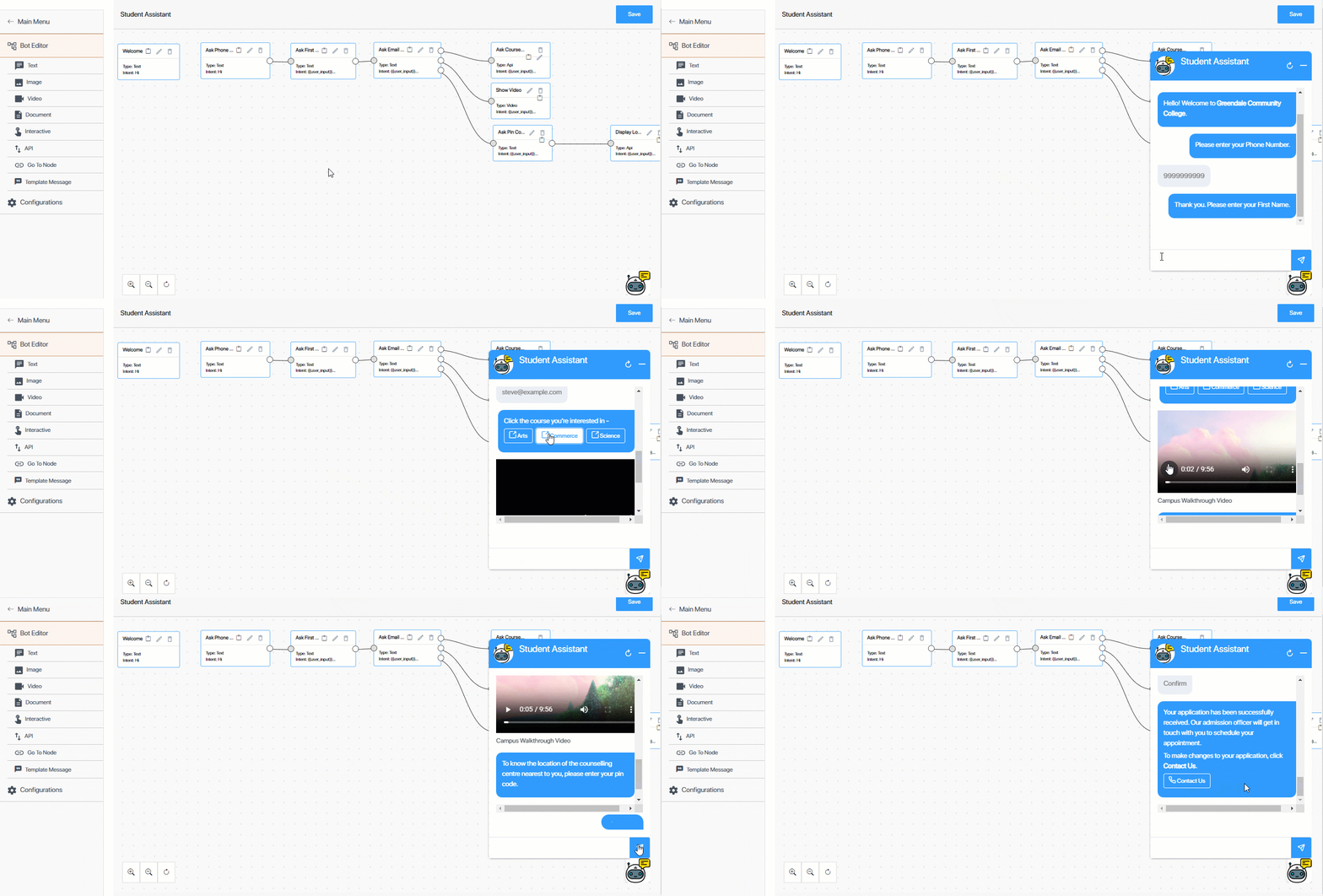
LeadSquared Chatbot


2. Prerequisites


3. How it Works

While you can create chat flows to cover multiple use cases, in this article, we’re looking at how you can create a flow for education institutes to display their courses and other offerings to potential students on their website/portal.

Example Use Case – Student Assistant Chat Flow

In this article, we’ve built a Journey Based Chatbot, and we’ve covered a scenario where new leads interact with the chatbot on an education portal/website. Through the chatbot (by integrating the Create a Lead API), we’ll capture the student’s phone numbers, names and email addresses, and use these details to create a new lead in our LeadSquared account.

Once these details are captured, the chatbot sends a list of courses that are available. From the given options, students select the courses they’re interested in. For the selected courses, the chatbot sends website links where the students can learn more about the course. Along with these links, the chatbot also sends a campus walkthrough video to the lead.

Then, the chatbot captures the lead’s pin code to show the nearest admission office to the lead (for which we’ve integrated an external API), where the lead can schedule an appointment with the admission officer. Once the lead confirms their admission center, the flow comes to an end, with the chatbot informing the lead that someone will soon get in touch with them to schedule an appointment.
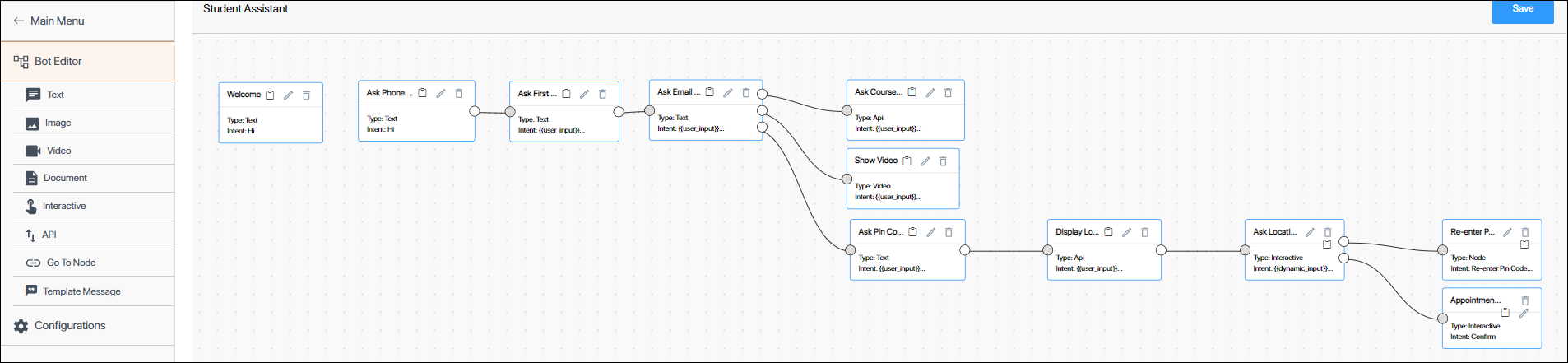
LeadSquared Chatbot

The steps we’ve followed to create the chatbot for the above use case are –

  1. Create a bot by providing a name and description.
  2. Create a Text Node to ask for the lead’s Phone Number.
  3. Create a Text Node to ask for the lead’s First Name.
    • Set up validation to validate the phone number captured in the previous step.
  4. Create a Text Node to ask for the lead’s Email Address.
  5. Create an API Node to capture the lead details in your LeadSquared account.
    • Set up validation to validate the Email Address captured in the previous step.
    • Before you do this, ensure you’ve added LeadSquared APIs to the chatbot. For this article, we’re using the Create a Lead API as an example to demonstrate how to create an API Node.
  6. Create an Image/Document/Video Node to share marketing material with the lead.
  7. Create a Text Node to ask for the lead’s pin code.
  8. Create an API node using an external API to display the locations under the pin code entered.
  9. Create an Interactive Node to confirm lead’s location.
    1. Create a Go To Node, and re-direct the lead back to the Ask Pin Code Node where the lead enters their pin. If required, the lead can change their pin code in this step.
    2. Create a Final Interactive Node where the appointment confirmation is sent to the lead. On this node, we’ve also given the lead an option to call the admission office from the chatbot.
Note: The set-up process we’ve followed is for demonstration purposes only. There are multiple ways in which you can set up the chatbot to achieve the same use case we’ve illustrated. We recommend you use this article to understand how to create a chatbot.


4. Create a Bot

Begin by creating a chatbot. This is the bot your leads will interact with when they visit your website/portal. To create a bot –

  1. On your LeadSquared account, navigate to Apps>Chatbot, and click Get Started.
  2. On the Dashboard screen, from the left panel, click Bots, and then click Create New Bot.
  3. On the Select Type pop-up, under Journey Based Bot, click Select.
  4. On the Create New Bot pop-up, enter a relevant Bot Name and Description for the bot.
    • This name is only for internal identification, and NOT the actual display name of the bot. We will set the display name in a later step.
  5. Once you’re done, click Save.

LeadSquared Chatbot


5. Create Text Nodes to Collect Lead Details

Once the chatbot is created, we’ll create the chat flow. A chat flow is a set of nodes (messages) grouped together in sequential order. A node is a single message that’s part of the chat flow.
A Text node is when the response to the lead is sent in the form of a simple text message.

5.1 Create a Welcome Text Node

In this step, we’re creating a Text Node (message) to greet the lead when they interact with the chatbot for the first time.

Aim – To greet the lead when they use the chatbot.

  • Lead Input Message – Hi
  • Chatbot Response – Hello! Welcome to Greendale Community College.
LeadSquared Chatbot

  1. From the Bot Editor screen, click Text.
  2. On the Text Node right panel, enter the following Node Configurations
    • Node name – Provide an internal display name for the node. We’re calling it “Welcome”.
    • Previous node – Since this is the first node we’re creating in the chat flow, we won’t select anything here.
      But if you’re creating a node further down the chat flow, you can select a previous node. An example of a sequence of two text nodes would be if the first node’s response is, “Welcome to Greendale Community College”, and the second node’s response is, “Greendale Community College (GCC) is an open-admissions college located in Greendale County, Colorado.”
    • Intent – The inputs (messages) received by the chatbot are known as intent. These inputs can be sent by a lead or by an API. Examples of intent sent by a lead could be “Hi”, “My order number is 445”, etc. Since we’re creating the first node in a sequence, we’ll hardcode* our intent as “Hi”. This means every time a lead sends “Hi” on the chatbot, the response we configure in the next step will be sent as a reply to the lead. To know about the other intent types available, refer to the Glossary.
    • Final Node – Since this is the first node in our chat flow, we won’t be checking this box.
    • Multi Node Response – A multi-node response is when you send a sequence of responses to a single message from the lead. For example, the lead sends the message ‘Hi’ and the bot responds with two messages – ‘Welcome’ and ‘Please enter your Phone Number’.
      We’ll check this box, because for the intent ‘Hi’, we’re sending a greetings message, along with a follow-up message asking for the lead’s phone number.
      Since this is the first node in the multi-node sequence, once you select the checkbox, ensure the value is set to 1.
  3. Once you’ve set up the Node Configurations, configure the Bot Response. This is the response your lead receives when they message the bot. In our example, we’re going to enter the following response – “Hello! Welcome to Greendale Community College.”
  4. To preview this response, click Preview. After you preview the response, make changes if required. Once you’re done, click Save.
  5. To check if the Intent and Response are set up correctly, click the emulator  Chatbot Icon. Then, enter the Intent message. If the Response is the same as the one you configured, the node is working fine.

Note:

  • *When you want to hardcode the intent, you have to enter the value in the box under Intent. You’re NOT required to tick any of the other options (Dynamic Intent and User Input) that are available.
  • You can configure the chatbot to send a greeting message to the lead as soon as the chatbot is launched (and without the lead having to input a message). To configure this feature on your account, contact your account manager, or write to support@leadsquared.com.
  • You can stylise the response using Italics, Bold and Strikethrough.
LeadSquared Chatbot

5.2 Ask for Phone Number

Through this Text node, we’ll ask the lead for their Phone Number. This node is the second in the line of multi-response nodes, and the Response message will be sent on the same Intent message the lead enters (‘Hi’) in the previous step.

Aim – To ask the lead for their Phone Number.

  • Lead Input Message – Hi
  • Chatbot Response – Please enter your Phone Number.
LeadSquared Chatbot

  1. From the Bot Editor screen, click Text.
  2. On the Text Node right panel, enter the following Node Configurations
    • Node name – Provide an internal display name for the node. We’re calling it “Ask Phone Number”.
    • Previous node – We will not be selecting a previous node because this node is part of the Multi Node sequence that we’re setting up on the first intent message (“Hi”).
    • Intent – We will continue to use “Hi” as the Intent.
    • Final Node – We won’t be checking this box.
    • Multi Node Response – We will be checking this box, and entering the value 2. This is because it’s the second response to the Intent message. Number subsequent multi node responses in sequential order (3, 4, 5, and so on).
  3. Once you’ve set up the Node Configurations, configure the Bot Response. In our example, we’ll enter the following response – “Please enter your phone number.”
  4. To preview this response, click Preview. After you preview the response, make changes if required. Once you’re done, click Save.
  5. To check if the Intent and Response are set up correctly, click the emulator Chatbot Icon. Then, enter the Intent message. If the Response is the same as the one you configured, the node is working fine.
LeadSquared Chatbot

5.3 Ask for First Name

Through this Text node, we’ll ask the lead for their First Name. The Intent message for this node is the Phone Number {{user_input}} the lead input in the previous step. In this node, we’ll also validate the phone number the lead provided.

Aim – To validate the Phone Number captured in the previous step, and ask the lead for their First Name.

  • Lead Input Message – 9999999999 (in our example)
  • Chatbot Response – Thank you. Please enter your First Name.
LeadSquared Chatbot

  1. From the Bot Editor screen, click Text.
  2. On the Text Node right panel, enter the following Node Configurations
    • Node name – Provide an internal display name for the node. We’re calling it “Ask First Name”.
    • Previous node – Since the lead would’ve responded (Intent) with their phone number in the previous step, we’ll now select the Previous Node as “Ask Phone Number”. This means the response we configure in this step will only be sent after the lead responds to the previous message.
    • Intent – Since the phone number entered is going to be unique to each lead, we’ll select User Input. This means that any value the lead provides will be considered as user intent.
      • Validate User Input – For phone numbers, email, and other unique lead fields, select this checkbox to validate the lead’s response, to ensure you’re not collecting junk values. Since we’re validating the phone number in this step, from the validator dropdown, select PHONE. This validator is available by default. To view the regex that defines a phone number, and to know more about validators, refer to Create Custom Validators for the Chatbot.
    • Final Node – We won’t be checking this box.
    • Multi Node Response – We won’t be checking this box.
  3. Once you’ve set up the Node Configurations, configure the Bot Response. In our example, we’re going to enter the following response – “Thank you for your response. Please enter your First Name.”
  4. To preview this response, click Preview. After you preview the response, make changes if required. Once you’re done, click Save.
  5. To check if the Intent and Response are set up correctly, click the emulator Chatbot Icon. Then, enter the Intent message. If the Response is the same as the one you configured, the node is working fine.
LeadSquared Chatbot

If the lead enters an invalid phone number, they’ll get the following error message –
LeadSquared Chatbot

5.4 Ask for Email Address

Through this Text node, we’ll ask the lead for their Email Address. The Intent message for this node is the First Name {{user_input}} the lead provided in the previous step.

Aim – To ask the lead for their Email Address.

  • Lead Input Message – Steve (in our example)
  • Chatbot Response – Thank you. Please enter your Email Address.
LeadSquared Chatbot

  1. From the Bot Editor screen, click Text.
  2. On the Text Node right panel, enter the following Node Configurations
    • Node name – Provide an internal display name for the node. We’re calling it “Ask Email Address”.
    • Previous node – Since the lead would’ve responded (Intent) with their First Name in the previous step, we’ll now select the Previous Node as “Ask First Name”.
    • Intent – Since the name entered is going to be unique to each lead, we’ll select User Input. This means that any value the lead provides will be considered as user intent.
      • Validate User Input – We won’t tick this box (because a name doesn’t contain any validations).
    • Final Node – We won’t be checking this box.
    • Multi Node Response – We won’t be checking this box.
  3. Once you’ve set up the Node Configurations, configure the Bot Response. In our example, we’re going to enter the following response – “Thank you. Please enter your Email Address.” We’re asking for the lead’s email address, for which we’ll set up an API node to capture all the lead’s details (phone, name, and email address) we’ve gathered thus far.
  4. To preview this response, click Preview. After you preview the response, make changes if required. Once you’re done, click Save.
  5. To check if the Intent and Response are set up correctly, click the emulator Chatbot Icon. Then, enter the Intent message. If the Response is the same as the one you configured, the node is working fine.
LeadSquared Chatbot


6. Create an API Node using a LeadSquared API

An API node contains an API (either LeadSquared APIs or any external APIs) integrated either to capture details from the chatbot (e.g., Lead Name, Lead Number, etc.), or display details to the lead (e.g., Pincodes, List of Hospitals, etc.). The Response you set up through an API node can be a simple Text response, or an Interactive Response, under which you can display Button options or List options.

Here, we’re creating an API node to create a lead in our LeadSquared account (through the Create a Lead API). In this node, we’ll add an interactive response that displays the courses offered as buttons (which will direct the lead to the landing page URL for each course).

The Intent message for this node is the Email Address {{user_input}} the lead input in the previous step, which we’ll also validate in this step.

Aim – To validate the Email Address captured in the previous step. To integrate the Create a Lead API with the node and display the courses offered.

  • Lead Input Message – steve@example.com (in our example)
  • Chatbot Response
    • For a new lead* – “Click the course you’re interested in.”
    • For an existing lead – “It looks like we already have your details. Please get in touch with our Admin office to know the status of your application.”

Note:

  • The Create a Lead API returns an Id only when a new lead is created. So we’re using the response variable ‘Id’ from the Create a Lead API to set up a condition to verify if a new lead was created or if the lead already exists in our LeadSquared account.
  • Before creating an API node, adding and setting up APIs (both LeadSquared APIs and external APIs are supported) on the Chatbot is mandatory. To know how to do this, refer to Integrate APIs with the Chatbot.
LeadSquared Chatbot

6.1 Node Configurations

In this step, we’re configuring how the node behaves when the user inputs their email Id.

  1. From the Bot Editor screen, click API.
  2. On the API Node right panel, enter the following Node Configurations
    • Node name – Provide an internal display name for the node. We’re calling it “Ask Course Preference”.
    • Previous node – Since the lead would’ve responded (Intent) with their email Id in the previous step, we’ll select the Previous Node as “Ask Email Address”.
    • Intent – Since the email Id entered is going to be unique to each lead, we’ll select User Input. The chatbot will accept a valid email Id as the response here.
      • Validate User Input – For phone numbers, email, and other unique lead fields, select this checkbox to validate the lead’s response, to ensure you’re not collecting junk values. From the validator dropdown, select EMAIL. This is available by default. To view the regex that defines an email address, and to know more about validators, refer to Create Custom Validators for the Chatbot.
    • Final Node – We won’t be checking this box.
    • Multi Node Response – We want to share our marketing materials and set up a CTA in the subsequent nodes. So, we’ll select this box, and set the value to 1. This is because this node is the first in a new multi-node sequence.
  3. Once you’ve set up the Node Configurations, complete the Response Configurations.
LeadSquared Chatbot

6.2 Response Configurations

In this step, from the list of APIs you’ve integrated with the chatbot, select the API you want to call when this node fires. Once the API is selected, we’re configuring a response using text and interactive nodes.

If required, you can add conditions based on the API response. In our example, we’re configuring –

  • An interactive response if the lead doesn’t exist in our LeadSquared account.
  • Text response if the lead exists in our LeadSquared account.
  1. From the Select API to call dropdown, select the API you want to integrate with this API node. We’re selecting the Create a Lead API (which we’ve named “Lead Capture” on the chatbot).
  2. If required, you can select Add Condition-Based Responses. We’re selecting the checkbox to identify if a lead already exists in our account, and for these leads, we’ll display a different response.
    • From the Variable Name dropdown, we’re selecting Id. The Id here is the lead Id generated when a new lead is created. This is the response variable we added when integrating the API with the chatbot.
      • To view the list of variables configured in the Chatbot, click Available Variables.
    • From the Conditions dropdown, we’re selecting Exists. To add multiple Conditions, click Add Condition.
  3. Response (If the conditions are true) – The response your lead sees when the API response fulfills the Conditions set in the previous step. This means if the API response returns a lead Id (which means the lead was created through the API call), we’ll display this chatbot response. In our example, we’re going to select Interactive, and then select Buttons and configure actions the lead can perform.
    • Header – The response header that’ll be displayed. This is optional. You can set an Image, Document, Video or Text as the response header.
    • Body – Enter the text response that’ll be sent to your leads. We’re entering – “Click the course you’re interested in -“
    • Under Button Configurations, select the button action (Text, Visit Website, Call Phone Number, or Download), and enter a display name for the button. We’re entering the names of courses we offer, and a Visit Website action for each course, which will redirect the lead to the corresponding landing page.
      • If you’ve selected the action Visit Website or Download, enter a valid URL link.
      • If you’ve selected the action Call Phone Number, enter a valid phone number.
    • Footer – You can display any relevant text information in the footer. This is optional.
  4. Response (If the conditions are false) – The response your lead sees when the API response does not fulfill the Conditions set in step 2 (of this section). This means if the API response does not return a lead Id (which may indicate that the lead already exists in our account), we’ll display this response. In our example, we’re going to select Text.
    • Under Bot Response, we’re entering the following response – “It looks like we already have your details. Please get in touch with our Admin office to know the status of your application.”
  5. To preview this response, click Preview. After you preview the response, make changes if required. Once you’re done, click Save.
  6. To check if the Intent and Response are set up correctly, click the emulator Chatbot Icon. Then, enter the Intent message. If the Response is the same as the one you configured, the node is working fine.
LeadSquared Chatbot

Note:

  • It is optional to Add Condition Based Responses. If you don’t add conditions, only one chatbot response will be shown to leads.
  • When you’re entering a website URL (for Visit Website buttons), ensure the URL contains “https://”. For e.g., the URL should be – “https://www.leadsquared.com/”.
  • If you configure an Interactive response, and then select Buttons, you can add up to three buttons. If you select Lists, you can add up to 10 lists.
  • If you set an Interactive response, and then select List, you’ll get the Action Button Text field.
    • If you’re integrating the chatbot with WhatsApp, it’s mandatory to input a value here (e.g., “Select an option”), since this is a prerequisite from WhatsApp’s end.
    • But, if you’re integrating the chatbot on web, then you can input a dummy value here, since the button won’t be displayed to your lead on the chatbot.

The Response (If the condition are false) sent to a lead will look like this –
LeadSquared Chatbot


7. Create an Image/Document/Video Node

An Image/Document/Video node shares the URL of these three media types as the chatbot response. The steps to set up an Image Node, Video Node and Document Node are the same.

We’re setting up a Video Node to share a campus walkthrough video. We’ll send this response once the lead successfully inputs their Email Id. We’re setting up this node as the 2nd node in the multi-response sequence.

Aim – To share a video/image/document with the lead.

  • Lead Input Message – steve@example.com (in our example)
  • Chatbot Response – Video/image/document.
LeadSquared Chatbot

  1. From the Bot Editor screen, click Video.
  2. On the Video Node right panel, enter the following Node Configurations
    • Node name – Provide an internal display name for the node. We’re calling it “Show Walkthrough Video”.
    • Previous node – Since we’re building this node based on the lead’s response when we ask their email Id, we’ll select the Previous Node as “Ask Email Address”.
    • Intent – Since the email Id entered is going to be unique to each lead, we’ll select User Input.
      • Validate User Input – We won’t select anything here, since the email validation happened in the Node Configurations step.
    • Final Node – We won’t be checking this box.
    • Multi Node Response – Since the Input for this node to trigger continues to be the lead’s email Id, we’ll select this box, and we’ll set the value to 2.
  3. Once you’ve set up the Node Configurations, configure the Bot Response URL. Enter the document/video/image URL.
    • If required, you can add a Caption. This is optional.
  4. To preview this response, click Preview. After you preview the response, make changes if required. Once you’re done, click Save.
  5. To check if the Intent and Response are set up correctly, click the emulator Chatbot Icon. Then, enter the Intent message. If the Response is the same as the one you configured, the node is working fine.

Note:

  • The following image formats are supported –
    • PNG
    • JPEG
    • JPG
    • GIF
  • Only video URLs with .mp4 extensions are supported.
LeadSquared Chatbot


8. Create a Text Node to Collect Lead Pin code

Next, we’re creating a Text node to ask for the lead’s pin code. Based on the pin code, we’ll show the nearest counselling centre.

Aim – To ask the lead for their pin code.

  • Lead Input Message – steve@example.com (in our example)
  • Chatbot Response – To know the location of the counseling center nearest to you, please enter your pin code.
LeadSquared Chatbot

  1. From the Bot Editor screen, click Text.
  2. On the Text Node right panel, enter the following Node Configurations
    • Node name – Provide an internal display name for the node. We’re calling it “Ask Pin Code”.
    • Previous node – Since the lead would’ve responded (Intent) with their email Id in the previous step, we’ll now select the Previous Node as “Ask Email Address”.
    • Intent – Since the email Id entered is going to be unique to each lead, we’ll select User Input.
      • Validate User Input – We won’t select anything here, since the email validation happened in the Node Configurations step.
    • Final Node – We won’t be checking this box.
    • Multi Node Response – Since the Input for this node to trigger continues to be the lead’s email Id, we’ll select this box, and we’ll set the value to 3.
  3. Once you’ve set up the Node Configurations, configure the Bot Response. In our example, we’re going to enter the following response – “To know the location of the counselling centre nearest to you, please enter your pin code.” We’re asking for the lead’s pin code, for which we’ll set up the API node to show the nearest location in the next section.
  4. To preview this response, click Preview. After you preview the response, make changes if required. Once you’re done, click Save.
  5. To check if the Intent and Response are set up correctly, click the emulator Chatbot Icon. Then, enter the Intent message. If the Response is the same as the one you configured, the node is working fine.
LeadSquared Chatbot


9. Create an API Node using an External API

Here, we’re creating an API node to display location based on the pin code entered in the previous step. We’re using an external (non-LeadSquared) API to pull this data.

The Intent message for this node is the Pin Code {{user_input}} the lead input in the previous step. We’ll set up an Interactive Response in this step, through which we’ll ask the lead to pick their location.

Note: Before creating an API node, adding and setting up APIs (both LeadSquared APIs and external APIs are supported) on the Chatbot is mandatory. To know how to do this, refer to Add APIs to the Chatbot.

Aim – To display locations based on the pin code captured in the previous step, and get confirmation if the location is accurate.

  • Lead Input Message – 560098 (in our example)
  • Chatbot Response (If the condition are true) – Select and confirm your location.
  • Chatbot Response (If the condition are false) – Invalid pin code.
LeadSquared Chatbot

In this step, we’re configuring how the node behaves when the user inputs their pin code. The steps listed here are the same as the Configure an API Node section. You can skip reading the steps if you’re familiar with the API node set-up process.

  1. From the Bot Editor screen, click API.
  2. On the API Node right panel, enter the following Node Configurations
    • Node name – Provide an internal display name for the node. We’re calling it “Display Location”.
    • Previous node – Since the lead would’ve responded (Intent) with their pin code in the previous step, we’ll select the Previous Node as “Ask Pin Code”.
    • Intent – Since the pin code entered is going to be different for each lead, we’ll select User Input.
      • Validate User Input – If you’ve created a custom validation, you can select it here. We’ve created a validator for Pin Codes. To know how to set up regex validations, refer to Create Custom Validators for the Chatbot.
    • Final Node – We won’t be checking this box.
    • Multi Node Response – We won’t be entering anything here.
  3. From the Select API to call dropdown, select the API you want to integrate with this API node. We’re selecting an external API that we added to the chatbot.
  4. If required, you can select Add Condition-Based Responses. We’re selecting the checkbox to identify if the pin code is valid.
    • From the Variable Name dropdown, we’re selecting Pincode, and from the Conditions dropdown, we’re selecting Exists. To add multiple Conditions, click Add Condition.
  5. Response (If the conditions are true) – The response your lead sees when the API response fulfills the Conditions set in the previous step. This means if the API returns a location for the pin code, we’ll display this location as our response. In our example, we’re going to select Interactive, and then select Buttons to list down the pin code location.
    • Header – The response header that’ll be displayed. This is optional. You can set an Image, Document, Video or Text as the response header.
    • Body – Enter the text response that’ll be sent to your leads. We’re entering – “Select and confirm your location -“.
    • Under Button Configurations, select the button action (Text, Visit Website, Call Phone Number, or Download), and enter a display name for the button. We’re entering – “{{Pincode}}”. We’re doing this to pull the location data from the API response, and dynamically display this on the chatbot.
    • Footer – You can display any relevant text information in the footer. This is optional.
  6. Response (If the condition are false) – The response your lead sees when the API response does not fulfill the Conditions set in step 2 (of this section). This means if the API response does not return the pin code, we’ll display this response. In our example, we’re going to select Text.
    1. Under Bot Response, we’re entering the following response – “Invalid pin code.”
  7. To preview this response, click Preview. After you preview the response, make changes if required. Once you’re done, click Save.
  8. To check if the Intent and Response are set up correctly, click the emulator Chatbot Icon. Then, enter the Intent message. If the Response is the same as the one you configured, the node is working fine.
LeadSquared Chatbot


10. Create an Interactive Node

As the name suggests, an Interactive node presents multiple options to the lead, and propmts them to select an option to continue the chat flow process. Interactive nodes allow you to give the lead options to Call, Visit a Website and View an Image.

The following data types can be displayed on an Interactive node –

  • Text
  • Image
  • Video
  • Document

And the following Button actions can be configured –

  • View Text
  • Visit a Website
  • Call a Phone Number
  • Download (a file)

You can also add up to 10 Lists as options.

In our Interactive node, we’re creating two Text buttons, and dynamically display the location based on the lead’s pin code.  We’ll also give the lead an option to either confirm and schedule their appointment or to re-enter a different pin code.

Aim – To give the lead the option to confirm their location, or re-enter their pin code.

  • Lead Input Message – 560098 (in our example)
  • Chatbot Response – Confirm if you’d like to schedule an appointment in our {{intent}} admission office.
    • Button 1 – Confirm.
    • Button 2 – Re-enter Pin Code.

LeadSquared Chatbot

  1. From the Bot Editor screen, click Interactive.
  2. On the Interactive Node right panel, enter the following Node Configurations
    • Node name – Provide an internal display name for the node. We’re calling it “Ask Location Confirmation”.
    • Previous node – Since the lead would’ve selected their location preference in the previous step, we’ll select the Previous Node as “Display Location”.
    • Intent – To dynamically display the lead’s location as part of your text response, select Dynamic Intent. This displays data present in an API as part of the response (e.g., Confirm if you’d like to schedule an appointment in our {{RR Nagar}} admission office.)
    • Final Node – We won’t be checking this box.
    • Multi Node Response – We won’t be entering anything here.
  3. Under Response Configurations, configure the response to your lead –
    • Header – The response header that’ll be displayed. This is optional. You can set an Image, Document, Video or Text as the response header.
    • Body – Enter the text response that’ll be sent to your leads. We’re entering – “Confirm if you’d like to schedule an appointment in our {{intent}} admission office.” Over here, {{intent}} is the location name (RR Nagar in our example) that’ll be dynamically pulled from the API response and displayed to the lead.
    • Footer – You can display any relevant text information in the footer. This is optional.
  4. Under Button Configurations, select the button action (Text, Visit Website, Call Phone Number, or Download), and enter a display name for the button. You can add up to three buttons.
    We’re creating two Text buttons – “Confirm” and “Re-enter Pin Code”.
  5. To preview this response, click Preview. After you preview the response, make changes if required. Once you’re done, click Save.
  6. To check if the Intent and Response are set up correctly, click the emulator Chatbot Icon. Then, enter the Intent message. If the Response is the same as the one you configured, the node is working fine.
LeadSquared Chatbot


11. Create a Go To Node

A Go To Node redirects to a different node in the chat flow process (for example, if you want the node to restart and go to the first message). This is useful when you want to take the lead back to the main menu, or to re-enter certain details.

We’re creating a Go To Node to redirect the lead back from the “Ask Location Confirmation” (when they select Re-enter Pin Code) to the “Ask Pin Code” node, where they can re-enter their pin code.

Aim – To give leads the option to re-enter their pin codes.

  • Lead Input Message – 560098 (in our example)
  • Chatbot Response – Redirects to the “Ask Pin Code” node.
LeadSquared Chatbot

  1. From the Bot Editor screen, click Go To Node.
  2. On the Interactive Node right panel, enter the following Node Configurations
    • Node name – Provide an internal display name for the node. We’re calling it “Re-enter Pin Code”.
    • Previous node – Since this node is built on the lead’s selection in the previous node, we’re selecting the “Ask Location Confirmation” node.
    • Intent – Both the buttons configured in the previous node are visible here. We’re selecting “Re-enter Pin Code” as the intent.
    • Final Node – We won’t be checking this box.
  3. Under Response Configuration, from the Go To Node dropdown, we’re selecting “Ask Pin Code”. This will redirect the lead to the selected node.
  4. Once you’re done, click Save.
  5. To check if the Intent and Response are set up correctly, click  Chatbot Icon. Then, enter the Intent message. If the Response is the same as the one you configured, the node is working fine.
LeadSquared Chatbot


12. Create a Final Interactive Node

This is the final node in our chat flow. We’re creating a Text node to inform our leads about the next step in their admission process.

Aim – To inform leads about the next steps in their admission process.

  • Lead Input MessageConfirm button click.
  • Chatbot Response – Your application has been successfully received. Our admission officer will get in touch with you to schedule your appointment. To make changes to your application, click Contact Us.
LeadSquared Chatbot

  1. From the Bot Editor screen, click Interactive.
  2. On the Interactive Node right panel, enter the following Node Configurations
    • Node name – Provide an internal display name for the node. We’re calling it “Appointment Confirmation Final Node”.
    • Previous node – Since the lead would’ve confirmed their location preference in the previous step, we’ll select the Previous Node as “Ask Location Confirmation”.
    • Intent – Since we’re displaying this node’s message only when the lead confirms their location (in the previous node), from the intent dropdown, select “Confirm”.
    • Final Node – Since this is the last node in the chat flow, we’ll be checking this box.
    • Multi Node Response – We won’t be entering anything here.
  3. Under Response Configurations, configure the response to your lead –
    • Header – The response header that’ll be displayed. You can set an Image, Document, Video or Text as the response header. This is optional.
    • Body – Enter the text response that’ll be sent to your leads. We’re entering – “Your application has been successfully received. Our admission officer will get in touch with you to schedule your appointment. To make changes to your application, click Contact Us.”
    • Footer – You can display any relevant text information in the footer. This is optional.
  4. Under Button Configurations, select the button action (Text, Visit Website, Call Phone Number, or Download), and enter a display name for the button. You can add up to three buttons.
    We’re creating one Call Phone Number button – “Contact Us”, and we’re entering our contact details.
  5. To preview this response, click Preview. After you preview the response, make changes if required. Once you’re done, click Save.
  6. To check if the Intent and Response are set up correctly, click the emulator Chatbot Icon. Then, enter the Intent message. If the Response is the same as the one you configured, the node is working fine.

Once you’ve set up the nodes, carry out the Configurations to complete the chat flow creation process.
LeadSquared Chatbot


13. Create a Handover Node

The handover node transfers the chat conversation to an agent in your organization, using LeadSquared Converse. This allows direct communication with an agent, especially when the chatbot can’t address certain queries, or when a lead requests to speak with an agent. This section isn’t included in the example flow from the previous sections because a lead can request agent assistance at any point during the conversation.

Note: Before you configure the Handover Node, ensure you’ve created a Chat Group and set up a Routing Rule.

Aim – To hand over the chat to a live agent.

  • Lead Input Message – Talk to the counsellor.
  • Chatbot Response – An agent will shortly address your concerns.
LeadSquared Chatbot

  1. From the Bot Editor screen, click Handover Node.
  2. On the Handover Node right panel, enter the following Node Configurations –
    • Node name – Provide an internal display name for the node. We’re calling it “Handover Node”.
    • Previous node – Depending on when you want to hand the conversation to a live agent, select a relevant node from the list of previous nodes.
    • Intent* – Enter a relevant hardcoded intent message (like, “Talk to an agent”, etc.).
    • Final Node – Depending on where you’re inserting this node into your chat flow, you can choose to select it as the Final Node.
    • Multi Node Response – We’re not entering anything here. But depending on the use-case you’re looking to solve, you can chose to configure this, or skip it.
  3. Select a Routing Rule – From the list of routing rules available in your account, select a rule based on which you want to hand over the chat to an agent.
    • If you haven’t previously created a rule, click Create routing rule to create a new rule.
  4. Add Condition Based Responses – You can set-up conditions based on when you want to hand over the chat to an agent. For e.g., you can set-up a condition to ensure the handover is done only during your business days (Monday-Friday), and during your working hours (9 AM to 6 PM). Once you enable the checkbox –
    • Select Work Days – Select the days of the week during which you want the agent handover to take place.
    • Time Range Picker – Select the time range between which you want the agent handover to take place.
    • Add Conditions – You can use the AND/OR operators to add multiple conditions to determine when the handover happens.
  5. Under Response, configure the response to your lead –
    • Response (If the conditions are true) – If the conditions are met (e.g., the lead sends the intent message within the working hours you’ve configured), the response you configure here is sent to your lead. The response we’ll send is “An agent will shortly address your concerns.”
    • Response (If the conditions are false) – If the conditions are not met (e.g., the lead sends the intent message outside the working hours you’ve configured), the response you configure here is sent to your lead. The response we’ll send is “To get your concerns resolved, please contact us Monday to Friday, between 9 AM to 6 PM.”
    • You can also send an interactive response. To know more about the options available when you chose this, refer to Create an Interactive Node.
  6. To preview this response, click Preview. After you preview the response, make changes if required. Once you’re done, click Save.
  7. To check if the Intent and Response are set up correctly, click the emulator Chatbot Icon. Then, enter the Intent message. If the Response is the same as the one you configured, the node is working fine.
Note: *Alternatively, you can select User Input, which would result in the chat getting handed over to an agent whenever a lead sends a message.
LeadSquared Chatbot


14. Template Message

This option allows you to create a node using a Web or WhatsApp message template. When creating the node, choose a template from the list of templates available in your account. Creating this node follows a process similar to that of a Text Node. Instead of entering the response content, select a relevant template from the Select Template dropdown.
LeadSquared Chatbot


15. Templated Flow

From the list of template flows available in your account, choose a relevant template you want to use when building the chatbot. After choosing the template, you can modify both the flow and the nodes in it to suit your use case.
LeadSquared Chatbot


16. Configurations

To complete the chatbot set-up, navigate to the Configurations screen.
LeadSquared Chatbot

16.1 Session Timeout

Configure the message you’ll send to the lead when the chat session ends because the lead hasn’t sent any message for a specified time period.
LeadSquared Chatbot

Click Edit to –

  • Set the hours and minutes of inactivity after which you want to display the message to your lead.
  • Add the timeout message the lead receives after the session times out.
  • To add multiple timeout messages, click .

Once you’re done, click Save.

LeadSquared Chatbot

16.2 Fallback Message

Fallback messages are sent when the chatbot doesn’t understand the lead’s message.
LeadSquared Chatbot

Click Edit to –

  • To send the previous chatbot message as the fallback message, enable the Azure Checkbox checkbox.
  • Add the fallback message the lead receives when the bot does not understand the lead’s response.
  • To add multiple timeout messages, click .

Once you’re done, click Save.
LeadSquared Chatbot

16.3 Inactivity Message

Configure the message the chatbot sends to the lead when the lead is inactive on the chatbot and hasn’t sent any message for a specified time period. This message is a reminder to the lead, to let them know the session is idle.
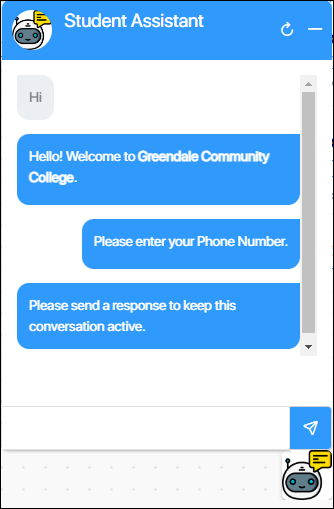
LeadSquared Chatbot

Click Edit to –

  • To send the previous chatbot message as the inactivity message, enable the Azure Checkbox checkbox.
  • Set the hours and minutes of inactivity after which you want to display the message to your lead.
  • Add the timeout message the lead receives after the session times out.
  • To add multiple timeout messages, click .

Once you’re done, click Save.

Note: The Inactivity Message is sent after a few minutes of inactivity, as a reminder to the lead. The Session Timeout message is sent after a longer period of inactivity, and to let the lead know that the session has been terminated. The inactivity period configured for Inactivity Message should be lesser than that of the time configured for the Session Timeout message.
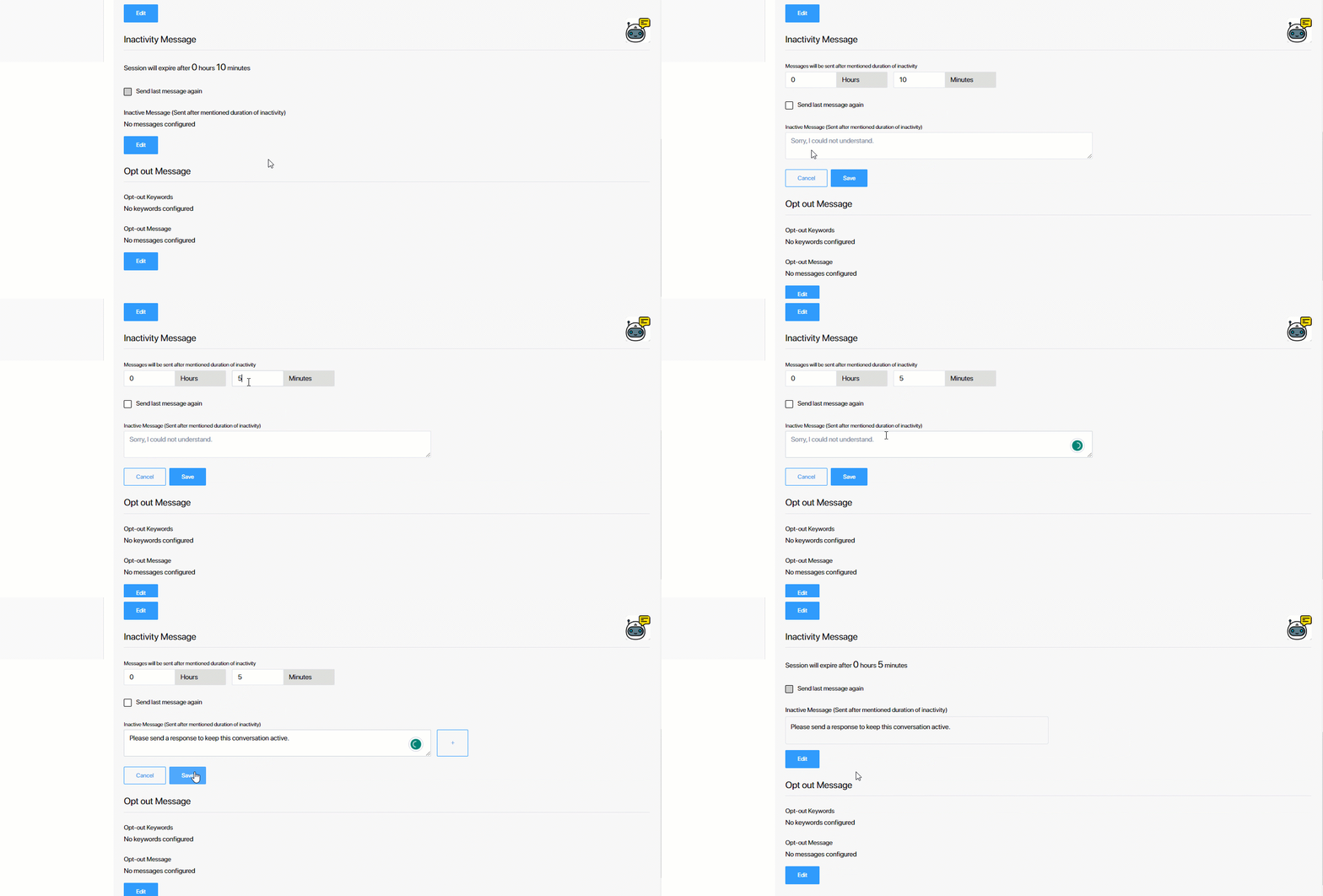
LeadSquared Chatbot

16.4 Opt-out Messages

When a lead sends any of the keywords configured here as an input message, the lead automatically opted out of further interactions with the chatbot. Click Edit to add the list of keywords. In the Opt-out Message box, configure the message you want to send as the chatbot response once the lead has opted out of the conversation.

Once you’re done, click Save.
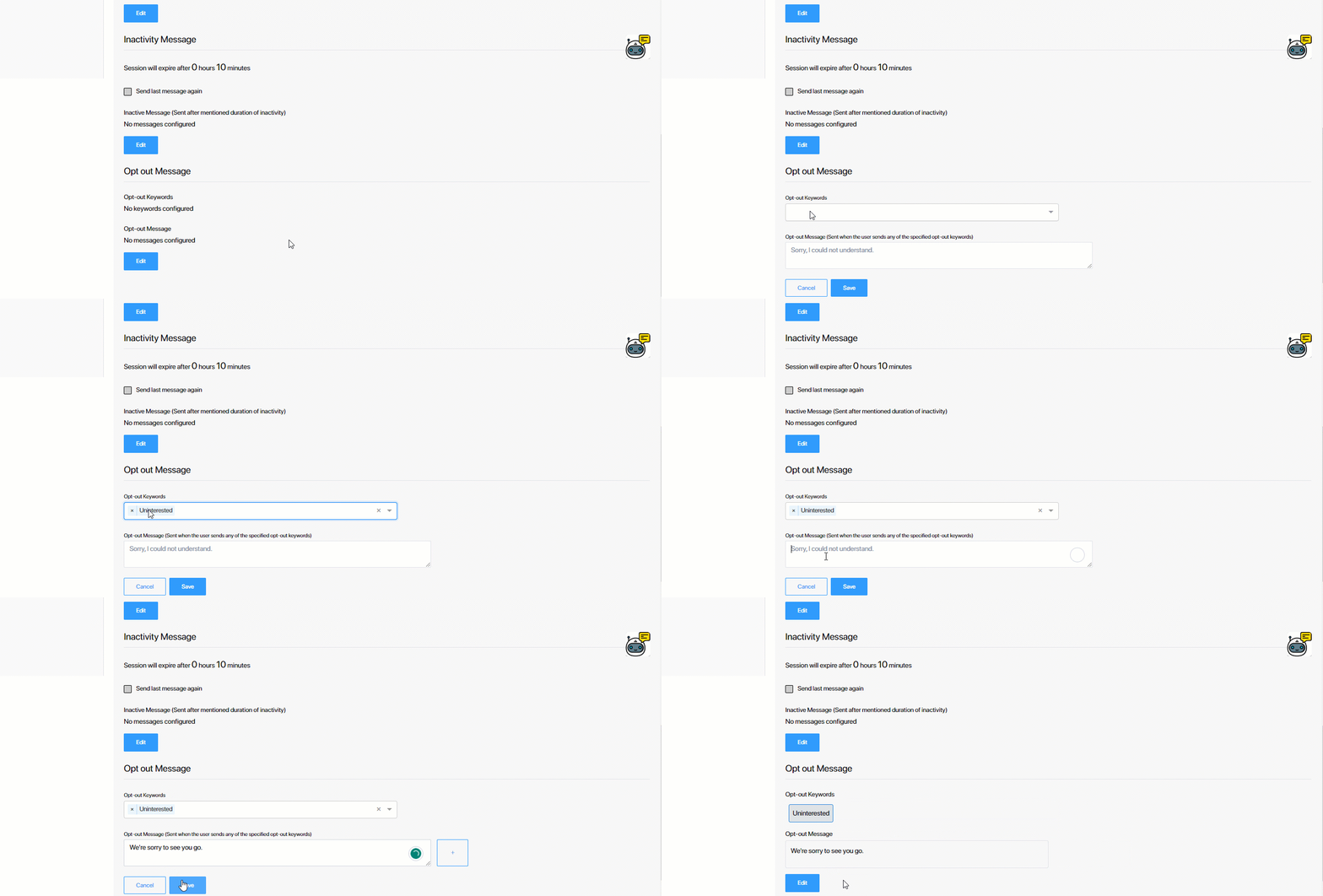
LeadSquared Chatbot

16.5 Restart Message

When a lead enters a configured keyword, the chatbot restarts the journey from the first message. To set up keywords, click Edit, enter them (e.g., “main menu”, “restart”, “begin again”), press Enter on your keyboard, and click Save.

LeadSquared Chatbot

16.6 Link FAQ Chatbot

You can link an FAQ Bot or a AI Knowledge Base Chatbot to the journey-based bot. If a lead asks a question that is not covered or triggers a fallback response, the system checks the linked bot for answers and responds accordingly. Use the Link FAQ Bot dropdown to link the bot, and then click Save.

Note: When this setting is enabled, the bot first checks the linked FAQ bot for an answer. If it can’t find one, it sends the fallback message configured in your account.
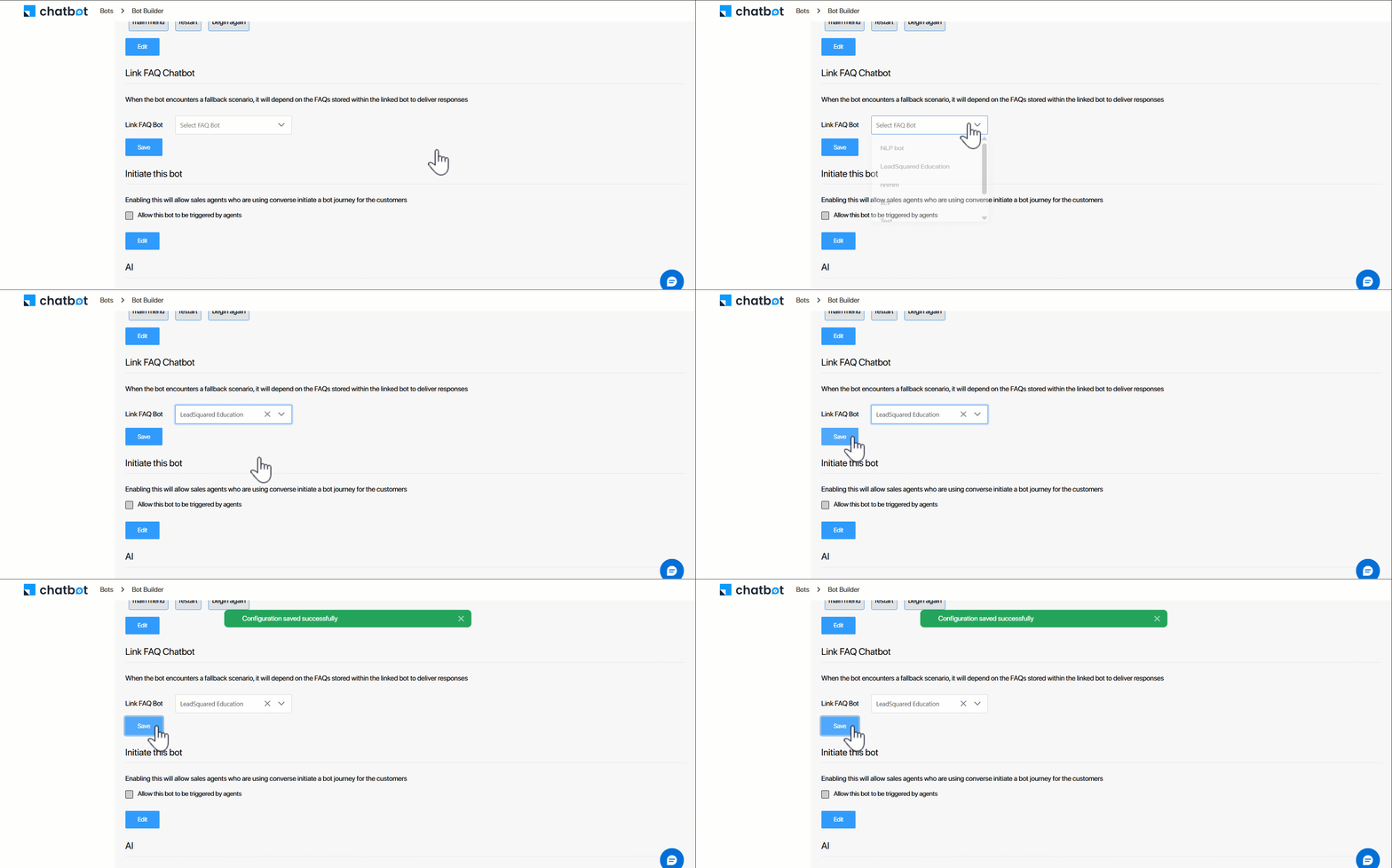
LeadSquared Chatbot


17. List of Templated Flows

We’ve provided a list of chatbot flows, designed to solve specific use cases, which can be imported into the bot builder. Once you’ve imported a template, you can customize it to reflect your business requirements. Currently, we have the OTP Verification template available, which allows you to create a bot for verifying OTPs entered by leads. To use a Templated Flow –

  1. Navigate to the Chatbot home page, and from the left-menu, click Templated Flow.
  2. On the Explore Templated Flows screen, for the template you want to use, click Import Template.
  3. From the Select a BOT dropdown, you can –
    • Import into a New Bot – You can create a bot from scratch, and import this template into the new bot. When you select this, enter a Bot Name (which is mandatory) and Bot Description.
    • Import into an Existing Bot – You can select an existing bot to import the template to.
  4. Once you’re on the bot builder screen, you can modify the template, and the nodes in the template, to meet your requirements. To know how to build a chatbot, refer to Build a Chatbot.
LeadSquared Chatbot


18. Other Actions

On the bot builder screen, you can search for a node using the node name, the user intent, the buttons configured and the Bot Display.
LeadSquared Service CRM


19. Next Steps

After you’ve set up the chat flow, you must configure the chatbot channel. To know how to do this, refer to Configure Chatbot Channel.


Any Questions?

Did you find this article helpful? Please let us know any feedback you may have in the comments section below. We’d love to hear from you and help you out!

LeadSquared Chatbot – Feature Guide

1. Feature Overview

LeadSquared’s Chatbot is a no-code, menu-driven bot builder through which you can create multiple chat flows to address lead queries swiftly and efficiently, while reducing your user’s efforts and workload. Chatbots are especially useful to automate answers to common enquiries, improve user productivity, and engage your leads 24*7 (including outside business hours).

There are two types of chatbots you can build –

  • Journey Based Chatbot – A chatbot that takes your lead on a journey to achieve specific goals (like generate a loan proposal document, course broucher, etc.).
  • AI Help Bot – A help bot that answers FAQs and other queries posted by your leads. This is especially useful in reducing support load, and to also ensure your leads get their queries resolved even outside business hours.
  • AI Knowledge Bot – An AI-powered chatbot that enhances a journey-based bot by answering questions outside the configured chat flow. It learns from the knowledge bases and resources you provide, including open-ended content like documents and website links.

You can integrate the chatbot with both WhatsApp and websites/portals. When integrated with WhatsApp, your leads can message the chatbot through WhatsApp. When integrated with a website, your lead can message the chatbot directly from the website.

LeadSquared Chatbot


2. Use Cases

The Chatbot is designed to address and resolve multiple use cases across various industries. Some of these use cases are listed below –

Use Case Solution
Capture Lead Details Map the chatbot to lead fields in your LeadSquared account. When a visitor on the chatbot enters their details (name, phone number, email, etc.), they are created as new leads in your account.
Engage Leads When visitors send messages outside business hours, the chatbot can engage them by recording their queries and providing relevant information. This ensures there’s no lead leakage, and that leads are engaged round the clock.
Provide Demos Use APIs to create chat flows containing video, image and PDF links that host your product/service demo (such as admission brochures, loan application forms, college campus walkthrough videos, etc.).
Collect Lead Documents Use the chatbot to automate lead document collection by mapping the chatbot to document lead fields in your account. When the lead submits relevant documents (e.g., marks cards, Aadhaar cards, salary slips, etc.) through the chatbot, the documents are automatically stored in your account.
Schedule Appointments Integrate LeadSquared Task APIs in the chat flow to automate task creation. When a lead is interested in receiving a demo, they can schedule it directly through the chatbot. This will also reduce the effort your users will have to put in when they create appointments with leads.


3. Prerequisites

  • This is a paid feature. To enable it on your account, contact your account manager, or write to support@leadsquared.com.
  • If you’re enabling integrating the chatbot with WhatsApp, we currently support WhatsApp Business accounts set up using Kaleyra or Gupshup. If you’ve set up your WhatsApp Business account using any other provider, please contact your account manager, and we’ll integrate your WhatsApp account with the chatbot.


4. Installation

  1. Navigate to Apps>Apps Marketplace.
  2. Search for LeadSquared Chatbot, and click Install.
    • Alternatively, you can find the connector on the left panel, under Chat.
  3. Once installed, hover your cursor over , and click Get Started.

To continue with the set-up process, and to create chat flows, refer to Build a Website Chatbot.

LeadSquared Chatbot


5. Glossary

When you’re creating a chatbot, you’ll come across a few terms for the first time on the LeadSquared platform. In this section, we’ve explained what each of these terms stands for –

Chatbot
A bot that has real-time conversations with your leads based on the chat flow you’ve created. Each chatbot is unique to solving a specific requirement. You can create multiple chatbots to solve multiple use cases. There are two types of chatbots – Journey Based Chatbot and AI Help Bot.


Journey Based Chatbot
This chatbot is used to help a lead achieve a specific goal (e.g., OTP verification, KYC check, etc.).


AI Help Bot
This chatbot is used to address common queries and FAQs the lead might have when using your product (e.g., queries about a loan like eligibility, loan tenure, etc.).


Chat flow
A set of nodes (messages) grouped together in sequential order. You can create multiple chat flows under each chatbot, and each of these chat flows can be interconnected with each other.


Node
A single message that’s part of the chat flow. Each node uses Text, Image, Video, Document, Interactive, or API as the base on which it’s built.

  • Text – This node sends a simple text message as the chatbot response.
  • Image – This node sends an image URL as the chatbot response.
  • Video – This node sends a video URL as the chatbot response.
  • Document – This node sends a document URL as the chatbot response.
  • Interactive – This node sends buttons and/or lists as options, from which the lead can choose a response.
  • API – This node contains an API (either LeadSquared APIs or any external APIs) integrated with the chatbot, either to capture details from the chatbot (e.g., Lead Name, Lead Number, etc.), or display details to the lead (e.g., Pincodes, List of Hospitals, etc.).

You can use multiple nodes (including multiple types like Text, Videos, API, etc.) to build a chat flow.


Intent
The inputs (messages) received by the chatbot is known as intent. These inputs can be sent by a lead or by an API. Examples of intent could be “Hi”, “My order number is 445”, etc. There are three types of Intents –

  • Hardcoded Intent – This is when you want to send a reply through the chatbot only for a message from a lead that’s an exact match to the intent you’ve created. For example, if you want the bot response to be “Welcome to…” only when the lead sends “Hi”, you can hardcode the intent with the word “Hi”.
  • User Input – This is when you want to reply for any message the lead sends, and when hardcoding the potential lead message won’t be required. For example, if you want the bot response to be, “Please enter your name”, and different leads enter different names, you want all the lead inputs to be valid. That’s when the bot will accept any input from the user, and send the response you’re configuring here, like “Thank you for giving us your name. Can you please proceed with your phone number?”
  • Dynamic Intent – This is when the inputs are received dynamically from an API response. For example, enter the node’s response as, “Select the city you’re residing in”, and configure an API to fetch a list of all Indian cities. Along with the “Select the city…” message, the lead will also get the list of Indian cities, from which they can select the city they’re in.


Bot Response
The response (reply) sent by the chatbot to your lead. You can add URLs, API response and text as the response.


6. Next Steps

  1. First, build a chatbot.
  2. To create validators, refer to Create Custom Validators for the Chatbot.
  3. Then, select a channel and integrate the chatbot with a website or WhatsApp. To do this, refer to Configure Chatbot Channels.
  4. To integrate LeadSquared APIs with the bot, refer to Integrate APIs with the Chatbot.
  5. To gain insights, refer to Chatbot Analytics.


Any Questions?

Did you find this article helpful? Please let us know any feedback you may have in the comments section below. We’d love to hear from you and help you out!

Using the Call Analysis Report in SIERA

1. Feature Overview

The Call Analysis Report in SIERA helps Sales Managers monitor call centre metrics and agent productivity within their teams. Sales users can use the report to track their total calls (inbound, outbound, connected, unanswered, missed) and talk time.


2. Prerequisites

SIERA is a paid feature. To enable it for your account, contact your account manager or support@leadsquared.com.


3. Call Analysis Report

To view the SIERA Call Analysis Report, navigate to Reports>SIERA>Reports>All Repots and search for Call Analysis Report.

new nav

3.1 Filters

Use this section to filter your report

Filter Description
Called On Date range on which the call was made
Sales Groups Use this to apply filters on specific Sales Groups
Owner Name Use this filter to apply filters on specific agents

Siera filters

Note: Apart from the above filters, you can choose and add up to 15 filters to the report. Click on filter icon to add more filters to your report. All the filters are multi-select filters which enable multiple values to be selected at once.

more filters

3.2 Data

Use this section to modify the rows and columns in your report –

  1. Select the Data tab.
  2. click on fields icon to choose the fields you would like to group and click Apply Settings.
  3. You can drag and drop the fields to change the order.
  4. In order to clear the groupings, click on the x delete icon for the fields and click  Apply Settings.
Note: You can add up to 3 rows and 1 column groupings.

Siera data

3.2.2 Pre-defined values

The Visualize section also has a set of pre-defined values.

  1. You can change the order by dragging the field box and clicking Apply Settings.
  2. You can delete a field from the view by clicking on the x delete icon next to the field and clicking Apply Settings.
  3. Click values icon to add a pre-defined value from the PRE-DEFINED section and click Apply Settings.
Note: Refer to section 4 for the descriptions of the pre-defined values.

siera pre-defined value

3.2.3 Additional Values

Apart from the pre-defined values, you can add additional values to the view –

  1. Click on values icon.
  2. You can select values from Lead, Opportunity, and Activity by clicking the + add icon.
  3. Once you select a value, you can click on the Edit icon to configure it.
  4. You can change the Display Name.
  5. Select an aggregator for the value.
  6. Click Save Changes.
  7. Once done, click Apply Settings.
Notes: Refer to the table below for the aggregator options.
Aggregator Description
Sum Displays the summation of all the values.
Max Displays the maximum value.
Min Displays the minimum value.
Count Displays the number of values.
Count Unique Displays the number of unique values.

siera additional values

3.3 Report Views

You can create and share multiple reports based on pre-set filter conditions. The filter values and groupings are saved and the data refreshes when the report view is opened.

  1. Select Report Views.
  2. Click Create New View.
  3. Enter a name for the report and click Save.
  4. Under My Views, you can only see the Report Views you have created.
  5. Alongside the view you want to share, click SIERA, and click Share View.
  6. To stop sharing a Report View, click SIERA, and click Stop Sharing.

siera report views

3.4 Quick Export

To enhance your experience while using SIERA, you can perform the Quick Export action to export all the data that’s present on the current report page you’re on. You can export this page as a CSV file and as an Excel file. This export happens instantaneously, without any reliance on the Export History tab. You can Quick Export the summary as well as the drill-down reports.

Note: You can restrict certain users from exporting the report by creating and applying Permission Templates.

SIERA quick export

3.5 Export

You can also perform the Export action to export all the rows across the entire report. You can export this page as a CSV file. Once you’ve performed the Export action, the report is queued as a link on the Export History tab. Once the file is rendered, you can download the report.

Note:

  • You can only Export up to 1,000 rows through this action.
  • You can restrict certain users from exporting the report by creating and applying Permission Templates.

SIERA export


4. Call Analysis Metrics

call analysis metric

4.1 Call Volume Analysis

Metric Description
Calls Total calls during the date range selected (Inbound + Outbound)
Calls Connected Total answered calls in the date range (Inbound answered + Outbound answered)
Unique Leads Total unique leads attempted in the date range (Inbound + Outbound)
Unique Leads Connected Total unique leads connected in the date range (Inbound answered + Outbound answered)
Outbound Calls Total calls dialled by the agents
Outbound Answered Calls Total calls answered by the leads
Inbound Calls Total calls answered by the agents


4.2 Call Duration Analysis

Metric Description
Total Call Duration Total call duration for Inbound and Outbound calls
Average Call Duration Total call duration for Inbound and Outbound calls/Number of calls
Calls < 2 minutes Total answered calls with call duration < 2 minutes (Inbound + Outbound)
Calls > 2 minutes and < 5 minutes Total answered calls with call duration > 2 minutes and < 5 minutes (Inbound + Outbound)
Calls > 5 minutes and < 10 minutes Total answered calls with call duration > 5 minutes and < 10 minutes (Inbound + Outbound)
Calls > 10 minutes Total answered calls with call duration < 10 minutes (Inbound + Outbound)


4.3 Not Connected Analysis

Metric Description
Inbound Missed Calls Total inbound calls from the leads not answered
Outbound Unanswered Calls Total outbound calls not answered by the leads


5. Call Analysis Use-Cases

5.1 New Leads Dialled Today

With the customization features offered in SIERA reports, users can add date fields as a filter. In this case, users can add leads Created On as a filter in the report. With the filter value of Today, we can identify the calls made for leads that were created today.

Steps –

  1. In the Filters section, click on filter icon.
  2. Search for Created On date field under the Leads entity, and select it using the + add siera icon.
  3. Select the value of Today and click on Apply Filters.

new leads dialled

Click on Report Views and save the report configuration.

new leads dialled


5.2 Total Call Duration for Answered Calls

Total call duration includes the total calls dialled. In order to exclude the ringer for missed calls, users can add Status as a filter to exclude these missed calls.

Steps –

  1. In the Filters section, click on filter icon.
  2. Search for the Status field under the Activity entity, and select it using the + add siera icon
  3. Deselect the Missed and NotAnswered status.

total call duration for answerd calls

Click on Report Views and save the report configuration.

total call duration for answerd calls


5.3 Call Recordings

Click on any call measure, for example, Connected Calls, to drill down to the lead level. Use the Call Recording URL to listen to the call recordings.

call recording


Any Questions?

Did you find this article helpful? Please let us know any feedback you may have in the comments section below. We’d love to hear from you and help you out!

Opportunity Permissions

1. Feature Overview

Opportunities in LeadSquared represent your potential deals. You can configure and grant opportunity permissions to your users across –

  • Role Level – The opportunity permissions are available by default to all the users present in your organization, and require no further configuration from your end.
  • Sales Groups – The opportunity permissions are available by default to the Sales Managers and Sales Users present in a sales group. These permissions grant special access to Sales Managers. Depending on the permissions given to them, they can view, modify and delete the opportunities owned by the Sales Users who report to them.
  • Permission Templates – For a permission template, the opportunity permissions will have to be configured at the opportunity type level. Through this, you can restrict user access to an opportunity type, enable field masking (in order to protect sensitive data such as PAN number, Social Security Number, health records, etc.), and grant opportunity import and opportunity export access to users.

Permissions help ensure that only authorized users will be able to access relevant opportunities.


2. Prerequisites

  • You must be the Administrator of your account.
  • You must have opportunities enabled in your account. To enable opportunities in your account, please write to support@leadsquared.com.
Note: You must enable the delete opportunity option while creating an opportunity type. On the Create Opportunity Type pop-up, against Allow Delete, click the . To know how to create an opportunity type, please refer to Opportunity Configurations.

Permissions for opportunities


3. Opportunity Permission across User Roles

Opportunity permissions are available to all the users in your organization by default. There are four user types available –

  • Administrator Users
  • Marketing Users
  • Sales Managers
  • Sales Users

To know more about user roles, please refer to User Roles and Access Rights.


3.1 Administrator Users

For Administrator users, the following permissions are available by default –

Permission Type Description
Create Administrators will be able to add new opportunities to all the leads in the system.
View Administrators will be able to view all the opportunities that exist in the system.
Modify Administrators will be able to edit and modify all the opportunities that exist in the system.
Delete Administrators will be able to delete any opportunity that exists in the system.


3.2 Marketing Users

For Marketing users, the following permissions are available by default –

Permission Type Description
Create Marketing users will be able to add new opportunities to all the leads in the system.
View Marketing users will be able to view all the opportunities that exist in the system.
Modify Marketing users will be able to edit and modify all the opportunities that exist in the system.
Delete Marketing users will be able to delete any opportunity that exists in the system.


3.3 Sales Managers

For Sales Managers, the following permissions are available by default –

Permission Type Description
Create Sales Managers will be able to add new opportunities to all the leads in the system.
View Sales Managers will be able to view all the opportunities that exist in the system.
Modify Sales Managers will be able to edit and modify all the opportunities that exist in the system.
Delete Sales Managers will be able to delete any opportunity that exists in the system.


3.4 Sales Users

For Sales Users, the following permissions are available by default –

Permission Type Description
Create Sales Users will only be able to add new opportunities to only accessible leads. Accessible leads are –

  • Leads associated with opportunities where the user is the opportunity owner.
  • Any lead where the user is the lead owner.
View Sales Users will only be able to view –

  • All the opportunities for which the user is the opportunity owner.
  • All the opportunities associated with the lead, where the user is the lead owner.
Modify Sales Users will only be able to modify accessible opportunities. Accessible opportunities are –

  • All the opportunities for which the user is the opportunity owner.
  • All the opportunities associated with the lead, where the user is the lead owner.
Delete Sales Users will only be able to delete accessible opportunities. Accessible opportunities are –

  • All the opportunities for which the user is the opportunity owner.
  • All the opportunities associated with the lead, where the user is the lead owner.


4. Opportunity Permission across Sales Groups

Permissions are available by default to sales groups, depending on how they’ve been configured, and the access granted to the group. Under each sales group, there are Group Managers and Sales Users. To know more about sales groups, please refer to Managing Lead and Account Access for Sales Users – Sales Groups.

4.1 Group Managers in a Sales Group

Group managers in a group have either of the following access-

  • Group Managers with a view all leads of the group access
  • Group Managers with a modify all leads of the group access

Depending on the existing access permissions a Group Manager has, the following permissions are available by default –


4.1.1 Group Managers with a View All Leads Access

Permission Type Description
Create Group managers will only be able to add new opportunities to accessible leads. Accessible leads are –

  • Leads associated with opportunities where the group manager is the opportunity owner.
  • Any lead where the group manager is the lead owner.
View Group managers will only be able to view –

  • All the opportunities for which the group manager is the opportunity owner.
  • All the opportunities associated with the lead, where the group manager is the lead owner.
  • All the opportunities that are accessible to the sales users who report to the group manager.
Modify Group managers will only be able to modify accessible opportunities. Accessible opportunities are –

  • All the opportunities for which the group manager is the opportunity owner.
  • All the opportunities associated with the lead, where the group manager is the lead owner.
Delete Group managers will only be able to delete accessible opportunities. Accessible opportunities are –

  • All the opportunities for which the group manager is the opportunity owner.
  • All the opportunities associated with the lead, where the group manager is the lead owner.


4.1.2 Group Managers with Modify All Leads Access

Permission Type Description
Create Group managers will only be able to add new opportunities to accessible leads. Accessible leads are –

  • Leads associated with opportunities where the group manager is the opportunity owner.
  • Any lead where the group manager is the lead owner.
View Group managers will only be able to view –

  • All the opportunities for which the group manager is the opportunity owner.
  • All the opportunities associated with the lead, where the group manager is the lead owner.
  • All the opportunities that are accessible to the sales users who report to the group manager.
Modify Group managers will only be able to modify accessible opportunities. Accessible opportunities are –

  • All the opportunities for which the group manager is the opportunity owner.
  • All the opportunities associated with the lead, where the group manager is the lead owner.
  • All the opportunities that are accessible to the sales users who report to the group manager.
Delete Group managers will only be able to delete accessible opportunities. Accessible opportunities are –

  • All the opportunities for which the group manager is the opportunity owner.
  • All the opportunities associated with the lead, where the group manager is the lead owner.
  • All the opportunities that are accessible to the sales users who report to the group manager.


4.2 Sales Users in a Sales Group

For the Sales Users in a group, the following permissions are available by default –

Permission Type Description
Create Sales Users will only be able to add new opportunities to accessible leads. Accessible leads are –

  • Leads associated with opportunities where the user is the opportunity owner.
  • Any lead where the user is the lead owner.
View Sales Users will only be able to view –

  • All the opportunities for which the user is the opportunity owner.
  • All the opportunities associated with the lead, where the user is the lead owner.
Modify Sales Users will only be able to modify accessible opportunities. Accessible opportunities are –

  • All the opportunities for which the user is the opportunity owner.
  • All the opportunities associated with the lead, where the user is the lead owner.
Delete Sales Users will only be able to delete accessible opportunities. Accessible opportunities are –

  • All the opportunities for which the user is the opportunity owner.
  • All the opportunities associated with the lead, where the user is the lead owner.


5. Permission Templates

Through Permission Templates, you can add and configure permissions to each opportunity type in your account. You can also enable field masking through permission templates. This will help protect client sensitive informartion (such as Aadhaar Number, Social Security Number, etc.) from your users.

You can grant permissions for the following permission types –

  • View – Allows users to view the opportunities under the opportunity type.
  • Create – Allows users to add a new opportunity under the opportunity type.
  • Edit – Allows users to edit an opportunity under the opportunity type.
  • Delete – Allows users to delete an opportunity under the opportunity type.
  • Export – Allows users to export opportunities under the opportunity type.
  • Import – Allows users to import opportunities under the opportunity type.

To know more, please refer to How to Create a Permission Template?

Permissions_2


Any Questions?

Did you find this article helpful? Please let us know any feedback you may have in the comments section below. We’d love to hear from you and help you out!

Telephony Advanced Configuration Through General Settings

1. Feature Overview

You can configure advanced settings for Telephony through the General Settings page. This article explains each of these settings in detail.


2. Prerequisites

  • Settings on this page are only accessible by LeadSquared Admin users.
  • Certain settings are available only if the associated feature is enabled on your account. Contact us at support@leadsquared.com if you want to enable new features on your account.


3. General Settings

Navigate to Settings>Telephony>General Settings.

telephony general settings


You will find the following configurations –

  • Allow International formats for Exotel Virtual Numbers

Enables you to configure international phone numbers in the Virtual Numbers (Caller Id) field of the Exotel V2 connector.

product updates sept 2021

  • Configure telephony ignore rules

When enabled, this setting will ignore calls from unknown numbers. This works across all telephony providers. Logs of ignored calls will still be posted in your account. To view telephony logs,  navigate to My Profile>Settings>API and Webhooks>Telephony Logs.

  • Disable Agent Popup in Multiple Tabs

When enabled, the Agent pop-up will only be displayed on the active browser tab (when LeadSquared is open on multiple tabs).

  • Disable Opening of Entity Details in Marvin

Lead or opportunity details will not open automatically when receiving an incoming call on Marvin.

  • Enable agent panel access by Teams

Restrict access to the agent panel (softphone) so that only agents belonging to the mapped team(s) can use the virtual number for calling. Agents outside the assigned team(s) will not see or access the softphone.

  • Enable Async APIs for Telephony (Capras)

For customers using the Exotel Telephony connector, once you enable this setting, you can use LeadSquared’s Async API framework to ensure more reliable call logs posting for outbound calls. To know more, refer to Exotel Connector.

  • Enable Default Opening of Disposition Form in Marvin

While on call, the first dynamic form will automatically open without needing to click the Disposition button.

  • Enable formatting of non-unique phone type lead fields

When enabled, phone type lead fields that are not marked unique, will be processed and formatted as follows –

+cc-<phone number>

For this to work, the default country code must be defined from the Company Profile settings (Settings>Profile>Organization Settings>Company Profile and define ‘Default Country Code’ field).

define default country code

  • Enable leading zeros in phone type lead fields

When enabled, users can create phone numbers with zero as the first digits. This is helpful for phone numbers in certain countries that support zeros as the first digit of the phone number.

  • Enable Showing Telephony Provider Errors Instead of Default LSQ Error

In the case of Click2Call, LeadSquared Telephony errors will be replaced with your telephony provider-specific errors in the Telephony logs.

  • Enable new phone number format setting

Once enabled, international phone numbers will be formatted in the cc+phonenumber format. 

  • Enable Virtual Number Randomization

In telephony connectors, where multiple virtual numbers are configured, the setting randomizes the virtual number with every call placed by an agent.

Virtual Number Randomization

  • Ignore Inbound Calls

When enabled, all incoming calls from unknown numbers received through any configured telephony connector (through the call log or agent pop-up) will be ignored. This ensures that users can focus only on calls with existing leads.

  • Redirect to lead details page

Enables you to redirect to the Lead Details page, instead of seeing the agent popup, while making or receiving calls from a lead.

  • Post phone call activities on opportunities resolved based on DID and IVR mapping
    • If this setting is enabled, opportunities will be created when a valid Virtual Number and IVR mapped to an opportunity type are passed through the Call Log API.
    • If the lead is already associated with a Lost/Won opportunity (of the same or a different type), the system will create a new Open opportunity—provided a valid Virtual Number and IVR are passed, and the default status of that opportunity type is set to Open.

3.1 NextGen Telephony Settings

The following settings let you configure frequently used backend controls for NextGen Telephony

Settings Description
NextGen – Disable the ‘Add Lead’ Button in the Telephony Bar Prevent users from adding new leads by disabling the “Add Lead” button in the Telephony bar
NextGen – Disable the ‘Call Disposition’ Button in the Telephony Bar Restrict access to call disposition by disabling the “Call Disposition” button in the Telephony bar.
NextGen – Show Only ‘Open Opportunities’ in Opportunity Grid Limit the Opportunity Grid to display only Open Opportunities, hiding all other statuses.
NextGen – Show Only Save and Dispose Button in Call Disposition Form Simplify the Call Disposition form by showing only the “Save and Dispose” button.
NextGen – Mask Unknown Phone Numbers in Telephony Bar Hide unknown phone numbers in the Telephony bar to help protect customer confidentiality.
NextGen – Disable the ‘Add Opportunity’ Button in the Telephony Bar Prevent users from adding new opportunities by disabling the “Add Opportunity” button in the Opportunity Grid.

Leadsquared - Telephony


Any Questions?

Did you find this article helpful? Please let us know any feedback you may have in the comments section below. We’d love to hear from you and help you out!

Auto-Fill Date and Time on Dynamic Forms

1. Feature Overview

This feature will help you auto-fill the Date, DateTime, or Time values on the Dynamic form.


2. Prerequisites

  • You must enable Dynamic Forms on your account.
  • This feature works on fields of data type: Date, DateTime, and Time.
  • The feature is only supported on Marvin.


3. Auto-Fill Date and Time as Default Value

To auto-fill date and time values in forms:

  1. Select a field with a data type of Date, DateTime, or Time.
  2. In the Field Properties tab, choose from the following under Set Default Date as:
    • None: No auto-fill.
    • Custom Date: Specify a custom date to auto-fill.
    • Current Date: The form’s filing date will be auto-filled.

auto-fill date time on forms


4. Calculate and Auto-Fill Date and Time based on Form Rules

Use Form Rules to calculate and auto-fill Date and Time values. For example, you can set a rule to auto-fill a Renewal Date as 1 year from the current date upon form load.

calculate date and time based on form rules


Any Questions?

We’d love to answer your questions or hear your own unique use cases. Feel free to share your experiences in the comments section below.

OCR, Bar Code and QR Code Functionality in Forms

1. Feature Overview

LeadSquared forms support Optical Character Recognition (OCR), Barcode, and QR code functionality. These features enable you to extract data from physical documents, scan product information, track delivery packages, and lots more. While Barcode and QR code operations are handled by us, the OCR feature requires you to integrate with an OCR third-party vendor.

To learn more about the forms feature, see How to Create a Form.


2. Prerequisites

  • You must be an administrator user of your LeadSquared account.
  • You must be registered with a third-party OCR vendor to use the OCR feature.
  • You must create a Custom Field Set (CFS) with file type fields where you can upload the documents, barcode/QR code images, etc. The CFS must be associated with a lead or an activity type.
  • Development effort is required. We suggest using LeadSquared Lapps for these features.


3. How It Works

These features are visible once you add a file type field (using a custom field set) to a form –

  1. While creating a form, add the custom field set (with file type fields) associated with leads or an activity.
  2. Select any file type field in the custom field set.
  3. The options for OCR (enable file export), Barcode and QR code will appear under Field Properties.

Forms file type CFS


4. OCR

To support OCR, we generate a file URL that can be passed to your OCR vendor. We suggest writing some custom code using LeadSquared Lapps to pass the file URL to your vendor, and receive the processed data. Using form rules, you can then populate the field values with the response from the OCR vendor.

Note: For security reasons, the file URL is only available for 30 seconds.

Here’s an example –
Let’s say you receive scanned copies of your lead’s PAN cards. You want to capture information from these scanned documents (PAN card number and date of birth) to your form. Here’s how you can set it up –

1. Write a Lapp
Write some code using LeadSquared Lapps to pass the PAN card documents from LeadSquared to your OCR vendor. The response should return the required fields – PAN card number and date of birth for example. This Lapp will be called by your LeadSquared form.

2. Add the Custom Field Set to Your Form
Add the CFS containing the file type fields to your form as shown above.

3. Enable File Export

  1. Select the file type field in your form.
  2. Under Field Properties, click the Enable File Export enable icon slider. 

enable file export OCR

4. Configure Form Rules
Navigate to the Rules tabs at the top of the page. Set up the condition as follows –

If PAN Card file is uploaded, then set value of PAN number and date of birth fields to ‘Data From Lapp’ (this calls the Lapp you wrote in step 1). Set the API response key fields to map the corresponding values returned from the OCR vendor. Click Add Rule when you’re done –

OCR Form Rule Set Up

For more details on form rules, see How to Create a Form.


5. Barcode and QR Code

LeadSquared supports barcode and QR code decoding. No third-party vendor is required for this service. The process is similar to the OCR set up listed above, with a few minor changes.

Here’s an example –
Let’s say you receive images of a barcode or QR. You want to capture information from these codes such as product details, price information, delivery tracking details, etc., to your form. Here’s how to set it up –

1. Write a Lapp
Write some code using LeadSquared Lapps to handle the information extracted by the barcode or QR code. This Lapp will be called by your form.

2. Add the Custom Field Set to Your Form
Add the CFS containing the file type fields to your form as shown above.

3. Enable Barcode Scanning or QR Code Scanning

  1. Select the file type field in your form.
  2. Under Field Properties, click the Enable Barcode Scanning or QR Code Scanning enable icon slider. 

QR Code forms integration

4. Configure Form Rules
Navigate to the Rules tabs at the top of the page. Set up the condition as follows –

If Product QR Code file is uploaded, then set value of Product Specification and Product Price fields to ‘Data From Lapp’ (this calls the Lapp you wrote in step 1). Set the API response key fields to map the corresponding values returned by the Lapp after barcode/QR code decoding. Click Add Rule when you’re done –

QR code scanning rules


Any Questions?

Was this article helpful? We’d love to hear your feedback in the comments section below.

Entity Share Option for Telephony

1. Feature Overview

When configuring the Telephony Agent pop-up, you may want to grant access to lead and opportunity details to users that are not lead/opportunity owners. This allows them to have the relevant information available on the pop-up while conversing with leads. This article will help you enable the Entity Share option through the Agent Pop-up.


2. Prerequisites

You must be an Admin user to configure the Entity Share option.


3. Entity Share Through Agent Pop-up

Navigate to Settings>Telephony Settings>Entity share via popup. You will be presented with the following configurations –

  • Enable lead share via agent pop-up – This configuration allows a non-lead owner to view and/or edit the lead’s details while on a call.
  • Enable Opportunity share via agent pop-up – This configuration allows a non-lead owner to view and/or edit Opportunities while on a call.

Click on Configure to enable them.

telephony entity share

Both configurations have the following permission settings –

  • Enable – Select to enable the configuration.
  • Access Type – Define the access type for the configuration –
    • View – Non-lead owners can only view the lead details.
    • Modify – Non-lead owners can view and modify the lead details.
  • Duration In Min – Specify the duration (in minutes) of lead share allowed while the agent is on the call.

telephony lead share permission


Any Questions?

Did you find this article helpful? Please let us know any feedback you may have in the comments section below. We’d love to hear from you and help you out!

LeadSquared WhatsApp Integration with WhatsApp Cloud API

1. Feature Overview

The WhatsApp Cloud API (hosted by Meta) enables you to send and receive WhatsApp messages without the cost of hosting your own servers. If you’re using WhatsApp Cloud API, this article will help you integrate with LeadSquared to avail WhatsApp messaging functionality right within the platform.

We also support WhatsApp integrations through other service providers like Infobip, Zoko, Kaleyra, Wati, and Gupshup.


2. Prerequisites

If you’re not familiar with LeadSquared’s WhatsApp integration, see WhatsApp Business Messaging Connector. For frequently asked questions, see WhatsApp Business FAQs.

  1. Get an approved WhatsApp Business Number and Account.
  2. To enable the WhatsApp Cloud API integration on your account, contact your account manager, or write to support@leadsquared.com.
  3. Submit Message Templates for Approval. To know how to do this, refer to Add WhatsApp Templates to LeadSquared.


3. Installation

For installation, refer to WhatsApp Business Messaging Connector.


4. Configuration

Once the connector is installed, add and configure your WhatsApp phone numbers to the connector.

4.1 Basic Details

WhatsApp Zoko LeadSquared Integration

Field Description
WhatsApp Business Number Select the country code, and provide your WhatsApp business number. This field is mandatory.
To get your WhatsApp business number, contact your Meta account representative or support team.
Account Name Provide a relevant name for your connector. This field is mandatory.
Allow Lead Generation on incoming message EnableSlider to allow automatic lead creation when you receive messages from unknown mobile numbers.
Lead Source From the dropdown, select a lead source for your leads.

Once you’re done, click Next.


4.2 Service Provider

From the available options, select WhatsApp Cloud and click Next.

LeadSquared Whatsapp Integration


4.3 Authentication Set-up

On this screen, enter –

LeadSquared Whatsapp Integration

Send Message URL – This URL is available in your Meta Developer Dashboard, under the App where you’ve configured WhatsApp Cloud API, in the sample Curl request to send and receive messages –

  1. Navigate to your Meta Dashboard (https://developers.facebook.com/apps/), and select the concerned App.
  2. Under Products>WhatsApp, click Getting Started.
  3. Under Send and receive messages, scroll down to Step 2: Send messages with the API.
  4. From the sample Curl request, copy the URL. For example –https://graph.facebook.com/v16.0/120345067891011/messages
  5. Paste this URL under Send Message URL in the configuration pop-up in your LeadSquared account.

LeadSquared WhatsApp Integration

WhatsApp Number – WhatsApp number provided by your Meta business account.

This is the WhatsApp business number you provided in the Basic Details screen. It’s a non-editable field. To change the number, navigate back to the Basic Details screen, and change it there.

Permanent Access Token – Generate a system user access token from your Meta Business Account.

  1. Navigate to your Meta Business Account (https://business.facebook.com/settings/people).
    1. Under Users, click System users, then click Add to create a new system user.
    2. Under System user role, select Admin.
  2. Select the system user you just created, and click Add assets.
    1. Select the concerned App (where you configured WhatsApp Cloud API functionality), and under Full control, enable the Manage App permission.
    2. Click Generate token, select the concerned App from the dropdown, and set Token expiration to Permanent.
    3. Under Available permissions, enable whatsapp_business_messaging and whatsapp_business_management, then click Generate token.
  3. Copy and save this token in a separate file on your system. This token won’t be visible in the dashboard later.
  4. Paste the token under Permanent Access Token in the configuration pop-up in your LeadSquared account

For more information, see Create a Permanent Access Token (Meta documentation).

LeadSquared WhatsApp Integration

Authentication Header Template – API header used to authenticate WhatsApp API calls.

Leave this field as is. This value is used in the header of the WhatsApp API calls for sending messages from your LeadSquared account.

Get Media URL – If you’re a WhatsApp Cloud user, please leave this field empty. However, if you’re using a third-party service provider that utilizes WhatsApp Cloud, then provide the URL where your service provider store media files sent by leads. This URL allows LeadSquared to access media files sent by your leads, enabling you to access these files directly from your LeadSquared account. To obtain this URL, reach out to your service provider’s account representative.

Notifications Webhook URL – Configure this webhook in your Meta app to get alerted when you receive a message or when a message’s status has changed.

Follow the instructions listed in the Configure a Webhook (Meta documentation).

  1. Navigate to your Meta Dashboard (https://developers.facebook.com/apps/), and select the concerned App.
  2. Under Products>WhatsApp, click Configuration.
  3. Then, find the webhooks section and click Configure a webhook.
    1. Callback URL – Copy the webhook URL from the LeadSquared WhatsApp configuration pop-up, under Notifications Webhook URL, and paste it here.
    2. Verify Token – Enter the following string – LSQCloudApi 
  4. Click Verify and save.

LeadSquared WhatsApp Integration

Once you’re done entering all the details on the LeadSquared WhatsApp configuration pop-up, click Next.


4.4 Converse Settings

LeadSquared Converse is an instant messaging feature that allows you to have real-time conversations with your leads via WhatsApp.

LeadSquared WhatsApp Integration

To integrate LeadSquared Converse with WhatsApp, complete the following steps –

  1. On the Converse Settings tab, toggle the Enable Converse Slider slider.
  2. Under User Access, grant permissions to users who can communicate with leads through the LeadSquared Converse.
    • Based on Role – From the Search and Select Users dropdown, select the LeadSquared user roles that can send messages through LeadSquared Converse.
    • Advanced (User Level) – Based on the value entered in the selected user boolean field (e.g., for the user Sam, the “Is Employee” user field contains the value “Yes”), the user will be able to send messages through LeadSquared Converse. From the Select User Field dropdown, select a relevant boolean field.
  3. Functionality – The following additional settings must be configured –
    • Approved Templates – Enable this functionality to allow your users to send approved WhatsApp templates to your leads.
    • Unapproved Templates – Enable this functionality to allow your users to send unapproved WhatsApp templates to your leads. These can only be sent if the 24-hours service window is active.
    • Notify Lead Owner* – When enabled, only lead owners will get notifications of the WhatsApp messages a lead sends. When disabled, all logged-in users will receive notifications of these WhatsApp messages.
    • Sending Rich Media – Enable this functionality to allow your users to send media files in the WhatsApp messages.

Note:

  • *Message notifications are only sent to one user, i.e., either the Lead Owner or to the user (other than the Lead Owner) that sent the WhatsApp message to the lead. When the Notify Lead Owner setting is enabled, only the Lead Owner will get notified, while the user who sent the message will not get a notification.
  • If you enable the Send Rich Media option, you must also enable the Approved Templates option. This ensures that you can add your media files to a template when messaging your leads.

LeadSquared Gupshup Integration


4.5 Advanced Settings

On this screen, provide the following details –

Interakt LeadSquared Integration

  • Activity Mapping – A LeadSquared activity field to capture your WhatsApp messages. This is the activity that will be posted every time a WhatsApp message is sent or received.
  • Default WhatsApp Number Fields – The number you set as the default phone number will be automatically selected when you’re sending a WhatsApp message to a lead. You can also select other numbers that are available from the Add Another Number dropdown.
  • Default Country Code – The default country code will be used to send messages to a phone number that’s stored in a custom field, if no country code is listed.
  • Enable Rich Media Template Support – If you want to include media files in your WhatsApp message, you must enable the Slider slider.
  • Show URL Preview in Custom Messages – Enable the sliderSlider to allow for URL previews in non-templatized WhatsApp messages.
  • Compliance Type – Here, you can select the compliance type for the WhatsApp template, by choosing either WhatsApp Opt-out or Opt-in.
  • WhatsApp Opt-out – Your leads can opt-in or out of receiving WhatsApp messages on the basis of this field. From the dropdown, select a LeadSquared lead field for the WhatsApp opt-in/opt-out functionality.
  • Blacklist Incoming Messages – If required, you can enable this option to blacklist incoming messages from specific numbers. This is useful when you want to block numbers that send inappropriate messages to your users. Once enabled, enter the phone numbers in the text box available on the right side of your screen. You can add phone numbers with 7-12 digits (excluding the country code). This option is available only when the Allow Lead Generation on incoming messages setting is enabled.
Note: You must create a custom lead field of boolean type to map to the WhatsApp opt-out functionality. For example, you may create a custom lead field called “WhatsApp Opt Out”. Leads for whom the field is selected/checked won’t receive WhatsApp messages.

Click Save & Close when you’re done.

  • If your credentials are correct, you’ll see the success message highlighted below.
  • If they were incorrect, the integration will fail.


5. Sync Templates

You can sync your existing WhatsApp templates directly with LeadSquared from your WhatsApp Business accounts. This reduces the time and effort needed for copying and pasting template data. To sync existing templates –

  1. In your LeadSquared account, navigate to Apps>Apps Marketplace, and search for the WhatsApp Business Connector.
  2. On the connector, hover your cursor over LeadSquared - Settings icon, and click Configure, and select the WhatsApp Cloud account for which you want to sync templates.
  3. On the Authentication tab, enter your WhatsApp Business Account’s ID. This is the account from which you want to sync templates with LeadSquared. Once you’re done, click Save.
  4. Then, navigate to Apps>WhatsApp Templates, and from the Account dropdown, select the WhatsApp Cloud account for which you want to sync templates.
  5. On the top-right side, click the Sync Account button that’s available. This will sync the existing templates in your WhatsApp Cloud account with your LeadSquared account.

Note: 

  • We use the template name as a unique key. If a template already exists in LeadSquared’s WhatsApp templates, it won’t be synchronized from the business account. If you wish to sync such templates, kindly delete them first from your LeadSquared account, and then proceed with the synchronization. Please note that you will need to define the mail merge fields, media files, and URLs again after deletion.
  • Newly synced templates will have the WhatsApp Template Error icon under Action. This means the templates need to be reviewed by you before you Save them. This is to ensure the template fields are mapped to the correct LeadSquared fields. Once this is done, you can begin using this template to send WhatsApp messages to your leads.

LeadSquared WhatsApp


6. Conversing with Leads via WhatsApp

Integrating Converse with LeadSquared’s WhatsApp connector will enable your users to have real-time conversations with your leads through WhatsApp. Using templatized messages, you’ll be able to attach and send media files (such as images, documents, etc.) in your conversations. To know more, refer to LeadSquared Converse.

LeadSquared WhatsApp Integration


7. Next Steps

Once the connector is successfully installed, you can proceed to add WhatsApp templates and finally message your leads. For details, see Adding WhatsApp Templates to LeadSquared.


Any Questions?

Did you find this article helpful? Please let us know any feedback you may have in the comments section below. We’d love to hear from you and help you out!

Make Calls and Send SMS Using the Mobile App

1. Feature Overview

Make outbound calls and send SMS to leads directly from the LeadSquared Mobile App. Select pre-existing SMS templates to be used or write your own message.

Note: 

  • Outbound calls from the mobile app requires an active mobile connection.
  • To initiate calls from the web app, refer to Make Calls on Your Phone Using the Web Platform.
  • From iOS devices, you can make and receive calls and SMS, but call and SMS tracking (in the lead’s activity history) and call recording is not supported.


2. Prerequisite

  • You must install the latest version of the LeadSquared mobile app
  • You must be logged into the LeadSquared mobile app.


3. Make Outbound Calls

On the LeadSquared mobile app, you can make calls using these methods –

3.1 Through Swipe Action

  1. Tap Leads.
  2. Once you can view the Leads page, swipe right on the relevant lead name card.
  3. Select Call.

LeadSquared - make calls through swipe action


3.2 On Lead Details Page

  • On the mobile app –
    1. Tap Leads.
    2. Tap on a name card to view the Lead Details page.
    3. Tap Contact and select Call.

LeadSquared - Make calls through contact icon

  • Alternatively –
    1. Tap Leads.
    2. Tap on a name card to view the Lead Details page.
    3. On the bottom of the screen, tap more icon.
    4. Tap Make a Call.

Note: You can also make calls from these pages –

  • Smart Views.
  • Accounts.
  • Opportunities.
  • Activity Details.
  • Task Details.
  • Leads Near Me.
  • Lead Notifications.

LeadSquared - make calls using More icon


4. Send SMS

4.1 Through Swipe Action

On the LeadSquared mobile app –

  1. Tap Leads.
  2. Once you can view the Leads page, swipe left on the relevant lead name card.
  3. Select Message.
  4. On the Messaging screen, you can either type your own message or choose from the available templates. To use an SMS template, tap Add icon.
  5. Alongside the relevant template, tap View. Then, tap Select.
  6. Tap Send icon.
  7. You will receive a notification about carrier charges that may be applied. Click Ok.

LeadSquared - Send SMS using swipe action


4.2 On Lead Details Page

  1. Tap Leads.
  2. Tap on a name card to view the Lead Details page.
  3. Tap Contact and select Send SMS.


Alternatively –

  1. On the bottom of the screen, tap more icon.
  2. Then, tap Send SMS.
  3. To use an SMS template, tap Select a template.
  4. Tap Send SMS.
Note: This is a custom feature. To enable this in your account, contact your account manager or write to  support@leadsquared.com.

LeadSquared - Send sms through Leads


5. Send SMS to Multiple Leads

To send SMS to multiple leads –

  1. Once you’re on the Manage Leads or Smart Views page, long press on a lead card to select it.
  2. Then, tap all the lead cards you wish to select.
  3. Tap Three dots.
  4. Select Send SMS.
  5. Type your message and tap Send icon.
  6. You will receive a notification about carrier charges that may be applied. Click Ok.

LeadSquared - Send SMS to Multiple Leads


Any Questions?

We’d love to answer your questions or hear your own unique use cases. Feel free to share your experiences in the comments section below.

Triggers in User Automation

A trigger is the starting point of an automation. Users can enter the automation based on 3 triggers –

  • On a Specific Date
  • Start of a Workday
  • End of a Workday


On a Specific Date

Use this trigger to initiate your automation on a specific date.
It works best for sending greetings on special occasions like birthdays, joining dates, anniversaries etc.

Note: You have to create these dates (birthdays, joining dates, etc.) as custom fields of type date-time for your users if you want to use this trigger. For more information, see Manage User Custom Fields.

Example Use Case

Let’s say you want to send a warm greeting to all your users on their birthdays. Here’s how you do it –

  1. From the main menu, navigate to Marketing>Automation and click the Create Automation button.
  2. On the Choose a Template pop-up, select the Build From Scratch option.
  3. Select the On a Specific Date trigger
    • In the User Field drop-down, select Birthday. You have to create ‘Birthday’ as a custom field of type date-time from the Manage User Custom Fields page.
    • You can Schedule the automation to trigger on the day of the event at a particular time, a number of days before the event and also repeat the trigger annually (great for birthdays).
    • Use the Additional Conditions link if you want to set more conditions, like setting the Is Working Today field to True for instance. In that case, your message won’t be sent to users who are on leave.
  4. Click Save when you’re done.

Once your trigger is set up, use the Notify User action to set up the birthday email. For more information on actions, see

On a Specific Date Trigger


Start of a Workday

You can trigger an automation at the start of each workday.
This works best for automatically checking-in your users at the start of their shifts.

Note: This trigger works according to the Workday Templates you define. If you’re unfamiliar with the auto check-in/check-out features, see LeadSquared Teams. The article introduces you to the teams feature and links to the workday templates, holiday calendar and leave tracker features that give you a complete attendance and leave management solution for your users.

Example Use Case

Let’s assume you want to automatically check-in your users at the start of a workday (we’re assuming you’ve already set up a workday template). Follow these steps –

  1. From the main menu, navigate to Marketing>Automation and click the Create Automation button.
  2. On the Choose a Template pop-up, select the Build From Scratch option.
  3. Select the Start of a Workday trigger
    1. You can choose to Schedule the automation to trigger minutes before or after the start of the workday, or at the exact start time of the workday. This is helpful if, for example, you want to send users a reminder to check-in if they’re available earlier than their regular shift timing.
    2. Use the Additional Conditions link if you want to set more conditions. For example, you can set a condition to only check-in users who are offline. In this way, you’ll avoid attempting to check-in users who’ve already checked themselves in manually. To do this, set the Availability Status field to Offline.
  4. Click Save.

Start of a workday trigger


End of a Workday

You can trigger an automation at the end of each workday.
This works best for automatically checking-out your users at the end of their shifts.

Note: This trigger works according to the Workday Templates you define. If you’re unfamiliar with the auto check-in/check-out features, see LeadSquared Teams. The article introduces you to the teams feature and links to the workday templates, holiday calendar and leave tracker features that give you a complete attendance and leave management solution for your users.

Example Use Case

Let’s assume you want to automatically check-out your users at the end of a workday (we’re assuming you’ve already set up a workday template). Here’s what you have to do –

  1. From the main menu, navigate to Marketing>Automation and click the Create Automation button.
  2. On the Choose a Template pop-up, select the Build From Scratch option.
  3. Select the End of a Workday trigger
    1. You can choose to Schedule the automation to trigger minutes before or after the end of the workday, or at the end time of the workday. This is helpful if, for instance, you want to send users a reminder to check-out before the workday is over.
    2. Use the Additional Conditions link if you want to set more conditions. For example, you can set a condition to only check-in users who are Online and Away. In this way, you’ll avoid attempting to check-in users who’ve already checked themselves in manually. To do this, set the Availability Status field to Online and Away.
  4. Click Save.

End of a workday trigger

Integrate Forminator with LeadSquared

1. Feature Overview

This connector captures leads from Forminator on your WordPress account to LeadSquared. You can configure the connector to capture leads in real-time from your WordPress Forminator. Once the leads are captured, you can leverage LeadSquared’s CRM features to nurture and convert your leads.


2. Prerequisites

  • You must be the Administrator of your LeadSquared account.
  • You must have the Forminator plugin installed in your WordPress account.
  • This is a paid feature. To enable it, reach out to your account manager, or write to support@leadsquared.com.


3. How it Works

To push lead data from your WordPress Forminator Forms to your LeadSquared account, configure the Forminator connector instance. Once configured, enable the connector sync.

During configuration, a webhook URL is generated in LeadSquared. You can copy the LeadSquared Webhook URL and configure it in your WordPress account. Once configured, the lead capture process is initiated.


4. Installation

You must first install and configure the Forminator connector.

  1. Navigate to Apps>Apps Marketplace.
  2. Search for Forminator, and click Install.
    • Alternatively, you can find the connector on the left panel, under Word Press.
  3. Once installed, hover your cursor over , and click Configure.

LeadSquared - Forminator installation


4.1 Configure the connector

Once you’ve installed the connector, on the Configure Forminator pop-up, configure the connector access for the non-Admin users in your account. Only those users for whom access is granted can view and access the connector (under the Apps main menu).

  1. Select if you want to grant Connector Access that’s Based on Role or Advanced (User Level).
    • Based on Role – From the Specify Roles dropdown, select the LeadSquared user roles that can use the connector.
    • Advanced (User Level) – From the Advanced (User Level) dropdown, select a user boolean field. Based on the value entered in the selected boolean field, the user can access the connector (e.g., for the user Sam, if the “Is Employee” boolean user field contains the value “Yes”, then this user can access the connector).
  2. Once you’re done, click Save Details. To continue the configuration, refer to the below sections.
Note: By default, all Admin users will have access to the connector.
LeadSquared - Forminator initial configurations


5. Admin Configuration

To continue the connector configuration, navigate to Apps>Forminator.

LeadSquared - Forminator navigation


5.1 Basic Settings

Enter the following details –

Property Description
Lead Source Enter the lead source through which the leads were captured (e.g.,Forminator, email campaign, etc.). This detail will be displayed on the Lead Details page, under Lead Source.
Default Country Code If the lead’s mobile number is captured without a country code, the default country code that’s selected from the dropdown will be added to the lead’s mobile number.
Select Time Zone The time zone followed in your WordPress account.
Lead Capture Search By Criteria To avoid duplicate leads, you must select one unique lead field (e.g., email Id, mobile number, PAN number, etc.) as the search key. This is used to identify the leads pushed from Forminator.

To know how to mark a LeadSquared lead field as unique, please refer to How to Make a Custom Field Unique.

Lead Capture Secondary Search By Criteria If lead identification and capture through the primary Search By criteria fails, it will be re-attempted using the secondary Search By criteria.
Select User to Notify on Failure If there is an error in fetching leads, the selected user will receive a failure message via email. You can select a user from the list of all the users available in your LeadSquared account.

To know more about the type of errors, please refer to Error Notifications.

Enable Notification To ensure notification emails are sent to the selected user when there’s a failed query, enable the Checkbox checkbox.

Once you’ve entered all the details, click Save & Next.

LeadSquared - Forminator basic settings


5.2 Entity Options

Define the sync behavior of the connector when leads are captured.

5.2.1 Lead/Contact Entity

Based on the Lead Capture Search By criteria (email Id, phone number, etc.), LeadSquared identifies and captures leads from Forminator. Lead capture is enabled by default, and it cannot be disabled. The following options are available to configure the connector’s Sync Behaviour –

  • Capture (Create and Update existing) Record – Leads that only exist in your WordPress account (but not in your LeadSquared account) will get created in LeadSquared. Leads that exist in both your data provider and LeadSquared accounts will get updated.
  • Create only new record – Leads that only exist in your WordPress account (but not in your LeadSquared account) will get created in LeadSquared.
  • Update only existing record – Leads that exist in both your WordPress account and LeadSquared accounts will get updated in LeadSquared.

LeadSquared - Forminator sync behaviour

5.2.2 Mapping

On the Mapping screen, the Forminator system fields mapped to the corresponding LeadSquared lead fields are visible. This mapping is carried out by default. If required, you can change or update the default field mapping.

  • To provide a default value for any field, click  , enter the value under Default Value, and click Google.
    • If the data provider doesn’t send data for any lead field, then the default value will get assigned to that specific field. But if the field already has an existing value, then the default value will be ignored.
  • To disable lead data capture for any field, disable the Zoom slider.
  • You can also mark and update a unique lead field as the search key from this screen, by clicking unique icon.
  • To create a custom Forminator field, click the Add Custom button.
    1. Once this field is created, you must map it to the relevant LeadSquared lead field.
    2. After the field is mapped, to save the custom field, click Google.
    3. To delete a custom field, click .

Once you’re done, click Save & Next.

Note:

  • Based on the lead fields configured in your Forminator, and the use case you’re trying to solve, add or update the lead fields mapped in LeadSquared.
  • If you face an error when carrying out the field mapping, refer to How to Map Entity Options for Lead Capture.

LeadSquared - forminator mapping


5.3 Generate Webhook URL

After you provide basic details and finish field mapping, a custom webhook URL is generated. To automate lead capture, copy this URL and configure it on your WordPress account. To know how to do this, refer to the next section.

After you’ve set up the webhook, click More Actions, and enable the sync job. This ensures that through the webhook, lead data from Forminator is pushed to LeadSquared.

Note: To view logs of all the sync jobs that have taken place, from the More Actions dropdown, click View Logs.

LeadSquared - Forminator generate webhook


6. Add Webhook to WordPress Form

Once the LeadSquared webhook is generated, add and configure this webhook on your WordPress Form.

6.1 Install Forminator Plugin

  1. In your WordPress account, hover your mouse over the Plugins option and click on Add New.
  2. Type Forminator in the search box.
  3. Click Install Now.

LeadSquared - forminator wordpress plugin


6.2 Create a Form and Configure the Webhook

  1. Once you install the plugin, navigate to the left side of your screen. Under the Forminator plugin, click Integrations.
  2. Alongside Webhook, click add plus. Then, click Activate.
  3. On the left side of your screen, under the Forminator plugin, click Forms.
  4. Alongside the form you’ve created, click Edit.
  5. Click Integrations. Alongside Webhook, click Settings icon.
  6. Enter the webhook URL you copied in section 5.3.
  7. Click Save.

LeadSquared - Forminator webhook


7. View Logs

Here, you can view logs of all the sync jobs that have taken place. View New Events (New Leads), Updated Events (Updated Leads), and Errors (when capturing leads).

  1. Navigate to Apps>Forminator.
  2. From the More Actions dropdown, click View Logs.
  3. You can filter the logs by selecting a date range (Today, Last 7 Days, This Month, and Last Month), by selecting the Job Status (“All”, “Success” and “Failure”), and by selecting the Sync Status (All, Error, and Success).
  4. You can view the sync status of the following events –
    • New Events – List of all the new leads that have been created in LeadSquared during the selected date range.
    • Updated Events – A list of all the –
      • Duplicate leads that were created with the same Search by Criteria value (e.g., with the same Email Id, Mobile Number, etc.).
      • Leads that previously contained errors, which were fixed and synced successfully.
    • Failed – The list of leads that have not been captured due to mapping errors (e.g., when a boolean field is mapped to an integer field, etc.).
  5. To view the Sync Response details, under Request ID/Sync Job ID, click the Id.
    • Under the right panel, you can view the response status, the API URL, the request, and the response.
    • The responses that are successful will contain the details of the leads that have been pushed from Forminator.
    • To view the lead capture response under Sync API Response, Leads Updated and Errors in Leads, click Information.

Note:

  • For a response that contains an error, the reason for the error is listed in the response. Once you fix it, you can click the Retry button to perform the sync again.
  • The current Lead Sync Behaviour will reflect in the Logs screen. This will help identify the sync that’s used (Capture or Update) for the selected Request/Sync Job Id.

google forms view logs


8. Other Actions

You can edit or delete the Forminator connector instance that you created. To do this –

  1. Navigate to Apps>App Marketplace.
  2. Search for Forminator.
  3. Alongside the Forminator connector, hover your cursor over .
  4. From the list of options, you can perform the following actions –
    • Edit Configuration
    • Disable Configuration
    • Remove Configuration

LeadSquared - forminator other actions


9. View Reports

You can view the total number of leads that have been pushed by Forminator, by referring to the Lead Source report. To know more, please refer to How to track the source of your Leads using Lead Source Report?


Any Questions?

Did you find this article helpful? Please let us know any feedback you may have in the comments section below. We’d love to hear from you and help you out!

Use Mobile App to Capture Text from Images

1. Feature Overview

Through the LeadSquared mobile app, you can extract text information from important documents (e.g., Passport, Aadhaar Card, PAN card, etc.), and store this information against relevant lead fields. This will reduce human errors that occur when entering important information (such as Aadhaar numbers, PAN numbers, etc.).


2. Prerequisite

In order to access this feature, you must be running the following versions of the mobile app –


3. Extract and Store Information

  1. Open a lead form (core or custom) on your mobile device, and from the top-right corner, tap LeadSquared Scan Documents.
  2. Then, you can either –
    • Take a picture – Take a new photo using your mobile camera.
    • Browse Files – Use an existing image from your device storage.
  3. Once the image is selected, resize the image to cover only the text data you want to capture.
  4. The text recognized by your device is listed sequentially at the bottom of your screen.
    • If the required text data is not captured, tap on the Scan Icon LeadSquared iOS icon to re-initiate text capture.
  5. Once you’re satisfied with the text that’s captured, tap and hold the text to Copy.
  6. Then, paste the text you’ve copied in the relevant form fields.
Note: By default, the mobile app enables you to capture text from images. To disable this feature across the mobile app, disable the Text Recognition Mobile App Additional Setting. Once disabled, you’ll not be able to view the LeadSquared Scan Documents icon.

LeadSquared Android App Updates


4. Use Auto Text Recognition to Scan Business Cards

You can now use auto text recognition to scan business cards and automatically map them against the relevant lead fields. Keep in mind that this feature is only available to scan business cards that include mobile number and email ID, and the details must be recognised by the mobile app.

  1. Open a lead form (core or custom) on your mobile device, and from the top-right corner, tap LeadSquared Scan Documents.
  2. Then, you can either –
    • Take a picture – Take a new photo using your mobile camera.
    • Browse Files – Use an existing image from your device storage.
  3. Once the image is selected, resize the image to cover only the text data you want to capture.
  4. The text recognized by your device is automatically stored  against relevant lead fields.
    • If the required text data is not captured, tap Scan Icon LeadSquared iOS again to re-initiate text capture.
  5. You can now review the details recorded. On this page, if the data captured is incorrect, under the relevant lead field, tap the Scanned Text dropdown. Now, select the correct information.
  6. Click Submit. You will now be redirected to the Add Lead form. On this page, to view all the details captured from the card, tap Scan Icon LeadSquared iOS. A text copy of the details captured will be displayed.

LeadSquared - Text Recognition in Mobile App


Any Questions?

Do you have questions or issues with the content in this article? Let us know in the comments section below. We’ll get back to you asap!

LeadSquared WhatsApp Integration with WATI

1. Feature Overview

WATI’s WhatsApp self-serve solution helps you engage your customers in a simple, secure and reliable way. WATI drive sales, support & marketing conversations through WhatsApp.

LeadSquared offers WhatsApp integration to help users communicate with their leads. Our WhatsApp functionality supports integrations through other solution providers like Infobip, Zoko, Kaleyra, and Gupshup. This article helps you set up WhatsApp messaging through LeadSquared using WATI as your service provider.


2. Prerequisites

If you’re not familiar with LeadSquared’s WhatsApp integration, see WhatsApp Business Messaging Connector. For frequently asked questions, see WhatsApp Business FAQs.

  1. To enable the Wati integration on your account, contact your account manager, or write to support@leadsquared.com.
  2. Get an approved WhatsApp Business Number and Account.
  3. Submit Message Templates for Approval. To know how to do this, refer to Add WhatsApp Templates to LeadSquared.


3. Installation

To know how to install the WhatsApp Business connector, refer to WhatsApp Business Messaging Connector.


4. Configuration

Once the connector is installed, add and configure your WhatsApp phone numbers to the connector.

4.1 Basic Details

WhatsApp Zoko LeadSquared Integration

Field Description
WhatsApp Business Number Select the country code, and provide your WhatsApp business number. This field is mandatory.
To get your WhatsApp business number, contact your WATI account representative.
Account Name Provide a relevant name for your connector. This field is mandatory.
Allow Lead Generation on incoming message EnableSlider to allow automatic lead creation when you receive messages from unknown mobile numbers.
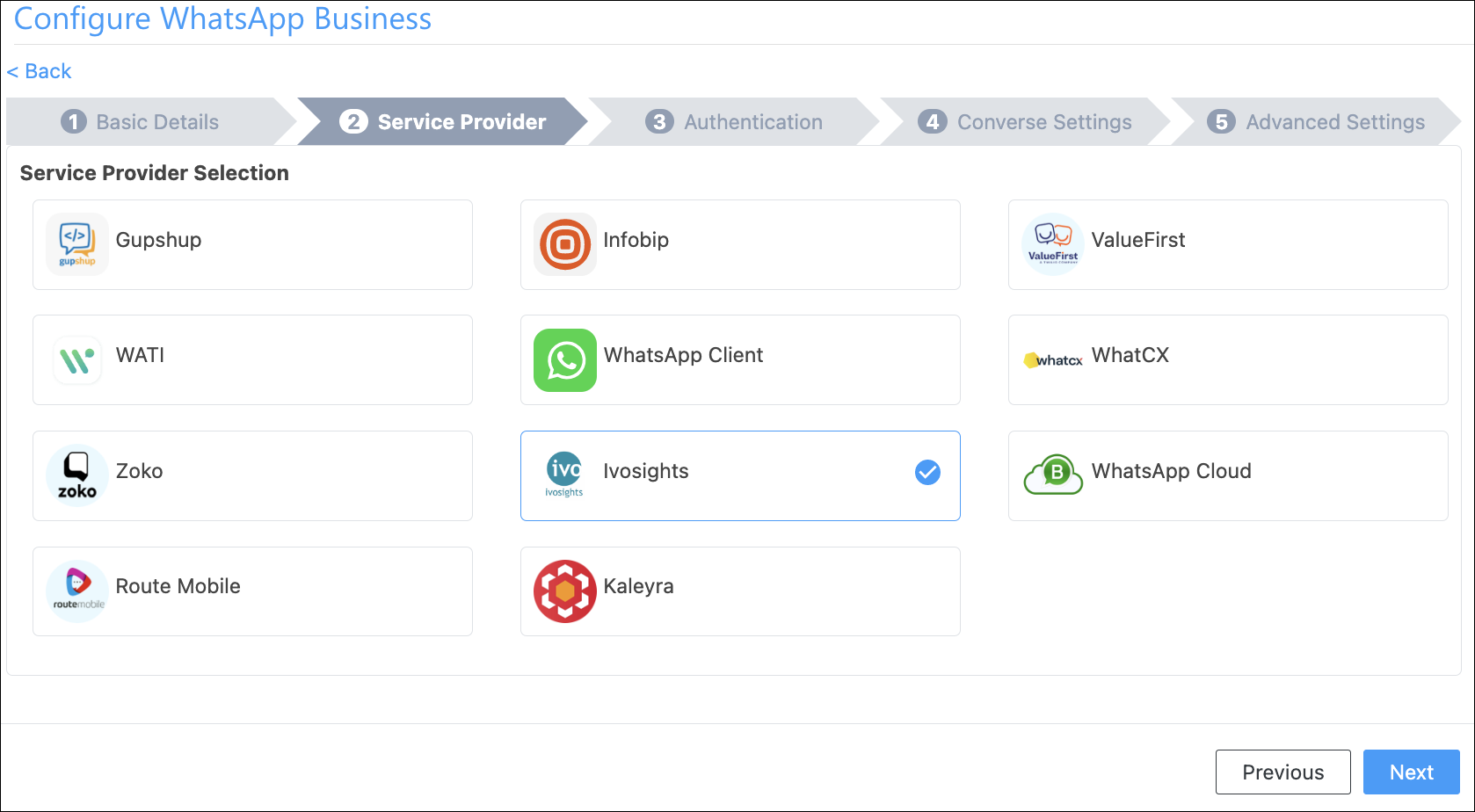
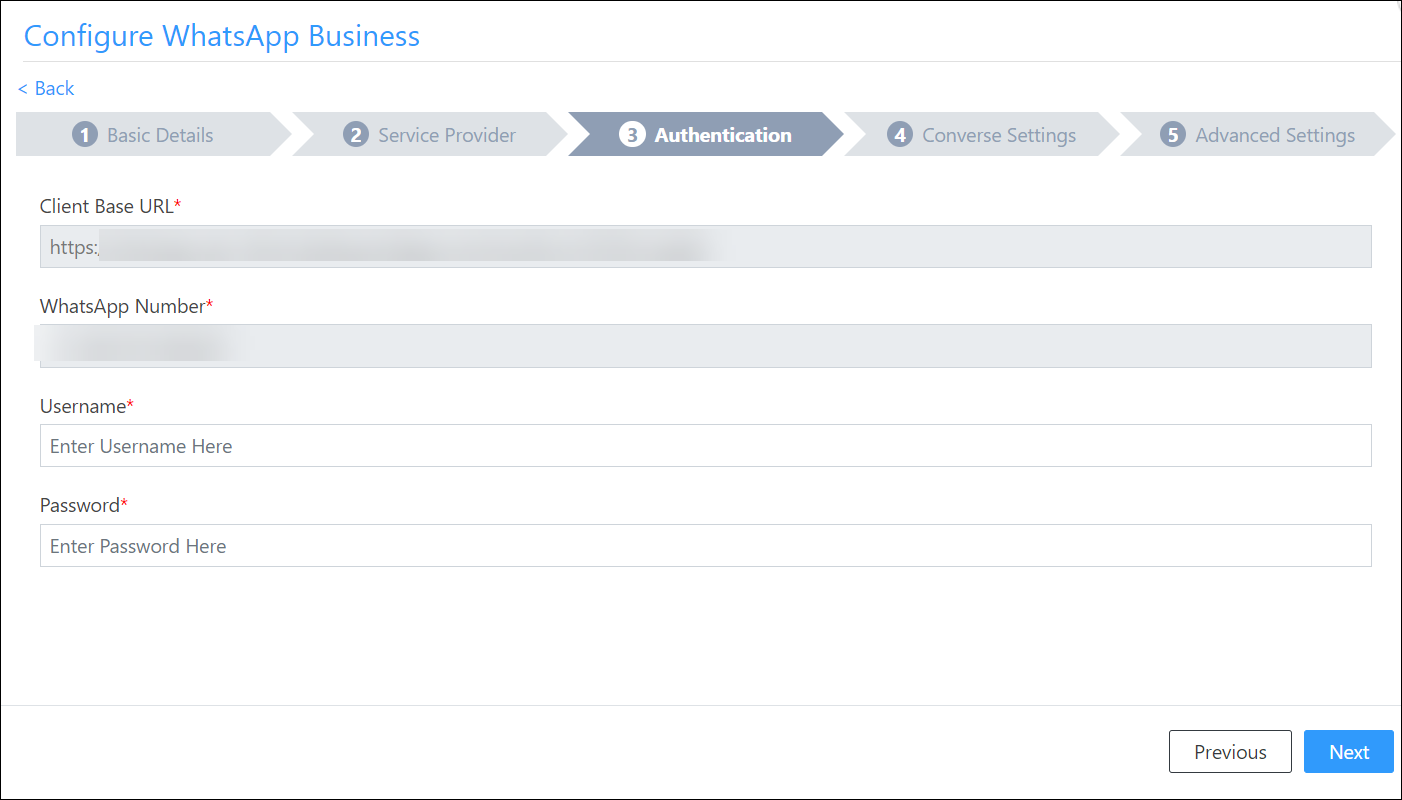
Lead Source From the dropdown, select a lead source for your leads.

Once you’re done, click Next.


4.2 Service Provider

From the available options, select Wati and click Next.

Wati Integration with LeadSquared


4.3 Authentication Set-up

On this screen, enter –

WhatsApp Zoko LeadSquared Integration

Field Description
Client Base URL The base URL is listed here. This is a non-editable field.
WhatsApp Number The WhatsApp business number you provided in the Basic Details screen. This is a non-editable screen. To change the number, navigate back to the Basic Details screen, and change the number there.
Username Your WATI account’s API endpoint, without the “https://”.

For example, if your API Endpoint is https://live-server-184.wati.io, the username would be live-server-184.wati.io.

To obtain your WATI API Endpoint –

  1. Login to your WATI account
  2. Click on API Docs. Here you’ll find the API Endpoint.
Password Your WATI account’s Access Token without the “Bearer” and the space after “Bearer”.

For example, if your Access Token is “Bearer ghFhbGciOiJIUzI1NiIsInR5cCI6IkpXVCJ9”, enter the password as “ghFhbGciOiJIUzI1NiIsInR5cCI6IkpXVCJ9“.

To get the Access Token –

  1. Login to your WATI account
  2. Click on API Docs. You’ll find Access Token here.

Once you’re done entering all the details, click Next.


4.4 Converse Settings

LeadSquared Converse is an instant messaging feature that allows you to have real-time conversations with your leads via WhatsApp.

LeadSquared WhatsApp Integration

To integrate LeadSquared Converse with WhatsApp, complete the following steps –

  1. On the Converse Settings tab, toggle the Enable Converse Slider slider.
  2. Under User Access, grant permissions to users who can communicate with leads through the LeadSquared Converse.
    • Based on Role – From the Search and Select Users dropdown, select the LeadSquared user roles that can send messages through LeadSquared Converse.
    • Advanced (User Level) – Based on the value entered in the selected user boolean field (e.g., for the user Sam, the “Is Employee” user field contains the value “Yes”), the user will be able to send messages through LeadSquared Converse. From the Select User Field dropdown, select a relevant boolean field.
  3. Functionality – The following additional settings must be configured –
    • Approved Templates – Enable this functionality to allow your users to send approved WhatsApp templates to your leads.
    • Unapproved Templates – Enable this functionality to allow your users to send unapproved WhatsApp templates to your leads. These can only be sent if the 24-hours service window is active.
    • Notify Lead Owner* – When enabled, only lead owners will get notifications of the WhatsApp messages a lead sends. When disabled, all logged-in users will receive notifications of these WhatsApp messages.
    • Sending Rich Media – Enable this functionality to allow your users to send media files in the WhatsApp messages.

Note:

  • *Message notifications are only sent to one user, i.e., either the Lead Owner or to the user (other than the Lead Owner) that sent the WhatsApp message to the lead. When the Notify Lead Owner setting is enabled, only the Lead Owner will get notified, while the user who sent the message will not get a notification.
  • If you enable the Send Rich Media option, you must also enable the Approved Templates option. This ensures that you can add your media files to a template when messaging your leads.

LeadSquared Gupshup Integration


4.5 Advanced Settings

On this screen, provide the following details –

  • Activity Mapping – A LeadSquared activity field to capture your WhatsApp messages. This is the activity that will be posted every time a WhatsApp message is sent or received.
  • Default WhatsApp Number Fields – The number you set as the default phone number will be automatically selected when you’re sending a WhatsApp message to a lead. You can also select other numbers that are available from the Add Another Number dropdown.
  • Default Country Code – The default country code will be used to send messages to a phone number that’s stored in a custom field, if no country code is listed.
  • Enable Rich Media Template Support – If you want to include media files in your WhatsApp message, you must enable the Slider slider.
  • Compliance Type – Here, you can select the compliance type for the WhatsApp template, by choosing either WhatsApp Opt-out or Opt-in.
  • WhatsApp Opt-out – Your leads can opt-in or out of receiving WhatsApp messages on the basis of this field. From the dropdown, select a LeadSquared lead field for the WhatsApp opt-in/opt-out functionality.
Note: You must create a custom lead field of boolean type to map to the WhatsApp opt-out functionality. For example, you may create a custom lead field called “WhatsApp Opt Out”. Leads for whom the field is selected/checked won’t receive WhatsApp messages.

Click Save & Close when you’re done.

  • If your credentials are correct, you’ll see the success message highlighted below.
  • If they were incorrect, the integration will fail.

Gupshup WhatsApp Integration


5. Create WhatsApp Templates

Once the connector is successfully installed, proceed to add WhatsApp templates from your WATI account.

When you’re creating a template in WATI, you must fulfil the following naming conventions for the templates to work as intended in LeadSquared –

If your template contains media files (Images, documents and videos), then –

  1. Navigate to Header.
  2. Add the media file.
  3. In the textbox that appears, type “{{attachmentLink}}“.

Wati Integration with LeadSquared

If your template body contains variables (e.g., {{name}}, {{orderNumber}}, etc.), then –

  1. Navigate to the Body.
  2. Type the content.
  3. Type the variable as {{1}} for the 1st variable, {{2}} for the second variable, and so on.
    For e.g., if your message is, “Hi {{name}}, please find the shipping details of your {{orderNumber}}…”, then you’ll have to type this out as, “Hi {{1}}, please find the shipping details of your {{2}}…”

Wati Integration with LeadSquared

If your template contains a Call to Action button with the Visit Website action, and the type is set to Dynamic, then –

  1. Go to the Button.
  2. From the dropdown, select Call to Action.
  3. Visit website is selected by default.
  4. Type out the display text- for the button.
  5. From the dropdown present under Visit Website, select Dynamic.
  6. Then, type out the static part of the website URL, and for the dynamic part of the URL, append {{buttonLink}}.

Wati Integration with LeadSquared

If your template contains variables or buttons with a Dynamic Visit Website as a CTA, then provide a default value for each variable in the Sample Content section at the bottom of the Template Create/Template Edit screen.

Wati Integration with LevadSquared

To add a WATI template to your LeadSquared account, refer to Adding WhatsApp Templates to LeadSquared.


6. Conversing with Leads via WhatsApp

Integrating Converse with LeadSquared’s WhatsApp connector will enable your users to have real-time conversations with your leads through WhatsApp. Using templatised messages, you’ll be able to attach and send media files (such as images, documents, etc.) in your conversations. To know more, refer to LeadSquared Converse.

LeadSquared WhatsApp Integration


7. Important Points

  • Delivery Status is currently not available for the messages sent through the WATI integration on the WhatsApp connector.
    • This means the Sent/Read/Delivered status for a sent message will NOT be available in your WhatsApp reports.
    • Additionally, the single tick, double tick and blue tick for WhatsApp messages sent from Converse will NOT be visible.
  • When sending non-templatized custom messages to your leads, you can only send text messages to your leads. Custom media files cannot be sent during these conversations.

Wati Integration with LevadSquared


Troubleshooting

WATI Inbound Webhook Getting Disabled for Inbound Messages

  • Issue: WATI (WhatsApp provider) webhook gets automatically disabled in the WATI portal when receiving an inbound message from a lead. Even if re-enabled, it gets disabled again after some time.
  • Cause: This occurs because LeadSquared does not support delivery report notifications from WATI. If the webhook is configured to track events like “Message Sent”, it may cause conflicts, leading to the webhook being disabled.
  • Solution:
    • Ensure that only the “Message Received” event is enabled in the webhook settings.
    • Disable delivery notifications like “Message Sent”.
    • Refer to the screenshot below for the correct webhook configuration.

LeadSquared WhatsApp Integrations


Any Questions?

Did you find this article helpful? Please let us know any feedback you may have in the comments section below. We’d love to hear from you and help you out!

View and Manage Incentive Programs

1. Feature Overview

This article will show you how to view the incentive calculations, approve incentive payouts, and manage the progress of the incentive program.

Note: LeadSquared’s Incentives feature lets you set up an incentive program for your sales teams. Before you continue with this article, you must first Create an Incentive Program.


2. Prerequisites

  • You must have a published incentive program.
  • Only Admins and the assigned Approvers can approve or reject the rewards.


3. How it Works

Approvers

Approvers will have access to the Approval, Dashboard, and My Incentives tabs on the Incentives page. They must approve all the eligible incentives of the users before they can be paid out –

  1. Navigate to Ace>Incentives>Approval to approve the incentives.
    1. Once you select an incentive program, you can view the reward calculation for all the users in the program.
    2. Select a user to either approve or reject the reward.
  2. The Dashboard will give you a complete picture of your team’s eligible incentives, approved incentives, the incentives that are paid out, and pending payouts.

incentives approver view


Admins

An Admin will have access to all Incentive features.

  1. An Admin can approve incentives on the Approvers’ behalf.
  2. Only Admins can make payouts to the users.
    1. Navigate to Ace>Incentives>Payout to get detailed information on the payouts that are pending.
    2. Select a user to make a payout for.
  3. The Dashboard gives Admins a complete picture of their organization’s eligible incentives, approved incentives, the incentives that are paid out, and pending payouts.

incentives admin view


Sales User

Sales Users will only have access to the My Incentives page. Here, users can keep track of their approval requests and payouts.

incentives user view


4. Incentive Approval

Navigate to the user approval page –

  1. Navigate to Ace>Incentives>Approval.
  2. Select an Incentive Program.
  3. Select a Cycle.
  4. Select a user.

Note:

  • The Approval page can only be accessed by Admins and Approvers.
  • Admins can approve incentives on behalf of the Approvers.

Incentive approval nav

Click on No. of Criteria Achieved. Here, you can view the Program Criteria achieved by the user. You can view further information regarding the Achieved Value and the Incentive they are eligible for based on reward calculation.

incentives criteria achieved

The Approval Status displays the approval stage for the user. In the following example, we have 2 approvers. The Eligible Amount (based on reward calculation) for the user is Rs. 32.63k You can enter the entire amount as the Approved Amount, or choose an appropriate amount. To reject the entire amount, enter 0 (zero). Next, enter a Remark and click Forward to Stage 2.

incentives first stage

As a higher-stage approver, you can override the decisions taken by the lower-stage approver. You can edit the amount that has been approved in the 1st stage – the approval or rejection from the last stage will be final. Once you are satisfied with the approved amount, click Proceed to move to the Payout stage.

incentives second stage

Note: An approver in a higher stage can also send back the approval to a lower stage.

incentives send back to stage 1


5. Incentive Payout

Navigate to the payout page –

  1. Navigate to Ace>Incentives>Payout.
  2. You can filter the page by User View or Program View.
  3. Select a user.
Note: The Payout page can only be accessed by Admin users.

incentives payout nav

Here, you can view the incentive amount that has been approved. Once you have paid out the incentive to the user, you can enter the payment details on this page and click Proceed with Payout – the Payout Status will be updated to Paid Out. If you have paid only a part of the approved amount, the Payout Status will still reflect as Pending.

incentive paid out

Note: You can also request a re-approval of the incentive from the last stage approver. Click Send Back to Approval. This option is not available if a partial amount has been paid out.

incentives payout send back to approver

You can also make payouts to the users through an Excel file. To do this, click Payout Using Excel. You can use the Sample File to add the payouts.

incentive payout excel


6. Incentive Dashboard

The incentive dashboard gives you a breakdown of the progress of the incentive programs.

Navigate to Ace>Incentives>Dashboard.

Note: The Incentive Dashboard can only be viewed by Admins and Approvers.

incentive nav dashboard

Select a Time Frequency for the total incentive breakdown in that time frame. If you are an Admin user, you can also select a specific Manager.

incentives dashboard 1

You can also drill down further into the incentive programs under the User View and Program View.

incentives dashboard 3


7. My Incentives

Navigate to Ace>Incentives>My Incentives. The My Incentives page displays all the payout requests and the approval requests for the respective user. This helps the sales users track all their achievements and keep a check on the rewards that need to be disbursed.

Note: The My Incentives page can be accessed by all users that are a part of the incentive program.

incentives my incentives


8. LeadSquared Mobile App – Incentives

You can also track the progress of your Incentive Programs through the LeadSquared Mobile App. The Mobile App will have three different views: Admin user view, Sales Manager view, and Sales User view.

Note: You cannot edit or create Incentive Programs through the LeadSquared Mobile App.

Incentives Admin View

Navigate to the LeadSquared Ace tab by clicking on the ace icon icon. Next, click on the Ace options icon and select Incentives.

Incentives mobile nav

On the Dashboard, you can view all the Incentive Programs assigned to a Manager. You can select a specific Manager through the dropdown.

Incentives pick manager

You can click on thegoals filter icon to apply a Time Frequency Filter.

Incentives time frequency

As an Admin, you can view the Eligible Incentive, Approved Incentive, Total Payout Done, and Pending for Payout statistics for all Incentive programs, or an Incentive program assigned to a specific Manager.

incentives payout admin

You can toggle between the statistics of individual users by selecting User View or individual Incentive programs by selecting Program View.

incentives user program

Select a user or a program to drill down into its details and progress.

Incentives program view

Incentives Sales Manager View

If you log in as a Sales Manager, you can view the progress of your Incentive through the Dashboard (programs where you are the Manager) and My Incentives (if you are part of a program) tabs.

manager view

incentives Sales User View

If you log in as a Sales User, you view the progression of all the Incentive programs you are a part of through the My Incentives tab.

incentives user view


Any Questions?

Did you find this article helpful? Please let us know any feedback you may have in the comments section below. We’d love to hear from you and help you out.