Capture Leads from Any Website with LeadSquared Form Widgets

1. Feature Overview

An LSQ Form widget acts as a “lead magnet”. An example of a lead magnet is a special deal offered to customers in exchange for their contact details. It can be a discount code, webinar, white paper, ebook, template, inquiry form, or another resource.

With LeadSquared, you can create and embed an LSQ Form Widget on your web page or landing page and start capturing leads in minutes.

Once the leads are captured, you can push them further down your sales funnel. For example, you can redirect the leads to a LeadSquared Application Portal, email them a welcome kit, or schedule a sales call.

LSQ Widget example


2. Example Use Cases

These examples illustrate different functionalities you can use, and outcomes you can achieve using the LSQ Widget.

Industry Use Case
Education
  • College University Admission – Capture course inquiries from a course landing page and redirect the lead to a college admissions portal page.
  • Career Training School/Technical School – Capture course inquiries from a website page and schedule a counselor call-back.
BFSI
  • Health Insurance – Capture enquires for an insurance premium amount and download a policy brochure.
  • Credit Card Application – Capture credit card eligibility inquiry and redirect it to a credit card application portal.
Health (ERM)
  • Book a consultation – Capture a consultation slot and register on the Hospital portal.
Real-Estate
  • Book visit – Capture a property visit request and download the estate plan.


3. Prerequisites

  • You must be an Administrator User to create and edit LeadSquared Widgets.
  • To create an Enquiry Widget –
    • You must have a Dynamic Form that is published.
    • LeadSquared Portal license is not required.
  • To create a Registration Widget –


4. How It Works

The process to install an LSQ Widget is as follows –

  1. Create and configure your LSQ Widget by navigating to Manage Widgets in LeadSquared.
  2. Customize the look and feel of your LSQ Widget through the various properties at your disposal.
  3. First, publish your LSQ Widget to the test environment, and then to the live environment.
  4. Place the downloaded JavaScript snippet into your website.
  5. The widget is now live on your website.


5. Manage Widgets

  1. Navigate to Workflow>Manage Widgets.
  2. Click Create Widget.
  3. Give your widget a name and click Create.

Create LSQ Widget

5.1 Enquiry Widget or Registration Widget

LSQ Widget Type Description
Enquiry Widget In an Enquiry Widget, OTP verification of lead details is not mandatory.
Registration Widget In a Registration Widget, your leads will need an OTP verification and will be registered on the LeadSquared Portal. You must have a LeadSquared Portal that has been published and a LeadSquared Portal Registration Form with OTP authentication enabled.

If you would like to create a Registration Widget, under the General tab, toggle Enable Portal Registration.

LSQ Widgets Enable Portal Registration

5.1.1 Configure OTP Messages for Registration Widget

On a Registration Widget, users receive a default OTP for verification. You can customize this OTP message after selecting a registration form.

  1. Click the icon in the General Tab.
  2. You can edit both the Email and SMS (Phone) content.
  3. Click the Custom button to edit the content.
    • Email – For email, you can edit the following fields:
      • From – Select a user as a sender.
      • Subject – Enter the subject of the email.
      • Select Email Template – Optionally, you can select an email template.
      • Content – Enter the content for the OTP email.
    • Phone – for SMS, you can edit the following field:
      • Select SMS Template – Optionally, you can select an email template.
      • Content – Select the editable field to enter your SMS content.

Configure otp messages

Note: You can test the OTP message while previewing the widget.

verify otp in preview

5.2 LSQ Form

Select a LeadSquared Portal Registration Form with OTP authentication enabled. The selected form will capture leads and register them on the LeadSquared Portal.

LSQ Widget Form

5.3 Register on Portal

Select a LeadSquared Portal to register the captured Leads. You must also define the Action on Successful submission of the form –

  • Open Portal Page – Select the portal page you want the lead to be redirected to on successful submission.
    • Page – From the dropdown, select the page or section you want your lead to be redirected to within the portal when the form is submitted.
  • Open External Link – Add an external link, and configure if it opens in the same tab or a new tab.
    • Link – If you choose Open External Link as the Action on Successful submission, then add the URL of the website you want your lead to be redirected to when the form is submitted.
  • Download File – Enable your leads to download a file (like prospectus, etc.) on submission by uploading it here.
    • Upload File – If you choose Download File as the Action on Successful submission, then under Upload File, click Choose File, to choose a file from your Document Library.
    • Use Mail Merge Values – Alternatively, you can mail merge a custom field set (CFS) that contains a file, by selecting the CFS from the dropdown.
  • Based On Rules – This option allows you to set-up rules based on the choices a lead makes. For example, if the lead chooses “City” as “New Delhi”, you can set-up a condition that redirects the lead to the portal page for leads in New Delhi. Similarly, if the lead chooses “Course” as “B.Tech”, you can set-up a condition to download the prospectus form for B.Tech applicants. To set-up rules –
    1. From the Actions on Successful submission dropdown, select Based on Rules.
    2. Click Configure Rules, and on the Configure Rules pop-up, rename the rule.
    3. From the any dropdown, choose if you want the condition to be any or all, and set-up the base rule.
    4. From the Then dropdown, select the action you want to be carried out when the condition is satisfied.
  • None – No action will be taken on successful submission.

LSQ Widget Portal


6. Customize Widget

The following video tutorial shows you how to customize the design of your widget using the options available in the widget designer –

The LSQ Widget can be customized using the following properties –

6.1 General

  • Form Design – There are three default form designs available in the Widget Designer. You can select a relevant design from the Form Design dropdown.
  • Show Form Title – To show the title of the form on your Form, toggle the slider.
  • Show Tabs/Navigation – To show the tabs that hold the sections in a form, and to show navigations between different tabs in the form, toggle the slider.
  • Show Section Names – To show the names of each section within the form, toggle the slider.
  • Show Input Field Labels – To show the input field labels on the placeholder, toggle the slider.
  • Accent Color – Select the font colour for section headers and buttons from the gradient screen or enter the hex code for a specific colour.
  • Form Validation Color – Select the colour that will indicate a field as mandatory.
  • Font – From the dropdown, select the font you want to display on the form.
  • Query String – You can send the value of a particular field (First Name, Mobile field, etc.), by adding a mail merge parameter here. This will ensure that the field value is carried forward to the subsequent pages that have been configured.
  • Open in New Tab – This is applicable only for Open External Link and Open Portal Page. To open the new page in a new browser tab, on successful submission of the form, toggle the Zoom slider.
  • Header Text – Enter the form’s title here.
  • Button Text – Enter the submission button’s display text here.

LSQ Widget Form Design


6.2 Spacing & Dimensions

You can customize the space and dimensions of the entire form, as well as each individual section within the form. To customize a section, click on the outer border of that section.

  • Padding – Set the padding for the form. If you want the padding dimensions to be applicable on all sides of the layout, against All Sides, toggle the slider.
  • Margin – Set the margin width for the form. If you want the margin to be applicable on all sides of the layout, against All Sides, toggle the Zoom slider.
  • Min Height – Set a minimum height for the form. If you want the height to be applicable on all sides of the layout, against All Sides, toggle the Zoom slider.
  • Max Width – Set the maximum width for the form. If you want the width to be applicable on all sides of the layout, against All Sides, toggle the Zoom slider.

LeadSquared Portals Signup Form


6.3 Border & Radius

  • Border – Set the size, style, and colour for the border around the form. If you want the border to be applicable on all sides of the selected layout, against All Sides, toggle the Zoom slider.
  • Color – Set a colour for the form’s border. You can select a colour either from the gradient screen or enter the hex code for a specific colour.
  • Border Radius – Set the radius for the border around the form. If you want the border radius to be applicable on all sides of the layout, against All Sides, toggle the  Zoom slider.

LeadSquared Portals Signup Form


6.4 Background

You can either choose to leave the form’s background blank or set an image or background colour.

  • To add an image, from the dropdown, select Image. Then, click Choose Image to choose an image from your Image Library.
  • To set the background colour, from the dropdown, select Color. Then, choose a colour from the gradient screen, or enter the hex code for a specific colour.
  • Select Slide Show to extend the idea of a hero image, allowing you to present multiple images in a sequence. Click Manage Slides to add more slides.
  • To leave the background blank, from the dropdown, select None.

Portals background

You also have the option to add a Background Overlay. It enhances the readability of the text and reduces visual stress for viewers. You can enable Background Overlay by toggling enable icon the slider. It has 2 options –

  • Color Overlay – A color filter that puts a tint on the selected element to make the text more readable.
  • Blur Overlay – Customize the intensity of the blur to be added to the background.

bg overlay


6.5 Shadows

Set a shadow for the form.

PDesigner_8


6.6 Advanced

Use this class name in your custom scripts to isolate and override its style and behavior without affecting any other components in the Widget.

LSQ Widget custom class name


6.7 Typography

Click on any section within the form to access the typography setting.

  • Font – Select the font you want to display in that section.
  • Font Size – Enter the preferred font size for the font in that section.
  • Font Weight – From the dropdown, select how thick or thin you want the font to look.
  • Color – Select the colour for the font.

LeadSquared Portals Signup Form


6.8 Configurations

To set a custom font or a custom script for the LSQ Widget, click on Settings.

LSQ Widget Settings


7. Install LSQ Widget

7.1 Publish the Widget

  1. Once the Widget is designed click on Publish to Test to validate its functionality.
  2. Type in Change Notes and click Yes.
  3. To publish the LSQ Widget to a live environment, click Publish to Live.
  4. Once published to a live environment, click Download Widget

Installing LSQ Widget


7.2 Embed the Widget on your Website

The file contains a JavaScript snippet that can be pasted into your website.

iframe LSQ Widget

Note: A widget installed on your website can be updated right from the LSQ Widget Designer and published live. Further action or reinstallation is not required.

FAQs

1. Can I remove the LeadSquared logo from the Widget?

The Widget can be white-labeled. Please get in touch with your account manager for more information or contact support@leadsquared.com.

2. Can I display the Widget inside an iframe?

The Widget is already loaded inside an iframe by default. Pasting the widget code inside another iframe will create nested iframes. It’s important to note that using nested iframes can result in slower page load times, increased memory usage, and potential conflicts between different iframe styles and scripts. Due to these considerations, it is not recommended to use the widget inside an iframe.

3. Do widgets capture UTM parameters?

If the URL contains UTM parameters, the widget will capture five standard UTM parameters –

  • utm_source
  • utm_medium
  • utm_campaign
  • utm_term
  • utm_content

These parameters will be recorded in the activity data. To view the captured parameters, please navigate to the Manage Activities page where you can access and analyze the captured UTM parameter data.

4. How can we test new enhancements on a widget that is currently live?

This is the suggested way to test new enhancements –

  1. Let’s assume you have a live widget called Home Loan.
  2. You can clone the Home Loan widget to get a cloned version called Home Loan Clone (You can clone a widget by selecting the Clone option under Actions on the Manage Widgets page).
  3. Make enhancements or changes to Home Loan Clone and publish it to the test environment.
  4. If you’re satisfied with the changes in the test environment, then publish it to live.
  5. If the cloned version did not provide satisfactory results, then the original Home Loan version is still available. You can choose to delete the cloned version and create a fresh clone of the original Home Loan version.


Any Questions?

Did you find this article helpful? Please let us know any feedback you may have in the comments section below. We’d love to hear from you and help you out!

Email Campaign Editor (BEE Editor)

1. Feature Overview

We’ve integrated Bee Editor with our Email Campaign editor. This editor helps you create responsive emails in minutes, using a feature-rich, drag-and-drop interface. To create personalised, custom email campaigns –

  1. Navigate to Marketing>Email Campaign and click Create Email Campaign.
  2. Select an available template or create your own template from scratch.
Note: To know more about creating email campaigns, see Create and Schedule Email Campaigns.

LeadSquared - Bee editor navigation


2. Prerequisite

You must be the Administrator or the Marketing User of your account.


3. Settings

On the right side of the page, you can access the general Settings of the Bee Editor. Change the background colour, default font, content area width, and more by customising setting fields. Here are a few links to guide you through this feature –

Action Link
Configure the entire design of the email (align content structures, set the background colour, etc.).  Configuring message settings
Understand how the Content, Rows, and Settings fields work. Settings, Rows, and Content: How do they work?
Make changes to the alignment of the email in mobile and desktop view. Mobile Optimization Options
Change the border settings (the border style, width and colour) of rows, columns and other content structures. Working with borders

LeadSquared - Bee editor settings


4. Rows and Columns

Navigate to the right side of the page to customize the Row properties of the Bee Editor.

  • Customise your emails by dragging and dropping content structures, adding background images, etc.
  • To delete your rows, click .
  • To duplicate/clone your rows, click .

Here are a few links to give you more details –

Action Link
Understand and customise the row properties setting (i.e., row background colour, image, etc.). How do I change the properties of a row?
Understand how to select rows and content inside rows. How do I select a row vs. content?

LeadSquared - Bee editor rows


5. Adding Content

From the right side of your screen, click Content to add rich content to your email (text, image, icons, etc). Here are a few links to guide you through this feature –

Action Link
Adjusts the letter and paragraph spacing. Letter spacing
Add GIFs or stickers in your email. Adding GIF animations & animated stickers with GIPHY
Add video content in your email. Adding video to your email
Correct mistakes while editing your email by using the undo, redo and history actions. Undo, redo & history
Set padding around a row, column or content blocks. Working with padding
Use various available and custom web fonts in your email. Using web fonts in the BEE editor
Add a custom HTML block and customise a section of your email template. Working with custom HTML
Browse and add images and documents in your email. Using the File Manager

LeadSquared - bee editor content


6. Working with Images

Add static images (background images, logos, etc.) and dynamic images (countdown timers, product recommendations, etc.) in your email. You can edit these images by cropping, resizing, adding filters and more. Here are a few links to guide you through this feature –

Action Link
Edit an image (i.e., crop, resize, add stickers, etc). Using the image editor
Add dynamic images in your email and personalise them using mail merge. Using dynamic images for countdown timers and personalized content
Add background images in your email. Adding a background image to your emails
Edit images by configuring Content Properties. (add filters, change the alignment, etc.). Editing image properties

LeadSquared - Bee editor images


7. Adding Special Links

To add links for mailing preferences, unsubscribe, view in browser, etc., click on any section/component of the email content, and from the toolbar, click Special Links.

LeadSquared Email Campaign


8. Other Actions

Apart from the actions mentioned above, you can also add comments in your email, manage and configure columns, save your email template, and do a lot more through this editor. Here are a few links to give you more details –

Action Link
Add comments on each element of your email content to notify another user about the changes to be made. Commenting
Manage columns in your email (i.e., add columns, change the alignment, etc.). Column management
Save your design as a template. Saving a message on beefree.io

LeadSquared - bee editor other actions


Any Questions?

We’d love to answer your questions or hear your own unique use cases. Feel free to share your experiences in the comments section below.

Custom Menus for Mobile App

1. Feature Overview

The Custom Menus app for the LeadSquared mobile application lets you create a customized menu to display information from third-party websites on the app. These menus appear in the navigation tab of your app from where allows you can access external URLs or the third-party data straight from the app itself.


2. Example Use Case

Consider that you want to schedule a GoTo meeting with your lead. Using the Custom Menu App, you can create a custom menu tab called “GoTo Meeting”. This tab will give you a browser view of the GoTo meeting URL. This allows you to access your meeting straight from the mobile app.
This is just one of the many industry-specific use cases this app can be used for.


3. Prerequisites

  • You must be an administrator of your LeadSquared account.
  • You must run the latest version of the LeadSquared Android or iOS app.


4. Installation

1. From the default dashboard of your LeadSquared web application, go to Apps>Apps MarketplaceThe Marketplace window appears –

2. From the left pane, go to UI Customization>Custom Menus for Mobile AppThe Custom Menus for Mobile App pop-up will appear –

3. Click Add Connector. Once the connector is installed, the Settings menu appears –


5. Configuration

1. Click Configure. The Configure Custom Menus for Mobile App pop-up box appears –

2. Select Click to Add Custom MenuThe area to create a custom menu appears on the right pane –

3. Complete the following details:

  • Title – Enter the title for the custom menu which appears in the LeadSquared mobile app.
  • URL – This is the web URL you need to pass. This field accepts mail-merge fields as well.
  • Visible for – This drop-down menu allows you to select which LeadSquared user types are able to view the custom menu in their respective mobile app. The drop-down can have the user types shown in the image below:

4. Once the settings are completed, click SaveThe custom menu is created. As an example, a custom menu tab for the GoTo meeting is created.

Once logged to the LeadSquared mobile app, a new tab called Custom Apps appears under which the GoTo meeting appears. Clicking on this opens the GoTo meeting login page from where you can log on to your GoTo meeting to schedule your meetings –

Similar to this, you can create multiple custom action tabs in your LeadSquared mobile app for other web URLs.


Any Questions?

Was this helpful? If you have questions, please leave us a comment below.

Karza Connector for KYC

1. Feature Overview

Karza Technologies offers Know Your Client (KYC) verification solutions for commercial, retail, financial, and banking services. Integrate LeadSquared with Karza to leverage their KYC verification services directly from your LeadSquared account.

Once integrated, you can use LeadSquared Forms and LeadSquared Portals to seamlessly verify KYC details like PAN, Aadhar, GST, Address, Mobile, Vehicle Registration Certificate, etc.

Services we currently support
Category Service Name  Description Use Cases
Asset & Vehicle Authentication Vehicle RC Authentication API to Authenticate Vehicle Registration in India Vehicle RC authentication & owner check-in used car loan journeys
Commercial Verifications GST Authentication API to authenticate 15 Digit GSTIN issued by the Goods and Service Tax Network in India. POI & POA in Commercial KYC verification
KYC OCR PAN OCR API to extract data from PAN card Auto-filling of PAN data to reduce manual data entry during onboarding
Aadhar OCR API to extract data from Aadhar card Auto-filling of Aadhar data to reduce manual data entry during onboarding
OCR Services Cheque OCR API to extract data from a cheque leaf Auto-filling of Bank account data to reduce manual data entry during onboarding
Driving License OCR API to extract data from Driving License Auto-filling of DL data to reduce manual data entry during onboarding
Retail Verifications PAN Authentication API to authenticate Permanent Account Number (PAN) issued by the Income Tax Department of India. PAN Authentication as Proof of Identity (POI) in Digital KYC
PAN Status Check API to authenticate the status and details of a given PAN. PAN status check in customer-facing journeys
PAN Profile (Detailed) API to share the demographic/profile details of an Individual/Entity using a PAN Auto-filling of verified PAN data to reduce manual data entry during onboarding
Aadhaar Number Verification API to authenticate the 12-digit Aadhaar Number of a user. Basic Aadhar Number verification in customer-facing journeys
Aadhaar Offline KYC (XML Verification) API to validate the XML file of an Aadhaar card Offline KYC during Full KYC
Utility Bills Authentication Mobile Authentication API to authenticate current status of a Mobile Number and the connection type [Prepaid / Postpaid] Non-OTP-based mobile authentication in customer-facing journeys
Electricity Bill Authentication API to authenticate Electricity Bills / Customer ID issued by various Electricity Distribution Companies across India. Proof of Address in Retail KYC (where Aadhar is not available) and commercial KYC
Services we plan to support in the near future
Category Service Name Description
Banking Authentication Bank AC Verification API to verify bank account holder name basis IFSC and account number
Commercial Verifications GSP GST Return Filing The API provides the filing history of the particular GSTIN with the GST Network. Delay and Default fields in the API response are calculated for the following – GSTR 1, GSTR 3B, and CMP 08. The due date and number of days of delay for filing returns can also be fetched using an optional request parameter
MCA Signatories API to authenticate directors/partners of company/LLP
Company and LLP Master Data API to authenticate Company, LLP, FCRN and Foreign LLP Identification Numbers issued by the Ministry of Corporate Affairs (MCA)
Shop & Establishment API to authenticate Shop & Establishment Certificates issued by Municipal Authorities in selective parts of India (list of supported areas attached below in notes)
Digital Essentials – Contactability Email Authentication API to authenticate email ID provided by the customers as part of the registration process
Employment & Income Authentication EPF Authentication API to authenticate Universal Account Number (UAN) issued by Employees Provident Fund Office (EPFO) in India, via OTP based Consent of the Account Holder
Miscellaneous CKYC Search API to search basic details of individual from CERSAI portal
CKYC Download API to download individual details that are uploaded at CERSAI portal
OCR Services ITR-V OCR API to extract data from Income Tax Return Acknowledgement Form (ITR-V) issued by the Income Tax Department of India
Retail Verifications Aadhaar XML Download (Aadhar eKYC) API to download the XML file on successful OTP validation (parsed XML O/P is shared in response)
Driver’s License Authentication API to authenticate Driver’s License issued by the Road Transport Offices of the States of India.
Voter ID (EPIC) Authentication API to authenticate Voters’ ID issued by the Election Commission of India.
Passport Verification API to verify passports issued by Passport Seva Kendra basis File Number and Date of Birth
DigiLocker Account Status API to check if the DigiLocker account exists for the given mobile number
DigiLocker Document List API to get the list of all documents from the user’s DigiLocker Account
DigiLocker Document Download API to download the documents linked with user’s DigiLocker account


2. Prerequisites

  • You must be the Administrator of your LeadSquared account to install and configure this connector.
  • You must have a Karza Account with access to their API collection for the required services.
  • This is a paid feature. To enable it, reach out to your account manager, or write to support@leadsquared.com.


3. How it Works

First, install, configure and test the Karza connector. Next, create a dynamic form to facilitate the actual KYC verification for the end user. Using form rules, call the relevant connector service, and map the response from Karza to display the KYC verification results and data to the end user. You can map the response to an additional field in the form such as ‘Is PAN Verified’, ‘Verification Status’, etc.

The Karza integration requires the following steps –

  1. Install and configure the Karza connector.
    1. Choose the required services (Retail Verification, Commercial Verification, Asset and Vehicle Verification, etc.).
    2. Map system/custom fields in LeadSquared (e.g., lead/opportunity/activity fields) to the attributes required by Karza for the chosen services.
  2. Use the Karza dashboard to test the connection for each service.
    The Karza dashboard provides a convenient tool to test the connection between LeadSquared and Karza, and access success/failure responses for each service.

    1. An API URL is generated for each service.
    2. Choose a lead to test the API and obtain a response.
    3. Note the attributes in the response payload.
  3. Create a dynamic form to facilitate the KYC process for the end user.
    1. Add the lead/opportunity details to the form (PAN number, Aadhaar number, GSTIN, etc.).
    2. Add an additional field to show the result of the KYC verification to the end-user.
      • For example, you can use fields like ‘Is PAN Verified’, ‘Is Aadhaar Verified’, etc.
      • Use additional fields to capture other data points returned by Karza.
    3. Use form rules to call the relevant API (available in the Karza dashboard for each service) and populate the additional field (that’s shown to the end-user, e.g., the ‘Is PAN Verfied’ field) with the verification response from Karza.*
    4. Publish the form
      • Embed the form in a work area within the LeadSquared application using the Process Designer.
      • Embed the form in a self-serve portal using the Portals Designer.

* Each service returns a user-friendly success (e.g., “Authentication Successful”) or error message (e.g., “Number to be authenticated seems invalid”) in the status.message response parameter.


4. Install and Configure the Connector

  1. From your LeadSquared account, navigate to Apps>Apps Marketplace.
  2. Search for Karza, and click Install.
    • Alternatively, you can find the connector on the left panel, under Verifications.
  3. Once installed, hover your cursor over , and click Configure.

LeadSquared KYC Integrations

4.1 API Authentication

Category Environment Base URL
All Authentication APIs (excluding GST) User Acceptance Testing (UAT) https://testapi.karza.in
Production (Live) https://api.karza.in
GST Authentication APIs User Acceptance Testing (UAT) https://gst.karza.in/uat
Production (Live) https://gst.karza.in/prod

Enter the following –

  1. Base URL (For all Authentication API(s) except GST).
    The base URL provided by Karza for KYC, Utility Bill, Asset and Vehicle, Employment and Income, Bank and Payments Authentication APIs.
  2. Base URL (For GST Authentication API(s)).
    The base URL provided by Karza for GST Authentication APIs.
  3. API Key
    The API provided by Karza for the Authentication APIs.

Click Save & Next when you’re done.

LeadSquared Karza Integration


4.2 Manage Services

Available services are listed under each category. Select a category (Retails Verification, Commercial Verification, etc.), then select the services you want to enable (PAN Authentication, Aadhar Number Verification, etc.).

Note: You can also enable multiple instances for each service. This allows you to create a separate instance (and field mapping) for the same service to cater to use cases like verifications of co-applicant, co-insurer, dependent, parental details, etc.
  1. Click Zoomto Enable multiple instances.
  2. The primary instance is created by default. Click Add Instance.
  3. Enter a name for the new instance – e.g., ‘Co-Applicant’.
    • To remove an instance, alongside the instance name, click .

LeadSquared Karza Integration


4.3 Request Mapping

For each service, map the attributes required by Karza with the corresponding LeadSquared fields. If you’ve enabled multiple instances of a service, be sure to map the required fields for each instance. For each service the following statuses are displayed – Not Mapped, Partially Mapped, Fully Mapped.

  1. Alongside each attribute, click Icons to view the attribute name.
  2. The input requirements for each field are specified.*
  3. Select the LeadSquared entity (lead/activity/opportunity) and the entity field (e.g., PAN Number) to map to the attribute.
  4. For services with multiple instances, you can use the Same as Primary Checkbox to inherit the mapping configured in the primary instance.
  5. Your mapping configurations are not autosaved. Click Save Mapping to save your configurations at each step, or after mapping all attributes. Close the configuration pop-up when you’re done.
Note: *For some attributes, the Regular Expression (Regex) is specified.  You can copy Icons the expression and use it directly in the Regex capability present at the field-level validation properties section while creating a dynamic form in LeadSquared.

LeadSquared Karza Integration


5. Test the Services

After installation and configuration, navigate to the Karza Verification Dashboard and test each service to ensure the connection is established and working as expected. After you test each service, the Icons tag will change to Icons.

Note: For all tested services, the API details, including the URL, attribute mapping, request body, and response, is available in the Karza Verification dashboard.
  1. On the main menu, navigate to Apps>Karza Verification.
  2. Alongside the service you want to test, click Icons.
  3. The basic details are pre-populated. Enter setup instructions, and then click Next.
  4. Alongside the API Request URL, click View Details.
    • This is the API URL you’ll call to test the service. It’s also the URL you’ll use to call service from your dynamic form.
    • Here, you can change the attribute-field mapping pre-configured at the connector level. Note that any changes made here will update the mapping of that attribute across all services where it’s used. If you made any changes, click Save and close the pop-up.
    • Click Next to proceed to the Test API step.
  5. Search for a lead using the lead’s complete email address. Click Search, then select the lead from the search results.
    The request attributes being passed in the request to Karza will be displayed (this is helpful for testing in UAT accounts, to ensure the data being passed in the request is valid).
    Also, you can select an activity type/opportunity type and the activity/opportunity instance to test the service.
Note: After you test a service, expand the API Details and API Response sections. Here you’ll find all the information (API URL, attribute mapping, post data, response) you require to configure the dynamic form rules and call the Karza service.

LeadSquared KYC Integrations


6.  Create a Dynamic Form for the KYC Process

Note: If you’re new to the Forms and Processes feature, see How to Create a Form. This section assumes you have some familiarity with setting up forms and form rules.

After testing the enabled Karza services, set up a seamless KYC process for the end-user using dynamic forms –

  1. Create a new form or edit an existing one. For more details, see How to Create a Form.
  2. Add the lead/activity/opportunity fields required for KYC to the form.
    • Ensure these fields were mapped correctly during the connector configuration and testing.
    • Add the Regex to the field-level validation properties.
  3. Add the relevant rules.

Example – PAN OCR and PAN Verification Services

In this example, we set up a dynamic form where –

  1. We use Karza’s PAN OCR service to extract information from an uploaded PAN card document
  2. We use Karza’s PAN Authentication service to verify the PAN card details

We’re using a multi-step form for this example. In the first step, we capture the customer’s mobile number, consent, and PAN document (using a custom field set).

LeadSquared Karza Integration

In the second step of the form, we use a boolean field, ‘Trigger PAN OCR’, to trigger the call to Karza’s OCR service, and populate the Name, PAN Number, and Date of Birth fields with the response.

LeadSquared Karza Integration

This is set up using the following example rule –

If ‘Trigger PAN OCR’ is true,
Then Set Value of Field ‘Name as per PAN’, ‘PAN Number’, and ‘Date of Birth’ using Data From API – POST <API URL, post data obtained from Karza verification dashboard> and map the specific response parameters to set the field values.

LeadSquared Karza Integration

All the details of the service (API URLs, Post Data, Mappings, Responses, etc) to enter in the form rule are available on the Karza Verification Dashboard.

LeadSquared Karza Integration

In the third step of the form, we call Karza’s PAN Authentication service to verify the PAN card details. We use a boolean field, ‘Trigger PAN Auth’, to trigger the call to Karza’s service, and populate the response in the ‘PAN Authentication Status’ field.

LeadSquared Karza Integration

Here’s the sample form rule used to set this up –

If ‘Trigger PAN Auth’ is true,
Then Set Value of Field ‘PAN Authentication Status’ using Data From API – POST <API URL, post data obtained from Karza verification dashboard> and map the specific response parameters to set the ‘PAN Authentication Status’ field values.

Note: All the details of the service (API URLs, Post Data, Mappings, Responses, etc) to enter in the form rule are available on the Karza Verification Dashboard.

LeadSquared Karza Integration


Next Steps

When you’re done, Publish the form. Next –


Any Questions?

Did you find this article helpful? Please let us know any feedback you may have in the comments section below. We’d love to hear from you and help you out!

Email Library – Adding Templates to Email Library

1. Feature Overview

Create reusable email templates for one-to-one emails and email campaigns on the Email Library page. You can view and edit these templates on the same page. You can also import any sample email templates you already have. The flow of the email template editor is the same as the email campaign editor.

Note:


2. Prerequisite

You must be the Administrator or the Marketing User of your account.


3. Add Email Templates

Navigate to Content>Email Library and click Add Email Template.  You can select the type of Email Template you want to add on the Add Email Template pop-up window.

  • Use Visual Designer – You can design your email template from scratch through this option. To know more about designing templates, see How to Design Emails in LeadSquared and Email Campaign Editor (BEE Editor).
  • Use Rich-Text Editor – You can create a template using LeadSquared’s standard rich-text editor. You can select this option to send simple messages with attached images and files.
  • Paste your HTML – You can use your own HTML template by pasting it in this section. To know more, see HTML Editor and Use your own Custom HTML to design Email Template.
  • Use Plain-Text Editor – You can draft simple messages with high deliverability through this option. However, you cannot add images or text formatting in this template.

Once you’re done designing your email template, you can save it as a draft by clicking on Save or publish it immediately by clicking on Save and Publish.

Note: 

  • Only published templates can be used in one-to-one emails and email campaigns.
  • The templates available in the editor you choose will depend on the editor you used to design your template. For example, HTML editor will only display the templates you created using the same editor.
  • You must upload the required images in Images and Documents to add them to your Email Templates.
  • You can personalize emails by including certain fields in the text like Lead First Name, Job Title, etc. To know more, see How to Personalize your Emails by Using Mail Merge Tags.
  • You can send test emails to different email addresses for review. To do so –
    • If you’ve chosen Use Visual Designer, click Test Content.
    • If you’ve chosen any of the other three options, enter the email addresses in the text box under Send Test Emails.
  • You can add unsubscribe, mailing preference, and view in browser link by adding the following code snippet before the end of the body tag –
    Action Code Snippet
    Unsubscribe <a href=”MXVAR[{unsubscribeurl}]”>Unsubscribe</a>
    Mailing Preference <a href=”MXVAR[{managesubscriptionurl}]”>Mailing Preferences</a>
    View in Browser <a href=”MXVAR[{viewinbrowserurl}]”>View in browser</a>

LeadSquared - Add email templates

4. Other Actions

  • To import sample templates to the Email Library page, under LeadSquared Templates, click Import Sample Templates.
  • To edit your HTML or text signature, under Related Settings, click Signature.
  • Alongside the email template name, if you hover your cursor over tags icon, you can view all the tags associated with the template. You can also add new tags or delete tags here. The Manage Tags action can also be used to perform the same.
  • To view these row actions, alongside the template, click LeadSquared
    • Publish – Publish the email templates in draft status.
    • Unpublish – Unpublish email templates.
    • Edit – Edit email templates.
    • Delete – Delete email templates.
    • Clone – Clone the selected email template.
    • Hide – Hide email templates with private information instead of deleting them.
    • Preview – Preview email templates

LeadSquared - email library

4.1 View Hidden Email Templates

Hide email templates that contain business records or private information instead of deleting them. By doing so, you can navigate, search and sort templates much faster without irrelevant templates cluttering the page. Once hidden, you can also choose to unhide these templates and show them on the Email Library.

  • To hide an email template, alongside the template, clickLeadSquared. Then, click Hide.
  • To view the hidden templates in your account, alongside Show Only Hidden, click SIERA Checkbox. You can now view all your hidden templates.
  • To unhide any template, alongside the template, clickLeadSquared. Then, click Unhide.
Note: Hidden email templates will only be displayed when you select Show Only Hidden.

LeadSquared - Hide email template

4.2 Add Tags to Email Templates

You can add tags to email templates while creating or editing them. This feature is now available by default to all users.

  • You can create new tags or select an existing one while drafting your email.

LeadSquared - email tags

  • You can retrieve email templates from the Email Library by filtering these templates based on their tags.

LeadSquared - email tags

  • In the email templates grid, alongside the email template name, if you hover your cursor over tags icon, you can view all the tags associated with the template. You can also add new tags or delete tags here.

LeadSquared - Email tags

  • On the Email Library, to manage (view, add, or delete) your tags, hover your cursor over LeadSquared - Settings icon and select Manage Tags.

LeadSquared - tags 3

  • Use email templates while drafting an email by clicking on Use Template. On the Use Template pop-up, you can filter the templates by their tags. You can also add or remove tags while saving the template.

LeadSquared - Manage tags

4.3 Clone & Edit Email Templates

  1. On your LeadSquared Dashboard, navigate to Content>Email Library.
  2. Alongside the relevant email template, click seria sales user dashboard actions.
  3. From the dropdown, select Clone.
  4. On the Clone Email Template popup, you can rename the cloned template. The name cannot be blank, must be unique among existing templates, and must not exceed 100 characters.
  5. The Include Tags toggle –
  • Will be enabled by default for email templates with tags. If cloned with these tags, a (tag icon) will be visible alongside the Email Template in the Email library.
  • Can be disabled if you do not want the tags to be cloned.
  • Will not be visible for email templates that do not have tags.
  1. To edit a cloned template, click seria sales user dashboard actions alongside the relevant cloned email template and select Edit from the dropdown.
Note: Sales users can only clone the templates created by them.

Leadsquared - Email Library


5. Send One to One Emails Using Templates

Send one-to-one emails using the templates available in the Email Library –

  1. Navigate to Leads>Manage Leads.
  2. Click LeadSquared and select Send Email.
  3. Click the Use Email from Library dropdown and select a template. Alternatively, you can enter the name of the template in the dropdown box.
  4. Make relevant changes and click Send.
LeadSquared - Send one to one emails using template


6. Send Email Campaigns Using Templates

  1. Navigate to Marketing>Email Campaigns and click Create Email Campaign.
  2. Enter the Email Campaign name and select how you would like to create the email – using email templates (visual designer) or using the Html Editor.

6.1 Using Visual Designer

  1. On step 1 of creating an email campaign, select Use Email Template.
  2. You can now view all the published visual designer templates. Select one and click Next.
  3. On the visual designer, you can customize your template and send it to your leads.
  4. To use another template, click the Use Template from Library dropdown and select a template.
  5. To save the customized email as a template, click Save as Template.
  6. To download the template, click Download Template.
  7. To upload a template from your device, click upload template.

LeadSquared - Visual designer email campaign using template

6.2 Using HTML Editor

  1. On step 1 of creating an email campaign, select Use HTML.
  2. Select an HTML Editor and click Next.
    • If you want to write your own HTML code and add rich text content (like coloured text, bold text, headings, etc.), select Use Rich-Text editor.
    • If you have a pre-written or third-party HTML code for the email, you can directly paste it into the editor by selecting the Paste your HTML option. This option is chosen in the gif shown below.
    • If you want to create a simple text email campaign without images and attachments, select Use Plain-Text editor.
  3. Once you can view the editor, click the Use Email from Library dropdown.
  4. Customise the template and send it to your leads.
LeadSquared - Html editor email campaign using template


FAQs

How do I move an email template from one LeadSquared account to another?
If you have multiple LeadSquared accounts and need to transfer an email template, follow these steps based on the template type:

  • For Visual Editor Templates:
    1. Log in to the account where the template is created.
    2. Go to the Email Library and locate the template.
    3. Edit the template and click Download Template to export it.
    4. Log in to the target account.
    5. Navigate to Email Library > Add Template > Visual Designer > Load Template > Save and Publish.
  • For Rich Text Editor Templates:
    1. Log in to the source account.
    2. Go to the Email Library and locate the template.
    3. Edit the template and click Edit HTML, then copy the HTML code.
    4. Log in to the target account.
    5. Navigate to Email Library > Add Template > Rich Text Editor > Edit HTML > Paste the copied HTML > Save and Publish.

The same process applies to Plain Text email templates.


Any Questions?

Did you find this article helpful? Please let us know any feedback you may have in the comments section below. We’d love to hear from you and help you out!

Image and File Manager

1. Feature Overview

You can manage your images and documents in LeadSquared’s Content Library. This content will be available in landing page designer and email composer.


2. Procedure

  1. To access the library navigate to Content>Images & Documents
  2. You can manage your images in the Image Library.
  3. You can manage your documents in Document Library.
  4. Use Manage Folders to organize images into a folder. You can also add new folders, rename an existing folder or delete a folder.

Images and Documents

1. Upload Images

  1. Under Manage Folders, create a new folder or select an existing folder.
  2. Select the folder in which you want to upload the images, and click the Upload Images button
  3. You can also drag and drop the image files inside the dotted area.

Note: You can upload up to 10 files in one go. Each file size should be 1 MB or less.

2. Browse Images

  1. You can select All Folders if you want to see all the images. Select Root Folder if you want to view the images in their default folder.
  2. Search for file based on image file name
  3. Use the Sort By and Thumbnail Size on the right to narrow down your search.

3. Image URL

Select the image and click the Copy URL button to get the URL on your clipboard.

Upload Images

4. Upload Documents

  1. Under Manage Folders, create a new folder or select an existing folder.
  2. Select the folder in which you want to upload the images, and click the Upload Images button
  3. You can also drag and drop the image files inside the dotted area.

5. Browsing Documents

  1. You can select All Folders if you want to see all the documents. Select Root Folder if you want to view the documents in their default folder.
  2. Search for files based on the document file name.
  3. Use the Sort By and Thumbnail Size on the right to narrow down your search.

6. Document URL

Select the image and click the Copy URL button to get the URL on your clipboard.

Upload Documents


3. Configure Access to Image and Document Library

Admins can configure and restrict user access to the Image and Document Library files through Permission Templates for View, Upload, and Delete actions. 

permission access content

A user without View, Upload, or Delete permission will get the following message when trying to perform the action –

content permission template


Troubleshooting

Why am I seeing an ‘Internal Server Error’ while uploading an image in Email Campaigns or the Library?

  • This error usually occurs when the image file name contains special characters (e.g., colons, commas, ampersands, etc.). Special characters can break the upload process.
  • How to fix it –
    • Rename the image file to remove any special characters.
    • Save the file and re-upload it.


Any Questions?

Did you find this article helpful? Please let us know any feedback you may have in the comments section below. We’d love to hear from you and help you out!

Email Settings – Feature Guide

1. Feature Overview

LeadSquared’s Email Settings feature allows you to –

  • Manage subscriptions to your email campaigns
  • Set restrictions on which users can send emails
  • Set restrictions on recipients by blocking email addresses or domains

Note:


2. Manage Email Subscription Preferences

To enable your leads to configure their subscription and manage subscription preferences, see Email Settings – Manage Email Subscription Preferences (Email Categories).


3. CC Prospects

To CC email addresses of contacts that aren’t leads in your system, see Email Settings – Recipients.


4. Block Email Addresses

To block specific email addresses from receiving your emails and view a list of these, see Email Settings – Blocked Email Address List.


5. Block Email Domains

To block certain domains from receiving your emails, see Email Settings – Blocked Email Address Domains.


6. Restrict Email Senders

To restrict your users from sending emails to leads, see Email Settings – Restrict Email Senders.


7. From Address Restrictions

To restrict a user role from sending emails on behalf of the lead owner or any other user, see Email Settings – From Address Restrictions.


FAQs

Why are emails not being sent even after DKIM and SPF settings are configured?
This could be happening for a number of reasons –

  • Ensure the sender domain is whitelisted – contact us at support@leadsquared.com.
  • You email credits may have run out. Contact the billing user in your account and ask them to replenish your email credits.
  • Check if someone in your team removed or updated DKIM/SPF settings after they were added.

Why are email open activities not being tracked?
The CNAME mapping for the email link domain may not be configured correctly, see Domain Settings for Email Links. If you need more help, contact us at support@leadsquared.com.


Any Questions?

We’d love to answer your questions or hear your own unique use cases. Feel free to share your experiences in the comments section below.

Use Custom Domains For Landing Pages Pro

1. Feature Overview

By default, landing pages created using Landing Pages Pro are hosted on a LeadSquared subdomain. To maintain brand consistency, you can instead publish landing pages on your own custom domain (e.g., pages.yourcompany.com).

This article explains how to configure a custom domain and map it to your Landing Pages Pro environment.


2. Prerequisites

  • You are an Admin user in your LeadSquared account.
  • You have access to the Landing Pages Pro feature (contact your account manager if not enabled).
  • Access to your Domain Name Service (DNS) provider’s account (GoDaddy, Hostgator, Bluehost, etc.).


3. How It Works

To publish landing pages on your custom domain securely (over HTTPS), you’ll need to configure two CNAME records in your DNS provider:

  • One CNAME record sets up an HTTPS certificate using LeadSquared’s certificate manager.
  • The second CNAME record maps your custom domain (e.g., pages.mybusiness.com) to LeadSquared’s CDN endpoint for content delivery.

You’ll switch between the Landing Pages Pro domain settings in LeadSquared and your DNS provider’s dashboard during the setup.

Here’s a quick overview of the steps involved. The following sections explain each in detail:

1. Configure the subdomain in Landing Pages Pro.

LeadSquared will generate a Name and Value pair for the first CNAME record.
This record sets up HTTPS to secure your landing pages.

2. Add and verify the first CNAME record in your DNS provider’s dashboard.

Use the values provided by LeadSquared on your DNS’s provierds dashboard and then verify. This confirms that the HTTPS certificate has been issued and is active.

3. After verification, add the CDN URL from LeadSquared on your provider’s dashboard.

This is used to serve your landing pages efficiently. Add the second CNAME record in your DNS provider. Use your custom domain as the host and the CDN URL as the value.

Once this is complete, your landing pages will be securely accessible via your custom domain.


4. Configure the Subdomain in Landing Pages Pro

To configure your subdomain on Landing Pages Pro –

  1. Navigate to Marketing>Landing Pages Pro.
  2. Click More Actions, and then select Manage Subdomains.
  3. Click + Add Subdomain.
  4. In the Domain dropdown, select + Add Domain to add a new domain.
    • Once the domain is added, it will appear in the dropdown list and can be selected.
  5. Enter the required subdomain.
  6. Click Continue.

LeadSquared will generate the CNAME Name and CNAME Value. Copy these details and configure them in your domain provider’s DNS settings (refer to the next section).

nav to create custom sub domain

Note: The request for CNAME record entries is valid for only 72 hours. You must complete the steps below within the window. If you miss it, click Regenerate, and copy the new Name and Value.

regenerate SSL certificate


5. Create and Verify CNAME Record for HTTPS Certificate

In this step, you’ll create a CNAME record in your DNS that connects your domain to a Certificate Manager and sets up an SSL certificate. This ensures your landing pages are secure and served over HTTPS.

Here is some documentation for popular DNS providers –

  1. GoDaddy: Add a CNAME record
  2. Namecheap: How to Create a CNAME Record For Your Domain
  3. Dreamhost: Adding a Custom DNS record
  4. Bluehost: DNS Management: How to Add, Edit, or Delete DNS Entries

Log in to your Domain Name Service provider’s account (GoDaddy, Hostgator, Bluehost, etc.).

  1. Click on the DNS settings for the selected URL and create a new CNAME record entry. Paste the above values in the Name (or host) and Value (or Target) fields, respectively.
  2. Select the minimum TTL value available.
  3. Save the record.
  4. Successful configurations may take some time to reflect.

Here’s an example from a Cloudflare account –

Add CNAME name and value on host

Navigate back to your LeadSquared account and on the Landing Page Pro Secure Domain page, click Verify & Continue.

Note: Always turn off proxy status on your DNS provider when verifying CNAME.

lpp subdomain verify and continue cname

Note: If you’re experiencing issues while validating your SSL certificate, review the following troubleshooting steps –

  • Domain mapped to .leadroot.com – If you’re using GoDaddy or Hostinger, ensure that the domain is not mapped to .leadroot.com. Remove any such CNAME entries, as they can interfere with SSL verification. For example, in the image below, remove .leadroot.com from the CNAME:Name field. 
    • troubleshooting leadroot lpp
  • CAA records blocking certificate issuance – Check your domain’s CAA (Certification Authority Authorization) records using a tool like nslookup.io:
    • If no CAA records are found, you can proceed with the SSL setup.
    • If CAA records exist, verify that a record allowing amazon.com is present. Specifically, the CAA record should include the issuewild tag for amazon.com. For details, refer to the AWS documentation: Set up CAA records.


6. Create and Verify CNAME record for the Sub-Domain

After successful verification of CNAME Name and Value, you’ll receive a CDN URL in the Connect Subdomain page. Copy this Value and use it to create a CNAME record for the subdomain.
  1. In your DNS provider’s account, click the DNS settings for the selected URL and create a new
    CNAME record entry.
  2. Paste the sub-domain name (e.g. ‘applications’ from applications.mybusiness.com) the Name (or Host) and CDN URL in the Value (or Target) fields, respectively.
  3. Select the minimum TTL value available and save the record.

add cdn on host

Navigate back to your LeadSquared account and on the Landing Page Pro Connect Domain page, click Verify & Complete Setup.

verify and complete setup custom domain step


7. FAQs

1. Should I enable auto-renewal for my SSL certificate?

Yes. We strongly recommend enabling auto-renewal for your SSL certificate through your hosting service provider during the CNAME setup process. If auto-renewal is not enabled by your hosting provider, the SSL certificate will expire, and your URL will become inaccessible. You will then need to manually complete the setup process again to restore access.

2. What should I do if I change my DNS provider?
If you switch to a new DNS provider, you must reconfigure the entire setup process. Delete the existing DNS records from your previous service provider and create the required records again with the new provider to ensure proper domain validation and SSL functionality.


Any Questions?

Leave us a comment below. We’d love to help you out!

Electronic Health Record (EHR-HL7) Connector

1. Feature Overview

An Electronic Health Record (EHR) is a digital way to store and keep track of a patient’s medical health records. The EHR-HL7 Connector follows HL7 standards to retrieve patient information from EHR systems, and populate this in corresponding lead and activity fields in LeadSquared. The connector also transfers existing lead data from your LeadSquared account to EHR systems. This connector facilitates patient registration (lead creation) and appointment management through your LeadSquared account.

Note:

  • This connector is currently available only for customers in the US.
  • This connector is only for customers who work in the healthcare domain.


2. Prerequisites

  • Before you install and configure this connector, contact your account manager or write to support@leadsquared.com to build a channel for this connector to transfer information between LeadSquared and your EHR system.
  • You must be the Administrator of your LeadSquared account to install and configure this connector.
  • This is a paid feature. To enable it, reach out to your account manager, or write to support@leadsquared.com.


3. How it Works

Before you install this connector, ensure the necessary channels are created for this connector to function as intended. Once the channels are created, install the connector to transfer lead and activity data between your EHR system and LeadSquared.

Once the connector is installed, build connector flows. This connector flow transfers patient health records and appointment activities from your EHR system to LeadSquared, and lead and activity data from your LeadSquared account to your EHR system.

  • Each connector flow can be built only for a specific event type (e.g., ADT – A08 “Update Patient”, SIU – S15 “Notification on Appointment Cancellation”, etc.).
  • You can build multiple such flows. Note that each flow only allows data to be transferred uni-directionally (one-way). Add a Message Template for each event type, in order for your EHR system to communicate with LeadSquared, and vice versa.

Once the Message Template is added, map HL7 fields in the message template to the corresponding LeadSquared lead/activity fields. This will begin the data transfer process between the two systems.


4. Install the Connector

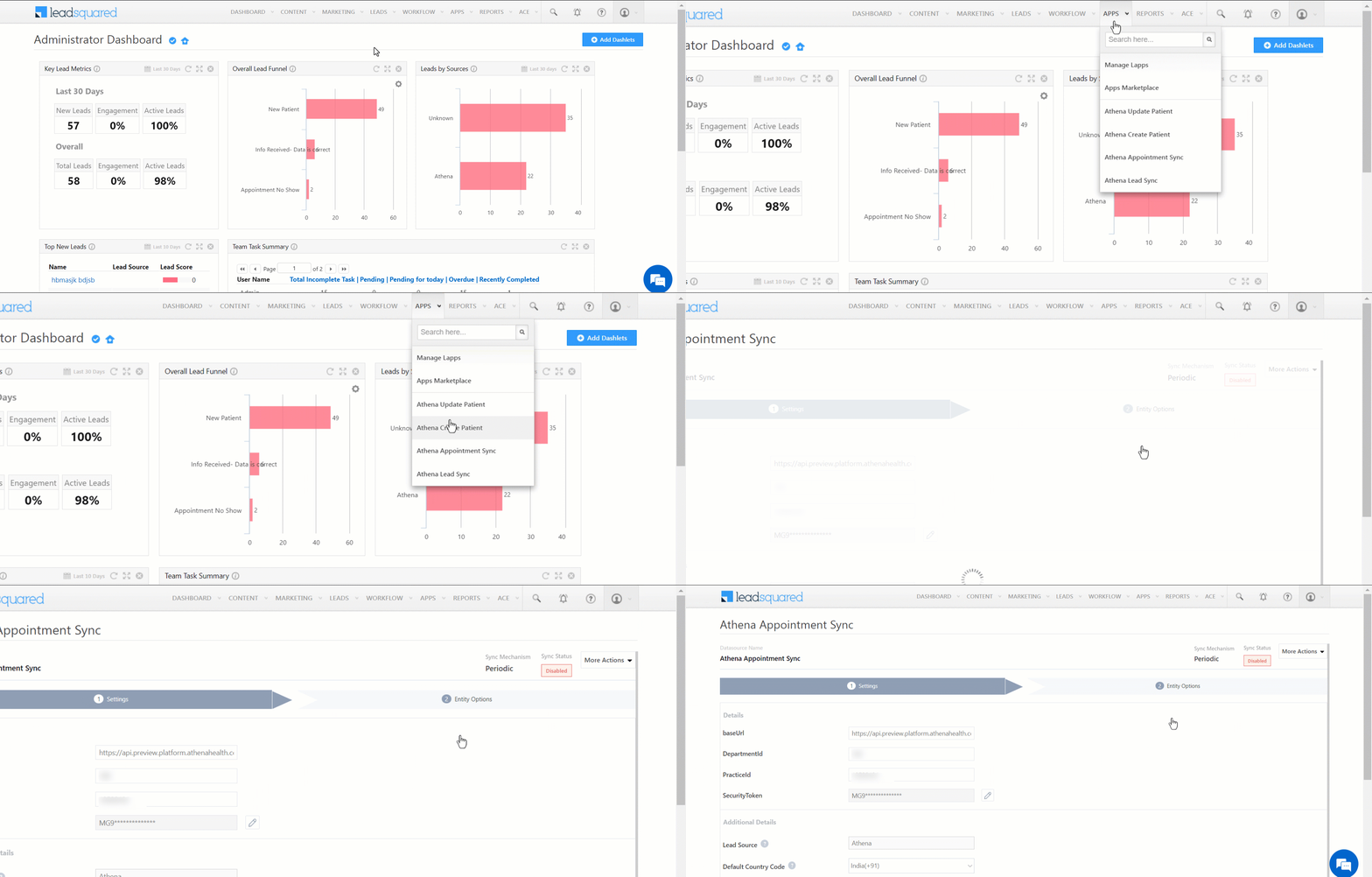
  1. Navigate to Apps>Apps Marketplace.
  2. Search for the EHR-HL7 Connector, and click Install.
    • Alternatively, you can find the connector on the left panel, under Lead Capture.
  3. Once installed, hover your cursor over , and click Configure.
  4. On the Configure EHR-HL7 Connector pop-up, from the Select User Role(s) dropdown, select the LeadSquared user roles to whom you want to grant connector access
  5. Once you’re done, click Save.
Note: By default, all Admin users will have access to the connector.

LeadSquared EHR Connector


5. Create EHR System to LeadSquared Connector Flow

Once you’ve installed the connector, create flows to determine the data flow direction between your EHR system and LeadSquared. Each flow will only support one operation (e.g., Lead Create in LeadSquared, Update Activity in LeadSquared, etc.). To create flows –

Note: To perform multiple operations, you must create multiple flows, where each flow performs the desired action.
  1. Navigate to Apps>EHR-HL7 Connector Configuration.
  2. Click the Create Flow button.
  3. Alongside Flow Type, select EHR to LeadSquared. Existing patient/appointment data from your EHR system gets captured and synced with your LeadSquared account.
  4. From the Select Entity dropdown, select the LeadSquared entity type you want to sync between your EHR system and LeadSquared. The available options are Lead or Activity.
  5. Depending on the Flow Type selected, the following options are displayed –
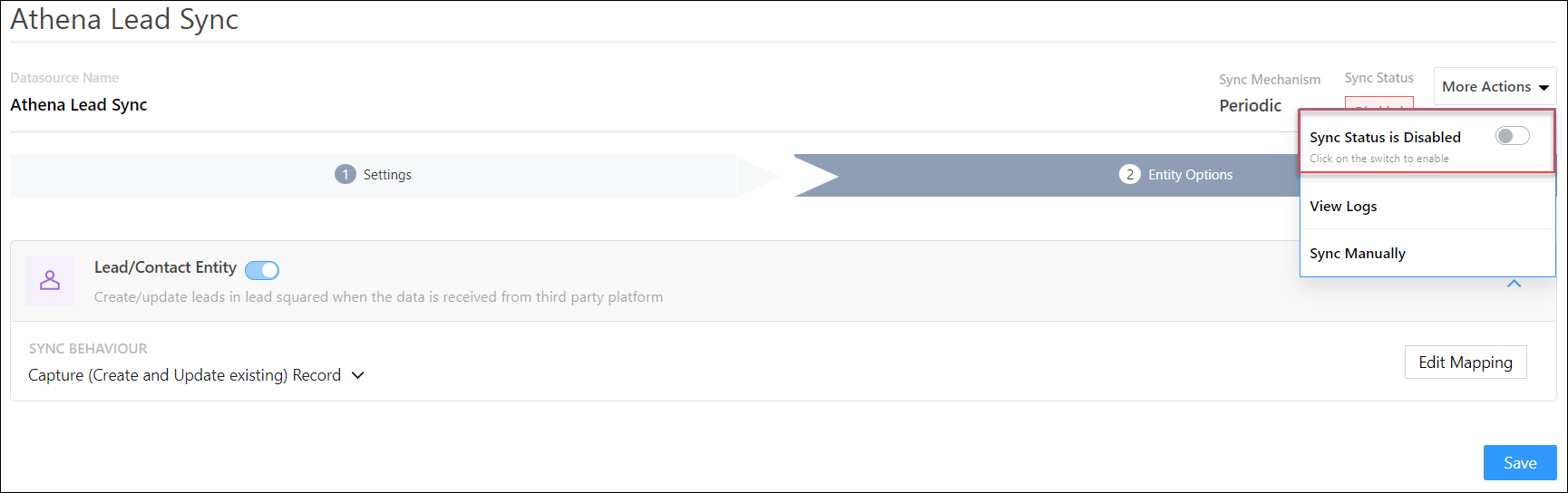
    • Select Sync Behaviour – Lead – This option shows up if you’ve selected Lead as the entity type. Configure the connector to perform the following actions when data is transferred from your EHR system to LeadSquared –
      • Capture (Create and Update existing) Record – Patients (leads) that only exist in your EHR system (but don’t exist as leads in your LeadSquared account) will get created in LeadSquared. Leads that exist in both your EHR system and LeadSquared accounts will get updated.
      • Create only new record – Patients (leads) that only exist in your EHR system (but don’t exist as leads in your LeadSquared account) will get created in LeadSquared.
      • Update only existing record – Leads that exist in both your EHR system and LeadSquared accounts will get updated.
      • Do Nothing – When this option is selected, no action will be performed when a lead is created or updated in your EHR system.
    • Select Sync Behaviour – Activity – This option shows up if you’ve selected Activity as the entity type. Along with configuring the sync behaviour for Leads (for which you can refer to the options listed above), configure the connector to perform the following actions when data is transferred from your EHR system to LeadSquared –
      • Capture (Create and Update existing) Record – Activities (e.g., appointments, etc.) that only exist in your EHR system (but don’t exist as activities in your LeadSquared account) will get created in LeadSquared. Activities that exist in both your EHR system and LeadSquared accounts will get updated.
      • Create only new record – Activities (e.g., appointments, etc.) that only exist in your EHR system (but don’t exist as activities in your LeadSquared account) will get created in LeadSquared.
      • Update only existing record – Activities that exist in both your EHR system and LeadSquared accounts will get updated.
      • Do Nothing – When this option is selected, no action will be performed when an activity is created or updated in your EHR system.
  6. Once you’re done, click Save & Configure.

LeadSquared's EHR Connector


5. Create LeadSquared to EHR System Connector Flow

Once you’ve installed the connector, create flows to determine the data flow direction between your LeadSquared account and EHR system. Each flow will only support one operation (e.g., Patient Creation in EHR system, Update Appointment in EHR system, etc.). To create flows –

Note: To perform multiple operations, you must create multiple flows, where each flow performs the desired action.
  1. Navigate to Apps>EHR-HL7 Connector Configuration.
  2. Click the Create Flow button.
  3. Alongside Flow Type, select LeadSquared to EHR – Existing lead/activity data from your LeadSquared account gets synced with your EHR system.
  4. From the Select Entity dropdown, select the LeadSquared entity type you want to sync between your EHR system and LeadSquared. The available options are Lead or Activity.
  5. Depending on the Flow Type selected, Select the LSQ Webhook Event. Configure the LeadSquared webhook to perform either of the following actions –
    • Lead/Lead Activity Create – When selected, the webhook transfers the details of a new lead or an activity from your LeadSquared account to your EHR account, where a new lead (patient) or a new activity (e.g., appointment) is created in the EHR system.
    • Lead/Lead Activity Update – When selected, the webhook transfers the details of any lead or activity from your LeadSquared account to your EHR account, and the lead’s (patient) or activity’s (e.g., appointment) details are updated in the EHR system.
  6. Once you’re done, click Save & Configure.
Note: If you’re configuring the Select Sync Behaviour – Activity option, you must also configure what happens to the leads (patients) that are tagged to this activity type (e.g., appointments, etc.) in your EHR system.

LeadSquared's EHR Connector


6. Configure the Connector

After the connector flow is set up, configure the Flow to transfer data between the EHR system and LeadSquared.

Note: The steps below are common to both EHR System to LeadSquared and LeadSquared to EHR System connector flows.

6.1 Basic Details

Enter the following details for the Flow –

  • Flow Name – A display name for the Flow Type created.
  • Flow Description – A description of the Flow Type created.
  • Select Channel – From the list of channels created for your LeadSquared account, select a channel type. To create a channel, contact your account manager, or write to support@leadsquared.com.

Once you’re done, click Save & Next.

LeadSquared's EHR Connector


6.2 Additional Details

Enter the following additional details –

Note: All the options listed below will show up if the Flow Type is EHR to LeadSquared. But if you’ve selected LeadSquared to EHR, only Select Default Country Code and Select Time Zone will show up.
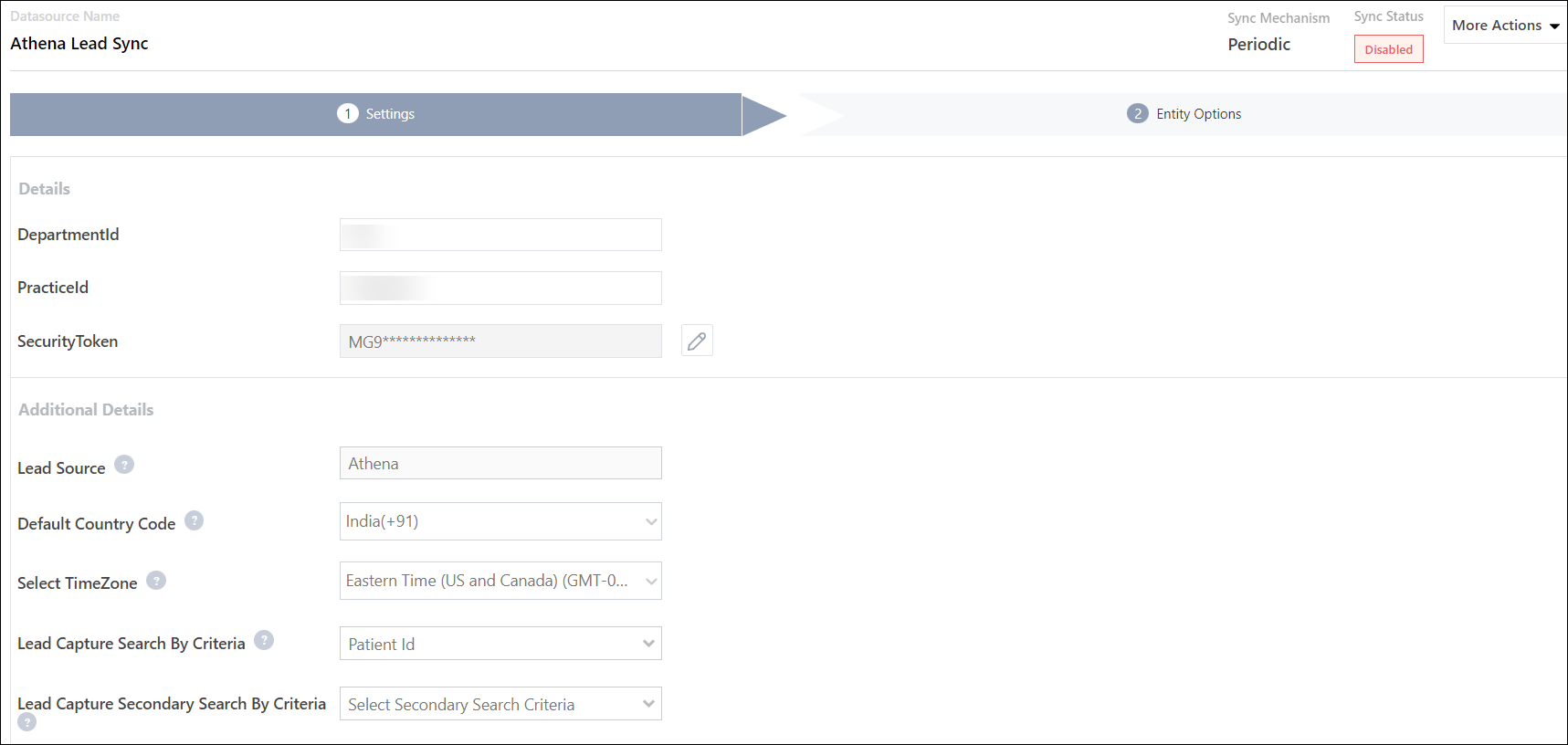
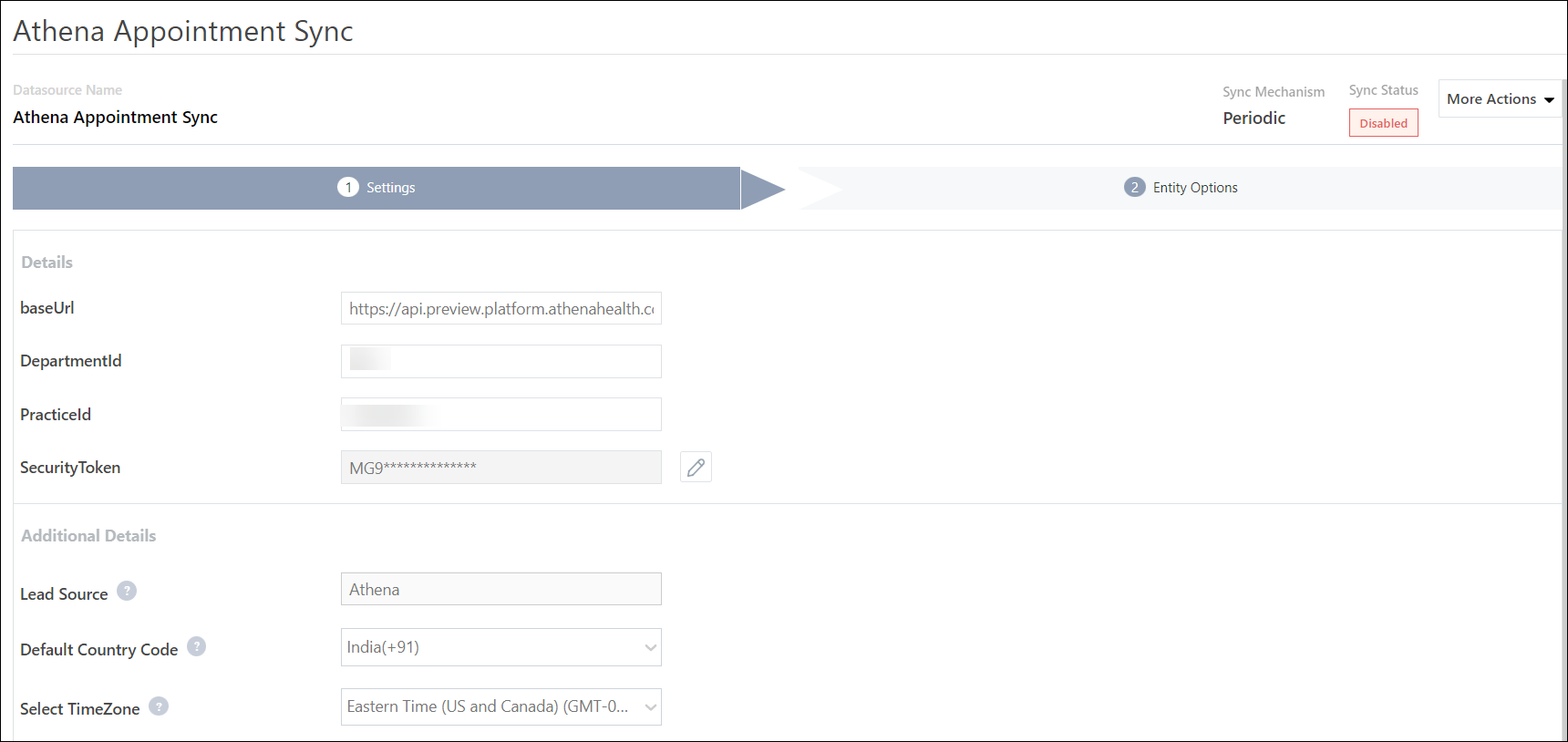
  • Lead Source – Enter the lead source through which the leads are captured (e.g., EHR connector, etc.). This detail will be displayed on the Lead Details page, under Lead Source.
  • Select Default Country Code – If the lead’s mobile number is captured without a country code, then the default country code that’s selected from the dropdown will be added to the lead’s mobile number.
  • Select Time Zone – Select a preferred timezone you want our backend system to follow when transferring data.
  • Select Primary Lead Capture Search By Criteria* – To avoid duplicate leads, you must select one unique lead field (e.g., Mrn, Patient Id, email Id, mobile number, PAN number, etc.) as the search key. This will be used to identify the leads pulled from your EHR system. To know how to mark a LeadSquared lead field as unique, please refer to How to Make a Custom Field Unique.
  • Lead Capture Secondary Search By Criteria – If lead identification and capture through the primary Search By criteria fails, it will be re-attempted using the secondary Search By criteria.

Once you’re done, click Save & Next.

Note: *The Mrn field (or a patient identifier field) should be mandatorily selected as either the Primary or Secondary Search Key.

LeadSquared's EHR Connector


6.3 HL7 Event Configuration

Select the event type (e.g., ADT – A04 “Register Patient”, SIU – S12 “Notification of New Appointment Booking”, etc.) for the flow you’re building.

Note: Contact your provider to obtain a valid HL7 Message Template.
  1. Here, from the HL7 Event Type dropdown, select the event type for which you’re building the Flow Type.
  2. Once the event type is selected, add the corresponding HL7 Message Template, which is used to transfer data between your EHR system and LeadSquared. This template will also be used to map the corresponding lead and activity fields in LeadSquared. To know more about these templates, refer to HL7-Definition V2.

LeadSquared's EHR Connector


6.4 Lead/Activity Mapping

On the Lead/Activity Mapping screen, based on the event selected and the Message Template that is passed, map the HL7 fields present in the template to the corresponding LeadSquared lead/activity fields. To know how to transform data present in the Message Template, refer to Message Delimiters.

Once you’re done mapping the fields, click Save & Close. The connector will now transfer patient and lead information between your LeadSquared account and EHR system.

Note:

  • A Custom Field should be created to capture and map the Mrn field (or any other patient identifier field) that was selected as a Search Key. To create a custom field, click the Add Custom button.
  • To view the existing value of a specific field in an HL7 Message Template, under HL7 Field, hover your cursor over the field.

LeadSquared's EHR Connector


Any Questions?

Did you find this article helpful? Please let us know any feedback you may have in the comments section below. We’d love to hear from you and help you out!

How to Use Iframes or Custom Code on Portals and Landing Pages Pro

1. Overview

Iframes let you embed custom designs or external tools inside Portals or Landing Pages Pro without affecting the main layout. To ensure your embedded content works smoothly, follow the guidelines listed on this page.


2. Guidelines For Iframe or Custom Code

1. When using AI tools to generate custom designs or widgets

If you’re using AI to generate HTML, CSS, or JavaScript:

  • Clearly specify that the code will run inside an iframe.
  • Prompt the AI not to use external JavaScript libraries—stick to basic HTML, CSS, and JS to avoid slow load times and reduced conversions.
  • Request the design in small sections, and embed each section in its own iframe instead of placing everything inside one large block.
  • Ensure all buttons, scrolling, and interactions work even within the confines of the iframe.

2. Do not use AI-generated code for forms

If you need a form next to your custom design, use the built-in drag-and-drop form builder. Place your LSQ form beside a custom code block to create a hybrid layout—this ensures proper tracking, reliable submissions, and consistent behavior across portals and landing pages.

3. Adjust spacing, width, and styling for a seamless embed

To make the iframe full width, remove padding, and align it neatly with your layout, refer to the platform’s instructional video (shown below) for spacing and container setup.

If the embedded content looks cut off or doesn’t extend fully at the bottom, add this CSS:

body, iframe {
    height: 1000px;
}

This helps the iframe appear smooth and continuous, without borders or unwanted scrolling.

adding iframe in lp and portals ai

Using Scripts in Portals and Landing Pages Pro for Google Analytics, FB Pixel, Chatbots and Other Custom Behaviour

1. Feature Overview

Portals and Landing Pages Pro are modular and can be altered, extended, or enhanced using JavaScript. They can be extended to accommodate additional functionality like –

  • Integrating analytics services to capture page views, engagement events, conversion events –
    • Portals and Landing Pages Pro broadcast specific engagement activities during the lead journey which can be subscribed to and posted to the respective analytics service.
  • Integrating third-party chatbot services.
  • Fetching/Updating data from external databases or apps using JavaScript.
  • Overriding the style of a specific component inside the designer using your own custom scripts.


2. Integrating Google Analytics and Facebook Pixel on Portals

On integration, both Google Analytics and Facebook Pixel track pageviews, visitor count, and other basic events. However, in order to track custom engagement or conversion activities, you must write custom push events specific to the analytics service.

  1. Navigate to Workflow>Manage Portals.
  2. Select the Portal you need to view and click Continue Editing.
  3. Click Mobile App Menu  and then Configurations.
  4. Click the Script dropdown.
  5. Paste the script obtained in the Inside Head and End of Body sections as per the specifications.

LeadSquared - Integrating scripts for third party tools


3. Integrating Google Analytics and Facebook Pixel on Landing Pages Pro

  1. Navigate to Marketing>Landing Pages Pro.
  2. Select a Landing Page.
  3. Click on the Settings icon lpp settings icon.
  4. Select Scripts.
  5. Paste the script obtained in the Inside Head and End of Body sections as per the specifications.


4. Troubleshooting

4.1  Frequent Issues Encountered

  • Wrong trigger configuration: The conditions you have targeted must be present for the expected trigger behaviour.
  • Extra specific triggers: Triggers must not be too specific. Example: A URL trigger that is set to fire on http://www.example.com will not fire if the URL is https://www.example.com . Use a common fragment for the trigger criteria, such as “example.com”.

4.2 Issues Encountered with Facebook Pixel

Refer to the following checklist to ensure that Pixel is firing properly.

  1. Check whether your raw pixel fires match. If you’re using Facebook pixel, you can check how many times your specific standard events were triggered in your pixel dashboard.
  2. If your raw pixel fires match but there’s a discrepancy in conversion values, check your currency, decimal places, and other variables in your purchase event codes.
  3. Do not use a combination of conditional and unconditional firing with your tags. Also, expect minor discrepancies while using conditional firing.
  4. If Facebook is reporting more conversions than your other analytics tools, use the Pixel Helper tool to check for duplicate pixel fires, which can sometimes be caused by redirects.
  5. If Facebook is reporting fewer conversions, check if the pixel piggybacking on existing tag managers has been implemented correctly.

4.3 Debugging Google Analytics and Facebook Pixel

The tools mentioned below can be used to debug Google Analytics and Facebook Pixel.

  1. Facebook Pixel Helper – Works in the background to look for conversions or Facebook pixels and provides real-time feedback on the implementation.
  2. Google Tag Assistant Recordings – Validates, diagnoses, and troubleshoots issues with your Google Analytics implementation in real-time. You can record typical user flows through your website and get an immediate analysis of your setup. Google Tag Assistant Recordings can help you find missing or mangled tags, invalid events, filters, and much more.


5. Overriding the Style of Portal and Landing Page Pro Components with Custom Scripts

You can use custom JavaScript to override a style property of a component that is not available in configurations. To override the CSS properties of a component, use its class name. The properties will be applied to all components with the class name. If you want to isolate this to a specific component, set a custom class name to the component and use this class with JavaScript to style it.

Select a portal component and tag it with a custom CSS class name –

  • Click the Advanced dropdown and enter a value in the Custom class name field.
  • Use this class name in your custom scripts to isolate and override its style and behavior without affecting any other components in the portal.

LeadSquared - Scripts in Form


6. Extending Portals with Custom Behaviour

Portals track various engagement events performed by leads. You can consume these events via custom scripts and –

  • Post them to –
    • Analytics services like Google Analytics
    • Advertisement services like Facebook Ads
  • Display a pop-up message on the portal, etc.
Trigger Event Name Event Payload 
When a user logs in to the portal successfully LSQ_FORM_LOGIN_SUCCESS Login method – otp, password
When a user initiates portal login LSQ_FORM_LOGIN_INITIATED Login method – otp, password
When a user fails portal login LSQ_FORM_LOGIN_FAILURE Login method – otp, password
When a user verifies email or phone number through OTP on the portal during registration LSQ_OTP_VERIFIED Verification type – signup, login
When a user initiates portal registration LSQ_FORM_SIGNUP_INITIATED Sign up method – otp, password
When a user registers on the portal successfully LSQ_FORM_SIGNUP_SUCCESS Sign up method – otp, password
When a user fails to register on the portal LSQ_FORM_SIGNUP_FAILURE Sign up method – otp, password
When a user raises forgot password request through the portals successfully LSQ_FORM_FORGOTPASSWORD_SUCCESS
When a user fails to raise forgot password request through the portals LSQ_FORM_FORGOTPASSWORD_FAILURE
When a user resets the portal password successfully LSQ_FORM_RESETPASSWORD_SUCCESS
When a user fails to reset the portal password LSQ_FORM_RESETPASSWORD_FAILED
When a form is loaded on the portal LSQ_FORM_LOAD_COMPLETE form name
When a form is saved on the portal, use the lsqformsubmissionsuccessateachstep event on .lsq-external-form-container, like this:

document.querySelector(".lsq-external-form-container").addEventListener('lsqformsubmissionsuccessateachstep', () => {
    console.log("Form saved on the portal.");
});

There will be no event payload.

When a form is submitted on the portal LSQ_FORM_SUBMITTED form name
When a form is saved as a draft on the portal LSQ_FORM_SAVE_AS_DRAFT_COMPLETE formName, portalId, TabId, FormId
When a user initiates payment via a payment gateway through forms on the portal LSQ_PAYMENT_INITIATED form name, product name, payment gateway, currency
When a user fails to complete payment via a payment gateway through forms on the portal LSQ_PAYMENT_FAILED form name, product name, payment gateway, currency
When a user completes a payment via a payment gateway through forms on the portal LSQ_PAYMENT_COMPLETED form name, product name, payment gateway, currency

When a form is saved on the portal, use the lsqformsubmissionsuccessateachstep event on .lsq-external-form-container, like this:

document.querySelector(".lsq-external-form-container").addEventListener('lsqformsubmissionsuccessateachstep', () => {
    console.log("Form saved on the portal.");
});

The event payload will be:

Common event payloads to be used in all triggers –

  • lead id – Prospect Id of the lead performing the action
  • portal id – Id of the portal on which the action was performed
  • timestamp – The time stamp at which the action was performed
  • page title – Name or title of the portal page on which the action was performed
  • page path – Absolute path or URL of the portal page on which the action was performed
  • origin – default value of the portal

These events can be consumed via custom scripts written at the Portal Designer > Configurations > Script: a) Inside Head <head> b) End of body <body>

window.addEventListener("LSQ_FORM_SIGNUP_SUCCESS", (event) => { 
    console.log("Printed when user has registered.", event.detail);
    // Your logic goes here. Push Google Analytics / Facebook Pixel events here or any other custom behaviour you intend to achieve.
    // Example: Track a Google Analytics Event
    //gtag('event', 'portal_sign_up', {'event_category' : 'admission_portal', 'event_label' : '2022_admission'});
    // Example: Track a Facebook Pixel Event
    //fbq('track', 'ViewContent', {content_name: 'Sign Up Form'});
});


Any Questions?

Did you find this article helpful? Please let us know any feedback you may have in the comments section below. We’d love to hear from you and help you out!

How to Pre-Populate and Capture Data (UTM) in Portals, Landing Pages Pro, and Widgets

1. Feature Overview

You can pre-populate Forms or Sign-Up Forms so the user can directly submit them and skip filling in different fields. This can be achieved by passing relevant data via query parameters. To know more about Portals, see Portal Management.


2. Query parameters

API Query parameters can be defined as the optional key-value pairs that appear after the question mark in the URL. They are extensions of the URL that are utilized to help determine specific content or action based on the data being delivered. Query parameters are appended to the end of the URL using a ‘?’. The question mark sign is used to separate path and query parameters.

If you want to add multiple query parameters, an ‘&’ sign is placed in between them to form what is known as a query string. It can feature various object types with distinct lengths such as arrays, strings, and numbers.

LeadSquared - Query parameters


3. Pre-populate data in Forms

Important: This feature only works on pages that do not require a login from the user.

To pass data to the Forms for the respective fields, we need to send the data in query parameters as key-value pairs. Here, the value is the actual value that must be populated in the Form field and the Key is the identifier of the field where the value must be populated. This key must adhere to a specific format –

This format has three components to it –

  1. Entity Prefix: A single letter representing the type of the entity.
    1. For Lead field – L
    2. For Activity field – A
    3. For Opportunity field – O
  2. Activity or Opportunity code if any (not applicable for lead field)
  3. ​​​​​​​​​​​​​​Schema Name: the schema name of the field you are trying to pre-fill

Some examples are –

  • For Lead fields: L_FirstName
  • For Activity fields: A_200_mx_Custom_1
Note: You can also have fields hidden that capture the query parameters and save.
LeadSquared - Pre-populating data in Forms


4. Capturing UTM Data

Portals, Landing Pages Pro, and Widgets can capture UTM parameter values from URLs.

To enable this, append any of the following UTM parameters to your Portals, LPP, or Widgets link:

  • utm_source
  • utm_medium
  • utm_campaign
  • utm_term
  • utm_content

Example:
https://leadsquared.com/?utm_source=google&utm_medium=social&utm_campaign=sale&utm_term=term&utm_content=buy

When a lead submits the form, the captured UTM values are available in the respective activity, such as the Form Submitted on Portals, Landing Pages, and Widgets activity on the lead details page.

utm data source portals lpp widgets


Any Questions?

Did you find this article helpful? Please let us know any feedback you may have in the comments section below. We’d love to hear from you and help you out!

Portals Smart Links

1. Feature Overview

Smart Links on Portals allow you to guide customers to resume progress from where they left off.

For example, if a student begins filling out an application for an online course but leaves before completing the payment process, you can send a follow-up email with a customized link for them to continue. Clicking the Smart Link will take them directly to the predefined page in the portal (e.g., the payment page).

Additionally, Portal admins can generate and trigger Smart Links for users to view or edit a student’s application, assisting them in completing their application process or course enrollment journey if needed.


2. Prerequisite

  • You must be an Admin user.
  • You will need to enable Portals on your account.
  • The Portal must be published in the live environment to set up Smart Links.
  • You must set up an Automation to trigger emails to leads.
  • You must install and configure the Custom Lead and List Actions Connector to make Smart Links accessible for your users.


3. Navigate to Smart Links on Portals

On the Portal Edit page, navigate to Settings>Authentication and click + Create Smart Link.

Note: The Portal must be published in the live environment to create Smart Links.

Portal smart links navigation


4. Configure Smart Link

Configuring the Smart Link involves the following steps –

Note: A maximum of 10 smart links can be configured per portal as default. To increase the limit you could reach out to billingops@leadsquared.com.
  • Name: Enter a name for the Smart Link.
  • Target Portal Page: Select the page the lead or the CRM user will be redirected to through the smart link. You can only select pages that require a login to the portal.
  • Share Link With: Select who’s allowed to access this link –
    • Lead: This option will allow the leads to access the Smart Link.
      • Entity Type: Select the relevant entity type to help users resume their progress on the portal page. You can choose either an Opportunity or an Activity. When the lead opens the Smart Link, the opportunity details or activities related to the lead will be retrieved.
        • Note: Entity details can be passed either in this configuration or while defining the trigger in the automation (refer to section 5.1). In either case, the entity details passed in the automation will take precedence.
      • Generate Short Link: You can create short links for easy sharing by selecting the Generate Short URL option.
        • Note: If you generate short, shareable links for smart links, the maximum expiry period that can be set is 6 months.
      • Set Link Expiry: Set an expiry date for the Smart Link by defining the month(s) and/or day(s). After the expiration date, the link will be inaccessible.
      • Set End Date: Set an end date for your smart link. Post the end date, the configured Smart Link will deactivate. The end date cannot be before the expiry date.
      • Maximum Usage Limit: Set the number of times the lead can access the link.
    • CRM User: This option will allow the CRM User to access the Smart Link.
      • Allow CRM user to edit: If enabled, the user will have access to edit the customer’s journey.
  • Auto Register Leads: By enabling this, Smart Links allow leads to bypass the login step and directly access specific portal pages.
    • For example, a student submits a lead form on your website, and their record is created in the CRM. With Auto Register Leads enabled, the student is automatically registered on the portal and receives a Smart Link. Clicking the link takes them directly to the student dashboard without requiring manual registration or login.

Smart links creation with Auto-Reg


5. Set Up Automation to Email Smart Links to Leads

Follow these steps to share the Smart Link with leads. As an example, let’s consider that automation will trigger and send an email to the lead to remind them to complete the payment on the portal.

This section covers three steps: Automation Trigger, Custom Webhook, and Send Email Action.

5.1 Automation Trigger

  • The automation will be triggered when an activity or opportunity is posted on the lead.
  • Optionally, you can add a Wait card to pause the automation for a few days.
  • Use an If/Else card to check if the lead has made the payment. For example, add a condition that checks if the payment status is Pending through the Lead Stage field.
    • If true, add a custom Webhook (refer to the next section).
Note: If the opportunity or activity trigger defined in the automation differs from the one described in the Entity Type (Section 4), it will be overwritten by the opportunity or activity specified in the automation trigger.

smart links send email to leads automation first step

5.2 Custom Webhook

  • If the payment is pending, configure a Custom Webhook to call the Smart Links Webhook URL. You can find the Webhook option under Custom action.
  • Copy and paste the Smart Link from the Portal’s Authentication Settings page into the Custom Webhook. Make sure to use https.
  • Save the response (Smart Link) in a temporary field by selecting Yes against Save Response.
  • Click Save.
Note: If you want to store the response permanently: create a custom lead field of type Website. Next, use an Update Lead card to update the custom lead field with the webhook response by mail-merging the value from the temporary field (in the example below, it’s PostWebhook4_Response).

portals smart links automation send email to lead step 2

5.3 Send Email Action

  • Add a Send Email action to the flow. You can find the Send Email option under the Messaging action.
  • Draft your email and mail-merge (or, hyperlink) the webhook response (Smart Link) into the email.
  • Once finalized, click Done.

Note: You can mail-merge either the temporary field or the custom lead field.

Once complete, you can publish the automation.

portals smart links automation send email to lead step 3


6. Configure Smart Links Access for CRM Users

Note: You must enable and install the Custom Lead and List Actions Connector.
  1. First, copy the Smart Link from the Portal Authentication Settings page.
  2. Next, configure the Smart Link in the Custom Lead and List Actions Connector by adding an action.

portals smart links configuration for crm users

Once configured, the users will be able to view the link posted against the lead through the Action button on the Manage Leads page. If permissions have been granted, the user can also edit the lead’s journey or application.

Portals smart links action on manage leads

For more details on how to configure the Custom Lead and List Actions Connector, refer to this article.


Any Questions?

Did you find this article helpful? Please let us know any feedback you may have in the comments section below. We’d love to hear from you and help you out!

OCR, Bar Code and QR Code Functionality in Forms

1. Feature Overview

LeadSquared forms support Optical Character Recognition (OCR), Barcode, and QR code functionality. These features enable you to extract data from physical documents, scan product information, track delivery packages, and lots more. While Barcode and QR code operations are handled by us, the OCR feature requires you to integrate with an OCR third-party vendor.

To learn more about the forms feature, see How to Create a Form.


2. Prerequisites

  • You must be an administrator user of your LeadSquared account.
  • You must be registered with a third-party OCR vendor to use the OCR feature.
  • You must create a Custom Field Set (CFS) with file type fields where you can upload the documents, barcode/QR code images, etc. The CFS must be associated with a lead or an activity type.
  • Development effort is required. We suggest using LeadSquared Lapps for these features.


3. How It Works

These features are visible once you add a file type field (using a custom field set) to a form –

  1. While creating a form, add the custom field set (with file type fields) associated with leads or an activity.
  2. Select any file type field in the custom field set.
  3. The options for OCR (enable file export), Barcode and QR code will appear under Field Properties.

Forms file type CFS


4. OCR

To support OCR, we generate a file URL that can be passed to your OCR vendor. We suggest writing some custom code using LeadSquared Lapps to pass the file URL to your vendor, and receive the processed data. Using form rules, you can then populate the field values with the response from the OCR vendor.

Note: For security reasons, the file URL is only available for 30 seconds.

Here’s an example –
Let’s say you receive scanned copies of your lead’s PAN cards. You want to capture information from these scanned documents (PAN card number and date of birth) to your form. Here’s how you can set it up –

1. Write a Lapp
Write some code using LeadSquared Lapps to pass the PAN card documents from LeadSquared to your OCR vendor. The response should return the required fields – PAN card number and date of birth for example. This Lapp will be called by your LeadSquared form.

2. Add the Custom Field Set to Your Form
Add the CFS containing the file type fields to your form as shown above.

3. Enable File Export

  1. Select the file type field in your form.
  2. Under Field Properties, click the Enable File Export enable icon slider. 

enable file export OCR

4. Configure Form Rules
Navigate to the Rules tabs at the top of the page. Set up the condition as follows –

If PAN Card file is uploaded, then set value of PAN number and date of birth fields to ‘Data From Lapp’ (this calls the Lapp you wrote in step 1). Set the API response key fields to map the corresponding values returned from the OCR vendor. Click Add Rule when you’re done –

OCR Form Rule Set Up

For more details on form rules, see How to Create a Form.


5. Barcode and QR Code

LeadSquared supports barcode and QR code decoding. No third-party vendor is required for this service. The process is similar to the OCR set up listed above, with a few minor changes.

Here’s an example –
Let’s say you receive images of a barcode or QR. You want to capture information from these codes such as product details, price information, delivery tracking details, etc., to your form. Here’s how to set it up –

1. Write a Lapp
Write some code using LeadSquared Lapps to handle the information extracted by the barcode or QR code. This Lapp will be called by your form.

2. Add the Custom Field Set to Your Form
Add the CFS containing the file type fields to your form as shown above.

3. Enable Barcode Scanning or QR Code Scanning

  1. Select the file type field in your form.
  2. Under Field Properties, click the Enable Barcode Scanning or QR Code Scanning enable icon slider. 

QR Code forms integration

4. Configure Form Rules
Navigate to the Rules tabs at the top of the page. Set up the condition as follows –

If Product QR Code file is uploaded, then set value of Product Specification and Product Price fields to ‘Data From Lapp’ (this calls the Lapp you wrote in step 1). Set the API response key fields to map the corresponding values returned by the Lapp after barcode/QR code decoding. Click Add Rule when you’re done –

QR code scanning rules


Any Questions?

Was this article helpful? We’d love to hear your feedback in the comments section below.

LeadSquared SMS Connectors – India

1. Feature Overview

LeadSquared SMS Connectors facilitates customer support and other marketing efforts through simple, secure and reliable text messages. This connector lets you integrate popular SMS providers with your LeadSquared account to send automated, one-to-one and bulk SMSes to leads and opportunities in India, directly from LeadSquared.

The following SMS providers are currently supported –

Important Note: In this article, we’ve used Gupshup as an example to demonstrate the installation and set-up process. The steps remain the same for all the other SMS providers, unless stated otherwise.


2. Prerequisites

  • To enable an SMS provider’s connector on your account, contact your account manager or write to support@leadsquared.com.
  • You must be an administrator user of your Leadsquared account.
  • Your account plan must support SMS integration.
  • The SMS sender Id, as well as the SMS templates you use, must be DLT approved. To know more, refer to Mandatory DLT Registration for SMS Services in India.


3. How it Works

Set up the connector by providing your SMS provider’s account details (Transactional and Promotional usernames, API Keys and Tokens, passwords, Principal Entity ID, DLT-approved Sender ID, etc.). Once it’s set up, create and configure the DLT-approved SMS templates you’ll be using to message your leads. After these templates are configured, send SMSes to your leads.


4. Install the Connector

To install the SMS connector on your account –

  1. From the main menu, navigate to Apps>Apps Marketplace.
  2. Search for the SMS connector you want to install*, and click Install.
    • Alternatively, you can find the connector on the left panel, under SMS.
  3. Then, click Configure.
  4. On the Configure SMS Connector pop-up, no further action is required on this page. To configure the connector, navigate to Apps>Configure SMS Connector.

LeadSquared Gupshup Integration


5. Configure the Connector

Once the connector is installed, navigate to Apps>Configure SMS Connector, and provide the following details for the SMS provider you’re looking to configure –

5.1 Authentication


Once you’re done, click Save & Next.

Gupshup LeadSquared Integration


5.2 Activity Creation

When SMSes are sent to your lead, an activity is posted automatically against that lead. Here, configure the activity creation method for the SMS activity.

  • Async API – This is the recommended method. If you’ve selected this method, enter your LeadSquared account’s Async API URL and API Key. To obtain both these values, navigate to My Profile>Settings>API and Webhooks>Async API.
  • Sync API – This method is selected by default. To post limited SMS activities against your lead, select Sync API.

Note:

  • Through the Sync API method, the activity creation process happens without any delays. But activity creation or tracking may fail during peak hours and when there’s high traffic to our servers. To work around this potential issue, we recommend you use the Async API method.
  • Async APIs must be enabled on your LeadSquared account for the Async method to work.

Gupshup LeadSquared Integration


5.3 Sender Management

To add your SMS account’s Sender IDs, click Add New, and on the Add Sender ID pop-up, enter the following details –

  • Sender ID – Your SMS account’s DLT approved sender Id. To obtain this Id, contact your account manager.
  • Name – A name to identify the Sender ID (e.g., Promotional, Transactional, etc.). This is primarily for internal references. This is optional.
  • Sender Distribution – Select the users to whom the Sender ID will be assigned –
    • Based on Role – Select the LeadSquared user roles (e.g., Administrator, Marketing User, etc.) to whom you want to assign the Sender ID.
    • Advanced (User Level) – Select a boolean user field that’s configured in your account. If the selected user field contains the value “True” for any user, the Sender ID will be assigned to them.

To add multiple Sender IDs, repeat the steps mentioned above. Once you’re done, click Save, and click Save & Next.

Gupshup LeadSquared Integration


5.4 Permissions

Configure the permissions you want to grant users for the Send SMS action (Single and Bulk). This action will be configured on the following pages –

  • Manage Leads page grid
  • Manage Opportunities page grid
  • Lead List
  • Automation Page

You can also configure permission you want to grant users for managing templates and reports. This action will be configured on the following pages –

  • Manage Templates (the SMS template creation screen)
  • Manage Reports (the SMS Reports screen)
  1. Under Functionality, click on the page for which you want to configure the permissions.
  2. On the Send SMS pop-up, provide the following details –
    • Action Label – Enter the display name of the SMS action (e.g., Send Text – Gupshup, Send Bulk Text – Karix, etc.). The limit on the number of characters you can add is 25.
    • Campaign Size – This is applicable only when sending bulk SMSes. You can send SMSes to up to 200 leads through the Lead Grid, and up to to 4 lakh (400,000) bulk SMSes through the Manage Lists page in one go.
    • Permission – Select if you want to enable users to Send SMS based on their user role or based on the values entered in a user boolean field.
      • Based on Role – Select the LeadSquared user roles based on which you want to grant Send SMS permissions.
      • Advanced (User Level) – Select a boolean user field that’s configured in your account. If the selected user field contains the value “True” for any user, they’ll be able to access the Send SMS action.
  3. To disable the action for your users on any page, under Enable/Disable, disable the Zoom slider. The action cannot be disabled for the Manage Templates and Manage Reports screens.
Note: To configure the send SMS action on the Manage Opportunities grid, copy the Configurable Action Url, and use it to create a new Custom Opportunity Actions. To know more, contact your account manager or write to suport@leadsquared.com.

LeadSquared Gupshup Integration


5.5 Advanced Settings

Compliance

The SMSes you send to your leads must meet regulatory compliance standards set by TRAI. You can either choose Opt-out or Opt-in as the compliance type. Once you select the type, from the list of boolean lead fields (e.g., ‘Do Not SMS’) available in your account, select an opt-out/opt-in field.
Leads for whom the value of the Opt-out field is set to ‘True’ will not receive any SMS. Alternatively, leads for whom the value of the Opt-in field is set to ‘True’ will receive SMSes.

Gupshup LeadSquared Integration

Date and Time Related Details

  • Timezone – Select the timezone your LeadSquared account should follow when sending SMSes to leads.
  • Date/Time Format – Select the date and time format your LeadSquared account should follow when sending SMSes to leads.

Gupshup LeadSquared Integration

You can define business hours during which SMSes can be sent to your leads. This step is optional.

  1. Alongside Business Hours, enable the Slider slider.
  2. From the Schedule dropdowns, define the business hours.
  3. From the Select Sender IDs dropdown, select the senders to whom this business hour definition will be applied.
Note: If Business Hours are defined, your users will not be able to send any messages outside these defined hours.

Gupshup LeadSquared Integration

Other Details

From the Other Phone Field dropdown, select the default phone field in which the lead’s phone number is stored in your account. Once you’re done, click Save & Close.

Note: To ensure a higher deliverability rate for your SMS campaigns, ensure phone control validations are enabled for this phone number field. To learn more, see Control Phone Number Format.

Gupshup LeadSquared Integration


6. Manage Templates

After the SMS connector is set up, add DLT Approved SMS templates which you’ll be using to message your leads.

Note:

  1. Navigate to Apps>Manage Templates. This is the action label name you’ve configured for the Manage Templates screen (e.g., Manage Templates – Gupshup, etc.).
  2. On the Manage Templates screen, click Add Template.
  3. On the Add/Edit Template pop-up, enter the following details –
    • Category – Select the LeadSquared category type for the SMS template.
      • Lead – Select this if you’re using this template to send messages to leads (e.g., offers, promotions, etc.).
      • Opportunity – Select this if you’re using this template to send messages to opportunities (e.g., offers, promotions, etc.).
      • Activity – Select this if you’re using this template to send notifications about an activity (e.g., Payments, Document Collections, etc.).
      • Task – Select this if you’re using this template to send notifications about a task (e.g., Appointment Reminders, Follow Ups, etc.).
      • User – Select this if you’re using this template to send messages to users (e.g., Reminders, Company Wide Announcements, etc.).
    • Template Name – Provide a name for the template.
    • Source Availability – Select if the template should be available to send Single SMS, Bulk SMSes and SMS through Automations. You can select all three sources if required. It is mandatory to select at least one source.
    • SenderId – Your DLT approved Sender Id.
    • Template Type – Choose if the template is –
      • Transactional – Order confirmation, account creation confirmation, etc.
      • Promotional – Ongoing offers, product launches, etc.
      • Service Implicit – OTPs, informational messages, bookings, etc. These messages are not intended for marketing purposes.
      • Service Explicit – Discounts, updates, etc. These messages are for marketing purposes.
    • DLT Template Id – The DLT approved template Id. To get your template approved, and to obtain this Id, please reach out to your SMS provider’s account manager.
    • Content – Enter the DLT approved Template content/message here.
      • Add Variable – To add mail merge fields, click Add Variable. Variables in LeadSquared are defined as {{var}} i.e, the variable name is enclosed within two curly brackets.  If the approved template contains a mail merge field “{#var#}”, then the LeadSquared mail merge value can only replace “{#var#}”, without changing anything else in the template. For e.g., “Hi {#var#}, hope you’re doing well!” can only be replaced by, “Hi @{Lead:FirstName,}, hope you’re doing well!”. We also support Custom Variables. You can use this to mail merge custom variables like the Company Name, website URLs, etc.
  4. Once you’re done entering all the details, click Save.
Note: The maximum character limit for the DLT variables is 30 (as mandated by DLT). This is including spaces.

LeadSquared Gupshup Integration

On the Manage Templates screen –

  • To edit an existing template, alongside the template, click .
  • To delete an existing template, alongside the template, click .
  • You can sort and filter existing templates by –
    • Sender ID
    • Last Modified By user
    • Category

LeadSquared Gupshup Integration


7. Send Single SMS

To send a one-to-one SMS to your leads –

  1. Navigate to Leads>Manage Leads.
  2. Alongside the lead you want to message, hover your cursor over . From the available options, under Messaging, click the messaging action label you’ve configured (e.g., Send Text – Gupshup, etc.).
  3. On the Send Text pop-up –
    • Select the Sender Id through the From dropdown.
    • Under Message Body, click Select a Template, and from the list of available templates, select the one you want to use.
    • If there are custom variables available, check if the relevant values are mapped to each variable.
  4. Once you’re done, click Send.
Note: The steps to send one-to-one SMS to your opportunities are the same as the ones listed above. To message your opportunities, navigate to Leads>Manage Opportunities.

LeadSquared Gupshup Integration

Alternatively, you can also send one-to-one SMSes from the Lead Details page. To do this, hover your cursor over the Lead Actions button, and under the Messaging option, click the messaging action label you’ve configured (e.g., Send Text – Gupshup, etc.).

LeadSquared Gupshup Integration


8. Send Bulk SMS

You can send bulk SMSes to your leads from the Manage Leads page and the Manage Lists page.

Note: At present, you can send bulk SMSes only through the following SMS connectors –

  • Karix
  • Gupshup
  • Mtalkz
  • TextNation
  • 100Coins
  • Airtel
  • ValueFirst
  • Twilio
  • Infobip
  • Exotel
  • MSG91
  • Soft-Tech

8.1 Manage Leads Page

  1. Navigate to Leads>Manage Leads.
  2. Alongside the leads you want to send the SMS to, select the Checkbox checkboxes..
  3. Hover your cursor over the Actions menu. From the available options, under Messaging, click the messaging action label you’ve configured (e.g., Send Bulk Texts – Gupshup, etc.).
  4. On the Send Bulk Text pop-up, enter the following details –
    • Campaign Details
      • Alongside Sending messages to…, check if the correct number field has been selected. You can select multiple number lead fields.
      • From the From dropdown, select the Sender Id.
      • Alongside Campaign Name, provide a relevant name for the SMS campaign.
      • Under Message Body, click Select a Template, and from the list of available templates, select the one you want to use.
        • Alternatively, to select a template, click select template icon.
      • Once you’re done, click Save & Next.
    • Custom Params
      • If there are custom variables available in the template, check if the relevant values are mapped to each variable.
      • To edit the value for a variable, click .
      • Once you’re done, click Save & Next.
    • Review and Send – On this tab, review if all the SMS details are correct.
  5. Once all the details are verified, click Send.
  6. On the send SMS confirmation screen, click Yes. The SMS is sent to all the selected leads.

LeadSquared Gupshup Integration


8.2 Manage Lists Page

  1. Navigate to Leads>Manage Lists.
  2. Alongside the list you want to send the SMS to, hover your cursor over Settings icon. From the available options, under Messaging, click the messaging action label you’ve configured (e.g., Send Bulk Texts – Gupshup, etc.).
    • Alternatively, open a list and from the List Actions menu, click Messaging, and click the action label you’ve configured.
  3. On the Send Bulk Text pop-up, enter the following details –
    • Campaign Details
      • Alongside Sending messages to…, check if the correct number field has been selected. You can select multiple number lead fields.
      • From the From dropdown, select the Sender Id.
      • Alongside Campaign Name, provide a relevant name for the SMS campaign.
      • Under Message Body, click Select a Template, and from the list of available templates, select the one you want to use.
        • Alternatively, to select a template, click select template icon.
      • Once you’re done, click Save & Next.
    • Custom Params
      • If there are custom variables available in the template, check if the relevant values are mapped to each variable.
      • To edit the value for a variable, click .
      • Once you’re done, click Save & Next.
    • Review and Send – On this tab, review if all the SMS details are correct.
  4. Once all the details are verified, click Send.
  5. On the send SMS confirmation screen, click Yes. The SMS is sent to all the selected leads.

LeadSquared Gupshup Integration


9. SMS via Automation

To send SMS via Automations

  1. Navigate to Workflow>Automation.
  2. Create a new automation, or edit an existing one.
  3. After selecting the type of automation and the trigger, click the add expand icon, click Messaging, and click the messaging action label you’ve configured (e.g., Send Automation Texts – Gupshup, etc.).
  4. After entering the required details and selecting a template, click Send SMS.
    • To mail merge multiple LeadSquared phone fields, click the Add Another Number button. Filter by the entity type under which the phone field is present, and use the search box to find and add the field. In the example below, we’ve mail merged the Lead Owner phone field to the automation.
  5. Publish the automation.

For more information, see How to Send SMS through Automation.

Note: You can send SMS via automation through this connector only for automations created using a Lead, Opportunity, Activity, Task, or User triggers.

LeadSquared SMS Connectors


10. View Reports

To view the reports and logs of all the SMSes sent through the SMS connector –

  1. Navigate to Apps>Manage Reports – SMS Connector.
  2. You can sort the report by the following filters –
    • Usage Reports – The logs of the total one-to-one as well as bulk messages sent through the connector.
      • Templates – Filter the reports on the basis of the templates used when sending the messages.
      • Message Source/User Wise – Filter the reports on the basis of the message source (Automation, Bulk and One-to-one messages).
      • Select Date – Select the time interval for which you want to view the SMS logs data. You can select a maximum date range of up to 90-days in the past.
      • Cumulative – This will render the report as a pie chart.
      • Timeline – This will render the report as a bar graph.
      • For pie charts, to populate the details section, click any part of the chart.
      • For bar graphs, if you delete any element, the display of the graph gets updated accordingly.

LeadSquared Gupshup Integration

    • Campaign Reports – The logs of all the bulk messages sent through the connector. This option will only show up if the connector supports bulk messaging.
      • Select Date – Select the time interval for which you want to view the SMS logs data. You can select a maximum date range of up to 90-days in the past.
      • Status – Filter by the campaign status (All, Success, Error, and Partial Error).
      • To view detailed logs of a campaign, click on the campaign. Alternatively, click the View icon. On the Batch Details screen, you can perform the following actions –
        • To view the API details, under Batch ID (the List Id), click the entry.
        • To view the status of the messages triggered, under Triggered, alongside the Batch Id you want to view the details for, click the number.
      • Message Triggered – The total number of leads to whom the messages were triggered.
      • Sent – The total number of successful messages sent to the SMS provider.
      • Messages Billable – Every block of 160 characters in a SMS is considered as a one SMS. For e.g., if you send one SMS that contains 340 characters, it is considered as 3 messages (160+160+20) under the Messages Billable header.
      • Error – Any internal LeadSquared errors (e.g., server errors, etc.) that cause the Send SMS action to fail will get logged under the Errors column.
      • Invalid – The following scenarios when sending SMSes will get logged under the Invalid column –
        • Formatting issues with the lead’s phone numbers
        • Empty or missing lead phone numbers
        • Sending SMS outside the configured Business Hours
        • If the DLT variable lenght exceeds the configured limit
      • Opted Out – The total number of messages sent to leads who have opted out of receiving messages.

Note: To download/export a report, under Actions, click download icon. The report contains the Lead Id, Phone Numbers, Opportunity Id, Message Content, Status Message, Message Type and Message Count of all the leads to whom the message was sent.

LeadSquared Gupshup Integration

Alternatively, click on the Batch Id to download a report that contains the Lead Phone Number and Message content of the SMS sent to leads.

LeadSquared Gupshup Integration


11. SMS Activities

You can track the SMS sent, from the Lead Details and Manage Activities pages. We automatically post SMS Sent activities in real-time.

11.1 Lead Details

To view more details, click the SMS Sent link for each activity.

LeadSquared Tech Alpha Connector


11.2 Manage Activities

You can also view the list of leads with SMS activities. Be sure to select SMS Sent from the Activity Type drop.

LeadSquared Tech Alpha Connector

You can use the Advanced Search feature to filter SMS based on different fields, such as campaigns, date-time fields, etc.

LeadSquared Tech Alpha Connector


Any Questions?

Did you find this article helpful? Please let us know any feedback you may have in the comments section below. We’d love to hear from you and help you out!

How to Add Custom Activity Types

1. Feature Overview

LeadSquared comes pre-built with a number of core or system activities like email bounced, email link clicked, website page visited, lead captured, etc. We automatically post these activities against your Leads or Opportunities, whenever they are performed. The activities then appear in the Manage Activites page or on the lead’s detail page. Example of an activity posted against a lead is “Had a Phone Conversation”, while an example of an activity posted against an opportunity is “Home Loan Proposal Email Open”.

In addition to core activities, you can also create custom activities to accommodate your own unique use cases. You can also add fields within each custom activity to capture relevant data. Here are some examples –

Industry Custom Activity
Real Estate Site Visit
Education Attended Fair
Healthcare Clinic Visit
Finance KYC Document Collection
Travel Itinerary Shared
Generic Attended Webinar, Downloaded Document, Had a Phone Call
Note:

  • If opportunities are enabled on your account, you can post activities directly on the opportunity. To know how to add activities to opportunities, refer to Opportunity Details.
  • This article shows you how to create activity types. Once you’ve created an activity type, you can add activities of that type to your leads from the Manage Activities page.


2. Create a Custom Activity Type

  1. Navigate to My Profile>Settings>Leads>Custom Activities & Scores and click Add.
  2. On the Add Custom Activity Type pop-up, enter the relevant activity details, then click Next. See the table below for more details.
  3. Now add custom fields related to the activity. Notes, Status and Owner fields are available by default. Click Add Field to add more custom fields. Select the data Type of the field (String, Number, DateTime, DropDown, etc.). You can also mark fields as mandatory. Click Next to go to the final step.
  4. Customize how you want your add/edit activity forms to appear. Drag and drop the fields you want displayed on the form from Available Fields to Activity Details. Click Add Section to add another section to the form.
  5. Click Save.

Custom Activity

Fields on the Add Custom Activity Type form (step 1 of 3) –

 Field Description
Name Name the activity here.
Description Describe the activity here.
Score Associate a lead score with the activity. See How does Lead Scoring work?
Direction Inbound or Outbound.
Enable Details View Users can add activities and tasks on an existing activity, and track them on the Activity Details page.
Delete Activity Allow users to delete the activity. If you want to select CRUD permissions for specific users, see Permission Templates.
Track Location Track the location the activity was created from (for mobile users).
Log Activity Changes Log updates to the activity. See How to Log Activity Updates.
Allow pre-dated Activities Enable to allow users to add activities with earlier dates.
Show in Activity List Shows in the activity list on the Manage Activities page.
Allow Attachments Allow users to attach files to the activity.
Quick Add Quick add the activity on the lead details page without opening the add activity form. Use this feature if the activity is very common and you need to add it to a large number of leads. See the image below.
Lock Activity Once your users post a Custom Activity, you can lock that activity to prevent anyone from making changes to it. To know more, refer to Lock Activity after Creation.

Quick Add activity on the Lead Details page –

Custom Activity_2

Note:


FAQs

  • What is the Character Limit for an Activity String Field in LeadSquared?
    The Activity String field in LeadSquared has a character limit of 200.
  • What if I need to store more than 200 characters?
    If your data exceeds the 200-character limit, you can use a String field in a Custom Field Sets (CFS), which supports up to 1000 characters.


Next Steps

Once you’ve created a custom activity type, you can start posting activities on leads and opportunities. See Manage Activities for more details.

Connect Your Google/Outlook Calendar with LeadSquared

1. Feature Overview

Sync your LeadSquared account with your Google/Outlook Calendar to –

  • Sync meetings/tasks between Gmail/Outlook and LeadSquared.
  • Sync internal meetings scheduled with your colleagues in your Gmail/Outlook calendar as tasks in LeadSquared.
  • View LeadSquared tasks assigned to you by your manager in your Gmail/Outlook calendar.
  • Sync recurring meetings with your LeadSquared account.
  • View rescheduled, cancelled, and deleted meetings in real-time on your Gmail/Outlook and LeadSquared calendar

Note:

  • This article is to help Sales Users sync their email accounts with LeadSquared. The steps listed below can be followed by Admin Users as well to sync their own email accounts with LeadSquared.
  • Only appointment task types can be synced.


2. Prerequisites


3. Sync Your Email Account with LeadSquared

Once the admin configurations are completed, connect your Outlook/Gmail accounts to LeadSquared. To do this –

  1. From the main menu, navigate to Apps>Google/Outlook Connector.
  2. Click Get Started.

Google Outlook Calendar Sync Connector


3.1 Authorization

  1. Next to the email provider’s name, click the Sign in button.
  2. Enter your login details, and Accept the necessary permissions. Your email provider is synced to the connector.
  3. Click Next.

Google Outlook Calendar Sync Connector

If you’re signing in using Outlook, you will have to reauthenticate the sign-in every 15-days. Reauthentication requires you to perform the Authorization steps listed above.

Note: Reauthentication is not required if you’ve signed in using Gmail.

Google Outlook Calendar Sync Connector


3.2 Sync Options

If required, you can change the Sync Direction and Allow internal meeting sync setting. Once you’re done, click Next.

Note: You won’t be able to make any changes on this screen if the Do not allow your users to set calendar configuration setting is enabled by your LeadSquared Admin.

Google Outlook Calendar Sync Connector


3.3 Calendar & Task Mapping

If required, you can change the Calendar & Task Mapping configurations.

Note: You won’t be able to make any changes on this screen if the Do not allow your users to set calendar configuration setting is enabled by your LeadSquared Admin.

Google Outlook Calendar Sync Connector


3.4 Schedule Online Meeting

For online meetings, meeting links (Google Meet/Teams Meeting) are automatically generated.
If required, you can add or remove keywords that’ll determine if a meeting should be considered an online meeting. You can also enable or disable the Consider the task as Online Meeting if no “Location” is specified setting. Once you’re done, click Next.

Note: You won’t be able to make any changes on this screen if the Do not allow your users to set calendar configuration setting is enabled by your LeadSquared Admin.

Google Outlook Calendar Sync Connector


3.5 Activate Sync

Once all the settings are configured, to sync your LeadSquared and email provider’s task calendars, click Activate Sync.

Google Outlook Calendar Sync Connector


3.6 Other Actions

Once your account is connected, you can view logs of all the tasks that have been synced between LeadSquared and your email provider’s accounts.

  • Date Range Filter – You can filter the logs by Today, Yesterday, Last 7 Days, Last 30 Days and Custom Date. If you select Custom Date, you can select up to a maximum of 60 days in the past.
  • Sync Direction – If you’ve enabled two-way sync, you can filter the sync direction by All, Inbound or Outbound.
  • To Disable Sync between your LeadSquared account and email provider, click , and click Disable Sync. This will stop the flow of tasks between both accounts.
  • To delete your synced account within the connector, click , and click Delete Account.

Google Outlook Calendar Sync Connector


4. Create and View Tasks

Once your email provider’s account is connected to LeadSquared, depending on the connector configurations, you can view Appointment and meeting tasks in your Gmail/Outlook and LeadSquared accounts.

4.1 View Meetings in Outlook

Once you create an Appointment task type in LeadSquared, you can view it in your Outlook Calendar.

Google Outlook Calendar Sync Connector


4.2 View Meetings in Gmail

LeadSquared Connectors


4.3 View Meetings in LeadSquared

Once you create a meeting from your Outlook/Gmail Calendar, you can view it as a task in your LeadSquared account.

Google Outlook Calendar Sync Connector


5. FAQs

Will this connector also capture new leads?
No, this connector only syncs meetings between LeadSquared and your email provider.

I have multiple Outlook/Gmail calendars. Will I be able to sync all of them with LeadSquared?
Calendar sync will only sync with a user’s primary calendar. If a user has multiple calendars in their Outlook or Gmail account, LeadSquared will only sync with the primary or default calendar.

Can I connect both my Outlook and Gmail accounts to LeadSquared?
No, you can either connect your Gmail or Outlook account. Both the accounts cannot be synced at the same time.

Can I sync past meetings (created before the connector was installed) from my Outlook/Gmail accounts?
Historical calendar event sync is NOT supportedAny events created prior to the connector integration will not be synced to LeadSquared.

Will new meetings be created if the lead doesn’t exist in my LeadSquared account?
When an appointment meeting is created from your email calendar, the meeting will only show up on the Lead Details page of leads that exist in LeadSquared. Meetings with leads that don’t exist in LeadSquared are categorized as internal meetings, and they are created with a task owner but no lead. LeadSquared will not create new leads if the meeting attendees do not exist in your LeadSquared account.

My lead has multiple email Ids, which one should I use to create meetings?
For the meeting to appear in your lead’s timeline, the lead must be using the same email address as the one stored in LeadSquared.

Are all-day events also supported?
All-day events will not be synced to LeadSquared.

Are my private calendar events also synced to LeadSquared?
Calendar sync does not sync private calendar events to your account. If a public event is later changed to private, the engagement will remain in your LeadSquared account, but changes to the event will no longer sync.


Any Questions?

Did you find this article helpful? Please let us know any feedback you may have in the comments section below. We’d love to hear from you and help you out!

Google/Outlook Calendar Sync Connector Set-up for Admin Users

1. Feature Overview

This connector syncs LeadSquared Tasks with your Google and Outlook calendars. It also lets you sync your Google and Outlook meetings with your LeadSquared Tasks calendar. This ensures you can view all appointments in one place, without having to navigate between different apps.

Additionally, from LeadSquared, you can view the meetings and tasks of all your users whose email accounts are synced with the connector. To know more about the benefits of installing this connector, refer to Google Outlook Calendar Sync Connector.

Note:

  • This article is to help Admin Users install and configure the Google Outlook Calendar Sync Connector. If you’re a Sales User who’s looking to sync your Gmail/Outlook account with LeadSquared, refer to Connecting your Google/Outlook Calendar with LeadSquared.
  • This connector only captures tasks, and does not create new leads.
  • You can only sync Appointment task types with your Google and Outlook calendars.
  • Once an Appointment task is created in LeadSquared, the task is automatically synced to a user’s calendar based on the task owner specified in LeadSquared.

LeadSquared Connectors


2. Prerequisites

  • You must be the Administrator of your LeadSquared account to install and configure this connector.
  • You must have an existing Microsoft Outlook or Gmail account.
  • This is a paid feature. To enable it, reach out to your account manager, or write to support@leadsquared.com.


3. How it Works

You can configure the connector to sync meetings in one direction or in both directions between Google/Outlook and LeadSquared.

First, the Admin user must configure the following steps

  1. Install the connector.
  2. Select the list of users that can access the connector, and grant permissions to these users.
  3. Select the email provider you want to sync with the connector, and determine the task flow direction (Two-way, Inbound, or Outbound).
  4. Select the list of LeadSquared Appointment task types you want to sync with your email provider.

Once configured by the admin, each user in the account must

  1. Connect their email account with the connector.
  2. Activate the Sync. Depending on the task flow direction, you can now view tasks in your LeadSquared and email provider’s calendars.


4. Install the Connector

  1. Navigate to Apps>Apps Marketplace.
  2. Search for Google/Outlook Calendar, and click Install.
    • Alternatively, you can find the connector on the left panel, under Email.
  3. Once installed, hover your cursor over , and click Configure.

Google Outlook Calendar Sync Connector


5. Configure the Connector

Once you’ve installed the connector, on the Configure Google/Outlook Calendar pop-up, configure the connector access for the non-Admin users in your account. Only those users for whom access is granted can view and access the connector (under the Apps main menu).

  1. Select if you want to grant Connector Access that’s Based on Role or Advanced (User Level).
    • Based on Role – From the Specify Roles dropdown, select the LeadSquared user roles that can use the connector.
    • Advanced (User Level) – From the Advanced (User Level) dropdown, select a user boolean field. Based on the value entered in the selected boolean field, the user can access the connector (e.g., for the user Sam, if the “Is Employee” boolean user field contains the value “Yes”, then this user can access the connector).
  2. Once you’re done, click Save Details. To continue the configuration, refer to the below sections.
Note: By default, all Admin users will have access to the connector.

Google Outlook Calendar Sync Connector


6. Admin Configuration

To continue the connector configuration, navigate to Apps>Google/Outlook Calendar.

Note: We’ve configured the connector by choosing Outlook as the email provider. The steps to configure the connector using Gmail are the same as the steps listed below.

Google Outlook Calendar Sync Connector


6.1 Provider Selection

Select, sync and configure the email provider your organization uses.

Note: You can only select and configure one email provider.
  1. From the options listed under Choose Email Provider, select your preferred provider.
  2. Once you’re done, click Next.

Google Outlook Calendar Sync Connector


6.2 Sync Options

Configure the direction of the task data sync between your email provider’s account and LeadSquared.

  • Email Provider to LeadSquared – All the meetings created in your email provider’s calendar will get synced to your LeadSquared account.
  • Two way Sync – All the meetings created in your email provider’s calendar will get synced to your LeadSquared account, and all the Appointment task types created in your LeadSquared account will get synced with your email provider’s account.
  • LeadSquared to Email Provider – All the Appointment task types created in your LeadSquared account will get synced with your email provider’s account.

Once you’re done, click Next.

Google Outlook Calendar Sync Connector


6.3 Calendar & Task Mapping

Select the LeadSquared task types to sync with your email provider.

Email Provider to LeadSquared

All the meetings from your email provider’s calendar are selected by default. Select the corresponding LeadSquared task to which this meeting task should be mapped. This LeadSquared task will get created every time there’s a new meeting scheduled in your email provider’s account.

Note:

  • For leads that don’t exist in your LeadSquared account, no lead is tagged to the Appointment task.
  • You can sync the meetings to only one LeadSquared task type.
  • You can select any Appointment task type (system and custom) present in your account. To know how to create a custom task, refer to How to Create Tasks and Schedule Reminders?

Google Outlook Calendar Sync Connector

LeadSquared to Email Provider

Every time the selected LeadSquared task types are created in LeadSquared, it will automatically get created as a meeting in your email provider’s account. Once you’re done, click Next.

Note: You can select multiple LeadSquared task types that you want to sync with your email provider’s account.

Google Outlook Calendar Sync Connector


6.4 Advanced Settings

Configure the following connector settings on this tab –

  • Organization Domains – List your organization’s email domain(s) (e.g., if a user’s official email Id is sri@example.com, the email domain is “example.com”.), and hit ENTER. The domains entered here are used to identify internal users in your organization. You can add multiple organization domains, to cover employees, contractors, third-party vendors, etc.
  • Allow internal meeting sync – By default, only external meetings are synced across the calendars.
    If a meeting is created between different users whose email domains are listed under Organization Domains, it is considered an internal meeting. To allow your LeadSquared and email provider calendars to sync and display these meetings to your internal users, enable this setting.
  • Schedule Online Meeting – When creating Appointments in LeadSquared, if any of the keywords entered here (e.g., online, remote, etc.) are entered in the Location task field, that Appointment is considered an online meeting. As a result of this, an online meeting is created in your email provider’s calendar, and an online meeting link is generated. You can add multiple keywords. These keywords are case insensitive.
  • Consider the task as Online Meeting if no “Location” is specified – When enabled, if an Appointment is created in LeadSquared, and the Location task field is empty, then the task is considered as an online meeting, and an online meeting link is generated and added to your email provider’s calendar.
  • Do not allow your users to set calendar configuration – When enabled, Admin and non-Admin users will not be able to change the connector configurations. Note that if users have existing settings configured, it is overwritten by the settings configured by the Admin. We recommend you enable this setting.

Once you’re done, click Save Details. The connector is successfully configured.

Note: To change existing Admin Configurations, click Edit Admin Configuration.

Google Outlook Calendar Sync Connector


7. My Dashboard

Note: To sync your email account calendar with your LeadSquared calendar, see Connecting your Google/Outlook Calendar with LeadSquared.

If you’ve synced your email account with LeadSquared, you’ll be able to view the logs of all the tasks tagged to you from the My Dashboard screen.

  • Date Range Filter – You can filter the logs by Today, Yesterday, Last 7 Days, Last 30 Days and Custom Date. If you select Custom Date, you can select up to a maximum of 60 days in the past.
  • Sync Direction – If you’ve enabled two-way sync, you can filter the sync direction by All, Inbound or Outbound.
  • To Disable Sync between your LeadSquared account and email provider, click , and click Disable Sync. This will stop the flow of tasks between both accounts.
  • To delete your synced account within the connector, click , and click Delete Account.
  • To refresh the list of tasks synced, alongside Last Event Received, click Refresh.
  • To retry a task with an error, under actions, click  Refresh.

Google Outlook Calendar Sync Connector


8. User Management

View the list of Active and Inactive users in your LeadSquared account. Filter them on the basis of the email provider they’ve used to sync with the connector. Click to perform the following actions –

  • View Dashboard – View your user’s connector Dashboard, where the list of tasks and task logs are present.
  • Disable Sync – Disables connector sync for the selected user.
  • Remove Account – Deletes the selected user’s account from the connector.

Google Outlook Calendar Sync Connector


9. FAQs

Will this connector also capture new leads?
No, this connector only syncs meetings between LeadSquared and your email provider.

I have multiple Outlook/Gmail calendars. Will I be able to sync all of them with LeadSquared?
Calendar sync will only sync with a user’s primary calendar. If a user has multiple calendars in their Outlook or Gmail account, LeadSquared will only sync with the primary or default calendar.

Can I connect both my Outlook and Gmail accounts to LeadSquared?
No, you can either connect your Gmail or Outlook account. Both the accounts cannot be synced at the same time.

Can I sync past meetings (created before the connector was installed) from my Outlook/Gmail accounts?
Historical calendar event sync is NOT supportedAny events created prior to the connector integration will not be synced to LeadSquared.

Will new meetings be created if the lead doesn’t exist in my LeadSquared account?
When an appointment meeting is created from your email calendar, the meeting will only show up on the Lead Details page of leads that exist in LeadSquared. Meetings with leads that don’t exist in LeadSquared are categorized as internal meetings, and they are created with a task owner but no lead. LeadSquared will not create new leads if the meeting attendees do not exist in your LeadSquared account.

My lead has multiple email Ids, which one should I use to create meetings?
For the meeting to appear in your lead’s timeline, the lead must be using the same email address as the one stored in LeadSquared.

Are all-day events also supported?
All-day events will not be synced to LeadSquared.

Are my private calendar events also synced to LeadSquared?
Calendar sync does not sync private calendar events to your account. If a public event is later changed to private, the engagement will remain in your LeadSquared account, but changes to the event will no longer sync.


Any Questions?

Did you find this article helpful? Please let us know any feedback you may have in the comments section below. We’d love to hear from you and help you out!

Export Opportunities

1. Feature Overview

Opportunities represent potential deals. You can add opportunities for leads who’ve shown interest in different products (such as different loans, insurances, etc.) that your business offers. These opportunities within LeadSquared can be exported and sent to you via email. This article will help you understand how you can export these opportunities.

For example, if your sales team creates opportunities for leads interested in different insurance plans, you can export all opportunities at the end of the week and share the report with your management team to review pipeline value and track which deals are likely to close.

To know more about Opportunities, refer to Manage Opportunities.


2. Export Opportunity

To export opportunities in a CSV file –

  1. From the top-bar menu, navigate to Lead Management>Opportunities.
  2. On the left-menu, navigate to the Opportunity Type you want to export.
  3. On the Manage Opportunities page, alongside the opportunities you want to export, select the checkbox.
    • You can also select all opportunities on the page by clicking the checkbox alongside Opportunity Name.
  4. Hover your cursor on the three dots menu on the top-right, and click Export opportunity type (e.g., Export Home Loans).
  5. On the Export Opportunity pop-up, choose whether you want to export All Fields or Selected Fields.
    • All Fields will export all the opportunity fields, along with a few lead fields.
    • Selected Fields lets you select the opportunity and lead fields you want to export.
  6. Once you finish, click Export. You’ll soon receive an email with a link to download the .csv file.
    • Alternatively, you can navigate to the Request History page, from where you can download a copy of the .csv file.

Note:

LeadSquared Opportunity Management


Any Questions?

Did you find this article helpful? Please let us know any feedback you may have in the comments section below. We’d love to hear from you and help you out!

Telephony Logs

Feature Overview

All events related to your telephony integration are logged and stored in the Telephony Logs section of your account settings.

For more details on Telephony integrations, see –


1. Search and Filter Logs

To navigate to the telephony logs section, from the main menu, go to My Profile>Settings>API & Webhooks>Telephony Logs.

You can filter based on

  • Events (Agent Popup, Click 2 Call, Call Log, Call Disposition, etc.)
  • Status (Success, Failure, etc.)
  • Caller (Universal Telephony Connector, Ozonetel, RingCentral, etc.)
  • Date Range (Today, Yesterday, Last 7 Days, Custom Range – can be set to any 7 day period)

Note:

  • Customers on the new ESS version (v2) can search the API payloads for data (email, phone numbers, etc.).
  • Logs are maintained for the past 60 days.

LeadSquared Telephony


2. View Data

To view the data received for any event, hover your cursor over the settings icon, and click View Data.

LeadSquared Telephony


Any Questions?

Leave a comment below if you have more questions. We’ll be happy to answer them.

Integrate Shopify with LeadSquared

1. Feature Overview

This connector captures leads and tasks in real time from your Shopify account to LeadSquared. Once the leads are synced, you can leverage LeadSquared’s CRM features to nurture and convert your leads.


2. Prerequisites

  • You must be the Administrator of your LeadSquared and Shopify accounts.
  • This is a paid feature. To enable it, reach out to your account manager, or write to support@leadsquared.com.


3. How it Works

Note: Before completing the following steps, you must create the following accounts on Shopify –

To push lead data from Shopify to your LeadSquared account, configure the Shopify connector instance. Once configured, enable the connector sync.

During configuration, a webhook URL is generated in LeadSquared. Copy this URL and set it up in your Shopify account. To know how to do this, refer to Webhooks Configuration Overview in Shopify. Once it’s set up, the lead capture process is initiated.


4. Installation

You must first install and configure the Shopify connector.

  1. Navigate to Apps>Apps Marketplace.
  2. Search for Shopify, and click Install.
    • Alternatively, you can find the connector on the left panel, under Lead Capture.
  3. Once installed, hover your cursor over , and click Configure.

Shopify install

4.1 Configure the connector

Once you’ve installed the connector, on the Configure Shopify pop-up, configure the connector access for the non-Admin users in your account. Only those users for whom access is granted can view and access the connector (under the Apps main menu).

  1. Select if you want to grant Connector Access that’s Based on Role or Advanced (User Level).
    • Based on Role – From the Specify Roles dropdown, select the LeadSquared user roles that can use the connector.
    • Advanced (User Level) – From the Advanced (User Level) dropdown, select a user boolean field. Based on the value entered in the selected boolean field, the user can access the connector (e.g., for the user Sam, if the “Is Employee” boolean user field contains the value “Yes”, then this user can access the connector).
  2. Once you’re done, click Save Details. To continue the configuration, refer to the below sections.
Note: By default, all Admin users will have access to the connector.

Shopify config


5. Admin Configuration

To continue the connector configuration, navigate to Apps>Shopify.

Shopify admin config

5.1 Basic Settings

Enter the following details –

Property Description
Lead Source Enter the lead source through which the leads were captured (e.g., Shopify, email campaign, etc.). This detail will be displayed on the Lead Details page, under Lead Source.
Default Country Code If the lead’s mobile number is captured without a country code, then the default country code that’s selected from the dropdown will be added to the lead’s mobile number.
Select Time Zone The time zone followed in your Shopify account.
Lead Capture Search By Criteria To avoid duplicate leads, you must select one unique lead field (e.g., email Id, mobile number, PAN number, etc.) as the search key. This will be used to identify the leads pushed from Shopify.

To know how to mark a LeadSquared lead field as unique, please refer to How to Make a Custom Field Unique.

Lead Capture Secondary Search By Criteria If lead identification and capture through the primary Search By criteria fails, it will be re-attempted using the secondary Search By criteria.
Select User to Notify on Failure If there is an error in fetching leads, the selected user will receive a failure message via email. You can select a user from the list of all the users available in your LeadSquared account.

To know more about the type of errors, please refer to Error Notifications.

Enable Notification To ensure notification emails are sent to the selected user when there’s a failed query, enable the Checkbox checkbox.

Once you’ve entered all the details, click Save & Next.

Shopify basic settings save

5.2 Entity Options

Define the sync behavior of the connector when leads are captured.

5.2.1 Lead/Contact Entity

Based on the Lead Capture Search By criteria selected (email Id, phone number, etc.), LeadSquared identifies and captures leads from your Shopify account. Lead capture is enabled by default, and it cannot be disabled.

Select one of the following options to configure the connector’s Sync Behaviour 

  • Capture (Create and Update existing) Record – Leads that only exist in your Shopify account (but not in your LeadSquared account) will get created in LeadSquared. Leads that exist in both your Calendly and LeadSquared accounts will get updated.
  • Create only new record – Leads that only exist in your Shopify account (but not in your LeadSquared account) will get created in LeadSquared.
  • Update only existing record – Leads that exist in both your Shopify and LeadSquared accounts will get updated in LeadSquared.

shopify lead or contact sync

5.2.2 Edit Mapping

Once you configure the Sync Behaviour, you’ll have to ensure the field mapping is accurate. To do this, click Edit Mapping. On the Default/Edit Mapping screen, the Shopify system fields mapped by default to the corresponding LeadSquared lead fields are visible. If required, you can change or update the default field mapping.

  • To provide a default value for any field, click  , enter the value under Default Value, and click Google.
    • If the data provider doesn’t send data for any lead field, then the default value will get assigned to that specific field. But if the field already has an existing value, then the default value will be ignored.
  • To disable lead data capture for any field, disable the Zoom slider.
  • To mark a unique lead field as the search key, click Mark Unique.
  • To create a custom Shopify lead field, click the Add Custom button.
    1. Once this field is created, you must map it to the relevant LeadSquared lead field.
    2. After the field is mapped, to save the custom field, click Google.
    3. To delete a custom field, click .

Shopify lead mapping

5.2.3 Activity Entity

Once leads are captured in LeadSquared, you can post custom activities to these leads. These activities will help users keep track of the lead’s journey to conversion.

To post activities to the leads captured from Shopify, against Activity Entity, enable the Slider slider. The following options are available to configure the connector’s Sync Behaviour when activities are synced to LeadSquared –

  • Capture (Create and Update existing) Record – New activities will get posted to the lead in LeadSquared while existing activities will get updated.
  • Create only new record – Only new activities will get posted to leads in LeadSquared.
  • Update only existing record – Only existing activities on the leads captured will get updated in LeadSquared.

Once you’re done, click Save & Next.

Note:

  • To configure activity mapping, refer to Edit Mapping.
  • To define which LeadSquared activity type you want to map and capture data to, contact your account manager or support@leadsquared.com.
  • An activity is classified as a new activity or an existing activity based on the Lead Capture Search By Criteria you’ve selected in the previous section.

Shopify activity mapping

5.3 Generate the Webhook URL

After you provide basic details and finish field mapping, a custom webhook URL is generated. To automate lead capture, copy this URL and set it up on your Shopify account. To know more, refer to Shopify Webhooks.

After you’ve set up the webhook, click More Actions, and enable the sync job. This ensures lead data from Shopify will be pushed to LeadSquared using the webhook.

Note: To view logs of all the sync jobs that have taken place, from the More Actions dropdown, click View Logs.

Shopify webhook url


6. View Logs

Here, you can view logs of all the sync jobs that have taken place. View New Events (New Leads), Updated Events (Updated Leads), and Errors (when capturing leads).

  1. Navigate to Apps>Shopify.
  2. From the More Actions dropdown, click View Logs.
  3. You can filter the logs by selecting a date range (Today, Last 7 Days, This Month, and Last Month), by selecting the Job Status (“All”, “Success” and “Failure”), and by selecting the Sync Status (All, Error, and Success).
  4. You can view the sync status of the following events –
    • New Events – List of all the new leads that have been created in LeadSquared during the selected date range.
    • Updated Events – A list of all the –
      • Duplicate leads that were created with the same Search by Criteria value (e.g., with the same Email Id, Mobile Number, etc.).
      • Leads that previously contained errors, which were fixed and synced successfully.
    • Failed – The list of leads that have not been captured due to mapping errors (e.g., when a boolean field is mapped to an integer field, etc.).
  5. To view the Sync Response details, under Request ID/Sync Job ID, click the Id.
    • Under the right panel, you can view the response status, the API URL, the request, and the response.
    • The responses that are successful will contain the details of the leads that have been pushed from Shopify.
    • To view the lead capture response under Sync API Response, Leads Updated and Errors in Leads, click Information.

Note:

  • For a response that contains an error, the reason for the error is listed in the response. Once you fix it, you can click the Retry button to perform the sync again.
  • The current Lead Sync Behaviour will reflect in the Logs screen. This will help identify the sync that’s used (Capture or Update) for the selected Request/Sync Job Id.

Shopify view logs


7. Other Actions

You can edit or delete the Shopify connector instance that you created. To do this –

  1. Navigate to Apps>App Marketplace.
  2. Search for Shopify.
  3. Alongside the Shopify connector, hover your cursor over .
  4. From the list of options, you can perform the following actions –
    • Edit Configuration
    • Disable Configuration
    • Remove Configuration

Shopify other actions


8. View Reports

You can view the total number of leads that have been pushed by Shopify, by referring to the Lead Source report. To know more, please refer to How to track the source of your Leads using Lead Source Report?

Integrate Shopify with LeadSquared


Any Questions?

Did you find this article helpful? Please let us know any feedback you may have in the comments section below. We’d love to hear from you and help you out!

How to Set Up User/Organization Hierarchy

1. Feature Overview

You can configure your LeadSquared account to reflect the hierarchy/reporting structure of your organization. Once set up, you can use the hierarchy to leverage features like LeadSquared Goals, Reporting, and Automation (for automated escalations).

LSQ Organization Hierarchy feature


2. Prerequisites

LeadSquared Organization Settings


3. How It Works

The user hierarchy is automatically created based on the ‘Reporting To’ field specified when a user is created. For information on how to create users, see Manage Users.

LeadSquared organization hierarchy


3. Set Up User Hierarchy

The user hierarchy drag and drop interface lets you set up your organization structure in minutes.

Even if you didn’t specify the reporting manager while creating the user, you can still use the drag and drop interface on the User Hierarchy screen to set up or change the reporting structure –

  1. Navigate to My Profile>Manage Users.
  2. Hover your cursor over the Actions menu, then click View User Hierarchy.
  3. Drag and drop users above or below each other to create your desired reporting structure.

LeadSquared User Hierarchy


4. Next Steps

Once your user/organization hierarchy is set up, you can –


5. Any Questions?

Still have questions? Leave us a comment below and we’ll get back to you ASAP.

Export Activities

1. Feature Overview

LeadSquared comes pre-built with a number of core or system activities (like Email Bounced, Website Page Visited, Lead Captured, etc.). You can also create custom activities to accommodate your own unique use cases (like Site Visit, Attended Webinar, etc.). These activities can be exported from LeadSquared into a CSV file.

For example, alongside tracking standard activities like “Website Page Visited”, you can create a custom activity like “Product Demo Completed” to capture when a sales rep finishes a demo with a prospect, and then export this data to analyse conversion rates across different demo sessions.

To know more, refer to Activity Management – Feature Guide.


2. Export Activities

To export your activities in a CSV file –

  1. From the top-bar menu, navigate to Lead Management>Activities.
  2. On the left-menu, navigate to the Activity Type you want to export.
  3. On the Activities page, alongside the activities you want to export, select the checkbox.
    • You can also select all activities on the page by clicking the checkbox alongside Associated To.
  4. Hover your cursor on the three dots menu on the top-right, and click Export activity type (e.g., Export Home Visit).
  5. On the Export Activity pop-up, choose whether you want to export All Fields or Selected Fields.
    • All Fields will export all the activity fields, along with a few lead fields.
    • Selected Fields lets you select the activity and lead fields you want to export.
  6. Once you finish, click Export. You’ll soon receive an email with a link to download the .csv file.
    • Alternatively, you can navigate to the Request History page, from where you can download a copy of the .csv file.

Notes:

  • You can export up to 5-lakh (500,000) activity records in a single request. To set the activity export limit on your account, contact your account manager, or write to support@leadsquared.com.
  • All date-time fields you export will be displayed in the time zone configured in your LeadSquared account. You can edit the time zone and other profile settings from Your Profile.
  • You can also export CFS fields. However, file type fields cannot be exported.

LeadSquared Sales CRM


Any Questions?

Did you find this article helpful? Please let us know any feedback you may have in the comments section below. We’d love to hear from you and help you out!

LeadSquared’s Geofencing

1. Feature Overview

Geofencing ensures your field sales users can post custom activities only when they’re physically present in the lead’s vicinity. Geofencing can be enabled for critical custom activities like posting Activity Audio Recordings, Collecting Documents, KYC Verification, etc.

Additionally, you can also Geofence Appointment and To-do task types, and define the radius within which your users can post the task.

Note: For the Geofencing feature to work, the Address lead field must contain valid data.

LeadSquared Android App Updates


2. Prerequisites

  • You must be the Administrator User to configure this feature.
  • Ensure location tracking is enabled on your user’s mobile device. To know more, refer to Location Tracking on LeadSquared Mobile.
  • In order to access this feature, you must run the following versions of the mobile app –


3. Enable Geofencing for Activities

Note: Activity geofencing is applicable for lead and opportunity activities.

From the LeadSquared web app –

  1. Navigate to My Profile>Settings>Mobile App>Additional Settings.
  2. Alongside Geofencing, pass the following JSON to geofence posting a custom activity –
[
{
"EntityType":"Activity",
"RestrictedEvents":[
{
"EventCode":"Activity code1",
"RestrictedActions":[
{
"Action":"Create",
"Geofence":"radius in metres"
}
]
},
{
"EventCode":"Activity code2",
"RestrictedActions":[
{
"Action":"Create",
"Geofence":200
}
]
}
]
}
]
Parameter
Description
Entity Type The LeadSquared entity type (“Activity” in this case) for which you want to enable Geofencing.
Restricted Events The custom activity types for which you want to enable Geofencing.
Event Code The activity event code of the activity types for which you want to enable Geofencing.

To obtain the code, navigate to My Profile>Settings>Leads>Custom Activities & Scores, and alongside the corresponding activity type, you’ll find the Code.

RestrictedActions The action you want to restrict your users from performing.
Action The action type (“Create” in this case) you want to restrict your users from performing.
Geofence Pass the Geofencing radius in meters. Your users will be able to post the activity only if they’re within this radius from the lead’s location.

3. Once you’re done, click Save. Your users can now post these custom activity types only when they’re in the lead’s vicinity.

LeadSquared Geofencing


You can manage activities of leads with multiple locations. Configure geofencing to work with any location associated with a lead, through the Geolocation CFS (Custom Field Set) fields.

  1. Navigate to My Profile>Settings>Mobile App>Additional Settings.
  2. Alongside Geofencing, pass the following JSON –
[
{
“EntityType”: “Activity”,
“EntityLocationSchemas”: [
“mx_Street1”,
“mx_Alternate_Location”
],
“RestrictedEvents”: [
{
“EventCode”: ” 200 “,
“RestrictedActions”: [
{
“Action”: “Create”,
“Geofence”: “200”
}
]
}
]
}
]
Note: “EntityLocationSchemas” parameter should be added in the existing JSON with the schema names of the Address CFS Fields to enable geofencing on the required fields. If this parameter is not passed in the JSON, then the activity geofencing will be validated against lead’s Address 1 fields (same as before).

Additionally, you can also manage activities of opportunities with multiple locations. Configure geofencing to work with any location associated with an opportunity.

  1. Navigate to My Profile>Settings>Mobile App>Additional Settings.
  2. Alongside Geofencing, pass the following JSON –

[
{
“EntityType”: “Activity”,
“EntityLocationSchemas”: [
“mx_Geolocation_CFS”,
“mx_Billing_Address”
],
“OpportunityLocationSchemas”: [
“mx_Custom_4”
],
“ShouldOnlyUseOppoLocation”: true,
“RestrictedEvents”: [
{
“EventCode”: “219”,
“RestrictedActions”: [
{
“Action”: “Create”,
“Geofence”: 500
}
]
},
{
“EventCode”: “204”,
“RestrictedActions”: [
{
“Action”: “Create”,
“Geofence”: 500
}
]
}
]
}
]

4. Enable Geofencing for Tasks

You can enable Geofencing for Appointment task types (My Profile>Settings>Leads>Appointments) when creating the task. To know how to do this, refer to Managing Task Types.

LeadSquared Geofencing


Any Questions?

Did you find this article helpful? Please let us know any feedback you may have in the comments section below. We’d love to hear from you and help you out!

Integrate Acuity Scheduling with LeadSquared

1. Feature Overview

When you create meetings with leads from your Acuity Scheduling account, this connector periodically captures and creates these leads, activities, and tasks (meetings) in your LeadSquared. Once the leads, activities, and tasks are synced, you can leverage LeadSquared’s CRM features to nurture and convert your leads.


2. Prerequisites

  • You must be the Administrator of your LeadSquared account.
  • You must have a paid Acuity account subscription.
  • This is a paid feature. To enable it, reach out to your account manager, or write to support@leadsquared.com.
Note: If you’ve previously subscribed to the Acuity connector and want to change the Acuity account integrated with LeadSquared, you’ll first need to unsubscribe from the old account. During Configuration, on the Basic Settings screen, enter the new account’s details. Then, in the last step, Subscribe to the new account.


3. How it Works

To pull leads, activities, and tasks from Acuity to LeadSquared, configure the Acuity connector instance, and add your Acuity account credentials. Once this is done, enable sync for the connector instance in LeadSquared. This will begin the lead, activity, and task capture process.


4. Installation

You must first install and configure the Acuity Scheduling connector.

  1. Navigate to Apps>Apps Marketplace.
  2. Search for Acuity Scheduling, and click Install.
    • Alternatively, you can find the connector on the left panel, under Scheduling.
  3. Once installed, hover your cursor over , and click Configure.

Acuity Scheduling install

4.1 Configure the connector

Once you’ve installed the connector, on the Configure Acuity Scheduling pop-up, configure the connector access for the non-Admin users in your account. Only those users for whom access is granted can view and access the connector (under the Apps main menu).

  1. Select if you want to grant Connector Access that’s Based on Role or Advanced (User Level).
    • Based on Role – From the Specify Roles dropdown, select the LeadSquared user roles that can use the connector.
    • Advanced (User Level) – From the Advanced (User Level) dropdown, select a user boolean field. Based on the value entered in the selected boolean field, the user can access the connector (e.g., for the user Sam, if the “Is Employee” boolean user field contains the value “Yes”, then this user can access the connector).
  2. Once you’re done, click Save Details. To continue the configuration, refer to the below sections.
Note: By default, all Admin users will have access to the connector.
Acuity scheduling config


5. Admin Configuration

To continue the connector configuration, navigate to Apps>Acuity Scheduling.

Acuity scheduling admin config

5.1 Basic Settings

Enter the following details –

Property Description
User ID Once you create an event type on Acuity, a User ID and API Key are generated. Paste the User ID here.
API Key Pass your Acuity account’s API Key here.
Lead Source Enter the lead source through which the leads were captured (e.g., Acuity, email campaign, etc.). This detail will be displayed on the Lead Details page, under Lead Source.
Default Country Code If the lead’s mobile number is captured without a country code, then the default country code that’s selected from the dropdown will be added to the lead’s mobile number.
Select Time Zone The time zone of your Acuity account.
Lead Capture Search By Criteria To avoid duplicate leads, you must select one unique lead field (e.g., email Id, mobile number, PAN number, etc.) as the search key. This will be used to identify the leads pulled from Acuity.

To know how to mark a LeadSquared lead field as unique, please refer to How to Make a Custom Field Unique.

Lead Capture Secondary Search By Criteria If lead identification and capture through the primary Search By criteria fails, it will be re-attempted using the secondary Search By criteria.
Select User to Notify on Failure If there is an error in fetching leads, the selected user will receive a failure message via email. You can select a user from the list of all the users available in your LeadSquared account.

To know more about the type of errors, please refer to Error Notifications.

Enable Notification Enable the Checkbox checkbox to ensure notification emails are sent to the selected user when there’s a failed query.

Once you’re done entering all the details, click Save & Next.
acuity scheduling basic settings save

5.2 Entity Options

Define the sync behavior of the connector when leads, activities, and tasks are captured.

5.2.1 Lead/Contact Entity

Based on the Lead Capture Search By criteria selected (email Id, phone number, etc.), LeadSquared identifies and captures leads from your Acuity account. Lead capture is enabled by default, and it cannot be disabled.

Select one of the following options to configure the connector’s Sync Behaviour 

  • Capture (Create and Update existing) Record – Leads that only exist in your Acuity account (but not in your LeadSquared account) will get created in LeadSquared. Leads that exist in both your Acuity and LeadSquared accounts will get updated.
  • Create only new record – Leads that only exist in your Acuity account (but not in your LeadSquared account) will get created in LeadSquared.
  • Update only existing record – Leads that exist in both your Acuity and LeadSquared accounts will get updated in LeadSquared.

acuity scheduling lead or contact sync

5.2.2 Edit Mapping

Once you configure the Sync Behaviour, you’ll have to ensure the field mapping is accurate. To do this, click Edit Mapping. On the Default/Edit Mapping screen, the Acuity system fields mapped by default to the corresponding LeadSquared lead/activity fields are visible. If required, you can change or update the default field mapping.

  • To provide a default value for any field, click  , enter the value under Default Value, and click Google.
    • If the data provider doesn’t send data for any lead/activity field, then the default value will get assigned to that specific field. But if the field already has an existing value, then the default value will be ignored.
  • To disable lead data capture for any field, disable the Zoom slider.
  • To mark a unique lead/activity field as the search key, click Mark Unique.
  • To create a custom Acuity lead/activity field, click the Add Custom button.
    1. Once this field is created, you must map it to the relevant LeadSquared lead/activity field.
    2. After the field is mapped, to save the custom field, click Google.
    3. To delete a custom field, click .

Acuity shceduling lead mapping

5.2.3 Task Entity

Once the meeting is created in your Acuity account, enable this setting to automatically create it as a task in your LeadSquared account. Once the task is created, it’ll be assigned to the lead owner. To configure the task type and edit other settings, click .

  • TaskType – You can rename the API Parameter, edit the description, and select the task type you want to map it to from the dropdown. All the tasks (system and custom) present in your account will show up in the dropdown.
    • Create a new task type dynamically if you don’t have an existing task type in LeadSquared corresponding to the data received in the webhook payload –
      • Alongside the TaskType parameter, click .
      • From the Default Mapping Key dropdown, select Custom.
      • Click , and enter the key in JSON payload that contains the task type data.
        • Add double braces on both sides of the key, e.g., {{Event.Task.Type}}
        • Permitted/allowed characters include alphanumeric, period ., and braces {}
      • A new task type will now be created dynamically based on the data received in the payload.

Integrate Calendly with LeadSquared

  • RelatedEntity – To create the task on the lead that’s captured, enter 1. Else, enter 0.
  • Reminder – To set a reminder for your users, enter the value in minutes. An email will be sent to the task owner before the due time based on this setting.
  • NotifyBy – If you want the task owner to receive the email reminder by email, enter 1100. Else, if you don’t want your users to receive an email reminder, enter 1000.

Acuity scheduling task mapping

5.2.4 Activity Entity

Once leads are captured in LeadSquared, you can post custom activities to these leads. These activities will help users keep track of the lead’s journey to conversion.

To post activities to the leads captured from Acuity, against Activity Entity, enable the Slider slider. The following options are available to configure the connector’s Sync Behaviour when activities are synced to LeadSquared –

  • Capture (Create and Update existing) Record – New activities will get posted to the lead in LeadSquared, while existing activities will get updated.
  • Create only new record – Only new activities will get posted to leads in LeadSquared.
  • Update only existing record – Only existing activities on the leads captured will get updated in LeadSquared.

Once you’re done, click Save & Next.

Note:

  • To configure activity mapping, refer to Edit Mapping.
  • To define which LeadSquared activity type you want to map and capture data to, contact your account manager or support@leadsquared.com.
  • An activity is classified as a new activity or as an existing activity based on the Lead Capture Search By Criteria you’ve selected in the previous section.

Acuity Scheduling activity mapping

5.3 Subscribe

Once you’re satisfied with the mapping details, enable the sync job. To do this –

  1. Click More Actions, and alongside Sync Status is Disabled, enable the Slider slider.
  2. Then, click Subscribe. This ensures that lead data is pushed from your Acuity account to LeadSquared.
Note: If you’ve previously subscribed to the Acuity connector and want to change the Acuity account integrated with LeadSquared, you’ll first need to unsubscribe from the old account. During Configuration, on the Basic Settings screen, enter the new account’s details. Then, in this step, Subscribe to the new account.

Acuity subscribe


6. View Logs

Here, you can view logs of all the sync jobs that have taken place. View New Events (New Leads and Activities), Updated Events (Updated Leads and Activities), and Errors (when capturing leads and activities).

  1. Navigate to Apps>Acuity Scheduling.
  2. From the More Actions dropdown, click View Logs.
  3. You can filter the logs by selecting a date range (Today, Last 7 Days, This Month, and Last Month), by selecting the Job Status (“All”, “Success” and “Failure”), and by selecting the Sync Status (All, Error, and Success).
  4. You can view the sync status of the following events –
    • New Events – List of all the new leads and activities that have been created in LeadSquared during the selected date range.
    • Updated Events – A list of all the –
      • Duplicate leads that were created with the same Search by Criteria value (e.g., with the same Email Id, Mobile Number, etc.).
      • Duplicate activities (such as Ticket Creation, etc.) posted on the same lead, using the same Search by Criteria value (e.g., with the same Email Id using the same Ticket Creation Id, etc.).
      • Leads and activities that previously contained errors, which were fixed and synced successfully.
    • Failed – The list of leads and activities that have not been captured due to mapping errors (e.g., when a boolean field is mapped to an integer field, etc.).
  5. To view the Sync Response details, under Request ID/Sync Job ID, click the Id.
    • Under the right panel, you can view the response status, the API URL, the request, and the response.
    • The responses that are successful will contain the details of the leads that have been pulled from Acuity.
    • To view the lead capture response under Sync API Response, Leads Updated and Errors in Leads, click Information.

Note:

  • For a response that contains an error, the reason for the error is listed in the response. Once you fix it, you can click the Retry button to perform the sync again.
  • The current Lead/Activity Sync Behaviour will reflect in the Logs screen. This will help identify the sync that’s used (Capture or Update) for the selected Request/Sync Job Id.

Acuity view logs


7. Other Actions

You can edit or delete the Acuity connector instance that you created. To do this –

  1. Navigate to Apps>App Marketplace.
  2. Search for Acuity Scheduling.
  3. Alongside the Acuity Scheduling connector, hover your cursor over .
  4. From the list of options, you can perform the following actions –
    • Edit Configuration
    • Disable Configuration
    • Remove Configuration

Acuity scheduling other actions


8. View Reports

You can view the total number of leads that have been pulled from Acuity, by referring to the Lead Source report. To know more, please refer to How to track the source of your Leads using Lead Source Report?

Integrate Acuity with LeadSquared


Any Questions?

Did you find this article helpful? Please let us know any feedback you may have in the comments section below. We’d love to hear from you and help you out!

Integrate Calendly with LeadSquared

1. Feature Overview

When you create meetings with leads from your Calendly account, this connector periodically captures and creates these leads, activities, and tasks (meetings) in your LeadSquared. Once the leads, activities, and tasks are synced, you can leverage LeadSquared’s CRM features to nurture and convert your leads.


2. Prerequisites

  • You must be the Administrator of your LeadSquared account.
  • You must have a paid Calendly account subscription.
  • This is a paid feature. To enable it, reach out to your account manager, or write to support@leadsquared.com.
Note: If you’ve previously subscribed to the Calendly connector and want to change the Calendly account integrated with LeadSquared, you’ll first need to unsubscribe from the old account. During Configuration, on the Basic Settings screen, enter the new account’s details. Then, in the last step, Subscribe to the new account.


3. How it Works

To pull leads, activities, and tasks from Calendly to LeadSquared, configure the Calendly connector instance, and add your Calendly account credentials. Once this is done, enable sync for the connector instance in LeadSquared. This will begin the lead, activity, and task capture process.


4. Installation

You must first install and configure the Calendly connector.

  1. Navigate to Apps>Apps Marketplace.
  2. Search for Calendly, and click Install.
    • Alternatively, you can find the connector on the left panel, under Scheduling.
  3. Once installed, hover your cursor over , and click Configure.

Calendly install

4.1 Configure the connector

Once you’ve installed the connector, on the Configure Calendly pop-up, configure the connector access for the non-Admin users in your account. Only those users for whom access is granted can view and access the connector (under the Apps main menu).

  1. Select if you want to grant Connector Access that’s Based on Role or Advanced (User Level).
    • Based on Role – From the Specify Roles dropdown, select the LeadSquared user roles that can use the connector.
    • Advanced (User Level) – From the Advanced (User Level) dropdown, select a user boolean field. Based on the value entered in the selected boolean field, the user can access the connector (e.g., for the user Sam, if the “Is Employee” boolean user field contains the value “Yes”, then this user can access the connector).
  2. Once you’re done, click Save Details. To continue the configuration, refer to the below sections.
Note: By default, all Admin users will have access to the connector.


5. Admin Configuration

To continue the connector configuration, navigate to Apps>Calendly.


5.1 Basic Settings

Enter the following details –

Property Description
Personal Access Token Once you create an event type on Calendly, an access token is generated. Paste that Personal Access Token here.
Lead Source Enter the lead source through which the leads were captured (e.g., Calendly, email campaign, etc.). This detail will be displayed on the Lead Details page, under Lead Source.
Default Country Code If the lead’s mobile number is captured without a country code, then the default country code that’s selected from the dropdown will be added to the lead’s mobile number.
Select Time Zone The time zone of your Calendly account.
Lead Capture Search By Criteria To avoid duplicate leads, you must select one unique lead field (e.g., email Id, mobile number, PAN number, etc.) as the search key. This will be used to identify the leads pulled from Calendly.

To know how to mark a LeadSquared lead field as unique, please refer to How to Make a Custom Field Unique.

Lead Capture Secondary Search By Criteria If lead identification and capture through the primary Search By criteria fails, it will be re-attempted using the secondary Search By criteria.
Select User to Notify on Failure If there is an error in fetching leads, the selected user will receive a failure message via email. You can select a user from the list of all the users available in your LeadSquared account.

To know more about the type of errors, please refer to Error Notifications.

Enable Notification Enable the Checkbox checkbox to ensure notification emails are sent to the selected user when there’s a failed query.

Once you’re done entering all the details, click Save & Next.

Calendly basic settings save

5.2 Entity Options

Define the sync behavior of the connector when leads, activities, and tasks are captured.

5.2.1 Lead/Contact Entity

Based on the Lead Capture Search By criteria selected (email Id, phone number, etc.), LeadSquared identifies and captures leads from your Calendly account. Lead capture is enabled by default, and it cannot be disabled.

Select one of the following options to configure the connector’s Sync Behaviour 

  • Capture (Create and Update existing) Record – Leads that only exist in your Calendly account (but not in your LeadSquared account) will get created in LeadSquared. Leads that exist in both your Calendly and LeadSquared accounts will get updated.
  • Create only new record – Leads that only exist in your Calendly account (but not in your LeadSquared account) will get created in LeadSquared.
  • Update only existing record – Leads that exist in both your Calendly and LeadSquared accounts will get updated in LeadSquared.

Calendly lead or contact sync

5.2.2 Edit Mapping

Once you configure the Sync Behaviour, you’ll have to ensure the field mapping is accurate. To do this, click Edit Mapping. On the Default/Edit Mapping screen, the Calendly system fields mapped by default to the corresponding LeadSquared lead/activity fields are visible. If required, you can change or update the default field mapping.

  • To provide a default value for any field, click  , enter the value under Default Value, and click Google.
    • If the data provider doesn’t send data for any lead/activity field, then the default value will get assigned to that specific field. But if the field already has an existing value, then the default value will be ignored.
  • To disable lead data capture for any field, disable the Zoom slider.
  • To mark a unique lead/activity field as the search key, click Mark Unique.
  • To create a custom Calendly lead/activity field, click the Add Custom button.
    1. Once this field is created, you must map it to the relevant LeadSquared lead/activity field.
    2. After the field is mapped, to save the custom field, click Google.
    3. To delete a custom field, click .

Calendly lead mapping

5.2.3 Task Entity

Once the meeting is created in your Calendly account, enable this setting to automatically create it as a task in your LeadSquared account. Once the task is created, it’ll be assigned to the lead owner. To configure the task type and edit other settings, click .

  • TaskType – You can rename the API Parameter, edit the description, and select the task type you want to map it to from the dropdown. All the task types present in your account will show up in the dropdown.
    • Create a new task type dynamically if you don’t have an existing task type in LeadSquared corresponding to the data received in the webhook payload –
      • Alongside the TaskType parameter, click .
      • From the Default Mapping Key dropdown, select Custom.
      • Click , and enter the key in JSON payload that contains the task type data.
        • Add double braces on both sides of the key, e.g., {{Event.Task.Type}}
        • Permitted/allowed characters include alphanumeric, period ., and braces {}
      • A new task type will now be created dynamically based on the data received in the payload.

Integrate Calendly with LeadSquared

  • RelatedEntity – To create the task on the lead that’s captured, enter 1. Else, enter 0.
  • Reminder – To set a reminder for your users, enter the value in minutes. An email will be sent to the task owner before the due time based on this setting.
  • NotifyBy – If you want the task owner to receive the email reminder by email, enter 1100. Else, if you don’t want your users to receive an email reminder, enter 1000.

Calendly task mapping

5.2.4 Activity Entity

Once leads are captured in LeadSquared, you can post custom activities to these leads. These activities will help users keep track of the lead’s journey to conversion.

To post activities to the leads captured from Calendly, against Activity Entity, enable the Slider slider. The following options are available to configure the connector’s Sync Behaviour when activities are synced to LeadSquared –

  • Capture (Create and Update existing) Record – New activities will get posted to the lead in LeadSquared, while existing activities will get updated.
  • Create only new record – Only new activities will get posted to leads in LeadSquared.
  • Update only existing record – Only existing activities on the leads captured will get updated in LeadSquared.

Once you’re done, click Save & Next.

Note:

  • To configure activity mapping, refer to Edit Mapping.
  • To define which LeadSquared activity type you want to map and capture data to, contact your account manager or support@leadsquared.com.
  • An activity is classified as a new activity or an existing activity based on the Lead Capture Search By Criteria you’ve selected in the previous section.

Calendly activity mapping

5.3 Subscribe

Once you’re satisfied with the mapping details, enable the sync job. To do this –

  1. Click More Actions, and alongside Sync Status is Disabled, enable the Slider slider.
  2. Then, click Subscribe. This ensures that lead data is pushed from your Calendly account to LeadSquared.
Note: If you’ve previously subscribed to the Calendly connector and want to change the Calendly account integrated with LeadSquared, you’ll first need to unsubscribe from the old account. During Configuration, on the Basic Settings screen, enter the new account’s details. Then, in this step, Subscribe to the new account.

Calendly subscribe


6. View Logs

Here, you can view logs of all the sync jobs that have taken place. View New Events (New Leads and Activities), Updated Events (Updated Leads and Activities), and Errors (when capturing leads and activities).

  1. Navigate to Apps>Calendly.
  2. From the More Actions dropdown, click View Logs.
  3. You can filter the logs by selecting a date range (Today, Last 7 Days, This Month, and Last Month), by selecting the Job Status (“All”, “Success” and “Failure”), and by selecting the Sync Status (All, Error, and Success).
  4. You can view the sync status of the following events –
    • New Events – List of all the new leads and activities that have been created in LeadSquared during the selected date range.
    • Updated Events – A list of all the –
      • Duplicate leads that were created with the same Search by Criteria value (e.g., with the same Email Id, Mobile Number, etc.).
      • Duplicate activities (such as Ticket Creation, etc.) posted on the same lead, using the same Search by Criteria value (e.g., with the same Email Id using the same Ticket Creation Id, etc.).
      • Leads and activities that previously contained errors, which were fixed and synced successfully.
    • Failed – The list of leads and activities that have not been captured due to mapping errors (e.g., when a boolean field is mapped to an integer field, etc.).
  5. To view the Sync Response details, under Request ID/Sync Job ID, click the Id.
    • Under the right panel, you can view the response status, the API URL, the request, and the response.
    • The responses that are successful will contain the details of the leads that have been pulled from Calendly.
    • To view the lead capture response under Sync API Response, Leads Updated and Errors in Leads, click Information.

Note:

  • For a response that contains an error, the reason for the error is listed in the response. Once you fix it, you can click the Retry button to perform the sync again.
  • The current Lead/Activity Sync Behaviour will reflect in the Logs screen. This will help identify the sync that’s used (Capture or Update) for the selected Request/Sync Job Id.

Calendly view logs


7. Other Actions

You can edit or delete the Calendly connector instance that you created. To do this –

  1. Navigate to Apps>App Marketplace.
  2. Search for Calendly.
  3. Alongside the Calendly connector, hover your cursor over .
  4. From the list of options, you can perform the following actions –
    • Edit Configuration
    • Disable Configuration
    • Remove Configuration

Calendly other actions


8. View Reports

You can view the total number of leads that have been pulled from Calendly, by referring to the Lead Source report. To know more, please refer to How to track the source of your Leads using Lead Source Report?

Integrate Calendly with LeadSquared


Any Questions?

Did you find this article helpful? Please let us know any feedback you may have in the comments section below. We’d love to hear from you and help you out!

Audio Recording for F2F Meetings

1. Feature Overview

Record the audio of face-to-face meetings through the LeadSquared mobile app. These recordings are automatically posted as attachments to activities, against your leads. This will help managers review client meetings, and provide feedback to sales users on the quality of the meetings/interactions.

Note:

  • To obtain the Activity Code for an activity, on the web app, navigate to My Profile>Settings>Leads>Custom Activities & Scores. You’ll find it under the Code.
  • To ensure your field sales users can post the Activity Audio Recordings only when they are physically present in the lead’s vicinity, enable LeadSquared Geofencing.
  • This feature can be enabled on both default and dynamic forms.

Audio Recording

This feature is available in 2 modes, Single Activity Mode or Dual Activity Mode.

Under the Dual Activity Mode, two activities are posted to the lead for each audio recording. The first activity (Start Activity) is posted when the audio recording activity is started by the user, and the second activity (End Activity) is posted when the audio recording activity is completed. This option can be used when managers want to informed/notified when the audio recording began, as well as when the audio recording was completed.

Note: This feature can be set-up only for default activity forms. It cannot be set up for dynamic forms used to capture activities.


2. Single Activity Mode JSON Set-Up

Under the Single Activity Mode, after the audio recording is completed, only an end activity is posted against the lead. This option can be used when managers don’t want to be informed/notified about when the meeting/recording has started, and are only interested in reviewing the recordings post-meeting.

2.1 Prerequisites

Within the custom activity type for which you want to capture audio recordings (e.g., F2F meeting), you must create three fields against which the following data will be mapped (to learn more, see How to Add Custom Activities Types) –

  • RecordingStartTimeField – You must create any DateTime field against which the start time of the audio recording can be stored.
  • RecordingEndTimeField – You must create any DateTime field against which the end time of the audio recording can be stored.
  • RecordingDurationField – You must create any text or number field against which the duration of the audio recording can be stored. The duration is always posted in minutes.


2.2. Enable Single Activity Mode

To enable the single activity mode,

  1. Login to the LeadSquared web application.
  2. Navigate to My Profile>Settings>Mobile App>Additional Settings.
  3. Against Activity Audio Recording, copy and paste the following JSON. Once you’ve added it, click Save.

LeadSquared Mobile app

{
"RecordingEnabled":true,
"Message":"Make sure to keep the device in between to capture audio better changed",
"Mode":"SingleActivity",
"Data":[
{
"MeetingStartEventCode":158,
"RecordingStartTimeField":"mx_Custom_1",
"RecordingEndTimeField":"mx_Custom_2",
"RecordingDurationField":"mx_Custom_3",
"Validations":{
"ActivityCreationLimitValidation":{
"TimeIntervalInDays":30,
"ActivityCount":1,
"RestrictedActivity":209,
"DisplayMessage":"Activity Creation validation Failed"
}
}
},
{
"MeetingStartEventCode":205,
"RecordingStartTimeField":"mx_Custom_1",
"RecordingEndTimeField":"mx_Custom_2",
"RecordingDurationField":"mx_Custom_3",
"Validations":{
"OTPValidation":{
"PhoneNumberFieldsSchema":[
"Phone",
"Mobile"
]
},
"ActivityCreationLimitValidation":{
"TimeIntervalInDays":2,
"ActivityCount":5,
"RestrictedActivity":167,
"DisplayMessage":"Activity Creation validation Failed"
},
"ActivityPostedCountValidations":[
{
"TimeIntervalInDays":1,
"MinimumActivityCount":1,
"Activity":154,
"DisplayMessage":"CFS activity has been created"
}
]
}
}
]
}

Field Description
RecordingEnabled To enable the audio recording feature on your account, pass true.
Message The message you want to display to your users, before the recording begins. Add the message within quotes.
Mode The activity mode type. Since this is a Single Activity Mode recording, pass “Single Activity”.
MeetingEndEventCode The activity code of the End Meeting activity. The activity form linked to this activity type will open once the meeting has ended. All the recordings and other fields will be posted on this activity.
DisplayName (Optional) The display name for the End Meeting activity. If this field is blank, then the End Meeting activity name will be displayed.
RecordingStartTimeField You must add the schema name of a relevant DateTime field to which the activity start time will be posted. This is posted on the End Meeting activity. This field will be disabled in the Add/Edit mode of the activity default form.
RecordingEndTimeField You must add the schema name of a relevant DateTime field to which the activity end time will be posted. This is posted on the End Meeting activity. This field will be disabled in the Add/Edit mode of the activity default form.
RecordingDurationField You must add the schema name of a relevant number field to which the activity duration time will be posted. This value will always be displayed in minutes. This is posted on the End Meeting activity. This field will be disabled in the Add/Edit mode of the activity default form.
Validations
  • OTP Validation – To prevent your users from posting unwanted recordings against a lead, pass this field. When this field is passed, your lead will receive an OTP before the recording starts. Once this OTP is entered by your user, the recording will begin. This field is optional.
  • Activity Creation Limit Validation – To limit the number of recording activities your users can post against a lead, pass this field. This field is optional.
    • Time Interval – The number of days across which the user can post the activities (e.g., 5 days).
    • Activity Count – The number of activities the user can post across the selected time interval (e.g., 3 activities).
  • Activity Posted Count Validations – This restricts your users from posting the activity audio recording unless they first post activity on the lead, within the past ‘N’ days. For e.g., you can configure the JSON to allow your users to post the activity audio recording only after they’ve posted the Phone Call activity on the lead in the past 7 days. This is optional.
    • Time Interval – The number of days in the past within which the user should have posted the additional activity (e.g., 7 days).
    • Minimum Activity Count – The minimum number of times the user should have posted the selected activity within the given time interval (e.g., 1).
    • Activity – The activity code of the additional activity the user must complete in order to post the audio recording.


3. Dual Activity Mode JSON Set-Up

Under the Dual Activity Mode, when the audio recording is started, a start activity is posted against the lead, and when the audio recording is completed, an end activity is posted against the lead. This option can be used when managers want to be informed/notified about when the meeting/recording has started, as well as when the meeting/recording has ended.

3.1 Prerequisites

You must create an activity that’ll be posted when the audio recording is started. This activity must not contain any mandatory fields, because it’s posted automatically in the background, from your mobile app. In the JSON, this activity is passed as “MeetingStartEventCode”.

Within the custom activity type for which you want to capture audio recordings (e.g., F2F meeting), you must create three fields against which the following data will be mapped (to learn more, see How to Add Custom Activities Types) –

  • RecordingStartTimeField – You must create any DateTime field against which the start time of the audio recording can be stored.
  • RecordingEndTimeField – You must create any DateTime field against which the end time of the audio recording can be stored.
  • RecordingDurationField – You must create any text or number field against which the duration of the audio recording can be stored. The duration is always posted in minutes.


3.2. Enable Dual Activity Mode

To enable the dual activity mode,

  1. Login to the LeadSquared web application.
  2. Navigate to My Profile>Settings>Mobile App>Additional Settings.
  3. Against Activity Audio Recording, copy and paste the following JSON. Once you’ve added it, click Save.

LeadSquared Mobile app

You must pass the following API to enable the Dual Activity Audio Recording feature. To add the API, from your LeadSquared main menu (on the desktop app), navigate to My Profile>Settings>Mobile App>Additional Settings, and add the below API against Activity Audio Recording. Once you’ve added it, click Save.

{
"RecordingEnabled":true,
"Message":"Make sure to keep the device in between to capture audio better changed",
"Mode":"DualActivity",
"Data":[
{
"MeetingStartEventCode":209,
"MeetingEndEventCode":210,
"DisplayName":"Meeting name",
"MeetingEndFormErrorMessage":"This activity cannot be added. Please add 'Appointment Start' activity",
"RecordingStartTimeField":"mx_Custom_1",
"RecordingEndTimeField":"mx_Custom_2",
"RecordingDurationField":"mx_Custom_3",
"Validations":{
"ActivityCreationLimitValidation":{
"TimeIntervalInDays":30,
"ActivityCount":1,
"RestrictedActivity":209,
"DisplayMessage":"Activity Creation validation Failed"
}
}
},
{
"MeetingStartEventCode":221,
"MeetingEndEventCode":222,
"DisplayName":"Meeting name",
"MeetingEndFormErrorMessage":"This activity cannot be added. Please add 'Appointment Start 2' activity",
"RecordingStartTimeField":"mx_Custom_1",
"RecordingEndTimeField":"mx_Custom_2",
"RecordingDurationField":"mx_Custom_3",
"Validations":{
"OTPValidation":{
"PhoneNumberFieldsSchema":[
"Phone",
"Mobile"
]
},
"ActivityCreationLimitValidation":{
"TimeIntervalInDays":2,
"ActivityCount":5,
"RestrictedActivity":167,
"DisplayMessage":"Activity Creation validation Failed"
},
"ActivityPostedCountValidations":[
{
"TimeIntervalInDays":1,
"MinimumActivityCount":1,
"Activity":154,
"DisplayMessage":"CFS activity has been created"
}
]
}
}
]
}


Field Description
Recording Enabled To enable the audio recording feature on your account, pass true.
Message The message you want to display to your users, before the recording begins. Add the message under quotes.
Mode The activity mode type. Since this is a Dual Activity Mode recording, pass “Dual Activity”.
MeetingStartEventCode The activity code of the Start Meeting activity to be posted before the audio recording begins. This activity must not contain any mandatory fields, because it’s being posted automatically in the background, from the mobile app. This activity cannot be edited.
MeetingEndEventCode The activity code of the End Meeting activity. The activity form linked to this activity type will open once the meeting has ended. All the recordings and other fields will be posted on this activity.
DisplayName (we need this in the JSON) The display name for the End Meeting activity. If this field is blank, then the End Meeting activity name will be displayed.
MeetingEndFormErrorMessage The error message to be displayed if the End Meeting activity is posted without posting the Start Meeting activity. Add the message under quotes.
RecordingStartTimeField You must add the schema name of a relevant DateTime field to which the activity start time will be posted. This is posted on the End Meeting activity. This field will be disabled in the Add/Edit mode of the activity default form.
RecordingEndTimeField You must add the schema name of a relevant DateTime field to which the activity end time will be posted. This is posted on the End Meeting activity. This field will be disabled in the Add/Edit mode of the activity default form.
RecordingDurationField You must add the schema name of a relevant number field to which the activity duration time will be posted. This value will always be displayed in minutes. This is posted on the End Meeting activity. This field will be disabled in the Add/Edit mode of the activity default form.
Validations
  • OTP Validation – To prevent your users from posting unwanted recordings against a lead, pass this field. When this field is passed, your lead will receive an OTP before the recording starts. Once this OTP is entered by your user, the recording will begin. This field is optional.
  • Activity Creation Limit Validation – To limit the number of recording activities your users can post against a lead, pass this field. This field is optional.
    • Time Interval – The number of days across which the user can post the activities (e.g., 5 days).
    • Activity Count – The number of activities the user can post across the selected time interval (e.g., 3 activities).
  • Activity Posted Count Validations – This restricts your users from posting the activity audio recording unless they post an additional activity on the lead, within the past ‘N’ days. For e.g., you can configure the JSON to allow your users to post the activity audio recording only after they’ve posted the Phone Call activity on the lead in the past 7 days. This is optional.
    • Time Interval – The number of days in the past within which the user should have posted the additional activity (e.g., 7 days).
    • Minimum Activity Count – The minimum number of times the user should have posted the selected activity within the given time interval (e.g., 1).
    • Activity – The activity code of the additional activity the user must complete in order to post the audio recording.

Note: The below points are common for both the activity modes –

  • Multiple recordings, up to 20 recordings, can be added.
  • The maximum file size must not exceed 10MB (approximately: Android ~ 90 mins, and iOS ~ 40 mins). If you require larger recordings, reach out to your account manager or contact us at support@leadsquared.com.


4. Add Activity Audio Recording to Dynamic Forms

For face-to-face meetings, users can now record the details they gather from the client while filling out the dynamic form. Recorded files will be associated with the activity present in the form which is defined in the JSON. To add activity audio recording to your dynamic forms, on the Mobile App Additional Settings page, enter the relevant JSON (single or dual activity mode) and include the form ID in it.

Sample JSON – 

{
  "RecordingEnabled": true,
  "Data": [
    {
      "FormId": "1bf1xxxx-xxxx-xxxx-xxx-0a9xxxxc4542",
      "RecordingStartTimeField": "mx_Custom_3",
      "RecordingEndTimeField": "mx_Custom_4",
      "RecordingDurationField": "mx_Custom_5",

"PauseOngoingRecording": false,
"StopOngoingRecording": false

    }
  ]
}

Note: 

  • If "PauseOngoingRecording" is false, the pause recording button will be hidden in the UI.
  • If "StopOngoingRecording" is false, the stop recording button will be hidden in the UI.
  • Users can upload multiple recordings (up to 20 and size 10mb/file) by tapping Add. You also have an option view and listen to the previously recorded files by tapping Recordings.
  • On form submission, all the recordings will be uploaded and associated with the relevant Activity (which is defined in the JSON).
  • If a user tries to exit the form without saving the details, then the recording will be displayed in the Pending recording section of the app’s menu. You can perform any action on the form directly from this section.

LeadSquared - Activity recording in dynamic form


Conditions for Adding Activities to Dynamic Forms

  • This feature is supported specifically within the following work areas –
    • Lead/Opportunity details>Add Activity
    • Lead/Opportunity>single selection>Add Activity
    • Lead/ Opportunity>card swipe > Add Activity.
  • If there are multiple activity types in the form, the described flow is applicable only for the activity type in the main form.
  • If main form does not contain any activity, then the first subform activity will be considered.
  • Flow is not applicable for subform added via the Add more setting.
  • If Save at each step form is being used, the recording will continue uninterrupted until the form is submitted, regardless of the current step the user is on. If the user decides to dismiss the form after saving a few steps, the recording will be stored in the ‘Pending recording’ section. Start time, end time and duration fields will also be updated only on form submission if the form type is Save at each step.
  • If there is no activity in the form configured in Json, then the flow is not applicable (Incorrect configuration).
  • In multi-level forms, the flow is applicable only for the first form in the process
  • If the activity in the main form has Create restrictions, then the recording flow will not function.


Limitations

  • If the user relaunches the app or restarts his device while a meeting is in progress, the data filled in the form will be lost. However, the recording will still be intact in the “Pending Recording” section.
  • If Save at each step is enabled in the form and user decides to dismiss the form after saving a few steps, the form submission will not have any recordings associated with it, unless the user submits the form again along with the audio from the pending recording section.


5. Send OTP via Lapps

To send OTP via Lapps, pass the SendOTPViaLapp parameter in the Validations object.

"Validations":{
"OTPValidation":{
"PhoneNumberFieldsSchema":[
"Phone",
"Mobile"
],
"SendOTPViaLapp":{
"LappId":"da_46224_a63081b7_1",
"LappEnv":"Live"}
}}

You can pass additional parameters within the Lapp to control –

  • The number of times users can attempt to resend OTPs.
  • The time between attempts the resend OTP button gets activated (to avoid sending multiple OTPs).
  • The custom message displayed to the user triggering the OTP.

Parameters to pass in the Lapp Configuration –

{"RemainingRetryCount":n,
"RetryTimeInterval":n,
"DisplayMessage":"enter custom message"}

If these parameters are not passed, the default configuration (system message, no counter, no timer) will apply.

Note: To enable OTP verification on a lead’s masked phone number, contact your account manager, or write to support@leadsquared.com.


6. Process – Dual Activity Mode

6.1 Android

  1. On the mobile app, tap on a lead, open the Activity History tab and tap the Call Recording Add Activity button.
  2. From the list, select the default activity form you want to add. Once selected, the recording confirmation screen with the custom message will show up. This feature is only available for default forms, and not dynamic forms.
  3. When you click Begin Recording, you’ll be redirected to a screen where the recording starts.
    • You can pause, stop, and restart the recording anytime on this screen.
    • You cannot navigate to other screens on the LeadSquared mobile app when the conversation is being recorded.
  4. If the permission popup appears, tap Allow.
  5. When you stop the recording, tap Upload. Once the activity form is filled up and submitted, the recording gets posted to the server.
  6. The Activity audio recording can be applied to Activities that need to be posted on Task completion as well. If the task is marked incomplete and the recording is complete, but the activity has not been posted, then the recording is saved under Pending Recording, and the task will remain open.
  7. Once the Activity is created, you can listen to or download the recording from the app.

LeadSquared's Audio Recording feature

Note: The above GIF is for the Dual Activity Mode. Except for the Begin Meeting activity being posted, the other steps remain the same for the Single Activity Mode as well.


Edge Cases

  • You can record the conversation even if your device is offline (not connected to the internet). The conversation is saved under Pending Recording.
  • If you exit this app and leave it running in the background, the recording will continue, and it will show up as a notification on your device.
  • While the recording is in progress, if the app is –
    • in the background, then the recording will continue, and it will be saved in the Pending Recordings section.
    • if the app is killed or the device is switched off, then the recording will be discarded.
  • When recording has stopped, then in all cases the recording is saved in the Pending Recordings section.
  • When a phone call is received and attended to during the recording in progress, then that recording will stop. But the user can continue recording the audio by adding another file.

Audio Recording


6.2 iOS

The steps on an iOS device are similar to those on Android.

The only point of difference is if you kill the app, switch off your device or log out of the app while the conversation is being recorded, whatever has been recorded up to then is saved in the Pending Recordings section.

LeadSquared's Audio Recording feature

Note: The above GIF is for the Dual Activity Mode. Except for the Begin Meeting activity being posted, the other steps remain the same for the Single Activity Mode as well.


Edge Cases – 

  • You can record the conversation even if your device is offline (not connected to the internet). The conversation is saved under Pending Recording.
  • If you exit this app and leave it running in the background, the recording will continue, and it will show up as a notification on your device.
  • While the recording is in progress, if the app is in the background, then the recording will continue, and it will be saved in the Pending Recordings section.
  • When recording has stopped, then in all cases the recording is saved in the Pending Recordings section.
  • When a phone call is received and attended to during the recording in progress, then that recording will stop. But the user can continue recording the audio by adding another file.

Audio Recording


Any Questions?

Did you find this article helpful? Please let us know any feedback you may have in the comments section below. We’d love to hear from you and help you out.

Integrate Google Forms with LeadSquared

1. Feature Overview

When your leads submit a Google Form, this connector captures their details in LeadSquared in real-time. Once the leads are synced, you can leverage LeadSquared’s CRM features to nurture and convert your leads.


2. Prerequisites

  • You must be the Administrator of your LeadSquared account.
  • You must have an active Google Forms account.
  • This is a paid feature. To enable it, reach out to your account manager, or write to support@leadsquared.com.


3. How it Works

To push lead data from Google Forms to your LeadSquared account, configure the Google Forms connector instance. Once configured, enable the connector sync.

During configuration, a webhook URL is generated in LeadSquared. Copy this URL and configure it in your Google Forms account. Once configured, the lead capture process is initiated.


4. Installation

You must first install and configure the Google Forms connector.

  1. Navigate to Apps>Apps Marketplace.
  2. Search for Google Forms, and click Install.
    • Alternatively, you can find the connector on the left panel, under Lead Capture.
  3. Once installed, hover your cursor over , and click Configure.

connector google form install

4.1 Configure the connector

Once you’ve installed the connector, on the Configure Google Forms pop-up, configure the connector access for the non-Admin users in your account. Only those users for whom access is granted can view and access the connector (under the Apps main menu).

  1. Select if you want to grant Connector Access that’s Based on Role or Advanced (User Level).
    • Based on Role – From the Specify Roles dropdown, select the LeadSquared user roles that can use the connector.
    • Advanced (User Level) – From the Advanced (User Level) dropdown, select a user boolean field. Based on the value entered in the selected boolean field, the user can access the connector (e.g., for the user Sam, if the “Is Employee” boolean user field contains the value “Yes”, then this user can access the connector).
  2. Once you’re done, click Save Details. To continue the configuration, refer to the below sections.
Note: By default, all Admin users will have access to the connector.
connector google forms configure


5. Admin Configuration

To continue the connector configuration, navigate to Apps>Google Forms.

connectors google form Admin configuration

5.1 Basic Settings

Enter the following details –

Property Description
Lead Source Enter the lead source through which the leads were captured (e.g., Google Forms, email campaign, etc.). This detail will be displayed on the Lead Details page, under Lead Source.
Default Country Code If the lead’s mobile number is captured without a country code, the default country code that’s selected from the dropdown will be added to the lead’s mobile number.
Select Time Zone The time zone followed in your Google Forms account.
Lead Capture Search By Criteria To avoid duplicate leads, you must select one unique lead field (e.g., email Id, mobile number, PAN number, etc.) as the search key. This is used to identify the leads pushed from Google Forms.

To know how to mark a LeadSquared lead field as unique, please refer to How to Make a Custom Field Unique.

Lead Capture Secondary Search By Criteria If lead identification and capture through the primary Search By criteria fails, it will be re-attempted using the secondary Search By criteria.
Select User to Notify on Failure If there is an error in fetching leads, the selected user will receive a failure message via email. You can select a user from the list of all the users available in your LeadSquared account.

To know more about the type of errors, please refer to Error Notifications.

Enable Notification To ensure notification emails are sent to the selected user when there’s a failed query, enable the Checkbox checkbox.

Once you’ve entered all the details, click Save & Next.

Connectors admin configuration basic settings

5.2 Entity Options

Define the sync behavior of the connector when leads are captured.

5.2.1 Lead/Contact Entity

Based on the Lead Capture Search By criteria (email Id, phone number, etc.), LeadSquared identifies and captures leads from your Google Forms account. Lead capture is enabled by default, and it cannot be disabled. The following options are available to configure the connector’s Sync Behaviour –

  • Capture (Create and Update existing) Record – Leads that only exist in your Google Forms account (but not in your LeadSquared account) will get created in LeadSquared. Leads that exist in both your data provider and LeadSquared accounts will get updated.
  • Create only new record – Leads that only exist in your Google Forms account (but not in your LeadSquared account) will get created in LeadSquared.
  • Update only existing record – Leads that exist in both your Google Forms account and LeadSquared accounts will get updated in LeadSquared.
  • Do Nothing – When a lead is created or updated in your Google Forms account, no action will be performed in your LeadSquared account.

lead or contact entity sync

5.2.2 Activity Entity

Once leads are captured to LeadSquared, you can post custom activities to these leads (e.g., Ticket Creation, Chat Transcript, etc.). These activities will help users keep track of the lead’s journey to conversion. To post activities to the leads captured, alongside Activity Entity, enable the Slider slider. The following options are available to configure the connector’s Sync Behaviour when activities are synced to LeadSquared –

  • Capture (Create and Update existing) Record – New activities will get posted to the lead in LeadSquared, while existing activities will get updated.
  • Create only new record – Only new activities will get posted to leads in LeadSquared.
  • Update only existing record – Only existing activities on the leads captured will get updated in LeadSquared.


Note: Activity Type Definitions is disabled by default.

google forms activity entity sync

5.2.3 Mapping

On the Mapping screen, the Google Forms system fields mapped to the corresponding LeadSquared lead fields are visible. This mapping is carried out by default. If required, you can change or update the default field mapping.

  • To provide a default value for any field, click  , enter the value under Default Value, and click Google.
    • If the data provider doesn’t send data for any lead field, then the default value will get assigned to that specific field. But if the field already has an existing value, then the default value will be ignored.
  • To disable lead data capture for any field, disable the Zoom slider.
  • You can also mark and update a unique lead field as the search key from this screen, by clicking unique icon.
  • To create a custom Google Forms field, click the Add Custom button.
    1. Once this field is created, you must map it to the relevant LeadSquared lead field.
    2. After the field is mapped, to save the custom field, click Google.
    3. To delete a custom field, click .

Once you’re done, click Save & Next.

Note: Based on the lead fields configured in your Google Forms, add or update the lead fields in LeadSquared.

google forms connector mapping

5.3 Generate Webhook URL

After you provide basic details and finish field mapping, a custom webhook URL is generated. To automate lead capture, copy this URL and configure it on your Google Forms account. To know how to do this, refer to the next section.

After you’ve set up the webhook, click More Actions, and enable the sync job. This ensures that through the webhook, lead data from Google Forms is pushed to LeadSquared.

Note: To view logs of all the sync jobs that have taken place, from the More Actions dropdown, click View Logs.

google forms webhook url


6. Add Webhook to Google Forms

Once the LeadSquared webhook is generated, add and configure this webhook on your Google Form.

Note: The steps documented in this section will have to be carried out on every new lead capture Google Form you create.

6.1 Add Script

  1. Copy the LeadSquared webhook URL, and navigate to the Google Form through which you’re capturing leads.
  2. On the top-right corner, click Integrate LeadSquared with Google Forms, and from the list of options, click Script editor.
  3. On the Apps Script screen, paste the following code –
    var webhook = "enter your URL here";
    function onSubmit(event) {
        const form = FormApp.getActiveForm();
        const allResponses = form.getResponses();
        const latestResponse = allResponses[allResponses.length - 1];
        var res = latestResponse.getItemResponses();
        var data = {};
        for (var i = 0; i < res.length; i++) {
            const qTitle = res[i].getItem().getTitle();
            var qAnswer = res[i].getResponse();
            data[qTitle] = qAnswer;
        }
    UrlFetchApp.fetch(webhook, {
            "method": "post",
            "contentType": "application/json",
            "payload": JSON.stringify(data)
        });
    };
  4. In the “enter your URL here” field, paste the LeadSquared webhook URL.
  5. Once you’re done, to save the code, click Integrate LeadSquared with Google Forms.

Integrate LeadSquared with Google Forms

6.2 Add Trigger

Once the code is saved –

  1. On the Apps Script screen, hover your cursor over Integrate LeadSquared with Google Forms, and click Triggers.
  2. On the Triggers screen, click Add Trigger.
  3. On the Add Triggers pop-up, select the following options from the corresponding dropdowns –
    • Choose which function to run – onSubmit
    • Choose which deployment should run – Head
    • Select event source – From form
    • Select event type – On form submit
  4. From the Failure notification settings dropdown, set the frequency in which you’d like to receive failure notifications from Google.
  5. Once you’re done, click Save. The leads who submit the form are now captured in your LeadSquared account.

Integrate LeadSquared with Google Forms


7. View Logs

Here, you can view logs of all the sync jobs that have taken place. View New Events (New Leads), Updated Events (Updated Leads), and Errors (when capturing leads).

  1. Navigate to Apps>Google Forms.
  2. From the More Actions dropdown, click View Logs.
  3. You can filter the logs by selecting a date range (Today, Last 7 Days, This Month, and Last Month), by selecting the Job Status (“All”, “Success” and “Failure”), and by selecting the Sync Status (All, Error, and Success).
  4. You can view the sync status of the following events –
    • New Events – List of all the new leads that have been created in LeadSquared during the selected date range.
    • Updated Events – A list of all the –
      • Duplicate leads that were created with the same Search by Criteria value (e.g., with the same Email Id, Mobile Number, etc.).
      • Leads that previously contained errors, which were fixed and synced successfully.
    • Failed – The list of leads that have not been captured due to mapping errors (e.g., when a boolean field is mapped to an integer field, etc.).
  5. To view the Sync Response details, under Request ID/Sync Job ID, click the Id.
    • Under the right panel, you can view the response status, the API URL, the request, and the response.
    • The responses that are successful will contain the details of the leads that have been pushed from Google Forms.
    • To view the lead capture response under Sync API Response, Leads Updated and Errors in Leads, click Information.

Note:

  • For a response that contains an error, the reason for the error is listed in the response. Once you fix it, you can click the Retry button to perform the sync again.
  • The current Lead Sync Behaviour will reflect in the Logs screen. This will help identify the sync that’s used (Capture or Update) for the selected Request/Sync Job Id.

google forms view logs


8. Other Actions

You can edit or delete the Google Forms connector instance that you created. To do this –

  1. Navigate to Apps>App Marketplace.
  2. Search for Google Forms.
  3. Alongside the Google Forms connector, hover your cursor over .
  4. From the list of options, you can perform the following actions –
    • Edit Configuration
    • Disable Configuration
    • Remove Configuration

google forms other actions


9. View Reports

You can view the total number of leads that have been pushed by Google Forms, by referring to the Lead Source report. To know more, please refer to How to track the source of your Leads using Lead Source Report?

Integrate LeadSquared with Google Forms


Any Questions?

Did you find this article helpful? Please let us know any feedback you may have in the comments section below. We’d love to hear from you and help you out!

Integrate Typeform with LeadSquared

1. Feature Overview

When your lead submits a form through Typeform, this connector captures them as leads in LeadSquared in real-time. Once the leads are synced, you can leverage LeadSquared’s CRM features to nurture and convert your leads.


2. Prerequisites

  • You must be the Administrator of your LeadSquared account.
  • You must have an active Typeform account, through which you’re using paid forms. To know more, speak to your Typeform account representative.
  • This is a paid feature. To enable it, reach out to your account manager, or write to support@leadsquared.com.


3. How it Works

To push lead data from Typeform to your LeadSquared account, configure the Typeform connector instance. Once configured, enable the connector sync.

During configuration, a webhook URL is generated in LeadSquared. Copy this URL and set it up in your Typeform account. Once it’s set up, the lead capture process is initiated.


4. Installation

You must first install and configure the Typeform connector.

  1. Navigate to Apps>Apps Marketplace.
  2. Search for Typeform, and click Install.
    • Alternatively, you can find the connector on the left panel, under Lead Capture.
  3. Once installed, hover your cursor over , and click Configure.

Typeform install

4.1 Configure the connector

Once you’ve installed the connector, on the Configure Typeform pop-up, configure the connector access for the non-Admin users in your account. Only those users for whom access is granted can view and access the connector (under the Apps main menu).

  1. Select if you want to grant Connector Access that’s Based on Role or Advanced (User Level).
    • Based on Role – From the Specify Roles dropdown, select the LeadSquared user roles that can use the connector.
    • Advanced (User Level) – From the Advanced (User Level) dropdown, select a user boolean field. Based on the value entered in the selected boolean field, the user can access the connector (e.g., for the user Sam, if the “Is Employee” boolean user field contains the value “Yes”, then this user can access the connector).
  2. Once you’re done, click Save Details. To continue the configuration, refer to the below sections.
Note: By default, all Admin users will have access to the connector.
typeform configure


5. Admin Configuration

To continue the connector configuration, navigate to Apps>Typeform.

open typeform

5.1 Basic Setting

Enter the following details –

Property Description
Lead Source Enter the lead source through which the leads were captured (e.g., Typeform, email campaign, etc.). This detail will be displayed on the Lead Details page, under Lead Source.
Default Country Code If the lead’s mobile number is captured without a country code, then the default country code that’s selected from the dropdown will be added to the lead’s mobile number.
Select Time Zone The time zone of your Typeform account.
Lead Capture Search By Criteria To avoid duplicate leads, you must select one unique lead field (e.g., email Id, mobile number, PAN number, etc.) as the search key. This will be used to identify the leads pushed from Typeform.

To know how to mark a LeadSquared lead field as unique, please refer to How to Make a Custom Field Unique.

Lead Capture Secondary Search By Criteria If lead identification and capture through the primary Search By criteria fails, it will be re-attempted using the secondary Search By criteria.
Select User to Notify on Failure If there is an error in fetching leads, the selected user will receive a failure message via email. You can select a user from the list of all the users available in your LeadSquared account.

To know more about the type of errors, please refer to Error Notifications.

Enable Notification To ensure notification emails are sent to the selected user when there’s a failed query, enable the Checkbox checkbox.

Once you’ve entered all the details, click Save & Next.

typeform basic settings save

5.2 Entity Options

Define the sync behaviour of the connector when leads are captured.

5.2.1 Lead/Contact Entity

Based on the Lead Capture Search By criteria selected (email Id, phone number, etc.), LeadSquared identifies and captures leads from your Typeform account. Lead capture is enabled by default, and it cannot be disabled.  The following options are available to configure the connector’s Sync Behaviour –

  • Capture (Create and Update existing) Record – Leads that only exist in your Typeform account (but not in your LeadSquared account) will get created in LeadSquared. Leads that exist in both your Typeform and LeadSquared accounts will get updated.
  • Create only new record – Leads that only exist in your Typeform account (but not in your LeadSquared account) will get created in LeadSquared.
  • Update only existing record – Leads that exist in both your Typeform and LeadSquared accounts will get updated in LeadSquared.

Once you’re done, click Save & Next.

typeform lead or contact entity

5.2.2 Activity Entity

Once leads are captured to LeadSquared, you can post custom activities to these leads (e.g., Ticket Creation, Chat Transcript, etc.). These activities will help users keep track of the lead’s journey to conversion. To post activities to the leads captured, alongside Activity Entity, enable the Slider slider. The following options are available to configure the connector’s Sync Behaviour when activities are synced to LeadSquared –

  • Capture (Create and Update existing) Record – New activities will get posted to the lead in LeadSquared, while existing activities will get updated.
  • Create only new record – Only new activities will get posted to leads in LeadSquared.
  • Update only existing record – Only existing activities on the leads captured will get updated in LeadSquared.

Note: Activity Type Definitions is disabled by default.

typeform activity entity

5.2.3 Mapping

On the Mapping screen, the Typeform system fields mapped to the corresponding LeadSquared lead fields are visible. This mapping is carried out by default. If required, you can change or update the default field mapping.

  • To provide a default value for any field, click  , enter the value under Default Value, and click Google.
    • If the data provider doesn’t send data for any lead field, then the default value will get assigned to that specific field. But if the field already has an existing value, then the default value will be ignored.
  • To disable lead data capture for any field, disable the Zoom slider.
  • You can also mark and update a unique lead field as the search key from this screen, by clicking unique icon.
  • To create a custom Typeform field, click the Add Custom button.
    1. Once this field is created, you must map it to the relevant LeadSquared lead field.
    2. After the field is mapped, to save the custom field, click Google.
    3. To delete a custom field, click .

Once you’re done mapping, click Save & Next.

Note: Based on the lead fields configured in your Typeform, add or update the lead fields in LeadSquared.

typeform mapping

5.3 Generate the Webhook URL

After you provide basic details and finish field mapping, a custom webhook URL is generated. To automate lead capture, copy this URL and set it up on your Typeform account. To know more, refer to Typeform Webhooks.

After you’ve set up the webhook, click More Actions, and enable the sync job. This ensures lead data from Typeform will be pushed to LeadSquared using the webhook.

Note: To view logs of all the sync jobs that have taken place, from the More Actions dropdown, click View Logs.

Webhook url typeform

To configure the webhook URL, and to enable other settings required to push leads from your Typeform account to LeadSquared, refer to the Setup Instructions –

Set-up instructions typeform


6. View Logs

Here, you can view logs of all the sync jobs that have taken place. View New Events (New Leads), Updated Events (Updated Leads), and Errors (when capturing leads).

  1. Navigate to Apps>Type Forms.
  2. From the More Actions dropdown, click View Logs.
  3. You can filter the logs by selecting a date range (Today, Last 7 Days, This Month, and Last Month), by selecting the Job Status (“All”, “Success” and “Failure”), and by selecting the Sync Status (All, Error, and Success).
  4. You can view the sync status of the following events –
    • New Events – List of all the new leads that have been created in LeadSquared during the selected date range.
    • Updated Events – A list of all the –
      • Duplicate leads that were created with the same Search by Criteria value (e.g., with the same Email Id, Mobile Number, etc.).
      • Leads that previously contained errors, which were fixed and synced successfully.
    • Failed – The list of leads that have not been captured due to mapping errors (e.g., when a boolean field is mapped to an integer field, etc.).
  5. To view the Sync Response details, under Request ID/Sync Job ID, click the Id.
    • Under the right panel, you can view the response status, the API URL, the request, and the response.
    • The responses that are successful will contain the details of the leads that have been pushed from Typeform.
    • To view the lead capture response under Sync API Response, Leads Updated and Errors in Leads, click Information.

Note:

  • For a response that contains an error, the reason for the error is listed in the response. Once you fix it, you can click the Retry button to perform the sync again.
  • The current Lead Sync Behaviour will reflect in the Logs screen. This will help identify the sync that’s used (Capture or Update) for the selected Request/Sync Job Id.

typeforms view logs


7. Other Actions

You can edit or delete the Typeform connector instance that you created. To do this –

  1. Navigate to Apps>App Marketplace.
  2. Search for Typeform.
  3. Alongside the Typeform connector, hover your cursor over .
  4. From the list of options, you can perform the following actions –
    • Edit Configuration
    • Disable Configuration
    • Remove Configurations

typeform other actions


8. View Reports

You can view the total number of leads that have been pushed by Typeform, by referring to the Lead Source report. To know more, please refer to How to track the source of your Leads using Lead Source Report?

Integrate LeadSquared with Typeforms


Any Questions?

Did you find this article helpful? Please let us know any feedback you may have in the comments section below. We’d love to hear from you and help you out!

Integrate Gravity Forms with LeadSquared

1. Feature Overview

When your lead submits a form through Gravity Forms, this connector captures them as leads in LeadSquared in real time. Once the leads are synced, you can leverage LeadSquared’s CRM features to nurture and convert your leads.


2. Prerequisites

  • You must be the Administrator of your LeadSquared account.
  • This is a paid feature. To enable it, reach out to your account manager, or write to support@leadsquared.com.
  • You must have an active Gravity Forms account, through which you’re using paid forms. To know more, speak to your Gravity Forms account representative.
  • You must download and install the Gravity Forms add-on. To know more, refer to Installing a Gravity Forms Add-On.


3. How it Works

To push lead data from Gravity Forms to your LeadSquared account, configure the Gravity Forms connector instance. Once configured, enable the connector sync.

During configuration, a webhook URL is generated in LeadSquared. Copy this URL and set it up in your Gravity Forms account. Once it’s set up, the lead capture process is initiated.


4. Installation

You must first install and configure the Gravity Forms connector.

  1. Navigate to Apps>Apps Marketplace.
  2. Search for Gravity Forms, and click Install.
    • Alternatively, you can find the connector on the left panel, under Lead Capture.
  3. Once installed, hover your cursor over , and click Configure.

gravity forms install

4.1 Configure the connector

Once you’ve installed the connector, on the Configure Gravity Forms pop-up, configure the connector access for the non-Admin users in your account. Only those users for whom access is granted can view and access the connector (under the Apps main menu).

  1. Select if you want to grant Connector Access that’s Based on Role or Advanced (User Level).
    • Based on Role – From the Specify Roles dropdown, select the LeadSquared user roles that can use the connector.
    • Advanced (User Level) – From the Advanced (User Level) dropdown, select a user boolean field. Based on the value entered in the selected boolean field, the user can access the connector (e.g., for the user Sam, if the “Is Employee” boolean user field contains the value “Yes”, then this user can access the connector).
  2. Once you’re done, click Save Details. To continue the configuration, refer to the below sections.
Note: By default, all Admin users will have access to the connector.
gravity forms config


5. Admin Configuration

To continue the connector configuration, navigate to Apps>Gravity Forms.

gravity forms admin config

5.1 Basic Settings

Enter the following details –

Property Description
Lead Source Enter the lead source through which the leads were captured (e.g., Gravity Forms, email campaign, etc.). This detail will be displayed on the Lead Details page, under Lead Source.
Default Country Code If the lead’s mobile number is captured without a country code, then the default country code that’s selected from the dropdown will be added to the lead’s mobile number.
Select Time Zone The time zone of your Gravity Forms account.
Lead Capture Search By Criteria To avoid duplicate leads, you must select one unique lead field (e.g., email Id, mobile number, PAN number, etc.) as the search key. This will be used to identify the leads pushed from Gravity Forms.

To know how to mark a LeadSquared lead field as unique, please refer to How to Make a Custom Field Unique.

Lead Capture Secondary Search By Criteria If lead identification and capture through the primary Search By criteria fails, it will be re-attempted using the secondary Search By criteria.
Select User to Notify on Failure If there is an error in fetching leads, the selected user will receive a failure message via email. You can select a user from the list of all the users available in your LeadSquared account.

To know more about the type of errors, please refer to Error Notifications.

Enable Notification To ensure notification emails are sent to the selected user when there’s a failed query, enable the Checkbox checkbox. Once you’ve entered all the details, click Save & Next.

Once you’ve entered all the details, click Save & Next.

gravity forms basic settings save

5.2 Entity Options

Define the sync behavior of the connector when leads are captured.

5.2.1 Lead/Contact Entity

Based on the Lead Capture Search By criteria (email Id, phone number, etc.), LeadSquared identifies and captures leads from your Gravity Forms account. Lead capture is enabled by default, and it cannot be disabled. The following options are available to configure the connector’s Sync Behaviour –

  • Capture (Create and Update existing) Record – Leads that only exist in your Gravity Forms account (but not in your LeadSquared account) will get created in LeadSquared. Leads that exist in both your data provider and LeadSquared accounts will get updated.
  • Create only new record – Leads that only exist in your Gravity Forms account (but not in your LeadSquared account) will get created in LeadSquared.
  • Update only existing record – Leads that exist in both your Gravity Forms account and LeadSquared accounts will get updated in LeadSquared.

gravity forms lead or contact entity

5.2.2 Mapping

On the Mapping screen, the Gravity Forms system fields mapped to the corresponding LeadSquared lead/activity fields are visible. This mapping is carried out by default. If required, you can change or update the default field mapping.

  • To provide a default value for any field, click  , enter the value under Default Value, and click Google.
    • If the data provider doesn’t send data for any lead/activity field, then the default value will get assigned to that specific field. But if the field already has an existing value, then the default value will be ignored.
  • To disable lead data capture for any field, disable the Zoom slider.
  • You can also mark and update a unique lead field as the search key from this screen, by clicking unique icon.
  • To create a custom Gravity Forms field, click the Add Custom button.
    1. Once this field is created, you must map it to the relevant LeadSquared lead field.
    2. After the field is mapped, to save the custom field, click Google.
    3. To delete a custom field, click .
Note: To map the payment data to a custom activity, select the activity type from the Activity Field Mapping screen.

gravity forms mapping

5.2.3 Activity Entity

To post payment activities on leads, against Activity Entity, enable the Slider slider. The following options are available to configure the connector’s Sync Behaviour when activities are posted in LeadSquared –

  • Capture (Create and Update existing) Record – New activities will get posted to the lead in LeadSquared, while existing activities will get updated.
  • Create only new record – Only new activities will get posted to leads in LeadSquared.
  • Update only existing record – Only existing activities on the leads captured will get updated in LeadSquared.

By default, your payment data is mapped to the “Gravity Forms” activity.

Note: An activity is classified as a new activity or an existing activity based on the Lead Capture Search By Criteria you’ve selected in the previous section.
Once you’re done, click Save & Next.

5.3 Generate the Webhook URL

After you provide basic details and finish field mapping, a custom webhook URL is generated. To automate lead capture, copy this URL and set it up on your Gravity Forms account. To know more, refer to Triggering Webhooks on Form Submissions.

After you’ve set up the webhook, click More Actions, and enable the sync job. This ensures lead data from Gravity Forms will be pushed to LeadSquared using the webhook.

Note: To view logs of all the sync jobs that have taken place, from the More Actions dropdown, click View Logs.

gravity forms webhook url


6. View Logs

Here, you can view logs of all the sync jobs that have taken place. View New Events (New Leads), Updated Events (Updated Leads), and Errors (when capturing leads).

  1. Navigate to Apps>Gravity Forms.
  2. From the More Actions dropdown, click View Logs.
  3. You can filter the logs by selecting a date range (Today, Last 7 Days, This Month, and Last Month), by selecting the Job Status (“All”, “Success” and “Failure”), and by selecting the Sync Status (All, Error, and Success).
  4. You can view the sync status of the following events –
    • New Events – List of all the new leads that have been created in LeadSquared during the selected date range.
    • Updated Events – A list of all the –
      • Duplicate leads that were created with the same Search by Criteria value (e.g., with the same Email Id, Mobile Number, etc.).
      • Leads that previously contained errors, which were fixed and synced successfully.
    • Failed – The list of leads that have not been captured due to mapping errors (e.g., when a boolean field is mapped to an integer field, etc.).
  5. To view the Sync Response details, under Request ID/Sync Job ID, click the Id.
    • Under the right panel, you can view the response status, the API URL, the request, and the response.
    • The responses that are successful will contain the details of the leads that have been pushed from Gravity Forms.
    • To view the lead capture response under Sync API Response, Leads Updated and Errors in Leads, click Information.

Note:

  • For a response that contains an error, the reason for the error is listed in the response. Once you fix it, you can click the Retry button to perform the sync again.
  • The current Lead Sync Behaviour will reflect in the Logs screen. This will help identify the sync that’s used (Capture or Update) for the selected Request/Sync Job Id.

Gravity forms view logs


7. Other Actions

You can edit or delete the Google Forms connector instance that you created. To do this –

  1. Navigate to Apps>App Marketplace.
  2. Search for Gravity Forms.
  3. Alongside the Gravity Forms connector, hover your cursor over .
  4. From the list of options, you can perform the following actions –
    • Edit Configuration
    • Disable Configuration
    • Remove Configuration

gravity forms more actions


8. View Reports

You can view the total number of leads that have been pushed by Gravity Forms, by referring to the Lead Source report. To know more, please refer to How to track the source of your Leads using Lead Source Report?

Integrate LeadSquared with Gravity Forms


Any Questions?

Did you find this article helpful? Please let us know any feedback you may have in the comments section below. We’d love to hear from you and help you out!

LeadSquared WhatsApp Integration with Zoko

1. Feature Overview

Zoko’s WhatsApp self-serve solution helps you engage your customers in a simple, secure and reliable way. Zoko facilitates customer support and other marketing efforts through WhatsApp.

LeadSquared offers WhatsApp integration to help users communicate with their leads. Our WhatsApp functionality supports integrations through other solution providers like InfobipKaleyra, and Gupshup. This article helps you set up WhatsApp messaging through LeadSquared using Zoko as your service provider.


2. Prerequisites

If you’re not familiar with LeadSquared’s WhatsApp integration, see WhatsApp Business Messaging Connector. For frequently asked questions, see WhatsApp Business FAQs.

  1. Reach out to us at support@leadsquared.com regarding Zoko WhatsApp integration.
  2. Get an approved WhatsApp Business Number and Account.
  3. Submit Message Templates for Approval. To know how to do this, refer to Add WhatsApp Templates to LeadSquared.


3. Installation

To know how to install the WhatsApp Business connector, refer to WhatsApp Business Messaging Connector.


4. Configuration

Once the connector is installed, add and configure your WhatsApp phone numbers to the connector.

4.1 Basic Details

WhatsApp Zoko LeadSquared Integration

Field Description
WhatsApp Business Number Select the country code, and provide your WhatsApp business number. This field is mandatory.
To get your WhatsApp business number, contact your Zoko account representative.
Account Name Provide a relevant name for your connector. This field is mandatory.
Allow Lead Generation on incoming message EnableSlider to allow automatic lead creation when you receive messages from unknown mobile numbers.
Lead Source From the dropdown, select a lead source for your leads.

Once you’re done, click Next.

4.2 Service Provider

From the available options, select Zoko and click Next.

WhatsApp Zoko LeadSquared Integration

4.3 Authentication Set-up

On this screen, enter –

WhatsApp Zoko LeadSquared Integration

Field Description
Client Base URL The base URL is listed here. This is a non-editable field.
WhatsApp Number The WhatsApp business number you provided in the Basic Details screen. This is a non-editable screen. To change the number, navigate back to the Basic Details screen, and change the number there.
Username Pass the following username – chat.zoko.io
Password Your Zoko account’s API key. To obtain the key, from your Zoko account, navigate to Settings>API Keys, hover your cursor over the key, and select Click here to Copy.

To know more, refer to How to Find the Zoko API Key.

Once you’re done entering all the details, click Next.

4.4 Converse Settings

LeadSquared Converse is an instant messaging feature that allows you to have real-time conversations with your leads via WhatsApp.

LeadSquared WhatsApp Integration

To integrate LeadSquared Converse with WhatsApp, complete the following steps –

  1. On the Converse Settings tab, toggle the Enable Converse Slider slider.
  2. Under User Access, grant permissions to users who can communicate with leads through the LeadSquared Converse.
    • Based on Role – From the Search and Select Users dropdown, select the LeadSquared user roles that can send messages through LeadSquared Converse.
    • Advanced (User Level) – Based on the value entered in the selected user boolean field (e.g., for the user Sam, the “Is Employee” user field contains the value “Yes”), the user will be able to send messages through LeadSquared Converse. From the Select User Field dropdown, select a relevant boolean field.
  3. Functionality – The following additional settings must be configured –
    • Approved Templates – Enable this functionality to allow your users to send approved WhatsApp templates to your leads.
    • Unapproved Templates – Enable this functionality to allow your users to send unapproved WhatsApp templates to your leads. These can only be sent if the 24-hours service window is active.
    • Notify Lead Owner* – When enabled, only lead owners will get notifications of the WhatsApp messages a lead sends. When disabled, all logged-in users will receive notifications of these WhatsApp messages.
    • Sending Rich Media – Enable this functionality to allow your users to send media files in the WhatsApp messages.

Note:

  • *Message notifications are only sent to one user, i.e., either the Lead Owner or to the user (other than the Lead Owner) that sent the WhatsApp message to the lead. When the Notify Lead Owner setting is enabled, only the Lead Owner will get notified, while the user who sent the message will not get a notification.
  • If you enable the Send Rich Media option, you must also enable the Approved Templates option. This ensures that you can add your media files to a template when messaging your leads.

LeadSquared Gupshup Integration

4.5 Advanced Settings

On this screen, provide the following details –

  • Activity Mapping – A LeadSquared activity field to your WhatsApp messages. This is the activity that will be posted every time a WhatsApp message is sent or received.
  • Default WhatsApp Number Fields – The number you set as the default phone number will be automatically selected when you’re sending a WhatsApp message to a lead. You can also select other numbers that are available from the Add Another Number dropdown.
  • Default Country Code – The default country code will be used to send messages to a phone number that’s stored in a custom field, if no country code is listed.
  • Enable Rich Media Template Support – If you want to include media files in your WhatsApp message, you must enable the Slider slider.
  • Compliance Type – Here, you can select the compliance type for the WhatsApp template, by choosing either WhatsApp Opt-out or Opt-in.
  • WhatsApp Opt-out – Your leads can opt-in or out of receiving WhatsApp messages on the basis of this field. From the dropdown, select a LeadSquared lead field for the WhatsApp opt-in/opt-out functionality.

Gupshup WhatsApp Integration

Note: You must create a custom lead field of boolean type to map to the WhatsApp opt-out functionality. For example, you may create a custom lead field called “WhatsApp Opt Out”. Leads for whom the field is selected/checked won’t receive WhatsApp messages.

Click Save & Close when you’re done.

  • If your credentials are correct, you’ll see the success message highlighted below.
  • If they were incorrect, the integration will fail.


5. Webhook Configuration

To receive incoming messages from your leads, as well as to get the delivery status (Sent, Delivered, Read, or Failed) of your outbound messages, configure the LeadSquared webhook in your Zoko account.

In LeadSquared

  1. Once the configuration is completed and saved in your LeadSquared account, a webhook is generated.
  2. To access the webhook, navigate to Apps>Apps Marketplace, search for the WhatsApp Business Connector, and click Configure.
  3. On the Configure WhatsApp Business pop-up, select the Zoko integration.
  4. On the Authentication tab, you’ll find the webhook alongside Notifications Webhook URL. Copy this webhook.

LeadSquared Zoko

In Zoko

  1. Login to your Zoko account, and click Settings.
  2. Then, under Dev Tools, click Webhooks.
  3. Enter the webhook URL you copied from LeadSquared.
  4. Under Events to send, select Message Delivery Update and Incoming Message.
  5. Once you’re done, click Create.

LeadSquared Zoko


6. Conversing with Leads via WhatsApp

Integrating Converse with LeadSquared’s WhatsApp connector will enable your users to have real-time conversations with your leads through WhatsApp. Using templatised messages, you’ll be able to attach and send media files (such as images, documents, etc.) in your conversations. To know more, refer to LeadSquared Converse.

LeadSquared WhatsApp Integration


5. Next Steps

Once the connector is successfully installed, you can proceed to add WhatsApp templates and finally message your leads. For details, see Adding WhatsApp Templates to LeadSquared.


FAQs

What namespace should I use for WhatsApp message templates with buttons when using Zoko as the provider?
If you’re using Zoko as your WhatsApp provider, make sure to set the namespace to template_type_button for templates that include buttons. This is a Zoko-specific requirement, and using the wrong namespace may cause your template to fail.


Any Questions?

Did you find this article helpful? Please let us know any feedback you may have in the comments section below. We’d love to hear from you and help you out!

Actions in Lead Automation

This article takes you through the various actions available in the automation feature.
Once set up, these actions will execute based on the conditions you define. You can easily automate your entire business use case from the conditions and actions available.

Actions in Automation


Messaging

To learn how to send email/SMS to leads, see Automation Actions – Messaging.


Lead Actions

To learn how to add activities to leads, add leads to lists, remove leads from lists, star/unstar leads, tag/untag leads, update leads and update activities (for activity based triggers), see Automation Actions – Lead Actions.


Sales Execution

To learn how to notify sales users, create tasks and distribute leads among them, see Automation Actions – Sales Execution.


Custom

To learn how to post activities through webhooks, see Automation Actions – Custom


Send to Sub-Automation

To learn how to use the sub-automation action, see Automation Actions – Sub Automation.

Lead Automation Conditions – If/Else

1. Feature Overview

The If/Else condition lets you setup Yes/No criteria. It allows you to set up alternative courses of action based on whether your criteria is met or not. You can set up If/Else conditions on lead, activity and task fields.

A few of the many applications of this condition are mentioned here –

Leads

  • If a lead is from Bangalore, add to the ‘Bangalore Leads’ list. Else, add to the ‘Other Leads’ list.
  • If a lead is from an online source, send a welcome email. Else set up a follow-up call.
  • If a lead is interested in ‘Product A’ send ‘Email A’. Else send ‘Email B’.

Opportunities

  • If an opportunity has a monthly income of 50,000, the Opportunity Status is ‘Relevant’. Else, the status is ‘Not Relevant’.
  • If an opportunity clicks on an email sent, then the Opportunity Stage is ‘Open’. Else, the stage is ‘Lost’.

Activities

  • If an activity is posted, say ‘Email Link Clicked’, then send an email to the lead.
  • If an ‘Unsubscribed’ activity is posted, then add the lead to a ‘Not Interested list’.

Tasks

  • After creating a task, say ‘Meeting’, wait till 4 hours. If the task status is pending, notify the user. Else, post an activity, ‘Meeting Completed’ for example.

Accounts

  • After an account is updated, if the account stage changes to ‘Customer’, send a welcome email. If the account stage changes to ‘Opportunity’, send nurturing emails instead.


2. Single If/Else Condition

Consider, if you give an If condition ” Lead visited on webpage” after the Wait condition of ”One day”.

condition set

Here If/Else conditions act as a Yes/No criteria for the Wait condition. After the wait condition of 1 day, if the Lead visits the web page, an Email is sent to the Lead. If the Lead does not visit the web page after 1 day, a notification Email is sent to the Lead Owner to follow-up with the Lead.

Setting Conditions on Activity and Task Triggers

Conditions on triggered activities and added activities

  • For activity based automations, where the trigger is new activity on a lead, activity update on a lead, if you choose the ‘Triggered Activity’ option in the in the If/Else condition then it will relate only to the triggered event.
  • If you select ‘Lead Activity’, it will relate to all corresponding events on the lead including past activities.

conditions on triggered activities

Conditions on triggered tasks and added tasks

  • If you set up task-based automations, where the trigger is Task Create, Task Reminder or Task Complete, you can then set up conditions on the triggered task in the If/Else action card.
  • If you add a task at some point in your automation using the ‘Create Task’ card, you can set conditions on it in a subsequent If/Else card.

task conditions in If/Else automation


3. Multi If/Else Condition

Use the Multi If/Else condition when you have a large number of outcomes to automate. The If/Else cards here will be aligned at the same horizontal level and the performance will be faster than using many single If/Else cards.

Example Use Case

Let’s say you want to send certain email campaigns to your leads based on their location. One way you could do it would be to set up multiple if/else cards as follows –

when to use multi if/else

Apart from being more tedious to set up, the configuration above will also run slower due to the multiple levels a lead will pass through.
Alternatively, a multi if/else card for the same use case would not only be easier to set up but would also execute faster –

multi if else example

Set Up the Multi If/Else Condition

Scroll down under Conditions, then click Multi If/Else.

multi if else condition

After adding the conditions you require, click Set Conditions.

setting new conditions

Continue to click the add expand icon to add more If/Else cards.

multi if else cards

Now add actions under each Else If card and the Else card as required.

add actions


4. FAQs

1. Does the “Between” operator in LeadSquared Automations (If/Else card) include the boundary ranges?

Yes, the “Between” operator in LeadSquared Automations includes the boundary ranges. For example, if the condition is set as Between 6 and 10, the condition will evaluate to True when the value is any of the following: 6, 7, 8, 9, or 10.

LeadSquared Automation FAQs


2. Multi If-Else Execution Behavior in Automation

  • Query: I’ve set up multiple If/Else cards in my automation. Why is only one If/Else condition being executed, even when multiple If/Else card conditions are being satisfied and are true?
  • Explanation: In LeadSquared automation, If/Else cards are evaluated sequentially from left to right. When a condition in an If/Else card is true, the corresponding action is executed, and the flow stops evaluating the remaining If/Else cards. If multiple If/Else conditions are true, the first true If/Else card from the left is executed, and the automation does not proceed to the subsequent cards.
  • Best Practice: To ensure accurate execution, place high-priority If/Else conditions on the left when creating the automation.


Any Questions?

Did this article answer your question? If not, write your question out in the comments section below and we’ll get back to you as soon as possible.

How to Share Opportunities for a Limited Duration

1. Feature Overview

The Opportunity Share feature lets you share an opportunity with a sales user for a configurable period. It also lets you control whether the user can perform read or edit actions on the opportunity.

Note:


2. Example Use Cases

Here is an example of a use case you can achieve using the opportunity share feature –

Sharing opportunities between teams or departments
Let’s look at the example of a bank that offers different products (Home Loan, Personal Loan, etc.). The Home Loans team contacts John, a lead, and sets up an appointment with him. After speaking to him, the Home Loans team gets a new personal loan requirement from John. Here, the Home Loans team can share John’s details with the Personal Loans team.


3. Prerequisites

  • The Opportunities feature must be enabled on your account.
  • Before sharing opportunities, from the advanced configuration settings, you must the Enable Opportunity Sharing.
  • You must enable the opportunity share automation card by contacting your account manager or support@leadsquared.com.
  • You must be an administrator user to create opportunity share automations.


4. Set up Opportunity Share

  1. Navigate to Workflow>Automation, and click Create Automation.
  2. Select any of the following triggers –
    • New Opportunity
    • Opportunity Update
    • New Activity on Opportunity
    • Activity Update on Opportunity
    • Task Created on Opportunity
    • Task Completed on Opportunity
    • Task Reminder for Opportunity
  3. After the trigger is selected, click expand, and under Opportunity Actions, click Share Opportunity.
  4. On the Share Opportunity pop-up, configure –
    • Share With – The sales user you want to share the opportunity with.
    • For – Select the duration for which you want to share the opportunity.
    • Access to – Select if you want to provide view-only access or view and modify the opportunity access.
  5. Once you’re done, click Save, and then click Publish. The automation is now live.

LeadSquared Opportunity Share API


5. View Opportunity Share History Tab

From the Manage Opportunities page, you can view the opportunity share history for any opportunity, including details such as the duration the opportunity was shared for and the source (API or Automation). The page can be filtered by users the entity was shared with and the share status (Processing, Completed, Failed).

Lead and Opportunity Share


6. Stop Sharing Opportunity Automation Card

Use the Stop Sharing Opportunity card to stop sharing opportunities when users complete their required activities. For example, you can revoke access once a user completes a document verification process and posts a ‘Document Collection’ activity. To know more, refer to Opportunity Automation Actions.

LeadSquared Automation Opportunity Share


Any Questions?

Do you have questions or issues with the content in this article? Let us know in the comments section below. We’ll get back to you asap!

Integrate CampusNexus with LeadSquared

1. Feature Overview

This connector periodically captures leads and activities from your CampusNexus account to LeadSquared. Once the leads and activities are synced, you can leverage LeadSquared’s CRM features to nurture and convert your leads.


2. Prerequisites

  • You must be the Administrator of your LeadSquared account.
  • You must have an active CampusNexus account.
  • This is a paid feature. To enable it, reach out to your account manager, or write to support@leadsquared.com.


3. How it Works

To pull lead and activity data from your CampusNexus account to your LeadSquared account, configure the CampusNexus connector instance, and add your CampusNexus account credentials. Once this is done, enable sync for the connector instance in LeadSquared. This will begin the lead and activity capture process.


4. Installation

  1. Navigate to Apps>Apps Marketplace.
  2. Search for CampusNexus, and click Install.
    • Alternatively, you can find the connector on the left panel, under Lead Capture.
  3. Once installed, hover your cursor over , and click Configure.

LeadSquared - Campusnexus installation


5. Configure the Connector

Once you’ve installed the connector, on the Configure CampusNexus pop-up, configure the connector access for the non-Admin users in your account. Only those users for whom access is granted can view and access the connector (under the Apps main menu).

  1. Select if you want to grant Connector Access that’s Based on Role or Advanced (User Level).
    • Based on Role – From the Specify Roles dropdown, select the LeadSquared user roles that can use the connector.
    • Advanced (User Level) – From the Advanced (User Level) dropdown, select a user boolean field. Based on the value entered in the selected boolean field, the user can access the connector (e.g., for the user Sam, if the “Is Employee” boolean user field contains the value “Yes”, then this user can access the connector).
  2. Once you’re done, click Save Details. To continue the configuration, refer to the below sections.
Note: By default, all Admin users will have access to the connector.
LeadSquared - Campusnexus initial configurations


6. Admin Configurations

After installation, navigate to Apps>CampusNexus and configure the connector settings in order to pull data from CampusNexus.

6.1 Basic Details

Enter the following details –

LeadSquared - Campusnexus settings

Property Description
Domain Enter your CampusNexus domain here.
Parameters Enter your CampusNexus API parameters here. E.g. -Country($select=Name), Campus($select=Name ,Program($select=Name).
CampusNexus API Key Enter your CampusNexus API Key here.
Lead Source Enter the lead source through which the leads were captured (e.g., CampusNexus, email campaign, etc.). This detail will be displayed on the Lead Details page, under Lead Source.
Default Country Code If the lead’s mobile number is captured without a country code, then the default country code that’s selected from the dropdown will be added to the lead’s mobile number.
Select Time Zone The time zone of your CampusNexus account.
Lead Capture Search By Criteria To avoid duplicate leads, you must select one unique lead field (e.g., email Id, mobile number, PAN number, etc.) as the search key. This will be used to identify the leads pulled from CampusNexus.

To know how to mark a LeadSquared lead field as unique, please refer to How to Make a Custom Field Unique.

Lead Capture Secondary Search By Criteria If lead identification and capture through the primary Search By criteria fails, it will be re-attempted using the secondary Search By criteria.
Select User to Notify on Failure If there is an error in fetching leads, the selected user will receive a failure message via email. You can select a user from the list of all the users available in your LeadSquared account.

To know more about the type of errors, please refer to Error Notifications.

Enable Notification Enable the Checkbox checkbox to ensure notification emails are sent to the selected user when there’s a failed query.
Sync Frequency By default, we’ve selected a 15-minute frequency to pull data from CampusNexus. You can use the ‘Hours’ and ‘Minutes’ dropdowns to select a custom interval, based on which lead data will be pulled.

Once you’re done entering all the details, click Save.

6.2 Mapping & Manage Sync

On the Entity Options screen, click Edit Mapping. The CampusNexus system fields mapped to the corresponding LeadSquared lead fields are visible. This mapping is carried out by default. If required, you can change or update the default field mapping.

  • To provide a default value for any field, enter the value under Default Value.
    • If the data provider doesn’t send data for any lead field, then the default value will get assigned to that specific field. But if the field already has an existing value, then the default value will be ignored.
  • To disable lead data capture for any field, disable the Zoom slider.
  • You can also mark and update a unique lead field as the search key from this screen, by clicking unique icon.
  • To create a custom CampusNexus field, click the Add Custom button.
    1. Once this field is created, you must map it to the relevant LeadSquared lead field.
    2. After the field is mapped, to save the custom field, click Google.
    3. To delete a custom field, click .

On this page, define the Sync Behaviour of the connector when leads and activities are captured –

  • Capture (Create and Update existing) Record – Leads that only exist in your CampusNexus account (but not in your LeadSquared account) will get created in LeadSquared. Leads that exist in both your CampusNexus and LeadSquared accounts will get updated.
  • Create only new record – Leads that only exist in your CampusNexus account (but not in your LeadSquared account) will get created in LeadSquared.
  • Update only existing record – Leads that exist in both your CampusNexus and LeadSquared accounts will get updated in LeadSquared.

LeadSquared - Campusnexus configuration


Activity Entity

Once leads are captured in LeadSquared, you can post custom activities to these leads. These activities will help users keep track of the lead’s journey to conversion.

To post activities to the leads captured from CampusNexus, against Activity Entity, enable the Slider slider. The following options are available to configure the connector’s Sync Behaviour when activities are synced to LeadSquared –

  • Capture (Create and Update existing) Record – New activities will get posted to the lead in LeadSquared, while existing activities will get updated.
  • Create only new record – Only new activities will get posted to leads in LeadSquared.
  • Update only existing record – Only existing activities on the leads captured will get updated in LeadSquared.

You can also map these activities to leads. Follow the steps mentioned under Mapping & Manage Sync (Section 5.2).

Once you’re done, click Save.

Note:

  • To define which LeadSquared activity type you want to map and capture data to, contact your account manager or support@leadsquared.com.
  • An activity is classified as a new activity or an existing activity based on the Lead Capture Search By Criteria you’ve selected in the previous section.

LeadSquared - Campusnexus activity entities


7. View Logs

Here, you can view logs of all the sync jobs that have taken place. View New Events (New Leads and Activities), Updated Events (Updated Leads and Activities), and Errors (when capturing leads and activities).

  1. Navigate to Apps>CampusNexus.
  2. Click the More Actions dropdown and select View Logs.
  3. You can filter the logs by selecting a date range (Today, Last 7 Days, This Month, and Last Month), by selecting the Job Status (“All”, “Success” and “Failure”), and by selecting the Sync Status (All, Error, and Success).
  4. You can view the sync status of the following events –
    • New Events – List of all the new leads and activities that have been created in LeadSquared during the selected date range.
    • Updated Events – A list of all the –
      • Duplicate leads that were created with the same Search by Criteria value (e.g., with the same Email Id, Mobile Number, etc.).
      • Duplicate activities (such as Ticket Creation, etc.) posted on the same lead, using the same Search by Criteria value (e.g., with the same Email Id using the same Ticket Creation Id, etc.).
      • Leads and activities that previously contained errors, which were fixed and synced successfully.
    • Failed – The list of leads and activities that have not been captured due to mapping errors (e.g., when a boolean field is mapped to an integer field, etc.).
  5. To view the Sync Response details, under Request ID/Sync Job ID, click the Id.
    • Under the right panel, you can view the response status, the API URL, the request, and the response.
    • The responses that are successful will contain the details of the leads that have been pulled from CampusNexus.
    • To view the lead capture response under Sync API Response, Leads Updated and Errors in Leads, click Information.

Note:

  • For a response that contains an error, the reason for the error is listed in the response. Once you fix it, you can click the Retry button to perform the sync again.
  • The current Lead/Activity Sync Behaviour will reflect in the Logs screen. This will help identify the sync that’s used (Capture or Update) for the selected Request/Sync Job Id.

LeadSquared - Campusnexus view logs


8. Other Actions

You can edit or delete the CampusNexus connector instance that you created. To do this –

  1. Navigate to Apps>Apps Marketplace and click the CampusNexus connector.
  2. On the CampusNexus connector page, click Settings.
  3. From the list of options, you can perform the following actions –
    • Add or edit Configurations
    • Disable the connector
    • Remove the connector

LeadSquared - Campusnexus other actions


9. View Reports

You can view the total number of leads that have been pulled from CampusNexus, by referring to the Lead Source report. To know more, please refer to How to track the source of your Leads using Lead Source Report?

Integrate LeadSquared with CampusNexus


Any Questions?

Did you find this article helpful? Please let us know any feedback you may have in the comments section below. We’d love to hear from you and help you out!

Can Sales Users Share Lists?

Sales Users cannot share lists. When a Sales user creates a list, it can only be viewed by that individual user. No other users (including other Sales users, Admins, Marketing users, and Sales Managers) will be able to view these lists.

When Admins, Marketing users, and Sales Managers create a list, it can be viewed by these three user types but not by Sales Users.

LeadSquared Goals – Feature Guide

1. Feature Overview

Goals is LeadSquared’s sales performance tracking tool, designed to measure and improve business outcomes across your organization. It empowers teams to set, track and achieve their targets, and provides managers with insights into collective and individual performance.

LeadSquared Goals Documentation

With Goals, you can create company-wide objectives that trickle down your organization’s hierarchy into team-level goals. This gives everyone in your organization clarity on the company’s priorities and their individual contributions.

Goals Documentation

Achievements are tracked in near real-time* so managers and teams can directly see the impact their work has on each goal. In addition to motivating team members, it helps managers appreciate accomplishments and address the challenges their teams face.

Goals Documentation

*Note:

  • Daily Cycles are updated within 30-60 minutes. Weekly and monthly cycles are updated every 2-4 hours.
  • LeadSquared Goals is a paid feature. For more information, or to enable it on your account, please reach out to your account manager or support@leadsquared.com.


2. Example Use Cases

Here are some examples of metrics you can measure and improve using Goals –

Revenue Targets Calling Targets Lead Funnel Targets Demo Targets
Leads converted to customers Number of dialled calls Number of new leads Total demos scheduled
Total sales value Number of converted calls Number of contacted leads Total demos completed
Conversion percentage Phone call duration Number of leads not contacted
Completed follow-up tasks Number of disqualified leads


3. Glossary

Term Definition
Goals Refers to

  1. The Goals product as a whole.
  2. Goals created by managers for their teams.
Goal Cycle The cyclical duration within which the goal achievement is calculated and refreshed – Daily, Weekly, and Monthly.
Organization Hierarchy LeadSquared’s organization hierarchy feature that enables you to capture the reporting structure of your organization in your LeadSquared account.
Ruleset A set of rules and conditions defined by administrators, that can be later used by managers to create Goals at the company or team level.
Goal Rules Building blocks of a Ruleset. A Ruleset consists of one or more Goal Rules. Goal rules define how the metric is measured and how achievements toward the metric are calculated.
LeadSquared Entity LeadSquared entities include Leads, Activities, Opportunities, and Tasks.
Achievement An accomplishment towards a goal. Achievements are attributed to users when they satisfy the set of rules and conditions defined by the Goal. Achievements reflect in the user’s progress bar on the Goals viewing page.


4. How It Works

  1. Set up Organization Hierarchy
    LeadSquared Administrators first set up the reporting hierarchy for the organization.
  2. Create a Ruleset
    Based on the manager’s requirements, administrators then create Rulesets, where the calculation logic and rules are defined.
  3. Create and Assign Goals to a Team
    Next, managers and team leads use the Rulesets to create Goals (they add targets, distribution percentages, etc.) and assign them to their teams.
  4. View and Manage Goals
    Finally, managers and sales reps monitor and analyze their performance through visual dashboards and reports, as they work towards achieving their targets.


FAQs

  1. Can I set daily goals for my team?
    Yes, you can set goals daily, weekly, monthly, biweekly, quarterly, and yearly goals.
  2. Can I track my team’s performance in real-time?
    Performance tracking is near real-time. Daily Cycles are updated within 30-60 minutes. Weekly and monthly cycles are updated every 2-4 hours.
  3. My goals change frequently. Does Goals allow me to change the team targets?
    Yes. You can edit/delete any yet-to-start or in-progress goal, at any given time.
  4. Does Goals support all Leadsquared entities such as Lead, Activity, Opportunity, Task, User, and Account?
    Goals currently support only Lead, Opportunity, and Activity entities. However, we plan to support other entities in the near future.
  5. Is the Goals feature only accessible and useful to managers and admins?
    No. Goals is a sales performance management tool that benefits everyone in the team. An agent can also access Goals under ‘Reports>Goals’ and can keep track of his/her performance using the ‘Assigned to me’ tab.
  6. Does Goals support the Sales groups and Teams features in LeadSquared?
    No, Goals works only on the basis of the LeadSquared Organization Hierarchy feature.
  7. Can I integrate Goals with my existing CRM (outside Leadsquared)?
    No. Currently, Goals is only supported within LeadSquared.
  8. Can I connect Goals with external data sources?
    No, we do not currently support integrations with external data.
  9. Can I create retrospective (back-dated) Goals?
    No, you can only create goals for future dates.
  10. Will goal achievements roll-up the organization hierarchy?
    Yes, achievements will roll-up from the individual level to the team and organization level.

LeadSquared Security Settings – Authentication Profiles

1. Feature Overview

If you want to enable or disable 2FA feature for users, it can be done by configuring Authentication Profiles. To learn more about 2FA, see LeadSquared Security Settings – Two Factor Authentication.

If you have Marvin enabled in your account, you can also redirect Marvin Users from the regular platform to Marvin. To know more about Marvin, refer to Marvin – Feature Guide.


2. Prerequisite


3. How it Works

Two Factor Authentication – Create a Profile (group) that contains all the users for whom you want to enable/disable Two Factor Authentication. Then, enable/disable Mandate Two Factor Authentication for that Profile.

User Redirection – Create a Profile (group) that contains all the users for whom you want to enable/disable User Redirection. Then, enable/disable User Redirection for that Profile.


4. Two Factor Authentication

  1. From the main menu, navigate to My Profile>Settings>Security>Authentication Profiles.
  2. Under Authentication Profiles, click Create.
  3. On the Create Authentication Profile pop-up, enter the following details –
    1. Profile Details – Enter a relevant Profile Name and Description.
    2. Login Settings – Depending on your requirement, alongside Mandate Two Factor Authentication, enable or disable the enable icon slider.
    3. Users – From the list of Available Users, select the users for whom you want to enable/disable 2FA, and click Right Arrow.
  4. Once you’re done, click Save. Mandate Two Factor Authentication is now enabled/disabled for the users in this Profile.

LeadSquared Authentication Profiles


5. Redirect Users to Marvin

When a user with Marvin enabled in their account logs into the regular platform, you can immediately redirect them to Marvin by enabling the user redirection setting –

  1. Navigate to My Profile>Settings>Security>Authentication Profiles.
  2. Click Create.
  3. Click Login Settings.
  4. Enable Redirect To Marvin.

LeadSquared - Enable user redirection (Marvin)


6. Other Actions

  • To edit the Profile Details, Login Settings, and the list of Users in the Profile, hover your cursor over , and click Edit.
  • To delete an existing Profile, click hover your cursor over , and click Delete.

LeadSquared Authentication Profiles


Troubleshooting

Marvin Users Logged Out When Opening Leads from Dashlet

  • Issue Description: When Marvin users click on a lead from a dashlet, they are unexpectedly logged out and redirected to the standard LeadSquared login page instead of remaining within Marvin.
  • Cause: This issue occurs when the “Redirect to Marvin” setting is not enabled in the authentication profile for Marvin users. Without this setting, users are redirected to the default LeadSquared login page upon accessing leads.
  • Solution: To resolve this issue, ensure that Marvin users have the correct authentication settings by following these steps:
    1. Go to: SettingsSecurityAuthentication Profile
    2. Check the login settings for Marvin users. Ensure that:
      • “Redirect to Marvin” is enabled.
      • “Mandate Two-Factor Authentication (2FA)” is enabled.
    3. Create separate authentication profiles:
      • Marvin Users: Enable both “Redirect to Marvin” and “Mandate Two-Factor Authentication.”
      • Normal Users: Enable only “Mandate Two-Factor Authentication.”

By configuring separate authentication profiles with the correct settings, Marvin users will stay logged in when opening leads from dashlets.


Any Questions?

Did you find this article helpful? Please let us know any feedback you may have in the comments section below. We’d love to hear from you and help you out!

CallTrackingMetrics Telephony Connector (v2)

1. Feature Overview

The LeadSquared CallTrackingMetrics Telephony connector integrates your CallTrackingMetrics (CTM) application with LeadSquared.

Through this connector, you can avail the following benefits –

  • Ability to make outbound calls (click to call) and automatically track the calls in Lead Activity History.
  • You can manage users in your CTM account directly from LeadSquared.
  • Prevents lead leakage by tracking outbound and inbound phone call logs as activities.
  • Access call recordings of inbound and outbound calls.
  • Display lead information pop-up to LeadSquared users when an incoming call is received or an outgoing call is placed.


2. Prerequisites

  • You must be an Administrator User of your LeadSquared account to access the app settings.
  • You need an active CallTracking Metrics account with at least one tracking number.
  • The ‘Agents’ in CTM should have the same email addresses as the LeadSquared users you’re looking to sync –
    • If john@example.com is a user in LeadSquared, with associated phone number ‘XXX-XXXXX’, a user with the same email address (john@example.com) associated with that ‘Inbound Phone Number’ should be available in CTM.
  • Before you install the CTM Telephony connector, we recommend you download and set up the CTM dialer desktop application.

Note:

  • The agent phone number for this connector is not fetched from the Agent Phone Number field in LeadSquared. Instead, you must configure a phone number when setting up the connector.
    • If you’re migrating from the CTM Telephony v1 connector, then you must delete existing phone numbers in the Agent Phone Number field before you set up the CTM Telephony v2 connector.
  • You can also embed your entire call tracking metrics dashboard in LeadSquared and access it directly from your LeadSquared account. For more information, see Embed Your Call Tracking Metrics Dashboard in LeadSquared.


3. How it Works

Using the CTM connector, you can create users in your CTM account directly from LeadSquared. You can also update their phone numbers from LeadSquared, and ensure that data between LeadSquared and CTM users and agents are synced.

After the connector is configured, you’ll be able to –

  1. Make and receive phone calls from the following pages –
    • Lead Details
    • Manage Leads
  2. Leverage the agent pop-up to capture lead details.
  3. View and manage phone call activities, complete with call details like duration, status, recordings, etc.
  4. Use other LeadSquared features like automation to automate workflows based on call disposition.


4. Install the Connector

  1. From the main menu, navigate to Apps>Apps Marketplace.
  2. Search for CTM Telephony, and click Install.
    • Alternatively, you can find the connector on the left panel, under Telephony – United States.
  3. Once the connector is installed, hover your cursor over the settings icon, and click Configure.

LeadSquared Telephony Integrations


5. Authentication

Once installed, configure the connector to sync your CTM account with LeadSquared.

  1. Enter the following details to authenticate your CTM account –
    • Account Number – Enter your CTM account number here.
    • API Key – Enter your API Key here.
    • API Secret – Enter your API Secret Key here.
  2. Once you’re done, click Save & Next
Note: To obtain your CallTrackingMetrics Account Number, API key, and API secret key, refer to CTM API Keys, or on your CallTrackingMetrics account navigate, to Settings>Account Settings (under Account Management).

LeadSquared Telephony Integrations


6. Sync Virtual Numbers

6.2.1 Example Use Case

Give your agents the option to choose from a list of virtual numbers while calling a lead from LeadSquared.

For example, if an educational institution wants to call a lead for admissions to a New York campus, agents can select a local New York virtual number, for Texas, they can select a local Texas virtual number, and so on.

6.2.2 Procedure

Click Sync Virtual Numbers to auto-sync numbers from your CTM account to LeadSquared. The sync may take a few minutes to complete (click to refresh the grid). You can allow/disallow calling from specific virtual numbers by clickingZoom under the Allow Calling column. This controls whether that virtual number will be shown as an option to the agent while placing the call to the lead from the agent pop-up.

Note: Virtual numbers can be synced only once every 2 hours.

LeadSquared Telephony Integrations

At the time of dial-out, agents can choose the appropriate virtual number from the drop-down –

Note: If a user has an outbound number assigned to them (refer to Section 7, User Sync), calls will be placed through the outbound number; the selected virtual number from the dropdown will not be used. The virtual number will only be applicable when the user does not have an outbound number assigned.

LeadSquared Telephony Integrations


7. User Sync

Sync users between your CTM and LeadSquared accounts.

7.1 For New Accounts

If you are setting up a new CTM account (with no existing users) with LeadSquared, you can directly migrate existing users from your LeadSquared account. These users will get created inside your CTM account.

  1. On the User Sync tab, click Add Users.
  2. Alongside the users you want to migrate to CTM, click the Checkbox checkbox.
  3. Once you’re done, click Add Users. These users will now get created in your CTM account.
Note: Users can be synced only once every 2 hours.

7.2 For Existing Accounts

If you are syncing a CTM account that contains existing users with LeadSquared, ensure the users have been created with the same email Id in both CTM and LeadSquared. To sync these users, on the User Sync tab, click Sync Users.

The other actions you can perform are –

  • To delete an existing user from the CTM Connector, click .
  • To change the Outbound or Inbound numbers of an existing user, click , and select the new number from the dropdown.
    • By default, all the Outbound numbers present in your CTM account will be displayed here. To add more Outbound numbers, refer to Buy CTM Tracking Numbers.
    • For Inbound numbers, enter the 10-digit number along with the country code (e.g., +1-6557828771, etc.).

Once you’re done, click Save & Next.

Note: You can only migrate existing users from your LeadSquared account to your CTM account. To know how to create users, refer to Manage Users.

LeadSquared Telephony Integrations


8. Click2Call

Configure the following settings –

Call Tracking Metrics click 2 call

  • Enable Click2Call – When enabled, users can call the lead by clicking the lead’s phone number. The CTM Connector will become the primary telephony provider when placing a call.

LeadSquared Telephony Integrations

  • Enable Auto Lead Dialing – When enabled, the call is placed to the lead regardless of whether the agent answers the call or is unavailable. This guarantees faster throughput for calls because –
    • The agent doesn’t have to answer the call before it’s placed to the lead.
    • The call is still made to the lead even if the agent’s status accidentally changes to unavailable.

Click Save & Next to proceed.


9. Agent Pop-up

CTM Agent popup

  • Enable Agent Pop-up – When enabled, the agent pop-up form is displayed to your users during the call.*
    • Agent Pop-up Configuration – From the list of options, select which types of calls you want to display the agent pop-up for –
      • Outbound
      • Inbound
      • Inbound and Outbound
  • Enabled Call End Status (only for Marvin) – When enabled, it notifies the Marvin app when a call has ended, and the calling panel (the panel on the bottom of your screen) will close automatically.
  • Enable Softphone – When enabled, you’ll be able to access the softphone pop-up inside LeadSquared.**
  • Enable New CTM Softphone – This is the recommended softphone to set up when using the CTM connector. The CTM softphone has improved performance and lets you stay connected to the call when switching between browser tabs.***

Note:

  • *To configure the field you’d like displayed in the agent pop-up form, navigate to My Profile>Settings>Leads>Lead Forms, and select the Agent Pop-up Form. Alternatively, you can also configure a more advanced, dynamic form using the Forms feature and then use the Process Designer to embed the form in the agent pop-up work area.
  • **If both this softphone and the CTM softphone are enabled, the system will prioritize the new CTM softphone for use. However, it will fall back to the old softphone if there are any issues with the CTM softphone. That said, it is strongly recommended to use only the new CTM softphone for the best experience.
  • ***To use the new softphone, the user must be a CTM user and should be synced in the CTM connector. But unlike the old softphone, the new softphone does not require the user to log in to the CTM portal.

9.1 Launching the New CTM Softphone

To launch the new CTM softphone: Click on the Soft Phone panel and click Launch Phone.

new ctm launch phone agent panel

Note: When using the new CTM softphone, if you close the window shown below, the call will disconnect.

new ctm connector softphone


10. Default Settings

LeadSquared Telephony Integrations

Sometimes leads call an IVR number and then disconnect the call while waiting in queue to talk to an agent. In these instances, LeadSquared creates a new lead and posts the incoming call activity to the default ‘system user’ in your account. You can enter an email id here to assign all such leads to a particular agent in your account. This way, the agent can track unanswered IVR calls and call the leads back.


11. Actions

Once your CTM account is successfully integrated with LeadSquared, you can start making calls to leads directly from your LeadSquared account. You can also receive calls and access the call logs for your leads.

11.1 Place Outbound Calls

  1. Navigate to the Manage Leads page, and click on the lead you want to call.
  2. On the Lead Details page, from the Lead vCard, click the lead’s number to place the call.
  3. On the Confirm pop-up, click Ok. Your call is placed to the lead.

LeadSquared CTM Telephony

11.2 Receive Inbound Calls

You can receive the inbound calls from your leads on any page in the LeadSquared platform.

For New Leads – If you receive a call from a new number that does not correspond to any lead in your LeadSquared account, a new lead will automatically get created and the call details will get logged.
For Existing Leads – Calls received from numbers that already exist in your LeadSquared account will reflect on the Lead Details page, under the Activity History tab for the given lead.

Note: When you receive calls from a number that doesn’t correspond to existing leads, by default a new lead is created in LeadSquared. To disable this –

LeadSquared CTM Telephony

11.3 Access Call Logs

Once the call (Inbound and Outbound) is completed, a call recording is posted against the lead on the Lead Details page, under the Activity History tab.

  • To listen to the recording, click LeadSquared CTM Telephony.
  • To download the recording, click Cloud Calling.

LeadSquared CTM Telephony


12. Reports

You can track key phone call metrics using the default reports available in your account, by navigating to Reports>Reports Home>Telephony and SMS.

LeadSquared Reports

However, we recommend upgrading to our new reporting infrastructure SIERA, and using the more advanced, highly customizable Call Analysis Report.

Siera filters


Troubleshooting

Call Recording Not Playing in Activity History (CTM Telephony) – 401 Unauthorized Error

  • Issue: Call recordings in the Activity History tab for CTM Telephony are not playing, showing a 401 Unauthorized error.
  • Cause: This happens when 2FA (Two-Factor Authentication) is enabled for the Agency account in CTM Telephony and password protection for recordings is turned on.
  • Solution” To resolve this, update the security settings in your CTM account:
    1. Go to Account > Settings > Security.
    2. Enable and then disable the Override the Agency Security Settings option.
    3. Under Password Protected Recordings, ensure “Require a user login to access call recordings” is turned OFF.

After making these changes, you should be able to play call recordings without any issues.


Any Questions?

Did you find this article helpful? Please let us know any feedback you may have in the comments section below. We’d love to hear from you and help you out!

Create Rulesets

1. Feature Overview

Rulesets are the fundamental building blocks of the LeadSquared Ace feature. They enable organizations to define and measure a variety of sales performance metrics for Goals, Incentives, and Leaderboards.

Before you create a Ruleset, identify –

  • What you want to measure (the performance metric – sales revenue, new leads added, etc.)
  • How you want to measure it (by aggregating lead data, activity data, opportunity data, etc.)
  • When you want to measure it (when a new lead is created and the lead stage is ‘Customer’, when a sales activity is posted and its status is ‘Won’, etc.)
  • Against whom do you want to measure it (the user working on, and achieving the goal)

Identifying this information at a high level makes it easy to navigate the more granular configurations required when creating a Ruleset.

Note: Only LeadSquared Admins can create Rulesets. Once created by the admin, managers across the organization can use the Rulesets to create and track goals, incentives, and leaderboards specific to their own teams.

Achievement Breakdown rulesets


2. Example Use Cases

Rulesets give you the flexibility to set and track various sales performance metrics –

Achievement Example Ruleset Configuration
Revenue – Track revenue targets and achievements across teams, over daily, weekly and monthly cycles. Goal Template Documentation
Lead/Customer Acquisition – Monitor lead generation and customer acquisition metrics, or track customized achievements for stage transitions across your sales pipelines. Goal Template Documentation
Call Centre Performance – Stay on top of your telephony performance by tracking key call center metrics and KPIs (talk-time, call volume, etc.). Goal Template Documentation


3. Prerequisites

  • LeadSquared Goals, Incentives, and Leaderboards are a paid feature. To enable it on your LeadSquared account, contact your account manager or support@leadsquared.com.
  • You must enable the audit log feature for your account. Please contact your account manager or write to us at support@leadsquared.com to get it enabled for your account.
  • You must set up your organizational structure using LeadSquared’s Organization Hierarchy feature.
  • You must be an Administrator user to create Rulesets.
  • If you’re using any Custom Activity or Sales Activity to calculate, ensure Log Activity Changes is enabled.


4. Components of a Ruleset

4.1 Ruleset Type

You can create 2 types of Rulesets – Sticky or Non-Sticky. Each caters to a specific type of use case. To learn how to choose the ruleset type adequate to your use case, see Sticky vs. Non-Sticky Rulesets.

4.2 Achievement Breakdown

The Achievement Breakdown lets you drill down and visualize the contributing data points that lead to the achievement of a Goal or an Incentive program.

4.3 Rules

Rulesets are comprised of Rules. You can add one or more rules to a Ruleset.

A rule consists of –

  1. The LeadSquared Entity (e.g., lead, activity, opportunity, etc.) and the Rule Trigger (lead created, activity updated, etc.).
  2. The Aggregate Function (e.g., Count, Distinct Count, Sum) and Aggregate Field (e.g., Prospect Id field of Lead, Order Value field of Sales Activity, Deal Size field of Opportunity).
    This determines how the achievement will be calculated. For example, to measure sales revenue, you can sum the order value field of all sales activities. To measure new leads added, you can count the prospect Id field for all new leads (prospects).
  3. The User Attribution Field. This field determines which LeadSquared user the achievement is attributed to (e.g, lead owner, lead created by, sales owner, opportunity owner, etc.).
  4. The Date Attribution Field. This field determines the date on which the achievement is attributed to the user (created on, modified on, sales date, etc.).
  5. The Conditions
    • Additional rules for attributing the achievement to a user (lead stage is customer, lead city is Bangalore, etc.).

Throughout this article, we use the example of a ‘Revenue Targets’ Ruleset, where we sum (add) the ‘order value’ field of all sales activities and obtain the revenue contribution of each user –

Goal Template Documentation


5. Create a Ruleset

  1. From the main menu, navigate to ACE.
  2. Click LeadSquared ACE.
  3. Enter a name and description, then click Create.

LeadSquared Goals


6. Choose the Ruleset Type

Sticky On and Sticky Off determine how achievements are attributed to your users. To learn more see, Sticky vs. Non-Sticky Rulesets.

LeadSquared ACE


7. Achievement Breakdown

To enable Achievement Breakdown, click on the toggle achievement breakdown enable. This functionality will let you drill down and visualize the contributing data points that lead to the achievement.

achievement breakdown enable


8. Set Rules

8.1 Select the Entity and the Rule Trigger-

  1. Click add first rule.
  2. On the Add Rule pop-up, enter a Rule Name.
  3. Select the entity (Lead or Activity)
  4. Select the trigger
    • For Lead, you can trigger the rule when
      • A lead is created or updated
    • For Activity, you can trigger the rule when
      • An activity is posted on a lead
      • An activity is posted on an opportunity
      • An activity is posted on an existing activity (for more info, see Post Activities on Activities)
    • If you select Activity, choose the Activity Type.
  5. Click Next.

We selected the Activity entity, the Activity on Lead action or rule trigger, and we specified the activity type as Sales Activity. Our rule will trigger whenever a user posts a sales activity on a lead.

add rule entity


8.2 Select the Aggregate Function and Field

Select either Count, Distinct Count or Sum.
In the next step, you’ll specify an Aggregate field (Prospect Id, Opportunity Id, Deal Value, etc.). The aggregate function will be performed on this field to calculate the achievement.

Function Description Supported Data Types Examples 
Count
Counts the number of aggregation fields (of the lead/activity/opportunity), to calculate the achieved  value.
All Data Types
  • Count of leads
  • Count of phone calls
  • Count of meetings
  • Count of product demos
Distinct Count
Counts only distinct aggregate field values.
All Data Types
  • Count of unique leads called
  • Number of unique sales activities created on a lead
Sum
Adds all the values of the summable aggregation field.
Number
  • Sum of order value
  • Sum of invoice amount
  • Sum of gross income

Next, search for, and select the Aggregation Field. This is the field on which the aggregation function (count or sum) will be performed.

  • The Count and Distinct Count functions work on fields of any data type.
  • The Sum function works only on number-type fields.

Continuing our ‘Revenue Targets’ example, we chose the SUM function and the Order Value field of the sales activity.

Goal Template Documentation

Note: Ensure you choose the appropriate aggregate function and field. Depending on your account setup, you may store the value of product/service sales in multiple fields (order estimated value, order value, total invoice amount, etc.). Selecting the appropriate field here ensures that the revenue is calculated correctly.


8.3 Select the User Field

Specify the user the achievement will be attributed to.

  1. Click Select User Identification field.
  2. Select the user type field.

LeadSquared goals templates

Note: Ensure you select the appropriate user field. Depending on your account setup, you may have different lead owners, activity owners, sales owners, opportunity owners, etc. You want to attribute the achievements to the user who deserves the credit.


8.4 Select the Date Field

Specify the date on which the achievement will be attributed to the user.

  1. Click Select Date Identification field.
  2. Select the date field.
  3. Click Continue.

LeadSquared goals templates

Note: Ensure you select the appropriate date field. For instance, depending on your process, users might create a sales activity on a certain date (activity ‘Created On’ field, e.g., 10th Jan) but actually make the sale on a different date (‘Sales Date’ field, e.g., 12th Feb). Selecting the correct date ensures the achievement is attributed to the user in the correct cycle.

In our  ‘Revenue Targets’ example, for the Aggregation field, we chose Order Value under Sales Activity. For the User field, we selected Sales Owner under Sales Activity, and, for the Date field we picked Sales Date.


8.5 Set Conditions –

Set conditions that have to be fulfilled for the rule to trigger. This step is optional. To publish the Ruleset without adding conditions, click Publish.

  1. Click Add Condition.
  2. From the right panel, use the dropdowns to set a condition.
  3. After the condition is configured, click Add.
  4. To add multiple conditions, click LeadSquared Goals.
  5. In the criteria pattern box below, click Edit Pattern to change the logical operator (And/Or) between the conditions.
    • Type in the new pattern and click Update.
    • You can also create condition groups using parenthesis (). For example, (1 AND 2) OR (3 AND 4).
  6. Once you’re done, click Save Rule.

Here, we’re setting a condition to ensure that achievements are only attributed to users when –

  • The lead stage is ‘Customer’
    AND
  • The country is ‘India’

Goal Template Documentation

You can set up more complex conditions using combinations of both AND and OR operators. For example, let’s say you want to apply the following conditions to your rule –

  • The lead must come through a specific marketing channel/campaign
    AND

    • The lead must be interested in a Data Science course
      OR
    • The lead must be interested in a Business Analytics course

The rule can be set up as (1 AND (2 OR 3)).

Note: While editing a condition pattern, the only permitted characters are curly braces (), numbers 1,2,3,4 etc., and AND, OR operators. You can’t re-use a number twice, for example, (1 AND (1 OR 2)) is incorrect and triggers an error.

Goal Template Documentation


8.6 Add Multiple Rules

You can add multiple rules to a Ruleset.

For instance, if you’re creating a Ruleset to measure total phone call duration, you can create one rule to measure duration for inbound phone call activities and another for outbound phone call activities. Both rules will be added together to calculate the achievement (duration of inbound phone calls + duration of outbound phone calls).

To add more rules, click Add more rules.

Note:

  • The aggregate function applies to all Rules within a Ruleset. You can’t create one rule using the Count function and another rule using the Sum function, in the same Ruleset.
  • Rules are always added together to calculate the total achievement. In the example below, if there are 5 inbound call activities and 5 outbound call activities for a particular user, the total achievement will be 10 phone calls (5 inbound + 5 outbound).

add more rules full

Here’s an example of multiple rules for a revenue calculation Ruleset. The first rule triggers when an activity form is submitted, and the second when a follow-up activity is posted on a lead –

Goal Template Documentation


9. Custom Ruleset

With Custom Rulesets, you have the flexibility to create tailored Rulesets that address complex use cases, meeting the specific needs of an enterprise.

usecase

Example Usecase

let’s consider the following use case –

An enterprise needs to calculate the lead conversion % of its users based on the leads that have been assigned to them.

(Leads converted / Leads assigned) * 100

The steps below will demonstrate how to achieve this calculation through custom Rulesets.

Creating Custom Rulesets

Start by creating two rules –

Leads Assigned – Calculates leads created and assigned to a user.

Leads Converted – Calculates the number of sales made by a user. There is an additional condition in this formula where once a sale is made, the lead’s stage must change to Customer.

2 rules

Click the Switch to Custom Formula button.

switch to custom

On the Formula Builder, you have the option to create a custom formula using Rules, numbers, mathematical operators, and parenthesis.

For our example, we will create the following formula –

(Leads converted / Leads assigned) * 100

Then, click Done and Publish Ruleset.

custom ruleset


10. Publish, Unpublish, and Delete a Ruleset

Rulesets can be in one of four statuses – Draft, Published, Unpublished, and Deleted.

Note: Only published Rulesets can be used by sales managers and representatives to create goals, incentives, and leaderboards.


10.1 Publish a Ruleset

When you publish a Ruleset, it appears in the create goals, incentives, and leaderboards form, and managers can use the Ruleset to create and assign them to their teams.
Click Publish RuleSet. On the confirmation pop-up, click Yes.

LeadSquared ACE


10.2 Edit a Ruleset

You can edit a Ruleset and change the rules at any time (draft, published, or unpublished).

When you edit and update a published Ruleset with Live Goals, Incentive Program, and Leaderboards* associated with it, they will be automatically updated –

  • All previous data will be updated based on your changes.
  • The achievement calculation for the upcoming cycles will also reflect your changes.
  • You can’t roll back or revert to a previous version of the Ruleset.

*Any status other than draft and unpublished (i.e., Yet to Start, In Progress, Completed).

LeadSquared ACE


10.3 Unpublish a Ruleset

Unpublish a Ruleset when you don’t want managers to use it to create future Goals, Incentives, and Leaderboards. When a Ruleset is unpublished it no longer appears in the create Goals, Incentives, and Leaderboard form.

The Goals, Incentive Program, and Leaderboards that are already using the Ruleset will freeze –

  • The achievement calculation for them will stop – achievements for subsequent cycles won’t be calculated.
  • Previous data will still be visible.

LeadSquared ACE


10.4 Re-publish a Ruleset

An unpublished Ruleset can be published again. If you change any Rules or settings before re-publishing the Ruleset –

  • All previous data for the Goal, Incentive Program, and Leaderboards will be updated based on your changes.
  • The achievement calculation for the upcoming cycles will also reflect your changes.
  • You can’t roll back or revert to a previous version of the Ruleset.

LeadSquared ACE


10.5 Delete a Ruleset

To delete a Ruleset, on the top right corner of the page,  click Goals Templates.

Note that only Rulesets that have draft goals associated with them can be deleted. If even a single goal associated with the Ruleset is not in the draft status (published, unpublished, completed, etc.), you can’t delete the Ruleset.

LeadSquared ACE


11. Manage Rulesets

All Rulesets are visible to admins on the Rulesets tab of the Ace page. Click a Ruleset name to view and edit the Ruleset configurations or create a new Ruleset.
Use the Status and Aggregate Function filters to Rulesets or use the search bar on the right side of the page. The number of live goals associated with a Ruleset is also visible on the grid.

Goal Template Documentation


Next Steps

Once you’ve published Rulesets, create and assign Goals to your teams.

Sticky vs. Non-Sticky Rulesets

What are Sticky and Non-Sticky Rulesets?

Sticky and Non-Sticky are two distinct types of Rulesets you can create to configure Goals. They determine how the goal achievements are calculated and attributed to your sales reps/users. Each type of Ruleset caters to a specific kind of use case.

As a general rule of thumb, Non-Sticky Rulesets are helpful when achievements must be reverted, such as in the case of almost all revenue goals (that include returns and refunds).

Sticky Rulesets are helpful when achievements have to be retained, such as in the cases of lead/opportunity stage and owner changes, where regardless of the future lead stage of the lead/opportunity or the future owner, you still want to credit the sales reps responsible for previous stage transitions.


When to Use a Sticky and Non-Sticky Ruleset?

Let’s say you want to track the number of leads your users convert into customers. You define a goal rule (count of leads) and add the condition – lead stage is ‘Customer’.
Your users start changing lead stages to ‘Customer’ and racking up their achievements.

Now, let’s assume you have a different set of users working on changing the lead’s stage from ‘Customer’ to ‘Upsell’. When these users change a lead’s stage to ‘Upsell’, the condition of your goal rule (lead stage is ‘Customer’) is no longer satisfied. The achievements attributed to your users will now be removed (Non-Sticky Ruleset) because the lead stage is no longer ‘Customer’. However, your users still deserve the credit for converting those leads into customers.

Enter Sticky and Non-Sticky! With Sticky Rulesets, the system ensures that the achievement isn’t removed from the user, even when the stage is changed to ‘Upsell’ by the next team. The system maintains an audit trail of all changes, and ensures that achievements stick (or are retained), even if the current state of the record has changed.


Example – Lead Stage Conversion

Let’s assume you have two teams, Team Customer and Team Upsell. You want to define 2 sets of lead conversion Goals where,

  • Team Customer must convert X number of prospects into customers
  • Team Upsell must convert X number of customers to upsells


Configurations

You set up these Goals using 2 different Rulesets –

LeadSquared ACE

The first Ruleset attributes achievements to ‘Team Customers’, based on the count of leads in stage ‘Customer’.

LeadSquared ACE

The next Ruleset attributes achievements to ‘Team Upsells’, based on the count of leads in stage ‘Upsell’.

LeadSquared ACE


Achievements

On the 1st of August, 1 new lead enters the system (the lead’s stage is Prospect).

Your sales rep from ‘Team Customer’, Ari, starts converting the lead from a prospect to a customer –

By the 2nd of August, thanks to Ari, the lead is now a customer.

Modified On Date Leads Converted  Leads in Stage ‘Customer’ Expected Achievement
2nd August 1 1 1

On the 3rd of August, your rep from ‘Team Upsell’, Bob, converts the lead from a customers to an upsell –

Modified On Date Leads Converted  Lead in Stage ‘Upsell’ Expected Achievement
3rd August 1 1 1


Why Non-Sticky Rulesets won’t work here

On the 3rd of August, with a Non-Sticky Ruleset, here’s what Ari’s achievements look like –

Modified On Date Leads Converted  Leads in Stage – Customer Actual Achievement
2nd August 1 0 0

Why is Ari’s total achievement 0?
Because the condition ‘Lead Stage is Customer’ is no longer met (Bob changed the lead stage to upsell).


Enter Sticky Rulesets

Here’s where Sticky Rulesets come in. When you make the Ruleset Sticky, on the 3rd of August, even though the current lead stage is upsell, Ari’s previous achievements will ‘stick’. His achievements will still look like this –

Modified On Date Leads Converted  Leads in Stage – Customer Actual Achievement
2nd August 1 0 1


Create and Assign Goals

1. Feature Overview

Once Goal Rulesets are published, Admins and Sales Managers can use them to create and assign Goals to users.

If you’re new to the Goals feature, see LeadSquared Goals.

Creating a goal involves –

  1. Selecting a ruleset
  2. Defining the goal cycle (weekly, monthly, etc.)
  3. Select users to assign the goal to (according to the Organization Hierarchy)*
  4. Configure the goal targets for each cycle ($10k for Jan, $10k for Feb, etc.) and the distribution percentage among users (50% or 5k to Jenny, 50% or 5k to Smita)

Once set up, achievements are automatically attributed to users. Managers can track the progress of their teams and individual sales users can track their own contributions.

*Admins and Managers can assign goals to any users reporting to them within their Organization Hierarchy.

For e.g., in the image below, Yogesh is the Admin User and CEO, who has four Sales Managers (Rajveer, Jenny, Sameer, and Joseph) and one Sales User (Smita) reporting to him. Yogesh creates a Goal and assigns it to his reportees. While Yogesh can assign Goals to his reportees, he can also assign one to Kat.

Similarly, when Joseph creates a Goal and assigns it to his reportees, he can also assign a Goal to Peter.

LeadSquared ACE


2. Prerequisites

  • Only Admins, and users who have reportees under them, can create and assign Goals.
  • Before you create and assign Goals, you must ensure there are Published Goal Rulesets.
  • Ensure that the Organization Hierarchy for your organization is set up.


3. Create Goals

Across this article, we’ll show how Yogesh creates and assigns Revenue Target Goals for his team.
After you’ve created a Goal Ruleset –

  1. Navigate to the Managed By Me screen.
  2. Click Create your First Goal.
    • If you have existing goals in your account, click Create (present on the top-right corner).
  3. On the Create Goal pop-up –
    • Enter the Goal Name and Description.
  4. Once you’re done, click Create Goal.
Note: Your Goal Name must be different from past Goals (both existing as well as deleted Goals).

Create goals


3.1 Set Attributes

Here, select a Ruleset for the Goal. We’re using a ruleset that was created to calculate revenue.

  1. Click Select Ruleset.
  2. On the Select a Ruleset  pop-up, select the ruleset you want to use and click Use this ruleset
  3. Next, select the Calculation Type –
    •  Roll Up – In a Roll Up calculation, the result will be the summation of the achievements of the entire team in the hierarchy. For example, the goal is achieved if the target revenue is generated by the entire team.
      • Consider Selected Users – Only the cumulative achievements of selected users (in section 3.2) will be considered towards the Goal.
      • Consider All Users – Achievements of all users in the hierarchy will be considered for the achievement of the Goal (even if they are not selected for the Goal program).
    • Non Roll Up – In a Non Roll Up calculation, the result will depend only on the individual achievements of the users. For example, each user will have a revenue goal individually.
  4. Define the Goal Achievement criteria
    • Achieve Equal to or More – The users should hit or exceed their targets.
    • Maintain Greater than or equal to – The user should maintain or exceed their targets. This option is used when the average value tends to fluctuate. For example, if the weekly target is ₹30k deal size, the user could hit ₹30k in the first week, but ₹20k in the next week.
    • Maintain Less Than or equal to – The user should maintain or hit a number lower than the prescribed target. For example, the user has to maintain an average call time of 3 minutes or less.
  5. Goal Redistribution Access – When you select the Calculation Type as Roll Up, you will have the option to enable this setting. Here, admins can allow their direct reportees to redistribute assigned goals within their hierarchy. This provides more flexibility in managing team goals while ensuring accountability remains within the reporting structure.
    • Adding modifiers – With modifier access, users can modify both their individual and team targets within their respective hierarchy. You can select specific users to grant them modifier access.
  6. Roll Up Target – This setting determines whether a user’s target contributions should roll up to their manager. If enabled, the target will be aggregated at the manager’s level. If disabled, only the user’s achievements will be included, but their target will remain independent. If the Goal Redistribution Access is enabled, the target will have to be rolled up and this cannot be disabled.
  7. Then, select the Goal cycle duration –
    • Duration of each cycle – Each cycle can run for a Daily, Weekly, Biweekly, Monthly, Quarterly, Yearly, or Custom duration. In our example, we want revenue to be calculated on a Monthly basis, so we chose Monthly.
    • First cycle date range – The starting date of the first cycle. We want to run this cycle for the entire year of 2022, so we chose 1st Jan 2022.
    • Last monthly cycle date range – The month in which you want the cycle to end. We’ve chosen Dec, 2022.
  8. Once you’re done, click Save & Next.

Note:

  • If you select Weekly as your Goal Cycle duration –
    • By default the starting day of the week is Monday. This cannot be changed to a different day.
    • You can set the Cycle Start Date to Monday for the present week, even if your current day is Wednesday.
  • If you select Monthly as your Goal Cycle duration, you can set the Cycle Start Date to any day in the current month only. For example, if the current date is 10th February, you can set the Cycle Start Date to 1st February (but not 25th January).
  • The maximum Goal Cycle duration for –
    • Daily is 700 Goal Cycles.
    • Weekly is 104 Goal Cycles.
    • Biweekly is 52 Goal Cycles.
    • Monthly is 24 Goal Cycles.
    • Quarterly is 10 Goal Cycles.
    • Yearly is 16 Goal Cycles.

set attributes

Custom Cycle Duration

To choose your own Cycle Duration, Select a Custom cycle. Under the Custom cycle, select either a Uniform cycle or a Non Uniform cycle.

  • Uniform cycle – You can select the number of days in each custom cycle, and define a uniform gap between them.
    • For example, we can set 5 continuous days in a custom cycle with a gap of 2 days in between.
  • Non Uniform cycle – You can select the Start Date and End Date of each cycle with a non-uniform gap in between them.
    • For example, the gap between the first and second cycles can be 4 days, while the gap between the second and third cycles can be 2 days.

The maximum Goal Cycle duration for the Custom cycle is 700 days.

Goal custom cycle


4. Distribute Goals

Distribution can be done in two ways, with and without a Target Ruleset.

  • When you distribute without a Target Rule Set, targets remain fixed. You’ll need to manually assign or upload values for each user.
  • When you use a Target Rule Set, targets are auto-distributed based on another metric (e.g., Leads Assigned), ensuring that each user’s goal is proportional to their workload.

This flexibility allows you to align targets either dynamically (data-driven) or statically (predefined), depending on your business process.

4.1 Distrubite Goals without a Target Ruleset

Select the users you want to assign the Goal to. Then, distribute the goal to the selected users, by allocating a percentage of the total goal value to each user. Enter the Goal value for each cycle, and divide this value among all users the Goal is assigned to.

  1. Select the users you want to assign the Goal to. We’re selecting all the users who directly report to Yogesh.
  2. Against each user, under Goal Achievement, enter their individual target for the selected cycle. This sum total of the Goal value assigned to each user is added, and automatically populated alongside Cycle Goal Value.
  3. Click on the cycle instance (12th Oct 2023 to 11th Nov 2023) to select a different cycle period. If you want to allocate the same value for all the cycles, click Copy Distribution to Other Cycles. In our example, the $500 monthly revenue target is allocated to all five users (in the 20% equal split we configured) for the rest of the year.
  4. Once you’re done, click Publish, and on the Publish Goal pop-up, click Yes, Publish Goal. The Goal is now live.

Note:

  • Along with assigning Goals to other users, Goal Owners can also assign the Goal to themselves.
  • Goal owners can assign the Goal only to those users that directly report to them.
  • The total Allocated Goal Value you assign to each user does not have to tally with the Cycle Goal Value. It can be equal to, more than, or less than the total cycle value. For e.g., if your Cycle Goal Value is $1,000, and you have five users, you can assign $300 as the Allocated Goal Value to each individual user.
  • If you’ve enabled Goal Redistribution Access with Modifiers, only your direct reportees will be available for selection. You can assign them a goal value, and they can further redistribute it within their hierarchy. Additionally, you can choose which users should have modifier access.

publish goal

4.2 Distrubite Goals with a Target Ruleset

Instead of entering static targets, you can now select a Target Rule Set.

The target for each user is automatically calculated based on the chosen rule set’s logic (e.g., leads assigned). Targets update dynamically as underlying data changes (e.g., new leads assigned during the goal period).

For Example:

Achievement Rule Set: Revenue

Target Rule Set: Leads Assigned

If User A has 50 leads assigned and User B has 100, their revenue targets are automatically set in proportion (User A’s target is based on 50 leads, User B’s on 100 leads).

ace goals assign target ruleset

4.3 Suggested Goal Value

Suggested Goal Value to help motivate users beyond their assigned targets.

  • Target Value: The minimum goal users need to achieve.
  • Suggested Goal Value: An admin-defined stretch value that highlights the user’s potential.

For example, if a user’s the target is to generate 100 leads, admins can set a suggested goal of 150—encouraging users to go beyond their baseline performance.

To enable this feature, navigate to Settings>Goal Settings and enable Suggested Goal Value.

enable and configure suggested goal value

4.4 Import Goals & Users

You can also import Goals and users through an Excel file. To do this, click Add Users & Goals using Excel. You can use the Sample File to add the Goals.

import


5. View and Track Goals

Depending on the Organization Hierarchy set up in your account, different users will have different Goal Views.

LeadSquared ACE Goals

Under the Managed By Me tab, Goal Owners (like Yogesh from our example) can track all the goals they’ve created and assigned to their reportees.

Leadsquared ACE Goals

Goal Owners can also use the following filters to track Goals –

  • Goal Status
    • In Progress

LeadSquared Goals

    • Yet to start

LeadSquared Goals

    • Completed

LeadSquared Goals

    • Draft

LeadSquared Goals

    • Unpublished

LeadSquared Goals

    • All
  • Cycle Duration
    • All
    • Daily
    • Weekly
    • Monthly
  • Goal Owner – Users who’ve created Goals

LeadSquared ACE Goals

Certain Goal Owners (like Richard) don’t have access to create rulesets. These users can use existing rulesets to create and assign Goals to their reportees (like Praveen, Nikhil, and Peter), and track progress from the Managed by Me tab.

Leadsquared ACE Goals

If these Goal Owners (like Richard) have Goals assigned to them by their Managers (like Joseph), they can view the goals assigned to them from the Assigned to Me tab.

LeadSquared ACE Goals

Certain users (like Nikhil) don’t have access to either create or assign Goals.

Leadsquared ACE Goals

These users can only track Goals assigned to them by their Managers (like Richard), from the Assigned to Me tab.

LeadSquared ACE Goals

A user’s progress towards achieving the Goal is tracked through the Progress Bar. The user can achieve the exact value, under-achieve or over-achieve. Each colour in the bar indicates the percentage of the goal achieved –

Percentage Split Colour
0-24.9 Red
25-49.9 Orange
50-74.9 Yellow
75-99.9 Light Green
100 & above Dark Green


6. Goals Drill Down

All Goal Owners can drill down and track the progress made by users working under them, across multiple organization levels. Contributions made by users in the lower levels of the organization hierarchy are automatically aggregated to the managers’ goals. This gives the Goal Owner clarity on each team’s progress, as well as each individual’s progress towards achieving the Goal.

Note: You must enable the Achievement Breakdown option in the Ruleset to view Achievement Breakdowns.
  • To view the Achievement Breakdown of a Goal, click on the achievement breakdown icon icon.
  • To view a specific user’s Achievement Breakdown, click the view more button achievement breakdown button next to the user’s achievement.
  • You can also download drill-down records of a goal as a CSV file. Simply open the drill-down view and click Download as CSV to export the records for external analysis or sharing.
  • To view a specific team’s achievements, click on the LeadSquared Goals icon next to the team’s manager.
    • A Rollup Goal with the Consider Selected Users option will only show users who are part of the Goal.
    • A Rollup Goal with the Consider All Users option will show all users – even if they are not part of the Goal. However, the users who are not part of the Goal will have a Not part of the goal description tag.

Ace goals drill down overview


7. Actions

On the Goals Managed by Me screen, Goal Owners can perform the following actions –

7.1 Rename Goal

To rename the Goal and update Goal details –

  1. On the top-left side of your screen, against the Goal name, click LeadSquared ACE Goals.
  2. Click Change Goal Name & Description, and on the Update Goal pop-up, update the details.
  3. Once you’re done, click Update.

LeadSquared ACE Goals


7.2 Column Customization

You can customize the column to display other user fields –

  1. On the right side of your screen, click  LeadSquared ACE Goals.
  2. From the Configure Columns pop-up, select the columns you want to display and click Done.

LeadSquared ACE Goals


7.3 Edit Goals

Based on the Goal status, you can edit the following Goal details –

LeadSquared ACE Goals

Note: When editing a Goal, you cannot use the Copy Distribution to all cycles logic to automatically Allocate Goal Value to all your users. Instead, you’ll have to manually Allocate Goal Value to each user, for each Goal Cycle.
Status Goal Cycle Start Date Goal Cycle End Date User Goal Value
Yet to Start green tick icon green tick icon green tick icon
In Progress red cross green tick icon green tick icon
Completed red cross red cross green tick icon
Draft green tick icon green tick icon green tick icon
Unpublished – Yet to Start green tick icon green tick icon green tick icon
Unpublished – In Progress red cross green tick icon green tick icon


7.4 Other Actions

  • To delete a Goal, click LeadSquared ACE Goals.
  • To unpublish a goal, click Unpublish.
Note: You cannot delete a Completed Goal.

LeadSquared Goals


8. Access to Goals Features

Based on your role, you can view the following Goal tabs when creating and assigning Goals and Goal Rulesets.

Note:

  • Admin users can view and track all the Goals in their account, including all the Goals created by other users.
  • When users have 0 reportees but 1 or more Goals they’ve created, this can mean Goals that were created in the past, when they had reportees under them.
User Type Number of Reportees reporting to the User Number of Goals Created by the User Goal Ruleset Goal Managed by Me Goal Assigned to Me
Admin 0 0 green tick icon green tick icon green tick icon
1 or more 0 green tick icon green tick icon green tick icon
0 1 or more green tick icon green tick icon green tick icon
1 or more 1 or more green tick icon green tick icon green tick icon
Non-admin 0 0 red cross red cross green tick icon
1 or more 0 red cross green tick icon green tick icon
0 1 or more red cross green tick icon green tick icon
1 or more 1 or more red cross green tick icon green tick icon


9. LeadSquared Mobile App – Goals

You can also track the progress of your LeadSquared Goals through the LeadSquared Mobile App. The Mobile App will have three different views: Admin user view, Sales Manager view, and Sales User view.

Note: You cannot edit or create Goals through the LeadSquared Mobile App.

Goals Admin View

Navigate to LeadSquared Goals tab by clicking on the Ace icon icon.

Ace Goals nav

On the Managed by Me tab you can view all the Goals assigned to a Goal Owner. You can select a specific Goal Owner through the dropdown.

Ace Goals managed by me

You can click on the goals filter icon to filter the Goals.

Goals filter

You can select a particular Goal for a detailed view. You can view different cycles and the performance of the users under this Goal.

Goals check users

Click on the download icon to download the data in an Excel format.

goals download data

As an Admin, you can also navigate to the Rulesets tab by clicking on the ace rulesets nav icon.

Goals rulesets

Goals Manager View

If you log in as a Sales Manager, you can view the progress of your goals through the Managed by Me (Goals where you are the Goal Owner) and Assigned to Me (Goals that have been assigned to you) tabs.

Goals Manager View

Goals Sales User View

If you log in as a Sales User, you view the progression of all your Goals through the Assigned to Me tab.

Goals user view


10. Custom Notifications

Apart form the default system nudges, ACE Notifications helps you send custom notifications that keep users and managers engaged by sending timely nudges about their progress.

To configure custom notifications, refer to Create Custom Notifications on ACE.

example custom notification


Any Questions?

Did you find this article helpful? Please let us know any feedback you may have in the comments section below. We’d love to hear from you and help you out!

Create Custom Notifications on ACE

1. Feature Overview

ACE Notifications help keep users and managers engaged by sending timely nudges about their progress. Notifications can be configured as time-based (pre-defined time intervals or cycle completion based) or progress-based (triggered when a percentage of the goal is achieved).


2. Prerequisites

  • Only Admins and Super Admins can manage notifications and create custom notifications.
  • At present, custom notifications are only available for Goals.


3. Types of Custom Notifications

1. Time-Based Notifications

Triggered on specific intervals during the goal cycle.

Example:

  • Send a reminder every week-day (Monday–Friday) in the morning.
  • Send nudges at 10%, 30%, or 75% of the goal cycle duration.

2. Progress-Based Notifications

Triggered when a user’s achievement crosses a percentage of their target.

Example: Send a nudge when a user reaches 25%, 50%, or 100% of their target.


4. Notification Settings

Notification settings provide centralized control over how goal-related updates are sent. They include General Settings, which act as the high-level switch to enable or disable notifications across the account, and the Notifications Library, which stores all saved custom notification templates (both automatic and manual).

4.1 General Settings

Navigate to Settings>Notifications>General Settings.

This is the high-level control for notifications. From here, you can enable or disable notifications for the entire account. If notifications are disabled at this level, no automatic or manual notifications will be sent, even if they are configured in individual goals. To start using goal-based notifications, ensure that general notifications are enabled first.

Note:

  • These settings apply to all users (admins, managers, and sales users).
  • Only Admins and Super Admins can configure these settings.

navigate to ace notification settings

4.2 Notification Library

Navigate to Settings>Notifications>Notification Library. The library lists all custom notification templates.

navigate to ace notification library


5. Creating a Notification

Navigate to Settings>Notifications>Notification Library and click Create Custom Notification.

Enter a name and description for the custom notification.

ace create custom notifications step 1


6. Configuring Time Based Notifications

Follow these steps to configure time-based notifications –

6.1 Set Attributes

  1. Choose the notification category (refer to section 3): Time-based.
  2. Communication Preferences: Select the relevant module to define the focus of the notification, then choose your preferred delivery channels to ensure updates reach users in the most effective way.
    1. Module: Goals, Incentives, and Leaderboard (At present, only Goals as a module is available).
    2. Select Channel(s): Email, App, or both.
  3. Choose Trigger:
    1. Automatic – Sent based on configured frequency.
    2. Manual – Template saved for on-demand use.
  4. Configure Notification Details: Select the frequency and delivery time for the notification.
    1. Notification Frequency:
      • Daily.
      • Weekdays (Mon–Fri).
      • Cycle-based intervals (e.g., 10%, 30%, 75% of the cycle).
    2. Notification Time:
      • Morning (time close to 10:00 A.M).
      • Evening (time close to 9:00 PM).
  5. Optionally, you can assign this notification to specific goals (by frequency type: monthly, weekly, etc.).

ace create custom notification step 2

6.2 Compose Notification

  1. Create Separate Content for Managers and Users – By default, the messages will be auto-generated. But you can edit these messages and draft tailored messages for each audience on Email and Push-App. For example, managers may need consolidated team performance updates, while users should receive individual progress updates.
  2. Insert Dynamic Values – Personalize notifications by adding placeholders such as:
    • Achievement Percentage – Show how much of the goal has been achieved.
    • Reporting Manager – Reference the user’s reporting manager.
    • On-Track/Off-Track Status – Provide a quick performance indicator to keep recipients aware of their standing.
  3. Supporting Details – Add key information to make the notification more useful. This includes audience-specific content for managers and users, dynamic values like required vs. actual run rate, and actionable links that redirect recipients to goal details for quick follow-up.
  4. Preview Before Finalizing – Verify that dynamic fields and links render correctly for both users and managers before saving the notification.

ace create custom notifications step 3


7. Configuring Progress Based Notifications

Follow these steps to configure progress-based notifications –

7.1 Set Attributes

  1. Choose the notification category (refer to section 3): Progress-Based.
  2. Communication Preferences: Select the relevant module to define the focus of the notification, then choose your preferred delivery channels to ensure updates reach users in the most effective way.
    1. Module: Goals, Incentives, and Leaderboard (At present, only Goals as a module is available).
    2. Select Channel(s): Email, App, or both.
  3. Choose Trigger:
    1. Automatic – Sent based on configured frequency. In progress-based notification, you can only select an automatic trigger.
  4. Configure Notification Details: Select the frequency and delivery time for the notification.
    1. Notification Frequency:
      • Select a predefined or custom percentage of achievement.
    2. Notification Time:
      • Morning (time close to 10:00 A.M).
      • Evening (time close to 9:00 PM).
  5. Optionally, you can assign this notification to specific goals (by frequency type: monthly, weekly, etc.).

set attributes for progress based notifications on ace

7.2 Compose Notification

  1. On-Track/Off-Track Messages For Managers and Users – For each achievement percentage configured in the notification frequency, the system sends an on-track or off-track message. Default messages are provided, but you can edit the content for both Email and App notifications.
  2. Insert Dynamic Values – Personalize notifications by adding placeholders such as:
    • Achievement Percentage – Show how much of the goal has been achieved.
    • Reporting Manager – Reference the user’s reporting manager.
    • On-Track/Off-Track Status – Provide a quick performance indicator to keep recipients aware of their standing.
  3. Supporting Details – Add key information to make the notification more useful. This includes audience-specific content for managers and users, dynamic values like required vs. actual run rate, and actionable links that redirect recipients to goal details for quick follow-up.
  4. Preview Before Finalizing – Verify that dynamic fields and links render correctly for both users and managers before saving the notification.

compose message for progress based notifications on ace


8. Sending Manual Notifications

Note: Manual notifications are only available for Time-Based Notifications.

If you selected a manual trigger while creating a notification, you’ll need to send it manually from the Manage Goals page. You can also choose to send automated notifications manually, provided they are already assigned to that goal.

  1. Go to Manage Goals – Navigate to the Manage Goals page and locate a goal that is currently in progress.
  2. Open Goal View – Click on the goal to open its detailed view.
  3. Select Users – Choose one, multiple, or all users assigned to the goal.
  4. Click Send Notification – Once users are selected, a Send Notification button will appear at the top.
  5. Compose Notification – In the Compose Notification window:
    1. Pick a manual notification or an automation-based notification already linked to the goal.
    2. Select delivery channels (Email, Push-App, or both).
    3. Edit manager content, user content, and add supporting details like required vs. actual run rate.
  6. Preview & Send – Review the notification and click Send Notification to deliver it immediately.

ace send custom manual notifications


Any Questions?

Did you find this article helpful? Please let us know any feedback you may have in the comments section below. We’d love to hear from you and help you out!

Send Nudges on Your Goals

1. Feature Overview

A Nudge sends a timely reminder to Sales Managers and Sales Users on the performance and progress of their Goals. It’s a great way to motivate users to complete their Goals.

If you’re new to the Goals feature, see LeadSquared Goals.

Note:

  • This article will show you how to configure a Progress Nudge.
  • For now, you can only send Nudges to users through emails. Stay tuned, the option to send a Nudge to Mobiles and Carter will be released soon!


2. Prerequisites

  • Only Admins, and users who have reportees under them, can configure a Nudge. For more information, see How to Configure User Hierarchy.
  • You must have a Goal that has been published.


3. How it Works

  1. Navigate to the Manage Nudges page.
  2. Filter the Goals you have published.
  3. Now, you have the option to enable or disable the Nudge, edit its frequency, and preview the messaging.


4. Configuring a Nudge

Navigate to Ace>Goals>Managed by Me>Manage Nudges>Progress Nudge.

Nudges goals navigation

Filter down the Goals that have been published. You can only create nudges for published goals –

Filter Description
Cycle Type Select the Cycle Type of the Goal you are configuring the Nudge for.
Goal Status You can choose to view all Goals, Published Goals that are in progress, or Goals that have been published but are yet to start.
Goal Owner Select a user who is the Goal Owner. Or, choose to see all Goal Owners.
Templates Select the appropriate Goal Ruleset for the Goal. Or, choose to see all Rulesets.
Note: Only Admins have access to the Goal Owner and Templates filter.

Nudges goal filter

Once you have filtered the Goal you want to configure, click on nudge goal edit Edit.

Nudges goals edit

Note: You can also choose to configure similar Goal Cycle Nudges in bulk.

Nudges goal bulk edit

You can enable or disable a Nudge for the Goal by toggling nudge switch toggle ON/OFF – Progress Nudge. Once enabled, the Goal owner and all users that have been assigned this particular Goal will receive the Nudge.

nudge switch on or off

The Select Platform options let you choose the medium through which a Nudge will be sent. For now, only the Email option is available to use – Mobile and Carter will be released soon.

Nudge select platforms

The Set Nudge Time and Send Nudge On options let you choose the frequency of your nudge.

Nudges goals frequency

Note:

  • You can choose to send a Nudge 7 days a week.
  • You can only choose to send Nudges through pre-set nudge timings. Refer to the table below for Nudge timings on different cycles.

Nudge Timings

Once you have configured your Nudge, click Apply Changes & Close.

Nudge goals save

Click on Preview to preview the Nudge. You can toggle between the Nudge preview for the Sales Manager and Sales User.

Note: At present, the nudge’s message content cannot be changed.

Nudge goals preview


Any Questions?

Did you find this article helpful? Please let us know any feedback you may have in the comments section below. We’d love to hear from you and help you out

Integrate Razorpay with LeadSquared

1. Feature Overview

This connector captures leads and activities (such as payment data, payment status, etc.) in real time from your Razorpay account to LeadSquared. Once the leads and activities are synced, you can leverage LeadSquared’s CRM features to nurture and convert your leads.

Note: This connector only captures leads and activities from your Razorpay account in your LeadSquared account. If you want to generate Razorpay payment links directly from your LeadSquared account, refer to Razorpay Payment Link Generation in LeadSquared.


2. Prerequisites

  • You must be the Administrator of your LeadSquared account.
  • You must have an active Razorpay account.
  • This is a paid feature. To enable it, reach out to your account manager, or write to support@leadsquared.com.


3. How it Works

To push lead and activity data from Razorpay to your LeadSquared account, configure the Razorpay connector instance. Once configured, enable the connector sync.

During configuration, a webhook URL is generated in LeadSquared. Copy this URL and set it up in your Razorpay account. Once it’s set up, the activity and lead capture process are initiated.

For e.g., let’s look at two use cases –

  • New Lead – John does not exist as a lead in LeadSquared. On a third-party portal, he makes a payment through Razorpay. Once the payment is completed, John is captured as a new lead in your LeadSquared account, and an activity is posted with the payment details.
  • Existing Lead – Paul is an existing lead in LeadSquared. On a third-party portal, he makes a payment through Razorpay. Once the payment is completed, a payment activity is posted against Paul in LeadSquared.


4. Installation

You must first install and configure the Razorpay connector.

  1. Navigate to Apps>Apps Marketplace.
  2. Search for Razorpay (Payment Notifications), and click Install.
    • Alternatively, you can find the connector on the left panel, under Payment Gateway.
  3. Once installed, hover your cursor over , and click Configure.

Razorpay install

4.1 Configure the connector

Once you’ve installed the connector, on the Configure Razorpay (Payment Notifications) pop-up, configure the connector access for the non-Admin users in your account. Only those users for whom access is granted can view and access the connector (under the Apps main menu).

  1. Select if you want to grant Connector Access that’s Based on Role or Advanced (User Level).
    • Based on Role – From the Specify Roles dropdown, select the LeadSquared user roles that can use the connector.
    • Advanced (User Level) – From the Advanced (User Level) dropdown, select a user boolean field. Based on the value entered in the selected boolean field, the user can access the connector (e.g., for the user Sam, if the “Is Employee” boolean user field contains the value “Yes”, then this user can access the connector).
  2. Once you’re done, click Save Details. To continue the configuration, refer to the below sections.
Note: By default, all Admin users will have access to the connector.
Razorpay config


5. Admin Configuration

To continue the connector configuration, navigate to Apps>Razorpay (Payment Notifications).

Razorpay admin config

5.1 Basic Settings

Enter the following details –

Property Description
Lead Source Enter the lead source through which the leads were captured (e.g., Razorpay, email campaign, etc.). This detail will be displayed on the Lead Details page, under Lead Source.
Default Country Code If the lead’s mobile number is captured without a country code, then the default country code that’s selected from the dropdown will be added to the lead’s mobile number.
Select Time Zone The time zone followed in your Razorpay account.
Lead Capture Search By Criteria This is used to identify existing leads who made the payment using Razorpay.

This is also used to avoid creating duplicate leads. You must select one unique lead field (e.g., email Id, mobile number, PAN number, etc.) as the search key. This will be used to identify the leads pushed from Razorpay.

Lead Capture Secondary Search By Criteria If lead identification and capture through the primary Search By criteria fails, it will be re-attempted using the secondary Search By criteria.
Select User to Notify on Failure If there is an error identifying and capturing leads who made the payment, the selected user will receive a failure message via email. You can select a user from the list of all the users available in your LeadSquared account.

To know more about the type of errors, please refer to Error Notifications.

Enable Notification Enable the Checkbox checkbox to ensure notification emails are sent to the selected user when there’s a failed query.

Once you’re done entering all the details, click Save & Next.

Razorpay Basic Settings save

5.2 Entity Options

Define the sync behavior of the connector when payment activities and leads are captured.

5.2.1 Lead/Contact Entity

Based on the Lead Capture Search By criteria (email Id, phone number, etc.), LeadSquared identifies and captures leads from your Razorpay account. Lead capture is enabled by default, and it cannot be disabled.  The following options are available to configure the connector’s Sync Behaviour –

  • Capture (Create and Update existing) Record – Leads that do not exist in your LeadSquared account will get created. Leads that currently exist in your LeadSquared account will get updated.
  • Create only new record – Leads that do not exist in your LeadSquared account will get created.
  • Update only existing record – Leads that currently exist in your LeadSquared account will get updated.

Note:

  • A lead is classified as a new lead or an existing lead based on the Lead Capture Search By Criteria you’ve selected in the previous section.

5.2.2 Mapping

On the Mapping screen, the Razorpay system fields mapped to the corresponding LeadSquared lead/activity fields are visible. This mapping is carried out by default. If required, you can change or update the default field mapping.

  • To provide a default value for any field, click  , enter the value under Default Value, and click Google.
    • If the data provider doesn’t send data for any lead/activity field, then the default value will get assigned to that specific field. But if the field already has an existing value, then the default value will be ignored.
  • To disable lead data capture for any field, disable the Zoom slider.
  • You can also mark and update a unique lead field as the search key from this screen, by clicking unique icon.
  • To create a custom Razorpay field, click the Add Custom button.
    1. Once this field is created, you must map it to the relevant LeadSquared lead field.
    2. After the field is mapped, to save the custom field, click Google.
    3. To delete a custom field, click .
Note: To map the payment data to a custom activity, select the activity type from the Activity Field Mapping screen.
Razorpay lead mapping


5.2.3 Activity Entity

To post payment activities on leads, against Activity Entity, enable the Slider slider. The following options are available to configure the connector’s Sync Behaviour when activities are posted in LeadSquared –

  • Capture (Create and Update existing) Record – New activities will get posted to the lead in LeadSquared, while existing activities will get updated.
  • Create only new record – Only new activities will get posted to leads in LeadSquared.
  • Update only existing record – Only existing activities on the leads captured will get updated in LeadSquared.

By default, your payment data is mapped to the “Razorpay” activity.

Note: An activity is classified as a new activity or an existing activity based on the Lead Capture Search By Criteria you’ve selected in the previous section.
Once you’re done, click Save & Next.

Razorpay activity mapping

5.3 Generate the Webhook URL

After you provide basic details and finish field mapping, a custom webhook URL is generated. To automate lead and activity capture, copy this URL and set it up on your Razorpay account. To know more, refer to Set Up and Edit Razorpay Payments Webhooks.

After you’ve set up the webhook, click More Actions, and enable the sync job. This ensures payment data from Razorpay will be pushed to LeadSquared using the webhook.

Razorpay webhook url

Note: To view logs of all the sync jobs that have taken place, from the More Actions dropdown, click View Logs.

To configure the webhook URL, and enable other settings required to push leads from your Razorpay account to LeadSquared, refer to the Setup Instructions –

Razorpay setup


6. View Logs

Here, you can view logs of all the sync jobs that have taken place. View New Events (New Leads and Activities), Updated Events (Updated Leads and Activities), and Errors (when capturing leads and activities).

  1. Navigate to Apps>Razorpay (Payment Notifications).
  2. From the More Actions dropdown, click View Logs.
  3. You can filter the logs by selecting a date range (Today, Last 7 Days, This Month, and Last Month), by selecting the Job Status (“All”, “Success” and “Failure”), and by selecting the Sync Status (All, Error, and Success).
  4. You can view the sync status of the following events –
    • New Events – List of all the new leads and activities that have been created in LeadSquared during the selected date range.
    • Updated Events – A list of all the –
      • Duplicate leads that were created with the same Search by Criteria value (e.g., with the same Email Id, Mobile Number, etc.).
      • Duplicate payment activities posted on the same lead, using the same Search by Criteria value (e.g., with the same Email Id and the same Payment Id, etc.).
      • Leads and activities that previously contained errors, which were fixed and synced successfully.
    • Errors – The list of leads and activities that have not been captured due to mapping errors (e.g., when a boolean field is mapped to an integer field, etc.).
  5. To view the Sync Response details, under Request ID/Sync Job ID, click the Id.
    • Under the right panel, you can view the response status, the API URL, the request, and the response.
    • The responses that are successful will contain the details of the leads that have been pushed by Razorpay.
    • To view the lead capture response under Sync API Response, Leads Updated and Errors in Leads, click Information.

Note:

  • For a response that contains an error, the reason for the error is listed in the response. Once you fix it, you can click the Retry button to perform the sync again.
  • The current Lead/Activity Sync Behaviour will reflect in the Logs screen. This will help identify the sync that’s used (Capture or Update) for the selected Request/Sync Job Id.

Razorpay view logs


8. Other Actions

You can edit or delete the Razorpay connector instance that you created. To do this –

  1. Navigate to Apps>App Marketplace.
  2. Search for Razorpay (Payment Notifications).
  3. Alongside the Razorpay connector, hover your cursor over .
  4. From the list of options, you can perform the following actions –
    • Edit Configuration
    • Disable Configuration
    • Remove Configuration

Razorpay other actions


9. View Reports

You can view the total number of leads that have been pushed by Razorpay, by referring to the Lead Source report. To know more, please refer to How to track the source of your Leads using Lead Source Report?

Integrate LeadSquared with Razorpay


Any Questions?

Did you find this article helpful? Please let us know any feedback you may have in the comments section below. We’d love to hear from you and help you out!

Customize the Lead Details Page/View (LDVC)

1. Feature Overview

Based on each Team’s requirements, LeadSquared Admin users can customise the Tabs, Actions, Buttons and Lead vCard on the Lead Details page. To display different Lead Details page views for different teams, you can select the –

  • System tabs (Activity History, Tasks, etc.) and Custom Tabs (KYC Documents Collected, Support Tickets, etc.) you want to display to your users
  • Actions your users can perform (Send Email, Call Lead, etc.) from the Lead Actions dropdown
  • Quick Action Buttons
  • Lead fields you want to display on the Lead vCard

Note:

  • This article deals with Lead Details customization on the web app. To know more about Lead Details customization on the mobile app, click here.
  • You can also customize the Lead vCard when setting it up (from the lead form customization options), but you won’t be able to assign different vCards for different teams there. That can only be done through the Lead Details Customization feature described in this article.

Leadsquared - Lead Details Page


2. Prerequisites

  • You must be the Administrator of your LeadSquared account.
  • This feature is available by default if your LeadSquared account is created after 20th September 2022.
    • If your account was created before this date, contact your account manager or write to support@leadsquared.com to enable it on your account.


3. Customise Lead Details Page

  1. Navigate to My Profile>Settings>Leads>Lead Details View.
  2. Click Create.
    • Alternatively, we’ve provided a Sample View. If you wish to customize this view, you can do so by hovering your cursor over , and clicking Edit. The steps listed below will remain the same.

LeadSquared Lead Details Customization

3.1 Details

On the Create Lead Details View pop-up, under the Details tab, enter the following details –

  • Name – A name for the view you’re creating. This is mandatory.
  • Description – A description for the view you’re creating.

Once you’re done, click Next.

LeadSquared Lead Details Customization

3.2 v-Card

LeadSquared Lead Details Customization

From the Available Fields, drag and drop* lead fields to the relevant vCard section –

  • Metric Section – All the lead fields that are denoted by a number (e.g., Age, Weight, etc.). You can add up to four fields here.
  • Lead Properties – All the custom and system lead fields that are available in your account.

Once you’re done, click Next.

Note:

  • *Alternatively, to add a lead field, click .
  • To remove a field, click Minus.
  • To reorder a field, drag and drop the field to the desired location.
  • Only Metric Fields (number data type lead fields) can be added to the Metrics Section, whereas all lead fields can be added to Lead Properties.
  • You can’t add the same field to both the Metric Section and Lead Properties.
  • To find a specific field, use the Search option.

LeadSquared Lead Details Customization

3.3 Tabs

LeadSquared Lead Details Customization

Select the tabs you want to display to your users.

  • To add a tab, from the list of Available Tabs, drag and drop the tab under Selected Tabs.
    • Alternatively, alongside the tab you want to add, click.
  • To set a default tab your users will see when they open the Lead Details page, alongside the tab’s name, click Default.
  • To reorder the tabs, drag and drop the tab to the desired location.
  • To reset the list of selected tabs, click Reset.
  • To add a new custom tab, click Add New, and –
    1. Type – Select if it’s an Activity or a Custom tab.
    2. Tab Name – Enter a relevant name for the tab.
    3. Notable Activities – If you selected the type as Activity, choose the activity types you want to display under the tab.
    4. URL – If you selected the type as Custom, paste the URL of the page you want to display within the tab.
    5. Once you’re done, click Save.

Once you’re done, click Next.

Note:

  • All system tabs are denoted in orange.
  • All custom tabs are denoted in blue.
  • All user-created tabs are denoted in grey.

LeadSquared Lead Details Customization

3.4 Actions

LeadSquared Lead Details Customization

From the Available Actions, drag and drop* the desired action to –

  • Action Buttons – The button actions present on the Lead Details page. You can add up to five actions here.
  • Lead Actions Drop-down – The actions users can perform through the Lead Actions dropdown.

Once you’re done, click Save, and on the Confirm pop-up, click Save.

Note:

  • *Alternatively, to add an action, click .
  • To remove an action, click Minus.
  • You can add up to four fields in the Metric Section.
  • To reorder a field, drag and drop the field to the desired location.
  • You can’t add the same action to both the Action Buttons section and the Lead Actions Drop-down.
  • To reset the list of selected actions, click Reset.

LeadSquared Lead Details Customization


4. Assign Lead Details View to Teams

Once a view is created, to assign it to the relevant teams –

  1. Alongside the view you want to assign, hover your cursor over , and click Assign to Teams. You will be redirected to the Teams page.
  2. On the Teams page, alongside the team for which you want to assign the view, hover your cursor over , and click Apply Lead Details View.
  3. On the Apply Lead Details View pop-up, from the Lead Details View dropdown, select the view you want to assign.
  4. If you want to replace your User View Tabs (tabs created by individual sales users) with the Lead Details View tab, alongside Replace Lead Details View, enable the checkbox.
  5. Once you’re done, click Save.

Note:

LeadSquared Lead Details Customization


5. Other Actions

On the Lead Details View page, alongside a published view, hover your cursor over to perform the following actions –

  • Edit – Edit the view. The steps to edit are the same as the Customise Lead Details Page.
  • Clone – Click Clone to duplicate the view.
  • Delete – Click Delete to delete the view.

LeadSquared Lead Details Customization


FAQs

Why is the Process button for the Activity form not visible for any users?
If you can’t see the Process button for activity forms, it may be hidden in the Lead Details View layout. To fix this, move the Activity option from the Available Actions section to the Action Buttons section, then save the layout.


Any Questions?

Do you have questions or issues with the content in this article? Let us know in the comments section below. We’ll get back to you asap!

Zendesk Connector

1. Feature Overview

The Zendesk Connector syncs tickets between your Zendesk and LeadSquared accounts. It lets you manage your tickets and interactions with the leads (End Users) directly from LeadSquared, and also allows you to create tickets in Zendesk from your LeadSquared account.

Additionally, if a ticket is added to a Zendesk End User that does not exist as a lead in LeadSquared, a new lead gets created in your account. To know more, refer to Zendesk Connector.


2. Prerequisites

  • You must be the Administrator of your LeadSquared account.
  • This is a paid feature. To enable it on your account, please reach out to your account manager, or write to support@leadsquared.com.
  • Unique fields in your LeadSquared account must include Email Id, Phone Number, and Mobile Number.
  • Lead share via API must be enabled on your LeadSquared account. To enable it, please reach out to your account manager, or write to support@leadsquared.com.
  • This connector is only supported on LeadSquared accounts that have more than 30 custom Activity fields.
  • For any Zendesk custom ticket field, we only sync up to 200 characters in LeadSquared.
Note: For tickets to be automatically assigned to the correct user in LeadSquared, the same email Id must be used for the LeadSquared Sales User and the Zendesk Support Agent. If the agent doesn’t exist (as a user) in LeadSquared, the incoming ticket will be assigned to the LeadSquared System User.


3. How it Works

Once the connector is installed and configured, tickets from your Zendesk account are automatically mapped as activities against leads in LeadSquared. A new activity type, along with a new tab on the Lead Details page, called “Support Tickets”, is created by default. From this tab, you can perform various actions on your tickets like updating them, replying to your leads, and notifying your users.

When you create new tickets from LeadSquared (from the Smart Views, Manage Leads, and Lead Details pages) they are automatically mapped to existing End Users in your Zendesk account.


4. Install the Connector

  1. From the main menu, navigate to Apps>Apps Marketplace.
  2. Search for Zendesk Connector, and click Install.
    • Alternatively, you can find the connector on the left panel, under Customer Support.
  3. Once the connector is installed, hover your cursor over , and click Configure.

LeadSquared Zendesk Integration


5. Configure the Connector

Once the connector is installed, on the Configure Zendesk Connector pop-up, provide the following details –

5.1 Authentication

Enter the following details to authenticate your Zendesk account –

  1. Zendesk Domain – Enter your Zendesk domain name here.
  2. Zendesk Email – Enter your Zendesk email Id here.
  3. Zendesk API Key – Enter your Zendesk API key here. To know more, refer to Generating a New API token in Zendesk.
  4. Once you’re done, click Save & Next.

LeadSquared Zendesk Integration


5.2 Configuration

  • Create Lead if not exist – When enabled, if a ticket is added to a lead that does not exist in your LeadSquared account, a new lead is automatically created.
  • Enable reply to customer – When enabled, you’ll be able to chat and reply to your customers (leads) in real-time, from LeadSquared.
  • Activity Name – The name of the activity. This field is not editable.
  • Activity Description – The activity description, which will help your users understand what the activity does.
  • Activity Score – The default score for the activity. Every time this activity is posted, this score will get added to the overall lead score.
  • Show in Activity Grid – To make this activity visible on the Activity Grid on the Manage Activities and Smart Views page, enable the checkbox.
Note: To edit the score associated with the ‘Support Ticket’ activity, navigate to My Profile>Settings>Leads>Custom Activities & Scores, and edit the support ticket activity.

LeadSquared Zendesk Integration


5.3 Form Configuration

Select the ticket fields you want to display to your LeadSquared users when they Create and Update Tickets. The data in these fields will automatically get mapped to the corresponding fields in Zendesk. Additionally, configure the actions your users can perform when they work on a ticket (form) –

  • Hide/Visible – To display the field to your users, enable the Slider slider.
  • Editable – To allow your users to edit this field, enable the Slider slider. This will only show up when a user updates an existing ticket.
  • Required – To make a field mandatory for your users, enable the Slider slider.
  • Bulk Update – To allow bulk update for this field, enable the Slider slider. This will only show up when a user updates an existing ticket.

Zendesk LeadSquared Connector


5.4 Default Mapping

By default, the Zendesk Ticket and Contact system fields are mapped to the corresponding LeadSquared Activity and Lead fields. If required, you can also add custom activity and lead fields.

Note: You cannot edit or update any of the default field mappings.

To add a custom field –

  1. Click Add Custom.
  2. Under Zendesk Ticket/Contact Fields, from the dropdown, select the custom Zendesk field.
  3. Under Map to Leadsquared Field, select the corresponding LeadSquared field.
  4. Under Enable/Disable, click Slider to enable data capture to the selected field.
  5. Once you’re done, click  Integrate LeadSquared with Freshdesk.
  6. After adding all the custom fields, click Save & Next.

Note:

  • To edit a custom field, click Integrate LeadSquared with Freshdesk.
  • To delete a custom field, click Integrate LeadSquared with Freshdesk.

LeadSquared Zendesk Integration


5.4 Webhooks

The webhooks are automatically created and configured in your Zendesk and LeadSquared accounts. No further action is required from your end. To view the webhook, click Webhook Details.

LeadSquared Zendesk Integration


5.5 Sync Settings

To improve the overall performance of the connector, we recommend you Enable caching.

  1. Alongside Enable caching, enable the Slider slider.
  2. Under App Token, enter your LeadSquared account’s Cache Service App Token.
  3. From the Cache duration dropdown, select the maximum duration for which you want to store cache data.
  4. Once you’re done, click Save. The connector is successfully installed and configured in your account.
Note: To obtain your Cache Service App Token, contact your account representative, or write to support@leadsquared.com.

Zendesk LeadSquared Connector

Additionally, you can manually sync existing Zendesk tickets with LeadSquared. Tickets that were created in the past 15 days (from the date of the manual sync) can be synced.

  1. Alongside Allow Manual Sync, enable the Slider slider.
  2. From the Sync Time Period dropdown, select the date range within which you want to carry out the sync. You can select Last 7 Days or Custom Date Range.
  3. If you’ve selected Custom Date Range, enter the Start Date and End Date.
  4. Once you’re done, click Trigger Now. The tickets in the selected date range will get synced with LeadSquared.
  5. Lastly, click Save & Next. The connector is successfully installed and configured in your account.

Zendesk LeadSquared Connector


6. Individual Ticket Actions

Once your accounts are synced, support tickets from Zendesk become visible under the Activity History tab on the Lead Details page. Additionally, a separate tab called Support Tickets is created on the Lead Details page, where these tickets are mapped as activities to your leads. You can filter these tickets by –

  • Status – Open, Pending, Resolved, and Closed.
  • Priority – Low, Medium, High, and Urgent.
  • Owner – The ticket owner in LeadSquared.
  • Date – Today, Last 7 Days, Last 15 Days, or Last 30 Days.

Note:

  • You can send and receive attachments (images, documents, PDFs, videos, etc.) from your lead when replying to a ticket. You can also add attachments when creating and updating a note.
  • You can search for a ticket using the Ticket ID or the ticket’s subject line.

LeadSquared Zendesk Integration

On the Support Tickets tab, you can perform the following actions –

6.1 Reply to a Ticket

  1. Alongside the ticket you want to reply to, click Comments, and then click the Reply button.
  2. You can choose the sender email Id from which your leads will receive the reply, through the From dropdown.
  3. In the text box, type your reply.
  4. To add an attachment to your reply, click Attachment, and then drag and drop the file you want to send to your lead.
  5. If required, you can add other LeadSquared users to the mail thread, by adding them to the CC or BCC tab.
  6. Once you’re done, click Send Reply. The lead will receive your reply.

Note:

  • You can add multiple attachments to the reply, but the combined file size of all the attachments must be less than 6MB.
  • After typing out a reply, if you want to save it as a draft, click Save Changes.

LeadSquared Zendesk Integration


6.2 Update a Ticket

To edit and update the details of a ticket (such as the Subject, Status, Description, Priority, etc.) –

  1. Alongside the ticket you want to update, click Comments.
  2. Then, click the Edit Ticket button.
  3. On the Edit Ticket screen, enter the new values for the fields you want to update.
  4. Once you’re done, click Save Changes. The ticket will get updated in your LeadSquared and Zendesk accounts.

LeadSquared Zendesk Integration

To assign the ticket to a different user, from the Agent dropdown, select the user you want to reassign the ticket to.

LeadSquared Zendesk Integration

You can also update the ticket by hovering your cursor over Three dots, and clicking Edit Ticket.

LeadSquared Zendesk Integration


6.3 Add a Note

  1. Alongside the ticket you want to add a note to, click Comments, and then click the Add a Note button.
  2. From the Notify To dropdown, select the LeadSquared user you want to notify with the note.
  3. In the text box, type the contents of your note.
  4. To add an attachment to your note, click Attachment, and then drag and drop the file you want to add to the note.
  5. Once you’re done, click Add Note.

LeadSquared Zendesk Integration


6.4 View Conversations

You can view ticket-related conversations with your leads from the following screens –

Lead Details Screen

On the Lead Details screen, from the Support Ticket tab, click Comments to view the conversations with your lead.

Note: Every time you receive a response from your leads, you’ll get a Customer Response notification (marked in red), tagged against the lead.

Zendesk LeadSquared Connector

Manage Activites Screen

To view the conversation from the Manage Activities screen –

  1. Navigate to Leads>Manage Activities.
  2. From the Activity Type dropdown, select Support Ticket Activity.
  3. Alongside the lead you want to view the conversations for, hover your cursor over .
  4. From the options, hover your cursor over Custom Actions, and click View Details.
  5. You can view the conversation on the View Details pop-up.

Integrate LeadSquared with Freshdesk

Note: You can also perform the following actions on the Manage Activities page, from the View Details pop-up –

  • Reply to your Lead
  • Add a Note
  • Assign the ticket to a different user
  • Update Status and Priority of the ticket


7. Bulk Ticket Actions

In addition to the actions listed above, you can perform the following actions from the Manage Activities and Smart Views pages –

7.1 Update Multiple Tickets

To update multiple tickets in bulk –

  1. Navigate to any one of the pages listed above, and alongside the leads for whom you want to update tickets, click Checkbox.
  2. Hover your cursor over the Leads menu, then hover your cursor over Custom Actions, and click Bulk Ticket Update.
  3. On the Bulk Ticket Update pop-up, for the desired fields, enter the new values.
  4. Once you’re done, click Save Changes. The selected tickets are updated. To view the ticket update status, see Ticket Logs.
Note: You can only bulk update the form (ticket) fields for which you’ve enabled Bulk Update.

Freshdesk LeadSquared Connector


7.2 Merge Tickets

If you’ve created multiple tickets on the same lead, or if you have multiple tickets created for the same issue, you can merge all these tickets into a single ticket. This will help your users focus on a single ticket, and take the issue to resolution.

Note: When you merge tickets –

  • Only conversations with your leads present in the selected secondary tickets are merged with the primary ticket. All the other ticket details (such as Ticket Status, lead details, etc.) remain unchanged in the primary ticket.
  • Once merged, the status of the secondary tickets is changed to Closed.
  1. Navigate to any one of the pages listed above, and alongside the leads for whom you want to merge tickets, click Checkbox.
  2. Hover your cursor over the Leads menu, then hover your cursor over Custom Actions, and click Merge Ticket.
  3. On the Merge Ticket pop-up –
    • By default, the first ticket you’ve selected is marked as Primary. To mark a different ticket as Primary, alongside the ticket, click Freshdesk LeadSquared Connector.
    • To find a specific ticket among the list of selected tickets, use the Search By field. You can Search By Email or Ticket ID.
    • To remove a ticket you no longer want to merge, alongside the ticket, click Freshdesk LeadSquared Connector.
  4. Once you’ve selected the Primary ticket, click Continue.
  5. On this screen, a default note is added to the Primary as well as Secondary tickets, to help your users keep track of the tickets that have been merged.
    • If required, you can edit this default note on any of the tickets. To do so, alongside the note you want to edit, click Freshdesk LeadSquared Connector.
    • If you want to send this note via email to the Secondary ticket owners, enable Checkbox Add secondary recipients to CC.
    • To make this note visible to your lead (contact), click on Private, and from the dropdown, select Public.
  6. Once you’re done, click Merge. The selected tickets are now merged, and you can find all the conversation details under the Primary ticket.

Freshdesk LeadSquared Connector


8. Create Tickets in LeadSquared

When you add tickets to leads in LeadSquared, they are automatically added to existing End Users in Zendesk. If a ticket is added to a lead that does not exist in your Zendesk account, then a new End Users is created. You can add and update tickets to your leads from the following screens –

Note: Before you create tickets, ensure the ticket creation form is configured when setting up the connector.

8.1 Smart Views

Here, you can create tickets on leads, and update existing tickets. To create a ticket –

  1. From the main menu, navigate to Leads>Smart Views.
  2. On the Leads Smart Views tab, alongside the lead you want to add a ticket to, hover your cursor over .
  3. Under Custom Actions, click Create Ticket.
  4. On the Create Ticket pop-up, enter all the necessary details.
  5. Once you’re done, click Create Ticket.

LeadSquared Freshdesk Integration

To update an existing ticket –

  1. From the main menu, navigate to Leads>Smart Views.
  2. On the Tickets Smart Views tab, alongside the ticket you want to update, hover your cursor over .
  3. Under Custom Actions, click Update Ticket.
  4. On the Update Ticket pop-up, enter all the necessary details.
  5. Once you’re done, click Save Changes.
Note: To know how to create a custom Smart Views tab for tickets, refer to Smart Views.

LeadSquared Freshdesk Integration


8.2 Manage Leads

To create a ticket from the Manage Leads screen –

  1. From the main menu, navigate to Leads>Manage Leads.
  2. Alongside the lead you want to add the ticket to, hover your cursor over .
  3. Under Custom Actions, click Create Ticket.
  4. On the Create Ticket pop-up, enter all the necessary details.
  5. Once you’re done, click Create Ticket. The ticket is automatically mapped to the corresponding lead in your Zendesk account.

LeadSquared Freshdesk Integration


8.3 Lead Details

To create a ticket from the Lead Details page –

  1. Hover your cursor over the Lead Actions menu.
  2. Under Custom Actions, click Create Ticket.
  3. On the Create Ticket pop-up, enter all the necessary details.
  4. Once you’re done, click Create Ticket.

LeadSquared Freshdesk Integration


8.4 Manage Activities

From the Manage Activities screen, you can update existing tickets.

  1. From the main menu, navigate to Leads>Manage Activities.
  2. From the Activity Type dropdown, select Support Ticket Activity.
  3. Alongside the ticket you want to update, hover your cursor over .
  4. Under Custom Actions, click Update Ticket.
  5. On the Update Ticket pop-up, enter all the necessary details.
  6. Once you’re done, click Save Changes.

LeadSquared Freshdesk Integration


9. View New Lead

In Zendesk, if you add a ticket to an End User that does not exist in LeadSquared, a new lead is automatically created, with the lead’s Name, Email Id, and Phone Number. The Create Lead if not exist setting must be enabled for this feature to work.Integrate LeadSquared with Freshdesk


10. View Logs

A detailed log of all the Bulk Update requests made is maintained in your account. To view this log, navigate to Apps>Support Ticket Logs.

  • You can filter logs by the following statuses –
    • Error
    • Failure
    • Partial
    • Success
    • All
  • To view the API details of a Request, under Actions, click Freshdesk LeadSquared Connector.
  • You can filter the logs by –
    • Today
    • Yesterday
    • Last 7 days
    • Custom Date

Freshdesk LeadSquared Connector


Any Questions?

Did you find this article helpful? Please let us know any feedback you may have in the comments section below. We’d love to hear from you and help you out!

LeadSquared Outlook Integration

1. Feature Overview

Through this integration, you can directly create new leads, update existing leads, post activities, create and update tasks on LeadSquared from your Microsoft Outlook account.

Note:

  • This integration is supported on the mobile and desktop Outlook app, as well as the Outlook web version.
  • This integration only supports the Lead Details view and Actions on incoming emails to your users.

LeadSquared Outlook Integration


2. Prerequisites

  • You must have an active Microsoft Outlook account.
  • You must have an active LeadSquared account.


3. Installation

You can install the LeadSquared app to your Outlook account through any of the following options –

Note: Once you install the LeadSquared app from the web browser or the desktop app, the installation will be visible across the Outlook web browser, desktop app as well as mobile app.

From the Outlook desktop app

  1. Open your Outlook desktop app, and on the app banner, click LeadSquared Outlook Integration.
  2. In the search box, enter LeadSquared.
  3. On the LeadSquared for Outlook screen, click Add.
  4. Once the app is added, click Get Started. The app is now installed on your Outlook account.
Note: To know more, refer to Installing Office Add-ins to your mailbox.

LeadSquared Outlook Integration

From your web browser

  1. If you’re signed in to your Outlook account on your web browser, click Outlook Web Browser and then click Add Ins.
  2. In the Search box, search for LeadSquared.
  3. On the LeadSquared for Outlook page, click Get it now.
  4. On the One more thing pop-up, enable the permissions LeadSquared Outlook Integration_2 checkbox.
  5. Once you’re done, click Continue.
  6. Once the app is successfully added to your account, click Open in Outlook Web. The app is installed.

LeadSquared Outlook Integration


4. Log in to LeadSquared

Once you’ve installed the app on your Outlook account, you must link your LeadSquared account to the app.

From the desktop app

  1. On your Outlook home screen, from the app banner, click LeadSquared for Outlook.
  2. On the Welcome screen, enter your LeadSquared account’s Access Key and Secret Key. To obtain these keys, refer to How do I obtain API Access keys in LeadSquared?
  3. Once you’ve entered the keys, click Log in to LeadSquared. Your LeadSquared account is successfully linked with your Outlook account.

LeadSquared Outlook Integration

From the web browser

  1. On the Outlook web browser screen, click on any lead from whom you’ve received an email.
  2. On the email, click the More actions Outlook More Actions icon, and from the available options, click LeadSquared for Outlook.
  3. On the Welcome screen, enter your LeadSquared account’s Access Key and Secret Key. To obtain these keys, refer to How do I obtain API Access keys in LeadSquared?
  4. Once you’ve entered the keys, click Log in to LeadSquared. Your LeadSquared account is successfully linked with your Outlook account.

LeadSquared Outlook Integration

From the mobile app

  1. On the Outlook mobile app home screen, tap on any lead you’ve received an email from.
  2. On the email, tap the Outlook Mobile options icon, and from the available options, tap Outlook Mobile LeadSquared logo.
  3. On the Welcome screen, enter your LeadSquared account’s Access Key and Secret Key. To obtain these keys, refer to How do I obtain API Access keys in LeadSquared?
  4. Once you’ve entered the keys, click Log in to LeadSquared. Your LeadSquared account is successfully linked with your Outlook account.

LeadSquared Outlook Integration


5. Add Leads from Outlook

Once your LeadSquared account is integrated with Outlook, you can start adding leads.

  1. On your Outlook account, open the email that you’ve received from your lead, and from the inbox banner, click LeadSquared for Outlook.
  2. On the LeadSquared for Outlook screen, click Create Lead in LeadSquared.
  3. Under Create New Lead, in the default lead fields, enter the relevant lead details.
    • The email field is pre-populated with the lead’s email Id, and this value cannot be edited.
  4. Once you’re done, click Save in LeadSquared.
  5. To view this lead on the LeadSquared Manage Leads page, click LeadSquared Outlook Integration.
Note: Only lead fields configured in the Lead vCard will show up on the LeadSquared for Outlook screen in Outlook.

LeadSquared Outlook Integration

Note: If you’ve set up a Lead Distribution Automation on your account, pass the Lead Origin Is Not EmailPlugin condition to ensure the lead is getting assigned to the correct owner.

Outlook Lead Distribution Condition


6. Update Lead Details & Lead Stage

6.1 Lead Details

To update an existing lead’s details –

  1. On your Outlook account, open the email that you’ve received from your lead, and from the inbox banner, click LeadSquared for Outlook.
  2. Alongside Lead Details, click LeadSquared Outlook Integration.
  3. Enter the updated value in the relevant lead fields, and click Update. The lead details are updated in LeadSquared.

Note:

  • You cannot update a lead’s email Id from your Outlook account.
  • Only lead fields configured in the Lead vCard can be updated from the LeadSquared for Outlook screen.

LeadSquared Outlook Integration


6.2 Lead Stage

To update the lead stage of a lead from Outlook –

  1. On your Outlook account, open the email that you’ve received from your lead, and from the inbox banner, click LeadSquared for Outlook.
  2. Alongside the lead stage, click LeadSquared Outlook Integration.
  3. On the LeadSquared for Outlook screen, alongside the lead stage, click LeadSquared Outlook Integration.
  4. On the Update Lead Stage screen, from the New Lead Stage dropdown, select a lead stage.
  5. Once you’re done, click Update. The lead stage is updated.

LeadSquared Outlook Integration

Note: By default, users will not be able to view leads for which they’re not the lead owner. To change this, apply the View Leads Permission Template.

LeadSquared Outlook Integration


7. Add Activities from Outlook

You can post the following email activities to the leads in your account –

  • Negative Response to Email
  • Neutral Response to Email
  • Inbound Lead through Email
  • Positive Response to Email
  • Unsubscribed

To post an activity to a lead –

  1. On your Outlook account, open the email that you’ve received from your lead, and from the inbox banner, click LeadSquared for Outlook.
  2. On the LeadSquared for Outlook screen, click Post Activity.
  3. On the Post Activity screen, from the Select Activity dropdown, select the email activity you want to post.
  4. Once you’re done, click Post Activity. The activity is posted to your lead.

LeadSquared Outlook Integration

You can also view the activities added to the lead on the LeadSquared for Outlook screen.

LeadSquared Smart Views


8. Add & Update Tasks from Outlook

8.1 Add Tasks

You can add the following default task types to the leads in your account –

  • To-Do
    • Follow-up
    • Phone call
  • Appointment
    • Meeting

To assign a task –

  1. On your Outlook account, open the email that you’ve received from your lead, and from the inbox banner, click LeadSquared for Outlook.
  2. On the LeadSquared for Outlook screen, click Create Task.
  3. On the Create Task screen, from the Task Type dropdown, select the task type you want to create.
  4. Assign the task to your user, and enter other details that are required to create the task.
  5. Once you’re done, click Create Task. The task is successfully created and assigned to your user.
Note: To change the task owner from your Outlook account, reach out to your account manager, or write to support@leadsquared.com.

LeadSquared Smart Views

You can also view the tasks created from the LeadSquared for Outlook screen.

LeadSquared Smart Views


8.2 Update Tasks

To update a task through your Outlook account –

  1. Open the email that you’ve received from your lead, and from the inbox banner, click LeadSquared for Outlook.
  2. Under Recent Task, click on the task you want to update.
  3. On the Task Details screen, you can –
    • Mark the task as complete. To do this, against Mark as completed, toggle LeadSquared Outlook Integration.
    • Edit and update the task fields. To do this, click the Edit button.
  4. Once you edit the fields, click Update Task. The task is successfully updated.

LeadSquared Smart Views


Any Questions?

Did you find this article helpful? Please let us know any feedback you may have in the comments section below. We’d love to hear from you and help you out!

Integrate WhatsApp Contact Capture with LeadSquared

1. Feature Overview

When your users share contact details of leads (as VCF files) to your WhatsApp Business chat number, this connector captures the contact data in real time and maps it to your LeadSquared account. Once the leads are synced, you can leverage LeadSquared’s CRM features to nurture and convert your leads.


2. Prerequisites

  • You must be the Administrator of your LeadSquared account.
  • You must have an active WhatsApp Business account.
  • This is a paid feature. To enable it, reach out to your account manager, or write to support@leadsquared.com.


3. How it Works

To push contact (lead) data from your WhatsApp Business account to your LeadSquared account, configure the WhatsApp Chat connector instance. Once you set it up, a webhook URL is generated. Configure this URL in your WhatsApp service provider account (e.g., Gupshup, Kaleyra, etc.), and enable the sync for the connector instance in LeadSquared. This will begin the lead capture process.


4. Installation

You must first install and configure the WhatsApp Contact Capture connector.

  1. Navigate to Apps>Apps Marketplace.
  2. Search for WhatsApp Contact Capture, and click Install.
    • Alternatively, you can find the connector on the left panel, under Lead Capture.
  3. Once installed, hover your cursor over , and click Configure.

Whatsapp Contact Capture install

4.1 Configure the connector

Once you’ve installed the connector, on the Configure WhatsApp Contact Capture pop-up, configure the connector access for the non-Admin users in your account. Only those users for whom access is granted can view and access the connector (under the Apps main menu).

  1. Select if you want to grant Connector Access that’s Based on Role or Advanced (User Level).
    • Based on Role – From the Specify Roles dropdown, select the LeadSquared user roles that can use the connector.
    • Advanced (User Level) – From the Advanced (User Level) dropdown, select a user boolean field. Based on the value entered in the selected boolean field, the user can access the connector (e.g., for the user Sam, if the “Is Employee” boolean user field contains the value “Yes”, then this user can access the connector).
  2. Once you’re done, click Save Details. To continue the configuration, refer to the below sections.
Note: By default, all Admin users will have access to the connector.

whatsapp contact capture config


5. Admin Configuration

To continue the connector configuration, navigate to Apps>WhatsApp Contact Capture.

whatsapp contact capture admin config

5.1 Basic Settings

Enter the following details –

Property Description
Lead Source Enter the lead source through which the leads were captured (e.g., WhatsApp Contact Capture, email campaign, etc.). This detail will be displayed on the Lead Details page, under Lead Source.
Default Country Code If the lead’s mobile number is captured without a country code, then the default country code that’s selected from the dropdown will be added to the lead’s mobile number.
Select Time Zone The time zone of your WhatsApp Business account.
Lead Capture Search By Criteria To avoid duplicate leads, you must select one unique lead field (e.g., email Id, mobile number, PAN number, etc.) as the search key. This will be used to identify the leads pushed from WhatsApp.

To know how to mark a LeadSquared lead field as unique, please refer to How to Make a Custom Field Unique.

Lead Capture Secondary Search By Criteria If lead capture through the primary Search By criteria fails, it will be re-attempted using the secondary Search By criteria.
Select User to Notify on Failure If there is an error in fetching leads, the selected user will receive a failure message via email. You can select a user from the list of all the users available in your LeadSquared account.

To know more about the type of errors, please refer to Error Notifications.

Enable Notification Enable the Checkbox checkbox to ensure notification emails are sent to the selected user when there’s a failed query.

Once you’re done entering all the details, click Save & Next.

whatsapp contact capture basic settings save

5.2 Entity Options

Define the sync behavior of the connector when leads are captured.

5.2.1 Lead/Contact Entity

Based on the Lead Capture Search By criteria selected (email Id, phone number, etc.), LeadSquared identifies and captures leads from your WhatsApp Business account. Lead capture is enabled by default, and it cannot be disabled.  The following options are available to configure the connector’s Sync Behaviour –

  • Capture (Create and Update existing) Record – Leads that only exist in your WhatsApp Business account (but not in your LeadSquared account) will get created in LeadSquared. Leads that exist in both your WhatsApp Business and LeadSquared accounts will get updated.
  • Create only new record – Leads that only exist in your WhatsApp Business account (but not in your LeadSquared account) will get created in LeadSquared.
  • Update only existing record – Leads that exist in both your WhatsApp Business and LeadSquared accounts will get updated in LeadSquared.

whatsapp contact capture lead or contact sync

5.2.2 Mapping

On the Mapping screen, the WhatsApp Contact Capture system fields mapped to the corresponding LeadSquared lead fields are visible. This mapping is carried out by default. If required, you can change or update the default field mapping.

  • To provide a default value for any field, click  , enter the value under Default Value, and click Google.
    • If the data provider doesn’t send data for any lead field, then the default value will get assigned to that specific field. But if the field already has an existing value, then the default value will be ignored.
  • To disable lead data capture for any field, disable the Zoom slider.
  • You can also mark and update a unique lead field as the search key from this screen, by clicking unique icon.
  • To create a custom WhatsApp Contact Capture field, click the Add Custom button.
    1. Once this field is created, you must map it to the relevant LeadSquared lead field.
    2. After the field is mapped, to save the custom field, click Google.
    3. To delete a custom field, click .

Once you’re done mapping, click Save & Next.

whatsapp contact capture entity options

5.3 Webhook URL

After you provide basic details and finish field mapping, a custom webhook URL is generated. To automate lead capture, copy this URL and configure it in your WhatsApp service provider’s account (reach out to the account manager from your service provider’s end).

After you’ve configured the URL, click More Actions, and enable the sync job. This ensures the data will be pushed to LeadSquared using the webhook configured in your WhatsApp service provider’s account.

whatsapp contact capture webhook

Note:

  • To know how to configure this Webhook URL in your WhatsApp Business account, please get in touch with your WhatsApp service provider’s account manager.
  • From the More Actions dropdown, click View Logs to view the logs of all sync jobs that have taken place.

To know more, refer to the setup instructions –

whatsapp contact capture set-up

Note: Paste and pass the following parameters at the end of the webhook –

(?wanumber={wnum}&mobile={from}&message={body})


6. View Logs

Here, view logs of all the sync jobs that have taken place. View New Events (New Leads) Updated Events (Updated Leads), and Errors (when capturing leads).

  1. Navigate to Apps>Whatsapp Contact Capture.
  2. From the More Actions dropdown, click View Logs.
  3. You can filter the logs by selecting a date range (Today, Last 7 Days, This Month, and Last Month), by selecting the Job Status (“All”, “Success” and “Failure”), and by selecting the Sync Status (All, Error, and Success).
  4. You can view the sync status of the following events –
    • New Events – List of all the new leads that have been created in LeadSquared during the selected date range.
    • Updated Events – A list of all the –
      • Duplicate leads that were created with the same Search by Criteria value (e.g., with the same Email Id, Mobile Number, etc.).
      • Leads that previously contained errors, which were fixed and synced successfully.
    • Errors – The list of leads that have not been captured due to mapping errors (e.g., when a boolean field is mapped to an integer field, etc.).
  5. To view the Sync Response details, under Request ID/Sync Job ID, click the Id.
    • Under the right panel, you can view the response status, the API URL, the request, and the response.
    • The responses that are successful will contain the details of the leads that have been pushed by WhatsApp.
    • You can also view the lead capture response under Sync API Response, Leads Updated and Errors in Leads, by clicking Information.
Note: For a response that contains an error, the reason for the error is listed in the response. Once you fix it, you can click the Retry button to perform the sync again.

whatsapp view logs


7. Other Actions

You can edit or delete the WhatsApp Contact Capture connector instance that you created. To do this –

  1. Navigate to Apps>App Marketplace.
  2. Search for WhatsApp Contact Capture.
  3. Alongside the WhatsApp Contact Capture connector, hover your cursor over .
  4. From the list of options, you can perform the following actions –
    • Edit Configuration
    • Disable Configuration
    • Remove Configuration

whatsapp contact capture extra


8. View Reports

You can view the total number of leads that have been pushed by WhatsApp, by referring to the Lead Source report. To know more, please refer to How to track the source of your Leads using Lead Source Report?

Note: Since the leads are captured from your user’s WhatsApp chat, the Lead Source of these leads will be the user’s mobile number.

Integrate LeadSquared with WhatsApp


Any Questions?

Did you find this article helpful? Please let us know any feedback you may have in the comments section below. We’d love to hear from you and help you out!

Mobile App Additional Settings

Feature Overview

You can configure the mobile app at a granular level for your sales users through the Mobile App Additional Settings. To access the settings, from the LeadSquared web app, navigate to My Profile>Settings>Mobile App>Additional Settings.

LeadSquared - Mobile App - Additional Settings


App Related

Setting  Description
App Screenshot Enable the Slider slider to allow screenshot and video capture of the mobile app. If this setting is disabled, screen recording is restricted, and any attempt to capture the screen results in blurred content.
Check In and Out Entity Level Pass a JSON here to enable check-in and check-out at the entity level. To know more, refer to Lead/Opportunity Level Check-in and Check-out.
Check-in/Check-Out location and time restrictions. Pass a JSON here to restrict users from checking in/checking out on the mobile app based on the time and location preferences.
Default Dashboard You can switch between the Casa and Analytics dashboards on the mobile app homepage. Through this setting, select which dashboard should open first on the screen.
Enforce Secure Lock This will lock the LeadSquared mobile app, and whenever the app is launched, it can be unlocked only from the device level (e.g., through fingerprint unlock, mobile pin code unlock, face recognition, etc.). This will add an additional layer of security to the mobile app, by ensuring only the mobile device owner can view data inside LeadSquared. Additionally, a secure screen is introduced that prevents sensitive app content from being visible while using multiple apps simultaneously.

Once enabled, if the app is unlocked but it remains in the background for 15-minutes, the app is automatically locked.

Note: The app lock depends on the device’s security settings. If device-level authentication (e.g., PIN, fingerprint, or face ID) is not enabled, the app cannot enforce this lock. Both device-level and app-level settings must be enabled for this feature to work properly.

Enforce Strict Address Look-up Enable the Slider slider to remove Google Plus codes in retrieved lead location. This is an android specific setting.
Hide Menu Options Enter the menu options to be hidden from the Settings menu.
Image linked Check-in/out Enable this setting to make it mandatory for users to capture a photo of themselves during the check-in/out process. You can choose to enable this setting for –

  • Check-in only
  • Check-out only or
  • Both Check-in and Check-out

Set the Location Tracking Accuracy as V2-High for this feature to work.

Location accuracy level Select the accuracy level (low, medium, or high) of the location fetched. By default, this level will be set to low. With higher accuracy levels, battery consumption also increases.
Minimum Version(s) Supported From the dropdown, configure the LeadSquared mobile app update frequency for your users –

  • 0 Latest Only – To ensure your users are always using the latest app version, select this option. Once selected, and if a new app version is available on the Playstore/Appstore, users will not be able to access the app until they update it to the latest version.
  • Past 2 – If a user’s app version is older than the latest app on the Playstore/Appstore by 2 versions, they will not be able to access the app. For example, if a user’s app version is v14.5, but the latest app version is v14.8, the user won’t be able to access the app until they update it.
  • Past 4 – If a user’s app version is older than the latest app on the Playstore/Appstore by 4 versions, they will not be able to access the app. For example, if a user’s app version is v14.3, but the latest app version is v14.8, the user won’t be able to access the app until they update it.
Nudge Connector If the Nudges Connector is installed and configured in your account, this slider will be enabled by default. The slider cannot be enabled or disabled from this screen. To enable the Nudges Connector, reach out to your account manager, or write to support@leadsquared.com.
SFDC SSO Configuration Pass a JSON in a defined format here to configure SFDC SSO within mobile.
Side Menu – View All Items Enable the Slider slider to view the items on the bottom navigation bar on the side menu as well.

LeadSquared - App Related Mobile app additional settings


Attachments

Setting  Description
Images Compression By default, the image compression setting is set to “High”. You can change this using the following –

  • High – The images uploaded will be of high compression, low-quality resolution, and small file size.
  • Medium – The images uploaded will be of medium compression, medium-quality resolution, and medium file size.
  • Low – The images uploaded will be of low compression, high-quality resolution, and large file size.
  • Disabled – The images uploaded will not be compressed, will be of very high-quality resolution, and be a very large file.
Restrict file upload Restrict your users from attaching files through the “Attach/Browse file” options present under the Attachment and File type fields. For e.g., during a lead’s KYC verification, this setting ensures your field users capture the lead’s photo, rather than attaching and uploading photos shared with them by the lead.

The following options can be set –

  • Disable – The setting is disabled. Users can continue to attach files across the mobile app.
  • Across app* – Users are restricted from using the “Attach/Browse file” options across the mobile app.
  • Across app expect Notes – Users are restricted from using the “Attach/Browse file” options across the app, except when attaching files to the Notes field.
  • Across app including webview  – Users are restricted from using the “Attach/Browse file” options across the app including WebView forms and attachment fields

*If the Restrict file upload Mobile App Setting is set to Across App, you can override this setting for specific CFS fields, and allow your users to upload files to this CFS. This will ensure your users can’t upload files to any location inside the LeadSquared application, except for the CFS field for which this setting is enabled. To do this, when creating or editing a Custom Field Set, enable the Override ‘Restrict file upload’ mobile setting.

LeadSquared - Attachments


Forms

Setting  Description
Activity Audio Recording Pass a JSON here to record the audio of face-to-face meetings through the LeadSquared mobile app. To know more, please refer to Audio Recording for F2F Meetings.
Allow only current location in Lead’s Address This is a form level setting. When enabled, the user can fetch their current location and populate the lead’s Address. Users will not be able to manually edit any of these Address fields. To enable this feature, enter the relevant comma-separated Form IDs.
Bulk Contacts Import Enable the Slider slider to allow users to bulk import contacts from their mobile device. This feature is only available for iOS devices. You can bulk import a maximum of 20 contacts. All the validations set at the lead field level will be verified while importing contacts. Users will be prompted with errors if any of these validations fail. When you import contacts, leads will be created with the following details –

  • First name
  • Last name
  • Email id
  • Phone
  • Company
  • Website
  • Notes
Forms: Open i-frame link From your LeadSquared app, you can open i-Frame links –

  • Within the mobile app. This action happens by default.
  • In your mobile device’s browser. To know more about forms and processes, please refer to Forms and Processes on Mobile.
Forms: OTP re-verification Enable multiple OTP verifications in the Email and Phone fields of a form. This will be required every time a user submits a form.
Geofencing To ensure your field sales users can post custom activities only when they are in the lead’s vicinity, refer to LeadSquared Geofencing.
Import Contact Enable the Slider slider to allow user to import contacts while adding leads.
Mavis search preference Admins can define the search preference for Mavis dropdown fields within the dynamic form. Contains setting retrieves all options that contain the entered text. Starts With setting retrieves all options that begin with the entered text.
Prefetch location in Lead’s address When enabled, the Address 1 Lead Field in a form will be auto-populated with the user’s current location. To enable this feature, enter the relevant comma-separated Form IDs.
Save As Draft When enabled, the incomplete forms will be saved as drafts in the app. A maximum of 25 drafts can be saved at a time.
Set current location in lead address This is a tenant level setting. When enabled, the user’s current location is fetched and auto-populated as the lead’s Address. Users will not be able to manually edit any of these Address fields. This is to ensure users physically visit leads while adding them to LeadSquared.
Text Recognition By default, you can use the mobile app to capture text from images. To disable this feature across the mobile app, enable Text Recognition.
Work Area Validation By passing a JSON, you can restrict your users from performing all actions (such as Add Leads, Update Tasks, etc.) on the LeadSquared mobile app. For e.g., you can restrict your users from performing actions until they have completed their training, until their background verification check is complete, etc.
Access will be restricted based on the value of a Custom User Field. For e.g., you can enable access only when the value of the ‘Training Status’ custom field is ‘Completed’. To enable this feature on your account, reach out to your account manager, or write to support@leadsquared.com.By passing a JSON, you can customize the message that is displayed on the Mandatory Check-in popup in the mobile app.Sample JSON

{
“workAreaValidationMethods”: [
{
“method”: “Checkin”,
“forceCheckin” : “true”,
“forceCheckinMessage” : “”
}
]
}

Leadsquared - Mobile App Additional Settings


Gesture Actions

Setting  Description
Lead Card – Left Swipe Configure the Lead Card to perform any one of the following actions when the card is swiped left –

  • Disable – The setting is disabled, and the default action (Message Lead on Android devices and Add Task/Call/Message on iOS devices) is performed.
  • Call – A phone call is placed to the lead.
  • Message – A text message is sent to the lead.
  • Add activity – Allows you to select the activity type you want to add to the lead.
  • Converse – Allows you to message the lead using Converse.
  • Add task – Allows you to select the task type you want to add to the lead.
Lead Card – Right Swipe Configure the Lead Card to perform any one of the following actions when the card is swiped right –

  • Disable – The setting is disabled, and the default action (Call Lead on Android devices and no action on iOS devices) is performed.
  • Call – A phone call is placed to the lead.
  • Message – A text message is sent to the lead.
  • Add activity – Allows you to select the activity type you want to add to the lead.
  • Add task – Allows you to select the task type you want to add to the lead.
Opportunity Card – Left Swipe Configure the Opportunity Card to perform any one of the following actions when the card is swiped left –

  • Disable – The setting is disabled, and the default action (Add Task/Add Activity on Android and iOS devices) is performed.
  • Call – A phone call is placed to the opportunity.
  • Message – A text message is sent to the opportunity.
  • Add activity – Allows you to select the activity type you want to add to the opportunity.
  • Add task – Allows you to select the task type you want to add to the opportunity.
Opportunity Card – Right Swipe Configure the Opportunity Card to perform any one of the following actions when the card is swiped right –

  • Disable – The setting is disabled, and the default action (no action on Android devices and Call Opportunity on iOS devices) is performed.
  • Call – A phone call is placed to the opportunity.
  • Message – A text message is sent to the opportunity.
  • Add activity – Allows you to select the activity type you want to add to the opportunity.
  • Add task – Allows you to select the task type you want to add to the opportunity.

Gesture Actions


Lead

Setting Description
Hide Lead Age Enable this setting to hide the lead’s age on the Lead Card.

Lead


Location

Setting Description
Location Tracking Accuracy Configure this setting to set the accuracy of the location tracking feature on Mobile App. Keep in mind that as you increase the location tracking accuracy, the users’ battery consumption will also increase.

LeadSquared - Location tracking accuracy setting


Near Me

Setting Description
Explore – Google Key Enter your Google Map API Key to fetch and display businesses near you when using the Explore – Near Me feature.
Explore – Keywords Enter keywords denoting businesses (e.g., Supermarkets, Hospitals, Gyms, etc.) you want to show by default when using the Explore – Near Me feature.
Explore – Suggestive Search Enable this setting to display suggestions when using the Explore – Near Me search bar. For e.g., when users type “Hos”, the search results will show a list of all the places that contain the words “Hos” in their title, like Hosmat Hospital, Manipal Hospital, etc.
Geo Alerts Enable this setting to receive notifications about leads located near the user. Each notification will provide users with relevant details about nearby leads, such as the lead’s name and location. They can also take actions like calling the lead or navigating to their location using Google Maps directly from the notification. To use this feature,

  1. Enable the Geo Alerts feature under the Notifications settings on the mobile app.
  2. Ensure the location and notification permissions in the LeadSquared mobile app are turned on.

Once enabled,

  • Users will receive notifications when they mark a task complete or when they’ve been in the same location for over 30 minutes without completing a task or posting an activity.
  • Notifications will include the three nearest leads within a 3-kilometer radius, sorted by distance from their current location. If there are more leads available, those with no recent activities will be prioritized.
  • Users will receive a maximum of two notifications per day, with at least a two-hour gap between them.
  • If users haven’t received any notifications for two consecutive days, the radius for lead notifications will be broadened to 5 kilometers.
Lead – Custom Filter Once enabled, filter leads on ‘Near Me’ based on any system or custom dropdown field, including searchable dropdowns, large option sets, multi-select dropdowns, dropdowns with others.

You can select a maximum of 5 options.

Lead – Switch to V2 Before you enable the Lead – Custom Filter setting, enable Lead – Switch to V2.
Near Me – Measurement Units From the dropdown, select the relevant option to display the Near Me radius either in Kilometers, Meters or Miles, Yards.

Leadsquared - Near Me


Opportunity

Setting Description
Opportunity Custom Filter Admins can define exactly which fields should be shown in the opportunity list filter for each opportunity type. 4 custom fields can be added alongside 6 default ones (Owner, Status, Stage, Product, Date Range, Lead Stage). Filters within the Opportunity Tab in the Lead Details page will also reflect based on the opportunity type. If no type is selected, the default filter options will continue to apply. Filters will remain applied until you logout of the app.
Opportunity Call Tracking When enabled, outbound calls placed from the following pages will be tracked as activities on the opportunity instead of the lead –

  • Opportunity List.
  • Opportunity Details.
  • Opportunity Smart Views list.
  • Opportunity Smart Views.

For inbound calls, users will be given an option to track the activity on the lead or opportunity.

Leadsquared - Custom Opportunity Filters


Search

Setting Description
Lead Partial Search When enabled, on the On Lead Lists and Lead Smart Views, you can search for leads using partial keywords. For example, if you search for “Mar”, leads with the names “Marcus”, “Mark”, “Marianne”, etc., will show up in the search results.
Search Preference Use the following options to define the Lead and Account search behaviour across the mobile app –

  • Default – Enter the lead’s full name (e.g., John Smith) when searching for a lead. All the leads that contain the keywords entered (e.g, John Wayne, Alan Smith, etc.) will show up in the search results.
  • Partial – Enter the lead’s partial name (e.g., if you enter “Mar”, leads with the names “Marcus”, “Mark”, “Marianne”, etc., will show up) when searching for a lead.
  • Strict Search – Enter the lead’s/account’s exact name (e.g., John Smith, Bangalore Finance) when searching for a lead/account. Only the lead/account that contains both the keywords entered will show up in the search results.

Search

Once you’re done, click Save.

Note:

  • If the swipe action is customized for one side only (left or right), it will be disabled for the other side (the default actions will not be displayed on the other side).
  • Enable the Location Tracking on LeadSquared Mobile feature is enabled on your account before you pass the Geofencing JSON.
  • Users will not be able to post Geofenced activities on a lead that does not have a location.
  • Your users must have an active internet connection for the Geofencing feature to work.


Tasks

Setting Description
Task Completion Enter the relevant JSON to complete tasks on the LeadSquared Mobile App even when your users are not connected to the internet. They can mark tasks as Completed in offline mode, fill out associated completion forms, and continue working without interruption.

Leadsquared - Mobile App Additional Settings


Any Questions?

Did you find this article helpful? Please let us know any feedback you may have in the comments section below. We’d love to hear from you and help you out!

My Trips on LeadSquared Mobile

Important: You must have access to your Google Maps API Key to use this feature.

1. Feature Overview

My Trips is the LeadSquared mobile app’s day planning feature designed to boost users’ productivity by displaying the most efficient route and ensuring the completion of the maximum number of tasks per day. The feature allows the end user to configure their Start time, Start Location, End Time and End Location. My Trips will then intelligently plan your daily location-based tasks (Appointments & To-Dos) by considering the distance (proximity) and time (fixed appointments etc.) constraints.

Note: On the mobile app, the My Trips option will be displayed on the bottom bar or the side menu based on the Admin configurations made.

LeadSquared - My Trips

LeadSquared - My Trips - map view


2. Prerequisite

  • Your users must have the LeadSquared app installed on their mobile devices, and location permission access must be enabled. To know more, refer to Location Tracking on LeadSquared Mobile.
  • You must have an active Google Cloud Platform Account, and you must have access to your Google Maps API Key.
  • You must enable Distance Matrix API
  • To-do and appointment task types must be created with actual addresses, and not placeholder values (such as XYZ, etc.).
  • All tasks assigned to the user must be located within the same country. If tasks are due on the same day across different countries, then My Trips won’t work as intended.
  • The scheduled duration of the tasks must be less than a day, for it to show up in the plan.
  • Task forms must contain the ‘Location’ field, along with their respective values.

LeadSquared - Include location


3. Admin Configuration

Before the sales users can start using My Trips, the Administrator must perform the following configuration –

  1. Navigate to My Profile>Settings>Mobile App>Additional Settings.
  2. Under Near Me, alongside My Trips – Google Key, enter your Google API key.

To add My Trips to the bottom navigation bar or the side menu on the LeadSquared Mobile App, refer to Configure Mobile App Settings from the Web Platform.

LeadSquared - My Trips Google Key


4. My Trips Setting

On the mobile app, you can view My Trips on the bottom navigation bar or the side menu depending on your customisation. When you tap on My Trips, a One Time Setup pop-up will be displayed. This pop-up will only be displayed the first time a user opens My Trips. On this pop-up, you can configure the Start Time, Start Location, End Time, and End Location of your trips. The trips will be generated based on the details entered in the One Time Setup. For example, if the end time selected is 5 pm, the trip generated will end at the end location by 5 pm.

To edit these details later on, on the top right side of the screen, tap mobile settings icon. On the My Trips Settings page, you can also add up to 5 locations by tapping on Manage Locations. These locations can be selected while editing your Start and End location.

LeadSquared - My Trips One Time Setting


5. Using My Trips

Once you navigate to the My Trips page, you can view your generated trip for the day in one of two views – Agenda or Map view. The Agenda view displays a list of your tasks for the day as task cards arranged in order of proximity. The Map view displays a map with location tags of your tasks for the day along with the task cards. These cards also show the distance between the location of each task and the approximate time it will take for you to reach your destination. You can also view your previous and upcoming trips by selecting the relevant date on the calendar.

  • To add tasks to your trip apart from the ones displayed, on the bottom of your screen, tap Add task icon.
  • On the task card –
    • To view the directions to the task location, tap Location icon.
    • To call the lead, tap Call icon.
    • To cancel or reschedule a task, tap More options icon, then select your option.
  • You can tap on the card to view the task details. On the task details, you can also send WhatsApp messages or SMS to your lead using the available templates  –
    • To send a WhatsApp message to your lead, tap  whatsapp icon.
    • To send an SMS to your lead, tap SMS icon.
  • To start your trip for the day, on the bottom of your screen, tap Start Trip. This action is not supported when you view previous or upcoming trips.
  • Once you reach the task location, on the relevant task card, tap Start. A timer will immediately start to keep track of the time taken to perform each task.
  • If new tasks were added after your trip started or if you’ve deviated from the generated path, you can regenerate the trip to optimize your route based on the current time and location. To regenerate the tasks for the day, on the top right corner of the screen, tap regenerate icon.
  • When the task is completed, on the relevant task card, tap Mark Complete.
  • When you’re done with the tasks for the day, on the bottom of the screen, tap End Trip. You can end the trip even if you have pending tasks.

Note:

  • Geo-Tagged To-Dos that can’t be completed within the configured Start and End Times are ignored during trip generation. For example, when one task is in Bangalore and the next is in Delhi, they will not be included in the trip. However, appointments will still be shown with red dot on the task card suggesting that the user won’t be able to complete the task on time. 
  • My Trips can accommodate up to 8 geo-tagged tasks. The Trip generation engine will give priority to fixed appointments over to-dos while generating the tasks for the day.
  • In case of conflicting tasks (when two or more tasks are scheduled at the same time), the user will not be allowed to start the trip until the conflicting tasks are either re-scheduled or cancelled.
  • Only Scheduled Tasks (Appointments) that fall within the Start Time and End Time provided by the user will be considered for the trip.

LeadSquared - Using My Trips


Any Questions?

We’d love to hear your feedback to help improve this article. Feel free to enter your questions or grievances in the comments section below.

How to Log Out of LeadSquared

To log out from the LeadSquared web app –

  1. Hover your cursor over the LeadSquared Profile icon.
  2. From the dropdown, click Sign Out.

LeadSquared Log Out

To log out from the mobile app –

  1. From the mobile app, tap Mobile App Menu, and then tap Mobile App Menu.
  2. On the Settings screen, scroll down, and tap Logout.

LeadSquared Logout

Freshdesk Connector

1. Feature Overview

The Freshdesk Connector syncs tickets between your Freshdesk and LeadSquared accounts. It lets you manage your tickets and interactions with the leads (Contacts) directly from LeadSquared, and also allows you to create tickets in Freshdesk from your LeadSquared account.

Additionally, if a ticket is added to a Freshdesk Contact that does not exist as a lead in LeadSquared, a new lead gets created in your account. To know more, refer to Freshdesk Connector.


2. Prerequisites

  • You must be the Administrator of your LeadSquared account.
  • This is a paid feature. To enable it on your account, please reach out to your account manager, or write to support@leadsquared.com.
  • Your Freshdesk Account must have an active Pro Plan or above subscription, to avail better support when generating your Freshdesk reports.
  • Unique fields in your LeadSquared account must include Email Id, Phone Number, and Mobile Number.
  • Lead share via API must be enabled on your LeadSquared account. To enable it, please reach out to your account manager, or write to support@leadsquared.com.
  • For any Freshdesk custom ticket field, we only sync up to 200 characters in LeadSquared.
  • This connector is only supported on LeadSquared accounts that have more than 30 custom Activity fields.
  • In your Freshdesk account, you must enable the following setting-
    1. On the My Dashboard page, from the left-panel, click Integrate LeadSquared with Freshdesk.
    2. Under Workflows, click Automations.
    3. Under Ticket Creation, click Executing all matching rules.
    4. On the Rule execution type pop-up, click Execute all matching rules, and click Save.

Integrate LeadSquared with Freshdesk

Note: For tickets to be automatically assigned to the correct user in LeadSquared, the same email Id must be used for the LeadSquared Sales User and the Freshdesk Support Agent. If the user doesn’t exist in LeadSquared, the incoming ticket will be assigned to the LeadSquared System User.


3. How it Works

Before you install the connector in LeadSquared, you must enable Execute all matching rules in your Freshdesk account. This ensures all the automations work as expected.

Once the connector is installed and configured, tickets from your Freshdesk account are automatically mapped as activities against leads in LeadSquared. A new activity type, along with a new tab on the Lead Details page called Support Tickets, is created by default. From this tab, you can perform various actions on your tickets like updating them, replying to your leads, and notifying your users.

When you create new tickets from LeadSquared (from the Smart Views, Manage Leads, and Lead Details pages), they are automatically mapped to existing Contacts in your Freshdesk account.


4. Install the Connector

  1. From the main menu, navigate to Apps>Apps Marketplace.
  2. Search for Freshdesk Connector, and click Install.
    • Alternatively, you can find the connector on the left panel, under Customer Support.
  3. Once the connector is installed, hover your cursor over , and click Configure.

LeadSquared Freshdesk Integration


5. Configure the Connector

Once the connector is installed, on the Configure Freshdesk Connector V2.0 pop-up, provide the following details –

5.1 Authentication

Enter the following details to authenticate your Freshdesk account –

  1. FreshDesk Domain – Enter your Freshdesk domain name here.
  2. FreshDesk API Key – Enter your Freshdesk API key here. To know more, refer to How to find your Freshdesk API key.
  3. Once you’re done, click Save & Next.

LeadSquared Freshdesk Integration


5.2 Configuration

  • Create Lead if not exist – When enabled, if a ticket is added to a lead that does not exist in your LeadSquared account, a new lead is automatically created.
  • Enable reply to customer – When enabled, you’ll be able to chat and reply to your customers (leads) in real-time, from LeadSquared.
  • Activity Name – The name of the activity. This field is not editable.
  • Activity Description – The activity description, which will help your users understand what the activity does.
  • Activity Score – The default score for the activity. Every time this activity is posted, this score will get added to the overall lead score.
  • Show in Activity Grid – To make this activity visible on the Activity Grid on the Manage Activities and Smart Views page, enable the checkbox.
Note: To edit the score associated with the ‘Support Ticket’ activity, navigate to My Profile>Settings>Leads>Custom Activities & Scores, and edit the support ticket activity.

LeadSquared Freshdesk Integration


5.3 Form Configuration

Select the ticket fields you want to display to your LeadSquared users when they Create and Update Tickets. The data in these fields will automatically get mapped to the corresponding fields in Freshdesk. Additionally, configure the actions your users can perform when they work on a ticket (form) –

  • Hide/Visible – To display the field to your users, enable the Slider slider.
  • Editable – To allow your users to edit this field, enable the Slider slider. This will only show up when a user updates an existing ticket.
  • Required – To make a field mandatory for your users, enable the Slider slider.
  • Bulk Update – To allow bulk update for this field, enable the Slider slider. This will only show up when a user updates an existing ticket.

Freshdesk LeadSquared Connector


5.4 Default Mapping

By default, the Freshdesk Ticket and Contact system fields are mapped to the corresponding LeadSquared Activity and Lead fields. If required, you can also add custom activity and lead fields.

Note: You cannot edit or update any of the default field mappings.

To add a custom field –

  1. Click Add Custom.
  2. Under Freshdesk Ticket/Contact Fields, from the dropdown, select the custom Freshdesk field.
  3. Under Map to Leadsquared Field, select the corresponding LeadSquared field.
  4. Under Enable/Disable, click Slider to enable data capture to the selected field.
  5. Once you’re done, click  Integrate LeadSquared with Freshdesk.
  6. After adding all the custom fields, click Save & Next.

Note:

  • To edit a custom field, click Integrate LeadSquared with Freshdesk.
  • To delete a custom field, click Integrate LeadSquared with Freshdesk.

LeadSquared Freshdesk Integration


5.4 Webhooks

The webhooks are automatically created and configured in your Freshdesk and LeadSquared accounts. No further action is required from your end. To view the webhook, click Webhook Details.

In LeadSquared, you can also capture and map the SLA Policy changes made on your Freshdesk account. To do this, enable the Create SLA webhooks Slider slider. Once you’re done, click Save & Next.

LeadSquared Freshdesk Integration


5.5 Sync Settings

To improve the overall performance of the connector, we recommend you Enable caching.

  1. Alongside Enable caching, enable the Slider slider.
  2. Under App Token, enter your LeadSquared account’s Cache Service App Token.
  3. From the Cache duration dropdown, select the maximum duration for which you want to store cache data.
  4. Once you’re done, click Save. The connector is successfully installed and configured in your account.
Note: To obtain your Cache Service App Token, contact your account representative, or write to support@leadsquared.com.

Freshdesk LeadSquared Connector

Additionally, you can manually sync existing Freshdesk tickets with LeadSquared. Tickets that were created in the past 15 days (from the date of the manual sync) can be synced.

  1. Alongside Allow Manual Sync, enable the Slider slider.
  2. From the Sync Time Period dropdown, select the date range within which you want to carry out the sync. You can either select Last 7 Days or Custom Date Range.
    • If you’ve selected Custom Date Range, select the Start Date and End Date.
  3. Once you’re done, click Trigger Now. The tickets in the selected date range will get synced with LeadSquared.
  4. Then, click Save. The connector is successfully installed and configured in your account.

Freshdesk LeadSquared Connector


6. Individual Ticket Actions

Once your accounts are synced, support tickets from Freshdesk become visible under the Activity History tab on the Lead Details page. Additionally, a separate tab called Support Tickets is created on the Lead Details page, where these tickets are mapped as activities to your leads. You can filter these tickets by –

  • Status – Open, Pending, Resolved, and Closed.
  • Priority – Low, Medium, High, and Urgent.
  • Owner – The ticket owner in LeadSquared.
  • Date – Today, Last 7 Days, Last 15 Days, or Last 30 Days.

Note:

  • You can send and receive attachments (images, documents, PDFs, videos, etc.) from your lead when replying to a ticket. You can also add attachments when creating and updating a note.
  • You can search for a ticket using the Ticket ID or the ticket’s subject line.

LeadSquared Freshdesk Integration

On the Support Tickets tab, you can perform the following actions –

6.1 Reply to a Ticket

  1. Alongside the ticket you want to reply to, click Comments, and then click the Reply button.
  2. You can choose the sender email Id from which your leads will receive the reply, through the From dropdown.
  3. In the text box, type your reply.
  4. To add an attachment to your reply, click Attachment, and then drag and drop the file you want to send to your lead.
  5. If required, you can add other LeadSquared users to the mail thread, by adding them to the CC or BCC tab.
  6. Once you’re done, click Send Reply. The lead will receive your reply.

Note:

  • You can add multiple attachments to the reply, but the combined file size of all the attachments must be less than 6MB.
  • After typing out a reply, if you want to save it as a draft, click Save Changes.

LeadSquared Freshdesk Integration


6.2 Update a Single Ticket

To edit and update the details of a ticket (such as the Subject, Status, Description, Priority, etc.) –

  1. Alongside the ticket you want to update, click Comments.
  2. Then, click the Edit Ticket button.
  3. On the Edit Ticket screen, enter the new values for the fields you want to update.
  4. Once you’re done, click Save Changes. The ticket will get updated in your LeadSquared and Freshdesk accounts.

LeadSquared Freshdesk Integration

To assign the ticket to a different user, from the Agent dropdown, select the user you want to reassign the ticket to.

LeadSquared Freshdesk Integration

You can also update the ticket by hovering your cursor over Three dots, and clicking Edit Ticket.

LeadSquared Freshdesk Integration


6.3 Add a Note

  1. Alongside the ticket you want to add a note to, click Comments, and then click the Add a Note button.
  2. By default, your note is marked as Private. To make it visible to your lead, select Visible to Contact.
  3. From the Notify To dropdown, select the LeadSquared user you want to notify with the note.
  4. In the text box, type the contents of your note.
  5. To add an attachment to your note, click Attachment, and then drag and drop the file you want to send to your lead.
  6. Once you’re done, click Add Note. The selected user/lead will be notified.

Integrate LeadSquared with Freshdesk


6.4 View Conversations

You can view ticket-related conversations with your leads from the following screens –

Lead Details Screen

On the Lead Details screen, from the Support Ticket tab, click Comments to view the conversations with your lead.

Note: Every time you receive a response from your leads, you’ll get a Customer Response notification (marked in red), tagged against the lead.

LeadSquared Freshdesk Integration

Manage Activites Screen

To view the conversation from the Manage Activities screen –

  1. Navigate to Leads>Manage Activities.
  2. From the Activity Type dropdown, select Support Ticket Activity.
  3. Alongside the lead you want to view the conversations for, hover your cursor over .
  4. From the options, hover your cursor over Custom Actions, and click View Details.
  5. You can view the conversation on the View Details pop-up.

Note: You can also perform the following actions on the Manage Activities page, from the View Details pop-up –

  • Reply to your Lead
  • Add a Note
  • Assign the ticket to a different user
  • Update Status and Priority of the ticket

Integrate LeadSquared with Freshdesk


7. Bulk Ticket Actions

In addition to the actions listed above, you can perform the following actions from the Manage Activities and Smart Views pages –

7.1 Update Multiple Tickets

To update multiple tickets in bulk –

  1. Navigate to any one of the pages listed above, and alongside the leads for whom you want to update tickets, click Checkbox.
  2. Hover your cursor over the Leads menu, then hover your cursor over Custom Actions, and click Bulk Ticket Update.
  3. On the Bulk Ticket Update pop-up, for the desired fields, enter the new values.
  4. Once you’re done, click Save Changes. The selected tickets are updated. To view the ticket update status, View Logs.
Note: You can only bulk update the form (ticket) fields for which you’ve enabled Bulk Update.

Freshdesk LeadSquared Connector


7.2 Merge Tickets

If you’ve created multiple tickets on the same lead, or if you have multiple tickets created for the same issue, you can merge all these tickets into a single ticket. This will help your users focus on a single ticket, and take the issue to resolution.

Note: When you merge tickets –

  • Only conversations with your leads present in the selected secondary tickets are merged with the primary ticket. All the other ticket details (such as Ticket Status, lead details, etc.) remain unchanged in the primary ticket.
  • Once merged, the status of the secondary tickets is changed to Closed.
  1. Navigate to any one of the pages listed above, and alongside the leads for whom you want to merge tickets, click Checkbox.
  2. Hover your cursor over the Leads menu, then hover your cursor over Custom Actions, and click Merge Ticket.
  3. On the Merge Ticket pop-up –
    • By default, the first ticket you’ve selected is marked as Primary. To mark a different ticket as Primary, alongside the ticket, click Freshdesk LeadSquared Connector.
    • To find a specific ticket among the list of selected tickets, use the Search By field. You can Search By Email or Ticket ID.
    • To remove a ticket you no longer want to merge, alongside the ticket, click Freshdesk LeadSquared Connector.
  4. Once you’ve selected the Primary ticket, click Continue.
  5. On this screen, a default note is added to the Primary as well as Secondary tickets, to help your users keep track of the tickets that have been merged.
    • If required, you can edit this default note on any of the tickets. To do so, alongside the note you want to edit, click Freshdesk LeadSquared Connector.
    • If you want to send this note via email to the Secondary ticket owners, enable Checkbox Add secondary recipients to CC.
    • To make this note visible to your lead (contact), click on Private, and from the dropdown, select Public.
  6. Once you’re done, click Merge. The selected tickets are now merged, and you can find all the conversation details under the Primary ticket.

Freshdesk LeadSquared Connector


8. Create Tickets in LeadSquared

When you add tickets to leads in LeadSquared, they are automatically added to existing Contacts in Freshdesk. If a ticket is added to a lead that does not exist in your Freshdesk account, then a new Contact is created. You can add and update tickets to your leads from the following screens –

Note: Before you create tickets, ensure the ticket creation form is configured when setting up the connector.

8.1 Smart Views

Here, you can create tickets on leads, and update existing tickets. To create a ticket –

  1. From the main menu, navigate to Leads>Smart Views.
  2. On the Leads Smart Views tab, alongside the lead you want to add a ticket to, hover your cursor over .
  3. Under Custom Actions, click Create Ticket.
  4. On the Create Ticket pop-up, enter all the necessary details.
  5. Once you’re done, click Create Ticket.

LeadSquared Freshdesk Integration

To update an existing ticket –

  1. From the main menu, navigate to Leads>Smart Views.
  2. On the Tickets Smart Views tab, alongside the ticket you want to update, hover your cursor over .
  3. Under Custom Actions, click Update Ticket.
  4. On the Update Ticket pop-up, enter all the necessary details.
  5. Once you’re done, click Save Changes.
Note: To know how to create a custom Smart Views tab for tickets, refer to Smart Views.

LeadSquared Freshdesk Integration


8.2 Manage Leads

To create a ticket from the Manage Leads screen –

  1. From the main menu, navigate to Leads>Manage Leads.
  2. Alongside the lead you want to add the ticket to, hover your cursor over .
  3. Under Custom Actions, click Create Ticket.
  4. On the Create Ticket pop-up, enter all the necessary details.
  5. Once you’re done, click Create Ticket. The ticket is automatically mapped to the corresponding lead in your Freshdesk account.

LeadSquared Freshdesk Integration


8.3 Lead Details

To create a ticket from the Lead Details page –

  1. Hover your cursor over the Lead Actions menu.
  2. Under Custom Actions, click Create Ticket.
  3. On the Create Ticket pop-up, enter all the necessary details.
  4. Once you’re done, click Create Ticket.

LeadSquared Freshdesk Integration


8.4 Manage Activities

From the Manage Activities screen, you can update existing tickets.

  1. From the main menu, navigate to Leads>Manage Activities.
  2. From the Activity Type dropdown, select Support Ticket Activity.
  3. Alongside the ticket you want to update, hover your cursor over .
  4. Under Custom Actions, click Update Ticket.
  5. On the Update Ticket pop-up, enter all the necessary details.
  6. Once you’re done, click Save Changes.

LeadSquared Freshdesk Integration


9. View New Lead

In Freshdesk, if you add a ticket to a Contact that does not exist in LeadSquared, a new lead is automatically created, with the lead’s Name, Email Id, and Phone Number. The Create Lead if not exist setting must be enabled for this feature to work.Integrate LeadSquared with Freshdesk


10. View Logs

A detailed log of all the Bulk Update requests made is maintained in your account. To view this log, navigate to Apps>Support Ticket Logs.

  • You can filter logs by the following statuses –
    • Error
    • Failure
    • Partial
    • Success
    • All
  • To view the API details of a Request, under Actions, click Freshdesk LeadSquared Connector.
  • You can filter the logs by –
    • Today
    • Yesterday
    • Last 7 days
    • Custom Date

Freshdesk LeadSquared Connector


Any Questions?

Did you find this article helpful? Please let us know any feedback you may have in the comments section below. We’d love to hear from you and help you out!

Managing and Configuring Lead Stages

1. Feature Overview

Leads go through different stages as they progress from being prospects to becoming your customers.
For example, here’s a sample sales funnel with a number of different lead stages –

LeadSquared - Sample Sales Funnel

In a nutshell, the Lead Stages feature helps you create and track your sales funnel within LeadSquared. It gives the Sales User information about where a lead is in the funnel and helps them perform relevant activities and tasks to convert leads into customers.

LeadSquared is configured with three default Lead Stages

  • Prospect
  • Opportunity
  • Customer
Note: Lead Stages may vary from company to company and industry to industry. LeadSquared allows you to customize and add Lead Stages to account for these variations.

You can create new stages, and edit existing ones to suit your preference. Once you’ve configured it, you can leverage other LeadSquared features like Automations based on the Lead Stage for a streamlined workflow.


2. Prerequisites

  • You must be the administrator of your LeadSquared account.
  • You should have a clear idea of the different stages in your sales funnel.


3. Active and Inactive Stages

Qualified Leads that have the potential to become customers can be categorised under Active Stages like Prospect or Opportunity.

Disqualified Leads that do not show any promise of becoming successful customers can be categorised under Inactive Stages like Invalid or Not Interested.


4. Creating and Configuring Lead Stages

Follow the steps below to add and arrange a new Lead Stage – 

  1. Navigate to My Account>Settings>Leads>Lead Stages
  2. Under Active Lead Stages or Inactive Lead Stages, click Add.
  3. Click to save the newly created Lead Stage. 
  4. Under the Enable Comments on Stage Change section, click the Azure checkbox checkbox to let your Sales Users make and read comments about the Stage change.
  5. Under Other Properties, click any of checkboxes Azure checkbox  to add the available characteristics to the Lead Stage.

LeadSquared - Adding Lead S

Properties Description
Enables comments about stage change to describe the process behind the lead going through the sales funnel.
Is Mandatory Marks the field as mandatory. Users won’t be able to create a new lead record without filling this field.
Show in Quick Add Includes the field in the quick add lead option to create a new lead.
Include in Mail Merge Includes this field as a mail merge option for email personalization.
Show in Import Enables the field for mapping during lead import through CSV.


5. Other Actions

  • To edit/rename the Lead Stage, click Edit.
  • To delete the Lead Stage, click delete.
  • To arrange the Lead Stages, in a sequential order, click .

LeadSquared - Editing Lead Stages


6. Next Steps

Once you are done creating and configuring Lead Stages, you can view them on your Manage Leads or Smart Views page. You can also view the Lead Stage of a specific lead on the Lead Details page.

The Automation feature helps automatically push your leads through your sales funnel based on your sales workflows. To know more, see Automation – Feature Guide.

LeadSquared - Lead Stage in Lead Details page


Any Questions?

Did you find this article helpful? Please let us know any feedback you may have in the comments section below. We’d love to hear from you and help you out!

Lead Management – Feature Guide

1. Feature Overview

Leads are your potential customers. In LeadSquared, you can track your lead’s journey from creation, through marketing and sales activities, all the way to conversion.

The lead entity is highly customizable. In addition to system fields (first name, email, etc.), you can create custom lead fields (enrollment Id, passport number, etc.) to capture details specific to your business use cases.
Features like lead scoring and prioritization enable you to apply your own business logic to categorize leads based on their suitability, interest, and engagement, and push them further down the sales funnel.

Once a lead is created in your system, you can track activities (website visits, email opens, phone calls, etc.), perform tasks (schedule meetings, demos, site visits, etc.), and use a variety of other features to convert them into customers.

Unique Fields

A lead is created when at least one unique lead field is present from the list of available fields. A unique field will help prevent duplicate lead creations, and also help differentiate leads from each other. To know more about unique fields, refer to How to Make a Custom Field Unique in Your LeadSquared Application.

But in case you’ve created duplicate leads, you can merge them with existing leads, sanitize the existing data and avoid creating them in future. To know more, refer to How to Avoid Creating Duplicate Leads.


2. How to Create Leads

You can create leads in LeadSquared through multiple channels –

  • Form Widgets
    You can create and embed a LeadSquared Form Widget on your web page or landing page and start capturing leads in minutes.
  • Landing Pages
    LeadSquared’s landing pages provide existing templates that are optimized to help you capture and convert your leads.
  • Manually
    You can add leads manually to LeadSquared, from the Manage Leads page. To know more, please refer to How to Add Leads.
  • Import Leads
    If you are using another lead generation platform to capture leads, then you can import these leads to LeadSquared through CSV files. To know more, refer to How to Import Leads to LeadSquared.
  • APIs
    Capture leads programmatically through APIs.
  • Portals
    LeadSquared’s Portal feature allows you to build your own portal to capture leads, through online forms.
  • Third-Party Marketplaces
    By integrating third-party lead-capture applications (such as MagicBricks, Sulekha, Common Floor, etc.) with LeadSquared, you’ll be able to view all the leads generated and utilize LeadSquared’s functionalities on these leads.
  • Others
    You can also use different marketing channels such as email inboxes, external CRM software, chat-messaging tools, etc., to capture leads.


3. Prerequisites

You must be the administrator of your LeadSquared account to access lead settings.


4. Configuration

4.1 Lead Fields

You’ll have to set-up lead fields to collect the lead’s information. This will help you identify and differentiate a lead from other leads, and help you classify the leads as per your business requirements.

Note: Here’s a quick video to Create Custom Lead Fields.

To create a custom lead field –

  1. From the main menu, navigate to My Profile>Settings>Leads>Create Lead Field.
  2. On the Create Lead Field page, provide a Display Name for the lead field, and enter all the other details.
  3. Once you’ve entered all the details, click Save.
    • If you want to add another lead field, click Save and Add New.

Property
Description
Display Name The name of the field (first name, second name, email Id, etc.). This field is compulsory.
Include Field in Section The section in which the lead field will be visible. The options available are Lead Details, Additional Details and Hidden Fields.
Mail Merge Default Value The default value that’ll be used when the mail merge value is not provided for this field.
Data Input Type The data type of the lead field. Some of the options available are number, email Id, website, dropdown, boolean, etc.
Show As The way in which the input field will appear on the LeadSquared user interface. The options are either as a textbox or text-area.
Maximum Length The maximum number of characters which can be included in the field is 256 characters.
Lead Field Properties The additional properties which determine how the lead field behaves. Hover your cursor over each option to know more about the field.
Is Mandatory Marks the field as mandatory. Users won’t be able to create a new lead record without filling this field.
Show in Import Makes this field available for mapping during lead import through CSV.
Use in Lead Clone Makes the field available when users try to clone a lead.
Show in Quick Add Makes this field available when a user uses the Quick Add form to add a lead.
Include in Mail Merge Includes this field as a mail merge option for email personalization or automation.
Lock after Create Non-admin users won’t be able to update this field once a lead is created.

Note:

  • A comprehensive pop-up box of all dependent areas where a lead field is utilized, is displayed when a user tries to delete the field.
  • Lead Lists or Quick Filters containing the lead field for inactive users must be deleted by the admins before deleting the lead field itself.


4.2 Lead Stages

Lead Stage represents the current position of your lead in the sales funnel. Leads may be at different levels of engagement with your offers depending upon their awareness, need, interest and budget. The position of a lead in sales funnel based on its level of engagement is called Lead Stage. For more details see, Managing Lead Stages.

By default, LeadSquared is configured with three default Lead Stages –

  • Prospect
  • Opportunity
  • Customer

Lead Stages may vary from company to company and industry to industry. Keeping this variation in mind, LeadSquared allows you to customize and add Lead Stages. To add lead stages –

  1. From the main menu, navigate to My Profile>Settings>Leads>Lead Stages.
  2. Enter the Display Name for the custom lead field.
  3. Under Active Stages, click the Add button to add lead stages.
  4. Under Inactive Stages, click the Add button to add lead stages.
  5. To edit an existing lead stage, hover your cursor on the right side of the lead stage, and click the Edit icon.
  6. To delete an existing lead stage, hover your cursor on the right side of the lead stage, and click the delete icon.
  7. Click the Checkbox checkbox against Enable Comments on Stage Change if you want to enable user comments when updating a lead field.
  8. Under Other Properties, click the Checkbox checkbox against the properties that you want to enable. Hover your cursor over each option to know more about that property.

Lead

Properties Description
Is Mandatory Marks the field as mandatory. Users won’t be able to create a new lead record without filling this field.
Show in Quick Add Includes the field in the quick add lead option to create a new lead.
Include in Mail Merge Includes this field as a mail merge option for email personalization.
Show in Import Enables the field for mapping during lead import through CSV.


4.3 Lead Sources

Lead sources are the avenues through which you acquire leads. Common lead sources include social media, organic search, trade shows, inbound calls, etc. By default, you’ll find the following lead sources in your account –

  • Organic Search
  • Referral Sites
  • Direct Traffic
  • Social Media
  • Inbound Email
  • Inbound Phone Call
  • Outbound Phone Call
  • Email Marketing
  • Pay per click Ads

These lead sources are relevant to most businesses, and you cannot delete them from your account. However, you can add your own lead sources that suit your business. To know how to add lead sources, and perform other actions, refer to Settings: Managing Lead Sources.


4.4 Lead Forms

Lead forms can be customized to capture lead fields relevant for your business. While creating lead forms, you’ll be able to –

  • Create, edit and delete sections in a lead form
  • Manage the sequence of different sections
  • Manage the position of different fields in a section
  • Move a field from one section to another section
  • Manage the length of a field  displayed in the form
  • Hide unused custom fields

By default, LeadSquared is configured with three basic sections – Lead DetailsAdditional Details and Hidden Details. To create your own sections, rename or delete an existing, refer to Lead Form Customization.

Note: The forms mentioned in this section are basic lead ‘create’ and ‘edit’ forms. To create advanced dynamic forms with custom rules, see How to Create a Form.


5. Lead Tracking

Lead tracking allows you to track a lead’s activities (views, clicks, etc) on your websites. This section also includes information on landing page domains, tracking URLs (using UTM parameters) and more.

Leads


5.1 Tracking Script

Once you install the LeadSquared tracking script on your website, you can track the different sources (such as online ads, social media, organic searches, etc.) through which your leads are visiting your website. You can also track other events that leads perform on your website, such as link clicks, page views, etc. To know how to install a tracking script on your website, refer to How to Deploy the LeadSquared Tracking Script on Your Website?

Leads


5.2 Website & Landing Page Domains

You can track website visits on multiple domains (and sub-domains under each domain) in LeadSquared. You can also customize landing page URLs in your own domain and associate multiple sub-domains for your landing pages. To know more, refer to Configuring Multiple Domains in LeadSquared.


5.3 Email Link Domain

LeadSquared encodes the links to webpages are included in the emails you send to your leads, to track who clicked on your emails and the links. After they click the links and visit your website or landing pages, we further track their visits on your web pages. To know more, refer to Domain Settings for Email Links.


5.4 Ignore IPs

You can ignore IP addresses for various use cases, such as not wanting to track internal users, product-specific visitors, etc. To do this, enter the IP addresses on which you want tracking to be disabled, and click Create once you’re done.

Leads


5.5 Tracking URLs

Create tracking URLs for your landing pages with UTM codes to enable multi-dimensional tracking across your campaigns, social media pages and other sources. To know more, refer to How to Use Tracking URL Feature.


5.6 Reverse IP Lookup

By enabling Reverse IP Lookup, you can identify the location details of a lead (such as city, state and country) when they submit on LeadSquared landing pages. For more information, please refer to Reverse IP Lookup.


5.7 Multiple Email Opens

By enabling Multiple Email Opens, you can track multiple email opens for the same lead. To know more, refer to Multiple Email Opens.


6. Lead Prioritization

Through lead prioritization, you can segregate quality leads from dis-engaged leads,and reach out to leads that you can easily convert into customers. To know more, refer to Lead Prioritization.

Leads


6.1 Lead Scoring

Lead Score is the measure of Lead activity in response to your marketing offers. An engaged Lead interacts with you online or offline. These interactions are essentially Lead activities with varied level of importance. To know more, please refer to How does Lead Scoring work?


6.2 Lead Quality Criteria

Lead Quality Criteria helps you set rules that would identify leads closest to your ideal customer persona. Leads are evaluated against these rules and assigned a score. This score can be used to filter leads that are best suited for carrying out sales activities. To know more, refer to Lead Quality Criteria – Setup.


6.2 Engagement Scoring

Engagement Score is calculated based on the recent activities of leads. By determining the engagement level of a lead with these activities, you can set rules to determine the score. The score helps you separate engaged from dis-engaged leads. To know more, refer to Setup Criteria of Lead Engagement Scoring.


7. Lead Actions

The Manage Leads page is where you can perform all actions on the leads, such as import leads, bulk updates, add to list, add activity, among others. You can use the filtering options, quick search and advanced search to filter leads according to your requirements. You can save quick filters, and also create lists on leads, where you can perform dedicated actions. To know more, refer to

Note: To prevent your sales users from copying and printing sensitive lead information (like Name, Email, Phone number, etc.) from the Lead Details page and Manage Leads grid. This is to prevent the misuse and leakage of your confidential lead data. To enable this feature, contact your account manager, or write to support@leadsquared.com.

Leads

7.1 Import Leads

You can import external leads that you’ve captured, to LeadSquared, through a CSV file. To use this feature, navigate to the Manage Leads page and click the Import Leads button. To know more, refer to How to Import Leads to LeadSquared.


7.2 Export Leads

You can export your leads that are available in LeadSquared, from the Manage Leads page or the Smart Views page. The exported leads are sent to your registered email Id in a CSV file. To know more, refer to How to Export Your Leads/Lead Details.


7.3 Merge Leads

If you have created duplicate leads in your account, you can merge them into a single lead. This helps you eliminate multiple leads present with the same details, in your account. To know more, refer to How to Merge Leads in your LeadSquared Account.


8. Customize Lead Details View

Admins can fully customize the Lead Details page to match each team’s unique requirements. This ensures that different teams see the information and actions most relevant to them. You can configure the following:

  • Tabs – Choose which System Tabs (e.g., Activity History, Tasks) and Custom Tabs (e.g., KYC Documents, Support Tickets) are visible to your users.
  • Actions – Define which actions are available from the Lead Actions dropdown (e.g., Send Email, Call Lead).
  • Quick Action Buttons – Add frequently used actions as one-click buttons for easy access.
  • Lead vCard – Select the specific lead fields you want displayed in the vCard for a quick snapshot of key details.


9. Object Types

Leads are your potential customers, but businesses often need to capture entities with various personas (students, parents, or school representatives). The Object Type feature facilitates this by allowing you to categorize these entities as distinct objects, each with its own set of fields and forms. This ensures that only relevant information is gathered for each type of entity. Additionally, it provides the flexibility to manage unique stages, workflows, and pipelines for each object type. Reach out to support@leadsquared.com to get this enabled on your account. For those accounts with this feature enabled, the term Lead will be renamed as Object across your LeadSquared iOS application.


Next Steps

You can add activities (such as link clicks, email opens, etc.) on your leads. This will help you track the lead’s journey, and help you take the necessary steps to lead conversion. To know more, refer to Manage Activities.

You can schedule tasks and reminders (such as appointments, phone calls, etc.) on your leads, for your sales users. This will help you keep track of the progress made by your users to take your leads to conversion. To know more, refer to How to Create Tasks and Schedule Reminders.


Any Questions?

Did you find this article helpful? Please let us know any feedback you may have in the comments section below. We’d love to hear from you and help you out!

Languages Available in LeadSquared

1. Feature Overview

You can change the language used in your LeadSquared account. Keep in mind that the entire user interface does not get translated into the language you have chosen. Some words and buttons would still be displayed in English.

Note: The localization feature isn’t available by default for the LeadSquared Platform and for ACE. To enable this feature, contact your account manager or write to support@leadsquared.com. It is available by default for Marvin and the LeadSquared Mobile App.


2. Languages Available in LeadSquared

2.1 LeadSquared Platform

The regular LeadSquared platform supports the following languages –

  • English.
  • Hindi.
  • Indonesian.
  • Portuguese Brazilian.
  • Spanish Latin America.
  • Vietnamese.

You can change the language displayed in your LeadSquared account on the top left side of your account, next to your logo or on the bottom part of the page.

Note: leadsquared.com supports Indonesian in some features on the following pages –

    • Products.
    • Solutions.
    • Industries.
    • Pricing.
    • Demo pages.

LeadSquared - Change Language on regular platform


2.2 Ace

Ace supports the following languages –

  • English.
  • Hindi.
  • Indonesian.
  • Portuguese Brazilian.
  • Spanish Latin America.
  • Vietnamese.

You can change the language displayed in your Ace account on the top right side of your account, next to your logo or on the bottom part of the page as shown in the image below –

LeadSquared - Change language on ACE


2.3 Marvin

Marvin supports the following languages –

  • English.
  • Hindi.
  • Indonesian.
  • Portuguese Brazilian.
  • Spanish Latin America.
  • Vietnamese.
  • Arabic.

To change the language displayed in your Marvin account –

  1. On the bottom left of your screen, click My Profile.
  2. Click Settings.
  3. Under Personalisation tab, click the dropdown under Language and select the relevant option.

LeadSquared - change language in marvin


2.4  Mobile App

The LeadSquared mobile app supports the following languages –

  • English.
  • Hindi.
  • Indonesian.
  • Portuguese Brazilian.
  • Spanish Latin America.
  • Vietnamese.
  • Tamil.
  • Gujarati.
  • Kannada.
  • Telugu.
  • French.
  • Dutch.

To change the language displayed in your mobile app –

  1. Click LeadSquared - Mobile app menu.
  2. Click Setting icon.
  3. Select Set Language and choose the relevant language.

LeadSquared - Change language in mobile app


Any Questions?

Did you find this article helpful? Please let us know any feedback you may have in the comments section below. We’d love to hear from you and help you out!

Integrate Indiaproperty.com with LeadSquared

1. Feature Overview

This connector captures leads periodically from your Indiaproperty.com account to LeadSquared. Once the leads are synced, you can leverage LeadSquared’s CRM features to nurture and convert your leads.


2. Prerequisites

  • You must be the Administrator of your LeadSquared account.
  • You must have an active Indiaproperty.com account.
  • This is a paid feature. To enable it, reach out to your account manager, or write to support@leadsquared.com.


3. How it Works

To push lead data from Indiaproperty.com to your LeadSquared account, configure the Indiaproperty.com connector instance. Once configured, enable the connector sync.

During configuration, a webhook URL is generated in LeadSquared. Copy this URL and set it up in your Indiaproperty.com account. Once it’s set up, the lead capture process is initiated.


4. Installation

  1. Navigate to Apps>Apps Marketplace.
  2. Search for Indiaproperty.com, and click Install.
    • Alternatively, you can find the connector on the left panel, under Lead Capture.
  3. Once installed, hover your cursor over , and click Configure.

LeadSquared - Indiaproperty installation


5. Configure the Connector

Once you’ve installed the connector, on the Configure Indiaproperty pop-up, configure the connector access for the non-Admin users in your account. Only those users for whom access is granted can view and access the connector (under the Apps main menu).

  1. Select if you want to grant Connector Access that’s Based on Role or Advanced (User Level).
    • Based on Role – From the Specify Roles dropdown, select the LeadSquared user roles that can use the connector.
    • Advanced (User Level) – From the Advanced (User Level) dropdown, select a user boolean field. Based on the value entered in the selected boolean field, the user can access the connector (e.g., for the user Sam, if the “Is Employee” boolean user field contains the value “Yes”, then this user can access the connector).
  2. Once you’re done, click Save Details. To continue the configuration, refer to the below sections.
Note: By default, all Admin users will have access to the connector.

LeadSquared - Indiaproperty initial configurations


6. Admin Configurations

After installation, navigate to Apps>Indiaproperty and configure the connector settings to pull data from Indiaproperty.com –

6.1 Settings

On the Settings screen, enter the following details –

LeadSquared - Indiaproperty settings

Property Description
enc (API Key) Enter your Indiaproperty.com account key.
API Login Enter your Indiaproperty.com API login key.
Password Enter your Indiaproperty.com account password.
Lead Source Enter the lead source through which leads were captured (e.g., Indiaproperty.com, email campaign, etc.). This detail will be displayed on the Lead Details page, under Lead Source.
Default Country Code If the lead’s mobile number is captured without a country code, then the default country code that’s selected from the dropdown will be added to the lead’s mobile number.
Select Time Zone The time zone of your Indiaproperty.com account.
Lead Capture Search By Criteria To avoid duplicate leads, you must select one unique lead field (e.g., email Id, mobile number, PAN number, etc.) as the search key. This will be used to identify and pull leads from Indiaproperty.com.

To know how to mark a LeadSquared lead field as unique, please refer to How to Make a Custom Field Unique.

Select User to Notify on Failure If there is an error in fetching leads, the selected user will receive a failure message via email. You can select a user from the list of all the users available in your LeadSquared account.

To know more about the type of errors, please refer to Error Notifications.

Sync Frequency By default, we’ve selected a 15-minutes frequency to pull data from Indiaproperty.com. You can use the ‘Hours’ and ‘Minutes’ dropdowns to select a custom interval, based on which lead data will be pulled.

Once you’re done entering all the details, click Save & Next.


6.2 Mapping & Manage Sync

On the Entity Options screen, click Edit Mapping. The Indiaproperty.com system fields mapped to the corresponding LeadSquared lead fields are visible. This mapping is carried out by default. If required, you can change or update the default field mapping.

  • To provide a default value for any field, enter the value under Default Value.
    • If the data provider doesn’t send data for any lead field, then the default value will get assigned to that specific field. But if the field already has an existing value, then the default value will be ignored.
  • To disable lead data capture for any field, disable the Zoom slider.
  • You can also mark and update a unique lead field as the search key from this screen, by clicking unique icon.
  • To create a custom Indiaproperty.com field, click the Add Custom button.
    1. Once this field is created, you must map it to the relevant LeadSquared lead field.
    2. After the field is mapped, to save the custom field, click Google.
    3. To delete a custom field, click .

LeadSquared - Indiaproperty mapping


Enable Sync

After mapping the Indiaproperty.com fields to the corresponding LeadSquared lead fields, enable lead sync. To do this, from the More Actions dropdown, click the Slider slider, and then click Save & Close. Once the sync is enabled, LeadSquared will pull leads from Indiaproperty.com every 15-minutes (or depending on the Sync Frequency configured).

LeadSquared - Indiamart Sync

You can also manually sync leads, outside of the Sync Frequency that’s configured. This is especially useful if you have old/legacy lead data in your Indiaproperty.com account.

  1. From the More Actions dropdown, click Sync Manually.
  2. On the Sync Manually pop-up, enter Start Date, End Date, and Time during which the lead data was captured in your Indiaproperty.com account.
  3. Once you’re done, click Submit. The leads that were captured during the selected time frame will be synced to LeadSquared.

Note:

  • It is recommended you run a manual sync job right after you configure the connector. This will ensure all the historic lead data available on your Indiaproperty.com account will be synced to LeadSquared.
  • The Sync Start Time & End Time must be within a date range of seven days (e.g., from 20th July to 26th July).
  • You can sync up to 4,000 leads at once.

LeadSquared - Indiaproperty sync manually


7. View Logs

Here, you can view logs of all the sync jobs that have taken place. View new leads, updated leads, lead capture errors and total lead capture events. You can also view the lead sync response and lead capture job status.

  1. Navigate to Apps>Indiaproperty.com.
  2. Click the More Actions dropdown and select View Logs.
  3. You can filter the logs by selecting a date range, and by selecting a Job Status (“All”, “Success” and “Failure”).
    • The maximum date range you can select is the last 60 days.
  4. You can view the sync status of the leads captured across the following tiles –
    • New Leads – List of all the new leads that have been pulled by LeadSquared during the selected date range.
    • Updated Leads – A list of all the –
      • Duplicate leads that were created with the same Search by Criteria value (e.g., with the same Email Id, Mobile Number, etc.).
      • Leads that previously contained errors, which were fixed and synced successfully.
    • Errors – The list of leads that have not been captured due to mapping errors (e.g., when a boolean field is mapped to an integer field, etc.).
    • Total Events – A list of all the lead capture events that have taken place.
  5. To view the Sync Response details, under Sync API Response, click the response.
    • Here, you can view the response status, the API URL, the request and the response.
    • The responses that are successful will contain the details of the leads that have been pulled from Indiaproperty.com.
    • You can also view the lead capture response under Created, Updated and Errors, by clicking Information.
Note: For a response that contains an error, the reason for the error is listed in the response. Once you fix it, you can click the Retry button to perform the sync again.

LeadSquared - Indiaproperty view logs


8. Other Actions

You can edit or delete the CampusNexus connector instance that you created. To do this –

  1. Navigate to Apps>Apps Marketplace and click the Indiaproperty.com connector.
  2. On the Indiaproperty.com connector page, click Settings.
  3. From the list of options, you can perform the following actions –
    • Add or edit Configurations
    • Disable the connector
    • Remove the connector

LeadSquared - Indiaproperty other actions


9. View Reports

You can view the total number of leads that have been pulled from Indiaproperty.com by referring to the Lead Source report. To know more, please refer to How to track the source of your Leads using Lead Source Report?

Integrate LeadSquared with Indiaproperty.com


Any Questions?

Did you find this article helpful? Please let us know any feedback you may have in the comments section below. We’d love to hear from you and help you out!

Integrate Zendesk Chat with LeadSquared

1. Feature Overview

This connector captures leads and activities (such as chat data, etc.) in real-time from your Zendesk Chat account to LeadSquared. Once the leads and activities are synced, you can leverage LeadSquared’s CRM features to nurture and convert your leads.


2. Prerequisites

  • You must be the Administrator of your LeadSquared account.
  • You must have an active Zendesk and Zendesk Chat account.
  • This is a paid feature. To enable it, reach out to your account manager, or write to support@leadsquared.com.


3. How it Works

To push lead and activity data from your Zendesk Chat account to your LeadSquared account, configure and enable the Zendesk Chat connector instance. Once you set it up, a webhook URL is generated.

Copy this webhook URL and configure it in your Zendesk Chat account.  Then, add a Zendesk chat trigger, and pass the sample payload listed below. Post that, enable automatic ticket creation, and configure the Zendesk pre-chat form.  Once all these steps are completed, the lead and activity capture process is initiated.

For e.g., when an End User initiates a chat conversation in your Zendesk Chat account, this user is captured as a lead in LeadSquared based on the Lead Capture Search by Criteria you setup (e.g., Email, Phone Number, etc.). When tickets are added to this user in your Zendesk Chat account, you can configure multiple activities to be created against the corresponding lead in LeadSquared (based on the Ticket Id).


4. Installation

You must first install and configure the Zendesk Chat connector.

  1. Navigate to Apps>Apps Marketplace.
  2. Search for Zendesk Chat, and click Install.
    • Alternatively, you can find the connector on the left panel, under Chat.
  3. Once installed, hover your cursor over , and click Configure.

Zendesk chat install

4.1 Configure the connector

Once you’ve installed the connector, on the Configure Zendesk Chat pop-up, configure the connector access for the non-Admin users in your account. Only those users for whom access is granted can view and access the connector (under the Apps main menu).

  1. Select if you want to grant Connector Access that’s Based on Role or Advanced (User Level).
    • Based on Role – From the Specify Roles dropdown, select the LeadSquared user roles that can use the connector.
    • Advanced (User Level) – From the Advanced (User Level) dropdown, select a user boolean field. Based on the value entered in the selected boolean field, the user can access the connector (e.g., for the user Sam, if the “Is Employee” boolean user field contains the value “Yes”, then this user can access the connector).
  2. Once you’re done, click Save Details. To continue the configuration, refer to the below sections.
Note: By default, all Admin users will have access to the connector.
Zendesk chat config


5. Admin Configuration

To continue the connector configuration, navigate to Apps>Zendesk Chat.

Zendesk chat admin config

5.1 Basic Settings

Enter the following details –

Property Description
Lead Source Enter the lead source through which the leads were captured (e.g., Zendesk Chat, email campaign, etc.). This detail will be displayed on the Lead Details page, under Lead Source.
Default Country Code If the lead’s mobile number is captured without a country code, then the default country code that’s selected from the dropdown will be added to the lead’s mobile number.
Select Time Zone The time zone of your Zendesk Chat account.
Lead Capture Search By Criteria To avoid duplicate leads, you must select one unique lead field (e.g., email Id, mobile number, PAN number, etc.) as the search key. This will be used to identify the leads pushed from Zendesk Chat.

To know how to mark a LeadSquared lead field as unique, please refer to How to Make a Custom Field Unique.

Select User to Notify on Failure If there is an error in fetching leads, the selected user will receive a failure message via email. You can select a user from the list of all the users available in your LeadSquared account.

To know more about the type of errors, please refer to Error Notifications.

Enable Notification Enable the Checkbox checkbox to ensure notification emails are sent to the selected user when there’s a failed query.

Once you’re done entering all the details, click Save & Next.

Zendesk chat basic settings save

5.2 Entity Options

Through the Zendesk Chat connector instance, you can create leads and activities in your LeadSquared account. Define the sync behavior of the connector when leads and activities are captured.

5.2.1 Lead/Contact Entity

Based on the Lead Capture Search By criteria (email Id, phone number, etc.), LeadSquared identifies and captures leads from your Zendesk Chat account. Lead capture is enabled by default, and it cannot be disabled.  The following options are available to configure the connector’s Sync Behaviour –

  • Capture (Create and Update existing) Record – Leads that only exist in your Zendesk Chat account (but not in your LeadSquared account) will get created in LeadSquared. Leads that exist in both your Zendesk Chat account and LeadSquared accounts will get updated.
  • Create only new record – Leads that only exist in your Zendesk Chat account (but not in your LeadSquared account) will get created in LeadSquared.
  • Update only existing record – Leads that exist in both your Zendesk Chat account and LeadSquared accounts will get updated in LeadSquared.
Note: A lead is classified as a new lead or an existing lead based on the Lead Capture Search By Criteria you’ve selected in the previous section.

Zendesk chat lead or contact sync

5.2.2 Mapping

On the Mapping screen, the Zendesk Chat system fields mapped to the corresponding LeadSquared lead/activity fields are visible. This mapping is carried out by default. If required, you can change or update the default field mapping.

  • To provide a default value for any field, click  , enter the value under Default Value, and click Google.
    • If the data provider doesn’t send data for any lead/activity field, then the default value will get assigned to that specific field. But if the field already has an existing value, then the default value will be ignored.
  • To disable lead data capture for any field, disable the Zoom slider.
  • You can also mark and update a unique lead field as the search key from this screen, by clicking unique icon.
  • To create a custom Zendesk Chat field, click the Add Custom button.
    1. Once this field is created, you must map it to the relevant LeadSquared lead field.
    2. After the field is mapped, to save the custom field, click Google.
    3. To delete a custom field, click .

Zendesk chat lead mapping

5.2.3 Activity Entity

Once leads are captured to LeadSquared, you can post custom activities to these leads (e.g., Ticket Creation, Chat Transcript, etc.). These activities will help users keep track of the lead’s journey to conversion.

To post activities to the leads captured from Zendesk Chat, against Activity Entity, enable the Slider slider. The following options are available to configure the connector’s Sync Behaviour when activities are synced to LeadSquared –

  • Capture (Create and Update existing) Record – New activities will get posted to the lead in LeadSquared while existing activities will get updated.
  • Create only new record – Only new activities will get posted to leads in LeadSquared.
  • Update only existing record – Only existing activities on the leads captured will get updated in LeadSquared.

By default, your chat data is mapped to the Zendesk Chat activity. If you want to map this data to a different activity type, reach out to your account manager, or write to support@leadsquared.com.

Note: An activity is classified as a new activity or an existing activity based on the Lead Capture Search By Criteria you’ve selected in the previous section.
Once you’re done, click Save & Next.

Zendesk chat activity merge

5.3 Generate the Webhook URL

After you provide basic details and finish field mapping, a custom webhook URL is generated. To automate lead capture, copy this URL and configure it in your Zendesk Chat account. To know more, refer to Creating webhooks in Admin Center.

After you’ve configured the URL, click More Actions, and enable the sync job. This ensures the data will be pushed to LeadSquared using the webhook configured in Zendesk Chat.

Zendesk chat webhook url

Note:

  • The API must be configured in Zendesk Chat using the POST method.
  • From the More Actions dropdown, click View Logs to view the logs of all sync jobs that have taken place.

To configure the webhook URL, and enable other settings required to push leads from your Zendesk Chat account to LeadSquared, refer to the Setup Instructions –

Zendesk chat setup


6. Setup in Zendesk Chat

Once the webhook URL is generated in LeadSquared, set it up in your Zendesk Chat account.

6.1 Create a Webhook

Paste the webhook URL under Endpoint URL. Create the webhook with the following details –

  • Name the webhook as ‘LeadSquared’.
  • Set the Request method to POST.
  • Set the Request format to JSON.

To know more, refer to Creating a webhook in Zendesk.

Integrate LeadSquared with Zendesk Chat

6.2 Add Triggers

Once you create the webhook, create a trigger that meets ALL the following conditions –

  1. Status is set to Open.
  2. Channel is set to Chat.
  3. Under Actions, select Notify Active webhook.
  4. Then, select the LeadSquared webhook created in the previous section, and pass the following sample payload –

{
"title":"{{ticket.title}}",
"comment":"{{ticket.comments_formatted}}",
"ticket_id":"{{ticket.id}}",
"account":"{{ticket.account}}",
"url":"{{ticket.url}}",
"assignee_email":"{{ticket.assignee.email}}",
"assignee_full_name":"{{ticket.assignee.name}}",
"assignee_first_name":"{{ticket.assignee.first_name}}",
"requester_full_name":"{{ticket.requester.name}}",
"requester_first_name":"{{ticket.requester.first_name}}",
"requester_last_name":"{{ticket.requester.last_name}}",
"requester_email":"{{ticket.requester.email}}",
"requester_language":"{{ticket.requester.language}}",
"requester_phone":"{{ticket.requester.phone}}",
"requester_details":"{{ticket.requester.details}}"
}

To know more, refer to Creating triggers for automatic ticket updates and notifications.

Integrate LeadSquared with Zendesk Chat

6.3 Enable Automatic Ticket Creation

After a trigger is added, enable automatic ticket creation. To do this –

  1. Navigate to Settings>Account>Zendesk Support>Ticket Creation – chats.
  2. Set Automatic ticket creation to Automatic.
  3. Set Transcript Visibility to Public.
  4. Once you’re done, click Save Changes.

Integrate LeadSquared with Zendesk Chat

6.4 Pre-chat Form

Lastly, you must enable the Pre-chat form in Zendesk. When setting up the form, enable Require phone number. This will ensure that visitor’s phone numbers are captured. To know more, refer to Enabling the pre-chat form on the Chat widget.

Integrate LeadSquared with Zendesk Chat


7. View Logs

Here, you can view logs of all the sync jobs that have taken place. View New Events (New Leads and Activities), Updated Events (Updated Leads and Activities), and Errors (when capturing leads and activities).

  1. Navigate to Apps>Zendesk Chat.
  2. From the More Actions dropdown, click View Logs.
  3. You can filter the logs by selecting a date range (Today, Last 7 Days, This Month, and Last Month), by selecting the Job Status (“All”, “Success” and “Failure”), and by selecting the Sync Status (All, Error, and Success).
  4. You can view the sync status of the following events –
    • New Events – List of all the new leads and activities that have been created in LeadSquared during the selected date range.
    • Updated Events – A list of all the –
      • Duplicate leads that were created with the same Search by Criteria value (e.g., with the same Email Id, Mobile Number, etc.).
      • Duplicate activities (such as Ticket Creation, etc.) posted on the same lead, using the same Search by Criteria value (e.g., with the same Email Id using the same Ticket Creation Id, etc.).
      • Leads and activities that previously contained errors, which were fixed and synced successfully.
    • Errors – The list of leads and activities that have not been captured due to mapping errors (e.g., when a boolean field is mapped to an integer field, etc.).
  5. To view the Sync Response details, under Request ID/Sync Job ID, click the Id.
    • Under the right panel, you can view the response status, the API URL, the request, and the response.
    • The responses that are successful will contain the details of the leads that have been pushed by Zendesk Chat.
    • To view the lead capture response under Sync API Response, Leads Updated and Errors in Leads, click Information.

Note:

  • For a response that contains an error, the reason for the error is listed in the response. Once you fix it, you can click the Retry button to perform the sync again.
  • The current Lead/Activity Sync Behaviour will reflect in the Logs screen. This will help identify the sync that’s used (Capture or Update) for the selected Request/Sync Job Id.

Zendesk Chat view logs


8. Other Actions

You can edit or delete the Zendesk Chat connector instance that you created. To do this –

  1. Navigate to Apps>App Marketplace.
  2. Search for Zendesk Chat.
  3. Alongside the Zendesk Chat connector, hover your cursor over .
  4. From the list of options, you can perform the following actions –
    • Edit Configuration
    • Disable Configuration
    • Remove Configuration

Zendesk chat other actions


9. View Reports

You can view the total number of leads that have been pushed by Zendesk Chat, by referring to the Lead Source report. To know more, please refer to How to track the source of your Leads using Lead Source Report?

Integrate LeadSquared with Zendesk Chat


Any Questions?

Did you find this article helpful? Please let us know any feedback you may have in the comments section below. We’d love to hear from you and help you out!

How to Bulk Update Multiple Opportunity Fields?

You can bulk update multiple opportunity fields through Opportunity Import. Before you get started, you must ensure at least one Opportunity Duplicate Detection rule is in place. Begin by exporting the opportunities you want to update. In the exported CSV file, update the relevant opportunity fields. Once you’re done, import this CSV file back into LeadSquared. The multiple opportunity fields you’ve changed in the CSV will then get updated.

Note:

  1. First, select and export the opportunities you want to update from your LeadSquared account. To know more, refer to Export Opportunities.
  2. In the CSV file that contains the opportunities, update the values of the opportunity fields (e.g., Deal Value, Stage, Documents, etc.) you want to change.
  3. Delete all opportunity and lead fields in the CSV file except –
    1. The Prospect ID lead field.
    2. The opportunity fields you want to update the values for.
    3. The opportunity field(s) based on which the duplicate detection rule(s) has been set up.
  4. Once you’re done, save the CSV file, and import it back into the LeadSquared (refer to Import Opportunities).
  5. On the Import Rules tab, against Handling duplicate Personal Loans, enable Overwrite duplicates.
  6. Alongside Mandatory, enable the Checkbox against Do not create new opportunities. This will ensure duplicate opportunities are not created on import.
    • If you don’t want to change the opportunity owner during import, enable the Checkbox against Do not update owner of existing opportunities.
  7. Once you’re done, click Import. This will bulk update all the selected opportunity fields.

In the below example, we’ve set up the duplicate detection rule on the “Opportunity Status” field, and we’re looking to bulk update the “Opportunity Stage” and the “Expected Deal Size” fields –

Bulk Update Multiple Opportunity Fields

Request History

1. Feature Overview

The Request History page allows you to view the asynchronous requests you’ve made from your LeadSquared account (e.eg, Delete Leads, Lead Export, etc.). Admin users can view all the request logs of different users, while other users can only view their own logs.

Note: API request logs can only be accessed from the API logs page.


2. Request History Setting

  • To view the logs of your requests, navigate to Settings>Profile>Request History.
  • Once you complete a request, you will receive an email notification.
    • If you’re an Admin user, you can opt to receive emails for requests raised by other users. To do so, select the Subscribe me to notifications checkbox.

LeadSquared - Subscribe to notifications

  • You can download the CSV file of all the Lead Imports from the Request History page. To do this –
    1. Hover your cursor over and select Send Import Report.
    2. You will then receive an email with the link from where you can download the CSV file.
Note: You can download a CSV file of Lead Exports by following the same steps.

LeadSquared - Download lead import


Any Questions?

Did you find this article helpful? Please let us know any feedback you may have in the comments section below. We’d love to hear from you and help you out!

Tech Alpha SMS Connector

1. Feature Overview

The Tech Alpha SMS connector lets you send texts to leads directly from your LeadSquared account. In addition, you’ll be able to –

  • Set up automated SMS campaigns with notifications and reminders.
  • Eliminate the need to switch between multiple applications to manage your SMS activities.
  • Send bulk SMS to multiple leads.
Note: Through this connector, you can only send SMS to leads in India.


2. Prerequisites

  • You must be an administrator user of your Leadsquared account.
  • Your account plan must support SMS integration.
  • Async APIs must be enabled on your LeadSquared account.
  • You must have an active account with Tech Alpha.
  • The SMS sender Id, as well as the SMS templates you use, must be DLT approved. To know more, refer to Mandatory DLT Registration for SMS Services in India.


3. How it Works

  1. To send SMS to your leads using this connector, you must set up the connector by providing your Tech Alpha account details (username, password, and DLT approved Sender ID) in LeadSquared.
  2. Once you set up the connector, create and configure SMS templates you’ll be using to message your leads. These templates must be DLT approved.
  3. After these templates are configured, you can send one-to-one SMS, as well as bulk SMS to your leads.
    • Additionally, you can also create automations to send SMS to your leads.


4. Install the Connector

To install the Tech Alpha SMS Connector on your account –

  1. From the main menu, navigate to Apps>Apps Marketplace.
  2. Search for Tech Alpha SMS Connector, and click Install.
    • Alternatively, you can find the connector on the left panel, under SMS.
  3. Once the connector is installed, hover your cursor over settings, and click Configure.

LeadSquared Tech Alpha Connector


5. Configure the Connector

5.1 Authentication

Once the connector is installed, connect and integrate your Tech Alpha account with LeadSquared.

  1. Enter the following Tech Alpha credentials –
    • Username – Your Tech Alpha account username.
    • Password – Your Tech Alpha account password.
  2. Then, add Sender-IDs. To do this, click the Add New button, and enter the –
    • Sender ID – Your Tech Alpha sender Id. To get your sender Id, please reach out to your Tech Alpha account manager.
    • Sender Name – The name of the SMS sender.
  3. Once you’re done, click Google. To add more Sender-IDs, click Add New.
  4. After adding the authentication details, click Next.

Note:

  • The Sender-ID must be DLT approved.
  • To edit an existing Id, click .
  • To delete an existing Id, click .

LeadSquared Tech Alpha Connector


5.2 Additional Settings

Enter the following additional details –

LeadSquared Tech Alpha Connector

Property Description
Async Base URL Enter your LeadSquared account’s Async API URL and API Key. To obtain both these values, navigate to My Profile>Settings>API and Webhooks>Async API.

The Async URL is listed against Your API host, and the API key is listed under API Key.

Async Token
Opt-Out Field From the list of boolean fields available in your account, select an opt-out field. Leads for which the value of the opt-out field is set to ‘True’ will not receive any SMS.
Allow Roles to Manage Templates Select the user roles to whom you want to grant template access. These user roles will be able to create, edit and delete templates. By default, “Administrator” is selected.
Allow Updating/Deleting Template By Creator Only Check the Checkbox checkbox to restrict template edit or delete access to users who didn’t create the template.
Enable Template Testing Before Saving Check the Checkbox checkbox to send a test SMS before saving a template.

Once you’re done, click Save.


6. Configure SMS Templates

Once the app is installed, configure the SMS templates.

  1. Navigate to Apps>Manage Tech-Alpha Templates.
  2. Click Add Template.
  3. On the Add/Modify Template pop-up, enter the following details –
    • Name – A name for the template.
    • DLT Template Id – The DLT approved template Id. To get your template approved, and to obtain this Id, please reach out to your Tech Alpha account manager.
    • Template Tag – A tag to identify your template. This field is optional.
    • SenderId – The DLT approved Sender Id.
    • Template Type – Choose if the template is Transactional (order confirmation, account creation confirmation, etc.) or Promotional (ongoing offers, product launches, etc.).
    • Template Available To – Choose who you want the template to be available to – Only Me (Personal), Everyone, or Specific Roles.
      • If you choose Specific Roles, from the Select Role dropdown, select the user roles for which you want to make the template available.
    • Message Body – Enter the DLT approved Template content/message here. To add mail merge fields, click mail merge code icon. If the approved template contains a mail merge field “{#var#}”, then the LeadSquared mail merge value can only replace “{#var#}”, without changing anything else in the template. For e.g., “Hi {#var#}, hope you’re doing well!” can only be replaced by, “Hi @{Lead:FirstName,}, hope you’re doing well!”.
  4. Once you’re done, click Save.

LeadSquared Tech Alpha Connector

If Enable Template Testing Before Saving is enabled, then in the Test Template pop-up, enter the Test Recipient Number, and click Test & Save Template.

Activity History Tab Connector


7. Send SMS

You can send one-to-one as well as bulk SMS to your leads. When you initiate the send text action, you’ll see the following pop-up –

LeadSquared Tech Alpha Connector

Field Description
Sending Message to You can send messages to multiple numbers saved under the lead.

LeadSquared Tech Alpha Connector

Multiple leads will show up while sending Bulk SMS.

LeadSquared Tech Alpha Connector

From You can select from the list of DLT approved Sender-IDs that was provided when configuring the connector.

LeadSquared Tech Alpha Connector

Campaign Name This option appears while sending bulk SMS. Enter a campaign name to identify different SMS campaigns.
Message Body Select the message you want to send, from the list of DLT approved templates. You cannot type your own message.
Templates select template icon The list of DLT approved templates available in your account.


7.1 One to One SMS from Manage Leads Page

  1. Navigate to Leads>Manage Leads.
  2. Against an existing lead, under Actions, hover your cursor overSettings icon.
  3. Then, hover your cursor over Messaging, and click Send SMS(α).
  4. After entering the required details and selecting a template, click Send SMS.

LeadSquared Tech Alpha Connector


7.2 One to One SMS from the Lead Details Page

On the Lead Details page –

  1. Hover your cursor over the Lead Actions button.
  2. Then, hover your cursor over Messaging, and click Send SMS(α).
  3. After entering the required details and selecting a template, click Send SMS.

LeadSquared Tech Alpha Connector


7.3 SMS via Automation

You can also send SMS to leads through automation.

  1. Navigate to Workflow>Automation.
  2. Create a new automation, or edit an existing one.
  3. After selecting the type of automation and the trigger, click the add expand icon, click Messaging, and then click Send SMS(α).
  4. After entering the required details and selecting a template, click Send SMS.

For more information, see How to Send SMS through Automation.

Note: You can send SMS via automation through the Tech Alpha connector only for automations created using a Lead, Activity, Task, or User trigger.

LeadSquared Tech Alpha Connector


7.4 Bulk SMS from Manage Leads Page

  1. Navigate to Leads>Manage Leads.
  2. Select the Checkbox checkboxes alongside the leads you want to send the SMS to.
  3. Hover your cursor over the Actions button, then hover it over Messaging, and click Send SMS(α).
Note: You can also use filters or the Advanced Search feature to find the leads you want to message.

LeadSquared Tech Alpha Connector


7.5 Manage Lists

You can send bulk SMS to your lead lists from the Manage Lists page.

  1. Navigate to Leads>Manage Lists.
  2. Alongside the list you want to send the SMS to, hover your cursor over Settings icon.
  3. From the options available, hover your cursor over Messaging, and click Send SMS(α).

LeadSquared Tech Alpha Connector


8. SMS Activities

You can track the SMS sent, from the Lead Details and Manage Activities pages. We automatically post SMS Sent activities in real-time.

8.1 Lead Details

To view more details, click the SMS Sent link for each activity.

LeadSquared Tech Alpha Connector


8.2 Manage Activities

You can also view the list of leads with SMS activities. Be sure to select SMS Sent from the Activity Type drop.

LeadSquared Tech Alpha Connector

You can use the Advanced Search feature to filter SMS based on different fields, such as campaigns, date-time fields, etc.

LeadSquared Tech Alpha Connector


Any Questions?

Did you find this article helpful? Please let us know any feedback you may have in the comments section below. We’d love to hear from you and help you out!

Integrate Olark with LeadSquared

1. Feature Overview

This connector captures leads and activities (such as chat data, etc.) in real time from your Olark account to LeadSquared. Once the leads and activities are synced, you can leverage LeadSquared’s CRM features to nurture and convert your leads.


2. Prerequisites

  • You must be the Administrator of your LeadSquared account.
  • You must have an active Olark account.
  • This is a paid feature. To enable it, reach out to your account manager, or write to support@leadsquared.com.


3. How it Works

To push lead and activity data from your Olark account to your LeadSquared account, configure the Olark connector instance. Once you set it up, a webhook URL is generated. Configure this URL in your Olark account, and enable the sync for the connector instance in LeadSquared. This will begin the lead and activity capture process.

For e.g., when a lead initiates a chat conversation in your Olark account, they are captured as a lead in LeadSquared based on the Lead Capture Search by Criteria you set up (e.g., Email, Phone Number, etc.). When tickets are added to this lead in your Olark account, you can configure multiple activities to be created against the corresponding lead in LeadSquared (based on the Ticket Id).


4. Installation

You must first install and configure the Olark connector.

  1. Navigate to Apps>Apps Marketplace.
  2. Search for Olark, and click Install.
    • Alternatively, you can find the connector on the left panel, under Chat.
  3. Once installed, hover your cursor over , and click Configure.

Olark install

4.1 Configure the connector

Once you’ve installed the connector, on the Configure Olark pop-up, configure the connector access for the non-Admin users in your account. Only those users for whom access is granted can view and access the connector (under the Apps main menu).

  1. Select if you want to grant Connector Access that’s Based on Role or Advanced (User Level).
    • Based on Role – From the Specify Roles dropdown, select the LeadSquared user roles that can use the connector.
    • Advanced (User Level) – From the Advanced (User Level) dropdown, select a user boolean field. Based on the value entered in the selected boolean field, the user can access the connector (e.g., for the user Sam, if the “Is Employee” boolean user field contains the value “Yes”, then this user can access the connector).
  2. Once you’re done, click Save Details. To continue the configuration, refer to the below sections.
Note: By default, all Admin users will have access to the connector.

Olark config


5. Admin Configuration

To continue the connector configuration, navigate to Apps>Olark.

Olark admin config

5.1 Basic Settings

Enter the following details –

Property Description
Lead Source Enter the lead source through which the leads were captured (e.g., Olark, email campaign, etc.). This detail will be displayed on the Lead Details page, under Lead Source.
Default Country Code If the lead’s mobile number is captured without a country code, then the default country code that’s selected from the dropdown will be added to the lead’s mobile number.
Select Time Zone The time zone of your Olark account.
Lead Capture Search By Criteria To avoid duplicate leads, you must select one unique lead field (e.g., email Id, mobile number, PAN number, etc.) as the search key. This will be used to identify the leads pushed from Olark.

To know how to mark a LeadSquared lead field as unique, please refer to How to Make a Custom Field Unique.

Select User to Notify on Failure If there is an error in fetching leads, the selected user will receive a failure message via email. You can select a user from the list of all the users available in your LeadSquared account.

To know more about the type of errors, please refer to Error Notifications.

Enable Notification Enable the Checkbox checkbox to ensure notification emails are sent to the selected user when there’s a failed query.

Once you’re done entering all the details, click Save & Next.

Olark basic settings save

5.2 Entity Options

Define the sync behavior of the connector when leads and activities are captured.

5.2.1 Lead/Contact Entity

Based on the Lead Capture Search By criteria selected (email Id, phone number, etc.), LeadSquared identifies and captures leads from your Olark account. Lead capture is enabled by default, and it cannot be disabled.  The following options are available to configure the connector’s Sync Behaviour –

  • Capture (Create and Update existing) Record – Leads that only exist in your Olark account (but not in your LeadSquared account) will get created in LeadSquared. Leads that exist in both your Olark and LeadSquared accounts will get updated.
  • Create only new record – Leads that only exist in your Olark account (but not in your LeadSquared account) will get created in LeadSquared.
  • Update only existing record – Leads that exist in both your Olark and LeadSquared accounts will get updated in LeadSquared.

Olark lead or contact sync

5.2.2 Mapping

On the Mapping screen, the Olark system fields mapped to the corresponding LeadSquared lead/activity fields are visible. This mapping is carried out by default. If required, you can change or update the default field mapping.

  • To provide a default value for any field, click  , enter the value under Default Value, and click Google.
    • If the data provider doesn’t send data for any lead/activity field, then the default value will get assigned to that specific field. But if the field already has an existing value, then the default value will be ignored.
  • To disable lead data capture for any field, disable the Zoom slider.
  • You can also mark and update a unique lead/activity field as the search key from this screen, by clicking unique icon.
  • To create a custom Olark field, click the Add Custom button.
    1. Once this field is created, you must map it to the relevant LeadSquared lead/activity field.
    2. After the field is mapped, to save the custom field, click Google.
    3. To delete a custom field, click .

Olark lead mapping

5.2.3 Activity Entity

Once leads are captured in LeadSquared, you can post custom activities to these leads (e.g., Ticket Creation, Chat Transcript, etc.). These activities will help users keep track of the lead’s journey to conversion.

To post activities to the leads captured from Olark, against Activity Entity, enable the Slider slider. The following options are available to configure the connector’s Sync Behaviour when activities are synced to LeadSquared –

  • Capture (Create and Update existing) Record – New activities will get posted to the lead in LeadSquared, while existing activities will get updated.
  • Create only new record – Only new activities will get posted to leads in LeadSquared.
  • Update only existing record – Only existing activities on the leads captured will get updated in LeadSquared.

By default, your chat data is mapped to the Olark activity. If you want to map this data to a different activity type, reach out to your account manager, or write to support@leadsquared.com.

Note: An activity is classified as a new activity or an existing activity based on the Lead Capture Search By Criteria you’ve selected in the previous section.

Once you’re done, click Save & Next.

Olak activity mapping

5.4 Webhook URL

After you provide basic details and finish field mapping, a custom webhook URL is generated. To automate lead capture, copy this URL and configure it in your Olark account (reach out to your account manager from Olark). For more instructions, refer to Olark Webhooks integration guide and Creating Webhooks Integrations for Olark.

After you’ve configured the URL, click More Actions, and enable the sync job. This ensures the data will be pushed to LeadSquared using the webhook configured in Olark.

Olark webhook url

Note:

  • To know how to configure this Webhook URL in your Olark account, please get in touch with your account manager from Olark.
  • The API must be configured in Olark using the POST method.
  • From the More Actions dropdown, click View Logs to view the logs of all sync jobs that have taken place.

To know more, refer to the setup instructions –


6. View Logs

Here, you can view logs of all the sync jobs that have taken place. View New Events (New Leads and Activities), Updated Events (Updated Leads and Activities), and Errors (when capturing leads and activities).

  1. Navigate to Apps>Olark.
  2. From the More Actions dropdown, click View Logs.
  3. You can filter the logs by selecting a date range (Today, Last 7 Days, This Month, and Last Month), by selecting the Job Status (“All”, “Success” and “Failure”), and by selecting the Sync Status (All, Error, and Success).
  4. You can view the sync status of the following events –
    • New Events – List of all the new leads and activities that have been created in LeadSquared during the selected date range.
    • Updated Events – A list of all the –
      • Duplicate leads that were created with the same Search by Criteria value (e.g., with the same Email Id, Mobile Number, etc.).
      • Duplicate activities (such as Ticket Creation, etc.) posted on the same lead, using the same Search by Criteria value (e.g., with the same Email Id using the same Ticket Creation Id, etc.).
      • Leads and activities that previously contained errors, which were fixed and synced successfully.
    • Errors – The list of leads and activities that have not been captured due to mapping errors (e.g., when a boolean field is mapped to an integer field, etc.).
  5. To view the Sync Response details, under Request ID/Sync Job ID, click the Id.
    • Under the right panel, you can view the response status, the API URL, the request, and the response.
    • The responses that are successful will contain the details of the leads that have been pushed by Olark.
    • To view the lead capture response under Sync API Response, Leads Updated and Errors in Leads, click Information.

Note:

  • For a response that contains an error, the reason for the error is listed in the response. Once you fix it, you can click the Retry button to perform the sync again.
  • The current Lead/Activity Sync Behaviour will reflect in the Logs screen. This will help identify the sync that’s used (Capture or Update) for the selected Request/Sync Job Id.

Olark view logs


7. Other Actions

You can edit or delete the Olark connector instance that you created. To do this –

  1. Navigate to Apps>App Marketplace.
  2. Search for Olark.
  3. Alongside the Olark connector, hover your cursor over .
  4. From the list of options, you can perform the following actions –
    • Edit Configuration
    • Disable Configuration
    • Remove Configuration

Olark other actions


8. View Reports

You can view the total number of leads that have been pushed by Olark, by referring to the Lead Source report. To know more, please refer to How to track the source of your Leads using Lead Source Report?

Integrate LeadSquared with Olark


Any Questions?

Did you find this article helpful? Please let us know any feedback you may have in the comments section below. We’d love to hear from you and help you out!

Why Is the Agent Pop-up Not Showing/Visible for Phone Calls?

If the Agent pop-up is not showing up when receiving calls, there are a few settings you may need to check –

1. Verify if the agent popup is enabled on the connector configuration page.
This will vary depending on the telephony provider (CallTrackingMetrics, Ozonetel, RingCentral, Super Receptionist, etc.) configured in your account. Ensure that the Agent Pop-up API is correctly configured and the pop-up is enabled. The following example is for the Ozonetel telephony connector.

agent pop up configuration

2. Check in the user’s profile that the “Show Phone Call Popup” setting is enabled. After enabling it, log out and log back into your account.
Navigate to My Profile>Manage Users and edit the user’s profile. On the Edit User pop-up, navigate to the Other Details tab and click Edit. Enable the Show Phone Call Popup Checkbox setting.

Enable Show Phone Call Popup

3. Check if the agent phone numbers are added.
Check to see if the agent phone numbers are added correctly in the user profile. Ensure the phone number is entered in the correct format +CC-PhoneNo.

troubleshooting agent popup

4. Check the browser console to see if the call is established.
Check the Browser Console>Network tab>check websocket(WS) to see if the call is established and the phone number in the call is the same as the number added in “Agent Phone Numbers” in the user profile.

agent popup console log

If you’re still facing issues, contact your account manager or write to us at support@leadsquared.com.

Integrate tawk.to with LeadSquared

1. Feature Overview

This connector captures leads in real-time from your tawk.to account to LeadSquared. Once the leads are synced, you can leverage LeadSquared’s CRM features to nurture and convert your leads.


2. Prerequisites

  • You must be the Administrator of your LeadSquared account.
  • You must have an active tawk.to account.
  • This is a paid feature. To enable it, reach out to your account manager, or write to support@leadsquared.com.


3. How it Works

To push lead data from your tawk.to account to your LeadSquared account, configure the tawk.to connector instance. Once you set it up, a webhook URL is generated. Configure this URL in your tawk.to account, and enable the sync for the connector instance in LeadSquared. This will begin the lead capture process.


4. Installation

You must first install and configure the tawk.to connector.

  1. Navigate to Apps>Apps Marketplace.
  2. Search for tawk.to, and click Install.
    • Alternatively, you can find the connector on the left panel, under Chat.
  3. Once installed, hover your cursor over , and click Configure.

tawk install

4.1 Configure the connector

Once you’ve installed the connector, on the Configure tawk.to pop-up, configure the connector access for the non-Admin users in your account. Only those users for whom access is granted can view and access the connector (under the Apps main menu).

  1. Select if you want to grant Connector Access that’s Based on Role or Advanced (User Level).
    • Based on Role – From the Specify Roles dropdown, select the LeadSquared user roles that can use the connector.
    • Advanced (User Level) – From the Advanced (User Level) dropdown, select a user boolean field. Based on the value entered in the selected boolean field, the user can access the connector (e.g., for the user Sam, if the “Is Employee” boolean user field contains the value “Yes”, then this user can access the connector).
  2. Once you’re done, click Save Details. To continue the configuration, refer to the below sections.
Note: By default, all Admin users will have access to the connector.


5. Admin Configuration

To continue the connector configuration, navigate to Apps>tawk.to.

tawk admin config

5.1 Basic Settings

Enter the following details –

Property Description
Lead Source Enter the lead source through which the leads were captured (e.g., tawk.to, email campaign, etc.). This detail will be displayed on the Lead Details page, under Lead Source.
Default Country Code If the lead’s mobile number is captured without a country code, then the default country code that’s selected from the dropdown will be added to the lead’s mobile number.
Select Time Zone The time zone of your tawk.to account.
Lead Capture Search By Criteria To avoid duplicate leads, you must select one unique lead field (e.g., email Id, mobile number, PAN number, etc.) as the search key. This will be used to identify the leads pushed from tawk.to.

To know how to mark a LeadSquared lead field as unique, please refer to How to Make a Custom Field Unique.

Select User to Notify on Failure If there is an error in fetching leads, the selected user will receive a failure message via email. You can select a user from the list of all the users available in your LeadSquared account.

To know more about the type of errors, please refer to Error Notifications.

Once you’re done entering all the details, click Save & Next.

tawk basic settings save

5.2 Entity Options

Define the sync behavior of the connector when leads and activities are captured.

5.2.1 Lead/Contact Entity

Based on the Lead Capture Search By criteria selected (email Id, phone number, etc.), LeadSquared identifies and captures leads from your tawk.to account. Lead capture is enabled by default, and it cannot be disabled.  The following options are available to configure the connector’s Sync Behaviour –

  • Capture (Create and Update existing) Record – Leads that only exist in your Olark account (but not in your LeadSquared account) will get created in LeadSquared. Leads that exist in both your Olark and LeadSquared accounts will get updated.
  • Create only new record – Leads that only exist in your Olark account (but not in your LeadSquared account) will get created in LeadSquared.
  • Update only existing record – Leads that exist in both your Olark and LeadSquared accounts will get updated in LeadSquared.

tawk lead or contact sync

5.2.2 Mapping

On the Mapping screen, the tawk.to system fields mapped to the corresponding LeadSquared lead fields are visible. This mapping is carried out by default. If required, you can change or update the default field mapping.

  • To provide a default value for any field, click  , enter the value under Default Value, and click Google.
    • If the data provider doesn’t send data for any lead field, then the default value will get assigned to that specific field. But if the field already has an existing value, then the default value will be ignored.
  • To disable lead data capture for any field, disable the Zoom slider.
  • You can also mark and update a unique lead field as the search key from this screen, by clicking unique icon.
  • To create a custom tawk.to field, click the Add Custom button.
    1. Once this field is created, you must map it to the relevant LeadSquared lead field.
    2. After the field is mapped, to save the custom field, click Google.
    3. To delete a custom field, click .

Once you’re done mapping, click Save & Next.

tawk lead mapping

5.3 Webhook URL

After you provide basic details and finish field mapping, a custom webhook URL is generated. To automate lead capture, copy this URL and configure it in your tawk.to account (reach out to your account manager from tawk.to). For more information, refer to Creating and managing Webhooks and tawk.to Webhooks.

After you’ve configured the URL, click More Actions, and enable the sync job. This ensures the data will be pushed to LeadSquared using the webhook configured in tawk.to.

tawk webhook url

Note:

  • To know how to configure this Webhook URL in your tawk.to account, please get in touch with your account manager from tawk.to.
  • The API must be configured in tawk.to using the POST method.
  • From the More Actions dropdown, click View Logs to view the logs of all sync jobs that have taken place.

To know more, refer to the setup instructions –

tawk setup


6. View Logs

Here, you can view logs of all the sync jobs that have taken place. View new leads, updated leads, lead capture errors, and total lead capture events. You can also view the lead sync response and lead capture job status.

  1. Navigate to Apps>tawk.to.
  2. From the More Actions dropdown, click View Logs.
  3. You can filter the logs by selecting a date range, and by selecting a Job Status (“All”, “Success” and “Failure”).
    • The maximum date range you can select is the last 60 days.
  4. You can view the sync status of the leads captured across the following tiles –
    • New Leads – List of all the new leads that have been pushed to LeadSquared during the selected date range.
    • Updated Leads – A list of all the –
      • Duplicate leads that were created with the same Search by Criteria value (e.g., with the same Email Id, Mobile Number, etc.).
      • Leads that previously contained errors, which were fixed and synced successfully.
    • Errors – The list of leads that have not been captured due to mapping errors (e.g., when a boolean field is mapped to an integer field, etc.).
    • Total Events – A list of all the lead capture events that have taken place.
  5. To view the Sync Response details, under Sync API Response, click the response.
    • Here, you can view the response status, the API URL, the request and the response.
    • The responses that are successful will contain the details of the leads that have been pushed by tawk.to.
    • You can also view the lead capture response under CreatedUpdated and Errors, by clicking Information.
Note: For a response that contains an error, the reason for the error is listed in the response. Once you fix it, you can click the Retry button to perform the sync again.

tawk.to view logs


7. Other Actions

You can edit or delete the tawk.to connector instance that you created. To do this –

  1. Navigate to Apps>App Marketplace.
  2. Search for tawk.to.
  3. Alongside the tawk.to connector, hover your cursor over .
  4. From the list of options, you can perform the following actions –
    • Edit Configuration
    • Disable Configuration
    • Remove Configuration

tawk other actions


8. View Reports

You can view the total number of leads that have been pushed by tawk.to, by referring to the Lead Source report. To know more, please refer to How to track the source of your Leads using Lead Source Report?

Integrate LeadSquared with tawk.to


Any Questions?

Did you find this article helpful? Please let us know any feedback you may have in the comments section below. We’d love to hear from you and help you out!

Integrate AskLaila with LeadSquared

1. Feature Overview

This connector captures leads in real time from your AskLaila account to LeadSquared. Once the leads are synced, you can leverage LeadSquared’s CRM features to nurture and convert your leads.


2. Prerequisites

  • You must be the Administrator of your LeadSquared account.
  • You must have an active AskLaila account.
  • This is a paid feature. To enable it, reach out to your account manager, or write to support@leadsquared.com.


3. How it Works

To push lead data from your AskLaila account to your LeadSquared account, configure the AskLaila connector instance. Once you set it up, a webhook URL is generated. Configure this URL in your AskLaila account, and enable the sync for the connector instance in LeadSquared. This will begin the lead capture process.


4. Installation

You must first install and configure the AskLaila connector.

  1. Navigate to Apps>Apps Marketplace.
  2. Search for AskLaila, and click Install.
    • Alternatively, you can find the connector on the left panel, under Lead Capture.
  3. Once installed, hover your cursor over , and click Configure.

Asklaila install

4.1 Configure the connector

Once you’ve installed the connector, on the Configure AskLaila pop-up, configure the connector access for the non-Admin users in your account. Only those users for whom access is granted can view and access the connector (under the Apps main menu).

  1. Select if you want to grant Connector Access that’s Based on Role or Advanced (User Level).
    • Based on Role – From the Specify Roles dropdown, select the LeadSquared user roles that can use the connector.
    • Advanced (User Level) – From the Advanced (User Level) dropdown, select a user boolean field. Based on the value entered in the selected boolean field, the user can access the connector (e.g., for the user Sam, if the “Is Employee” boolean user field contains the value “Yes”, then this user can access the connector).
  2. Once you’re done, click Save Details. To continue the configuration, refer to the below sections.
Note: By default, all Admin users will have access to the connector.

Asklaila config


5. Admin Configuration

To continue the connector configuration, navigate to Apps>AskLaila.

Asklaila admin config

5.1 Basic Settings

Enter the following details –

Property Description
Lead Source Enter the lead source through which the leads were captured (e.g., AskLaila, email campaign, etc.). This detail will be displayed on the Lead Details page, under Lead Source.
Default Country Code If the lead’s mobile number is captured without a country code, then the default country code that’s selected from the dropdown will be added to the lead’s mobile number.
Select Time Zone The time zone of your AskLaila account.
Lead Capture Search By Criteria To avoid duplicate leads, you must select one unique lead field (e.g., email Id, mobile number, PAN number, etc.) as the search key. This will be used to identify the leads pushed from AskLaila.

To know how to mark a LeadSquared lead field as unique, please refer to How to Make a Custom Field Unique.

Select User to Notify on Failure If there is an error in fetching leads, the selected user will receive a failure message via email. You can select a user from the list of all the users available in your LeadSquared account.

To know more about the type of errors, please refer to Error Notifications.

Once you’re done entering all the details, click Save & Next.

Asklaila basic settings save

5.2 Entity Options

Define the sync behavior of the connector when leads are captured.

5.2.1 Lead/Contact Entity

Based on the Lead Capture Search By criteria (email Id, phone number, etc.), LeadSquared identifies and captures leads from your AskLaila account. Lead capture is enabled by default, and it cannot be disabled. The following options are available to configure the connector’s Sync Behaviour –

  • Capture (Create and Update existing) Record – Leads that only exist in your AskLaila account (but not in your LeadSquared account) will get created in LeadSquared. Leads that exist in both your data provider and LeadSquared accounts will get updated.
  • Create only new record – Leads that only exist in your AskLaila account (but not in your LeadSquared account) will get created in LeadSquared.
  • Update only existing record – Leads that exist in both your AskLaila account and LeadSquared accounts will get updated in LeadSquared.

Asklaila lead or contact sync

5.2.2 Mapping

On the Mapping screen, the AskLaila system fields mapped to the corresponding LeadSquared lead fields are visible. This mapping is carried out by default. If required, you can change or update the default field mapping.

  • To provide a default value for any field, click  , enter the value under Default Value, and click Google.
    • If the data provider doesn’t send data for any lead field, then the default value will get assigned to that specific field. But if the field already has an existing value, then the default value will be ignored.
  • To disable lead data capture for any field, disable the Zoom slider.
  • You can also mark and update a unique lead field as the search key from this screen, by clicking unique icon.
  • To create a custom AskLaila field, click the Add Custom button.
    1. Once this field is created, you must map it to the relevant LeadSquared lead field.
    2. After the field is mapped, to save the custom field, click Google.
    3. To delete a custom field, click .

Once you’re done mapping, click Save & Next.

Asklaila lead mapping

5.3 Webhook URL

After you provide basic details and finish field mapping, a custom webhook URL is generated. To automate lead capture, copy this URL and configure it in your AskLaila account (reach out to your account manager from AskLaila).

After you’ve configured the URL, click More Actions, and enable the sync job. This ensures the data will be pushed to LeadSquared using the webhook configured in AskLaila.

To know more, please refer to the Set-up Instructions.

Asklaila webhook url

Note:

  • To know how to configure this Webhook URL in your AskLaila account, please get in touch with your account manager from AskLaila.
  • The API must be configured in AskLaila using the GET method.
  • From the More Actions dropdown, click View Logs to view the logs of all sync jobs that have taken place.


6. View Logs

Here, you can view logs of all the sync jobs that have taken place. View new leads, updated leads, lead capture errors and total lead capture events. You can also view the lead sync response and lead capture job status.

  1. Navigate to Apps>AskLaila.
  2. From the More Actions dropdown, click View Logs.
  3. You can filter the logs by selecting a date range, and by selecting a Job Status (“All”, “Success” and “Failure”).
    • The maximum date range you can select is the last 60 days.
  4. You can view the sync status of the leads captured across the following tiles –
    • New Leads – List of all the new leads that have been pushed to LeadSquared during the selected date range.
    • Updated Leads – A list of all the –
      • Duplicate leads that were created with the same Search by Criteria value (e.g., with the same Email Id, Mobile Number, etc.).
      • Leads that previously contained errors, which were fixed and synced successfully.
    • Errors – The list of leads that have not been captured due to mapping errors (e.g., when a boolean field is mapped to an integer field, etc.).
    • Total Events – A list of all the lead capture events that have taken place.
  5. To view the Sync Response details, under Sync API Response, click the response.
    • Here, you can view the response status, the API URL, the request and the response.
    • The responses that are successful will contain the details of the leads that have been pushed by AskLaila.
    • You can also view the lead capture response under CreatedUpdated and Errors, by clicking Information.
Note: For a response that contains an error, the reason for the error is listed in the response. Once you fix it, you can click the Retry button to perform the sync again.

Asklaila View logs


7. Other Actions

You can edit or delete the AskLaila connector instance that you created.

  1. Navigate to Apps>App Marketplace.
  2. Search for AskLaila.
  3. Alongside the AskLaila connector, hover your cursor over .
  4. From the list of options, you can perform the following actions –
    • Edit Configuration
    • Disable Configuration
    • Remove Configuration

Asklaila other actions


8. View Reports

You can view the total number of leads that have been pushed by AskLaila, by referring to the Lead Source report. To know more, please refer to How to track the source of your Leads using Lead Source Report?

Integrate LeadSquared with tawk.to


Any Questions?

Did you find this article helpful? Please let us know any feedback you may have in the comments section below. We’d love to hear from you and help you out!

Integrate Justdial with LeadSquared

1. Feature Overview

This connector captures leads in real-time from your Justdial account to LeadSquared. Once the leads are synced, you can leverage LeadSquared’s CRM features to nurture and convert your leads.


2. Prerequisites

  • You must be the Administrator of your LeadSquared account.
  • You must have an active Justdial account.
  • This is a paid feature. To enable it, reach out to your account manager, or write to support@leadsquared.com.


3. How it Works

To push lead data from Justdial to your LeadSquared account, configure the Justdial connector instance. Once configured, enable the connector sync.

During configuration, a webhook URL is generated in LeadSquared. Copy this URL and set it up in your Justdial account. Once it’s set up, the lead capture process is initiated.


4. Installation

  1. Navigate to Apps>Apps Marketplace.
  2. Search for Justdial, and click Install.
    • Alternatively, you can find the connector on the left panel, under Lead Capture.
  3. Once installed, hover your cursor over , and click Configure.

LeadSquared - Justdial installation


5. Configure the Connector

Once you’ve installed the connector, on the Configure Justdial pop-up, configure the connector access for the non-Admin users in your account. Only those users for whom access is granted can view and access the connector (under the Apps main menu).

  1. Select if you want to grant Connector Access that’s Based on Role or Advanced (User Level).
    • Based on Role – From the Specify Roles dropdown, select the LeadSquared user roles that can use the connector.
    • Advanced (User Level) – From the Advanced (User Level) dropdown, select a user boolean field. Based on the value entered in the selected boolean field, the user can access the connector (e.g., for the user Sam, if the “Is Employee” boolean user field contains the value “Yes”, then this user can access the connector).
  2. Once you’re done, click Save Details. To continue the configuration, refer to the below sections.
Note: By default, all Admin users will have access to the connector.
LeadSquared - Justdial initial configurations


6. Configuration

After installation, navigate to Apps>Justdial and configure the connector settings in order to pull data from Housing.com.

6.1 Basic Details

Enter the following details –

LeadSquared - Justdial settings

Property Description
Lead Source Enter the lead source through which the leads were captured (e.g., Justdial, email campaign, etc.). This detail will be displayed on the Lead Details page, under Lead Source.
Default Country Code If the lead’s mobile number is captured without a country code, then the default country code that’s selected from the dropdown will be added to the lead’s mobile number.
Select Time Zone The time zone of your Justdial account.
Lead Capture Search By Criteria To avoid duplicate leads, you must select one unique lead field (e.g., email Id, mobile number, PAN number, etc.) as the search key. This will be used to identify the leads pushed from Justdial.

To know how to mark a LeadSquared lead field as unique, please refer to How to Make a Custom Field Unique.

Lead Capture Secondary Search By Criteria If lead identification and capture through the primary Search By criteria fails, it will be re-attempted using the secondary Search By criteria.
Select User to Notify on Failure If there is an error in fetching leads, the selected user will receive a failure message via email. You can select a user from the list of all the users available in your LeadSquared account.

To know more about the type of errors, please refer to Error Notifications.

Once you’re done entering all the details, click Save & Next.


6.2 Mapping

Once you’re done with the basic settings, click Entity Options. On this screen, the Justdial system fields mapped to the corresponding LeadSquared lead fields are visible. This mapping is carried out by default. If required, you can change or update the default field mapping.

  • To provide a default value for any field, click  , enter the value under Default Value, and click Google.
    • If the data provider doesn’t send data for any lead field, then the default value will get assigned to that specific field. But if the field already has an existing value, then the default value will be ignored.
  • To disable lead data capture for any field, disable the Zoom slider.
  • You can also mark and update a unique lead field as the search key from this screen, by clicking unique icon.
  • To create a custom Justdial field, click the Add Custom button.
    1. Once this field is created, you must map it to the relevant LeadSquared lead field.
    2. After the field is mapped, to save the custom field, click Google.
    3. To delete a custom field, click .

Once you’re done mapping, click Save & Next.

LeadSquared - Justdial mapping


6.3 Webhook URL

After you provide basic details and finish field mapping, a custom webhook URL is generated. To automate lead capture, copy this URL and configure it in your Justdial account (reach out to your account manager from Justdial).

After you’ve configured the URL, click More Actions, and enable the sync job. This ensures the data will be pushed to LeadSquared using the webhook configured in Justdial.

To know more, please refer to the Set-up Instructions.

LeadSquared - Justdial sync

Note:

  • To know how to configure this Webhook URL in your Justdial account, please get in touch with your account manager from Justdial.
  • The API must be configured in Justdial using the GET method.


7. View Logs

Here, you can view logs of all the sync jobs that have taken place. View new leads, updated leads, lead capture errors and total lead capture events. You can also view the lead sync response and lead capture job status.

  1. Navigate to Apps>Justdial.
  2. Click the More Actions dropdown and select View Logs.
  3. You can filter the logs by selecting a date range, and by selecting a Job Status (“All”, “Success” and “Failure”).
    • The maximum date range you can select is the last 60 days.
  4. You can view the sync status of the leads captured across the following tiles –
    • New Leads – List of all the new leads that have been pushed to LeadSquared during the selected date range.
    • Updated Leads – A list of all the –
      • Duplicate leads that were created with the same Search by Criteria value (e.g., with the same Email Id, Mobile Number, etc.).
      • Leads that previously contained errors, which were fixed and synced successfully.
    • Errors – The list of leads that have not been captured due to mapping errors (e.g., when a boolean field is mapped to an integer field, etc.).
    • Total Events – A list of all the lead capture events that have taken place.
  5. To view the Sync Response details, under Sync API Response, click the response.
    • Here, you can view the response status, the API URL, the request and the response.
    • The responses that are successful will contain the details of the leads that have been pushed by Justdial.
    • You can also view the lead capture response under Created, Updated and Errors, by clicking Information.
Note: For a response that contains an error, the reason for the error is listed in the response. Once you fix it, you can click the Retry button to perform the sync again.

LeadSquared - Justdial view logs


8. Other Actions

You can edit or delete the Justdial connector instance that you created. To do this –

  1. Navigate to Apps>Apps Marketplace and click the Justdial connector.
  2. On the Justdial connector page, click Settings.
  3. From the list of options, you can perform the following actions –
    • Add or edit Configurations
    • Disable the connector
    • Remove the connector

LeadSquared - Justdial other actions


9. View Reports

You can view the total number of leads that have been pushed by Justdial, by referring to the Lead Source report. To know more, please refer to How to track the source of your Leads using Lead Source Report?

Integrate LeadSquared with Justdial


Any Questions?

Did you find this article helpful? Please let us know any feedback you may have in the comments section below. We’d love to hear from you and help you out!

Integrate Unbounce with LeadSquared

1. Feature Overview

This connector captures leads in real-time from your Unbounce account to LeadSquared. Once the leads are synced, you can leverage LeadSquared’s CRM features to nurture and convert your leads.


2. Prerequisites

  • You must be the Administrator of your LeadSquared account.
  • You must have an active Unbounce account.
  • This is a paid feature. To enable it, reach out to your account manager, or write to support@leadsquared.com.


3. How it Works

To push lead data from Unbounce to your LeadSquared account, configure the Unbounce connector instance. Once configured, enable the connector sync.

During configuration, a webhook URL is generated in LeadSquared. Copy this URL and set it up in your Unbounce account. Once it’s set up, the lead capture process is initiated.


4. Installation

  1. Navigate to Apps>Apps Marketplace.
  2. Search for Unbounce, and click Install.
    • Alternatively, you can find the connector on the left panel, under Lead Capture.
  3. Once installed, hover your cursor over , and click Configure.

LeadSquared - Unbounce installation


5. Configure the Connector

Once you’ve installed the connector, on the Configure Unbounce pop-up, configure the connector access for the non-Admin users in your account. Only those users for whom access is granted can view and access the connector (under the Apps main menu).

  1. Select if you want to grant Connector Access that’s Based on Role or Advanced (User Level).
    • Based on Role – From the Specify Roles dropdown, select the LeadSquared user roles that can use the connector.
    • Advanced (User Level) – From the Advanced (User Level) dropdown, select a user boolean field. Based on the value entered in the selected boolean field, the user can access the connector (e.g., for the user Sam, if the “Is Employee” boolean user field contains the value “Yes”, then this user can access the connector).
  2. Once you’re done, click Save Details. To continue the configuration, refer to the below sections.
Note: By default, all Admin users will have access to the connector.
LeadSquared - Unbounce initial configurations


6. Admins Configurations

After installation, navigate to Apps>Unbounce and configure the connector settings in order to pull data from Unbounce.

6.1 Basic Details

Enter the following details –

LeadSquared - Unbounce settings

Property Description
Lead Source Enter the lead source through which the leads were captured (e.g., Unbounce, email campaign, etc.). This detail will be displayed on the Lead Details page, under Lead Source.
Default Country Code If the lead’s mobile number is captured without a country code, then the default country code that’s selected from the dropdown will be added to the lead’s mobile number.
Select Time Zone The time zone of your Unbounce account.
Lead Capture Search By Criteria To avoid duplicate leads, you must select one unique lead field (e.g., email Id, mobile number, PAN number, etc.) as the search key. This will be used to identify the leads pushed from Unbounce.

To know how to mark a LeadSquared lead field as unique, please refer to How to Make a Custom Field Unique.

Lead Capture Secondary Search By Criteria If lead identification and capture through the primary Search By criteria fails, it will be re-attempted using the secondary Search By criteria.
Select User to Notify on Failure If there is an error in fetching leads, the selected user will receive a failure message via email. You can select a user from the list of all the users available in your LeadSquared account.

To know more about the type of errors, please refer to Error Notifications.

Once you’re done entering all the details, click Save & Next.


6.2 Mapping

Once you’re done with the basic settings, click Entity Options. On this screen, the Unbounce system fields mapped to the corresponding LeadSquared lead fields are visible. This mapping is carried out by default. If required, you can change or update the default field mapping.

  • To provide a default value for any field, click  , enter the value under Default Value, and click Google.
    • If the data provider doesn’t send data for any lead field, then the default value will get assigned to that specific field. But if the field already has an existing value, then the default value will be ignored.
  • To disable lead data capture for any field, disable the Zoom slider.
  • You can also mark and update a unique lead field as the search key from this screen, by clicking unique icon.
  • To create a custom Unbounce field, click the Add Custom button.
    1. Once this field is created, you must map it to the relevant LeadSquared lead field.
    2. After the field is mapped, to save the custom field, click Google.
    3. To delete a custom field, click .

Once you’re done mapping, click Save & Next.

LeadSquared - Unbounce mapping


6.3 Webhook URL

After you provide basic details and finish field mapping, a custom webhook URL is generated. To automate lead capture, copy this URL and configure it in your Unbounce account (reach out to your account manager from Unbounce). For more instructions, refer to Integrating Your Service with Unbounce and Using a Webhook in Unbounce.

After you’ve configured the URL, click More Actions, and enable the sync job. This ensures the data will be pushed to LeadSquared using the webhook configured in Unbounce.

Note:

  • To know how to configure this Webhook URL in your Unbounce account, please get in touch with your account manager from Unbounce.
  • The API must be configured in Unbounce using the POST method.
  • From the More Actions dropdown, click View Logs to view the logs of all sync jobs that have taken place.

LeadSquared - Unbounce sync


7. View Logs

Here, you can view logs of all the sync jobs that have taken place. View new leads, updated leads, lead capture errors and total lead capture events. You can also view the lead sync response and lead capture job status.

  1. Navigate to Apps>Unbounce.
  2. Click the More Actions dropdown and select View Logs.
  3. You can filter the logs by selecting a date range, and by selecting a Job Status (“All”, “Success” and “Failure”).
    • The maximum date range you can select is the last 60 days.
  4. You can view the sync status of the leads captured across the following tiles –
    • New Leads – List of all the new leads that have been pushed to LeadSquared during the selected date range.
    • Updated Leads – A list of all the –
      • Duplicate leads that were created with the same Search by Criteria value (e.g., with the same Email Id, Mobile Number, etc.).
      • Leads that previously contained errors, which were fixed and synced successfully.
    • Errors – The list of leads that have not been captured due to mapping errors (e.g., when a boolean field is mapped to an integer field, etc.).
    • Total Events – A list of all the lead capture events that have taken place.
  5. To view the Sync Response details, under Sync API Response, click the response.
    • Here, you can view the response status, the API URL, the request and the response.
    • The responses that are successful will contain the details of the leads that have been pushed by Unbounce.
    • You can also view the lead capture response under Created, Updated and Errors, by clicking Information.
Note: For a response that contains an error, the reason for the error is listed in the response. Once you fix it, you can click the Retry button to perform the sync again.

LeadSquared - Unbounce view logs


8. Other Actions

You can edit or delete the Unbounce connector instance that you created. To do this –

  1. Navigate to Apps>Apps Marketplace and click the Unbounce connector.
  2. On the Unbounce connector page, click Settings.
  3. From the list of options, you can perform the following actions –
    • Add or edit Configurations
    • Disable the connector
    • Remove the connector

LeadSquared - Unbounce other actions


9. View Reports

You can view the total number of leads that have been pushed by Unbounce, by referring to the Lead Source report. To know more, please refer to How to track the source of your Leads using Lead Source Report?

Integrate LeadSquared with Unbounce


Any Questions?

Did you find this article helpful? Please let us know any feedback you may have in the comments section below. We’d love to hear from you and help you out!

Integrate Sulekha with LeadSquared

1. Feature Overview

This connector captures leads in real-time from your Sulekha account to LeadSquared. Once the leads are synced, you can leverage LeadSquared’s CRM features to nurture and convert your leads.


2. Prerequisites

  • You must be the Administrator of your LeadSquared account.
  • You must have an active Sulekha account.
  • This is a paid feature. To enable it, reach out to your account manager, or write to support@leadsquared.com.


3. How it Works

To push lead data from Sulekha to your LeadSquared account, configure the Sulekha connector instance. Once configured, enable the connector sync.

During configuration, a webhook URL is generated in LeadSquared. Copy this URL and set it up in your Sulekha account. Once it’s set up, the lead capture process is initiated.


4. Installation

  1. Navigate to Apps>Apps Marketplace.
  2. Search for Sulekha, and click Install.
    • Alternatively, you can find the connector on the left panel, under Lead Capture.
  3. Once installed, hover your cursor over , and click Configure.

LeadSquared - Sulekha installation


5. Configure the Connector

Once you’ve installed the connector, on the Configure Sulekha pop-up, configure the connector access for the non-Admin users in your account. Only those users for whom access is granted can view and access the connector (under the Apps main menu).

  1. Select if you want to grant Connector Access that’s Based on Role or Advanced (User Level).
    • Based on Role – From the Specify Roles dropdown, select the LeadSquared user roles that can use the connector.
    • Advanced (User Level) – From the Advanced (User Level) dropdown, select a user boolean field. Based on the value entered in the selected boolean field, the user can access the connector (e.g., for the user Sam, if the “Is Employee” boolean user field contains the value “Yes”, then this user can access the connector).
  2. Once you’re done, click Save Details. To continue the configuration, refer to the below sections.
Note: By default, all Admin users will have access to the connector.

LeadSquared - Sulekha installation


6. Admin Configurations

After installation, navigate to Apps>Sulekha and configure the connector settings in order to push data from Sulekha.

6.1 Basic Details

Enter the following details –

LeadSquared - Sulekha settings

Property Description
Lead Source Enter the lead source through which the leads were captured (e.g., Sulekha, email campaign, etc.). This detail will be displayed on the Lead Details page, under Lead Source.
Default Country Code If the lead’s mobile number is captured without a country code, then the default country code that’s selected from the dropdown will be added to the lead’s mobile number.
Select Time Zone The time zone of your Sulekha account.
Lead Capture Search By Criteria To avoid duplicate leads, you must select one unique lead field (e.g., email Id, mobile number, PAN number, etc.) as the search key. This will be used to identify the leads pushed from Sulekha.

To know how to mark a LeadSquared lead field as unique, please refer to How to Make a Custom Field Unique.

Lead Capture Secondary Search By Criteria If lead identification and capture through the primary Search By criteria fails, it will be re-attempted using the secondary Search By criteria.
Select User to Notify on Failure If there is an error in fetching leads, the selected user will receive a failure message via email. You can select a user from the list of all the users available in your LeadSquared account.

To know more about the type of errors, please refer to Error Notifications.

Once you’re done entering all the details, click Save & Next.


6.2 Mapping

Once you’re done with the basic settings, click Entity Options. On this screen, the Sulekha system fields mapped to the corresponding LeadSquared lead fields are visible. This mapping is carried out by default. If required, you can change or update the default field mapping.

  • To provide a default value for any field, click  , enter the value under Default Value, and click Google.
    • If the data provider doesn’t send data for any lead field, then the default value will get assigned to that specific field. But if the field already has an existing value, then the default value will be ignored.
  • To disable lead data capture for any field, disable the Zoom slider.
  • You can also mark and update a unique lead field as the search key from this screen, by clicking unique icon.
  • To create a custom Sulekha field, click the Add Custom button.
    1. Once this field is created, you must map it to the relevant LeadSquared lead field.
    2. After the field is mapped, to save the custom field, click Google.
    3. To delete a custom field, click .

Once you’re done mapping, click Save & Next.

LeadSquared - Sulekha mapping


6.3 Webhook URL

After you provide basic details and finish field mapping, a custom webhook URL is generated. To automate lead capture, copy this URL and configure it in your Sulekha account (reach out to your account manager from Sulekha).

After you’ve configured the URL, click More Actions, and enable the sync job. This ensures the data will be pushed to LeadSquared using the webhook configured in Sulekha.

LeadSquared - Sulekha sync

Note: To know how to configure this Webhook URL in your Sulekha account, please get in touch with your account manager from Sulekha.

To know more, refer to the setup instructions –

Integrate LeadSquared with Sulekha


7. View Logs

Here, you can view logs of all the sync jobs that have taken place. View new leads, updated leads, lead capture errors and total lead capture events. You can also view the lead sync response and lead capture job status.

  1. Navigate to Apps>Sulekha.
  2. Click the More Actions dropdown and select View Logs.
  3. You can filter the logs by selecting a date range, and by selecting a Job Status (“All”, “Success” and “Failure”).
    • The maximum date range you can select is the last 60 days.
  4. You can view the sync status of the leads captured across the following tiles –
    • New Leads – List of all the new leads that have been pushed to LeadSquared during the selected date range.
    • Updated Leads – A list of all the –
      • Duplicate leads that were created with the same Search by Criteria value (e.g., with the same Email Id, Mobile Number, etc.).
      • Leads that previously contained errors, which were fixed and synced successfully.
    • Errors – The list of leads that have not been captured due to mapping errors (e.g., when a boolean field is mapped to an integer field, etc.).
    • Total Events – A list of all the lead capture events that have taken place.
  5. To view the Sync Response details, under Sync API Response, click the response.
    • Here, you can view the response status, the API URL, the request and the response.
    • The responses that are successful will contain the details of the leads that have been pushed by Sulekha.
    • You can also view the lead capture response under Created, Updated and Errors, by clicking Information.
Note: For a response that contains an error, the reason for the error is listed in the response. Once you fix it, you can click the Retry button to perform the sync again.

LeadSquared - Sulekha view logs


8. Other Actions

You can edit or delete the Sulekha connector instance that you created. To do this –

  1. Navigate to Apps>Apps Marketplace and click the Sulekha connector.
  2. On the Sulekha connector page, click Settings.
  3. From the list of options, you can perform the following actions –
    • Add or edit Configurations
    • Disable the connector
    • Remove the connector

LeadSquared - Sulekha view logs


9. View Reports

You can view the total number of leads that have been pushed by Sulekha, by referring to the Lead Source report. To know more, please refer to How to track the source of your Leads using Lead Source Report?

Integrate LeadSquared with Sulekha


Any Questions?

Did you find this article helpful? Please let us know any feedback you may have in the comments section below. We’d love to hear from you and help you out!

Integrate OptinMonster with LeadSquared

1. Feature Overview

This connector captures leads in real-time from your OptinMonster account to LeadSquared. Once the leads are synced, you can leverage LeadSquared’s CRM features to nurture and convert your leads.


2. Prerequisites

  • You must be the Administrator of your LeadSquared account.
  • You must have an active OptinMonster account.
  • This is a paid feature. To enable it, reach out to your account manager, or write to support@leadsquared.com.


3. How it Works

To push lead data from OptinMonster to your LeadSquared account, configure the OptinMonster connector instance. Once configured, enable the connector sync.

During configuration, a webhook URL is generated in LeadSquared. Copy this URL and set it up in your OptinMonster account. Once it’s set up, the lead capture process is initiated.


4. Installation

  1. Navigate to Apps>Apps Marketplace.
  2. Search for OptinMonster, and click Install.
    • Alternatively, you can find the connector on the left panel, under Lead Capture.
  3. Once installed, hover your cursor over , and click Configure.

LeadSquared - Optinmonster installation


5. Configure the Connector

Once you’ve installed the connector, on the Configure OptinMonster pop-up, configure the connector access for the non-Admin users in your account. Only those users for whom access is granted can view and access the connector (under the Apps main menu).

  1. Select if you want to grant Connector Access that’s Based on Role or Advanced (User Level).
    • Based on Role – From the Specify Roles dropdown, select the LeadSquared user roles that can use the connector.
    • Advanced (User Level) – From the Advanced (User Level) dropdown, select a user boolean field. Based on the value entered in the selected boolean field, the user can access the connector (e.g., for the user Sam, if the “Is Employee” boolean user field contains the value “Yes”, then this user can access the connector).
  2. Once you’re done, click Save Details. To continue the configuration, refer to the below sections.
Note: By default, all Admin users will have access to the connector.
LeadSquared - OptinMonster initial configurations


6. Admin Configurations

After installation, navigate to Apps>OptinMonster and configure the connector settings in order to push data from OptinMonster.

6.1 Basic Details

Enter the following details –

LeadSquared - Optinmonster settings

Property Description
Lead Source Enter the lead source through which the leads were captured (e.g., OptinMonster, email campaign, etc.). This detail will be displayed on the Lead Details page, under Lead Source.
Default Country Code If the lead’s mobile number is captured without a country code, then the default country code that’s selected from the dropdown will be added to the lead’s mobile number.
Select Time Zone The time zone of your OptinMonster account.
Lead Capture Search By Criteria To avoid duplicate leads, you must select one unique lead field (e.g., email Id, mobile number, PAN number, etc.) as the search key. This will be used to identify the leads pushed from OptinMonster.

To know how to mark a LeadSquared lead field as unique, please refer to How to Make a Custom Field Unique.

Lead Capture Secondary Search By Criteria If lead identification and capture through the primary Search By criteria fails, it will be re-attempted using the secondary Search By criteria.
Select User to Notify on Failure If there is an error in fetching leads, the selected user will receive a failure message via email. You can select a user from the list of all the users available in your LeadSquared account.

To know more about the type of errors, please refer to Error Notifications.

Once you’re done entering all the details, click Save & Next.


6.2 Mapping

Once you’re done with the basic settings, click Entity Options. On this screen, the OptinMonster system fields mapped to the corresponding LeadSquared lead fields are visible. This mapping is carried out by default. If required, you can change or update the default field mapping.

  • To provide a default value for any field, click  , enter the value under Default Value, and click Google.
    • If the data provider doesn’t send data for any lead field, then the default value will get assigned to that specific field. But if the field already has an existing value, then the default value will be ignored.
  • To disable lead data capture for any field, disable the Zoom slider.
  • You can also mark and update a unique lead field as the search key from this screen, by clicking unique icon.
  • To create a custom OptinMonster field, click the Add Custom button.
    1. Once this field is created, you must map it to the relevant LeadSquared lead field.
    2. After the field is mapped, to save the custom field, click Google.
    3. To delete a custom field, click .

Once you’re done mapping, click Save & Next.

LeadSquared - Optinmonster mapping


6.3 Webhook URL

After you provide basic details and finish field mapping, a custom webhook URL is generated. To automate lead capture, copy this URL and configure it in your OptinMonster account (reach out to your account manager from OptinMonster). For more instructions, refer to How to Connect OptinMonster with a Webhook.

After you’ve configured the URL, click More Actions, and enable the sync job. This ensures the data will be pushed to LeadSquared using the webhook configured in OptinMonster.

Note: To know how to configure this Webhook URL in your OptinMonster account, please get in touch with your account manager from OptinMonster.

LeadSquared - Optinmonster sync


7. View Logs

Here, you can view logs of all the sync jobs that have taken place. View new leads, updated leads, lead capture errors and total lead capture events. You can also view the lead sync response and lead capture job status.

  1. Navigate to Apps>OptinMonster.
  2. Click the More Actions dropdown and select View Logs.
  3. You can filter the logs by selecting a date range, and by selecting a Job Status (“All”, “Success” and “Failure”).
    • The maximum date range you can select is the last 60 days.
  4. You can view the sync status of the leads captured across the following tiles –
    • New Leads – List of all the new leads that have been pushed to LeadSquared during the selected date range.
    • Updated Leads – A list of all the –
      • Duplicate leads that were created with the same Search by Criteria value (e.g., with the same Email Id, Mobile Number, etc.).
      • Leads that previously contained errors, which were fixed and synced successfully.
    • Errors – The list of leads that have not been captured due to mapping errors (e.g., when a boolean field is mapped to an integer field, etc.).
    • Total Events – A list of all the lead capture events that have taken place.
  5. To view the Sync Response details, under Sync API Response, click the response.
    • Here, you can view the response status, the API URL, the request and the response.
    • The responses that are successful will contain the details of the leads that have been pushed by OptinMonster.
    • You can also view the lead capture response under Created, Updated and Errors, by clicking Information.
Note: For a response that contains an error, the reason for the error is listed in the response. Once you fix it, you can click the Retry button to perform the sync again.

LeadSquared - Optinmonster view logs


8. Other Actions

You can edit or delete the OptinMonster connector instance that you created. To do this –

  1. Navigate to Apps>Apps Marketplace and click the OptinMonster connector.
  2. On the OptinMonster connector page, click Settings.
  3. From the list of options, you can perform the following actions –
    • Add or edit Configurations
    • Disable the connector
    • Remove the connector

LeadSquared - Optinmonster other actions


9. View Reports

You can view the total number of leads that have been pushed by OptinMonster, by referring to the Lead Source report. To know more, please refer to How to track the source of your Leads using Lead Source Report?

Integrate LeadSquared with OptinMonster


Any Questions?

Did you find this article helpful? Please let us know any feedback you may have in the comments section below. We’d love to hear from you and help you out!

Integrate Shiksha.com with LeadSquared

1. Feature Overview

This connector captures leads in real-time from your Shiksha.com account to LeadSquared. Once the leads are synced, you can leverage LeadSquared’s CRM features to nurture and convert your leads.


2. Prerequisites

  • You must be the Administrator of your LeadSquared account.
  • You must have an active Shiksha.com account.
  • This is a paid feature. To enable it, reach out to your account manager, or write to support@leadsquared.com.


3. How it Works

To push lead data from Shiksha.com to your LeadSquared account, configure the Shiksha.com connector instance. Once configured, enable the connector sync.

During configuration, a webhook URL is generated in LeadSquared. Copy this URL and set it up in your Shiksha.com account. Once it’s set up, the lead capture process is initiated.


4. Installation

  1. Navigate to Apps>Apps Marketplace.
  2. Search for Shiksha.com, and click Install.
    • Alternatively, you can find the connector on the left panel, under Lead Capture.
  3. Once installed, hover your cursor over , and click Configure.

LeadSquared - Shiksha installation


5. Configure the Connector

Once you’ve installed the connector, on the Configure Shiksha pop-up, configure the connector access for the non-Admin users in your account. Only those users for whom access is granted can view and access the connector (under the Apps main menu).

  1. Select if you want to grant Connector Access that’s Based on Role or Advanced (User Level).
    • Based on Role – From the Specify Roles dropdown, select the LeadSquared user roles that can use the connector.
    • Advanced (User Level) – From the Advanced (User Level) dropdown, select a user boolean field. Based on the value entered in the selected boolean field, the user can access the connector (e.g., for the user Sam, if the “Is Employee” boolean user field contains the value “Yes”, then this user can access the connector).
  2. Once you’re done, click Save Details. To continue the configuration, refer to the below sections.
Note: By default, all Admin users will have access to the connector.
LeadSquared - Shiksha initial configurations


6. Admin Configurations

After installation, navigate to Apps>Shiksha and configure the connector settings in order to push data from Shiksha.com.

6.1 Basic Details

Enter the following details –

LeadSquared - Shiksha settings

Property Description
Lead Source Enter the lead source through which the leads were captured (e.g., Shiksha.com, email campaign, etc.). This detail will be displayed on the Lead Details page, under Lead Source.
Default Country Code If the lead’s mobile number is captured without a country code, then the default country code that’s selected from the dropdown will be added to the lead’s mobile number.
Select Time Zone The time zone of your Shiksha.com account.
Lead Capture Search By Criteria To avoid duplicate leads, you must select one unique lead field (e.g., email Id, mobile number, PAN number, etc.) as the search key. This will be used to identify the leads pushed from Shiksha.com.

To know how to mark a LeadSquared lead field as unique, please refer to How to Make a Custom Field Unique.

Lead Capture Secondary Search By Criteria If lead identification and capture through the primary Search By criteria fails, it will be re-attempted using the secondary Search By criteria.
Select User to Notify on Failure If there is an error in fetching leads, the selected user will receive a failure message via email. You can select a user from the list of all the users available in your LeadSquared account.

To know more about the type of errors, please refer to Error Notifications.

Once you’re done entering all the details, click Save & Next.


6.2 Mapping

Once you’re done with the basic settings, click Entity Options. On this screen, the Shiksha.com system fields mapped to the corresponding LeadSquared lead fields are visible. This mapping is carried out by default. If required, you can change or update the default field mapping.

  • To provide a default value for any field, click  , enter the value under Default Value, and click Google.
    • If the data provider doesn’t send data for any lead field, then the default value will get assigned to that specific field. But if the field already has an existing value, then the default value will be ignored.
  • To disable lead data capture for any field, disable the Zoom slider.
  • You can also mark and update a unique lead field as the search key from this screen, by clicking unique icon.
  • To create a custom Shiksha.com field, click the Add Custom button.
    1. Once this field is created, you must map it to the relevant LeadSquared lead field.
    2. After the field is mapped, to save the custom field, click Google.
    3. To delete a custom field, click .

Once you’re done mapping, click Save & Next.

LeadSquared - Shiksha mapping


6.3 Webhook URL

After you provide basic details and finish field mapping, a custom webhook URL is generated. To automate lead capture, copy this URL and configure it in your Shiksha.com account (reach out to your account manager from Shiksha.com).

After you’ve configured the URL, click More Actions, and enable the sync job. This ensures the data will be pushed to LeadSquared using the webhook configured in Shiksha.com.

LeadSquared - Shiksha sync

Note:

  • To know how to configure this Webhook URL in your Shiksha.com account, please get in touch with your account manager from Shiksha.com.
  • The API must be configured in Shiksha.com using the POST method.
  • From the More Actions dropdown, click View Logs to view the logs of all sync jobs that have taken place.

To know more, refer to the setup instructions –

Integrate LeadSquared with Shiksha.com


7. View Logs

Here, you can view logs of all the sync jobs that have taken place. View new leads, updated leads, lead capture errors and total lead capture events. You can also view the lead sync response and lead capture job status.

  1. Navigate to Apps>Shiksha.
  2. Click the More Actions dropdown and select View Logs.
  3. You can filter the logs by selecting a date range, and by selecting a Job Status (“All”, “Success” and “Failure”).
    • The maximum date range you can select is the last 60 days.
  4. You can view the sync status of the leads captured across the following tiles –
    • New Leads – List of all the new leads that have been pushed to LeadSquared during the selected date range.
    • Updated Leads – A list of all the –
      • Duplicate leads that were created with the same Search by Criteria value (e.g., with the same Email Id, Mobile Number, etc.).
      • Leads that previously contained errors, which were fixed and synced successfully.
    • Errors – The list of leads that have not been captured due to mapping errors (e.g., when a boolean field is mapped to an integer field, etc.).
    • Total Events – A list of all the lead capture events that have taken place.
  5. To view the Sync Response details, under Sync API Response, click the response.
    • Here, you can view the response status, the API URL, the request and the response.
    • The responses that are successful will contain the details of the leads that have been pushed by Shiksha.com.
    • You can also view the lead capture response under Created, Updated and Errors, by clicking Information.
Note: For a response that contains an error, the reason for the error is listed in the response. Once you fix it, you can click the Retry button to perform the sync again.

LeadSquared - Shiksha view logs


8. Other Actions

You can edit or delete the Shiksha.com connector instance that you created. To do this –

  1. Navigate to Apps>Apps Marketplace and click the Shiksha connector.
  2. On the Shiksha connector page, click Settings.
  3. From the list of options, you can perform the following actions –
    • Add or edit Configurations
    • Disable the connector
    • Remove the connector

LeadSquared - Shiksha other actions


9. View Reports

You can view the total number of leads that have been pushed by Shiksha.com, by referring to the Lead Source report. To know more, please refer to How to track the source of your Leads using Lead Source Report?

Integrate LeadSquared with Shiksha


Any Questions?

Did you find this article helpful? Please let us know any feedback you may have in the comments section below. We’d love to hear from you and help you out!

Integrate LiveChat with LeadSquared

1. Feature Overview

This connector captures leads and activities in real-time from your LiveChat account to LeadSquared. Once the leads and activities are synced, you can leverage LeadSquared’s CRM features to nurture and convert your leads.


2. Prerequisites

  • You must be the Administrator of your LeadSquared account.
  • You must have an active LiveChat account.
  • This is a paid feature. To enable it, reach out to your account manager, or write to support@leadsquared.com.


3. How it Works

To push lead and activity data from your LiveChat account to your LeadSquared account, configure the LiveChat connector instance. Once you set it up, a webhook URL is generated. Configure this URL in your LiveChat account, and enable the sync for the connector instance in LeadSquared. This will begin the lead and activity capture process.

For e.g., when a lead initiates a chat conversation in your LiveChat account, they are captured as a lead in LeadSquared based on the Lead Capture Search by Criteria you setup (e.g., Email, Phone Number, etc.). When tickets are added to this lead in your LiveChat account, you can configure multiple activities to be created against the corresponding lead in LeadSquared (based on the Ticket Id).


4. Installation

  1. Navigate to Apps>Apps Marketplace.
  2. Search for LiveChat, and click Install.
    • Alternatively, you can find the connector on the left panel, under Chat.
  3. Once installed, hover your cursor over , and click Configure.

LeadSquared - livechat installation


5. Configure the Connector

Once you’ve installed the connector, on the Configure LiveChat pop-up, configure the connector access for the non-Admin users in your account. Only those users for whom access is granted can view and access the connector (under the Apps main menu).

  1. Select if you want to grant Connector Access that’s Based on Role or Advanced (User Level).
    • Based on Role – From the Specify Roles dropdown, select the LeadSquared user roles that can use the connector.
    • Advanced (User Level) – From the Advanced (User Level) dropdown, select a user boolean field. Based on the value entered in the selected boolean field, the user can access the connector (e.g., for the user Sam, if the “Is Employee” boolean user field contains the value “Yes”, then this user can access the connector).
  2. Once you’re done, click Save Details. To continue the configuration, refer to the below sections.
Note: By default, all Admin users will have access to the connector.
LeadSquared - Livechat initial configurations


6. Admin Configurations

After installation, navigate to Apps>LiveChat and configure the connector settings in order to push data from LiveChat.

6.1 Basic Details

Enter the following details –

LeadSquared - Livechat settings

Property Description
Lead Source Enter the lead source through which the leads were captured (e.g., LiveChat, email campaign, etc.). This detail will be displayed on the Lead Details page, under Lead Source.
Default Country Code If the lead’s mobile number is captured without a country code, then the default country code that’s selected from the dropdown will be added to the lead’s mobile number.
Select Time Zone The time zone of your LiveChat account.
Lead Capture Search By Criteria To avoid duplicate leads, you must select one unique lead field (e.g., email Id, mobile number, PAN number, etc.) as the search key. This will be used to identify the leads pushed from LiveChat.

To know how to mark a LeadSquared lead field as unique, please refer to How to Make a Custom Field Unique.

Lead Capture Secondary Search By Criteria If lead identification and capture through the primary Search By criteria fails, it will be re-attempted using the secondary Search By criteria.
Select User to Notify on Failure If there is an error in fetching leads, the selected user will receive a failure message via email. You can select a user from the list of all the users available in your LeadSquared account.

To know more about the type of errors, please refer to Error Notifications.

Enable Notification Enable the Checkbox checkbox to ensure notification emails are sent to the selected user when there’s a failed query.

Once you’re done entering all the details, click Save & Next.


6.2 Entity Options

Through the LiveChat connector instance, you can create leads and activities in your LeadSquared account. Define the sync behavior of the connector when leads and activities are captured.

Lead/Contact Entity

Based on the Lead Capture Search By criteria selected (email Id, phone number, etc.), LeadSquared identifies and captures leads from your LiveChat account. Lead capture is enabled by default, and it cannot be disabled.  The following options are available to configure the connector’s Sync Behaviour

  • Capture (Create and Update existing) Record – Leads that only exist in your LiveChat account (but not in your LeadSquared account) will get created in LeadSquared. Leads that exist in both your LiveChat and LeadSquared accounts will get updated.
  • Create only new record – Leads that only exist in your LiveChat account (but not in your LeadSquared account) will get created in LeadSquared.
  • Update only existing record – Leads that exist in both your LiveChat and LeadSquared accounts will get updated in LeadSquared.
  • Do Nothing – When this option is selected, no action will be performed when a lead is created or updated in your LiveChat account.

LeadSquared - Livechat entity options

Activity Entity

Once leads are captured to LeadSquared, you can post custom activities to these leads (e.g., Ticket Creation, Chat Transcript, etc.). These activities will help users keep track of the lead’s journey to conversion.

To post activities to the leads captured from LiveChat, against Activity Entity, enable the Slider slider. The following options are available to configure the connector’s Sync Behaviour when activities are synced to LeadSquared –

  • Capture (Create and Update existing) Record – New activities will get posted to the lead in LeadSquared, while existing activities will get updated.
  • Create only new record – Only new activities will get posted to leads in LeadSquared.
  • Update only existing record – Only existing activities on the leads captured will get updated in LeadSquared.

LeadSquared - Livechat Activity options

By default, your chat data is mapped to the LiveChat activity. If you want to map this data to a different activity type, reach out to your account manager, or write to support@leadsquared.com.

Note: An activity is classified as a new activity or an existing activity based on the Lead Capture Search By Criteria you’ve selected in the previous section.

Once you’re done, click Save & Next.


6.3 Mapping

Once you’re done with the basic settings, click Entity Options. On this screen, the LiveChat system fields mapped to the corresponding LeadSquared lead fields are visible. This mapping is carried out by default. If required, you can change or update the default field mapping.

  • To provide a default value for any field, click  , enter the value under Default Value, and click Google.
    • If the data provider doesn’t send data for any lead field, then the default value will get assigned to that specific field. But if the field already has an existing value, then the default value will be ignored.
  • To disable lead data capture for any field, disable the Zoom slider.
  • You can also mark and update a unique lead field as the search key from this screen, by clicking unique icon.
  • To create a custom LiveChat field, click the Add Custom button.
    1. Once this field is created, you must map it to the relevant LeadSquared lead field.
    2. After the field is mapped, to save the custom field, click Google.
    3. To delete a custom field, click .

Once you’re done mapping, click Save & Next.

LeadSquared - Livechat mapping


6.4 Webhook URL

After you provide basic details and finish field mapping, a custom webhook URL is generated. To automate lead capture, copy this URL and configure it in your LiveChat account (reach out to your account manager from LiveChat). To know more, please refer to Building webhook apps in LiveChat.

After you’ve configured the URL, click More Actions, and enable the sync job. This ensures the data will be pushed to LeadSquared using the webhook configured in LiveChat.

LeadSquared - Livechat sync

Note: To know how to configure this Webhook URL in your LiveChat account, please get in touch with your account manager from LiveChat.

To know more, refer to the setup instructions –

Integrate LeadSquared with LiveChat


7. View Logs

Here, view logs of all the sync jobs that have taken place. View New Events (New Leads and Activities), Updated Events (Updated Leads and Activities), and Errors (when capturing leads and activities).

  1. Navigate to Apps>LiveChat.
  2. Click the More Actions dropdown and select View Logs.
  3. You can filter the logs by selecting a date range (Today, Last 7 Days, This Month, and Last Month), by selecting the Job Status (“All”, “Success” and “Failure”), and by selecting the Sync Status (All, Error, and Success).
  4. You can view the sync status of the following events –
    • New Events – List of all the new leads and activities that have been created in LeadSquared during the selected date range.
    • Updated Events – A list of all the –
      • Duplicate leads that were created with the same Search by Criteria value (e.g., with the same Email Id, Mobile Number, etc.).
      • Duplicate activities (such as Ticket Creation, etc.) posted on the same lead, using the same Search by Criteria value (e.g., with the same Email Id using the same Ticket Creation Id, etc.).
      • Leads and activities that previously contained errors, which were fixed and synced successfully.
    • Errors – The list of leads and activities that have not been captured due to mapping errors (e.g., when a boolean field is mapped to an integer field, etc.).
  5. To view the Sync Response details, under Request ID/Sync Job ID, click the Id.
    • Under the right panel, you can view the response status, the API URL, the request, and the response.
    • The responses that are successful will contain the details of the leads that have been pushed by LiveChat.
    • To view the lead capture response under Sync API Response, Leads Updated and Errors in Leads, click Information.

Note:

  • For a response that contains an error, the reason for the error is listed in the response. Once you fix it, you can click the Retry button to perform the sync again.
  • The current Lead/Activity Sync Behaviour will reflect in the Logs screen. This will help identify the sync that’s used (Capture or Update) for the selected Request/Sync Job Id.

LeadSquared - Livechat view logs


8. Other Actions

You can edit or delete the LiveChat connector instance that you created. To do this –

  1. Navigate to Apps>Apps Marketplace and search for ‘LiveChat’.
  2. Against the LiveChat connector, click Options.
  3. From the list of options, you can perform the following actions –
    • Edit Configurations
    • View Logs
    • Remove Configurations

LeadSquared - Livechat other actions


9. View Reports

You can view the total number of leads that have been pushed by LiveChat, by referring to the Lead Source report. To know more, please refer to How to track the source of your Leads using Lead Source Report?

Integrate LeadSquared with LiveChat


Any Questions?

Did you find this article helpful? Please let us know any feedback you may have in the comments section below. We’d love to hear from you and help you out!

Integrate MagicBricks with LeadSquared

1. Feature Overview

This connector captures leads in real-time from your MagicBricks account to LeadSquared. Once the leads are synced, you can leverage LeadSquared’s CRM features to nurture and convert your leads.


2. Prerequisites

  • You must be the Administrator of your LeadSquared account.
  • You must have an active MagicBricks account.
  • This is a paid feature. To enable it, reach out to your account manager, or write to support@leadsquared.com.


3. How it Works

To push lead data from MagicBricks to your LeadSquared account, configure the MagicBricks connector instance. Once configured, enable the connector sync.

During configuration, a webhook URL is generated in LeadSquared. Copy this URL and set it up in your MagicBricks account. Once it’s set up, the lead capture process is initiated.


4. Installation

  1. Navigate to Apps>Apps Marketplace.
  2. Search for MagicBricks, and click Install.
    • Alternatively, you can find the connector on the left panel, under Lead Capture.
  3. Once installed, hover your cursor over , and click Configure.

LeadSquared - Magicbricks installation


5. Configure the Connector

Once you’ve installed the connector, on the Configure MagicBricks pop-up, configure the connector access for the non-Admin users in your account. Only those users for whom access is granted can view and access the connector (under the Apps main menu).

  1. Select if you want to grant Connector Access that’s Based on Role or Advanced (User Level).
    • Based on Role – From the Specify Roles dropdown, select the LeadSquared user roles that can use the connector.
    • Advanced (User Level) – From the Advanced (User Level) dropdown, select a user boolean field. Based on the value entered in the selected boolean field, the user can access the connector (e.g., for the user Sam, if the “Is Employee” boolean user field contains the value “Yes”, then this user can access the connector).
  2. Once you’re done, click Save Details. To continue the configuration, refer to the below sections.
Note: By default, all Admin users will have access to the connector.
LeadSquared - Magicbricks initial configurations


6. Admin Configurations

After installation, navigate to Apps>MagicBricks and configure the connector settings in order to push data from MagicBricks.

6.1 Basic Details

Enter the following details –

LeadSquared - Magicbricks basic settings

Property Description
Lead Source Enter the lead source through which the leads were captured (e.g., MagicBricks, email campaign, etc.). This detail will be displayed on the Lead Details page, under Lead Source.
Default Country Code If the lead’s mobile number is captured without a country code, then the default country code that’s selected from the dropdown will be added to the lead’s mobile number.
Select Time Zone The time zone of your MagicBricks account.
Lead Capture Search By Criteria To avoid duplicate leads, you must select one unique lead field (e.g., email Id, mobile number, PAN number, etc.) as the search key. This will be used to identify the leads pushed from MagicBricks.

To know how to mark a LeadSquared lead field as unique, please refer to How to Make a Custom Field Unique.

Lead Capture Secondary Search By Criteria If lead identification and capture through the primary Search By criteria fails, it will be re-attempted using the secondary Search By criteria.
Select User to Notify on Failure If there is an error in fetching leads, the selected user will receive a failure message via email. You can select a user from the list of all the users available in your LeadSquared account.

To know more about the type of errors, please refer to Error Notifications.

Once you’re done entering all the details, click Save & Next.


6.2 Mapping

Once you’re done with the basic settings, click Entity Options. On this screen, the MagicBricks system fields mapped to the corresponding LeadSquared lead fields are visible. This mapping is carried out by default. If required, you can change or update the default field mapping.

  • To provide a default value for any field, click  , enter the value under Default Value, and click Google.
    • If the data provider doesn’t send data for any lead field, then the default value will get assigned to that specific field. But if the field already has an existing value, then the default value will be ignored.
  • To disable lead data capture for any field, disable the Zoom slider.
  • You can also mark and update a unique lead field as the search key from this screen, by clicking unique icon.
  • To create a custom MagicBricks field, click the Add Custom button.
    1. Once this field is created, you must map it to the relevant LeadSquared lead field.
    2. After the field is mapped, to save the custom field, click Google.
    3. To delete a custom field, click .

Once you’re done mapping, click Save & Next.

LeadSquared - Magicbricks mapping


6.3 Webhook URL

After you provide basic details and finish field mapping, a custom webhook URL is generated. To automate lead capture, copy this URL and configure it in your MagicBricks account (reach out to your account manager from MagicBricks).

After you’ve configured the URL, click More Actions, and enable the sync job. This ensures the data will be pushed to LeadSquared using the webhook configured in MagicBricks.

LeadSquared - Magicbricks sync

Note:

  • To know how to configure this Webhook URL in your MagicBricks account, please get in touch with your account manager from MagicBricks.

To know more, refer to the setup instructions –

Integrate LeadSquared with MagicBricks


7. View Logs

Here, you can view logs of all the sync jobs that have taken place. View new leads, updated leads, lead capture errors and total lead capture events. You can also view the lead sync response and lead capture job status.

  1. Navigate to Apps>MagicBricks.
  2. Click the More Actions dropdown and select View Logs.
  3. You can filter the logs by selecting a date range, and by selecting a Job Status (“All”, “Success” and “Failure”).
    • The maximum date range you can select is the last 60 days.
  4. You can view the sync status of the leads captured across the following tiles –
    • New Leads – List of all the new leads that have been pushed to LeadSquared during the selected date range.
    • Updated Leads – A list of all the –
      • Duplicate leads that were created with the same Search by Criteria value (e.g., with the same Email Id, Mobile Number, etc.).
      • Leads that previously contained errors, which were fixed and synced successfully.
    • Errors – The list of leads that have not been captured due to mapping errors (e.g., when a boolean field is mapped to an integer field, etc.).
    • Total Events – A list of all the lead capture events that have taken place.
  5. To view the Sync Response details, under Sync API Response, click the response.
    • Here, you can view the response status, the API URL, the request and the response.
    • The responses that are successful will contain the details of the leads that have been pushed by MagicBricks.
    • You can also view the lead capture response under Created, Updated and Errors, by clicking Information.
Note: For a response that contains an error, the reason for the error is listed in the response. Once you fix it, you can click the Retry button to perform the sync again.
LeadSquared - Magicbricks view logs


8. Other Actions

You can edit or delete the MagicBricks connector instance that you created. To do this –

  1. Navigate to Apps>Apps Marketplace and click the MagicBricks connector.
  2. On the MagicBricks connector page, click Settings.
  3. From the list of options, you can perform the following actions –
    • Add or edit Configurations
    • Disable the connector
    • Remove the connector

LeadSquared - Magicbricks other actions


9. View Reports

You can view the total number of leads that have been pushed by MagicBricks, by referring to the Lead Source report. To know more, please refer to How to track the source of your Leads using Lead Source Report?

Integrate LeadSquared with MagicBricks


Any Questions?

Did you find this article helpful? Please let us know any feedback you may have in the comments section below. We’d love to hear from you and help you out!

What to Do If You Forgot Password?

If you forgot your LeadSquared password, you can easily reset it, and log in back to your account. Before you begin the Reset Password process, ensure you have access to the email address registered with LeadSquared.


Web App

Navigate to https://login.leadsquared.com/, and click Forgot Password.

LeadSquared Login

Then, open the email sent to your registered email address, and click Reset Password.

LeadSquared Forgot Password

On the reset password screen, enter the new password, and click Reset Password. Use the new password to log in to your LeadSquared account.

LeadSquared Forgot Password


Mobile App

Open the Android/iOS mobile app, enter your registered email address and tap Continue.

LeadSquared Forgot Password

On the Welcome back screen, tap Forgot Password.

LeadSquared Forgot Password

Ensure your registered email address is reflected correctly, and tap Continue.

LeadSquared Forgot Password

Enter the OTP sent to your email address, and tap Continue.

LeadSquared Forgot Password

Then, enter the new password, and tap LeadSquared Mobile Tick.

LeadSquared Forgot Password

Once you do this, your password is successfully reset. Use the new password to log in to your LeadSquared account.

Integrate Your Custom Data Source with LeadSquared via the Universal Data Sync Connector (UDS)

1. Feature Overview

In addition to the default lead capture connectors (99acres, Zendesk Chat, Google Forms, Zoom Webinars, etc.) listed on your account, you can also build your own custom connectors to capture leads and activities from other data sources (e.g., HubSpot, Zohodesk, etc.) through the Universal Lead Capture Connector (ULC).

You can use the custom connector to make inbound and outbound requests. Once the leads are synced, you can leverage LeadSquared’s CRM features to nurture and convert your leads.

Note:

  • This article lists down steps to build a custom real-time and periodic sync connector. To configure the connector once it’s built, we recommend you refer to this article for –
  • You must install and configure the the Universal Lead Capture Connector (ULC). This is a paid feature. To enable it on your account, contact your account manager, or write to support@leadsquared.com.
  • To learn how to map the entity options for lead capture, click here.


2. Prerequisites

  • You must be the Administrator of your LeadSquared account.
  • You must install and configure the Universal Lead Capture Connector. This is a paid feature. To enable it on your account, contact your account manager, or write to support@leadsquared.com.
  • You must have developer experience. The custom connector requires API integration.
  • API to facilitate periodic lead sync from the third-party application to LeadSquared. The API must allow leads to be fetched by date range. The API must satisfy the following conditions –
    • Only REST APIs are supported.
    • Only GET, POST and HEAD methods are supported.
    • The connector also allows you to configure a transformation API to normalize the data (convert it to a flat JSON format).
    • Authentication must be passed through the API (using the header or query string). Complex authentication methods such as OAuth are not supported.


3. How it Works

Note: To demonstrate the following steps, we’ve built a Calendly custom connector, using Calendly Public APIs. This is purely done for instructional purposes and can be substituted with the data source of your choice.

Real-time Sync

First, build, configure and test your custom data connector. To do this –

  • Configure the webhook format, configure the authentication variables (which is optional) and map the API response data to the corresponding lead, activity or any other LeadSquared entity. To map the API response data to other LeadSquared entities (such as task fields, opportunity fields, etc.), enable Call Custom Actions, and use a relevant LeadSquared API to build and configure the custom action.
  • Once you map the connector fields in LeadSquared, a webhook URL is generated.
  • Configure this URL in your data provider’s account. To do this, you can either –
    • Copy this webhook and manually configure it in your data provider’s account.
    • Automatically pass the webhook from your LeadSquared account to your data provider’s account. To do this, you must develop a webpage that’ll perform this action, and configure this webpage inside the connector.

Periodic Sync

Create, configure and test your Sync API to capture leads and activities from your custom data source to LeadSquared.

  • In this step, configure the authentication variables, map the API response data to the corresponding lead, activity or any other LeadSquared entities, define the accepted formats for date/time data, and determine the sync frequency.
  • Then map the API response data to the corresponding lead, activity and other entity fields in LeadSquared.

In the steps below, we’ve configured the connector using the following example API, where leads will be fetched when the created-on date is after the start time of the sync operation…is the API fine? –

GET https://{{BaseURL}}/api/v2/users/search?query=created>{{START_DATE_TIME}}+role:end-user

LeadSquared Custom Universal Lead Capture


4. Install the Connector

To install the Universal Lead Capture app –

  1. From the main menu, navigate to Apps>Apps Marketplace,
  2. Search for Universal Lead Capture, and click Install.
    • Alternatively, you’ll find the app listed under the Lead Capture tab.
  3. Once the connector is installed, hover your cursor over settings, and click Configure.
  4. On the Configure Universal Lead Capture pop-up, from the Select Role dropdown, choose the user roles for which you want to give connector configuration and actions permission.
    • If you choose to not give permissions to other user roles, then skip this step, and directly click Save.
  5. Once you’re done, click Save. The connector is successfully installed.

No further configuration is required. To access and configure each individual connector, navigate to Apps>Universal Lead Capture.

LeadSquared Lead Capture App


5. Configure Custom Lead Providers

Once the Lead Capture connector is installed, create and configure your custom data source.

  1. On your LeadSquared account, navigate to Apps>Lead Capture.
  2. Click Add Custom, and pass the following details on the Enter Basic Information pop-up –
    • Data Source Name – The name of the data source from where leads will be pulled.
    • Help – The help article URL that covers installation and configuration.
    • Description – A short description of the connector instance.
    • Logo – You can either drag and drop the data source logo, or you can use the Choose File button.
  3. Once you’re done, click Save & Next.

LeadSquared Universal Lead Capture


6. Set-up – Real Time Sync

On the Universal Lead Capture screen, click Real-time Sync.

LeadSquared Universal Lead Capture

6.1 Basic Settings

On the Basic Settings screen, enter the following details –

LeadSquared Universal Lead Capture

Property Description
Lead Source Enter the lead source through which the leads were captured (e.g., Zendesk, QuikrHomes, email campaign, etc.). This detail will be displayed on the Lead Details page, under Lead Source.

To make the lead source Editable, click the Checkbox checkbox.

Default Country Code If the lead’s mobile number is captured without a country code, the system will automatically append the default country code selected from the dropdown to the lead’s mobile number.
Select Timezone The timezone followed in your custom data source’s account.
Lead Capture Search By Criteria To avoid capturing duplicate leads, select one unique lead field (e.g., email Id, mobile number, PAN number, etc.) as the search key. This will be used to identify and pull leads from your data provider’s account.
To know how to mark a LeadSquared lead field as unique, please refer to How to Make a Custom Field Unique.
Lead Capture Secondary Search By Criteria If lead identification and capture fail through the primary Search By criteria, a re-attempt will be made using the secondary Search By criteria.
Select User to Notify on Failure If there’s an error in fetching leads, the chosen user will receive a failure message via email. Select a user from the list of available users in your LeadSquared account.To know more about the type of errors, please refer to Error Notifications.
Enable Notification To ensure notification emails are sent to the selected user when there’s a failed query, enable the Checkbox checkbox.

Once you’ve entered the details, click Save & Next.

6.2 Webhook Format

Enter the following webhook details –

LeadSquared Universal Lead Capture

Property Description
API Method The format in which you receive data from your data provider. You can choose between GET, POST and HEAD. POST is selected by default.
Data Format The data format of the webhook you’re creating. This option will show up only if you select the API Method as POST. You can select one of the following –

  • Form Data
  • x-www-form-urlencoded
  • RAW JSON (application/JSON)
  • RAW XML
Set-up Instructions If required, you can add set-up and configuration instructions for your users.

Once you’re done, click Save & Next.

6.3 Authentication Variables

System Variables

A set of system variables are generated by default, which can be used to configure the API. These variables can be used to define the Transformation Logic, Lead Mapping, Custom Action Parameters, Activity Mapping, and custom configuration URLs.

LeadSquared Universal Lead Capture

Custom Variables

Depending on the data source you’re working with, define your own set of authentication variables (e.g., Base URL, Token, API Keys, etc.).

  1. Navigate to the Custom Variables tab, click the Add New button, and enter the following details –
    • Display Label – The display name of the variable (e.g., Secret Key, Token, etc.).
    • Variable – The variable name that’s passed (e.g., {{secretKey}}, {{token}}, etc.). This variable should be written within curly brackets “{{example}}”.
    • Value – The value of the variable that’s passed. Based on your requirements, you can choose to –
      • Call API/Lapps – The value will be fetched from an API or Lapps. This can be used to fetch the authentication value from a different API. You can do this by calling the API/Lapp in the API Builder pop-up, and map its response as the value.
      • Custom Values – Select this option to pass a custom value. In the pop-up, enter the custom value, and click Save & Close.
    • Type – Select the data type of the variable from the following options –
      • Text
      • Password
      • Boolean
      • Number
    • Sensitive Info – When this checkbox is enabled, the variable is marked as sensitive, and it will not be displayed on the interface. A log of this variable will not be maintained either.
  2. Once you’re done entering all the details, click Google to save the variable.
    • To add more variables, click the Add New button.
  3. Once you’re done adding variables, click Save & Next.,

Note: 

  • To edit an existing variable, click .
  • To delete an existing variable, click .

LeadSquared Universal Lead Capture

6.4 Transformation Logic

If the data received via Sync API is complex in structure and needs to be further transformed into a flat JSON structure, you can configure an External API here to parse the data. To do this, enable Slider, and configure the transformation API. The steps to configure the API are similar to the section below – Define API Schema.

LeadSquared Universal Lead Capture

6.5 Entity Options

Note: To learn how to map the entity options for lead capture, click here.

Here, define the sync behaviour of the connector when leads, activities and other entities are captured.

LeadSquared Universal Lead Capture

Lead/Contact Entity

Based on the Lead Capture Search By criteria (email Id, phone number, etc.), LeadSquared identifies and captures leads from your data provider. Lead capture is enabled by default, and it cannot be disabled. The following options are available to configure the connector’s Sync Behaviour –

  • Capture (Create and Update existing) Record – Leads that only exist in your data provider’s account (but not in your LeadSquared account) will get created in LeadSquared. Leads that exist in both your data provider and LeadSquared accounts will get updated.
  • Create only new record – Leads that only exist in your data provider’s account (but not in your LeadSquared account) will get created in LeadSquared.
  • Update only existing record – Leads that exist in both your data provider’s account and LeadSquared accounts will get updated in LeadSquared.
  • Do Nothing – When a lead is created or updated in your data provider’s account, no action will be performed in your LeadSquared account.

LeadSquared Universal Lead Capture

Edit Mapping

Once you configure the Sync Behaviour, you’ll have to ensure the field mapping is accurate. To do this, click Edit Mapping.

On the Default Mapping screen, map the API response to the corresponding LeadSquared lead and activity fields. To help you understand how to map your responses, we’ve listed down a few examples –

i) A straightforward, key-value pair response would be –

{

"page_name": "Final Lender Landing Page",

"page_id": "Summer-Campaign-1364",

"page_url": "http://aroundtheworldin80ways.com/Ladakh"

}

For such a response, you can map the keys to the corresponding LeadSquared lead fields (e.g., page_id to Related Landing Page ID, etc.).


ii) Nested key-value pairs –

{

"campaign":{

"id":"Zendesk-1364",

"title":"Zendesk_Leads"
},

"lead":{

"Name":"Paul Adams",

"email":"paul@example.com",

"phone":"9999999999"

}

}

Here, there’s a key-value pair (“title”) nested within an object (“campaign”). To map the parameters within the object to the corresponding LeadSquared lead fields, map it as a dot notation response (e.g., campaign.title to Source Campaign, etc.).


iii) A key containing a dotted notation –

{

"page_name":"Visit Ladakh",

"page_id":"Summer-Campaign-1364",

"data.json":{

"email":"paul@example.com",

"mobile_number":"9999999999",

"date_submitted":"2021-04-24"

}

}

Here, the key (“data.json”) that contains different parameters (“email”, mobile”, “date_submitted”), is rendered as a dotted notation. To map this key to the corresponding lead field, map it as follows – data*json.email to Email, data*json.mobile_number to Mobile Number, etc.).


iv) An encoded value –

{

"FirstName":"Paul+MX",

"Phone":"9999999999",

"Source":"Zendesk",

"EmailAddress":"mx%example.com"

}

Here, the response value (“EmailAddress”) is encoded (“mx%example.com”). To get the masked value, decode it when mapping the response (e.g., decode=>EmailAddress).


v) When you only want to capture data from certain fields –

{

"items":[

{
"nickname":"Paul",
"body":"From visitor",
"visitor_nickname":"Paul_1364",
"kind":"MessageToOperator",
"timestamp":"1629476535.249866"
},
{
"nickname":"Jai",
"body":"Hi from agent",
"operatorId":"5763330742157312",
"kind":"MessageToVisitor",
"timestamp":"1629476545.909106"
},
{
"nickname":"Jai",
"body":"how agent can help?",
"operatorId":"5763330742157312",
"kind":"MessageToVisitor",
"timestamp":"1629476556.704914"
}

]

}

To capture certain of the fields of the JSON object (“nickname”, “body”) use the parseTranscript key, followed by the JSON section (items in our case), and then give the fields you want to capture (parseTranscript=>items=>[“nickname”,”body”]).

To map your fields to LeadSquared –

  • Pass the –
    • Mapping Key 
    • Display Name
    • Lead Field in which you want to store the field value.
    • Data Type of the data present in this field.
  • Click the Update if Empty checkbox if you don’t want to update the value of a field every time the sync takes place.
    • This is helpful to prevent re-updating important/sensitive identification-related fields like Social Security Numbers, PAN Card numbers, etc.
  • To provide a default value for any field, click  , enter the value under Default Value, and click Google.
    • If the data provider doesn’t send data for any lead/activity field, then the default value will get assigned to that specific field. But if the field already has an existing value, then the default value will be ignored.
  • To disable lead data capture for any field, disable the Zoom slider.
  • To create a custom Calendly lead/activity field, click the Add Custom button.
    1. Once this field is created, you must map it to the relevant LeadSquared lead/activity field.
    2. After the field is mapped, to save the custom field, click Google.
    3. To delete a custom field, click .

Note:

  • You can’t enable ‘Update if Empty’ on a unique field (primary/secondary search key, and searchable key in the activity entity).
  • You can enable ‘Update if Empty’ on a maximum of 10 fields.

Mapping for custom data source integration with LeadSquared

Call Custom Actions

If required, you can configure the connector instance to perform other actions such as Create Task, Update Task, Create Opportunity, etc. This can be achieved by adding and configuring the relevant LeadSquared API for the action you want to perform. To configure the action –

Note: In the below steps, we’re configuring a Create an Appointment action using the Create an Appointment LeadSquared API.
  1. Alongside Call Custom Actions, enable Slider, and click Add Custom Action.
  2. On the Define Param Mapping pop-up, enter the following details –
    • Basic Details – Enter the Name and Description of the action (e.g., Create an Appointment). Once you’re done, click Save & Next.

LeadSquared Universal Lead Capture

    • Param Mapping – Here you’ll have to map the API parameters to capture details from your LeadSquared account and from the data provider’s account.  
  • Click Add Custom, and enter the following details –
    1. API Params – The parameters present in the API you’re passing.
    2. Default Mapping Key – The default value for the corresponding parameter.
    3. Description – The description for the parameter and key you’ve added.
  • In our example, we’ve added all the mandatory parameters listed under the Create an Appointment API.
  • The values for the first four parameters your see (“TaskType“, “RelatedEntity“, “Reminder“, “NotifyBy“) are present within LeadSquared. This allows us to hardcode the Default Mapping Key for these values.
  • The Default Mapping Key values for the other parameters are dynamic, since the values are being pulled from the data source provider’s account (Calendly in our example). To ensure there’s no format mismatch between LeadSquared and the data provider’s account, we recommend you pass the Default Mapping Key in the LiquidJS format.
  • We’ve passed two additional parameters that are not present in the Create an Appointment API – “event” and “eventId“. These are differentiator parameters. These parameters allow us to perform two different actions (e.g. Create and Update/Create and Delete, etc.) using the same API webhook we’re creating.
    • In our example, if we only pass “event“, a new Appointment task will get created. But if we only pass “eventId“, then an existing Appointment task will get updated.
    • If you’re looking to create a single API that allows you to perform two different actions, we recommend that you add similar differentiator parameters.
  • To add more parameters, click Add Custom.
  • Once you’re done, click Save & Next.
  • Once the API is working as expected, click Save & Close.
Note: You can configure custom actions only using LeadSquared APIs. Configuration using third-party APIs is not supported.

LeadSquared Universal Lead Capture

    • Define API Schema – Add and configure the API through which the custom actions will be performed in LeadSquared.
      • API Configurations – Add and configure the API URL, the Header and the Body.
        1. In the Request URL box, enter the base URL and the other parameters you want to pass in the API.
        2. Click the Add New button to enter the API headers (accessKey, secretKey, etc.).
          • You can configure the content type format from the available options (Form Data, Raw JSON and x-www-form-urlencoded).
          • You can configure the API language from the available options (JSON or XML).
          • Parameters for which the values that are hardcoded are automatically added to the Body.
          • The “orgID” parameter is optional. You can include it in the Body when testing the API, and you can remove it once the API works as expected. The “orgID” is automatically picked up from your account.
        3. Once you’re done, click Save & Go to Test API.
      • Test API – Once the API details are added, pass values to test the API. Once you’ve added the values, click Send Test.
        • If the API works as expected, click Go to Response Mapping.
        • If the API doesn’t work as expected, identify the errors by viewing the logs. Once they’re fixed, click Go to Response Mapping.
      • Response Mapping – To help LeadSquared make sense of the API response, map the response parameters as success, failure or error
        1. Under the Key and Value fields, map relevant key-value responses.
        2. From the Mapping dropdown, select the correct outcome for that particular response.
        3. Under Message, enter the message you want to display in the response.
        4. After mapping a response, click Google. To map additional responses, click the Add Mapping button.
        5. Once you’re done, click Save & Close. The custom action you’ve configured will now fire as expected.
LeadSquared Custom Universal Lead Capture

Activity Entity

Once leads are captured to LeadSquared, you can post custom activities to these leads (e.g., Ticket Creation, Chat Transcript, etc.). These activities will help users keep track of the lead’s journey to conversion. To post activities to the leads captured, alongside Activity Entity, enable the Slider slider. The following options are available to configure the connector’s Sync Behaviour when activities are synced to LeadSquared –

  • Capture (Create and Update existing) Record – New activities will get posted to the lead in LeadSquared, while existing activities will get updated.
  • Create only new record – Only new activities will get posted to leads in LeadSquared.
  • Update only existing record – Only existing activities on the leads captured will get updated in LeadSquared.

The steps to configure mapping is the same as the steps listed above, under Edit Mapping (for leads).

LeadSquared Universal Lead Capture

Note: You can view and configure the Activity Type when editing the mapping.

LeadSquared Universal Lead Capture

6.6 Manage System/Custom Steps

Identify the pages you want to display to your users when they’re configuring the connector. By default, the Webhook URL page is displayed to your users.

LeadSquared Universal Lead Capture

Once the connector configuration is completed, a webhook URL is generated. Use this URL to integrate your data source with LeadSquared.

You have the option to allow your users to access or not access the Webhook URL that’s generated for the connector. To revoke access, disable the Zoom slider. By revoking access, you can prevent manual errors from occurring when your users copy and paste the URL in your data provider’s account.

Additionally, when you disable access, you have the option to develop and add a webpage in the connector, which automatically configures the webhook URL in your data provider’s account. Once you build this webpage, to include it in your connector and display the page to your users –

  1. Alongside Webhook URL, disable the Zoom slider.
  2. Click Add New.
  3. Enter the following details –
    • Display Label – The display name of the page you’re displaying to your users.
    • Description – A description for the page you’re adding.
    • URL – The URL of the webpage you’ve developed.
    • Enable – To revoke page access to your users, disable the Zoom slider.
  4. Once you’re done, click Google.
    • To add additional pages, click Add New, and repeat the steps listed above.

Once you’re done identifying the pages you want to display to your users, click Save & Close. Once the webhook URL is configured

LeadSquared Universal Lead Capture

6.7 Webhook URL

After you provide basic details and finish field mapping, a custom webhook URL is generated. To automate lead capture, copy this URL and use it to configure a webhook, or build an automation in your LeadSquared account.

After you’ve set up the webhook, click More Actions, and enable the sync job. This ensures that through the webhook, lead data from your custom data provider’s account is pushed to LeadSquared.

Note: To know more about the Webhook action, refer to User Automation Actions – Webhook.

LeadSquared Universal Lead Capture


7. Set-up Periodic Sync

On the Universal Lead Capture screen, click Periodic Sync.

LeadSquared Universal Lead Capture

7.1 Basic Settings

On the Basic Settings screen, enter the following details –

LeadSquared Universal Lead Capture

Property Description
Lead Source Enter the lead source through which the leads were captured (e.g., Zendesk, QuikrHomes, email campaign, etc.). This detail will be displayed on the Lead Details page, under Lead Source.

To make the lead source Editable, click the Checkbox checkbox.

Default Country Code If the lead’s mobile number is captured without a country code, the system will automatically append the default country code selected from the dropdown to the lead’s mobile number.
Select Timezone The timezone followed in your custom data source’s account.
Lead Capture Search By Criteria To avoid capturing duplicate leads, select one unique lead field (e.g., email Id, mobile number, PAN number, etc.) as the search key. This will be used to identify and pull leads from your data provider’s account.
To know how to mark a LeadSquared lead field as unique, please refer to How to Make a Custom Field Unique.
Lead Capture Secondary Search By Criteria If lead identification and capture fail through the primary Search By criteria, a re-attempt will be made using the secondary Search By criteria.
Select User to Notify on Failure If there’s an error in fetching leads, the chosen user will receive a failure message via email. Select a user from the list of available users in your LeadSquared account.To know more about the type of errors, please refer to Error Notifications.
Enable Notification To ensure notification emails are sent to the selected user when there’s a failed query, enable the Checkbox checkbox.
Sync Frequency Using the ‘Hours’ and ‘Minutes’ dropdowns, define the time intervals in which data is pulled.

Once you’ve entered the details, click Save & Next.

7.2 Authentication Variables

System Variables

A set of system variables are generated by default, which can be used to configure the API. These variables can be used to define the Transformation Logic, Lead Mapping, Custom Action Parameters, Activity Mapping, and custom configuration URLs.

LeadSquared Universal Lead Capture

Custom Variables

Depending on the data source you’re working with, define your own set of authentication variables (e.g., Base URL, Token, API Keys, etc.).

  1. Navigate to the Custom Variables tab, click the Add New button, and enter the following details –
    • Display Label – The display name of the variable (e.g., Secret Key, Token, etc.).
    • Variable – The variable name that’s passed (e.g., {{secretKey}}, {{token}}, etc.). This variable should be written within curly brackets “{{example}}”.
    • Value – The value of the variable that’s passed. Based on your requirements, you can choose to –
      • Call API/Lapps – The value will be fetched from an API or Lapps. This can be used to fetch the authentication value from a different API. You can do this by calling the API/Lapp in the API Builder pop-up, and map its response as the value.
      • Custom Values – Select this option to pass a custom value. In the pop-up, enter the custom value, and click Save & Close.
    • Type – Select the data type of the variable from the following options –
      • Text
      • Password
      • Boolean
      • Number
    • Sensitive Info – When this checkbox is enabled, the variable is marked as sensitive, and it will not be displayed on the interface. A log of this variable will not be maintained either.
  2. Once you’re done entering all the details, click Google to save the variable.
    • To add more variables, click the Add New button.
  3. Once you’re done adding variables, click Save & Next.,

Note: 

  • To edit an existing variable, click .
  • To delete an existing variable, click .

LeadSquared Universal Lead Capture

7.3 Sync Start and End Time Settings

Each data provider follows a specific date-time format (Unix TimeStamp Format, MM-dd-yyyy HH:mm:ss, etc.). Here, you can define the date-time format followed by your data provider.

  1. Define Format by either choosing Unix TimeStamp Format or Date Time Format.
    • If you chose Date Time Format, from the Enter Date Time Format dropdown, specify the format your data provider follows.
  2. From the Selected Time Zone dropdown, select the timezone your data source provider follows.
  3. Once you’re done, click Save & Next.

LeadSquared Universal Lead Capture

Note: You can also add your own custom Date Time format, by pasting it (e.g., YYYY-MM-DDTHH:mm:ssZ, etc.) in the Enter Date Time Format box.

LeadSquared Universal Lead Capture

7.4 Define API Schema

Add and configure the API through which leads will be pulled from the custom data source.

API Configuration
First, configure the API.

  1. Select the API request method from the options available (GET or POST).
  2. In the Request URL box, enter the base URL and the other parameters you want to pass in the API.
  3. Click the Add New button to enter the API headers (accessKey, secretKey, etc.).
  4. Click Body, and then click the Add New button to enter the other parameters (startTime, etc.).
    • To edit a parameter, click .
    • To delete a parameter, click .
  5. Then, from the available options (Form Data, Raw JSON and x-www-form-urlencoded), select the content type.
  6. Once you’re done, click Go to Test API.

LeadSquared Custom Universal Lead Capture

Test API
After the API is configured, test it to ensure leads are being pulled as expected.

  1. Against the corresponding boxes, enter the values for each parameter.
  2. After you’ve entered the values, click Send Test.
  3. Once a Success response is returned, in the response, you can view the lead data that’s being pulled.
  4. Then, click Go to Response Mapping.

LeadSquared Custom Universal Lead Capture

Response Mapping
To help LeadSquared make sense of the API response, map the response parameters as data, success or failure.

For example, if your response looks like this –

{
"users":[
{
"id":35436,
"name":"Robert Jones",
"email":"robert@gmail.com"
},
{
"id":9873843,
"name":"Terry Gilliam"
}]}

For the mapping, response.data.users will be ‘Considered as Data’. This will consider the entire ‘Users’ object as data. You can then map the parameters within the object to the corresponding LeadSquared lead fields – e.g., name to First Name, email to Email, etc.

To map the API response –

  1. Click the Add Mapping button.
  2. Under the Key and Value fields, map relevant key-value responses.
    • To delete an existing key-value pair, under Actions, click .
  3. From the Mapping dropdown, select the correct outcome for that particular response. You can choose Consider as SuccessConsider as Error or Consider as Data.
  4. After mapping a response, click Google.
  5. To map additional responses, click the Add Mapping button.
  6. Once you’re done, click Save & Next.

LeadSquared Custom Universal Lead Capture

7.5 Transformation Logic

If the data received via Sync API is complex in structure and needs further transformation to a flat JSON structure, you can configure an External API here to parse the data.

To do this, enable Slider, and configure the transformation API. The steps to configure the API are similar to the previous section, Define API Schema.

Note: This step is optional. If required, you can transform the Sync API response.

LeadSquared Universal Lead Capture

7.6 Entity Option

Note: To learn how to map the entity options for lead capture, click here.

Here, define the sync behaviour of the connector when leads, activities and other entities are captured.

LeadSquared Custom Universal Lead Capture

Lead/Contact Entity

Based on the Lead Capture Search By criteria (email Id, phone number, etc.), LeadSquared identifies and captures leads from your data provider. Lead capture is enabled by default, and it cannot be disabled. The following options are available to configure the connector’s Sync Behaviour –

  • Capture (Create and Update existing) Record – Leads that only exist in your data provider’s account (but not in your LeadSquared account) will get created in LeadSquared. Leads that exist in both your data provider and LeadSquared accounts will get updated.
  • Create only new record – Leads that only exist in your data provider’s account (but not in your LeadSquared account) will get created in LeadSquared.
  • Update only existing record – Leads that exist in both your data provider’s account and LeadSquared accounts will get updated in LeadSquared.
  • Do Nothing – When a lead is created or updated in your data provider’s account, no action will be performed in your LeadSquared account.

LeadSquared Custom Universal Lead Capture

Edit Mapping

Once you configure the Sync Behaviour, you’ll have to ensure the field mapping is accurate. To do this, click Edit Mapping.

On the Default Mapping screen, map the API response to the corresponding LeadSquared lead and activity fields. To help you understand how to map your responses, we’ve listed down a few examples –

i) A straightforward, key-value pair response –

{

"page_name": "Final Lender Landing Page",

"page_id": "Summer-Campaign-1364",

"page_url": "http://aroundtheworldin80ways.com/Ladakh"

}

For such a response, you can map the keys to the corresponding LeadSquared lead fields (e.g., page_id to Related Landing Page ID, etc.).


ii) Nested key-value pairs –

{

"campaign":{

"id":"Zendesk-1364",

"title":"Zendesk_Leads"
},

"lead":{

"Name":"Paul Adams",

"email":"paul@example.com",

"phone":"9999999999"

}

}

Here, there’s a key-value pair (“title”) nested within an object (“campaign”). To map the parameters within the object to the corresponding LeadSquared lead fields, map it as a dot notation response (e.g., campaign.title to Source Campaign, etc.).


iii) A key containing a dotted notation –

{

"page_name":"Visit Ladakh",

"page_id":"Summer-Campaign-1364",

"data.json":{

"email":"paul@example.com",

"mobile_number":"9999999999",

"date_submitted":"2021-04-24"

}

}

Here, the key (“data.json”) that contains different parameters (“email”, mobile”, “date_submitted”), is rendered as a dotted notation. To map this key to the corresponding lead field, map it as follows – data*json.email to Email, data*json.mobile_number to Mobile Number, etc.).


iv) An encoded value –

{

"FirstName":"Paul+MX",

"Phone":"9999999999",

"Source":"Zendesk",

"EmailAddress":"mx%example.com"

}

Here, the response value (“EmailAddress”) is encoded (“mx%example.com”). To get the masked value, decode it when mapping the response (e.g., decode=>EmailAddress).


v) When you only want to capture data from certain fields –

{

"items":[

{
"nickname":"Paul",
"body":"From visitor",
"visitor_nickname":"Paul_1364",
"kind":"MessageToOperator",
"timestamp":"1629476535.249866"
},
{
"nickname":"Jai",
"body":"Hi from agent",
"operatorId":"5763330742157312",
"kind":"MessageToVisitor",
"timestamp":"1629476545.909106"
},
{
"nickname":"Jai",
"body":"how agent can help?",
"operatorId":"5763330742157312",
"kind":"MessageToVisitor",
"timestamp":"1629476556.704914"
}

]

}

To capture certain of the fields of the JSON object (“nickname”, “body”) use the parseTranscript key, followed by the JSON section (items in our case), and then give the fields you want to capture (parseTranscript=>items=>[“nickname”,”body”]).

To map your fields to LeadSquared –

  • Pass the –
    • Mapping Key 
    • Display Name
    • Lead Field in which you want to store the field value.
    • Data Type of the data present in this field.
  • Click the Update if Empty checkbox if you don’t want to update the value of a field every time the sync takes place.
    • This is helpful to prevent re-updating important/sensitive identification-related fields like Social Security Numbers, PAN Card numbers, etc.
    • Note:
      • You can’t enable ‘Update if Empty’ on a unique field (primary/secondary search key, and searchable key in the activity entity).
      • You can enable ‘Update if Empty’ on a maximum of 10 fields.
  • To provide a default value for any field, click  , enter the value under Default Value, and click Google.
    • If the data provider doesn’t send data for any lead/activity field, then the default value will get assigned to that specific field. But if the field already has an existing value, then the default value will be ignored.
  • To disable lead data capture for any field, disable the Zoom slider.
  • To mark a unique lead/activity field as the search key, click Mark Unique.
  • To create a custom Calendly lead/activity field, click the Add Custom button.
    1. Once this field is created, you must map it to the relevant LeadSquared lead/activity field.
    2. After the field is mapped, to save the custom field, click Google.
    3. To delete a custom field, click .

Integrate Custom Data Source with LeadSquared

Call Custom Actions

If required, you can configure the connector instance to perform other actions such as Create Task, Update Task, Create Opportunity, etc. This can be achieved by adding and configuring the relevant LeadSquared API for the action you want to perform. To configure the action –

Note: In the below steps, we’re configuring a Create an Appointment action using the Create an Appointment LeadSquared API.
  1. Alongside Call Custom Actions, enable Slider, and click Add Custom Action.
  2. On the Define Param Mapping pop-up, enter the following details –
    • Basic Details – Enter the Name and Description of the action (e.g., Create an Appointment). Once you’re done, click Save & Next.

LeadSquared Universal Lead Capture

    • Param Mapping – Here you’ll have to map the API parameters to capture details from your LeadSquared account and from the data provider’s account.  
  • Click Add Custom, and enter the following details –
    1. API Params – The parameters present in the API you’re passing.
    2. Default Mapping Key – The default value for the corresponding parameter.
    3. Description – The description for the parameter and key you’ve added.
  • In our example, we’ve added all the mandatory parameters listed under the Create an Appointment API.
  • The values for the first four parameters your see (“TaskType“, “RelatedEntity“, “Reminder“, “NotifyBy“) are present within LeadSquared. This allows us to hardcode the Default Mapping Key for these values.
  • The Default Mapping Key values for the other parameters are dynamic, since the values are being pulled from the data source provider’s account (Calendly in our example). To ensure there’s no format mismatch between LeadSquared and the data provider’s account, we recommend you pass the Default Mapping Key in the LiquidJS format.
  • We’ve passed two additional parameters that are not present in the Create an Appointment API – “event” and “eventId“. These are differentiator parameters. These parameters allow us to perform two different actions (e.g. Create and Update/Create and Delete, etc.) using the same API webhook we’re creating.
    • In our example, if we only pass “event“, a new Appointment task will get created. But if we only pass “eventId“, then an existing Appointment task will get updated.
    • If you’re looking to create a single API that allows you to perform two different actions, we recommend that you add similar differentiator parameters.
  • To add more parameters, click Add Custom.
  • Once you’re done, click Save & Next.
  • Once the API is working as expected, click Save & Close.
Note: You can configure custom actions only using LeadSquared APIs. Configuration using third-party APIs is not supported.

LeadSquared Universal Lead Capture

    • Define API Schema – Add and configure the API through which the custom actions will be performed in LeadSquared.
      • API Configurations – Add and configure the API URL, the Header and the Body.
        1. In the Request URL box, enter the base URL and the other parameters you want to pass in the API.
        2. Click the Add New button to enter the API headers (accessKey, secretKey, etc.).
          • You can configure the content type format from the available options (Form Data, Raw JSON and x-www-form-urlencoded).
          • You can configure the API language from the available options (JSON or XML).
          • Parameters for which the values that are hardcoded are automatically added to the Body.
          • The “orgID” parameter is optional. You can include it in the Body when testing the API, and you can remove it once the API works as expected. The “orgID” is automatically picked up from your account.
        3. Once you’re done, click Save & Go to Test API.
      • Test API – Once the API details are added, pass values to test the API. Once you’ve added the values, click Send Test.
        • If the API works as expected, click Go to Response Mapping.
        • If the API doesn’t work as expected, identify the errors by viewing the logs. Once they’re fixed, click Go to Response Mapping.
      • Response Mapping – To help LeadSquared make sense of the API response, map the response parameters as success, failure or error
        1. Under the Key and Value fields, map relevant key-value responses.
        2. From the Mapping dropdown, select the correct outcome for that particular response.
        3. Under Message, enter the message you want to display in the response.
        4. After mapping a response, click Google. To map additional responses, click the Add Mapping button.
        5. Once you’re done, click Save & Close. The custom action you’ve configured will now fire as expected.

LeadSquared Custom Universal Lead Capture

Activity Entity

Once leads are captured to LeadSquared, you can post custom activities to these leads (e.g., Ticket Creation, Chat Transcript, etc.). These activities will help users keep track of the lead’s journey to conversion. To post activities to the leads captured, alongside Activity Entity, enable the Slider slider. The following options are available to configure the connector’s Sync Behaviour when activities are synced to LeadSquared –

  • Capture (Create and Update existing) Record – New activities will get posted to the lead in LeadSquared, while existing activities will get updated.
  • Create only new record – Only new activities will get posted to leads in LeadSquared.
  • Update only existing record – Only existing activities on the leads captured will get updated in LeadSquared.

The steps to configure mapping is the same as the steps listed above, under Edit Mapping.

Note: You can view and configure the Activity Type when editing the mapping.

LeadSquared Universal Lead Capture

7.7 Manage System/Custom Steps

Click Add New to add the connector pages you want to display or hide from your users when they’re configuring the connector. Once you’re done, click Save & Close.

LeadSquared Universal Lead Capture

7.8 Enable Sync

After mapping the data source fields to the corresponding LeadSquared lead fields, enable status sync. To do this, from the SIERA dropdown, click the Slider slider, and then click Save & Close. Once the sync is enabled, LeadSquared will pull leads from your data source at regular intervals, depending on the Sync Frequency configured.

LeadSquared Universal Lead Capture

You can also manually sync leads, outside of the Sync Frequency that’s configured. This is especially useful if you have old/legacy lead data in your data source provider’s account.

  1. From the SIERA dropdown, click Sync Manually.
  2. On the Sync Manually pop-up, enter Start Date, End Date, and Time during which the lead data was captured in your TradeIndia account.
  3. Once you’re done, click Submit. The leads that were captured during the selected time frame will be synced to LeadSquared.

Note:

  • It is recommended you run a manual sync job right after you configure the connector. This will ensure all the historic lead data available on your data provider’s account will be synced to LeadSquared.
  • The Sync Start Time & End Time must be within a date range of seven days (e.g., from 20th July to 26th July).
  • You can sync up to 4,000 leads at once.

LeadSquared Universal Lead Capture


8. Other Actions

You can perform the following actions on your custom integration –

  • Edit Basic Information – Change and edit the basic details (data source name, logo, etc.).
  • View Logs – View logs of all the sync jobs that have taken place.
  • Delete Data Source – Delete the entire data source, including all the settings.

LeadSquared Custom Universal Lead Capture


Any Questions?

Did you find this article helpful? Please let us know any feedback you may have in the comments section below. We’d love to hear from you and help you out!

How to Freeze the Action Column?

You can freeze (lock) the Actions columns to ensure it’s are visible at all times, when scrolling horizontally and viewing other lead details on the page.

On the Manage Leads or Smart Views pages, the Freeze Action Column LeadSquared Freeze icon is present on the Lead Grid, next to Actions.

LeadSquared Platform Updates

Activity History Tab Connector

1. Feature Overview

If you have common leads across multiple LeadSquared accounts, use the Activity History Tab Connector to view their activity history in the same account in real-time (without switching between different accounts).

The connector fetches and displays Phone Call activities and Custom Activities posted on common leads across your LeadSquared accounts. You can also display these activities on third-party mobile or web applications.

To know more about the connector, please refer to Activity History datasheet.

LeadSquared Activity History Tab Connector


2. Prerequisites

  • You must be the administrator of your LeadSquared account to install and configure this connector.
  • This is a paid feature. To enable it, please reach out to your account manager, or write to support@leadsquared.com.
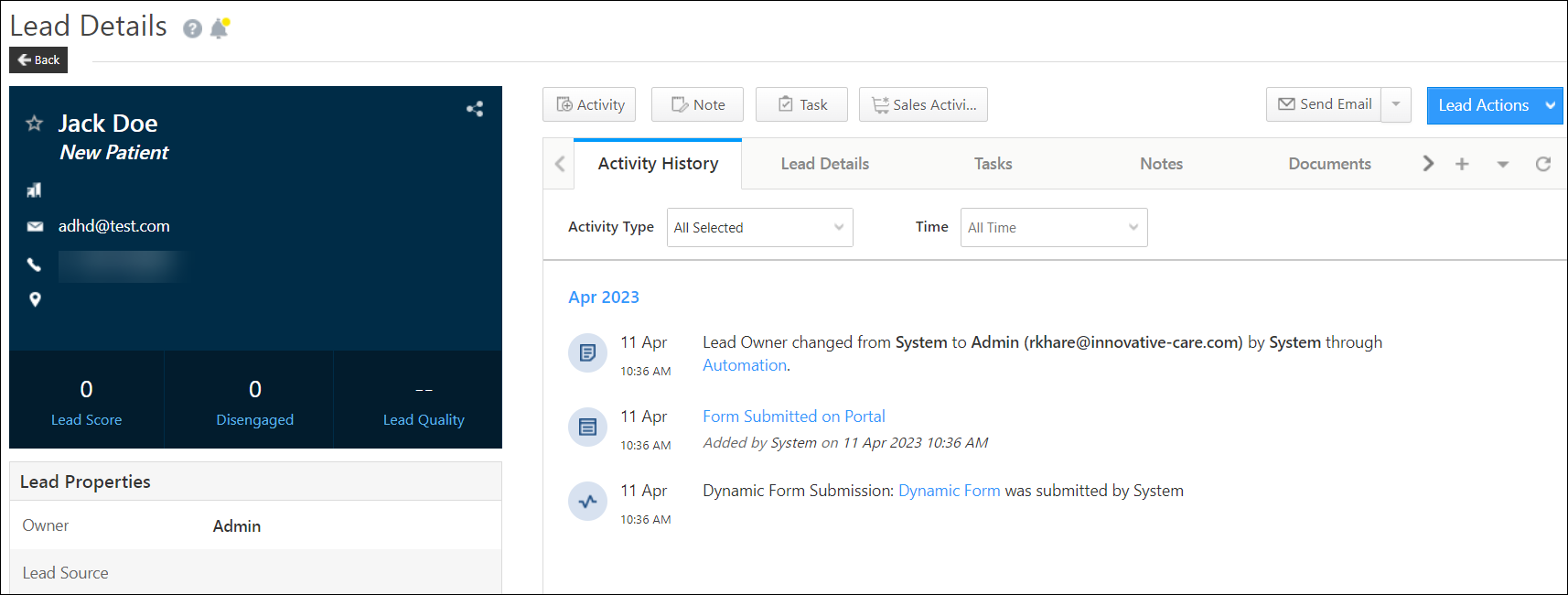
  • If you want to display activities between two LeadSquared accounts, the Custom Tab Connector must be installed and configured on the account in which you want to display the activities.


3. How it Works

Once this connector is installed and configured, an app URL is generated. This URL must be configured using the Custom Tab Connector in the account you want to display the activity history in. You can also use the URL to render the activity history page in a third-party application.

On the LeadSquared account where you want to display the activities –

  1. Install and configure the Activity History Tab Connector.
    1. Add the API Access Key and Secret Key of the second account, from where you want to fetch activities.
    2. Select the activities you want to display, along with the unique lead field (the search key), and Save the details. The app URL is generated.
  2. On the Custom Tab Connector, create a new tab and add the app URL. To know how to create a custom tab, please refer to Custom Tab Connector.
  3. Navigate to the Lead Details page. You can view the list of activities that are fetched for all the common leads.

To display these activities outside LeadSquared, you can similarly embed the Activity History Connector app URL on any third-party application.


4. Install the Connector

On the LeadSquared account in which you want to display the activities –

  1. From the main menu, navigate to Apps>Apps Marketplace.
  2. Search for Activity History Tab Connector, and click Install.
    • Alternatively, you can find the connector on the left panel, under UI Customization.
  3. Once installed, hover your cursor over settings, and click Configure.

LeadSquared Activity History Tab Connector


5. Configure the Connector

After the connector is installed, add the API Access Key and Secret Key of the second account, from where you want to fetch the activities.

  1. On the Configure Activity History Tab Connector pop-up, click Create Activity History Tab.
  2. On the Activity History Tab on Lead Details screen, provide the following details –
    1. Tab Name – A display name for the tab.
    2. Access Key & Secret Key – The API Access Key and Secret Key of the second account. To obtain these keys, navigate to My Profile>Settings>API and Webhooks>API Access Keys.
    3. Select Unique Field – Select the unique lead field which will be used to identify common leads between both accounts. You can choose between Email Address and Phone.
    4. Select Activity Types – Select the activity type you want to display on the custom tab. You can select both activity types.
  3. Once you’re done, click Save. You’ll get a message stating the “App URL Created Successfully”. Copy and save this URL.

LeadSquared Activity History Tab Connector


6. Create Custom Tab

In order to display the activities added to common leads, create a custom tab.

Note: This step assumes that you’ve already enabled and installed the Custom Tab Connector on the account in which you want to display the activities.
  1. Navigate to Apps>Apps Marketplace, and search for the Custom Tab Connector.
  2. Hover your cursor over Settings icon, and click Configure.
  3. On the Configure Custom Tab Connector pop-up –
    1. Title – Enter the display title for the custom tab.
    2. URL – Paste the app URL you copied in the previous step.
  4. From Show Tab In, choose where you want to display this tab.
  5. Once you’re done, click Save.

Activity History Tab Connector


7. View Activities

  1. Navigate to the Manage Leads page, and click on any common lead present in both accounts.
  2. On the Lead Details page, click the custom tab you created in the previous step.
  3. Here, you can view the list of activities that were posted on this lead in the second account.

LeadSquared Activity History Tab Connector


Any Questions?

Did you find this article helpful? Please let us know any feedback you may have in the comments section below. We’d love to hear from you and help you out!

Error Notifications When Capturing Leads from Third Party Apps

Error Notifications

When capturing leads from a thrid-party application, if your leads are not being captured as intended, we’ll notify you via email, about the reasons behind this failure.

  • Sync Job Failed – In this instance, the Sync API or the Transformation API have failed, and no leads have been pulled from the data source.

LeadSquared Lead Capture Connector

  • Partial Sync Error Notification – In this instance, more than 30% of the total leads pulled have an error.

LeadSquared Lead Capture Connector

  • Sync Job Failed continuously – In this instance, the sync job has failed to fetch any leads in five continuous attempts.

LeadSquared Lead Capture Connector

  • Configuration/Sync Disabled – If any user has manually disabled the sync process, we will notify you about the same. This is done to ensure that you’re aware of the update, and to remind you to enable the sync process before you restart the lead capture process.

LeadSquared Lead Capture Connector


Any Questions?

Did you find this article helpful? Please let us know any feedback you may have in the comments section below. We’d love to hear from you and help you out!
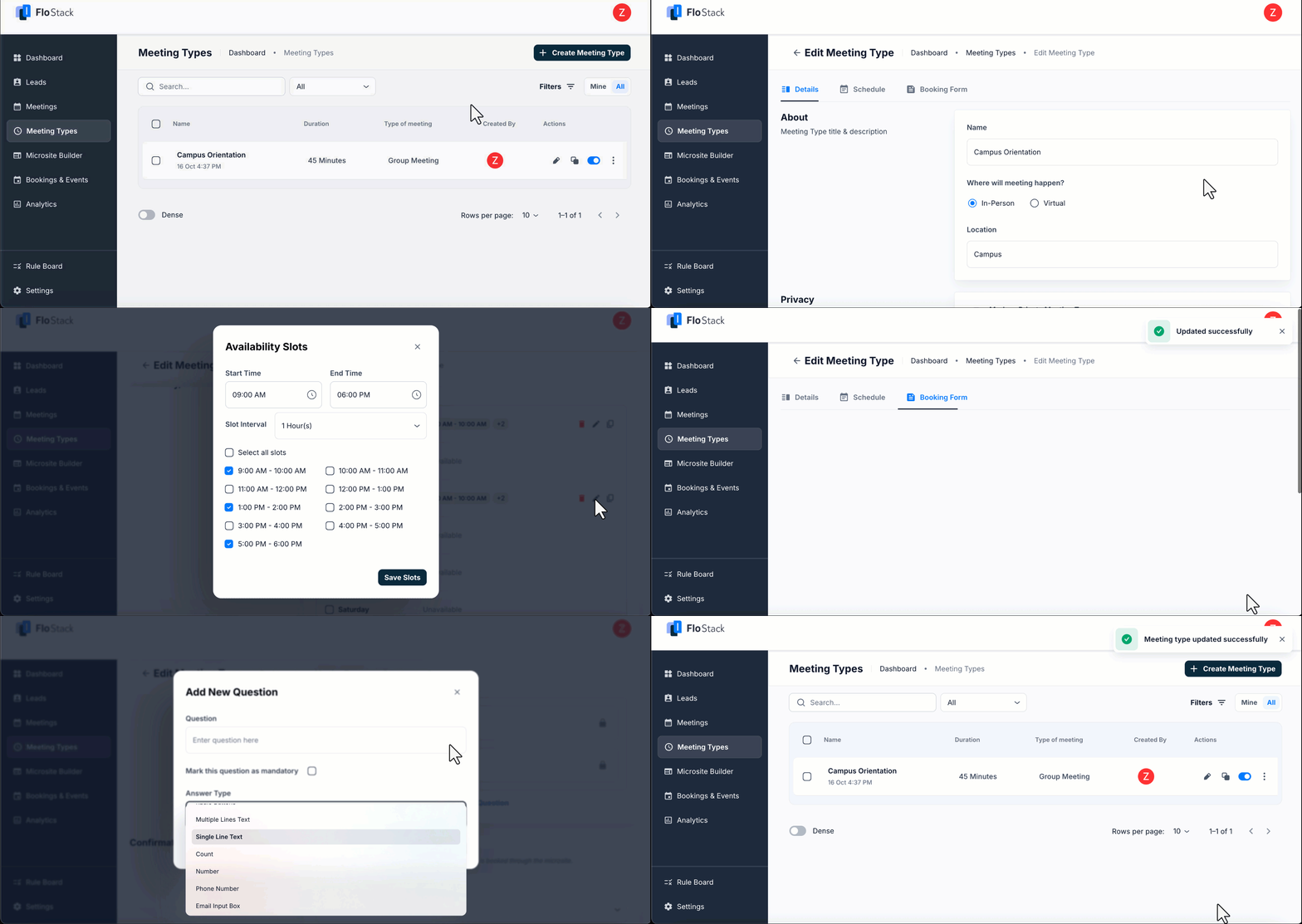
Integrate IndiaMART with LeadSquared

1. Feature Overview

This connector captures leads periodically from your IndiaMART account to LeadSquared. Once the leads are synced, you can leverage LeadSquared’s CRM features to nurture and convert your leads.


2. Prerequisites

  • You must be the Administrator of your LeadSquared account.
  • You must have an active IndiaMART account.
  • This is a paid feature. To enable it, reach out to your account manager, or write to support@leadsquared.com.


3. How it Works

To pull leads, activities and tasks from IndiaMART to LeadSquared, configure the IndiaMART connector instance, and add your IndiaMART account credentials. Once this is done, enable sync for the connector instance in LeadSquared. This will begin the lead, activity and task capture process.


4. Installation

  1. Navigate to Apps>Apps Marketplace.
  2. Search for IndiaMART, and click Install.
    • Alternatively, you can find the connector on the left panel, under Lead Capture.
  3. Once installed, hover your cursor over , and click Configure.

LeadSquared - Indiamart Installation


5. Configure the Connector

Once you’ve installed the connector, on the Configure IndiaMART pop-up, configure the connector access for the non-Admin users in your account. Only those users for whom access is granted can view and access the connector (under the Apps main menu).

  1. Select if you want to grant Connector Access that’s Based on Role or Advanced (User Level).
    • Based on Role – From the Specify Roles dropdown, select the LeadSquared user roles that can use the connector.
    • Advanced (User Level) – From the Advanced (User Level) dropdown, select a user boolean field. Based on the value entered in the selected boolean field, the user can access the connector (e.g., for the user Sam, if the “Is Employee” boolean user field contains the value “Yes”, then this user can access the connector).
  2. Once you’re done, click Save Details. To continue the configuration, refer to the below sections.
Note: By default, all Admin users will have access to the connector.
LeadSquared - Indiamart initial configurations


6. Admin Configurations

To configure the connector settings to pull data from IndiaMART, navigate to Apps>IndiaMART.

6.1 Settings

On the Settings screen, enter the following details –

LeadSquared - Indiamart settings

Property Description
v2 CRM Key Reach out to your account representative from IndiaMART to obtain the v2 CRM key.
Lead Source Enter the lead source through which leads were captured (e.g., IndiaMART, email campaign, etc.). This detail will be displayed on the Lead Details page, under Lead Source.
Default Country Code If the lead’s mobile number is captured without a country code, then the default country code that’s selected from the dropdown will be added to the lead’s mobile number.
Select Time Zone The time zone of your IndiaMART account.
Lead Capture Search By Criteria To avoid duplicate leads, you must select one unique lead field (e.g., email Id, mobile number, PAN number, etc.) as the search key. This will be used to identify and pull leads from IndiaMART.

To know how to mark a LeadSquared lead field as unique, please refer to How to Make a Custom Field Unique.

Select User to Notify on Failure If there is an error in fetching leads, the selected user will receive a failure message via email. You can select a user from the list of all the users available in your LeadSquared account.

To know more about the type of errors, please refer to Error Notifications.

Sync Frequency By default, we’ve selected a 3-hours frequency to pull data from IndiaMART. You can use the ‘Hours’ and ‘Minutes’ dropdowns to select a custom interval, based on which lead data will be pulled.

Once you’re done entering all the details, click Save & Next.


6.2 Lead/Contact Entity

Based on the Lead Capture Search By criteria selected (email Id, phone number, etc.), LeadSquared identifies and captures leads from your IndiaMART account. Lead capture is enabled by default, and it cannot be disabled.

Select one of the following options to configure the connector’s Sync Behaviour 

  • Capture (Create and Update existing) Record – Leads that only exist in your IndiaMART account (but not in your LeadSquared account) will get created in LeadSquared. Leads that exist in both your IndiaMART and LeadSquared accounts will get updated.
  • Create only new record – Leads that only exist in your IndiaMART account (but not in your LeadSquared account) will get created in LeadSquared.
  • Update only existing record – Leads that exist in both your IndiaMART and LeadSquared accounts will get updated in LeadSquared.
  • Do Nothing – When this option is selected, no action will be performed when a lead is created or updated in your IndiaMART account.


6.3 Mapping & Manage Sync

On the Entity Options screen, click Edit Mapping. The IndiaMART system fields mapped to the corresponding LeadSquared lead fields are visible. This mapping is carried out by default. If required, you can change or update the default field mapping.

  • To provide a default value for any field, enter the value under Default Value.
    • If the data provider doesn’t send data for any lead field, then the default value will get assigned to that specific field. But if the field already has an existing value, then the default value will be ignored.
  • To disable lead data capture for any field, disable the Zoom slider.
  • You can also mark and update a unique lead field as the search key from this screen, by clicking unique icon.
  • To create a custom IndiaMART field, click the Add Custom button.
    1. Once this field is created, you must map it to the relevant LeadSquared lead field.
    2. After the field is mapped, to save the custom field, click Google.
    3. To delete a custom field, click .

LeadSquared - Indiamart Mapping


6.4 Enable Sync

After mapping the IndiaMART fields to the corresponding LeadSquared lead fields, enable lead sync. To do this, from the More Actions dropdown, click the Slider slider, and then click Save. Once the sync is enabled, LeadSquared will pull leads from IndiaMART every 3-hours (or depending on the Sync Frequency configured).

LeadSquared - Indiamart Sync

You can also manually sync leads, outside of the Sync Frequency that’s configured. This is especially useful if you have old/legacy lead data in your IndiaMART account.

  1. From the More Actions dropdown, click Sync Manually.
  2. On the Sync Manually pop-up, enter Start Date, End Date, and Time during which the lead data was captured in your IndiaMART account.
  3. Once you’re done, click Submit. The leads that were captured during the selected time frame will be synced to LeadSquared.

Note:

  • It is recommended you run a manual sync job right after you configure the connector. This will ensure all the historic lead data available on your IndiaMART account will be synced to LeadSquared.
  • The Sync Start Time & End Time must be within a date range of seven days (e.g., from 20th July to 26th July).
  • You can sync up to 4,000 leads at once.

LeadSquared - Indiamart manual sync


7. View Logs

Here, you can view logs of all the sync jobs that have taken place. View new leads, updated leads, lead capture errors and total lead capture events. You can also view the lead sync response and lead capture job status.

  1. Navigate to Apps>IndiaMART.
  2. Click the More Actions dropdown and select View Logs.
  3. You can filter the logs by selecting a date range, and by selecting a Job Status (“All”, “Success” and “Failure”).
    • The maximum date range you can select is the last 60 days.
  4. You can view the sync status of the leads captured across the following tiles –
    • New Leads – List of all the new leads that have been pulled by LeadSquared during the selected date range.
    • Updated Leads – A list of all the –
      • Duplicate leads that were created with the same Search by Criteria value (e.g., with the same Email Id, Mobile Number, etc.).
      • Leads that previously contained an error, which were fixed and synced successfully.
    • Errors – The list of leads that have not been captured due to mapping errors (e.g., when a boolean field is mapped to an integer field, etc.).
    • Total Events – A list of all the lead capture events that have taken place.
  5. To view the Sync Response details, under Sync API Response, click the response.
    • Here, you can view the response status, the API URL, the request and the response.
    • The responses that are successful will contain the details of the leads that have been pulled from IndiaMART.
    • You can also view the lead capture response under Created, Updated and Errors, by clicking Information.
Note: For a response that contains an error, the reason for the error is listed in the response. Once you fix it, you can click the Retry button to perform the sync again.

LeadSquared - Indiamart View logs


8. Other Actions

You can edit or delete the IndiaMART connector instance you created.

  1. Navigate to Apps>Apps Marketplace and click the IndiaMART connector.
  2. On the IndiaMART connector page, click Settings.
  3. From the list of options, you can perform the following actions –
    • Add or edit Configurations
    • Disable the connector
    • Remove the connector

LeadSquared - Indiamart Other actions


9. View Reports

You can view the total number of leads that have been pulled from IndiaMART by referring to the Lead Source report. To know more, please refer to How to track the source of your Leads using Lead Source Report?

LeadSquared Integration with IndiaMART


Any Questions?

Did you find this article helpful? Please let us know any feedback you may have in the comments section below. We’d love to hear from you and help you out!

Integrate Commonfloor with LeadSquared

1. Feature Overview

This connector captures leads periodically from your Commonfloor account to LeadSquared. Once the leads are synced, you can leverage LeadSquared’s CRM features to nurture and convert your leads.


2. Prerequisites

  • You must be the Administrator of your LeadSquared account.
  • You must have an active Commonfloor account.
  • This is a paid feature. To enable it, reach out to your account manager, or write to support@leadsquared.com.


3. How it Works

To pull leads, activities and tasks from Commonfloor to LeadSquared, configure the Commonfloor connector instance, and add your Commonfloor account credentials. Once this is done, enable sync for the connector instance in LeadSquared. This will begin the lead, activity and task capture process.


4. Installation

  1. Navigate to Apps>Apps Marketplace.
  2. Search for Commonfloor, and click Install.
    • Alternatively, you can find the connector on the left panel, under Lead Capture.
  3. Once installed, hover your cursor over , and click Configure.

LeadSquared - Commonfloor navigation


5. Configure the Connector

Once you’ve installed the connector, on the Configure Commonfloor pop-up, configure the connector access for the non-Admin users in your account. Only those users for whom access is granted can view and access the connector (under the Apps main menu).

  1. Select if you want to grant Connector Access that’s Based on Role or Advanced (User Level).
    • Based on Role – From the Specify Roles dropdown, select the LeadSquared user roles that can use the connector.
    • Advanced (User Level) – From the Advanced (User Level) dropdown, select a user boolean field. Based on the value entered in the selected boolean field, the user can access the connector (e.g., for the user Sam, if the “Is Employee” boolean user field contains the value “Yes”, then this user can access the connector).
  2. Once you’re done, click Save Details. To continue the configuration, refer to the below sections.
Note: By default, all Admin users will have access to the connector.
LeadSquared - Commonfloor initial configurations


6. Admin Configurations

To configure the connector settings to pull data from Commonfloor, navigate to Apps>Commonfloor.

6.1 Settings

On the Settings screen, enter the following details –

LeadSquared - Commonfloor settings

Property Description
Id Enter your Commonfloor account Id.
Key Enter your Commonfloor account key.
Lead Source Enter the lead source through which leads were captured (e.g., Commonfloor, email campaign, etc.). This detail will be displayed on the Lead Details page, under Lead Source.
Default Country Code If the lead’s mobile number is captured without a country code, then the default country code that’s selected from the dropdown will be added to the lead’s mobile number.
Select Time Zone The time zone of your Commonfloor account.
Lead Capture Search By Criteria To avoid duplicate leads, you must select one unique lead field (e.g., email Id, mobile number, PAN number, etc.) as the search key. This will be used to identify and pull leads from Commonfloor.

To know how to mark a LeadSquared lead field as unique, please refer to How to Make a Custom Field Unique.

Lead Capture Secondary Search By Criteria If lead identification and capture through the primary Search By criteria fails, it will be re-attempted using the secondary Search By criteria.
Select User to Notify on Failure If there is an error in fetching leads, the selected user will receive a failure message via email. You can select a user from the list of all the users available in your LeadSquared account.

To know more about the type of errors, please refer to Error Notifications.

Sync Frequency By default, we’ve selected a 30-minutes frequency to pull data from Commonfloor. You can use the ‘Hours’ and ‘Minutes’ dropdowns to select a custom interval, based on which lead data will be pulled.

Once you’re done entering all the details, click Save & Next.


6.2 Mapping & Manage Sync

On the Entity Options screen, click Edit Mapping. The Commonfloor system fields mapped to the corresponding LeadSquared lead fields are visible. This mapping is carried out by default. If required, you can change or update the default field mapping.

  • To provide a default value for any field, enter the value under Default Value.
    • If the data provider doesn’t send data for any lead field, then the default value will get assigned to that specific field. But if the field already has an existing value, then the default value will be ignored.
  • To disable lead data capture for any field, disable the Zoom slider.
  • You can also mark and update a unique lead field as the search key from this screen, by clicking unique icon.
  • To create a custom Commonfloor field, click the Add Custom button.
    1. Once this field is created, you must map it to the relevant LeadSquared lead field.
    2. After the field is mapped, to save the custom field, click Google.
    3. To delete a custom field, click .

LeadSquared - Commonfloor mapping


6.3 Enable Sync

After mapping the Commonfloor fields to the corresponding LeadSquared lead fields, enable lead sync. To do this, from the More Actions dropdown, click the Slider slider. Once the sync is enabled, LeadSquared will pull leads from Commonfloor every 30 minutes (or depending on the Sync Frequency configured).

LeadSquared - Commonfloor sync

You can also manually sync leads, outside of the Sync Frequency that’s configured. This is especially useful if you have old/legacy lead data in your Commonfloor account.

  1. From the More Actions dropdown, click Sync Manually.
  2. On the Sync Manually pop-up, enter Start Date, End Date, and Time during which the lead data was captured in your Commonfloor account.
  3. Once you’re done, click Submit. The leads that were captured during the selected time frame will be synced to LeadSquared.

Note:

  • It is recommended you run a manual sync job right after you configure the connector. This will ensure all the historic lead data available on your Commonfloor account will be synced to LeadSquared.
  • The Sync Start Time & End Time must be within a date range of seven days (e.g., from 20th July to 26th July).
  • You can sync up to 4,000 leads at once.

LeadSquared - Commonfloor Sync manually


7. View Logs

Here, you can view logs of all the sync jobs that have taken place. View new leads, updated leads, lead capture errors and total lead capture events. You can also view the lead sync response and lead capture job status.

  1. Navigate to Apps>Commonfloor.
  2. Click the More Actions dropdown and select View Logs.
  3. You can filter the logs by selecting a date range, and by selecting a Job Status (“All”, “Success” and “Failure”).
    • The maximum date range you can select is the last 60 days.
  4. You can view the sync status of the leads captured across the following tiles –
    • New Leads – List of all the new leads that have been pulled by LeadSquared during the selected date range.
    • Updated Leads – A list of all the –
      • Duplicate leads that were created with the same Search by Criteria value (e.g., with the same Email Id, Mobile Number, etc.).
      • Leads that previously contained errors, which were fixed and synced successfully.
    • Errors – The list of leads that have not been captured due to mapping errors (e.g., when a boolean field is mapped to an integer field, etc.).
    • Total Events – A list of all the lead capture events that have taken place.
  5. To view the Sync Response details, under Sync API Response, click the response.
    • Here, you can view the response status, the API URL, the request and the response.
    • The responses that are successful will contain the details of the leads that have been pulled from Commonfloor.
    • You can also view the lead capture response under Created, Updated and Errors, by clicking Information.
Note: For a response that contains an error, the reason for the error is listed in the response. Once you fix it, you can click the Retry button to perform the sync again.

LeadSquared - commonfloor view logs


8. Other Actions

You can edit or delete the Commonfloor connector instance you created.

  1. Navigate to Apps>Apps Marketplace and click the Commonfloor connector.
  2. On the Commonfloor connector page, click Settings.
  3. From the list of options, you can perform the following actions –
    • Add or edit Configurations
    • Disable the connector
    • Remove the connector

LeadSquared - Commonfloor other actions


9. View Reports

You can view the total number of leads that have been pulled from Commonfloor by referring to the Lead Source report. To know more, please refer to How to track the source of your Leads using Lead Source Report?

LeadSquared Integration with Commonfloor


Any Questions?

Did you find this article helpful? Please let us know any feedback you may have in the comments section below. We’d love to hear from you and help you out!
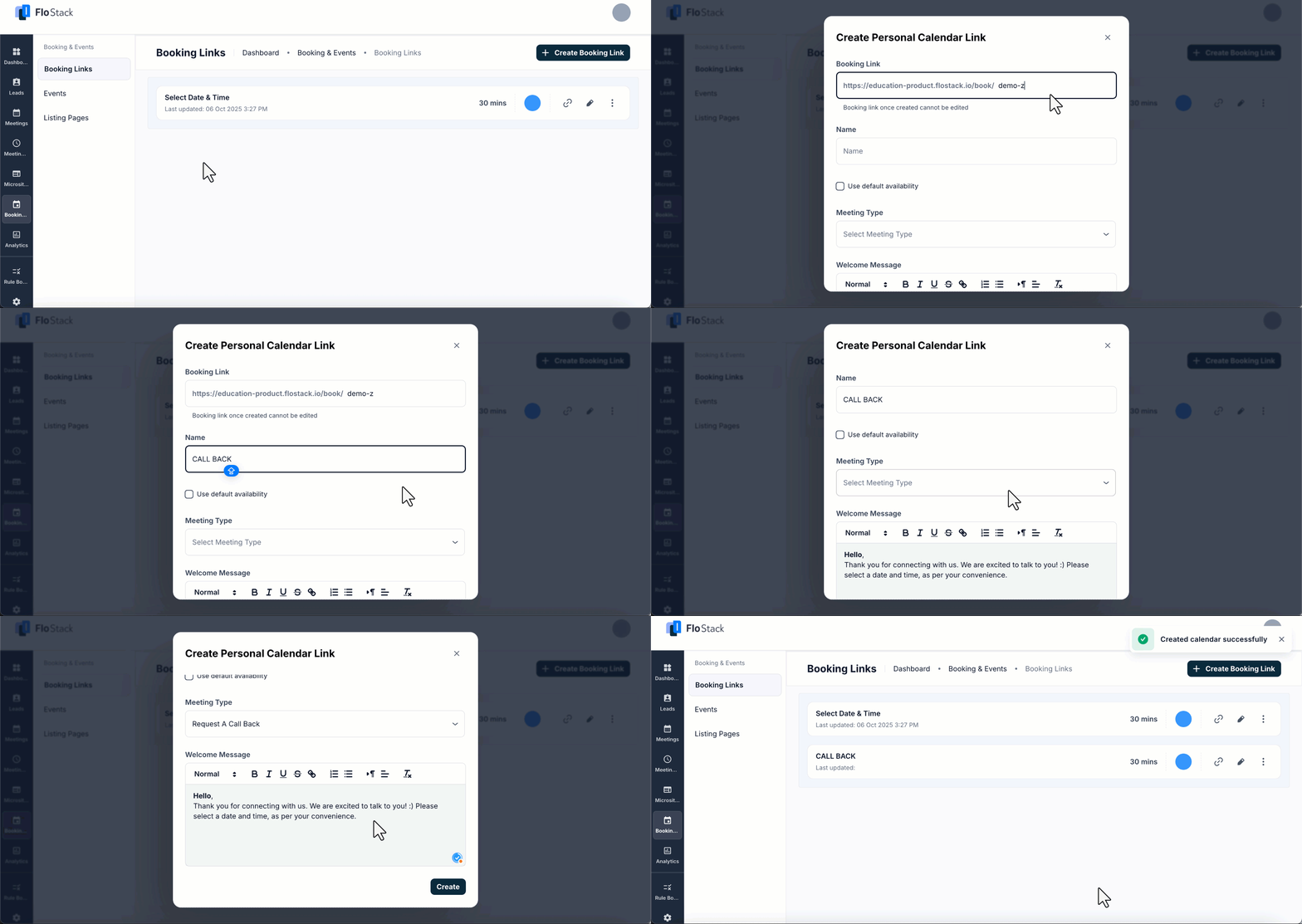
Integrate Housing.com with LeadSquared

1. Feature Overview

This connector captures leads periodically from your Housing.com account to LeadSquared. Once the leads are synced, you can leverage LeadSquared’s CRM features to nurture and convert your leads.


2. Prerequisites

  • You must be the Administrator of your LeadSquared account.
  • You must have an active Housing.com account.
  • This is a paid feature. To enable it, reach out to your account manager, or write to support@leadsquared.com.


3. How it Works

To push lead data from Housing.com to your LeadSquared account, configure the Housing.com connector instance. Once configured, enable the connector sync.

During configuration, a webhook URL is generated in LeadSquared. Copy this URL and set it up in your Housing.com account. Once it’s set up, the lead capture process is initiated.


4. Installation

  1. Navigate to Apps>Apps Marketplace.
  2. Search for Housing, and click Install.
    • Alternatively, you can find the connector on the left panel, under Lead Capture.
  3. Once installed, hover your cursor over , and click Configure.

LeadSquared - Housing installation


5. Configure the Connector

Once you’ve installed the connector, on the Configure Housing pop-up, configure the connector access for the non-Admin users in your account. Only those users for whom access is granted can view and access the connector (under the Apps main menu).

  1. Select if you want to grant Connector Access that’s Based on Role or Advanced (User Level).
    • Based on Role – From the Specify Roles dropdown, select the LeadSquared user roles that can use the connector.
    • Advanced (User Level) – From the Advanced (User Level) dropdown, select a user boolean field. Based on the value entered in the selected boolean field, the user can access the connector (e.g., for the user Sam, if the “Is Employee” boolean user field contains the value “Yes”, then this user can access the connector).
  2. Once you’re done, click Save Details. To continue the configuration, refer to the below sections.
Note: By default, all Admin users will have access to the connector.
LeadSquared - housing initial configurations


6. Admin Configurations

After installation, navigate to Apps>Housing and configure the connector settings in order to pull data from Housing.com.

6.1 Settings

On the Settings screen, enter the following details –

LeadSquared - Housing configurations

Property Description
Housing Id Enter your Housing.com account Id.
Housing Secret Key Enter your Housing.com account secret key.
Lead Source Enter the lead source through which leads were captured (e.g., Housing.com, email campaign, etc.). This detail will be displayed on the Lead Details page, under Lead Source.
Default Country Code If the lead’s mobile number is captured without a country code, then the default country code that’s selected from the dropdown will be added to the lead’s mobile number.
Select Time Zone The time zone of your Housing.com account.
Lead Capture Search By Criteria To avoid duplicate leads, you must select one unique lead field (e.g., email Id, mobile number, PAN number, etc.) as the search key. This will be used to identify and pull leads from Housing.com.

To know how to mark a LeadSquared lead field as unique, please refer to How to Make a Custom Field Unique.

Select User to Notify on Failure If there is an error in fetching leads, the selected user will receive a failure message via email. You can select a user from the list of all the users available in your LeadSquared account.

To know more about the type of errors, please refer to Error Notifications.

Sync Frequency By default, we’ve selected a 3-hour frequency to pull data from Housing.com. You can use the ‘Hours’ and ‘Minutes’ dropdowns to select a custom interval, based on which lead data will be pulled.

Once you’re done entering all the details, click Save & Next.


Mapping & Manage Sync

Once you’re done with the basic settings, click Entity Options. On the Mapping screen, the Housing.com system fields mapped to the corresponding LeadSquared lead fields are visible. This mapping is carried out by default. If required, you can change or update the default field mapping.

  • To provide a default value for any field, enter the value under Default Value.
    • If the data provider doesn’t send data for any lead field, then the default value will get assigned to that specific field. But if the field already has an existing value, then the default value will be ignored.
  • To disable lead data capture for any field, disable the Zoom slider.
  • You can also mark and update a unique lead field as the search key from this screen, by clicking unique icon.
  • To create a custom Housing.com field, click the Add Custom button.
    1. Once this field is created, you must map it to the relevant LeadSquared lead field.
    2. After the field is mapped, to save the custom field, click Google.
    3. To delete a custom field, click .

LeadSquared - Housing mapping


Enable Sync

After mapping the Housing.com fields to the corresponding LeadSquared lead fields, enable lead sync. To do this, from the More Actions dropdown, click the Slider slider, and then click Save. Once the sync is enabled, LeadSquared will pull leads from Housing.com every 3-hours (or depending on the Sync Frequency configured).

LeadSquared - Housing sync

You can also manually sync leads, outside of the Sync Frequency that’s configured. This is especially useful if you have old/legacy lead data in your Housing.com account.

  1. From the More Actions dropdown, click Sync Manually.
  2. On the Sync Manually pop-up, enter Start Date, End Date, and Time during which the lead data was captured in your Housing.com account.
  3. Once you’re done, click Submit. The leads that were captured during the selected time frame will be synced to LeadSquared.

Note:

  • It is recommended you run a manual sync job right after you configure the connector. This will ensure all the historic lead data available on your Housing.com account will be synced to LeadSquared.
  • The Sync Start Time & End Time must be within a date range of seven days (e.g., from 20th July to 26th July).
  • You can sync up to 4,000 leads at once.

LeadSquared - Housing manual sync


7. View Logs

Here, you can view logs of all the sync jobs that have taken place. View new leads, updated leads, lead capture errors and total lead capture events. You can also view the lead sync response and lead capture job status.

  1. Navigate to Apps>Housing.
  2. Click the More Actions dropdown and select View Logs.
  3. You can filter the logs by selecting a date range, and by selecting a Job Status (“All”, “Success” and “Failure”).
    • The maximum date range you can select is the last 60 days.
  4. You can view the sync status of the leads captured across the following tiles –
    • New Leads – List of all the new leads that have been pulled by LeadSquared during the selected date range.
    • Updated Leads – A list of all the –
      • Duplicate leads that were created with the same Search by Criteria value (e.g., with the same Email Id, Mobile Number, etc.).
      • Leads that previously contained an error, which were fixed and synced successfully.
    • Errors – The list of leads that have not been captured due to mapping errors (e.g., when a boolean field is mapped to an integer field, etc.).
    • Total Events – A list of all the lead capture events that have taken place.
  5. To view the Sync Response details, under Sync API Response, click the response.
    • Here, you can view the response status, the API URL, the request and the response.
    • The responses that are successful will contain the details of the leads that have been pulled from Housing.com.
    • You can also view the lead capture response under Created, Updated and Errors, by clicking Information.
Note: For a response that contains an error, the reason for the error is listed in the response. Once you fix it, you can click the Retry button to perform the sync again.

LeadSquared - Housing view logs


8. Other Actions

You can edit or delete the Housing.com connector instance you created. To do so –

  1. Navigate to Apps>Apps Marketplace and click the Housing connector.
  2. On the Housing connector page, click Settings.
  3. From the list of options, you can perform the following actions –
    • Add or edit Configurations
    • Disable the connector
    • Remove the connector

LeadSquared - Housing other actions


9. View Reports

You can view the total number of leads that have been pulled from Housing.com by referring to the Lead Source report. To know more, please refer to How to track the source of your Leads using Lead Source Report?

LeadSquared Integration with Housing.com


Any Questions?

Did you find this article helpful? Please let us know any feedback you may have in the comments section below. We’d love to hear from you and help you out!

Integrate 99acres with LeadSquared

1. Feature Overview

This connector captures leads from your 99acres account to LeadSquared. You can configure the connector to capture leads periodically or in real-time, from your 99acres account. Once the leads are captured, you can leverage LeadSquared’s CRM features to nurture and convert your leads.


2. Prerequisites

  • You must be the Administrator of your LeadSquared account.
  • You must have an active 99acres account.
  • This is a paid feature. To enable it, reach out to your account manager, or write to support@leadsquared.com.


3. How it Works

Real-time Sync

To push lead data from your 99acres account to your LeadSquared account, configure the 99acres connector. Once configured, enable the connector sync.

During configuration, a webhook URL is generated in LeadSquared. Copy this URL and set it up in your 99acres account. Once it’s set up, the lead capture process is initiated.


Periodic Sync

To pull leads, activities and tasks from 99acres to LeadSquared, configure the 99acres connector instance, and add your 99acres account credentials. Once this is done, enable sync for the connector in LeadSquared. This will begin the lead, activity and task capture process.


4. Installation

  1. Navigate to Apps>Apps Marketplace.
  2. Search for 99acres, and click Install.
    • Alternatively, you can find the connector on the left panel, under Lead Capture.
  3. Once installed, hover your cursor over , and click Configure.

LeadSquared - 99acres installation


5. Configure the Connector

Once you’ve installed the connector, on the Configure 99acres pop-up, configure the connector access for the non-Admin users in your account. Only those users for whom access is granted can view and access the connector (under the Apps main menu).

  1. Select if you want to grant Connector Access that’s Based on Role or Advanced (User Level).
    • Based on Role – From the Specify Roles dropdown, select the LeadSquared user roles that can use the connector.
    • Advanced (User Level) – From the Advanced (User Level) dropdown, select a user boolean field. Based on the value entered in the selected boolean field, the user can access the connector (e.g., for the user Sam, if the “Is Employee” boolean user field contains the value “Yes”, then this user can access the connector).
  2. Once you’re done, click Save Details. To continue the configuration, refer to the below sections.
Note: By default, all Admin users will have access to the connector.

LeadSquared - 99acres initial configurations


6. Configuration – Real-time Sync

After installation, navigate to Apps>99acres and select Real-time Sync. Then, configure the connector settings to push data from 99acres –

6.1 Basic Details

Enter the following details –

LeadSquared - 99acres settings

Property Description
Lead Source Enter the lead source through which the leads were captured (e.g., 99acres, email campaign, etc.). This detail will be displayed on the Lead Details page, under Lead Source.
Default Country Code If the lead’s mobile number is captured without a country code, then the default country code that’s selected from the dropdown will be added to the lead’s mobile number.
Select Time Zone The time zone of your 99acres account.
Lead Capture Search By Criteria To avoid duplicate leads, you must select one unique lead field (e.g., email Id, mobile number, PAN number, etc.) as the search key. -This will be used to identify the leads pushed from 99acres.

To know how to mark a LeadSquared lead field as unique, please refer to How to Make a Custom Field Unique.

Lead Capture Secondary Search By Criteria If lead identification and capture through the primary Search By criteria fails, it will be re-attempted using the secondary Search By criteria.
Select User to Notify on Failure If there is an error in fetching leads, the selected user will receive a failure message via email. You can select a user from the list of all the users available in your LeadSquared account.

To know more about the type of errors, please refer to Error Notifications.

Once you’re done entering all the details, click Save & Next.


6.2 Mapping

On the Mapping screen, the 99acres system fields mapped to the corresponding LeadSquared lead fields are visible. This mapping is carried out by default. If required, you can change or update the default field mapping.

  • To provide a default value for any field, click  , enter the value under Default Value, and click Google.
    • If the data provider doesn’t send data for any lead field, then the default value will get assigned to that specific field. But if the field already has an existing value, then the default value will be ignored.
  • To disable lead data capture for any field, disable the Zoom slider.
  • You can also mark and update a unique lead field as the search key from this screen, by clicking unique icon.
  • To create a custom 99acres field, click the Add Custom button.
    1. Once this field is created, you must map it to the relevant LeadSquared lead field.
    2. After the field is mapped, to save the custom field, click Google.
    3. To delete a custom field, click .

Once you’re done mapping, click Save & Next.

LeadSquared - 99acres mapping


6.3 Webhook URL

After you provide basic details and finish field mapping, a custom webhook URL is generated. To automate lead capture, copy this URL and configure it in your 99acres account (reach out to your account manager from 99acres).

After you’ve configured the URL, click More Actions, and enable the sync job. This ensures the data will be pushed to LeadSquared using the webhook configured in 99acres.

LeadSquared - 99acres sync

Note: To know how to configure this Webhook URL in your 99acres account, please get in touch with your account manager from 99acres.

To know more, you can refer to the setup instructions –

Integrate LeadSquared with 99acres


7. Configuration – Periodic Sync

After installation, navigate to Apps>99acres and select Periodic Sync. Then, configure the connector settings to pull data from 99acres –

7.1 Settings

On the Settings screen, enter the following details –

LeadSquared - 99acres periodic settings

Property Description
User Name Enter your 99acres account username.
Password Enter your 99acres account password.
Lead Source Enter the lead source through which the leads were captured (e.g., 99acres, email campaign, etc.). This detail will be displayed on the Lead Details page, under Lead Source.
Default Country Code If the lead’s mobile number is captured without a country code, then the default country code that’s selected from the dropdown will be added to the lead’s mobile number.
Select Time Zone The time zone of your 99acres account.
Lead Capture Search By Criteria To avoid duplicate leads, you must select one unique lead field (e.g., email Id, mobile number, PAN number, etc.) as the search key. This will be used to identify and pull leads from 99acres.

To know how to mark a LeadSquared lead field as unique, please refer to How to Make a Custom Field Unique.

Lead Capture Secondary Search By Criteria If lead identification and capture through the primary Search By criteria fails, it will be re-attempted using the secondary Search By criteria.
Select User to Notify on Failure If there is an error in fetching leads, the selected user will receive a failure message via email. You can select a user from the list of all the users available in your LeadSquared account.

To know more about the type of errors, please refer to Error Notifications.

Sync Frequency By default, we’ve selected a 15-minute frequency to pull data from 99acres. You can use the ‘Hours’ and ‘Minutes’ dropdowns to select a custom interval, based on which lead data will be pulled.

Once you’re done entering all the details, click Save & Next.


6.2 Mapping & Manage Sync

Map Fields

On the Mapping screen, the 99acres system fields mapped to the corresponding LeadSquared lead fields are visible. This mapping is carried out by default. If required, you can change or update the default field mapping.

  • To provide a default value for any field, enter the value under Default Value.
    • If data is not captured for any lead field, then the default value will get assigned to that specific field. But if the field already has an existing value, then the default value will be ignored.
  • To disable lead data capture for any field, disable the Zoom slider.
  • You can also mark and update a unique lead field as the search key from this screen, by clicking unique icon.
  • To create a custom 99acres field, click the Add Custom button.
    1. Once this field is created, you must map it to the relevant LeadSquared lead field.
    2. After the field is mapped, to save the custom field, click Google.
    3. To delete a custom field, click .

LeadSquared - 99acres periodic mapping


Enable Sync

After mapping the 99acres fields to the corresponding LeadSquared lead fields, enable lead sync. To do this, from the More Actions dropdown, click the Slider slider, and then click Save & Close. Once the sync is enabled, LeadSquared will pull leads from 99acres every 15 minutes (or depending on the Sync Frequency configured).

LeadSquared - 99acres periodic sync

You can also manually sync leads, outside of the Sync Frequency that’s configured. This is especially useful if you have old/legacy lead data in your 99acres account.

  1. From the More Actions dropdown, click Sync Manually.
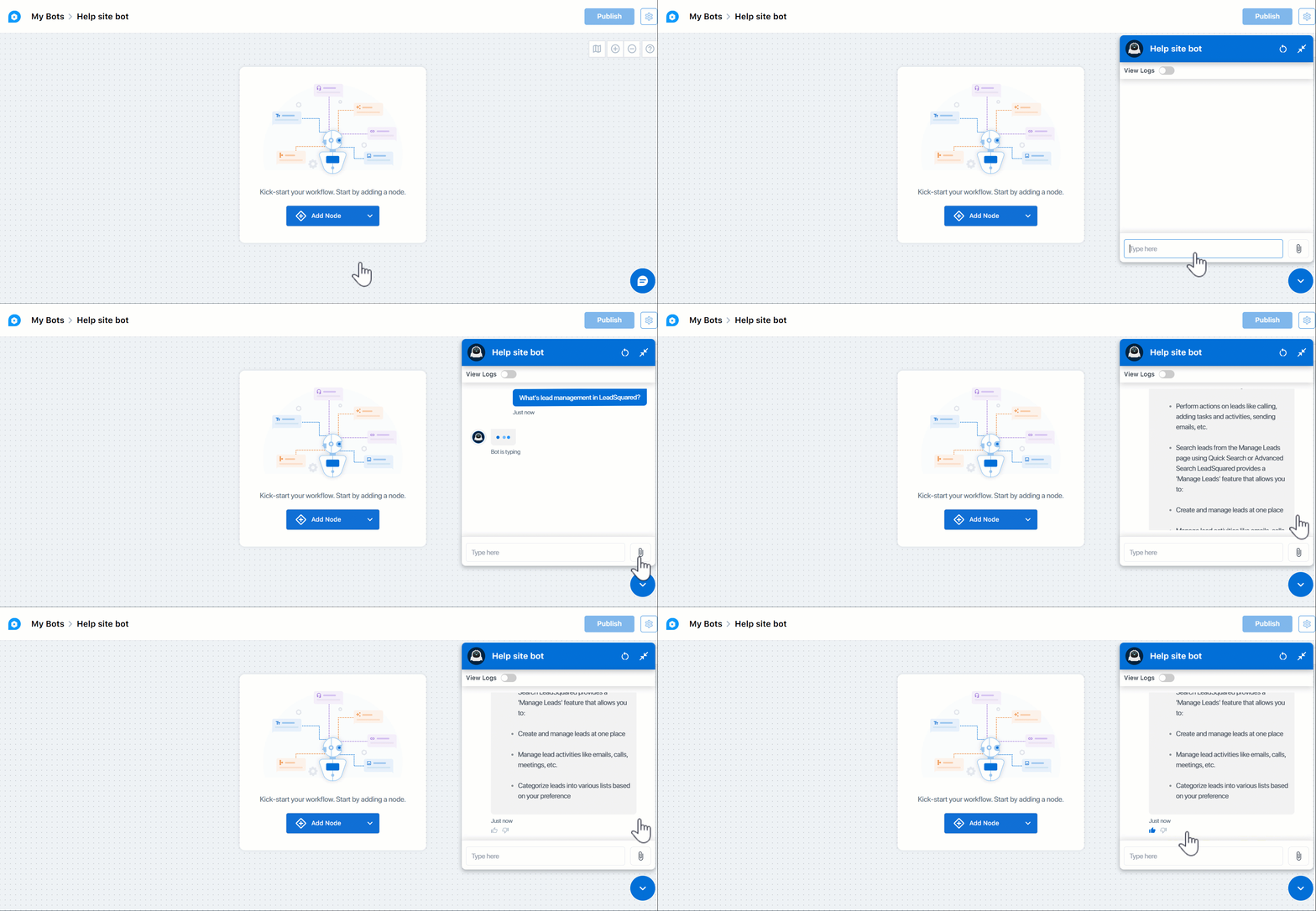
  2. On the Sync Manually pop-up, enter Start Date, End Date, and Time during which the lead data was captured in your 99acres account.
  3. Once you’re done, click Submit. The leads that were captured during the selected time frame will be synced to LeadSquared.

Note:

  • It is recommended you run a manual sync job right after you configure the connector. This will ensure all the historic lead data available on your 99acres account will be synced to LeadSquared.
  • The Sync Start Time & End Time must be within a date range of seven days (e.g., from 20th July to 26th July).
  • You can sync up to 4,000 leads at once.

LeadSquared - 99acres sync manually


7. View Logs

Here, you can view logs of all the sync jobs that have taken place. View new leads, updated leads, lead capture errors and total lead capture events. You can also view the lead sync response and lead capture job status.

  1. Navigate to Apps>99acres.
  2. Click the More Actions dropdown and select View Logs.
  3. You can filter the logs by selecting a date range, and by selecting a Job Status (“All”, “Success” and “Failure”).
    • The maximum date range you can select is the last 60 days.
  4. You can view the sync status of the leads captured across the following tiles –
    • New Leads – List of all the new leads that have been captured by LeadSquared during the selected date range.
    • Updated Leads – A list of all the –
      • Duplicate leads that were created with the same Search by Criteria value (e.g., with the same Email Id, Mobile Number, etc.).
      • Leads that previously contained errors, which were fixed and synced successfully.
    • Errors – The list of leads that have not been captured due to mapping errors (e.g., when a boolean field is mapped to an integer field, etc.).
    • Total Events – A list of all the lead capture events that have taken place.
  5. To view the Sync Response details, under Sync API Response, click the response.
    • Here, you can view the response status, the API URL, the request and the response.
    • The responses that are successful will contain the details of the leads that have been captured from 99acres.
    • You can also view the lead capture response under Created, Updated and Errors, by clicking Information.
Note: For a response that contains an error, the reason for the error is listed in the response. Once you fix it, you can click the Retry button to perform the sync again.

LeadSquared - 99acres view logs


8. Other Actions

You can edit or delete a 99acres connector instance you created.

  1. Navigate to Apps>Apps Marketplace and click the 99acres connector.
  2. On the 99acres connector page, click Settings.
  3. From the list of options, you can perform the following actions –
    • Add or edit Configurations
    • Disable the connector
    • Remove the connector

LeadSquared - 99acres other actions


9. View Reports

You can view the total number of leads that have been captured from 99acres by referring to the Lead Source report. To know more, please refer to How to track the source of your Leads using Lead Source Report?

LeadSquared Integration with 99acres


Any Questions?

Did you find this article helpful? Please let us know any feedback you may have in the comments section below. We’d love to hear from you and help you out!

Portal Redirection & Error Handling

1. Overview

This document outlines the Portal’s redirection rules and provides explanations to assist in debugging your implementation.


2.SmartLink Auto-Evaluation Matrix

When configuring a SmartLink—a feature designed to automatically log users into the Portal—options are available to configure associated activities and opportunities. Once an activity or opportunity is configured within the SmartLink and subsequently triggered via automation, the relevant activity ID or opportunity ID is integrated into the SmartLink’s URL.

Although this table specifically illustrates activity-based SmartLinks, the principles apply similarly to opportunity-based and combined activity-and-opportunity integrations.

Example: Activity-Based SmartLink

Case
Activity Defined
ActivityId Passed
Same Actvity Type
URL Has ActivityId
Valid Link
Outcome
A
Yes
Yes
Yes
Yes
Yes
Configured SmartLink target
B
Yes
Yes
No
No
No
Home Page
C
No
No
No
Yes
No
Home Page
D
No
Yes
No
Yes
Yes
Configured SmartLink target

2.1 SmartLink Failure Routing

If a SmartLink fails for any reason, such as expiration, the user will be redirected to the Portal’s Home Page.

Scenario
Trigger
Outcome
SmartLink failure
SmartLink cannot be validated/resolved
Home Page

3. Duplicate Activity

If duplicate activity handling is configured within the forms (under Portal Settings), this section outlines how the system behaves when a duplicate is detected. Essentially, the system attempts to redirect to the flow configured in the Login or Signup form.

Step
Check
If True
If False
1
Any page with login action exists (by hierarchy)
Go to first page with login action
Home Page
2
Login action type = Link Page
Configured Link Page, likely dashboard
Home Page
3
Login action type = Rule-Based
Execute rules
Home Page
4
Any rule outputs “Link Page”
To Configured Link Page, likely dashboard
Home Page

4. Mismatch / Unauthorized — Routing

If a user attempts to access the Portal using a Lead, Activity, or Opportunity ID not associated with their account, they will be logged out and redirected to the Home Page.

Scenario
Trigger
Outcome
Activity–Lead mismatch
Activity does not belong to the referenced Lead
Logout → Home Page
Unauthorized entity usage
Using another user’s Lead/Activity/Opportunity Id
Logout → Home Page

Set SIERA Dashboard or Report as Your Mobile App Landing Page

1. Feature Overview

Quickly view all the important metrics and insights the moment you launch the mobile app by setting a SIERA report or dashboard as the landing page. This eliminates the need to navigate through widgets and log in once again to view the complete dashboard. When a SIERA dashboard or report is linked through the ‘Custom Menu Tab – External Link’ in the Menu Builder, the app will handle authentication automatically, ensuring users are logged in without needing to re-enter their credentials.

Leadsquared - Set SIERA as Landing Page


2. Prerequisite

Casa must be enabled on your account. Contact support@leadsquared.com to activate it.


3. How It Works

To set a specific report or dashboard as the mobile app’s landing page, start by looking for it in SIERA. Then, copy its URL. Go to Casa Menu Builder and add this URL to the Custom Menu Tab as an External Link. This will make the report or dashboard the first thing you see when you open the mobile app.


4. Select SIERA Report or Dashboard

If you want to select a SIERA Report to be set as the mobile app landing page –

  1. From you LeadSquared Dashboard, navigate to Reports>SIERA.
  2. By default, the Reports page will be opened. If you want to set a SIERA Report as the landing page, click All Reports.
  3. Alongside the relevant report, click the Leadsquared - Set SIERA as Landing Page Actions button and select Copy Embed URL.

Leadsquared - Set SIERA as Landing Page

If you want to select a SIERA Dashboard to be set as the mobile app landing page –

  1. Navigate to Reports>SIERA and select Dashboards on the top-left corner of the screen alongside Reports.
  2. Click All Dashboards, and alongside the relevant dashboard, click the Leadsquared - Set SIERA as Landing Page Actions button and select Copy Embed URL.

Leadsquared - Set SIERA as Landing Page


5. Set SIERA Dashboard or Report as your Mobile App Landing Page

To set a SIERA dashboard or report as the landing page –

  1. Navigate to Apps>Casa from your LeadSquared Dashboard.
  2. From the side menu, under Mobile, select Menu.
  3. Click the edit icon alongside the relevant menu. You will be taken to the Menu Builder.

Leadsquared - Set SIERA as Landing Page

In the Menu Builder –

  1. Select Create New Tab under Custom Menu Tabs.
  2. On the popup, select the relevant icon and add the label.
  3. From the Navigate To dropdown select External Link and under Launch, paste the copied SIERA report or dashboard link.
  4. Ensure that the box alongside “SIERA Report / Dashboard?” is checked. Click Save.

Leadsquared - SIERA as Landing Page

Once the tab is configured –

  1. Click the + plus button alongside the name. The tab will be added to Visible Menu Tabs.
  2. Click and hold the Leadsquared - Set SIERA as Landing Page Move icon alongside the SIERA tab and drag it to the top of the Visible Menu Tabs list. Since the first tab in the list is set as the default landing page, this action will make the SIERA dashboard or report the landing page of your mobile app.

Leadsquared - SIERA as Landing Page


Any Questions?

Do you have questions or issues with the content in this article? Let us know in the comments section below. We’ll get back to you asap!

Lead Automation Actions – Lead Actions

Feature Overview

Here you’ll learn to trigger lead actions through automation.
Define criteria and then set up lead actions to automatically execute when that criteria is met –

  • Add Activity
  • Add Lead to List
  • Add Opportunity
  • Remove Lead from List
  • Star Lead
  • Tag Lead
  • Unstar Lead
  • Update Lead

Lead Automation_1


Add Activity

Click Add Activity and the Add Activity pop-up box appears. On this pop-up, you can add custom activities:

Select the required custom activity from the drop-down list.

Note: If your custom activity has any associated custom fields, click Add an Additional Field to add these fields.  You can additionally add mail merge field to the selected activity type.

Once you’re done, click Save. For more information on custom activities, please refer to How to Add a Custom Activity.

Use Dynamic Responses –

You can use dynamic responses from webhooks and Lapps to update lead fields. For more information, see Dynamic Responses in Automation.


Add Lead to List

Click Add Lead to List to add leads to a list, based on the previous set of criteria you’ve chosen.

Once you’ve selected the list to which you’ll be adding the leads, click Save.


Add Opportunity

Click Add Opportunity to add an opportunity on the lead.

Lead Automation_3

  • Opportunity Type – The opportunity type you want to add to the lead.
  • Enquiry – The enquiry under the opportunity type. By default, the first name, last name, and program (opportunity type name) are merged to create the enquiry name. You can also add additional mail merge fields.
  • Owner – The opportunity owner.
  • Status – The opportunity status.
  • Stage – The opportunity stage.


Remove Lead from List

Click Remove Lead from List to remove leads from an existing list, based on the previous set of criteria you’ve chosen.

Once you’re done selecting a list, click Save.

Note: To add a list name in the Remove Lead from List card or in the Add Lead to List card, you must first create a list from the Manage Lists page.


Star Lead

Star Lead allows you to highlight and discover leads seamlessly. For more information, refer to ‘Star’ your Leads.


Tag Lead

Tagging is a quick way to add a label to a lead for easy identification of leads. To automate adding tags to your leads, click Tag Lead, and on the pop-up, add relevant tags. For more information on Tags, refer to Tag your Leads.


Unstar Lead

Allows you to unstar or unmark a lead as important. For more information on this, refer to ‘Star’ your Leads.


Update Lead

Allows you to update an existing lead, by changing the lead field values, if required. To do this, click Update Lead, and update the required lead fields in the pop-up.

Lead Automation_2

In the above image, the ‘City’ lead field is updated to Bangalore, and the ‘Notes’ field is also updated. These lead fields are updated with these specific values if the lead satisfies the criteria you have specified.

Set Activity Owner as Lead Owner – 

You can set the activity owner as the lead owner. This is only possible when the trigger is New Activity on a Lead or Activity Update on a Lead. To do this all you have to do is select the Lead Field as Owner, click the Mail Merge checkbox and then select Activity Owner as under Value.

Note: If you use mail merge tags in the Update Lead card within an automation, the tag is always replaced with the latest available value of the field at the time the automation runs. When multiple automations update the same field (for example, Lead Status), the value set by the most recently executed automation will override earlier updates.

set lead owner as activity owner

Use Dynamic Responses –

You can use dynamic responses from webhooks and Lapps to update lead fields. For more information, see Dynamic Responses in Automation.


Update Activity

If you have selected an activity-based trigger (New activity on lead or Activity update on lead), you an additional lead action, Update Activity, will appear under the lead actions menu.

This functionality lets you automatically update any field created under that activity. Let’s say you triggered your automation with a ‘New Activity on Lead’ and set that new activity as a ‘Meeting’. You can now use the Update Activity option to automatically update any fields created under the meeting activity. Say you want to update the ‘Notes’ field of the meeting to say ‘Done with Meeting’, just click the Update Activity option, select the ‘Notes’ field and add the value ‘Done with Meeting’. You can also add additional activity fields using the Add Activity Fields link highlighted below.

Click Save. Every time there is a meeting with a lead, the notes field of the meeting will automatically be populated with the value ‘Done with Meeting’.

Use Dynamic Responses –

You can use dynamic responses from webhooks and Lapps to update lead fields. For more information, see Dynamic Responses in Automation.

Updating Dependent Fields –

The update activity action also supports dependent fields. So if you’ve created dependent fields through the Custom Scores and Activities page they’ll show up in the Update Activity action card. Here’s how you do it –

  1. Select the parent field from the Activity Field drop-down and select its value.
  2. Click the Add Activity Fields link.
  3. Select the child field and its value. The child field will only show values based on what you’ve chosen for the parent field due to the dependency.
  4. Click Save.

Updating Activity Fields


Numerical Calculations on Lead and Activity Fields

Update Lead, Add Activity and Update Activity actions now supports Numeric Calculations.
For example, if you maintain some numeric field like a custom score outside LeadSquared and you want to update that score based on LeadSquared attributes then here’s how you can do it –

  1. In the Update Lead, Add Activity or Update Activity action cards select the lead field (e.g., custom score) you want to update through a numeric calculation.
  2. Click the checkbox under the Add Mail Merge column.
  3. Type @ and select the lead and activity fields you want to perform numeric calculations on. Click the icon to see the possible numerical operators you can use.
  4. Click Save.

Note: The automation trigger must be New Activity on a Lead or Activity Update on a Lead. If you want to perform a numerical calculation involving an activity field,

  • The activity must be part of the automation trigger.
  • The activity field you want to perform numerical operations on must be of numerical type.

Numerical calculations in add, update activity and update lead

In the example, we’re updating the value of the lead field ‘Custom Score’ to @{Activity:mx_Custom_3,}  + @{Lead:EngagementScore,}


Troubleshooting

1. Lead Field Displays UTC Time Instead of Default Time Zone

  • Issue: When using Mail Merge on Lead fields (Date Type) via the Automation Update Lead card, the displayed time in the Lead field is shown in UTC instead of the Default time zone set in the user profile.
  • Cause: The automation process passes all date and time values in UTC by default, and then converts them based on the Default time zone set up in the user profile. However, if the lead field is not configured as “Date Time” in the “Show as” field, the time zone is not converted from UTC to the user’s time zone.
  • Solution:
    To resolve this issue, change the Lead field’s configuration from “Date” to “Date Time” in the “Show as” field. Save the changes to ensure proper time-zone conversion.

This adjustment will ensure that the displayed times align with the user’s Default time zone settings.


Any Questions?

Did you find this article helpful? Please let us know any feedback you may have in the comments section below. We’d love to hear from you and help you out!

Lead Automation Actions – Messaging

1. Feature Overview

Automate the entire process of contacting your leads!
Send emails and SMS to leads at the opportune moment. For example,

  • Send a warm welcome message when a lead signs up on your website.
  • A nurturing email to engage a lead who visited a pricing page.
  • A thank you note after you’ve made a sale.
  • Send an automated email on special occasions/holidays.
  • And lots more…

LeadSquared Messaging Automation


2. Send Email

This allows you to send emails to leads based on the condition satisfied.

  1. After clicking the Add expand icon on the previous card, under Actions, click Messaging, then click Send Email.
  2. On the Choose an Email Template pop-up box, select an existing email template or create a new one.

Email template select

You’ll be directed back to the automation page and the send email action will be visible.


3. Send Opt-in Email

Email Opt-in settings help protect your lead’s privacy rights. By combining these settings with the email opt-in automation action, enable leads to choose whether or not they want to receive emails from your organization. To know more, refer to Data Protection and Privacy Settings.

LeadSquared Messaging Automation


4. Send SMS

Sending SMS through automation required you to first install and configure an SMS connector. See How to Send SMS using Automation, for all the details.

LeadSquared Messaging Automation


5. WhatsApp

To send automated WhatsApp messages to your leads, refer to Send WhatsApp messages using Automations.

LeadSquared Messaging Automation


6. Troubleshooting

Issue: Appointment times vary between text reminders and email reminders for users in different time zones.

Example:

Text Reminder

Automation Troubleshooting

Email Reminder

Automation Troubleshooting

Root Cause:
This discrepancy occurs due to expected platform behaviour:

  • Email Reminders: The “Send Email” card loads the appointment or DateTime values statically based on the company’s time zone set in the “Company Profile” settings. As a result, email reminders reflect the time according to the company’s time zone.
  • Text Reminders: The “Send Text” card dynamically pulls data from the LeadSquared database. The DateTime values are updated based on the user’s time zone, as the telephony connector maps the DateTime according to user-specific data.

Solution:
Enable the ‘Enable Automation Mail Merge as per ‘From’ User’s Time Zone in Email Cards’ advanced configuration settings shown below. If you can’t find the setting, contact us at support@leadsquared.com.

LeadSquared Automation Troubleshooting


Any Questions?

Was this article helpful? Leave us a comment and let us know.

Publisher Connector & Publisher Portal

1. Feature Overview

Education institutions and publishers can use LeadSquared to maintain transparency on lead delivery and track leads in real-time. There are two features available –

  • The Publisher Connector gives education institutions a dashboard to view and compare the performance of different publishers.
  • The Publisher Portal helps publishers analyze the outcomes and real-time statuses of leads delivered to different educational institutions.


2. Publisher Connector

If you’re an educational institution with a LeadSquared account, you can download the Publisher Connector from the Apps Marketplace. You’ll get access to a similar dashboard where you can monitor the performance of your associated publishers –

LeadSquared's Publisher Portal


2.1 Prerequisites

  • This feature isn’t available by default. To enable it, please reach out to your account manager, or write to publisher.support@leadsquared.com.
  • You must be the administrator of your LeadSquared account to install and configure this connector.
  • The Publisher Connector will work as intended when colleges use student portals powered by LeadSquared. To know more, please refer to Portal Management – Feature Guide.
  • You can enable the Enable Portal Publisher Tracking setting to track the applicant’s journey. This step is optional. To enable this –
    1. Navigate to Workflow>Manage Forms.
    2. You can build a new form from scratch, or edit an existing form.
    3. On the Forms Designer, click theSettings iconicon to open the settings menu.
    4. Here, enable the Enable Portal Publisher Tracking setting.

LeadSquared's Publisher Portal


2.2 Installation

  1. From the main menu, navigate to Apps>Apps Marketplace.
  2. Search for Publisher Connector, and click Install.
    • Alternatively, you can find the connector on the left panel, under Publisher.

LeadSquared Publisher Portal


2.3 Configuration

Once the connector is installed, hover your cursor over , and click Configure.

Manage Publishers

  1. On the Configure Publisher Connector pop-up, from the list of available publishers, Select Publishers who can access and push lead data to your account.
  2. Alongside the publishers you’ve selected, to configure lead limits and permissions, click LeadSquared Publisher Portal. This step is optional.
    • Lead Push Settings – To Allow Lead Push via Publisher API, enable the Slider slider. Once enabled*, publishers can send leads using the Publisher API.
      • If the slider is enabled, you can set limits on the maximum number of leads publishers can send in a day through the Publisher API. If you choose to leave the field empty, then no limits are set on the number of leads the publisher can push. Once you enter the lead limit, click Save.
    • Permissions – Configure the following permissions –
      • Allow Viewing of Sensitive Information of leads – To allow your publishers to view your lead’s email Id and phone number lead fields, enable the Slider slider.
      • Allow Export of Lead Details – To allow your publishers to export leads out of the Publisher Portal, enable the Slider slider.
      • Once you’re done, click Save.
    • Column Sharing – To allow your publishers to view the following lead columns on the Publisher Portal, alongside the relevant column, enable the Slider slider –
      • Priority
      • Campus
      • Lead Stage
      • Remarks
      • To Apply this settings for all selected publishers, enable the Checkbox checkbox.
      • Once you’re done, click Save.

Note:

  • *When this setting is disabled, publishers will not be able to push leads through the Publisher API.
  • The Allow Lead Push via Publisher API setting does not affect leads that are sent through other sources (such as Landing Pages, LeadSquared Portals, etc.).
  • Based on your LeadSquared plan, there are rate limits imposed on the number of API calls you can make. To know more, refer to LeadSquared Rate Limits.
  • It’ll take 24-hours for the lead limit on the Publisher API to become live.

LeadSquared's Publisher Portal


Map Fields

  1. After you select the publishers, navigate to the Map Fields tab. Here, to capture a lead’s Cours, Priority, Campus, City, State and Remarks fields, map these to the corresponding LeadSquared lead fields. If a corresponding field doesn’t exist in your LeadSquared account, we’d recommend you Create a Custom Lead Field to capture this information.
  2. Once you’re done, click Save Mapping.
  3. No further action is required from your end. You can now track the lead data pushed by your publishers.

LeadSquared's Publisher Portal


2.4 View Lead Data

Once you’ve installed and configured the connector, you can now view the leads pushed by each publisher. To view the lead data, navigate to Apps>Publisher Leads.

On this page, you can perform the following actions –

  • Publisher – Select the publisher whose data you want to view, from where the leads have been pushed.
  • Lead Type – Filter by the lead type that’s been pushed to your account (Primary, Secondary, or Others).
  • Verification Status – Filter by the verification status (Verified, Not Verified) of the leads that have been pushed to your account.
  • Application Status – Filter by the lead’s student application status (Application Initiated, Enrolled, etc.) on your portal.
  • Date Range – Filter by the date range for which you want to view the lead data. By default, the last 30-days are displayed.
  • Export Leads – To export the leads as a CSV file, click Export Leads, and once the file is rendered, click Download.

LeadSquared's Publisher Portal

Publisher List – Click here to view a report that displays the total number of leads sent by each publisher.

  • To render the numbers as a percentage, alongside Show Percentages, enable the Slider slider.
  • To change the time frame of the list, use the date interval dropdown present alongside Export.
  • To export the list as a CSV file out of LeadSquared, click Export, and once the file is rendered, click Download.

LeadSquared's Publisher Portal


Publisher Lead Push

To share the API details with your publishers on how to push leads, click the Publisher Lead Push button.

LeadSquared's Publisher Portal

The API details will appear on the pop-up. From the drop-down, select the publisher with whom you want to share the API details. The API URL will change accordingly. Copy the URL and share it with your publisher.

LeadSquared's Publisher Portal


3. Publisher Portal

If you’re a publisher, you can log in to the portal using the URL and credentials provided to you. For more details, contact your account manager or write to publisher.support@leadsquared.com.

Note: Publishers must use the Publisher API, not the Lead Capture API to push leads to education institutes.

3.1 Push Leads

For details on how to push leads to the education institution, click the How to Push Leads button.

LeadSquared's Publisher Portal

The API details will appear on the pop-up. From the drop-down, select the education institution to push leads to. The API URL will change accordingly. Copy the URL and ensure that the POST HTTP method is used while calling the URL from your system/application.

push leads to colleges from publisher

Note: If you’re pushing leads to an educational institution from another medium, such as a student portal or landing page, you must use the source value provided in the pop-up. This ensures you can track leads correctly.

In the JSON payload, pass the lead details of the leads as attribute-value pairs, where –

  • Attribute – Schema name of the Lead field. To get the Schema name for all Lead fields, use the LeadsMetaData API.
  • Value – Value assigned to the given attribute.


3.2 View Lead Data

Once you’ve installed and configured the connector, on the dashboard, you can now view the lead data that’s captured. On this page, you can apply the following filters when viewing your leads –

  • College – Select the education institute to which the lead data has been pushed.
  • Lead Type – The lead type that’s been pushed to the college (Primary, Secondary, or Others).
  • Verification Status – The verification status (Verified, Not Verified) of the leads that have been pushed to a college.
  • Application Status – The lead’s current application status (Application Initiated, Enrolled, etc.).
  • Date Range – The date range for which you want to view the lead data. By default, the last 30-days are displayed.

LeadSquared Publisher Portal


3.3 Export Lead Data

To export lead data, click the Export button, and once the export file is ready, click Download.

LeadSquared Publisher Portal


3.4 Map Users

By default, only Admin users can view and access the Publisher Portal. Through the Map Users setting, Admins can give permissions to other user roles to view the student data pertaining to specific colleges in the Publisher Portal. To do this –

  1. Click the Map Users button.
  2. Alongside the user you want to whom you want to give permission to view the Publisher Portal, click LeadSquared's Publisher Portal.
  3. From the list of colleges, select the colleges for which you want to give the view permission.
  4. Once you’re done, click Save.

LeadSquared's Publisher Portal


3.5 College Lists

To view the report that displays the total number of leads sent to each college, click the Colleges List button.

  • To render the numbers as a percentage, alongside Show Percentages, enable the Slider slider.
  • To change the time frame of the list, use the date interval dropdown present alongside Export.
  • To export the list as a CSV file out of LeadSquared, click Export, and once the file is rendered, click Download.

LeadSquared's Publisher Portal


Any Questions?

Did you find this article helpful? Please let us know any feedback you may have in the comments section below. We’d love to hear from you and help you out!

Distance Travelled Report

Note: The Distance Travelled Connector has been deprecated and replaced by the Distance Travelled Report documented here.

1. Feature Overview

Track and monitor the distance travelled (in kilometres or miles) by your field sales users on any particular day. The distance travelled is calculated based on the check-in/check-out activities, and location coordinates identified by the LeadSquared Mobile App. Admins and Sales Managers can also apply filters on the report and export data.


2. Prerequisites

  • You must have the LeadSquared Mobile app installed on your device, and location permission access must be enabled. To know more, please refer to Location Tracking on LeadSquared Mobile.
  • Enable Location Insights on your account. To do so, contact your account manager or write to us at support@leadsquared.com.
  •  Admins must enable location tracking permissions for their users. To do so, navigate to Settings>Mobile App>Permissions. Under Location Tracking, enable all the permissions.
  •  Enable user check-in in your account for location tracking and distance calculation. To do so, navigate to Settings>Users and Permissions>User Check-in and enable the Show check-in widget to web users setting.
  •  All mobile users must Check-In/Check-Out daily for the system to effectively track their location and calculate the distance travelled during the day. Distance calculation will not be initiated for the day if the mobile user has not checked in.
  • To get data with highest location accuracy, refer to Measures to Ensure Higher Distance Computation Accuracy in Mobile App.


3. Distance Travelled Report

To view the Distance Travelled Report, navigate to Reports>Reports Home>Field Sales Tracking>Distance Travelled Report. On this page, based on your user role and organisational hierarchy, you can view the list of users and their corresponding distance travelled during the specified date range.

  • To edit the date range, above the list of users, click on the date dropdown and select the relevant date range. You can also create a custom date range here.
  • To add and/or reorder columns, alongside the column headers, click Add icon.
  • To find a specific user, enter the user’s name or email ID on the search bar.
  • To view a user’s location history, alongside the user name, click map icon.
  • To filter the report by teams or sales groups, click filter icon.
  • To export the report, on the top right side of the page, click Export. The data available for the selected date range will be exported in CSV format.

Note:

  • To view a user’s location history, you must select a specific date in the date range.
  • Distance calculation will not be initiated for the day if the mobile user has not checked in.
  • Sales Users cannot export the distance travelled report or perform any search/filter-related operations on the report.
  • The Distance Travelled Report cannot be accessed on mobile.

LeadSquared - Distance Travelled Report


4. Settings

To view the settings, on the bottom left corner of the page, click mobile settings icon. On this page, you can configure the following advanced setting –

  • Metric for distance – You can set the metric for distance as Kilometres and metres (km, m) or Miles and yards (mi, yd). Your selection will be applied to all distance related metric across journeys and reports.

Note: 

  • LeadSquared’s Proprietary Distance Computation Algorithm (Recommended) utilizes location coordinates from the mobile device of a checked-in user to estimate the distance travelled fairly accurately for any given day.
  • The Google Direction Maps API records the latitude and longitude coordinates and returns the distance travelled by your users, by assuming a specific path of travel.

Leadsquared - distance travelled report advanced settings


Any Questions?

We’d love to answer your questions or hear your unique use cases. Feel free to share your experiences in the comments section below.

How to Export More than 1,000,000 Opportunities

By default, you can export up to 100,000 opportunities in a single request. This limit can be increased to 1,000,000 by writing to us at support@leadsquared.com. If you need to export more than 1,000,000 opportunities, you can use a simple workaround by enabling the Auto ID field on your Opportunity Type. This lets you segment and export opportunities in smaller, manageable batches—ensuring you don’t miss any records.

Step 1: Enable the Auto ID Field for Your Opportunity Type

  1. Navigate to Settings>Opportunities>Opportunity Types.
  2. Alongside the Opportunity Type you want to export, under Actions, click Edit.
  3. Click Next on the popup to go to the Field Configurations.
  4. Click Add Field.
  5. Choose the data type Auto ID and set a display name (e.g., “Opportunity Number”).
  6. Click Next, then click Save.
Note: Auto ID is a system-generated number assigned to every opportunity. These numbers are not sequential across opportunity types—so IDs may appear “skipped” within a type because some are assigned to other types. However, it’s still the most reliable way to segment and export large volumes of data.

LeadSquared Opportunity Management

Step 2: Display the Auto ID Column

  1. Go to Opportunities>[Your Opportunity Type].
  2. Click the Column Customization icon.
  3. Enable the checkbox for the Auto ID field (we gave it the display name ‘Opportunity Number’).
  4. Click the column header to sort opportunities by Auto ID.

LeadSquared Opportunity Management

Step 3: Filter and Export Opportunities Using Auto ID

  1. Click Advanced Search.
  2. Add a condition: Auto ID is between 1 and 1000000. Click Add Condition.
  3. Click Find Opportunities to view the filtered results.
  4. From the grid, go to Actions>Export.

LeadSquared Opportunity Management

Step 4: Export Opportunities Beyond 1,000,000

  1. To export more than 1,000,000 opportunities, simply update the Auto ID range in Advanced Search:
  2. Auto ID is between 1000001 and 2000000, then export the results.
  3. Then: 2000001 to 3000000, and export the results and so on…

Even though the Auto ID range may include IDs assigned to other opportunity types, this is still the best way to ensure you don’t miss any records.

FAQs

Q. Why are some Auto ID numbers missing from my export?
Auto IDs are globally assigned across all opportunity types. So, within a single opportunity type, some numbers might be skipped if they were used by other types.

Q. Can I export opportunities with filters other than Auto ID?
Yes, but for large exports across millions of records, Auto ID is the most efficient way to paginate without missing any data.

Q. I don’t see the Auto ID option while adding a field. Why?
Make sure you select the correct data type (Auto ID) when creating the field. If it’s missing, reach out to support@leadsquared.com for help.

Customize LeadSquared Application Logo

1. Feature Overview

Personalize your account by uploading your organization’s logo in place of the default LeadSquared logo.

LeadSquared Logo


2. Prerequisite

You must be the Administrator of your LeadSquared account.


3. Upload a Logo

  1. Navigate to Settings>Profile>Custom Logo. 
  2. Click Update Logo.
  3. Once you’ve uploaded the new logo, click Save.

Note:

  • Only the following file types are supported –
    • gif.
    • jpg.
    • jpeg.
    • bmp.
    • tiff.
    • png.
  • Maximum file size allowed is 1024 KB.
  • There are no fixed dimension limits for the logo. For best results, use images with an aspect ratio between 1:1 (square) and 3:1 (rectangle). Logos with a width of 240px or more will display clearly without pixelation (240px is a recommended guideline, not a minimum requirement).

LeadSquared - Upload logo


Any Questions?

Did you find this article helpful? Please let us know any feedback you may have in the comments section below. We’d love to hear from you and help you out!

Nudges Connector

1. Feature Overview

The LeadSquared Nudges Connector sends nudges (push notifications) to your user’s desktop and mobile devices for various events, such as Lead Creation, Upcoming Tasks, Opportunity Creation, Activity Completion, etc.

Additionally, you can create custom nudge templates and add images to them for custom events such as policy update announcements, upcoming holidays, etc. You can also add and configure actions your users can perform through these nudges, such as View Lead Details, Call Lead, etc.

This connector will help you –

  • Close More Leads – Help your users achieve their goals by sending reminders and important updates as nudges.
  • Engage Your Team – Help your team prioritize key tasks with custom messages, program highlights, and policy updates.
  • Personalize Notifications – Send custom nudges to your users, unique to your organization.

To know more about this connector, please refer to Nudges via Carter.

Note:

  • If the Mobile App Notifications Connector is installed and configured on your account, you will not be able to send nudges to your user’s mobile device. Uninstall the Mobile App Notifications Connector before you install the Nudges Connector.
  • To send nudges to your user’s desktop, Carter must be enabled on your account. Contact us at support@leadsquared.com or your account manager to get it enabled for your account.

LeadSquared's Nudge Connector


2. Prerequisites

  • You must be an Administrator to configure this connector.
  • The Nudges Connector is a paid feature. To enable it on your account, please reach out to your account manager, or write to support@leadsquared.com.
    • To send desktop notifications, Carter must be enabled on your account.
  • To send mobile notifications, your users must be running the following versions of the mobile app –
  • Users must be signed in to the LeadSquared mobile and/or the web app to receive notifications.
  • Users must be connected to the internet on their mobile and/or desktop devices to receive notifications.


3. How it Works

To send nudge notifications, install and set up the Nudges Connector in your account. To send desktop notifications (in addition to mobile notifications), configure Carter Settings during installation.

Once the connector is installed, configure the templates that will go out as nudges to your users. You can choose from the default templates that are available, or you can build your own custom template from scratch.

After the templates are configured, nudges are sent to your users based on –

  • The pre-defined events for default templates.
  • Events you configure through automation triggers for custom templates. Ensure that the category you select while creating the template is the same as the automation trigger. For example, if you create a custom template with the Activity template, create an automation using an activity trigger (activity create, activity update, etc.).

You can also send one-time nudges to your users (in bulk) from the User Settings page.


4. Install the Connector

To install the Nudges Connector on your account –

  1. From the main menu, navigate to Apps>Apps Marketplace.
  2. Search for Nudges Connector, and click Install.
    • Alternatively, you can find the connector on the left panel, under Custom.
  3. Once the connector is installed, hover your cursor over settings, and click Configure.

LeadSquared's Nudges Connector

4.1 Connector Access

  1. On the Connector Access pop-up, click the Checkbox checkbox against the user roles for which you want to give template configuration and actions permissions.
    • By default, all the permissions are granted for the Admin User role.
    • If you choose to not give permissions to other user roles, then skip this step, and directly click Save & Next.
  2. Once you’re done, click Save & Next.

LeadSquared's Nudges Connector

4.2 Carter Settings

To send desktop notifications to your users, enable and configure Carter.

  1. On the Carter Settings pop-up, against Enable Carter, enable the Slider slider.
  2. From the Select Time Zone dropdown, select the time zone in which your users work.
  3. From the Select Date/Time Format dropdown, select the format you want to follow for date/time entries in your nudge templates.
  4. Once you’re done, click Save Details.
Note: If you don’t want to send desktop notifications, you can skip this section, and click Save Details.


5. Manage Default Nudge Templates

Once the connector is installed, configure and enable nudge templates. The following pre-defined nudge templates are available on the Manage Default Nudge Templates page –

  • Lead Create
  • Lead Owner Change (Update)
  • Task Create
  • Task Update
  • Task Reminder

To enable and manage the pre-defined nudge templates for leads and tasks –

  1. Navigate to Apps>Manage Nudge Templates.
  2. On the Manage Nudge Templates page, default templates are available under the Lead tab and the Task & Appointments tab.
  3. To do enable a default template, under Status, enable the Slider slider.
  4. To edit and configure a default template, under Actions, click , and edit the template from the Edit Predefined Nudges pop-up.

LeadSquared's Nudges Connector

5.1 Basic Details

Select the platform (Web and/or Mobile) on which you want your users to receive nudges. If you select both options, then the same notification will be sent to your user’s desktop as well as mobile.

Additionally, the following fields are available, but they cannot be edited –

  • Select Category – The category under which the default nudge template was created (Lead or Tasks & Appointments).
  • Nudge Event – The event (like Lead Create or Lead Owner change) on which you’re sending a nudge.
  • Template ID – The template ID of the nudge.

Once you’re done, click Save & Next.

Note: The Web option can be selected only if Carter is enabled on your account.

LeadSquared's Nudges Connector

5.2 Message Content

Here, add the following –

  1. Nudges Title – The title of the nudge notification your user will receive. If required, you can add mail merge lead fields to the title by clicking mail merge code icon. For e.g, you can title the nudge as New Lead Created – @{Lead:FirstName,}, Updated Lead Owner – @{LeadOwner:FirstName,}, etc.
  2. Message – The notification message your users will receive. If required, you can add mail merge lead fields to the title by clicking mail merge code icon. You can include up to 500 characters in the message.

Once you’re done, click Save & Next.

LeadSquared's Nudges Connector

5.3 Actions

The actions that your users can perform through the nudge notification. These actions will redirect your users to the selected screen within LeadSquared.

  • Click the Add Action button to add a new action. In total, you can add up to three actions.
  • Action Type – From the following options, select the action that will take place when your user interacts with the nudge notification –
    • View Lead
    • View Opportunity
    • View Activity
    • View Task
    • Open URL (Web/Mobile)
    • Open URL in device browser (Mobile Only)
    • Call
    • Check-In (Mobile Only)
    • Check-Out
    • Add Lead
    • Add Activity
    • Add Opportunity
    • Add Task
    • Call Routing (Mobile Only)
    • Open Smartviews (Mobile Only)
  • Action Label – The display name for the action inside the nudge notification.
  • Data Payload – For each action, we’ve configured the parameters that will be passed in the notification payload. You don’t need to edit the payload unless your implementation requires you to send certain parameters in place of the default ones.
  • Click Action – From the Action Types you’ve selected, only one action can be set as the Click Action. The click action will be performed when a user clicks (or taps) anywhere on the nudge notification. To perform the other two actions, the user must click on the Action Label inside the notification.

Once you’re done, click Save & Close. The template is automatically assigned to relevant users.

Note:

  • For Call Routing to work as intended, add only the Call Routing action to the Nudge template (and not other actions). To configure the Call Routing Custom Action, refer to Call From Mobile – Initiate phone calls from LeadSquared.
  • To add an action, click the Add Action button.
  • To delete an action, against an action, click .

LeadSquared's Nudges Connector


6. Manage Custom Nudge Templates

In addition to the pre-defined templates listed above, you can also create custom templates and add images to them. These templates can be created on events not listed as default templates. You can create templates for events like Opportunity Creation, Activity Creation, User Check-Out, etc. To create a custom template –

  1. Navigate to Apps>Manage Nudge Templates.
  2. On the Manage Nudge Templates page, navigate to the Custom Nudges tab, and click Create New Template.

LeadSquared's Nudges Connector


6.1 Basic Details

Add the following details –

  • Select Category – Select the LeadSquared category (Leads, Opportunity, Activity, Task, and User) under which you want to create a nudge.
  • Template Name – Display name for the template.

Once you’re done, click Save & Next.

LeadSquared's Nudges Connector

6.2 Message Content

Here, add the following –

  1. Nudges Title – The title of the nudge notification your user will receive. If required, you can add mail merge lead fields to the title by clicking mail merge code icon. For e.g, you can title the nudge as New Opportunity Assigned – @{Opportunity:Opportunity:mx_Custom_1,}, etc.
  2. Message – The notification message your users will receive. If required, you can add mail merge fields to the title by clicking mail merge code icon. You can include up to 500 characters in the message.
  3. Attach Image – You can display an image inside your custom template. Upload and attach the image by clicking attachment icon, or mail merge an image type field that contains the image by clicking mail merge code icon. This field is optional.

Once you’re done, click Save & Next.

LeadSquared's Nudges Connector

6.3 Actions

To know how to add actions to your nudges, please refer to Manage Default Nudge Templates – Actions.

Once you’re done, click Save & Close. After you publish the custom template, set up an automation to assign it to your users.


7. Assign Custom Templates through Automations

Once a custom template is created, set up an automation (except for One-time User nudges) that will assign the nudge to your users. In the automation, specify the trigger event that will prompt the nudges to be sent.

7.1 Lead, Opportunity, Activity and Task Triggers

If you’re setting up the automation using Lead, Opportunity, Activity, or Task triggers, to assign nudges to your users –

Note:

  • The entity selected as the category in your custom template should match the entity selected as an automation trigger. For example, if you choose “Lead” as the category when creating the custom template, ensure that the automation uses a Lead trigger (such as lead create, lead update, etc.).
  • If you’ve used a User trigger to set-up the automation, refer to the section below.
  1. Navigate to Workflow>Automation, and click Create Automation.
  2. Set up an automation, and ensure the trigger is the same as the entity used to create the template.
  3. Click the Add Automation button, click Custom, and then click Nudge Users.
  4. On the Nudge Users pop-up, from the Add Recipient dropdown, select the user that should receive the nudge. The following options are available –
    • Lead Owner
    • Activity Owner
    • Opportunity Owner
    • Task Owner
    • Select User – From this dropdown, you can select individual users to whom you want to send the nudge.
    • Object Field – If you have any field of type “User” that you want to send the nudge to, select the field here.
  5. From the Select Template dropdown, select the custom template you want to send to your users.
  6. Once you’re done, click Save, and Publish the automation.

LeadSquared's Nudges Connector

7.2 User Triggers

Send nudges to users on significant occasions, such as Anniversary Date, Appraisal Date, upon logging in, and similar events. To assign nudges to your users –

Note: Before you set up the automation, it is mandatory to obtain the token, which is passed as a Custom Header in the webhook. To obtain this, contact your account manager, or write to marketplaceteam@leadsquared.com, with the email subject line – [CM-Nudges] Access Token for {{Organization Name}}. For example, the email subject for us would be “[CM-Nudges] Access Token for LeadSquared”.

  1. Navigate to Apps>Nudges Connector. Alongside the template you want to send through the automation, click , and copy the Template ID.
  2. Then, navigate to Workflow>Automation, and click Create Automation. Select any User trigger. We’ve selected the On a Specific Date trigger.
  3. Click Add Automation, and under Custom, click Webhook. On the Webhook pop-up, enter the following details –
    • Name – Enter a relevant name for the webhook. We’re calling it “Nudge check in”.
    • URL – Select the method as https://, and paste this URL – nudges-api.leadsquaredapps.com/nudges/notificationPushEvent/api?to=@{User:UserID,}&templateId={{templateId}}&userId=@{User:UserID,}
      • In the URL, replace {{templateId}} with the Template ID copied from the Nudges Connector page.
      • Remove “https://” from the URL before you paste it.
    • Content Type – Select application/json.
    • Save Response – You can select either Yes or No.
    • Custom Headers – Click Add. Name the header as “x-auth-token” and pass the token value shared via email*.
    • Notify on Failure – Select which user you want to notify if the webhook fails.
    • Retry Count – The number of times you want to retry when the webhook fails.
  4. Once you’re done, click Save, and Publish.
Note: *To obtain this value, contact your account manager, or write to marketplaceteam@leadsquared.com, with the email subject line – [CM-Nudges] Access Token for {{Organization Name}}. For example, the email subject for us would be “[CM-Nudges] Access Token for LeadSquared”.

LeadSquared Nudges Connector


8. View Nudges

This is how Nudges look like on the desktop –

LeadSquared's Nudges Connector

And this is how it’ll look on the mobile app –

LeadSquared Mobile App updates


9. Send One-time Nudge Templates to Users

You can also send a single, one-time nudge (for both custom and default templates) to your users. This can be used for important announcements like a policy update, an upcoming event (a holiday), a critical situation at work, etc.

Note: From the User Settings page, you can only send user-based nudges, and not lead, opportunity, activity, or task-based nudges.
  1. Navigate to My Profile>Settings>Users and Permissions>Users.
  2. Against the users you want to send the nudge to, click the Checkbox checkbox.
  3. Then, hover your cursor over the Leads button, and click Nudge Users.
  4. On the Nudge User pop-up, from the Select Template dropdown, select the template you want to assign.
  5. Once you’re done, click Send. Your users will receive the nudge on their mobile devices.
Note: To know how to set up and initiate calls on the mobile app through Nudges, refer to Initiate Phone Calls on the LeadSquared Mobile app through the Web Platform.

LeadSquared's Nudges Connector


Any Questions?

Did you find this article helpful? Please let us know any feedback you may have in the comments section below. We’d love to hear from you and help you out!

How to Track Application Status Using Forms & Activities in Portals

1. Feature Overview

Portals allow users to fill out complex application forms (e.g. course application, loan application, scholarship application, etc) and track the status of their applications. They can also be configured to enable users to perform different actions based on the status of the application. A user’s application will go through several stages – Initiated, Applied, Processing, Approved, Rejected, etc.

Each stage change can be triggered either by some user interaction like initiating an application, submitting an application or through an external event like getting an application approved or rejected. These interactions are carried by the user onto Forms in Portals.

We expect:

  1. ​​​​​​​When a user starts filling out an application form ​​​​​​​–> Change the application activity status to ‘Initiated’
  2. When a user submits the application form –> Change the application activity status to ‘Applied

This article explains how you can automatically change the status of the application activity as per the user’s interaction with the application form. To know more about Portals, see Portal Management.


2. Prerequisites

  1. An Activity: To track the actions (status, information, selections, etc) carried out by the user/lead on the application Form. Here, the status will be a dropdown field with the following items: Active, Processing, Approved. To learn more about activities, see Manage Activities.
  2. A Multi-step Form: (Lead & Activity Fields) This will be our application Form with the above (1) activity fields integrated. Toggle the’Save at each step’ option via Manage Form > [Select the Form] > Additional Settings. So, it saves the Form progress at each step. For more details, see How to Save Multi-step forms in Portals.
  3. A Portal with the Form linked to the page.


3. Example Use Case

Let’s take the example of an education portal where users can visit and fill the application for a course. When the user opens the Form and saves the first step, we want to change the status of our activity (which gets created on the first save) to Active. This represents an application for a lead that is active and needs nurturing. When the user submits the application form, the status needs to be changed to Processing so that the lead’s application can be processed and given immediate attention.

Form filling initiated (Active) –> Form submitted (Processing) –> Approved (Approved)


4. Change Activity status to ‘Active’

This section explains how you can change the application activity status to Active when a user starts filling an application form.

Here we want to set the activity status to Active once the user fills the first form step/tab and clicks save. Hence, we’ll configure the rule accordingly on an activity field in the first tab so that when the user saves the first step, and this field contains a value, then we can consider the application as Active.

Note: Setting the rule on a lead field will make it difficult to operate on multiple applications by the same lead, therefore, we will set it on an activity field.
  1. Navigate to Workflow>Manage Forms.
  2. Hover your cursor over LeadSquared and select Live Edit.
  3. Drag an activity field from left hand side Field drawer. Your activity field must –
    • not be hidden
    • be required
    • need input in the first tab inside form.
  4. Click on the activity status field in the first tab and enable Hide by default.
  5. Switch to Rules from Form Designer via the topmost tab.
  6. To add a new rule, click on Add Rule.
  7. Add the rule – If Activity field (e.g., Application Name) contains data, then set value in the hidden Activity field to Active.

When the user opens the form and fills the first tab with the specific activity field and saves it, the activity status field will be set to Active. Based on this, we can set up automations to communicate with the user or even integrate application blocks in the Portal portals page acting as a ‘Dashboard’ page where users can track their Active applications and complete them.

LeadSquared - Changing Activity status to 'Active'

LeadSquared - Changing Activity status to 'Active' - rules


5. Change Activity Status to ‘Processing’

The activity status must be changed to Processing once the user fills the form and submits it. To do so –

  1. Navigate to Manage Forms.
  2. Hover your cursor over LeadSquared and select Live Edit.
  3. Drag an activity field from left hand side Field drawer. Your activity field must –
    • not be hidden
    • be required
    • need input in the first tab inside form.
  4. Switch to Rules from Form Designer via the topmost tab.
  5. To add a new rule, click on Add Rule.
  6. Add the rule – If Activity field (i.e. your activity field that’s not hidden) contains data, then set value in the hidden Activity field to Processing.

When the user submits the form after filling the last tab with the specific activity field, the activity status field will be set to Processing. Based on this we can set up automations to communicate with the user or even integrate application blocks in Portal portals page acting as a ‘Dashboard’ page where users can track their Processing applications and download their PDFs.

LeadSquared - Changing Activity status to 'Processing'

LeadSquared - Changing Activity status to 'Processing' - rules

Be sure to integrate Application Block with the application activity in the portals so that users can track their application status in real time and take specific actions on each status assigned.

LeadSquared - Application block


Any Questions?

Did you find this article helpful? Please let us know any feedback you may have in the comments section below. We’d love to hear from you and help you out!

How to Add a Payment Gateway to a Form (Paytm, Stripe, Razorpay, etc.)

1. Feature Overview

You can integrate a payment gateway directly into your forms to process transactions from leads. We currently support the following payment gateways –

If you’re new to the forms feature, see How to Create a Form.


2. Prerequisites

  • You must be an administrator user of your LeadSquared account to access the forms feature.
  • You must have an account with a supported payment gateway provider.
  • Your form must contain First Name and Email Address fields. It is good practice to make these fields mandatory.


3. Adding a Payment Field to a Form

While creating a form, on the left pane click Special Fields, then drag and drop the Payment field into your form.

adding a payment field


3.1 Setting Field Properties

Now click the Payment field in your form and choose a provider from the drop-down.

payment fields in forms

Based on the payment provider you select, you’ll have to enter the corresponding field properties that appear.

Note:

  • Users can pass custom parameters to send additional data to all payment providers. An example of this would be to pass additional information, to enable your finance team to carry our reconciliation easily.
  • When a payment field is used in a Form, a webhook must be enabled (on payment gateways that support webhooks) to publish that Form.
3.1.1 RazorPay

RazorPay LeadSquared Integration

Field Property Description
Key The API keys associated with your payment provider account.
Secret
Webhook Enabled It is mandatory to configure a webhook in your RazorPay account to improve the payment experience for your customers. Configuring a webhook ensures payment status updates are posted back to LeadSquared more reliably (in case of session timeouts,  network issues, etc.). To learn more, contact your account manager.
Once you configure the webhook in your RazorPay account, toggle this setting to activate the webhook.
Webhook Secret Enter your RazorPay account webhook secret key.
Show Button in Footer When enabled, the Pay button will show up on the bottom right side of the form.

When the Pay button is placed in any form step beside the last step, leads tend to make the payment and close the form immediately. When the setting is enabled, leads will automatically be taken to the next step after they’ve made the payment, which ensures they’ll complete the rest of the steps before submitting it.

In cases when the Pay button is placed in the form’s last step, it ensures leads can complete the payment and submit the form in one go. To know more, reach out to your account manager.

We support hosted check-out for Razorpay. So instead of using the default LeadSquared pop-up, you can redirect users to a checkout process in a new tab.

RazorPay


3.1.2 PayUMoney

PayU LeadSquared Integration

Field Property Description
Key The API keys associated with your payment provider account.
Salt
Transaction ID Generator Let’s you generate a transaction ID using a particular convention.
Webhook Enabled It is mandatory to configure a webhook in your PayUMoney account to improve the payment experience for your customers. Configuring a webhook ensures payment status updates are posted back to LeadSquared more reliably (in case of session timeouts,  network issues, etc.). To learn more, contact your account manager.
Once you configure the webhook in your PayUMoney account, toggle this setting to activate the webhook.
Show Button in Footer When enabled, the Pay button will show up on the bottom right side of the form.

When the Pay button is placed in any form step besides the last step, leads tend to make the payment and close the form immediately. When the setting is enabled, leads will automatically be taken to the next step after they’ve made the payment, which ensures they’ll complete the rest of the steps before submitting it.

In cases when the Pay button is placed in the form’s last step, it ensures leads can complete the payment and submit the form in one go. To know more, reach out to your account manager.

3.1.3 PayUBiz

PayUBiz LeadSquared Integration

Field Property Description
Key The API keys associated with your payment provider account.
Salt
Test Mode
Allows you to test payments on a staging environment.
Webhook Enabled  It is mandatory to configure a webhook in your PayUBiz account to improve the payment experience for your customers. Configuring a webhook ensures payment status updates are posted back to LeadSquared more reliably (in case of session timeouts,  network issues, etc.). To learn more, contact your account manager.
Once you configure the webhook in your PayUBiz account, toggle this setting to activate the webhook.
Show Button in Footer When enabled, the Pay button will show up on the bottom right side of the form.

When the Pay button is placed in any form step beside the last step, leads tend to make the payment and close the form immediately. When the setting is enabled, leads will automatically be taken to the next step after they’ve made the payment, which ensures they’ll complete the rest of the steps before submitting it.

In cases when the Pay button is placed in the form’s last step, it ensures leads can complete the payment and submit the form in one go. To know more, reach out to your account manager.

3.1.4 PayTM

Paytm LeadSquared Integration

Field Property Description
Merchant ID The Merchant Id associated with your PayTM account.
Merchant Key The Merchant Key associated with your PayTM account.
Industry Type Id
Industry ID (MCC) which the Tenant has registered with Paytm
Website URL of the tenant registered with PayTM.
Test Mode
Allows you to test payments on a staging environment.
Show Button in Footer When enabled, the Pay button will show up on the bottom right side of the form.

When the Pay button is placed in any form step beside the last step, leads tend to make the payment and close the form immediately. When the setting is enabled, leads will automatically be taken to the next step after they’ve made the payment, which ensures they’ll complete the rest of the steps before submitting it.

In cases when the Pay button is placed in the form’s last step, it ensures leads can complete the payment and submit the form in one go. To know more, reach out to your account manager.

3.1.5 Authorize.Net

Authorize.Net LeadSquared Integration

Field Property Description
API Login Id The API Login Id and Transaction Key associated with your Authorize.Net account. Login to your Authorize.Net merchant account and check under ‘Settings’.
Transaction Key
Public Client Token The public client token generated for the transaction. For more information, see Authorize.Net API Docs.
Test Mode Allows you to test payments on a staging environment.
Show Button in Footer When enabled, the Pay button will show up on the bottom right side of the form.

When the Pay button is placed in any form step beside the last step, leads tend to make the payment and close the form immediately. When the setting is enabled, leads will automatically be taken to the next step after they’ve made the payment, which ensures they’ll complete the rest of the steps before submitting it.

In cases when the Pay button is placed in the form’s last step, it ensures leads can complete the payment and submit the form in one go. To know more, reach out to your account manager.

3.1.6 PayFast

Payfast LeadSquared Integration

Field Property Description
Merchant Id The Merchant Id, Salt Passphrase and Merchant Key associated with your PayFast account are available on your PayFast Dashboard.
Salt Passphrase
Merchant Key
Test Mode Allows you to test payments on a staging environment.
Show Button in Footer When enabled, the Pay button will show up on the bottom right side of the form.

When the Pay button is placed in any form step beside the last step, leads tend to make the payment and close the form immediately. When the setting is enabled, leads will automatically be taken to the next step after they’ve made the payment, which ensures they’ll complete the rest of the steps before submitting it.

In cases when the Pay button is placed in the form’s last step, it ensures leads can complete the payment and submit the form in one go. To know more, reach out to your account manager.

3.1.7 Easebuzz

Easebuzz LeadSquared Integration

Field Property Description
Key The API keys associated with your Easebuzz account.
Secret
Test Mode Allows you to test payments on a staging environment.
Webhook Enabled  It is mandatory to configure a webhook in your EaseBuzz account to improve the payment experience for your customers. Configuring a webhook ensures payment status updates are posted back to LeadSquared more reliably (in case of session timeouts,  network issues, etc.). To learn more, contact your account manager.
Once you configure the webhook in your Easebuzz account, toggle this setting to activate the webhook.
Show Button in Footer When enabled, the Pay button will show up on the bottom right side of the form.

When the Pay button is placed in any form step beside the last step, leads tend to make the payment and close the form immediately. When the setting is enabled, leads will automatically be taken to the next step after they’ve made the payment, which ensures they’ll complete the rest of the steps before submitting it.

In cases when the Pay button is placed in the form’s last step, it ensures leads can complete the payment and submit the form in one go. To know more, reach out to your account manager.

3.1.8 Stripe

Stripe LeadSquared Integration.1

Field Property Description
Publishable Key The API and Secret Key associated with your Stripe account. To know how to obtain it, please refer to Locate API keys in the Stripe Dashboard.
Secret Key
Show Button in Footer When enabled, the Pay button will show up on the bottom right side of the form.

When the Pay button is placed in any form step beside the last step, leads tend to make the payment and close the form immediately. When the setting is enabled, leads will automatically be taken to the next step after they’ve made the payment, which ensures they’ll complete the rest of the steps before submitting it.

In cases when the Pay button is placed in the form’s last step, it ensures leads can complete the payment and submit the form in one go. To know more, reach out to your account manager.

3.2 Setting Product Properties

After setting the field properties, click Product Properties on the right pane.

product properties

Field Property Description
Product Information Details on the product.
Currency Choose between Indian Rupee (INR), US Dollar (USD), European Euro (EUR) and Singapore Dollar (SGD).
Set Amount Via You may either enter an exact amount or set the amount via API.

  • If you select Fixed, you must enter the amount in the field below.
  • If you select API, you must enter the API URL.
Currency Unit The currency unit you’d like to utilize. For example, Rupee or Paise, Dollars or Cents, etc.

In addition to the field and product properties, you can use the validation properties to make the payment field mandatory and/or hide the field by default (the field will only appear if there is an explicit ‘Show’ form rule associated with it).


3.3 Setting the Payment Value and Currency Dynamically via Rules

You can set the value of the payment and *currency dynamically using form rules. As a prerequisite, you must write a LeadSquared Lapp, or use Mavis DB or API, from where you can fetch the payment and currency values.

*Note: Only Razorpay and Stripe currently support dynamically setting the currency.

Here’s an example of a simple JSON you can use to dynamically set payment and currency values –

{
"Amount": 500,
"Currency": "GBP"
}
  1. After adding the payment field to your form, navigate to the Rules tab.
  2. Create a rule with the conditions and actions as per your requirements.

In this example, we’re setting the value of the payment through API depending on the insurance product being purchased. Be sure to enter the API URL and enter the correct response key to map the payment (and/or currency) parameters, to set the value of the chosen field.

setting payment value dynamically

Once you’re done you can Save and Exit. For more information on forms, see How to Create a Form.


4. Demo

Once you’ve published your form and created a process, you’ll be ready to receive payments through your selected payment provider.

Show Button in Footer is Disabled

Paytm payment in forms

Show Button in Footer is Enabled

Payment Preview

Payment Page

Paytm payment page


5. Async Payment Processing

You can process payments asynchronously to ensure that payment activities are posted to LeadSquared even if end-users are experiencing internet issues.

Note: This feature is currently supported only for RazorPay.
  1. Navigate to Settings>Additional Settings.
  2. Click Slider to Enable Async Processing.

 Async Payment Processing Form Settings

Enabling Webhooks

It is mandatory to generate a webhook and configure it in the payment provider’s account (if it supports webhooks) to ensure that payment events are more reliably delivered to LeadSquared. This helps avoid issues where the payment provider doesn’t pass on the event data to the LeadSquared endpoint due to internet issues, end-user intervention, etc.

Webhooks can be configured for the following providers –

  • RazorPay
  • PayUBiz
  • PayUMoney
  • EaseBuzz
  • Paytm

To set up a webhook for any of the listed payment providers, contact your account manager or support@leadsquared.com. Alternatively, you may set it up using this guide for Async API Webhook URL Generation Method.

Once the webhook is configured in the payment provider’s account, ensure that the enabled webhook is enabled in the LeadSquared payment form –

LeadSquared Forms


Any Questions?

If you have any doubts related to this article, please contact us at support@leadsquared.com or leave us a comment below.

How to Show Activity Status in Portal Dashboard

1. Feature Overview

Portals allow users to fill out complex application forms (e.g. course application, loan application, scholarship application, etc) and track the status of their applications. They can also be configured to enable users to perform different actions based on the status of the application. To learn more about portals, see LeadSquared Portals and Portal Management.
A user’s application will go through several stages like Initiated, Applied, Processing, Approved, Rejected, etc.

This feature can be used to –

  • Show payment transaction status & history
  • Show communication status & history
  • Show loan application status & history
  • Show interview or counseling status & history

Let’s configure a portal dashboard to show the statuses of all the application activities, relevant information with respect to each activity status and configure rules to route users to specific actions.


2. Prerequisites

  • An Activity: To track the actions (status, information, selections, etc) carried out by the user/lead on the application Form. Here, status will be a dropdown field with the following items: Active, Processing, Approved. To learn more about activities, see Manage Activities.
  • You must have a Portal with a Dashboard page.


  1. Navigate to Workflow>Manage Portals.
  2. Select the Portal you need to view and click Continue Editing.
  3. Click Google to add a new block and select Application from the Prompt. Pick a design that suits your use case.
  4. Once the block is added, click it and configure it from the Component Drawer.
  5. Expand the General settings and select Activity from the Integrate dropdown.
  6. Select the activity from the Activity dropdown below it.

LeadSquared - Add new block in Forms

4. Create UI State for Every Activity Status with Actions

You can track every status of the lead’s activities and take necessary actions on them. Let’s configure our integrated activity so that we can display the necessary information and link actions on every activity status. In this example, our activity goes through three status changes – Active > Processing > Approved. Every status change is displayed to the user.

​​​​​There are three items we need to figure out before we proceed – display trigger or rule for each state, the UI for each state, and the actions (if any) required on each state.

  1. ACTIVE:
    • Trigger: When activity status is active.
    • Display: The application ID, date of modification, status, and such.
    • Action: Direct the user to finish their pending application.
  2. PROCESSING:
    • Trigger: When activity status is processing.
    • Display: The application ID, date of modification, service selected, payment status, agent assigned and such.
    • Action: Direct the user to view their application in PDF format.
  3. APPROVED:
    • Trigger: When activity status is approved.
    • Display: The application ID, date of modification, status, and a congratulations message.
    • Action: Download the digital on-boarding kit.

Now, let’s look at how to configure each application activity state to reflect the above items.

  1. Click on the first component to edit the text and add activity-specific items using mail-merge fields.
  2. To configure the display rules or triggers, expand General settings and switch to Configuration tab.
  3. Click on Display Rules to open the prompt and configure the rule If Status is ‘Active’ Show and save.
  4. Click on the button in the component to configure the Action for the button.
  5. By opening the Component drawer, Configuration tab, General > Action on Click/Tap > Link Page (Application Page) ​​​​​​​Clone this item for other activity states and configure the triggers, and actions in similar fashion.
  6. Expand the General settings and under Action on Click/Tap, click Link Page.
  7. ​​​​​​​Clone this item for other activity states and configure the triggers, and actions in similar fashion.
LeadSquared - Configuring Application Activity Status
LeadSquared - Use cases with application block

5. Payment Transactions

Leads can track their payments better in Portals with the help of the Payment Transactions Application block. It reduces the custom design efforts and improves the user experience for the lead. You can use it as a dashboard for Payment tracking across use cases involving a Payment Activity.

  1. Add a block and select the Application tab.
  2. Select the Payment Transactions block.
  3. Select the newly added block and select payment activity under Activity Name.
  4. Configure Rules and mail-merge fields as mentioned in the previous sections.

portal payment transactions block


Any Questions?

Did you find this article helpful? Please let us know any feedback you may have in the comments section below. We’d love to hear from you and help you out!

Mobile Cloud Calling

1. Feature Overview

The LeadSquared Mobile Cloud Calling connector allows you to make calls to your leads over the internet, through the LeadSquared mobile app. The features of this connector are –

  • You can enable mobile cloud calling through your existing telephony provider by configuring APIs.
  • You can initiate cloud calling to your leads via your mobile app. This will eliminate your dependency on patchy mobile network coverage and other connectivity issues.
  • View lead details when a virtual call is received or initiated via the mobile app.
  • Track virtual missed calls, received via the mobile app. Also, record calls with 100% reliable call recordings and dispositions.

Note: Using this connector, you will only be able to place cloud calls through the LeadSquared mobile app.


2. Prerequisites

  • You must be the Administrator of your LeadSquared account.
  • Your account plan must support telephony integration.
  • There’s an API dependency on your Telephony Provider. Before configuring the connector, there are certain additional APIs required from your Telephony Provider. Please write to support@leadsquared.com, or reach out to your telephony partner account representative to make sure if the integration is possible with their telephony provider. Please refer to Click to Call Set-up, Incoming Agent Pop-up and List All DID Numbers sections to know more. (The APIs for Ozonetel are available. Please refer to the Sample APIs For Ozonetel section to know more).
  • Install and configure the LeadSquared Call and SMS Tracker App.
  • You must have the updated LeadSquared Apps on your mobile devices –
  • This is a paid feature. To enable it on your account, write to support@leadsquared.com or reach out to your Customer Success Executive.

Your telephony partner must provide the following APIs, to integrate with the Generic Mobile Cloud Calling connector. These APIs are part of the prerequisites.

1. Click2Call – GET/POST API for Click2Call (The GET as well as POST format will work)

This API will ensure that a cloud call is placed successfully from your user to your lead, from the LeadSquared mobile app.

Sample API –

Method – GET/POST
https://<Base API URL>/click2call?api_key=XXXX&username=XXXX&agentID=@{User:TelephonyAgentId,}&campaignName=@VirtualNumber&customerNumber=@CustomerNumber

Success Response{"status":"success", “message”: “call initiated successfully” "monitorUcid":"9179160xxxxx","callStartTime":"2020-xx-xx xx:xx:xx"}

Response
If DND: {“status”: “error”,”message”: “Customer number is in DND”}
Customer number format should be +91-95XXXXXX or 95XXXXXXX (Without country code).


2. Get Incoming Call session by Agent Number (for the Agent Pop-up API)

This API retrieves the lead’s mobile number from which an incoming call is received on your user’s mobile device. This enables LeadSquared to show an agent pop-up, from where your users can capture the lead’s details.

Sample API –

Method – GET/POST

Input Parameters –

  • Authentication credentials (apiKey or userName)
  • agentPhoneNumber (In request parameter, the agent Phone Number can be passed to API as a query parameter or in the request body)

Request: https://<Base API URL>PullAPI?apiKey=KKxxxxxxx&userName=demouser&agentPhoneNumber=984xxxxxxx

Success Response: {“status”:”success”,”customerNumber”:”984xxxxxx”,”monitorUcid”:”9179160xxxxx”,”callStartTime”:”2020-xx-xx xx:xx:xx”}

Note: The Success Response should contain the customerNumber on which the call is received.

Response

  • If the userName field is empty: { “status”: “error”,”message”: “userName should not be empty”}
  • If the apiKey field is empty: { “status”: “error”,”message”: “apiKey should not be empty”}
  • If the agentPhoneNumber field is empty: { “status”: “error”,”message”: “agentPhoneNumber should not be empty”}
  • If invalid userName or apiKey: { “status”: “error”,”message”: “userName or apiKey is Invalid”}
  • If invalid agentPhoneNumber: { “status”: “error”,”message”: Invalid Agent Phone Number”}
  • If maxLimit Exceeded: { “status”: “error”,”message”: “max limit exceeded”}
  • If No Data Found: {“status”:”error”,”message”:”There is no call at this moment with this Agent PhoneNumber”}


3. List of All DID/Virtual numbers for a Particular Account

We will be calling this API to sync all the DID number on our platform with a defined frequency, for example, once every 4 hours.

GET/POST: https://<Base API URL>/LeadSquare/PullDIDNumbers.php

Response: {“status”:”success”,”did_list”:[“984xxxxxx”, “94544545XX”]}


3. How it Works

  1. Install the Mobile Cloud Calling connector
  2. Set-up the Click To Call API
  3. Set-up the Incoming Agent Pop-up API
  4. Set-up the List All DID Numbers API
  5. Place a cloud call to your lead


4. Installation

  1. On the main menu, navigate to Apps>Apps Marketplace and search for Mobile Cloud Calling connector.
    • Alternatively, you can find the connector on the left panel, listed under Mobile.
  2. Click Install.
  3. Once the connector is installed, hover your cursor over the settings icon, and click Configure.
  4. On the Prerequisites screen, depending on your requirements, you can choose either Mobile App Calling – Both Default and Cloud Calling Enabled or Mobile App Calling – Only Cloud Calling Enabled.
    • Mobile App Calling – Both Default and Cloud Calling Enabled – From the LeadSquared mobile app, you can place cloud calls as well as regular calls through your service provider (such as Airtel, Vodafone, etc).
    • Mobile App Calling – Only Cloud Calling Enabled – From the LeadSquared mobile app, you can only place cloud calls.
  5. Then, from the User Field Containing Virtual Number(DID) dropdown, select the custom user field that contains the DID number. To know how to create user custom fields to add virtual numbers for your users, see Manage User Custom Fields.
  6. Once you’re done, click Next.

LeadSquared Cloud Calling Connector


5. Click to Call Set-up

You must then configure the Click to Call API. This API is called when your users tap the CloudCall option on the LeadSquared mobile app. This API will ensure that the call is placed successfully to the lead, from your user.

Below is an example of the sample API request and response –

  • Request (Method – GET) –https://telephonyProvider.leadsquared.com/CallManagement.svc/InitiateCall?AccessKey=@{User:AccessKey,}&SecretKey=@{User:SecretKey,}&LeadID=@{Lead:ProspectID,}&LeadPhone=@{Lead:Phone,}&LeadMobile=@{Lead:Mobile,}&AgentPhone=@{User:PhoneMobile,}&UserID=@{User:UserId,}
  • Response – {"status": "success", "data": "Call initiated successfully"}
Note: Only GET and POST methods are supported while configuring the API.

To set-up the Click to Call API, you must complete the following steps –

5.1 API Configuration

  1. On the Configure Mobile Cloud Calling pop-up, navigate to the Click to Call Set-up screen.
  2. From the dropdown, select the HTTP method.
  3. Enter the API request URL in the Enter request URL box.
    • You can use mail merge parameters in the API as shown in the example above.
  4. Map the query parameters to the relevant values (lead or user fields). To do so, for that particular Key-Value pair, under Actions, click . Then, click the value, and from the dropdown, select the relevant value. Once you’re done, click Google.
    • To delete an existing Key-Value pair, against the corresponding pair, under Actions, click .
    • To discard configuring a Key-Value pair, click Cross.
  5. To add a new Key-Value pair to the API request URL, click the Add New button.
  6. Once you’re done, click Go to Test API.

LeadSquared Cloud Calling Connector


5.2 Test API

Test the mail merge parameters that are present in the API, by providing sample values for each parameter. This is to ensure the API’s behaviour is correct when actual LeadSquared data is mapped to it in the live environment. To test the API –

  1. For each mail merge Input Test Data fields, provide a relevant sample value.
  2. Then, click Test and Map Response. This will automatically test the API and map the responses.

To make changes to the API, and to add or remove parameters, click Back to API Request.

LeadSquared Cloud Calling Connector


5.3 Response Mapping

To help LeadSquared make sense of the API response, map the response parameters as data, success, or errors. This will help the system identify success or error responses.

To configure and map the responses –

  1. To map a response, click the Add Mapping button.
  2. Under the Key and Value fields, enter relevant key-value responses.
    • To delete an existing Key-Value pair, against the corresponding pair, under Actions, click .
  3. Then, from the Mapping dropdown, select the correct outcome for that particular response. You can choose Consider as Success, Consider as Error or Consider as Data.
  4. To map additional responses, click the Add Mapping button.
  5. Once you’re done, click Save.
Note: Only APIs using JSON format are supported.

LeadSquared Cloud Calling Connector


6. Incoming Agent Pop-up

For Incoming Agent Pop-up to work, you must install the LeadSquared Call and SMS Tracker App, and configure the following setting –

  1. Navigate to the Settings screen, and tap Call and SMS.
  2. On the Call Settings screen, enable the following settings –
    • Show lead identification popup
    • Show popup for unknown numbers
  3. Once you’re done, the settings will be applied.

LeadSquared Mobile Cloud Calling app

Once these settings are enabled, the Incoming Agent Pop-up API fetches and displays the lead’s details (based on the incoming call Phone Number) as a pop-up.

LeadSquared Mobile Cloud Calling

If the lead doesn’t exist in LeadSquared, the pop-up displays “is not present in”, along with the DID number. You have the option to Add Contact (lead) in LeadSquared. Note that this is the DID number (and not the lead’s Phone Number). You are advised to obtain the lead’s Phone Number from the lead.

LeadSquared Mobile Cloud Calling

Below is an example of the sample API request and response –

  • Request (Method – GET) –
    https://providerapi/LeadSquared/PullAPI.php?apiKey=KKxxxxxxx&userName=demouser&agentPhoneNumber={{Agent_Number}}
  • Response – {"status":"success","customerNumber":"984xxxxxx","monitorUcid":"9179160xxxxx","callStartTime":"2020-xx-xx xx:xx:xx"}

The steps to configure the API, test the API and map the responses are the same as the steps for the Click to Call API. Please refer to the Click to Call Set-up section to carry out these steps.


7. List All DID Numbers

This API ensures that the user sees the Agent Pop-up only for calls received through the DID Number associated with their account. Since lead calls will be routed through the DID Number, the Agenet Pop-up will show up only for calls made by leads. This will prevent calls from non-leads, and other non-critical calls, from taking up your users time. This will also ensure that the API is deployed only for calls received from authorized DID/virtual numbers, and will reduce the overall load time, by not being deployed for calls being received from other numbers.

Below is an example of the sample API request and response –

  • Request (Method – GET) – https://providerapi/LeadSquare/DIDNumbers?apiKey=KKxxxxxxx
  • Response – {"status":"success","did_list":["984xxxxxx", "94544545XX"]}

The steps to configure the API, test the API and map the responses are the same as the steps for the Click to Call API. Please refer to the Click to Call Set-up section to carry out these steps.


8. Initiate Cloud Call

Once you’ve installed and configured the connector, your users can make and receive cloud calls. The following steps are uniform across Android and iOS devices.

  1. Open the LeadSquared mobile app, and navigate to the Leads screen.
  2. For the lead you want to call, tap on the lead, or swipe the lead card.
  3. On the Lead Details page, tap the icon, or tap the lead’s phone number.
  4. From the options, tap Cloud Call Lead, and wait for the call to initiate.
  5. Once the call is completed, the call details are available on the Activity History tab.
Note: Cloud call cannot be initiated for leads marked as ‘Do Not Call’.

LeadSquared Cloud Calling Connector

Once the call is completed, an outbound call activity is created on the Lead Activity History screen. If you haven’t installed the Universal Telephony Connector yet, install it and set up Call Log API. All inbound and outbound calls made through your Telephony account can be logged in LeadSquared by setting up Call Logs. These logs will be posted to LeadSquared as incoming/outgoing phone call activities.

LeadSquared Cloud Calling Connector


9. Mobile Cloud Connector Mail Merge Fields

This section lists the various mail merge fields available in the Mobile Cloud Calling connector.

Mail merge Expected value Description
@AssociatedPhoneNumberInE164 +918050004000 User phone number in E164 format, i.e. with country code (CC), but without ‘-‘ (hyphen).
@CustomerNumberInE164 +916565656565 Lead phone number in E164 format, i.e. with country code (CC), but without ‘-‘ (hyphen).
@CustomerNumberWithoutCountryCode 6565656565 Lead phone number without country code (CC).
@CustomerNumber +91-6565656565 Lead phone number with country code (CC).
@VirtualNumber +91-8050004000 Virtual Number with country code (CC).
@OpportunityId oppId Opportunity ID
@AssociatedPhoneNumberWithoutCountryCode 8050004000 User phone number without country code (CC).

9.1 Lead Mail Merge Fields

Note: Custom fields created for leads are not displayed here.

Field Description
@{Lead:mx_Alternate_Number, } Lead alternate number
@{Lead:Groups, } Lead sales groups
@{Lead:Longitude, } Lead location – longitude
@{Lead:Latitude, } Lead location – latitude
@{Lead:SourceIPAddress, } Lead source IP address
@{Lead:SourceReferrerURL, } Lead source referrer URL
@{Lead:ConversionReferrerURL, } Lead conversion referrer URL
@{Lead:LeadAge, } Lead age
@{Lead:GTalkId, } Lead Google Talk ID
@{Lead:TwitterId, } Lead Twitter ID
@{Lead:FacebookId, } Lead Facebook ID
@{Lead:LinkedInId, } Lead LinkedIn ID
@{Lead:SkypeId, } Lead Skype ID
@{Lead:GooglePlusId, } Lead Google Plus ID
@{Lead:CurrentOptInStatus, } The lead’s current opt-in status
@{Lead:OptInDate, } Lead opt-in date
@{Lead:OptInDetails, }
Lead opt-in details
@{Lead:LastOptInEmailSentDate, } Lead’s last opt-in email date
@{Lead:PhotoUrl, }  Lead photo URL
@{Lead:SourceReferrer, } Lead source referrer
@{Lead:SourceContent, } Lead source content
@{Lead:FirstLandingPageSubmissionDate, } Lead first landing page submission date
@{Lead:FirstLandingPageSubmissionId, } Lead first landing page submission ID
@{Lead:RelatedLandingPageId, } Lead related landing page ID
@{Lead:SourceMedium, } Lead source medium
@{Lead:LastVisitDate,} Lead last visit date
@{Lead:NotableEventdate, } Lead last notable activity date
@{Lead:NotableEvent, } Lead last notable activity
@{Lead:SourceCampaign, } Lead source campaign
@{Lead:CreatedByName, } Lead created by
@{Lead:ModifiedByName, } Lead modified by
@{Lead:ProspectActivityName_Max, } Lead last activity
@{Lead:ProspectActivityDate_Max, } Lead last activity date
@{Lead:EngagementScore, } Lead engagement score
@{Lead:Origin, } Lead origin
@{Lead:Revenue, } Lead order value
@{Lead:MailingPreferences, } Lead mailing preferences
@{Lead:ProspectActivityDate_Min, } Lead first activity date
@{Lead:Web_Referrer, } Lead web referrer
@{Lead:Web_RefKeyword,} Lead web referrer keyword
@{Lead:LeadLastModifiedOn,} Lead recently modified on
@{Lead:QualityScore01, } Lead quality score, 01
@{Lead:TimeZone, } Lead time zone
@{Lead:ProspectActivityId_Min, } Lead first activity ID
@{Lead:ProspectActivityId_Max, } Lead last activity ID
@{Lead:DoNotSMS, } Do Not SMS lead
@{Lead:Score, } Lead score
@{Lead:ProspectStage, } Lead stage
@{Lead:DoNotTrack, } Do not track lead
@{Lead:DoNotEmail, } Do not email lead
@{Lead:DoNotCall, } Do not call lead
@{Lead:JobTitle, } Lead job title
@{Lead:Company, } Lead company
@{Lead:StatusCode, } Lead status code
@{Lead:Website, } Lead website
@{Lead:Mobile, } Lead mobile number
@{Lead:Phone, } Lead phone number
@{Lead:Notes, } Lead notes
@{Lead:Source, } Lead source
@{Lead:EmailAddress, } Lead email
@{Lead:LastName, } Lead last name
@{Lead:FirstName, } Lead first name
@{Lead:ProspectAutoId, } Lead identification number
@{Lead:PageViewsPerVisit, } Lead page views per visit
@{Lead:OwnerIdEmailAddress, } Lead owner email
@{Lead:OwnerIdName, } Lead owner
@{Lead:mx_Zip, } Lead location – zip
@{Lead:mx_Country, } Lead location – country
@{Lead:mx_State, } Lead location – state
@{Lead:mx_City, } Lead location – city
@{Lead:mx_Street2, } Lead location – street address 2
@{Lead:mx_Street1, } Lead location – street address 1
@{Lead:RelatedProspectId, } Lead related prospect ID
@{Lead:AvgTimePerVisit, } Lead average time per visit
@{Lead:ProspectID, } Lead prospect ID
@{Lead:TotalVisits, } Lead total visits
@{Lead:LeadConversionDate, } Lead prospect creation date
@{Lead:ModifiedOn, } Lead modified on
@{Lead:ModifiedBy, } Lead modified by ID
@{Lead:CreatedOn, } Lead created on
@{Lead:CreatedBy, } Lead created by ID
@{Lead:OwnerId, } Lead owner
@{Lead:DeletionStatusCode, } Lead deletion status code
@{Lead:StatusReason, }  Lead status reason

9.2 User Mail Merge Fields

Note: Only the fields mx_Custom_1 to mx_Custom_10 are listed here. Other custom user fields will not appear, as they are created based on specific requirements.

Field Description
@{User:Availability, } User availability
@{User:IsCheckInEnabled, } Is user check-in enabled
@{User:State, } User’s state
@{User:PhoneOthers, } User’s other phone numbers
@{User:PhoneMobile, } User’s phone (Mobile)
@{User:PhoneMain, } User’s phone (Main)
@{User:AutoUserId, } User identification number (Auto ID)
@{User:TemplateNames, } Permission templates
@{User:mx_Custom_10, } Custom 10
@{User:mx_Custom_9, } Custom 9
@{User:mx_Custom_8, } Custom 8
@{User:mx_Custom_7, } Custom 7
@{User:mx_Custom_6, } Custom 6
@{User:mx_Custom_5, } Custom 5
@{User:mx_Custom_4, } Custom 4
@{User:mx_Custom_3, } Custom 3
@{User:mx_Custom_2, } Custom 2
@{User:mx_Custom_1, } Custom 1
@{User:TelephonyAgentId, } Telephony Agent Id
@{User:ZipCode, } User location – zip Code
@{User:Country, } User location – country
@{User:City, } User location – city
@{User:EmployeeId, } User Employee ID
@{User:longText, } Long text
@{User:dateTime, } User date-time
@{User:Test, } Test
@{User:number, } number
@{User:mx_Custom_Gender, } Gender
@{User:ImportId, } Import ID
@{User:DateOfResignation, } Date Of Resignation
@{User:DateOfJoining, } Date Of Joining
@{User:DateOfBirth, } Date Of Birth
@{User:IsCheckedIn, } Is user checked in
@{User:IsEmployee, } Is user Employee
@{User:IsSoftPhoneEnabled, } Is SoftPhone enabled
@{User:IsWorkingToday, } Is user working today
@{User:TeamId, } User’s team ID
@{User:WorkDayTemplateId, }  User’s work day template
@{User:HolidayCalendarId, } User’s holiday calendar
@{User:LastCheckedIpAddress, } User’s last checked IP address
@{User:CheckinCheckoutHistoryId, } User’s checkin-checkout history ID
@{User:LastCheckedOn, } User last checked on
@{User:IsAdministrator, } Is user an administrator
@{User:DeletionStatusCode, } User deletion status code
@{User:StatusReason, } User status reason
@{User:StatusCode, } User status code
@{User:AssociatedPhoneNumbers, } User associated phone numbers
@{User:Signature_Text, } User signature text
@{User:Signature_Html, } User signature HTML
@{User:DateFormat, } User date format
@{User:TimeZone, } User timezone
@{User:IsBillingUser, } Is Billing User
@{User:IsAgencyUser, } Is Agency User
@{User:CreatedBy, } User created by
@{User:IsDefaultOwner, } Is Default Owner
@{User:SessionID, } User session Id
@{User:TMP_ForgotPassword, } TMP Forgot Password
@{User:AuthToken, } User AuthToken
@{User:Password, } User password
@{User:EmailAddress, } User email address
@{User:LastName, } User last name
@{User:MiddleName, } User middle name
@{User:FirstName, } User first name
@{User:IsEmailSender, } Is user email sender
@{User:Address, } User address
@{User:OfficeLocationName, } User office location name
@{User:AvailabilityStatus, } User availability status
@{User:Skills, } User skills
@{User:SalesRegions, } User sales regions
@{User:Department, } User department
@{User:Team, } User old team
@{User:Designation, } User designation
@{User:PhotoUrl, } User photo URL
@{User:Groups, } User sales groups
@{User:UserID, } User Id
@{User:ManagerUserId, } Manager Name
@{User:UserType, } User type
@{User:IsPhoneCallAgent, } Is User a phone call agent
@{User:ModifyAllLeadsOfGroup, } Modify All Leads Of Group
@{User:ViewAllLeadsOfGroup, } View All Leads Of Group
@{User:Role, } User role
@{User:ModifiedOn, } User modified on
@{User:ModifiedBy, } User modified by
@{User:CreatedOn, } User created on


Any Questions?

Did you find this article helpful? Please let us know any feedback you may have in the comments section below. We’d love to hear from you and help you out!


Can You Display Different Variations of the Same Portal Page to Different Users?

Yes, Logic Cards enable you to display different variations of the same portal page to different users. Logic cards can be applied directly to content blocks in the Portals Designer.

For example, let’s say you want to display different credit cards on your homepage to different users based on their interests. So for example, you can show leads interested in ‘Platinum Chip Credit Cards’ a content block like this –

LeadSquared Portals

And leads interested in a ‘Silver Chip Credit Card’ will see a content block variation like this –

LeadSquared Portals


Modify Blocks

You can modify a content block by creating Logic Cards in two ways.

  1. Based on lead fields.
  2. Based on query parameters. For example, “https://cc.lsqportal.com/?product=platinum

For example, for a college application portal, different variations can be designed for users based in New Delhi, Mumbai, Hyderabad, etc. A user based in New Delhi will view a page that’s specific to only his city, and so on.

To modify Content blocks using Logic Cards –

  1. Click the outer border on a Content block.
    • To add a Content block, click the Google icon, and from the Add Block pop-up, select Content.
  2. On the right-panel, click Advanced, and then click Convert to Logic Card.
  3. Under Manage Logic Cards, click Manage.
  4. Against Logic 1, click the Logic Clone icon to clone the logic to add logic rules. You must repeat this process when you want to add a new logic.
  5. Then, close the Manage Logic Cards view, and from the Logic dropdown, select the logic you want to configure, and then click Display Rules. The display rules determine the critera based on which a specfic variation of the content block will be displayed.
    • You can perform the following actions a logic by clicking the LeadSquared Portals icon against it –
      • Rename
      • Set as default
      • Delete
  6. In the Logic Card Display Rules pop-up, set the rules based on which you want to display the Content block.
    • If you choose Entity Fields, then from the Select dropdown, choose the relevant lead field, and set the rule.
    • If you choose Query Parms, then enter the query parameter, and set the rule.
    • To add rules, click Add Form Tab.
    • To remove a rule, click Delete.
  7. Once you’re done adding rules, click Save.
  8. Repeat this process across the various Content blocks that you want to display, by adding multiple, similar rules.

LeadSquared Portals

Note: You must set one logic as default. This is to ensure that there’s a failsafe in place, if all other logics that are set fail. Logic 1 is already set to default.

Any Questions?

Did you find this article helpful? Please let us know any feedback you may have in the comments section below. We’d love to hear from you and help you out!

LeadSquared Portal Designer – Preview Forms as PDFs

1. Feature Overview

The ‘Preview’ content block in the Portal Designer allows your users to preview a non-editable version of a form. You can use it to display application forms that have been submitted, or acceptance/acknowledgement forms once an application is received.
You can also add and configure a button to allow users to download a form.

LeadSquared Platform Updates


2. Prerequisites

The Preview content block works by allowing you to integrate a field from a Custom Field Set (CFS), where a form has been saved (as a PDF). The block simply displays the PDF files saved in the field, on the portal webpage.

  • If you want to preview a form that a portal user has just submitted, you must enable the Save to Field settings when creating a form. This option is available while adding the Preview special field (Preview and Download Forms). If you’re new to the forms feature, see How to Create a Form.

LeadSquared Portal

  • Enabling the Save to Field setting is not necessary if you want to display any other PDF document (such as an acceptance/acknowledgement letter). You must ensure saved that this document is saved as a PDF file in either a CFS lead field, CFS activity field or CFS opportunity field. To know how to create a Custom Field Set, please refer to Custom Field Sets.
  • The Preview feature is a part of the LeadSquared Portals. To enable Portals on your account, please write to support@leadsquared.com.


3. How it Works

  1. You must add a Preview block to your Portal page.
  2. Inside the Preview block, you must integrate a Custom Field Set field where the PDF file is stored.
  3. Lastly, you can configure the look and feel of the Preview block.


4. Procedure

To preview a form to your leads –

  1. On the Portal Designer, hover your cursor where you want to add the Preview block, and click the  Add Block button.
  2. On the Add Block pop-up, click Preview, and select the layout from the list of available options.
  3. Then, to preview a form, choose a CFS field in which the form is stored.
    • If you want to display a lead CFS field where the PDF file is stored, then from the Select File Field dropdown, choose the lead field.
    • If you want to display an activity or opportunity CFS field where the PDF file is stored, then –
      1. From the Integrate dropdown, choose the entity (Activity or Opportunity).
      2. From the Activity/Opportunity dropdown, choose the activity/opportunity type within which the PDF file is stored.
      3. From the Select File Field dropdown, choose the activity/opportunity field.
  4. Once you’ve selected the PDF, configure the look and feel of the Preview section. To know how to do this, please refer to LeadSquared Portal Designer.
Note: By default, in the Select File Field dropdown, only fields that support PDF file types show up.

LeadSquared Portal

Download Form

Your users can also download the PDF file. To do this –

  1. In the Preview content block section, add a Button.
  2. From the Action on Click/Tap dropdown, select Download File.
  3. Then, select Use Mail Merge value, and choose the CFS field where the PDF file is stored.
  4. You can then chose to render this button as a Link or a Button.

LeadSquared Platform Updates


Any Questions?

Did you find this article helpful? Please let us know any feedback you may have in the comments section below. We’d love to hear from you and help you out!

How UDS Helps You Sign-up Only Verified Users in Portals

1. Overview

LeadSquared Portals now support UDS-based validation for signup (registration/login) forms. This ensures that only verified and approved users can sign up on your portal

When a user submits a registration form, the portal sends the form data to a UDS flow for real-time validation before the user account is created. UDS can run any custom logic—such as checking duplicates, verifying phone or email, blocking blacklisted users, or validating against external systems.

The validation runs on the Register Save Request at each step of the signup process — applicable to both single-step and multi-step forms.

Note: Non-registration forms are not supported in this integration.


2. Core Rules

Parameter

Description

Integration Point

The UDS endpoint can be integrated only with the Portal Signup Form.

Execution Trigger

The UDS flow is executed during the Registration Save Request (Save at Each Step).

Form Compatibility

Supports both single-step and multi-step signup forms.


3. Response Handling and Error Logic

The Portal’s behavior depends strictly on the HTTP status code returned by the UDS endpoint.

3.1 Successful Submissions

The signup submission proceeds only if the UDS returns a 200 status code.

Example – Success Response (200)

{
  "statusCode": 200,
  "responseHeaders": {},
  "body": {
    "status": "SUCCESS",
    "success": true,
    "errors": {},
    "data": "{{Write your message here}}",
    "requestId": "c1d2e3f4-5678-9012-3456-abcdefabcdef"
  }
}

3.2 Error Handling

If the UDS returns any other status code (e.g., 400, 500), the save request will be restricted. The error message displayed to the user depends on the response body received from the UDS.

Here are two possible error scenarios:

3.2.1 Scenario 1 – Custom Error Message (From UDS)

If the UDS response includes a correctly formatted body with an errors message array, the portal displays the custom message returned by UDS.

Example:

As seen in the screenshot, the user enters a blacklisted number.

The UDS returns a 500 status code, the UDS response body includes a requestId and an errors.message array containing, “This is a blacklisted number. Please try with another number.“.

The portal UI correctly displays this custom message to the user.

custom error message 1

3.2.2 Scenario 2 – Default Error Message (Fallback)

If the UDS response is not formatted correctly or lacks required fields, the portal shows a default error message.

Default Message: Portal-Form Validation Failed. Please check the Portal-Form Validation service.

Triggers for Default Message:

  • UDS returns an error status, but the response body does not include errors.message field.
  • The UDS response is missing either the status code or the request ID.

Example:

The screenshot shows a 500 status in the network request, but the UI displays the defaultPortal-Form Validation Failed...” error. This indicates the UDS response for that specific error did not provide the required message or Request ID in the expected format.

Default Error Message (Fallback)


4. UDS Configuration

To ensure successful validation, the flow should be a custom configuration type with real time response. Configure the UDS flow with the following settings:

Configuration

Required Setting

Flow Trigger

Custom Trigger

Action Type

Return Response (to send data back to Portal)

uds portals config overview

The flow must be initiated by a Custom Trigger and must use the Return Response action to send data back to the portal.

portals uds config custom return response

Next, copy the custom webhook URL.

custom webhook url

On the Portal Designer, select your Registration Form. Under States, paste the webhook URL in the UDS URL field. You should see a succesful validation.

enter uds link on portals


5. Trigger Details – Sample Payload data

Note: The following link provides a sample custom UDS app: UDS-POR Phone Number Dup Check. You can import this file directly to create the sample UDS flow (This file contains sensitive information and is accessible only to LeadSquared’s internal team). For assistance, contact support@leadsquared.com.

Below is a sample payload sent from the Portal during registration save. You can copy this payload directly into UDS to create a sample flow.

{ 

    "TaskId": "", 

    "ActivityId": "", 

    "FormId": "bf34eb59-4520-11ef-8227-064299b60867", 

    "PageId": "dllkufl5y", 

    "IsFormPreValidationEnabled": true, 

    "OpportunityId": "", 

    "FormEntity": [ 

        { 

            "FormId": "bf34eb59-4520-11ef-8227-064299b60867", 

            "TabId": "tab1", 

            "SectionId": "bf34eb59-4520-11ef-8227-064299b60867_tab1_section1", 

            "LeadFields": [ 

                { 

                    "SchemaName": "EmailAddress", 

                    "Value": "fjdsi@jifods.com", 

                    "RuleAppliedInfo": { 

                        "Hidden": 1, 

                        "Mandatory": 0 

                    }, 

                    "DataType": "Email", 

                    "RenderType": "Email" 

                }, 

                { 

                    "SchemaName": "Phone", 

                    "Value": "+91-9123411101", 

                    "RuleAppliedInfo": { 

                        "Hidden": 1, 

                        "Mandatory": 0 

                    }, 

                    "DataType": "Phone", 

                    "RenderType": "Phone" 

                }, 

                { 

                    "SchemaName": "FirstName", 

                    "Value": "firstname", 

                    "RuleAppliedInfo": { 

                        "Hidden": 1, 

                        "Mandatory": 0 

                    }, 

                    "DataType": "Text", 

                    "RenderType": "Textbox" 

                }, 

                { 

                    "SchemaName": "mx_Street1", 

                    "Value": "address", 

                    "RuleAppliedInfo": { 

                        "Hidden": 1, 

                        "Mandatory": 0 

                    }, 

                    "DataType": "Text", 

                    "RenderType": "Textbox" 

                } 

            ], 

            "ActivityFields": [], 

            "TaskFields": [], 

            "OpportunityFields": [] 

        } 

    ], 

    "ProcessFormEntity": [ 

        { 

            "FormId": "bf34eb59-4520-11ef-8227-064299b60867", 

            "TabId": "tab1", 

            "SectionId": "bf34eb59-4520-11ef-8227-064299b60867_tab1_section1", 

            "LeadFields": [ 

                { 

                    "SchemaName": "EmailAddress", 

                    "Value": "fjdsi@jifods.com", 

                    "RuleAppliedInfo": { 

                        "Hidden": 1, 

                        "Mandatory": 0 

                    }, 

                    "DataType": "Email", 

                    "RenderType": "Email" 

                }, 

                { 

                    "SchemaName": "Phone", 

                    "Value": "+91-9123411101", 

                    "RuleAppliedInfo": { 

                        "Hidden": 1, 

                        "Mandatory": 0 

                    }, 

                    "DataType": "Phone", 

                    "RenderType": "Phone" 

                }, 

                { 

                    "SchemaName": "FirstName", 

                    "Value": "firstname", 

                    "RuleAppliedInfo": { 

                        "Hidden": 1, 

                        "Mandatory": 0 

                    }, 

                    "DataType": "Text", 

                    "RenderType": "Textbox" 

                }, 

                { 

                    "SchemaName": "mx_Street1", 

                    "Value": "address", 

                    "RuleAppliedInfo": { 

                        "Hidden": 1, 

                        "Mandatory": 0 

                    }, 

                    "DataType": "Text", 

                    "RenderType": "Textbox" 

                } 

            ], 

            "ActivityFields": [], 

            "TaskFields": [], 

            "OpportunityFields": [] 

        } 

    ], 

    "ExecutionId": "", 

    "ActionId": "", 

    "ProcessDesignerId": "", 

    "ActivityCodeToUpdate": "", 

    "FormOpportunityCode": "0", 

    "ActivityCodesToUpdate": [], 

    "FormOperation": 1, 

    "DraftId": "", 

    "ActivityIdsToBeRemoved": [], 

    "RemovedOriginalSubformIds": [], 

    "PaymentVerificationKey": "", 

    "CurrentTabId": "", 

    "IsPortalRegistrationForm": true, 

    "UseRegisterV2": true, 

    "RegisterLeadEntity": { 

        "Email": "fjdsi@jifods.com", 

        "Password": "e5/ttqpaoGaZ8YOwJi1oMhD5G84sNxxxxxxxxxxxxxxxxxxxnQsxxxxxxxxxxxxxxxxxxxxxxxxxxxxxxxd88fnYUpUG8s4NJYLYSRPuJJiimQCZLnomE5+4E5WTCpP3ok4EAXJt9LEfZxxxxxxxxxxxxxx=", 

        "ConfirmPassword": "iJtO8GCA0LWnogZ0BrjXXZ8lXQKTKxxxxxxxxxxxxxxxxxxxqErxxxxxxxxxxxxxxxxxxxxxxxxxxxxxxxDKbOvM0d19OeYujwgDx52sbZlyhry0ZilMBfQs6TqCMZttI/nOECUjaubcxPJ1CUtdKna9AZyYXLQTxxxxxxxxxxxxx=" 

    }, 

    "PortalSpecificDetails": { 

        "TimeZoneInfo": "US/Central" 

    }, 

    "URLSearchParams": {}, 

    "LockKey": "", 

    "PortalDetails": { 

        "URL": "https://landingpagecreate4-dobwavuz.marketxpander.net/", 

        "IPAddress": "10.230.13.6", 

        "ConnectionSpeed": "4g", 

        "Platform": "Windows", 

        "BrowserName": "Chrome", 

        "BrowserVersion": "141.0.0.0", 

        "DeviceType": "Desktop", 

        "PageUrl": "https://landingpagecreate4-dobwavuz.marketxpander.net/", 

        "ReferrerUrl": "" 

    }, 

    "RenderSettings": { 

        "ProcessDesignerId": "", 

        "ActionId": "" 

    }, 

    "SavedTabIds": [], 

    "ConnectionSpeed": "4g", 

    "Platform": "Windows", 

    "BrowserName": "Chrome", 

    "BrowserVersion": "141.0.0.0", 

    "DeviceType": "Desktop", 

    "PageUrl": "https://landingpagecreate4-dobwavuz.marketxpander.net/", 

    "ReferrerUrl": "" 

}


6. Sample Return Response Logic

Here’s an example of how the Return Response action can handle phone number validation within a UDS Custom Flow.

const main = (input) => { 

    const phoneField = input?.data?.FormEntity?.[0]?.LeadFields?.find( 

        field => field?.SchemaName === "Phone" 

    ); 


    const phone = phoneField?.Value; 


    function findLead(phone) { 

        if (!phone) { 

            return { 

                statusCode: 200, 

                responseHeaders: {}, 

                body: { 

                    status: "SUCCESS", 

                    success: true, 

                    errors: {}, 

                    data: "Number is not provided", 

                    requestId: "c1d2e3f4-5678-9012-3456-abcdefabcdef" 

                } 

            }; 

        } else if (String(phone) === "+91-9876543210") { 

            return { 

                statusCode: 500, 

                responseHeaders: {}, 

                body: { 

                    status: "ERROR", 

                    success: false, 

                    errors: { 

                        message: [ 

                            "This is a blacklisted number. Please try with another number." 

                        ] 

                    }, 

                    data: null, 

                    requestId: "3bfcfe46-39dd-7c86-6a87-5196d2c65971" 

                } 

            }; 

        } else if (String(phone) === "+1-9876543210") { // +1 -> 400 

            return { 

                statusCode: 400, 

                responseHeaders: {}, 

                body: { 

                    status: "ERROR", 

                    success: false, 

                    errors: { 

                        message: [ 

                            "Bad request for this US number." 

                        ] 

                    }, 

                    data: null, 

                    requestId: "a1111111-2222-3333-4444-555555555001" 

                } 

            }; 

        } else if (String(phone) === "+93-9876543210") { // +202 -> 202 

            return { 

                statusCode: 202, 

                responseHeaders: {}, 

                body: { 

                    status: "SUCCESS", 

                    success: true, 

                    errors: {}, 

                    data: "Accepted for asynchronous processing", 

                    requestId: "a1111111-2222-3333-4444-555555555002" 

                } 

            }; 

        } else if (String(phone) === "+98-9876543210") { // +98 -> 400 

            return { 

                statusCode: 400, 

                responseHeaders: {}, 

                body: { 

                    status: "ERROR", 

                    success: false, 

                    errors: { 

                        message: [ 

                            "Invalid or malformed number for +98 sample." 

                        ] 

                    }, 

                    data: null, 

                    requestId: "b2222222-3333-4444-5555-666666666098" 

                } 

            }; 

        } else if (String(phone) === "+95-9876543210") { // -> 401 

            return { 

                statusCode: 401, 

                responseHeaders: {}, 

                body: { 

                    status: "ERROR", 

                    success: false, 

                    errors: { 

                        message: [ 

                            "Unauthorized - sample number." 

                        ] 

                    }, 

                    data: null, 

                    requestId: "c3333333-4444-5555-6666-777777777401" 

                } 

            }; 

        } else if (String(phone) === "+355-9876543210") { // -> 405 

            return { 

                statusCode: 405, 

                responseHeaders: {}, 

                body: { 

                    status: "ERROR", 

                    success: false, 

                    errors: { 

                        message: [ 

                            "Method Not Allowed - sample number." 

                        ] 

                    }, 

                    data: null, 

                    requestId: "d4444444-5555-6666-7777-888888888405" 

                } 

            }; 

        } else if (String(phone) === "+213-9876543210") { // -> 415 

            return { 

                statusCode: 415, 

                responseHeaders: {}, 

                body: { 

                    status: "ERROR", 

                    success: false, 

                    errors: { 

                        message: [ 

                            "Unsupported Media Type - sample number." 

                        ] 

                    }, 

                    data: null, 

                    requestId: "e5555555-6666-7777-8888-999999999415" 

                } 

            }; 

        } else if (String(phone) === "+376-9876543210") { // -> 429 

            return { 

                statusCode: 429, 

                responseHeaders: {}, 

                body: { 

                    status: "ERROR", 

                    success: false, 

                    errors: { 

                        message: [ 

                            "Too Many Requests - sample number." 

                        ] 

                    }, 

                    data: null, 

                    requestId: "f6666666-7777-8888-9999-aaaaaaaa429" 

                } 

            }; 

        } else if (String(phone).toUpperCase() === "NA" || String(phone).toUpperCase() === "N/A") { 

            return { 

                statusCode: 422, 

                responseHeaders: {}, 

                body: { 

                    status: "ERROR", 

                    success: false, 

                    errors: { 

                        message: [ 

                            "Phone value marked as NA (not applicable)." 

                        ] 

                    }, 

                    data: null, 

                    requestId: "09876543-21ab-cdef-0000-00000000NA01" 

                } 

            }; 

        } else { 

            return { 

                statusCode: 200, 

                responseHeaders: {}, 

                body: { 

                    status: "SUCCESS", 

                    success: true, 

                    errors: {}, 

                    data: "Valid number for registration", 

                    requestId: "96d8df97-0c27-821f-5cc8-ee04ac8c91b7" 

                } 

            }; 

        } 

    }


7. Debugging Errors

Refer to the UDS logs for any failures in execution. The Logs feature in UDS allows you to monitor and troubleshoot the execution of your data sync flows: Universal Data Sync (UDS) – Logs.

uds logs for portals


Any Questions?

If you have any questions related to forms that weren’t answered here, please leave comments below. We’ll be happy to help!